Retroverted Retroflexed Uterus
(RVF)
Undergraduate
Dr/ Ahmed Walid Anwar Morad
Assistant professor of OB/GYN
Benha University
2017
RVF
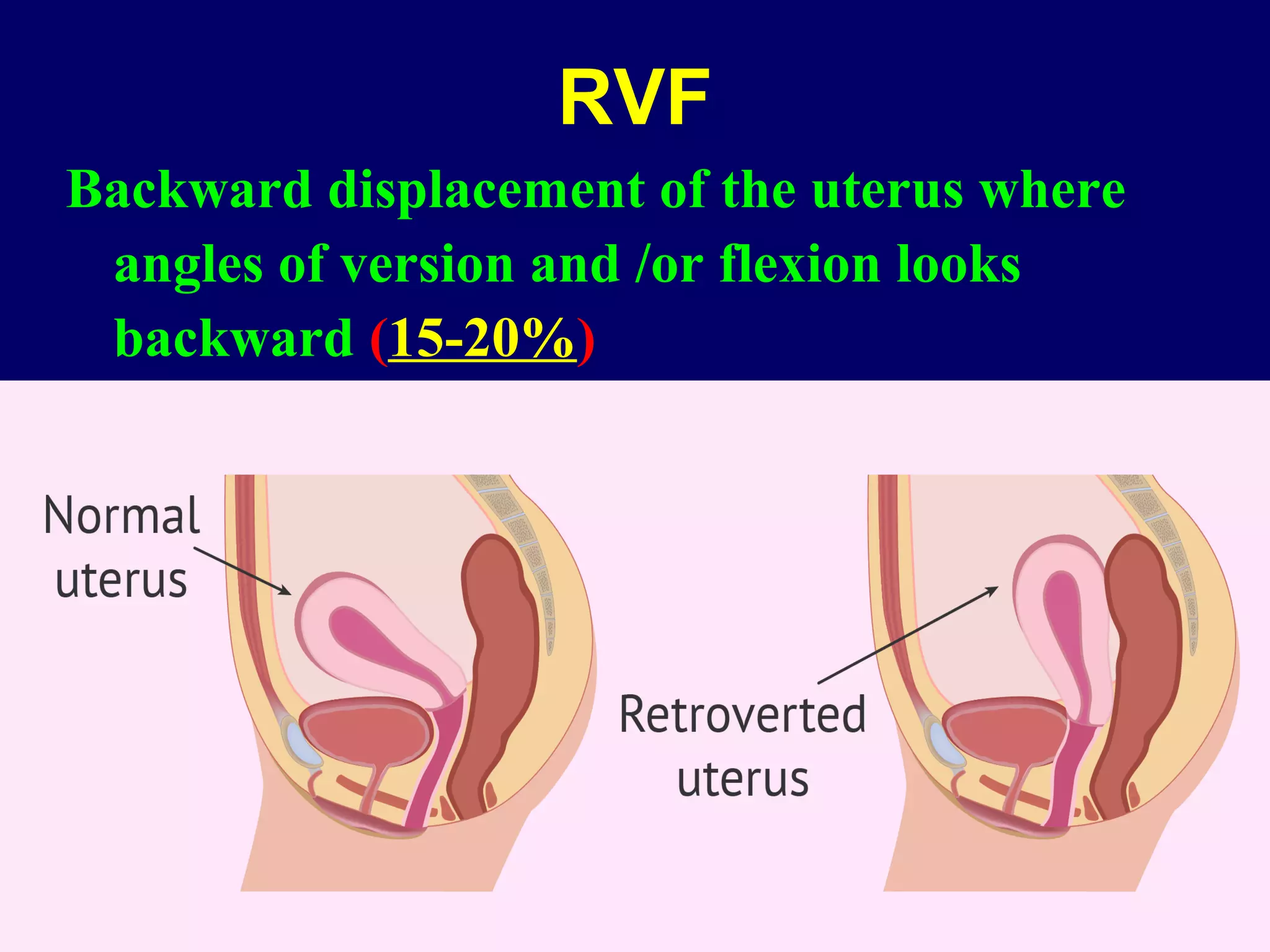
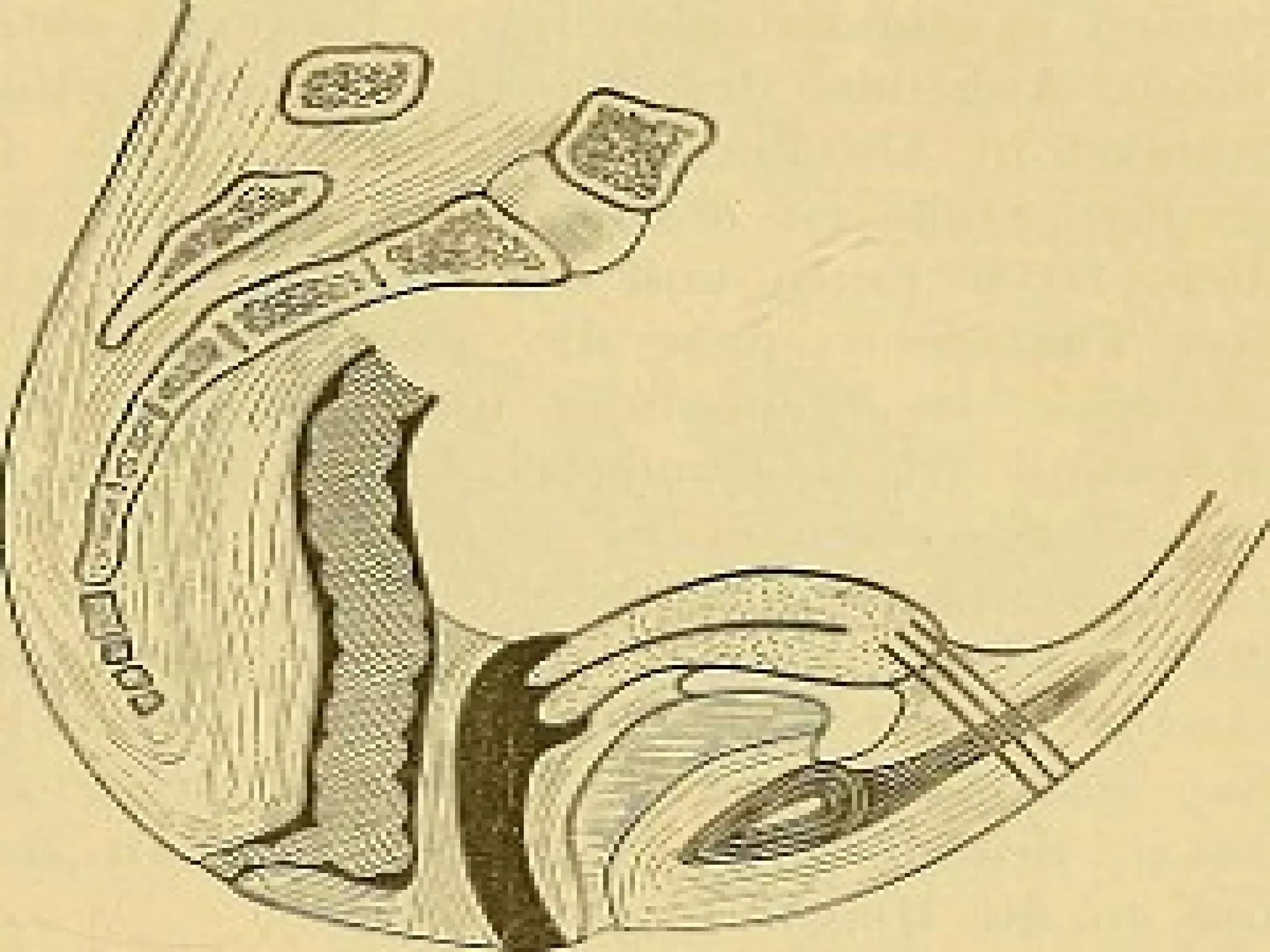
Backward displacement of the uterus where
angles of version and /or flexion looks
backward (15-20%)
Etiology
• Congenital : asymptomatic ,no treatment.
• Acquired:
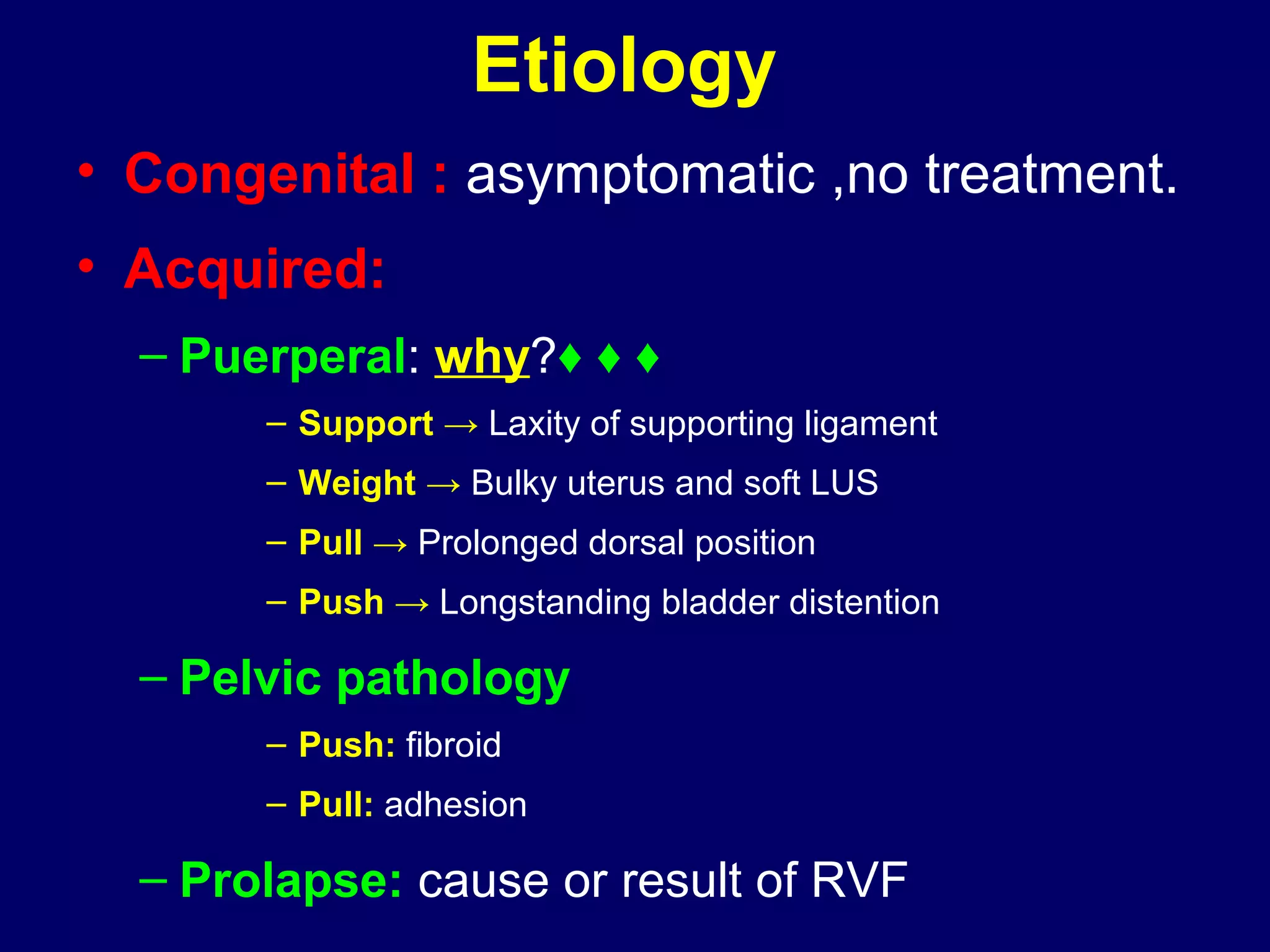
– Puerperal: why?♦ ♦ ♦
– Support → Laxity of supporting ligament
– Weight → Bulky uterus and soft LUS
– Pull → Prolonged dorsal position
– Push → Longstanding bladder distention
– Pelvic pathology
– Push: fibroid
– Pull: adhesion
– Prolapse: cause or result of RVF
Types of RVF
1. Mobile RVF
2. Fixed RVF
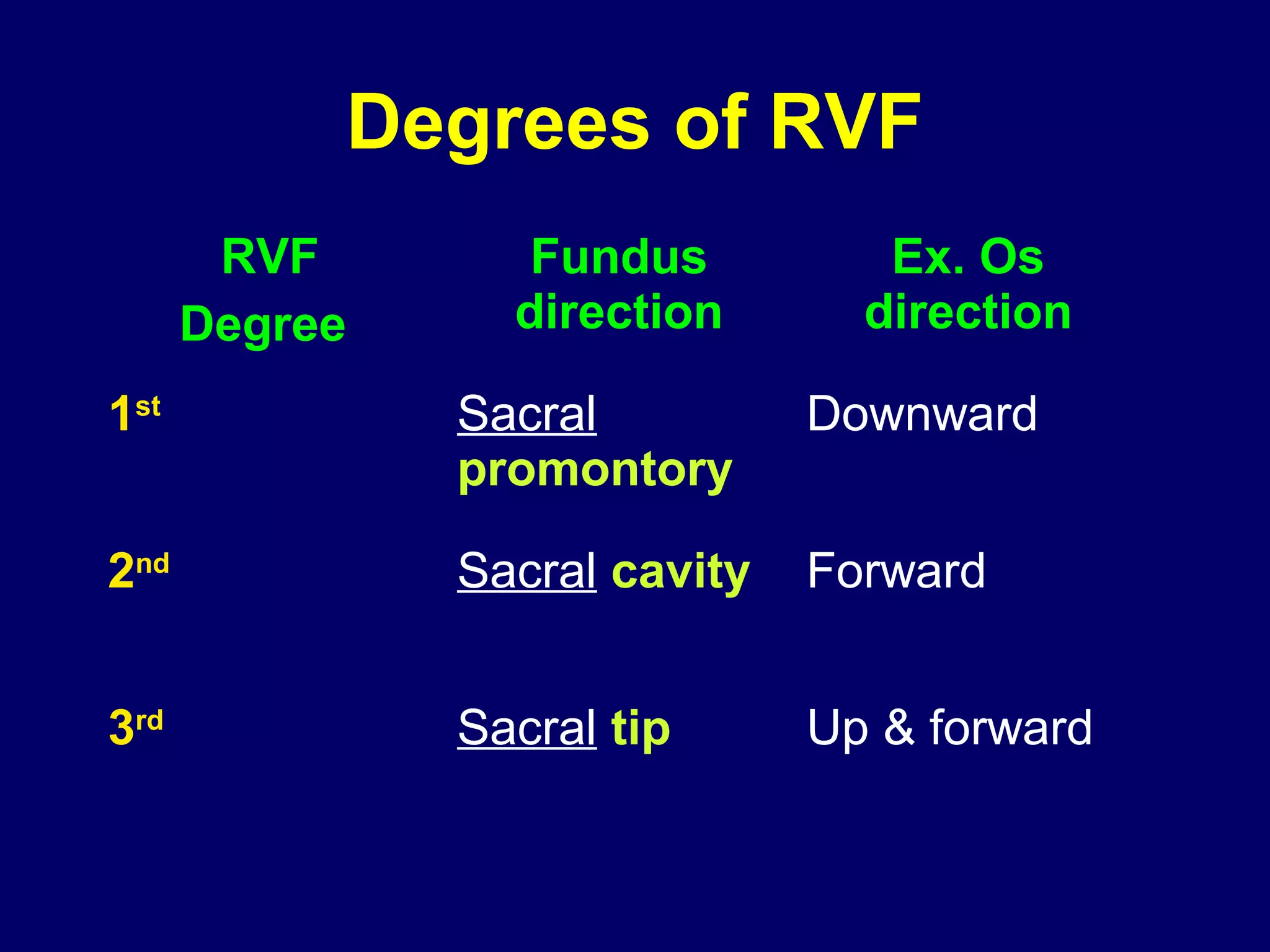
Degrees of RVF
RVF
Degree
Fundus
direction
Ex. Os
direction
1st
Sacral
promontory
Downward
2nd
Sacral cavity Forward
3rd
Sacral tip Up & forward
Diagnosis
• Symptoms:
– Asymptomatic: 50%
– Symptomatic:
• Pelvic congestion symptoms ?
• Pain:
– Low backache ( pressure on uterosacral & pelvic congestion)
– Dyspareunia ( ovary, uterus & pelvic congestion)
– Spasmodic dysmenorrhea ( cervical obstruction& hypoplasia)
• Infertility ????
• Complication during pregnancy: abortion ,incarceration ,
anterior sacculation
Signs:
– PV and bimanual:
• Posterior lip is 1st
to be felt
• Direction of ex. Os
• Body of uterus ( most common mass in Douglas pouch)
– Uterine sound: confirm direction
– Pessary test. ???
Special investigations:
– US
– HSG: lateral view
Diagnosis
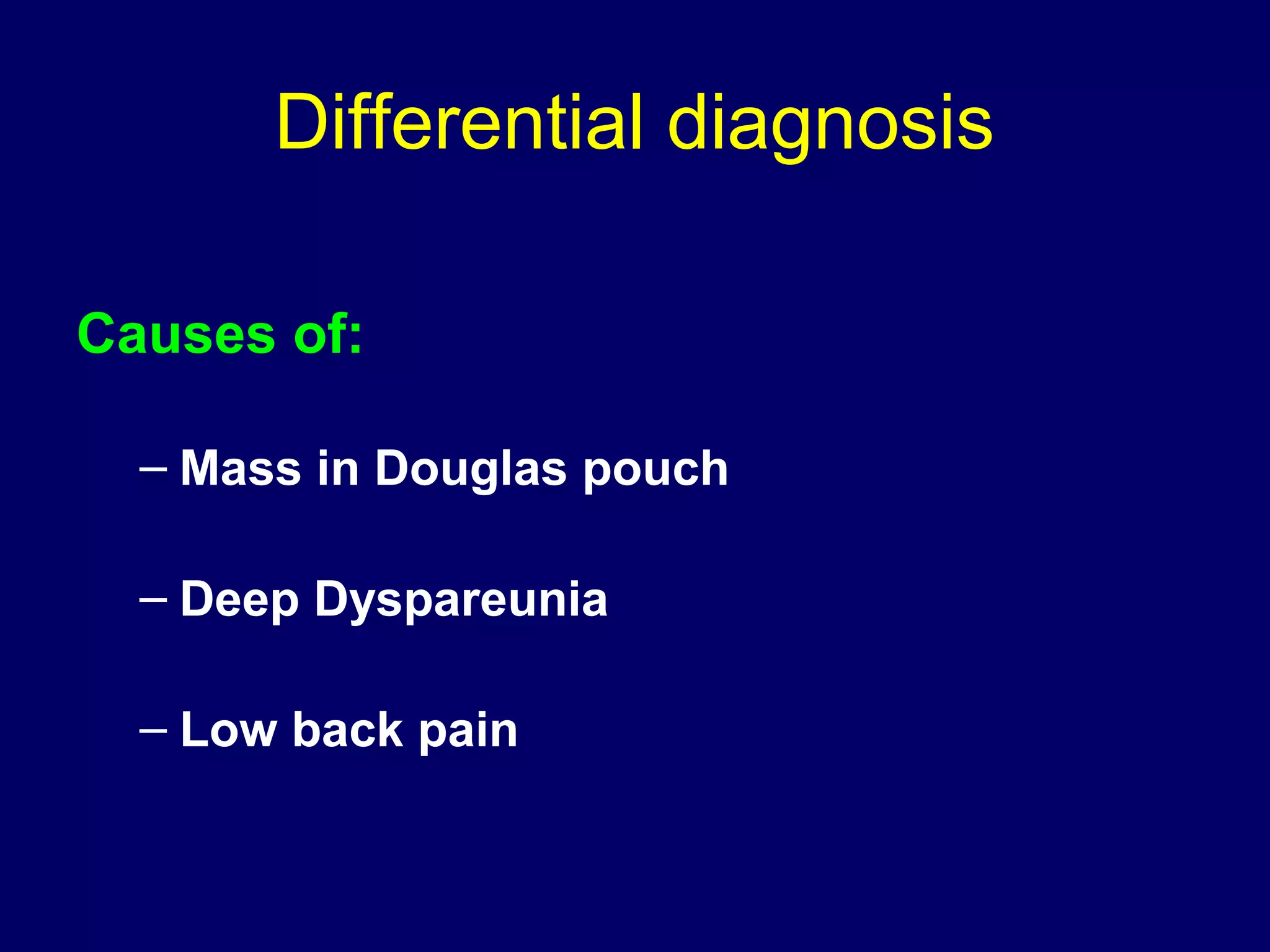
Differential diagnosis
Causes of:
– Mass in Douglas pouch
– Deep Dyspareunia
– Low back pain
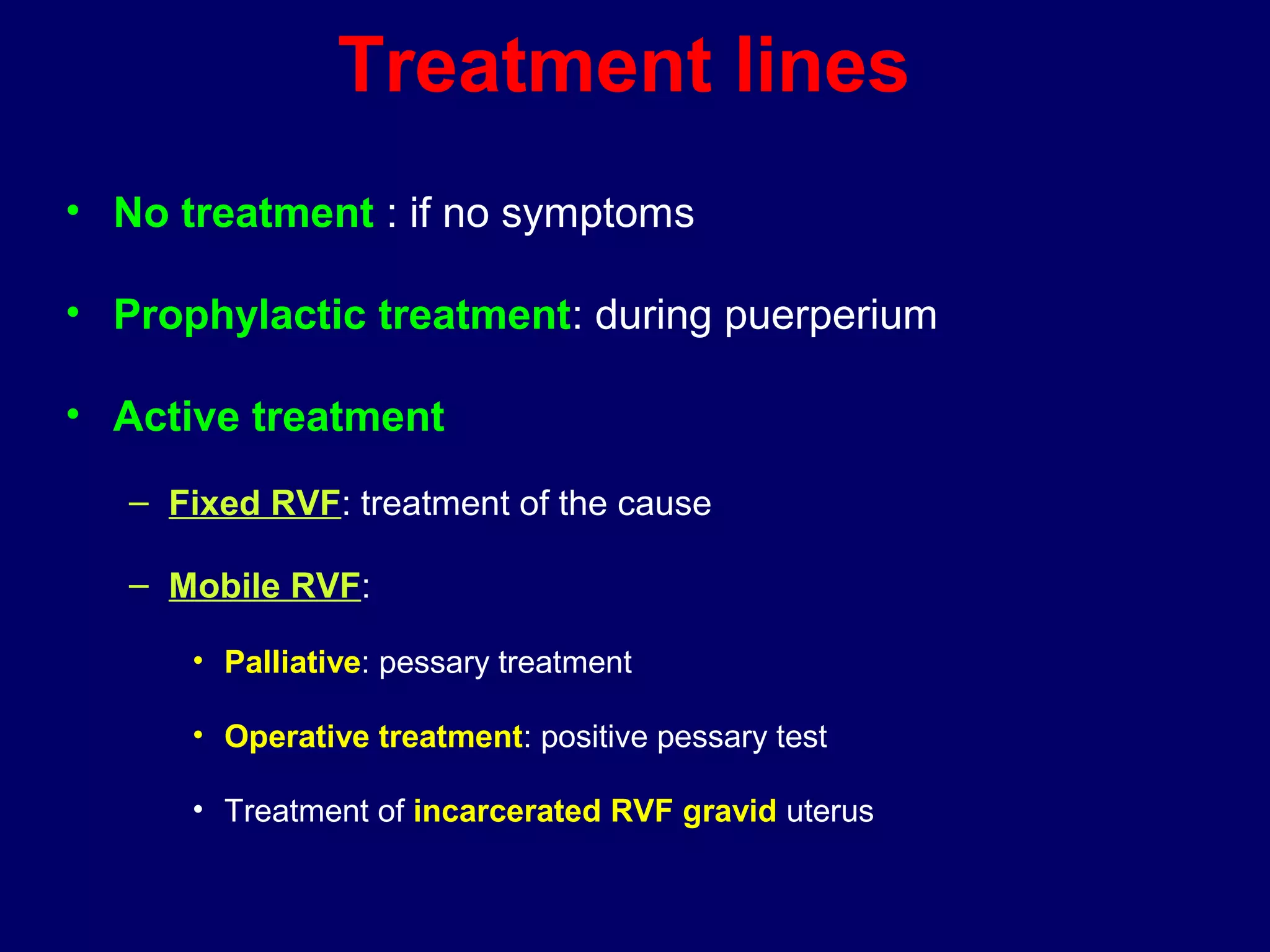
Treatment lines
• No treatment : if no symptoms
• Prophylactic treatment: during puerperium
• Active treatment
– Fixed RVF: treatment of the cause
– Mobile RVF:
• Palliative: pessary treatment
• Operative treatment: positive pessary test
• Treatment of incarcerated RVF gravid uterus
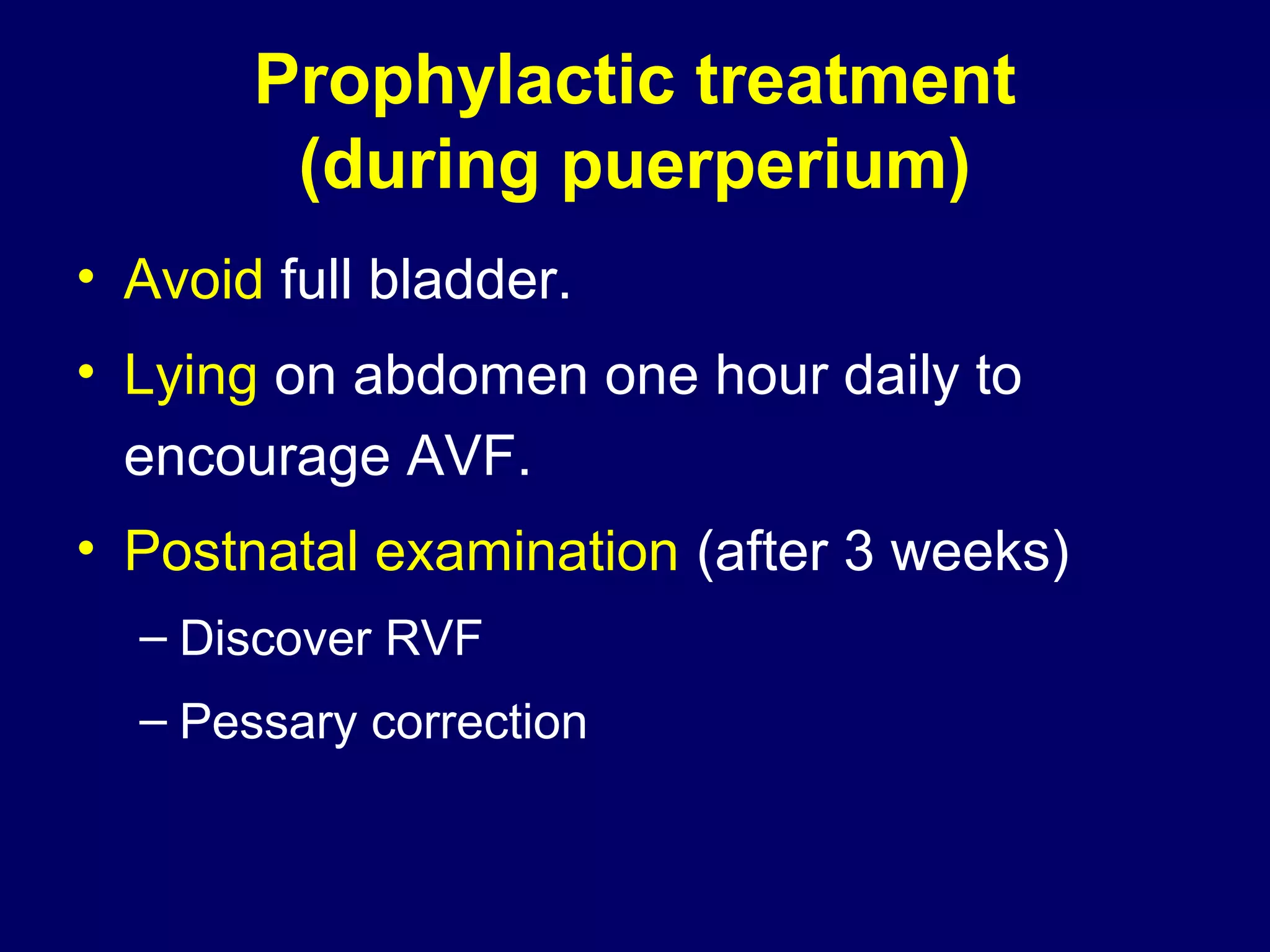
Prophylactic treatment
(during puerperium)
• Avoid full bladder.
• Lying on abdomen one hour daily to
encourage AVF.
• Postnatal examination (after 3 weeks)
– Discover RVF
– Pessary correction
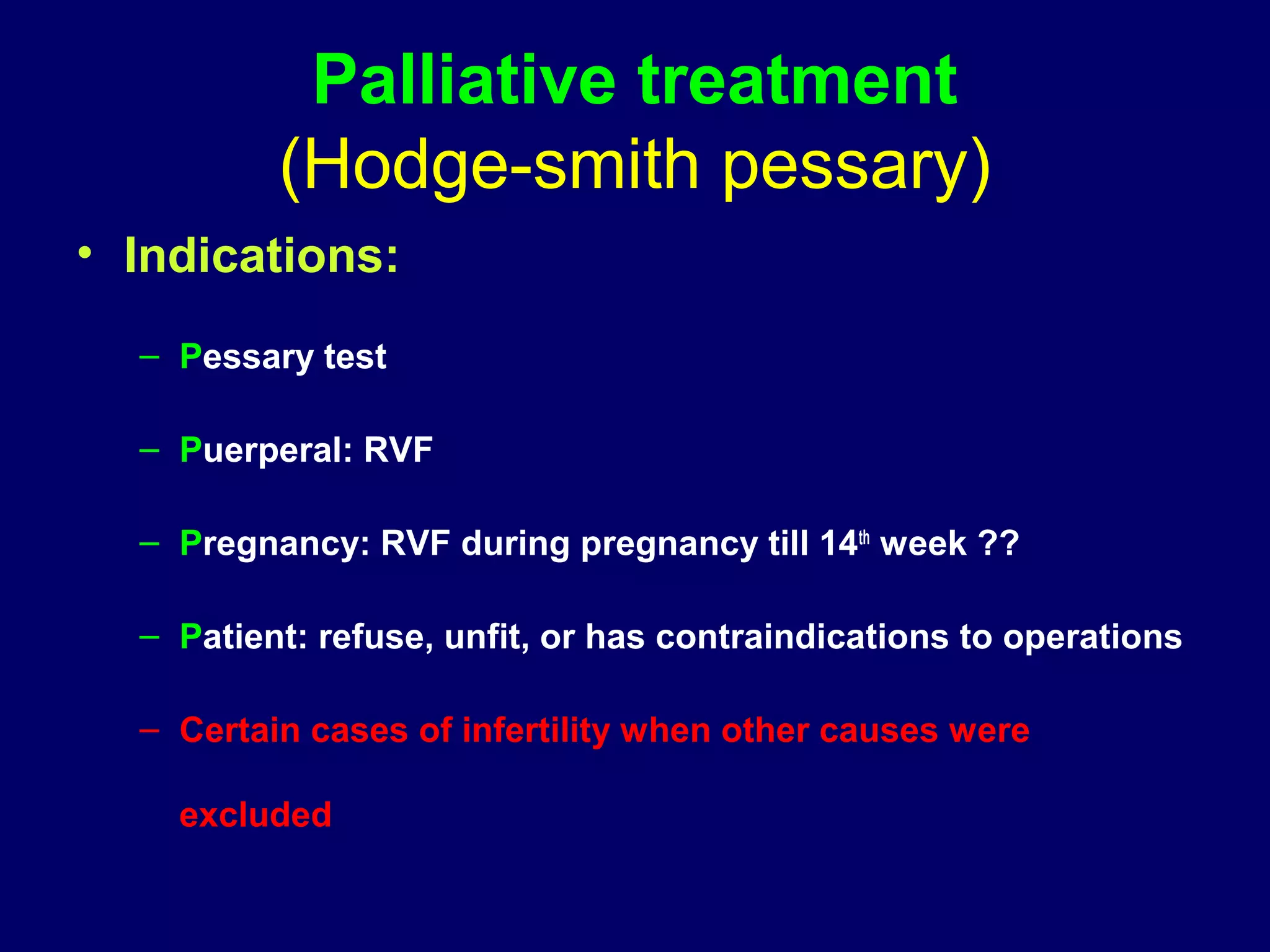
Palliative treatment
(Hodge-smith pessary)
• Indications:
– Pessary test
– Puerperal: RVF
– Pregnancy: RVF during pregnancy till 14th
week ??
– Patient: refuse, unfit, or has contraindications to operations
– Certain cases of infertility when other causes were
excluded
Surgical treatment
(if positive pessary test)
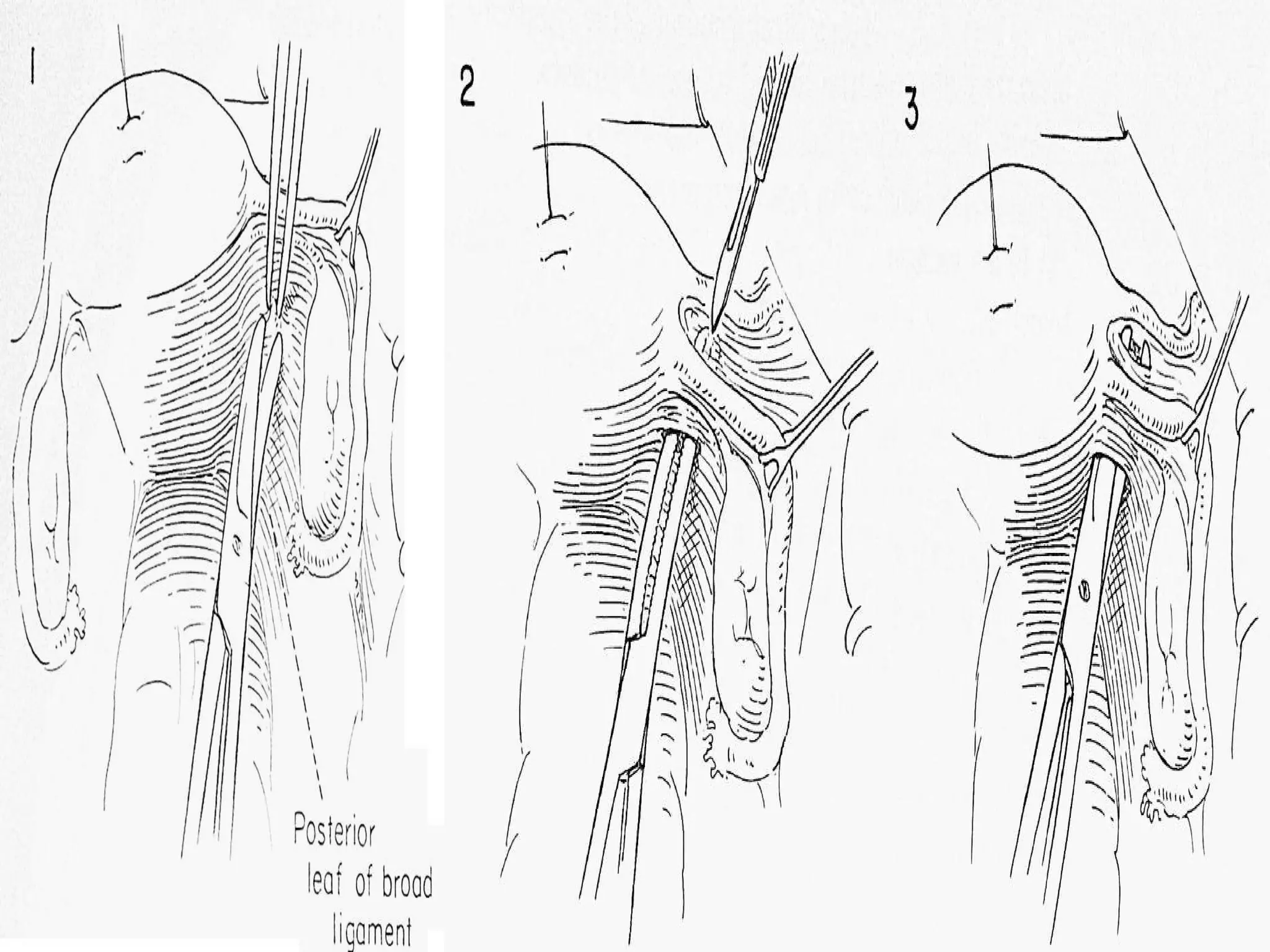
• Abdominal: laparotomy/laparoscopy
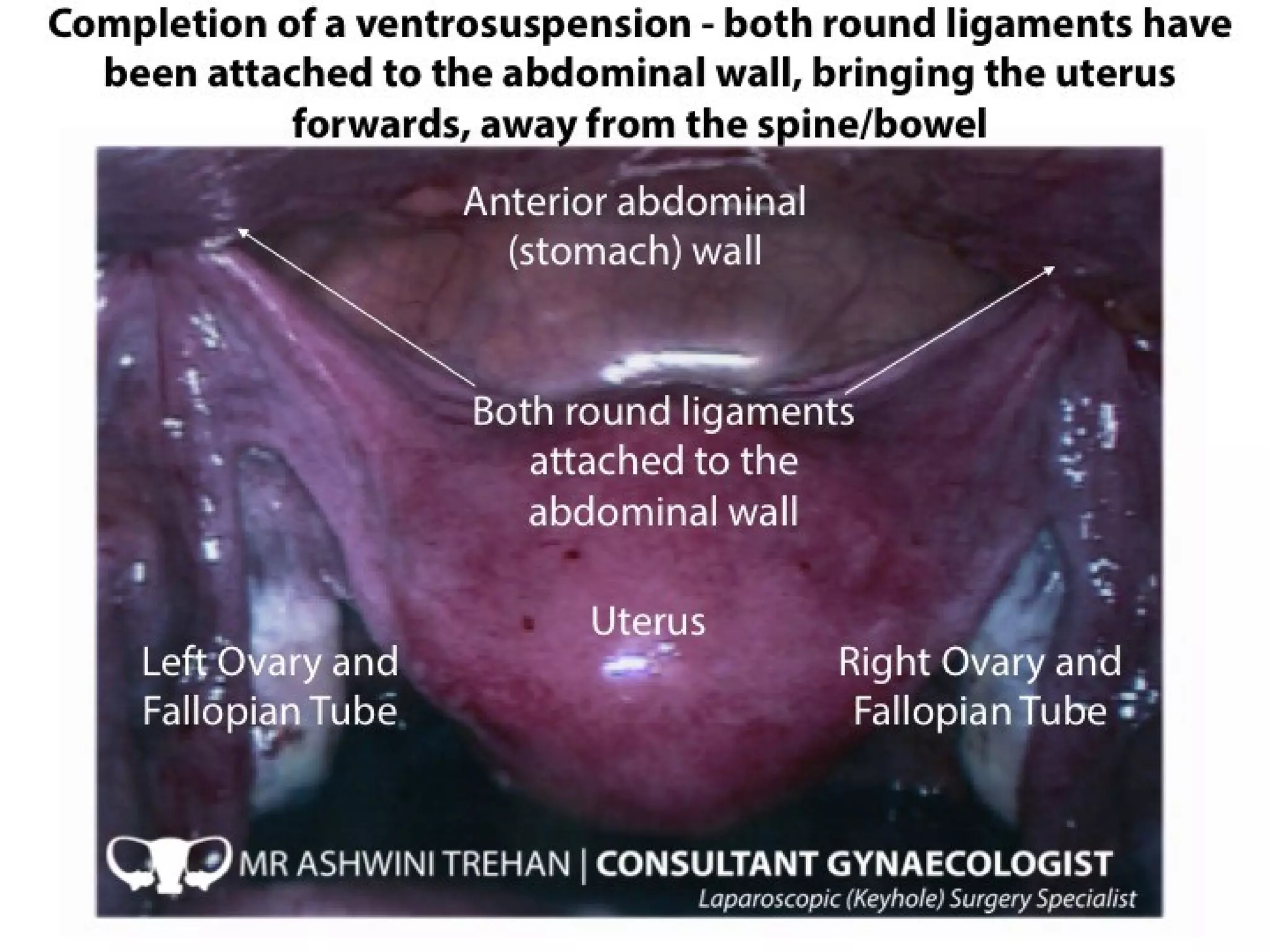
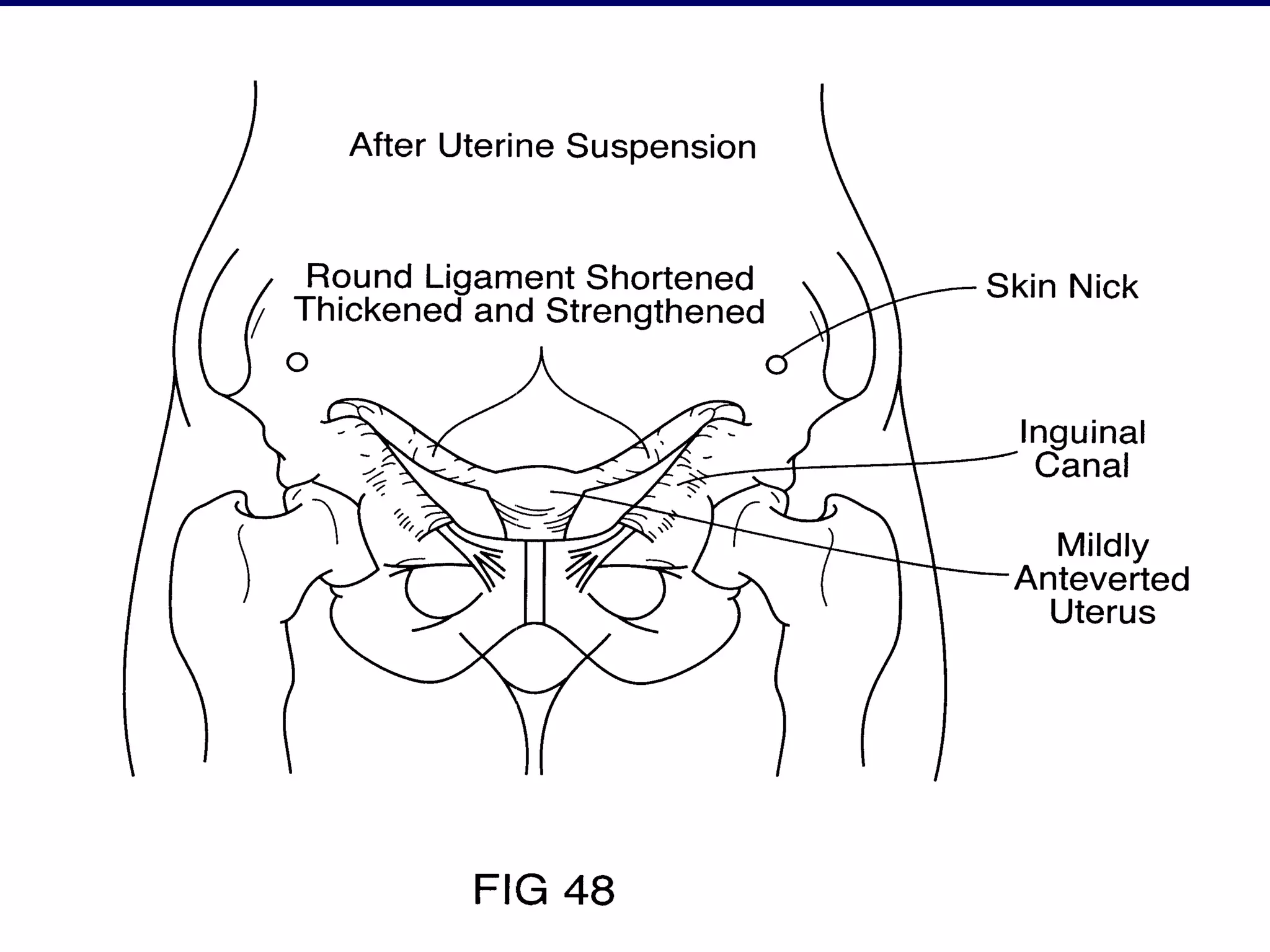
– Ventrosuspension: plication and suturing of both
round ligaments to anterior rectus sheath ( modified
Gilliam's operation)
– Ventrofixation: fundus suturing to anterior abdominal
wall (Bad, posterior sacculation during pregnancy)
– Baldy- Webster operation: round ligament passed
through broad ligament and sutured to back of the
uterus
Surgical treatment
(if positive pessary test)
• Vaginal:
– Open Douglas pouch : shortening of uterosacral
ligament.
– Open uterovesical pouch: plication of round
ligament.
Surgical treatment
(if positive pessary test)
• Inguinal: Plication of round ligament through
inguinal incision.
• RVF uterus & prolapse: fothergill operation
Treatment of incarcerated RVF
gravid uterus
• Catheterization of the bladder.
• Manual correction of uterus.
• Mobile: Pessary till 14th
week.
• Fixed :laparotomy to cut adhesion.
Uterine inversion
Uterine inversion
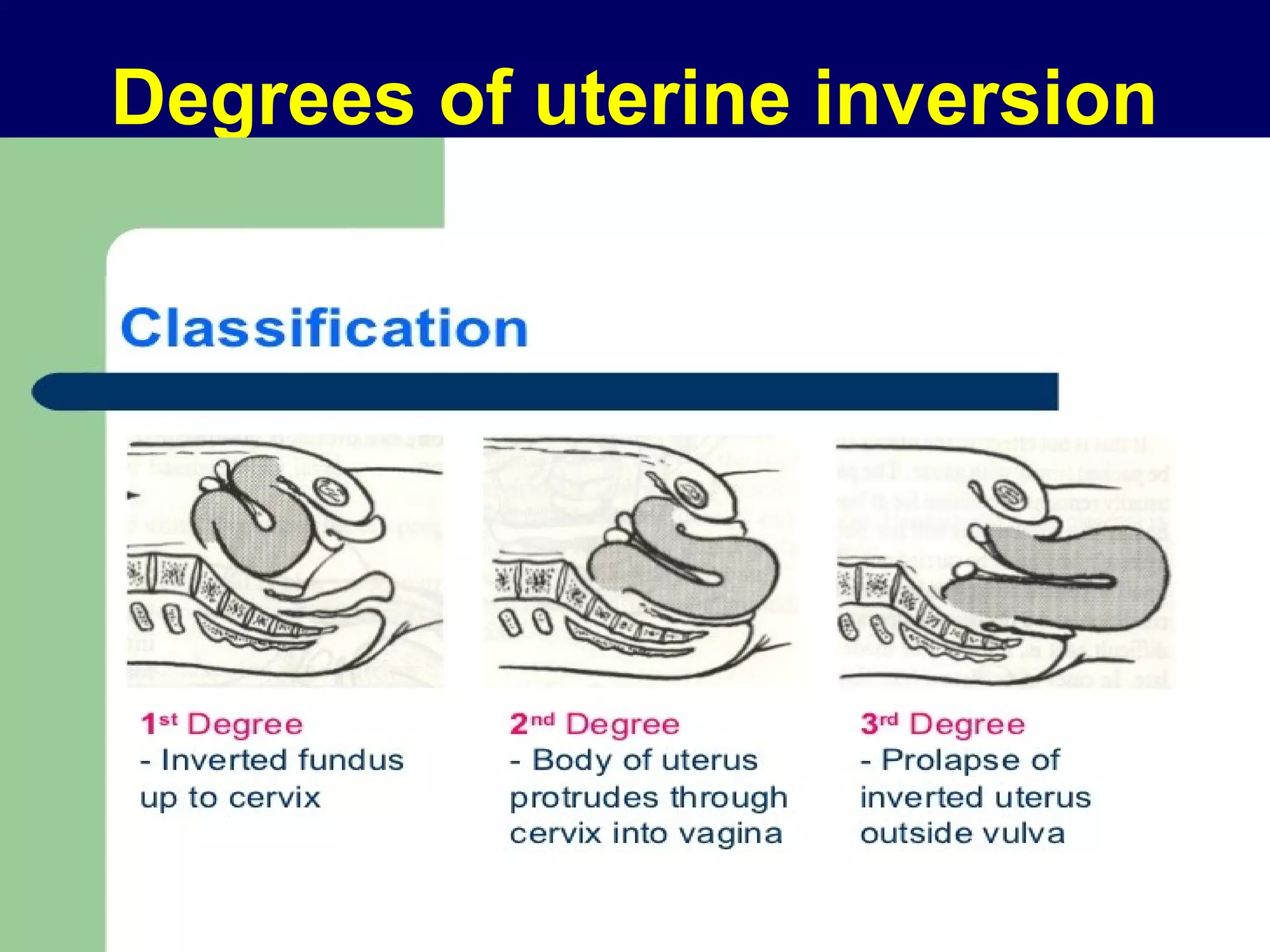
• Def : the uterus is turned inside out.
• Types:
– Acute: puerperal inversion during or
immediately after labor.??????
– Chronic : gradual descent of the fundus
through dilated cervix may be:
• puerperal or
• non puerperal
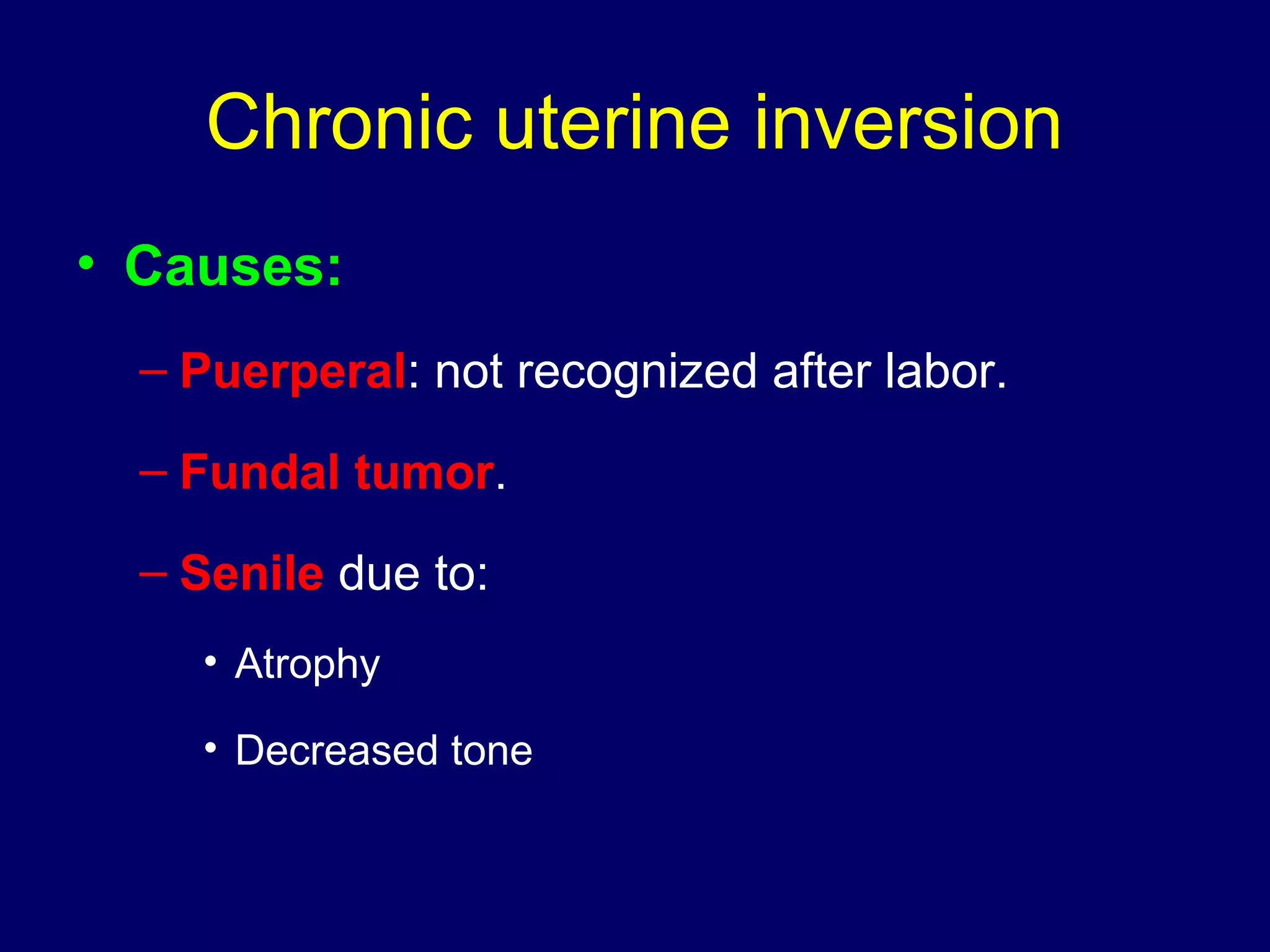
Degrees of uterine inversion
Chronic uterine inversion
• Causes:
– Puerperal: not recognized after labor.
– Fundal tumor.
– Senile due to:
• Atrophy
• Decreased tone
Chronic uterine inversion
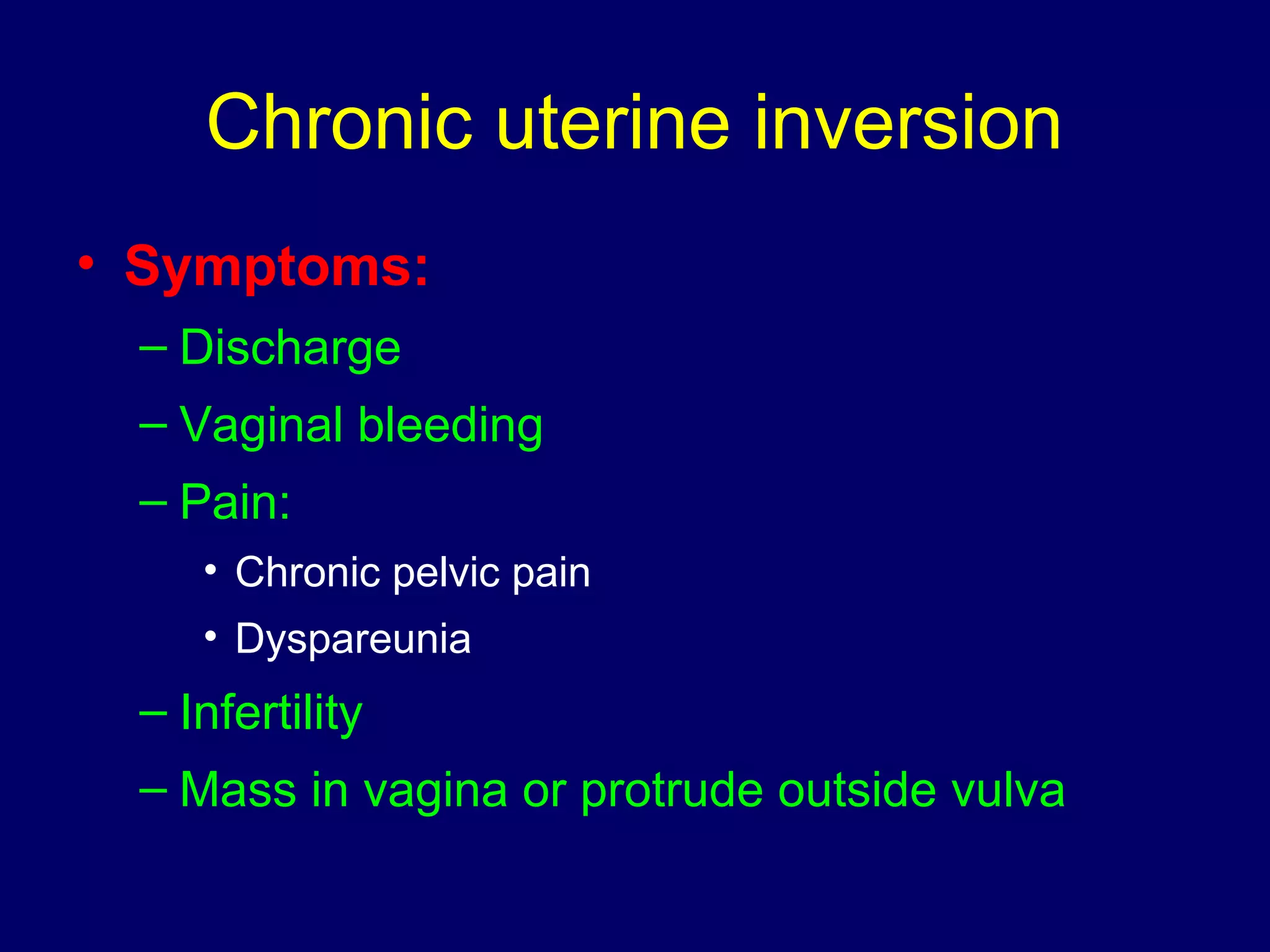
• Symptoms:
– Discharge
– Vaginal bleeding
– Pain:
• Chronic pelvic pain
• Dyspareunia
– Infertility
– Mass in vagina or protrude outside vulva
Chronic uterine inversion
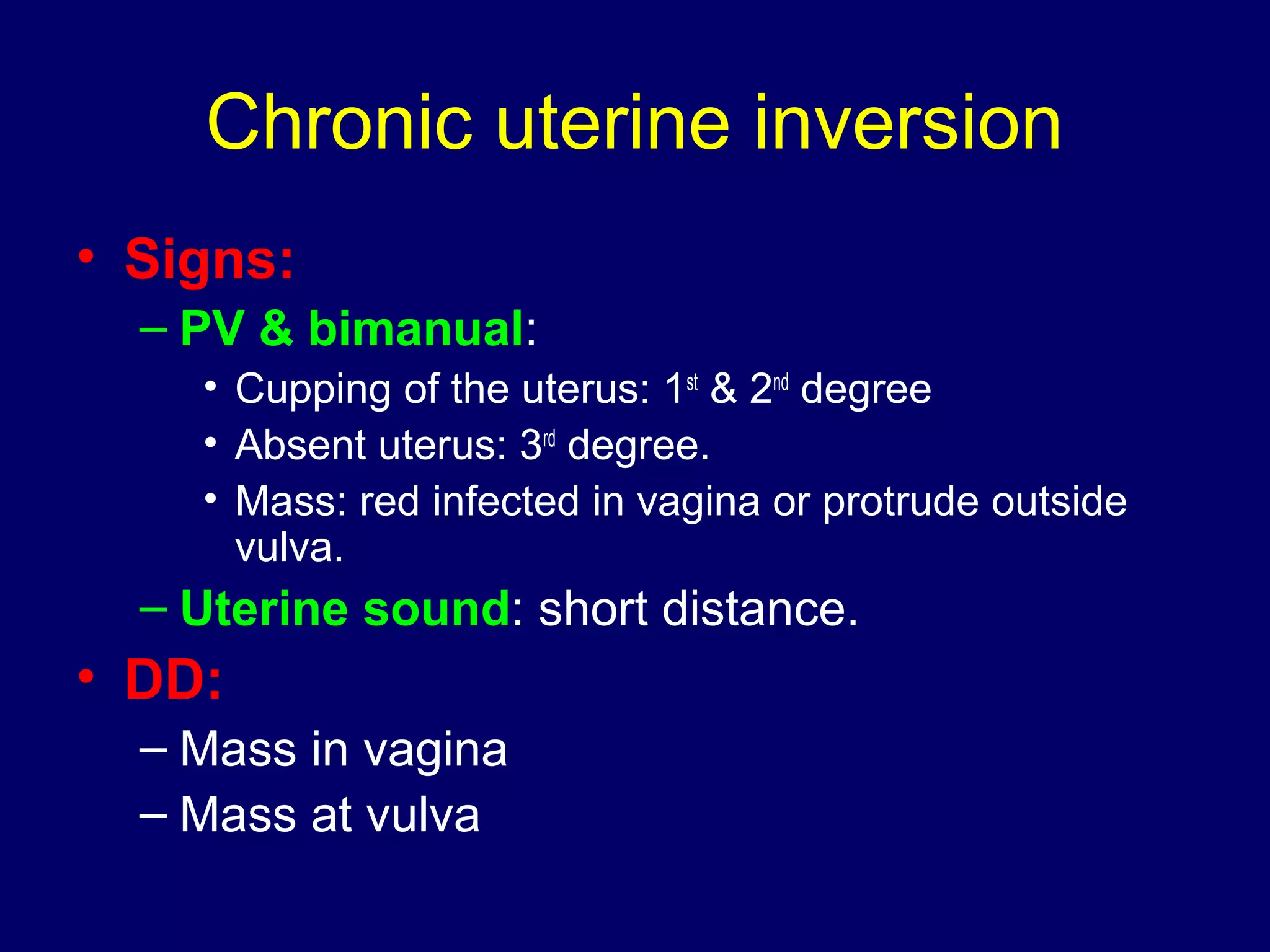
• Signs:
– PV & bimanual:
• Cupping of the uterus: 1st
& 2nd
degree
• Absent uterus: 3rd
degree.
• Mass: red infected in vagina or protrude outside
vulva.
– Uterine sound: short distance.
• DD:
– Mass in vagina
– Mass at vulva
Treatment
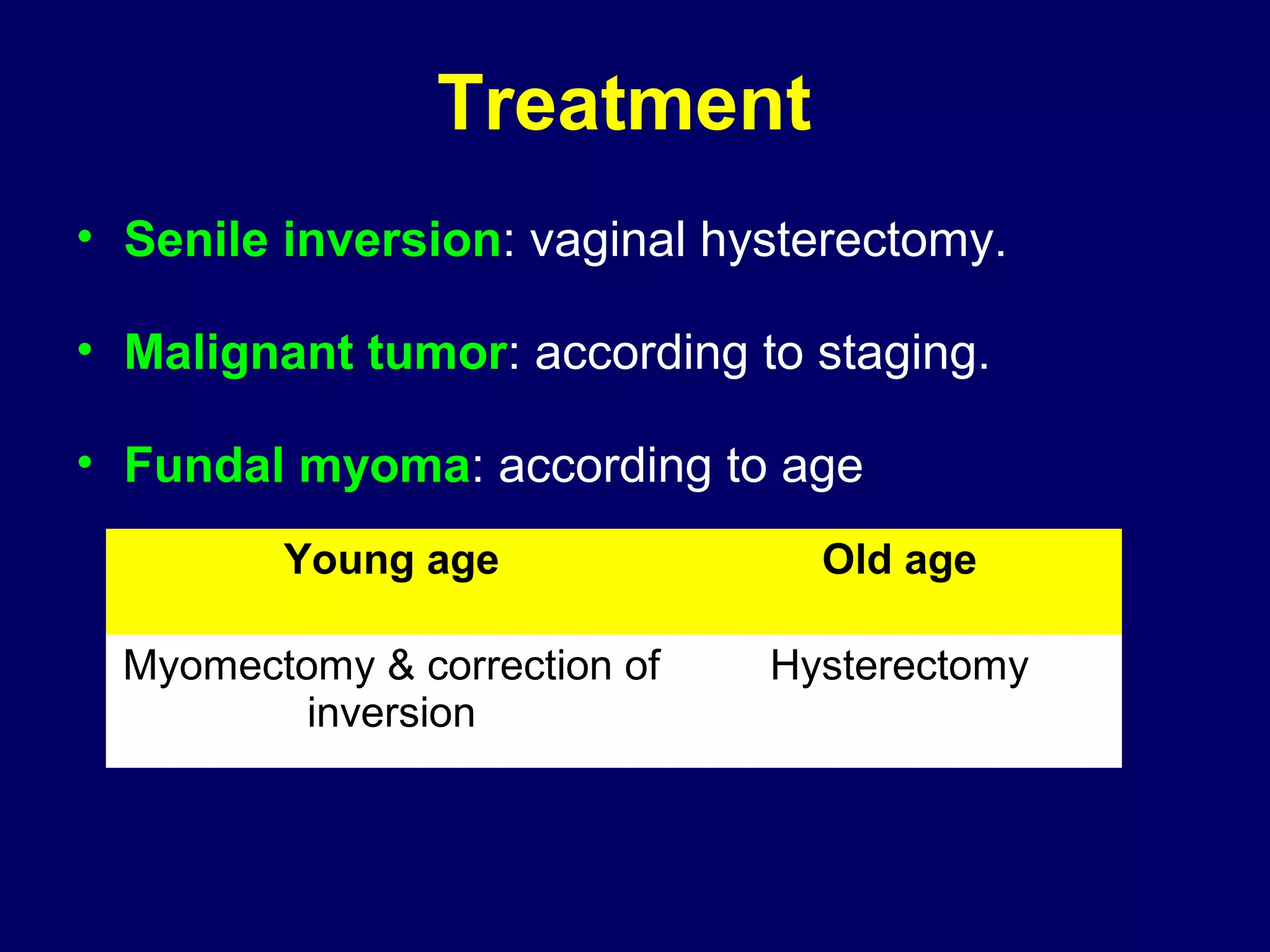
• Senile inversion: vaginal hysterectomy.
• Malignant tumor: according to staging.
• Fundal myoma: according to age
Young age Old age
Myomectomy & correction of
inversion
Hysterectomy
Treatment
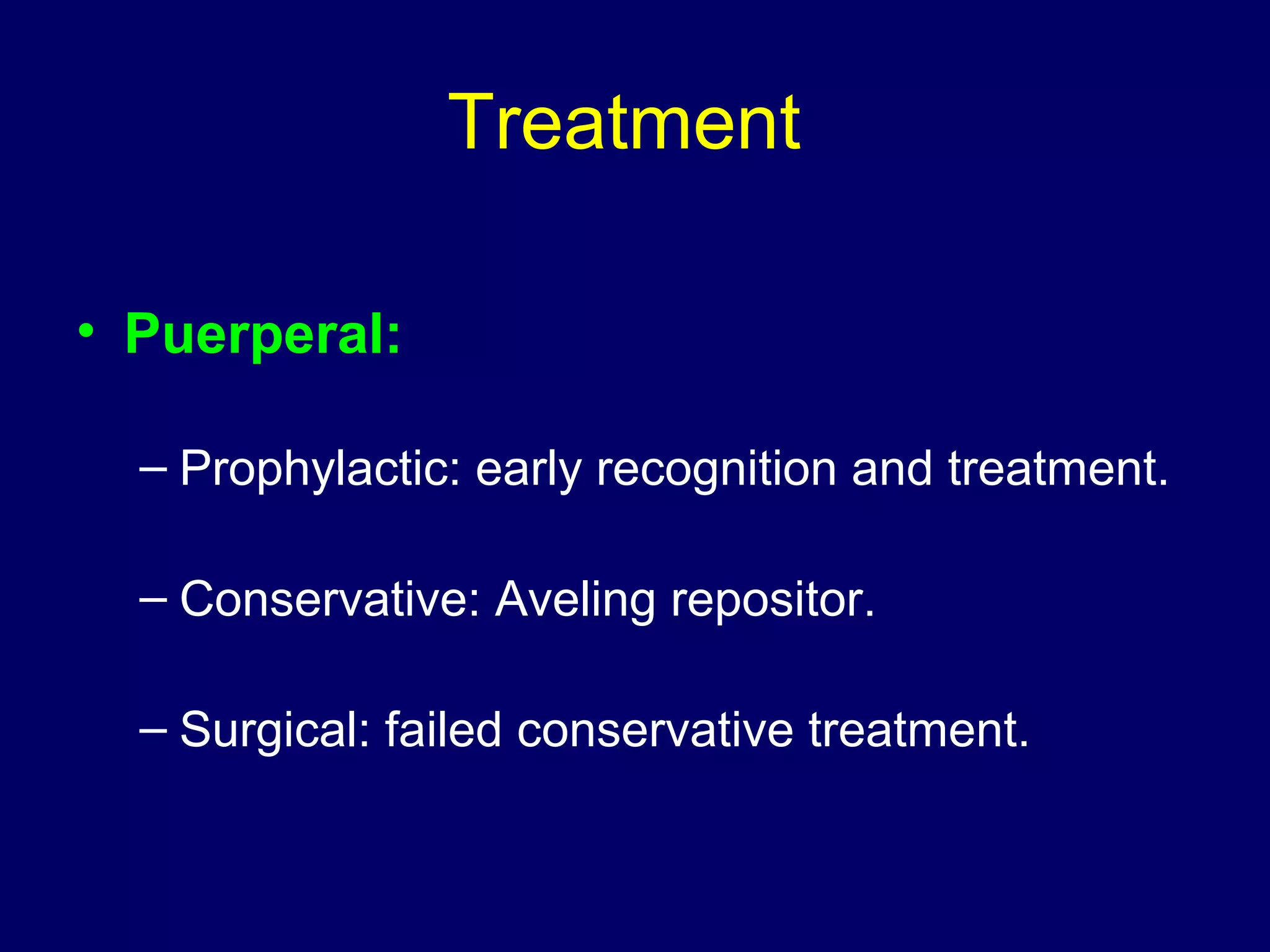
• Puerperal:
– Prophylactic: early recognition and treatment.
– Conservative: Aveling repositor.
– Surgical: failed conservative treatment.
Surgical treatment
(Chronic puerperal inversion)
• Old age: hysterectomy.
• Young age:
– Vaginal: division of cervical ring then
correction of inversion
• Ant. (Spinelli)
• Post. (Kustner)
– Abdominal:
• Traction on depressed fundus by volsellum
( Huntington)
• Division of cervical ring and pulling on fundus
– Ant. (Dobbin)
– Post. (Haultain)
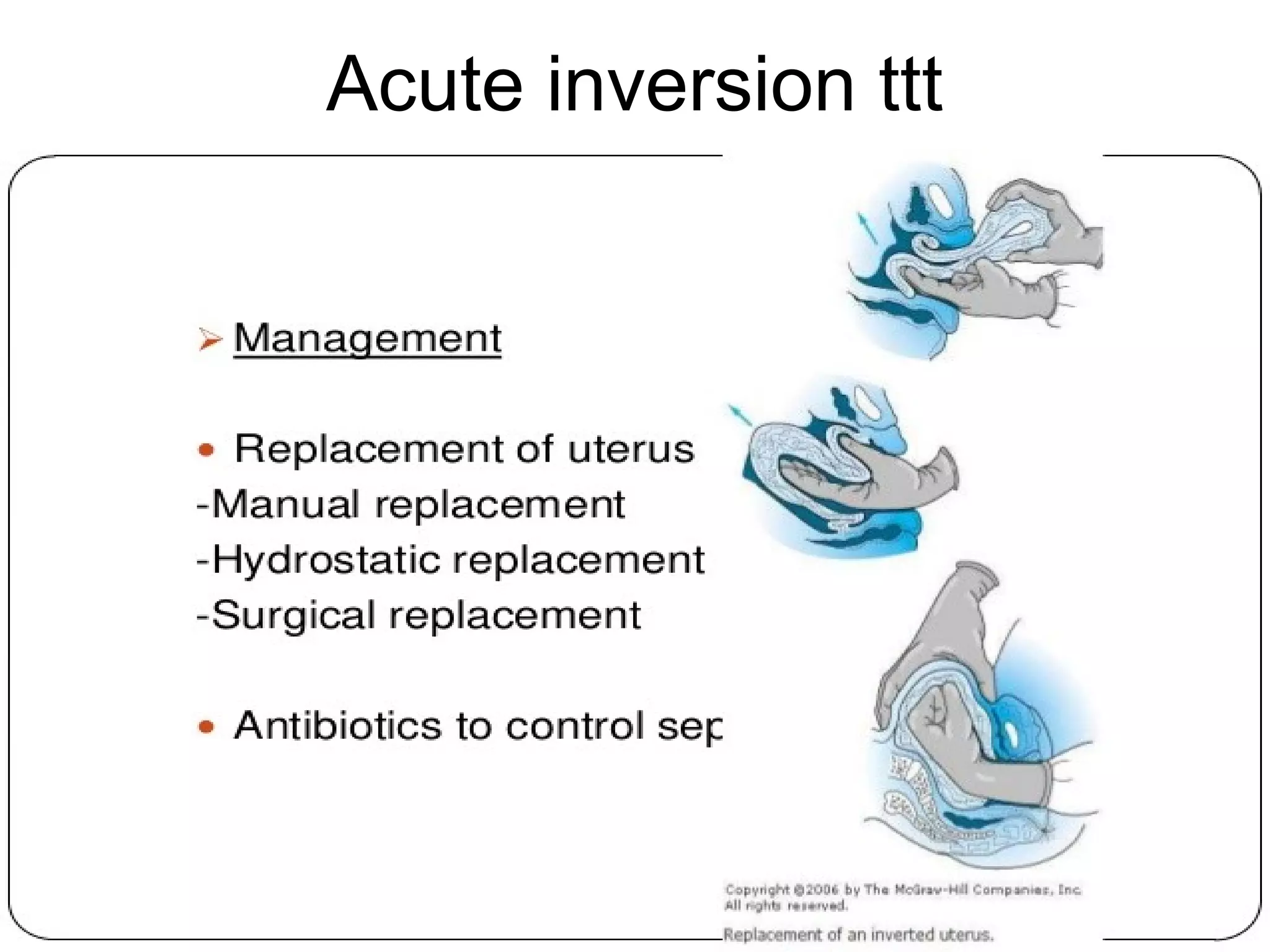
Acute inversion ttt
Thank You
Any Questions or
Comments?

Retroverted retroflexed uterus &uterine inversion

  • 1.
    Retroverted Retroflexed Uterus (RVF) Undergraduate Dr/Ahmed Walid Anwar Morad Assistant professor of OB/GYN Benha University 2017
  • 3.
    RVF Backward displacement ofthe uterus where angles of version and /or flexion looks backward (15-20%)
  • 4.
    Etiology • Congenital :asymptomatic ,no treatment. • Acquired: – Puerperal: why?♦ ♦ ♦ – Support → Laxity of supporting ligament – Weight → Bulky uterus and soft LUS – Pull → Prolonged dorsal position – Push → Longstanding bladder distention – Pelvic pathology – Push: fibroid – Pull: adhesion – Prolapse: cause or result of RVF
  • 5.
    Types of RVF 1.Mobile RVF 2. Fixed RVF
  • 6.
    Degrees of RVF RVF Degree Fundus direction Ex.Os direction 1st Sacral promontory Downward 2nd Sacral cavity Forward 3rd Sacral tip Up & forward
  • 7.
    Diagnosis • Symptoms: – Asymptomatic:50% – Symptomatic: • Pelvic congestion symptoms ? • Pain: – Low backache ( pressure on uterosacral & pelvic congestion) – Dyspareunia ( ovary, uterus & pelvic congestion) – Spasmodic dysmenorrhea ( cervical obstruction& hypoplasia) • Infertility ???? • Complication during pregnancy: abortion ,incarceration , anterior sacculation
  • 8.
    Signs: – PV andbimanual: • Posterior lip is 1st to be felt • Direction of ex. Os • Body of uterus ( most common mass in Douglas pouch) – Uterine sound: confirm direction – Pessary test. ??? Special investigations: – US – HSG: lateral view Diagnosis
  • 9.
    Differential diagnosis Causes of: –Mass in Douglas pouch – Deep Dyspareunia – Low back pain
  • 10.
    Treatment lines • Notreatment : if no symptoms • Prophylactic treatment: during puerperium • Active treatment – Fixed RVF: treatment of the cause – Mobile RVF: • Palliative: pessary treatment • Operative treatment: positive pessary test • Treatment of incarcerated RVF gravid uterus
  • 11.
    Prophylactic treatment (during puerperium) •Avoid full bladder. • Lying on abdomen one hour daily to encourage AVF. • Postnatal examination (after 3 weeks) – Discover RVF – Pessary correction
  • 12.
    Palliative treatment (Hodge-smith pessary) •Indications: – Pessary test – Puerperal: RVF – Pregnancy: RVF during pregnancy till 14th week ?? – Patient: refuse, unfit, or has contraindications to operations – Certain cases of infertility when other causes were excluded
  • 13.
    Surgical treatment (if positivepessary test) • Abdominal: laparotomy/laparoscopy – Ventrosuspension: plication and suturing of both round ligaments to anterior rectus sheath ( modified Gilliam's operation) – Ventrofixation: fundus suturing to anterior abdominal wall (Bad, posterior sacculation during pregnancy) – Baldy- Webster operation: round ligament passed through broad ligament and sutured to back of the uterus
  • 14.
    Surgical treatment (if positivepessary test) • Vaginal: – Open Douglas pouch : shortening of uterosacral ligament. – Open uterovesical pouch: plication of round ligament.
  • 15.
    Surgical treatment (if positivepessary test) • Inguinal: Plication of round ligament through inguinal incision. • RVF uterus & prolapse: fothergill operation
  • 20.
    Treatment of incarceratedRVF gravid uterus • Catheterization of the bladder. • Manual correction of uterus. • Mobile: Pessary till 14th week. • Fixed :laparotomy to cut adhesion.
  • 21.
  • 22.
    Uterine inversion • Def: the uterus is turned inside out. • Types: – Acute: puerperal inversion during or immediately after labor.?????? – Chronic : gradual descent of the fundus through dilated cervix may be: • puerperal or • non puerperal
  • 23.
  • 24.
    Chronic uterine inversion •Causes: – Puerperal: not recognized after labor. – Fundal tumor. – Senile due to: • Atrophy • Decreased tone
  • 25.
    Chronic uterine inversion •Symptoms: – Discharge – Vaginal bleeding – Pain: • Chronic pelvic pain • Dyspareunia – Infertility – Mass in vagina or protrude outside vulva
  • 26.
    Chronic uterine inversion •Signs: – PV & bimanual: • Cupping of the uterus: 1st & 2nd degree • Absent uterus: 3rd degree. • Mass: red infected in vagina or protrude outside vulva. – Uterine sound: short distance. • DD: – Mass in vagina – Mass at vulva
  • 27.
    Treatment • Senile inversion:vaginal hysterectomy. • Malignant tumor: according to staging. • Fundal myoma: according to age Young age Old age Myomectomy & correction of inversion Hysterectomy
  • 28.
    Treatment • Puerperal: – Prophylactic:early recognition and treatment. – Conservative: Aveling repositor. – Surgical: failed conservative treatment.
  • 29.
    Surgical treatment (Chronic puerperalinversion) • Old age: hysterectomy. • Young age: – Vaginal: division of cervical ring then correction of inversion • Ant. (Spinelli) • Post. (Kustner) – Abdominal: • Traction on depressed fundus by volsellum ( Huntington) • Division of cervical ring and pulling on fundus – Ant. (Dobbin) – Post. (Haultain)
  • 30.
  • 31.