Cyberpolitics Week 4: Democracy and public sphere
Democracy -  of the people, by the people, for the people
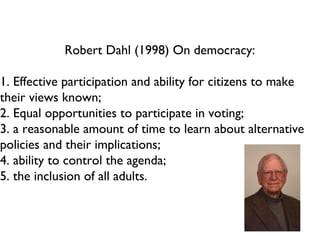
Robert Dahl (1998) On democracy: 1. Effective participation and ability for citizens to make their views known; 2. Equal opportunities to participate in voting; 3. a reasonable amount of time to learn about alternative policies and their implications; 4. ability to control the agenda; 5. the inclusion of all adults.
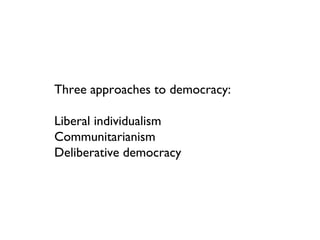
Three approaches to democracy: Liberal individualism  Communitarianism  Deliberative democracy
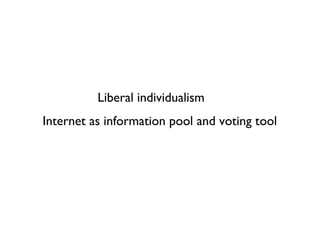
Liberal individualism Internet as information pool and voting tool
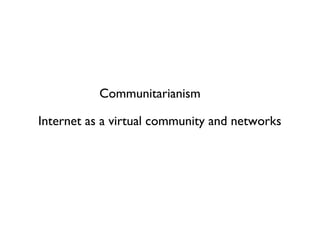
Communitarianism Internet as a virtual community and networks
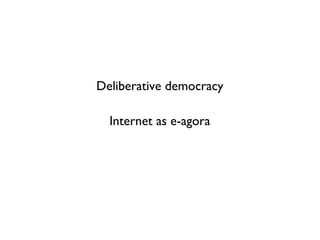
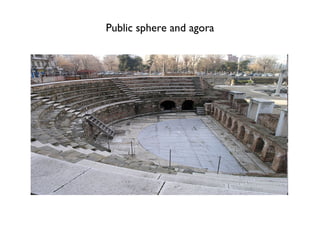
Deliberative democracy Internet as e-agora
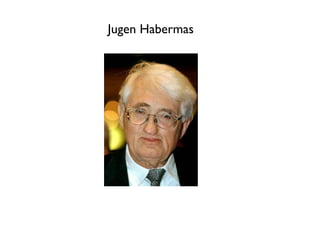
Jugen Habermas
Public sphere and agora
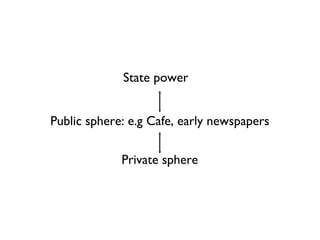
Public sphere: e.g Cafe, early newspapers Private sphere State power
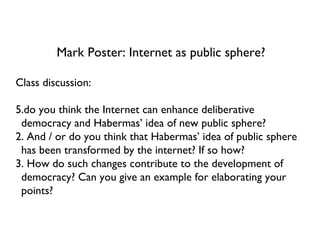
Mark Poster: Internet as public sphere? Class discussion:  do you think the Internet can enhance deliberative democracy and Habermas’ idea of new public sphere?  2. And / or do you think that Habermas’ idea of public sphere has been transformed by the internet? If so how? 3. How do such changes contribute to the development of democracy? Can you give an example for elaborating your points?
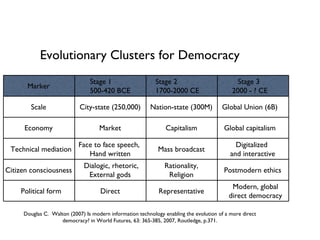
Marker Stage 1 500-420 BCE Stage 2 1700-2000 CE Stage 3  2000 - ? CE Scale Economy Technical mediation Citizen consciousness Political form City-state (250,000) Nation-state (300M) Global Union (6B) Market Capitalism Global capitalism Face to face speech,  Hand written Mass broadcast Digitalized  and interactive Dialogic, rhetoric, External gods Rationality, Religion Postmodern ethics Direct Representative Modern, global direct democracy Evolutionary Clusters for Democracy Douglas C.  Walton (2007) Is modern information technology enabling the evolution of a more direct democracy? in World Futures, 63: 365-385, 2007, Routledge, p.371.
Next Class: Quiz and class reading

Cyberpolitics2009w4

  • 1.
    Cyberpolitics Week 4:Democracy and public sphere
  • 2.
    Democracy - of the people, by the people, for the people
  • 3.
    Robert Dahl (1998)On democracy: 1. Effective participation and ability for citizens to make their views known; 2. Equal opportunities to participate in voting; 3. a reasonable amount of time to learn about alternative policies and their implications; 4. ability to control the agenda; 5. the inclusion of all adults.
  • 4.
    Three approaches todemocracy: Liberal individualism Communitarianism Deliberative democracy
  • 5.
    Liberal individualism Internetas information pool and voting tool
  • 6.
    Communitarianism Internet asa virtual community and networks
  • 7.
  • 8.
  • 9.
  • 10.
    Public sphere: e.gCafe, early newspapers Private sphere State power
  • 11.
    Mark Poster: Internetas public sphere? Class discussion: do you think the Internet can enhance deliberative democracy and Habermas’ idea of new public sphere? 2. And / or do you think that Habermas’ idea of public sphere has been transformed by the internet? If so how? 3. How do such changes contribute to the development of democracy? Can you give an example for elaborating your points?
  • 12.
    Marker Stage 1500-420 BCE Stage 2 1700-2000 CE Stage 3 2000 - ? CE Scale Economy Technical mediation Citizen consciousness Political form City-state (250,000) Nation-state (300M) Global Union (6B) Market Capitalism Global capitalism Face to face speech, Hand written Mass broadcast Digitalized and interactive Dialogic, rhetoric, External gods Rationality, Religion Postmodern ethics Direct Representative Modern, global direct democracy Evolutionary Clusters for Democracy Douglas C. Walton (2007) Is modern information technology enabling the evolution of a more direct democracy? in World Futures, 63: 365-385, 2007, Routledge, p.371.
  • 13.
    Next Class: Quizand class reading