Cyberpolitics Week One: Introduction to the course (Sep 7)
Ms.Lam Oi Wan 林藹雲 www.inmediahk.net www.globalvoiceso nline.org [email_address] com Twitter & facebook: oiw an
Course description  (note1): The course explores the relation between cyberspace and politics, in particular, the relation and the development of the Internet, democracy and civil society. The course examines how practices in the Internet generate a contesting terrain among dissident and state power, citizen and sub-citizen, new labour and global corporate by 1. employing theories around network society, public sphere, social movement and media studies; 2. by researching on or practicing online tools. Students will be guided to observe and analyze Internet culture and practices under the context of knowledge production of the global information society. 
Theoretical Framework: 1. The development of Internet technology and network society - Castells' network society framework 2. Internet technology, public sphere and democracy - Habermas’ theory on public sphere 3. Beyond technological determinism - critical theory and political process 4. The virtual and the real - identity and subjectivity issue
Practices 1. Culture and economy of sharing vs knowledge monopoly 2. Copyrights, Copyleft and Creative Commons 3. Free software movement and open source community 4. Grassroots media 5. Social mobilization
Internet governance 1. Internet governance and censorship debate 2. Development of the Internet in China
Project topics: 1. Internet (self)censorship practice in Hong Kong forum A research on the moderation of information by webmaster. 2. Social network mobilization The students are to identify characters and factors that contribute to the success and failure of a social network mobilization. 3. New media culture and actors in Hong Kong Students have to observe major social gatherings and interview participants in order to sketch the culture of local new media peers. 4. Comparative study on Internet censorship against indecency Australia, Hong Kong, South Korea, Germany, Japan and the U.S 5. New media citizen reporting project The students have to reflect upon a citizen reporting experience.
Assessment scheme 1. Small Quiz - 30% M.C or short questions 2. Project presentation and report- 30% 3. Big Quiz - 20% 4. Participation and discussion - 20%
Weekly Schedule
New on this year - more stress on participation and interaction - reading and quiz - workshop - some technical skills and practices - project topics rather than free choices - open book class exam - powerpoint and guest :) - interactive class - please ask question, give suggestion and feedback (what do you want to learn?)
Cyber and cybernetics Greek prefix: Kuber MIT professor:  Norbert Wiener
A note on politics
Cyberpolitics - Relation and interaction between techno-political space, actors and social-political structure
Internet History
1958: Advanced Research Projects Agency (ARPA)
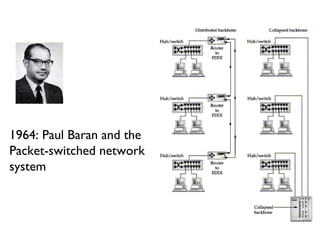
1964: Paul Baran and the Packet-switched network system
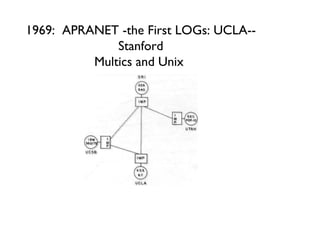
1969:  APRANET -the First LOGs: UCLA--Stanford Multics and Unix
1970: Network Control Program (NCP) finalized 1972: First demonstration at an international conference on computer communication
1973: Oil Crisis
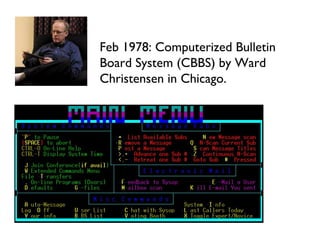
Feb 1978: Computerized Bulletin Board System (CBBS) by Ward Christensen in Chicago.
1978: the International Packet Switched Service (IPSS) established by UK based consortium (British post office and Telnet, etc) 1981: Networks grow from Europe, the U.S, Canada, Hong Kong and Australia  1983: TCP/IP replaced NCP 1985: National Science Foundation commissioned - 56Kb/S - 1.5Mb/S network 1988: Opening of the network to commercial interest - OS based on UNIX and Usernet
1989: World Wide Web - Tim Berners-Lee 1991: CERN publicized first website
What do we learn from the history of Internet? 1. What are the forces behind the development? 2. Who are the main actors in shaping the Internet? 3. What changes does the new technology bring to the existing structure and the actors?
Next week: Prepare discussion for reading
An anthropological introduction to youtube by Michael Wesch http://www.youtube.com/watch?v=TPAO-lZ4_hU

GPA 1035: introduction

  • 1.
    Cyberpolitics Week One:Introduction to the course (Sep 7)
  • 2.
    Ms.Lam Oi Wan林藹雲 www.inmediahk.net www.globalvoiceso nline.org [email_address] com Twitter & facebook: oiw an
  • 3.
    Course description (note1): The course explores the relation between cyberspace and politics, in particular, the relation and the development of the Internet, democracy and civil society. The course examines how practices in the Internet generate a contesting terrain among dissident and state power, citizen and sub-citizen, new labour and global corporate by 1. employing theories around network society, public sphere, social movement and media studies; 2. by researching on or practicing online tools. Students will be guided to observe and analyze Internet culture and practices under the context of knowledge production of the global information society. 
  • 4.
    Theoretical Framework: 1.The development of Internet technology and network society - Castells' network society framework 2. Internet technology, public sphere and democracy - Habermas’ theory on public sphere 3. Beyond technological determinism - critical theory and political process 4. The virtual and the real - identity and subjectivity issue
  • 5.
    Practices 1. Cultureand economy of sharing vs knowledge monopoly 2. Copyrights, Copyleft and Creative Commons 3. Free software movement and open source community 4. Grassroots media 5. Social mobilization
  • 6.
    Internet governance 1.Internet governance and censorship debate 2. Development of the Internet in China
  • 7.
    Project topics: 1.Internet (self)censorship practice in Hong Kong forum A research on the moderation of information by webmaster. 2. Social network mobilization The students are to identify characters and factors that contribute to the success and failure of a social network mobilization. 3. New media culture and actors in Hong Kong Students have to observe major social gatherings and interview participants in order to sketch the culture of local new media peers. 4. Comparative study on Internet censorship against indecency Australia, Hong Kong, South Korea, Germany, Japan and the U.S 5. New media citizen reporting project The students have to reflect upon a citizen reporting experience.
  • 8.
    Assessment scheme 1.Small Quiz - 30% M.C or short questions 2. Project presentation and report- 30% 3. Big Quiz - 20% 4. Participation and discussion - 20%
  • 9.
  • 10.
    New on thisyear - more stress on participation and interaction - reading and quiz - workshop - some technical skills and practices - project topics rather than free choices - open book class exam - powerpoint and guest :) - interactive class - please ask question, give suggestion and feedback (what do you want to learn?)
  • 11.
    Cyber and cyberneticsGreek prefix: Kuber MIT professor: Norbert Wiener
  • 12.
    A note onpolitics
  • 13.
    Cyberpolitics - Relationand interaction between techno-political space, actors and social-political structure
  • 14.
  • 15.
    1958: Advanced ResearchProjects Agency (ARPA)
  • 16.
    1964: Paul Baranand the Packet-switched network system
  • 17.
    1969: APRANET-the First LOGs: UCLA--Stanford Multics and Unix
  • 18.
    1970: Network ControlProgram (NCP) finalized 1972: First demonstration at an international conference on computer communication
  • 19.
  • 20.
    Feb 1978: ComputerizedBulletin Board System (CBBS) by Ward Christensen in Chicago.
  • 21.
    1978: the InternationalPacket Switched Service (IPSS) established by UK based consortium (British post office and Telnet, etc) 1981: Networks grow from Europe, the U.S, Canada, Hong Kong and Australia 1983: TCP/IP replaced NCP 1985: National Science Foundation commissioned - 56Kb/S - 1.5Mb/S network 1988: Opening of the network to commercial interest - OS based on UNIX and Usernet
  • 22.
    1989: World WideWeb - Tim Berners-Lee 1991: CERN publicized first website
  • 23.
    What do welearn from the history of Internet? 1. What are the forces behind the development? 2. Who are the main actors in shaping the Internet? 3. What changes does the new technology bring to the existing structure and the actors?
  • 24.
    Next week: Preparediscussion for reading
  • 25.
    An anthropological introductionto youtube by Michael Wesch http://www.youtube.com/watch?v=TPAO-lZ4_hU