Digital Public Sphere
Leila Bighash, Wei Wang & Bei Yan
Structure
1. Habermas and Public Sphere
2. The Net is a (more or less) Public Sphere
3. The Net isn’t a Public Sphere
5. Public Sphere and Civic Engagement
4. How to conceptualize politics in digital age?
1. Habermas & Public Sphere
(Froomkin, 2003)
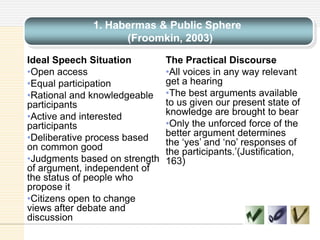
Ideal Speech Situation
•Open access
•Equal participation
•Rational and knowledgeable
participants
•Active and interested
participants
•Deliberative process based
on common good
•Judgments based on strength
of argument, independent of
the status of people who
propose it
•Citizens open to change
views after debate and
discussion
The Practical Discourse
•All voices in any way relevant
get a hearing
•The best arguments available
to us given our present state of
knowledge are brought to bear
•Only the unforced force of the
better argument determines
the ‗yes‘ and ‗no‘ responses of
the participants.‘(Justification,
163)
Critiques
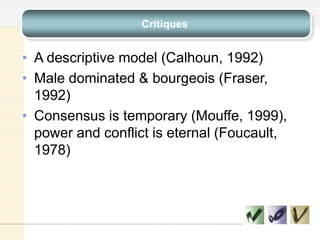
• A descriptive model (Calhoun, 1992)
• Male dominated & bourgeois (Fraser,
1992)
• Consensus is temporary (Mouffe, 1999),
power and conflict is eternal (Foucault,
1978)
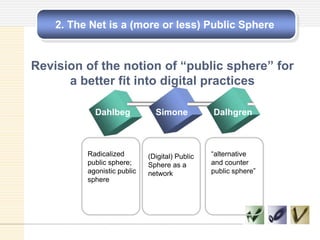
2. The Net is a (more or less) Public Sphere
Revision of the notion of “public sphere” for
a better fit into digital practices
Dahlbeg Simone Dalhgren
Radicalized
public sphere;
agonistic public
sphere
(Digital) Public
Sphere as a
network
―alternative
and counter
public sphere‖
Radicalized public sphere;
agonistic public sphere
• Deliberatively democratic model
 Features
 Criticized because…
• Radicalized public sphere
 ―Discursive radicalism‖
 ―inter-discursive contestation‖
• An ―agonistic public sphere‖ – counterpublics
 Internet matters in the ―agonistic public sphere‖!
• How to foster and expand this public sphere?
(Digital) Public Sphere as a Network
• deliberative public sphere as a network
 participatory digital technologies contributes as
it bridges ―enclave and shared nodes where
multiple publics can engage in deliberation within
and across public boundaries‖
 such as discussion boards, e-mail and text messages
• policy making process
 openness, access, and freedom (Castells, 2001)
 Feasible? --- e.g. In China, you are totally fine if only focusing on promoting
environmental protection issues, anti-discrimination activities which hardly
have any impact on subverting the one-party regime. In contrast, some
issues are still regarded as taboos and are too strictly censored to gain the
visibility in the public (Multiple tactics have been employed by Chinese
netizens to avoid censorship, but this is another story (Yang, 2009))
 Click me@@
 http://www.youtube.com/watch?v=quaZi5sckwE
online public sphere as
―alternative and counter public sphere‖
• The Internet helps
 available spaces for alternative and subaltern
organizations or individuals, facilitating
―an impressive communicative heterogeneity‖ (p.152)
 the structural connections—formalized institutional
procedures—between these communicative spaces
and the processes of decision making
• An inspiring view of contemporary political practices
 political apathy and disaffiliation?
 outside the parliamentary system
 the process of redefining just what constitutes the political, often within the
context of social movements
 politics, cultural values, identity processes, and local self-reliance measures
are interwoven (Beck, 1997)
• Civic Cultures
 citizens' lived experiences, personal resources, and subjective dispositions
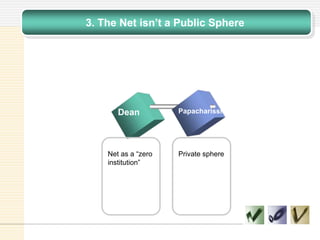
Dean Papacharissi
Net as a ―zero
institution‖
3. The Net isn’t a Public Sphere
Private sphere
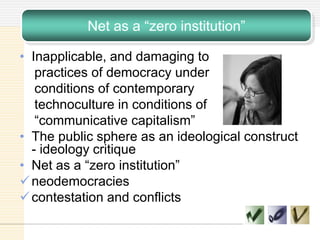
• Inapplicable, and damaging to
practices of democracy under
conditions of contemporary
technoculture in conditions of
―communicative capitalism‖
• The public sphere as an ideological construct
- ideology critique
• Net as a ―zero institution‖
neodemocracies
contestation and conflicts
Net as a ―zero institution‖
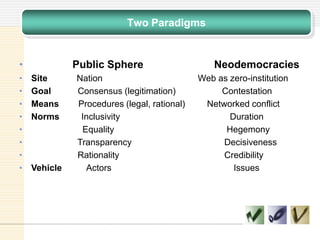
Two Paradigms
• Public Sphere Neodemocracies
• Site Nation Web as zero-institution
• Goal Consensus (legitimation) Contestation
• Means Procedures (legal, rational) Networked conflict
• Norms Inclusivity Duration
• Equality Hegemony
• Transparency Decisiveness
• Rationality Credibility
• Vehicle Actors Issues
―Digital Public Sphere‖ – an old fashion?
• Public and Private
 Arendt (1958); Habermas (1989); Thompson (2011)
 A dichotomized understanding to a contingent comprehension
• Private Sphere (Papacharissi, 2010)
 a new paradigm to understand the democracy in this digital age: the
private sphere, which contributes to a distinct way to participate in
democratic practices through the utilization of ―private media
environment‖. Private citizens are engaged in politics in a manner of
―autonomy, control, and self-expression‖.
• New types of democracy and civic engagement
 ―Monitory Democracy‖ (Keane, 2009)
4. How to conceptualize politics in digital age?
―cultural and media theorist working on
new media technologies, philosophy and
cultural studies‖
Gary Hall, 2008
 What he doesn't think:
Three theories of the Internet and
Politics
 1) Liberal/Democratizing Approach
 2) Renewed Public Sphere Approach
 3) Gift Economy Approach
Internet is Good vs. Internet is Bad
 What he does think:
Need openness in developing new way of
thinking/theorizing about the Internet and
politics
 Post-Hegemonic Era?
 ICTs are changing existence itself
Past theories are ―antipolitical‖ because the
are stuck in the language of cultural criticism
and don‘t allow for anything new
Gary Hall, 2008
 Poster‘s Essay ―Cyberdemocracy: The Interne
and the Public Sphere‖
May need to rethink modern interpretation
Consequences for three aspects of politics on the
Internet
 1) Technological Determinism
 2) The Public Sphere
 3) Democracy
Hypercyberdemocracy: Going beyond Poster by
questioning the legitimacy and authority of all
things including academia and the self
Gary Hall, 2008
1) Technological Determinism
 Internet is more than a tool
 ―No simple distinction between technology
and its users‖ (pp. 170)
 People cannot position themselves
outside of technology to fully understand
the effects of that technology
Hall, 2008
2) Public Sphere
 Internet challenges traditional notions of:
1) Politics
 Problematic: concept of individual identity and what it means
to be a liberated political society
2) Citizenship
 Problematic: the idea that there are/should be ―autonomous
unified individuals with the right to criticize government and
contribute to the way society is run‖
3) The Public Sphere
 Problematic: distinction between public & private
Challenges Habermas' concept of the public sphere because
―on the Internet the public and external space of technology is
always already a part of the private, internal space of human
subjectivity and even the body‖ (pp. 172, referencing Poster
1997, 209)
Hall, 2008
3) Democracy
 The Internet is a space that:
allows decentralized dialogue, new formations for
political groupings
can reveal new power relations among people who
communicate
highlights how technology is and always has been
part of what it means to be human
 Habermas's public sphere needs to be discarded and
replaced with a new form ―capable of representing
new subjectivities and collectivities‖ (pp. 175)
 Poster's essay gives the opportunity to explore new
meanings of politics, and perhaps something other
than democracy will emerge
Hall, 2008
5. Public Sphere and Civic Engagement
Q: Will online political participation lead to political
change offline?
Shirky (2003)
• Access to information is far less important
than access to conversation
• View new media as a long-term tool that
will strengthen civil society and public
sphere and incrementally lead to political
change (the environmental view) rather
than as a tool with immediate political
impact (the instrumental view)
Examples of deliberation online?
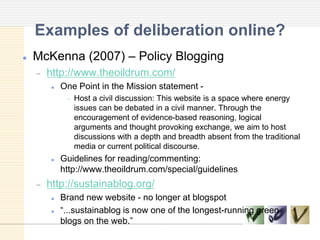
 McKenna (2007) – Policy Blogging
http://www.theoildrum.com/
 One Point in the Mission statement -
Host a civil discussion: This website is a space where energy
issues can be debated in a civil manner. Through the
encouragement of evidence-based reasoning, logical
arguments and thought provoking exchange, we aim to host
discussions with a depth and breadth absent from the traditional
media or current political discourse.
 Guidelines for reading/commenting:
http://www.theoildrum.com/special/guidelines
http://sustainablog.org/
 Brand new website - no longer at blogspot
 ―...sustainablog is now one of the longest-running green
blogs on the web.‖
Examples to explore
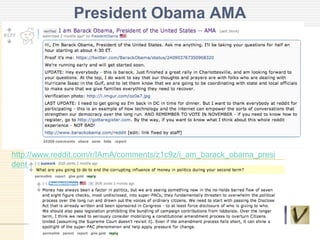
 President Obama AMA on Reddit -
http://www.reddit.com/r/IAmA/comments/z1c9z/i_am_barack_obama_president_of_the_united_states/?utm_source=dlvr.it&utm_
medium=feed
 Arab Spring Uprisings and the use of Twitter,
Facebook, and YouTube
Lewinski, M. & Mohammed, D. (2012) Deliberate
Design or Unintended Consequences: The
Argumentative Uses of Facebook During the Arab
Spring. Journal of Public Deliberation, 8(1), 1-11.
 http://www.publicdeliberation.net/cgi/viewcontent.cgi?article=1210&context=jpd
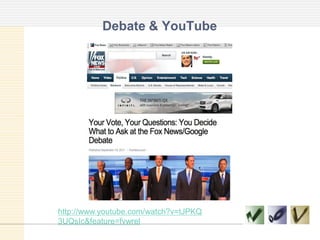
 Presidential Primary Debates and YouTube
President Obama AMA
http://www.reddit.com/r/IAmA/comments/z1c9z/i_am_barack_obama_presi
dent_of_the_united_states/c60mnz9
Arab Spring Uprisings &
Social Media
http://www.youtube.com/watch?v=lnPR90dJ3Gk
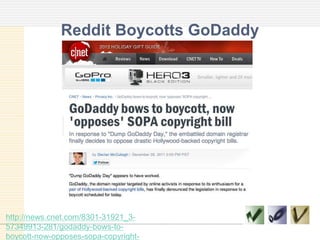
Reddit Boycotts GoDaddy
http://news.cnet.com/8301-31921_3-
57349913-281/godaddy-bows-to-
boycott-now-opposes-sopa-copyright-
Debate & YouTube
http://www.youtube.com/watch?v=tJPKQ
3UQsIc&feature=fvwrel
• How likely will an online public sphere lead
to political change in real life?
• 一上网:就觉得社会黑暗,官员腐败,恶
势力横行,民不聊生,马上就要革命了。
一上街:就觉得社会和谐,人民幸福,载
歌载舞,天下太平,一百年都不会出事
The Question lasts…
Thank you!
Happy Thanksgiving!

Digital public sphere leila bei-wei

  • 1.
    Digital Public Sphere LeilaBighash, Wei Wang & Bei Yan
  • 2.
    Structure 1. Habermas andPublic Sphere 2. The Net is a (more or less) Public Sphere 3. The Net isn’t a Public Sphere 5. Public Sphere and Civic Engagement 4. How to conceptualize politics in digital age?
  • 3.
    1. Habermas &Public Sphere (Froomkin, 2003) Ideal Speech Situation •Open access •Equal participation •Rational and knowledgeable participants •Active and interested participants •Deliberative process based on common good •Judgments based on strength of argument, independent of the status of people who propose it •Citizens open to change views after debate and discussion The Practical Discourse •All voices in any way relevant get a hearing •The best arguments available to us given our present state of knowledge are brought to bear •Only the unforced force of the better argument determines the ‗yes‘ and ‗no‘ responses of the participants.‘(Justification, 163)
  • 4.
    Critiques • A descriptivemodel (Calhoun, 1992) • Male dominated & bourgeois (Fraser, 1992) • Consensus is temporary (Mouffe, 1999), power and conflict is eternal (Foucault, 1978)
  • 5.
    2. The Netis a (more or less) Public Sphere Revision of the notion of “public sphere” for a better fit into digital practices Dahlbeg Simone Dalhgren Radicalized public sphere; agonistic public sphere (Digital) Public Sphere as a network ―alternative and counter public sphere‖
  • 6.
    Radicalized public sphere; agonisticpublic sphere • Deliberatively democratic model  Features  Criticized because… • Radicalized public sphere  ―Discursive radicalism‖  ―inter-discursive contestation‖ • An ―agonistic public sphere‖ – counterpublics  Internet matters in the ―agonistic public sphere‖! • How to foster and expand this public sphere?
  • 7.
    (Digital) Public Sphereas a Network • deliberative public sphere as a network  participatory digital technologies contributes as it bridges ―enclave and shared nodes where multiple publics can engage in deliberation within and across public boundaries‖  such as discussion boards, e-mail and text messages • policy making process  openness, access, and freedom (Castells, 2001)  Feasible? --- e.g. In China, you are totally fine if only focusing on promoting environmental protection issues, anti-discrimination activities which hardly have any impact on subverting the one-party regime. In contrast, some issues are still regarded as taboos and are too strictly censored to gain the visibility in the public (Multiple tactics have been employed by Chinese netizens to avoid censorship, but this is another story (Yang, 2009))  Click me@@  http://www.youtube.com/watch?v=quaZi5sckwE
  • 8.
    online public sphereas ―alternative and counter public sphere‖ • The Internet helps  available spaces for alternative and subaltern organizations or individuals, facilitating ―an impressive communicative heterogeneity‖ (p.152)  the structural connections—formalized institutional procedures—between these communicative spaces and the processes of decision making • An inspiring view of contemporary political practices  political apathy and disaffiliation?  outside the parliamentary system  the process of redefining just what constitutes the political, often within the context of social movements  politics, cultural values, identity processes, and local self-reliance measures are interwoven (Beck, 1997) • Civic Cultures  citizens' lived experiences, personal resources, and subjective dispositions
  • 9.
    Dean Papacharissi Net asa ―zero institution‖ 3. The Net isn’t a Public Sphere Private sphere
  • 10.
    • Inapplicable, anddamaging to practices of democracy under conditions of contemporary technoculture in conditions of ―communicative capitalism‖ • The public sphere as an ideological construct - ideology critique • Net as a ―zero institution‖ neodemocracies contestation and conflicts Net as a ―zero institution‖
  • 11.
    Two Paradigms • PublicSphere Neodemocracies • Site Nation Web as zero-institution • Goal Consensus (legitimation) Contestation • Means Procedures (legal, rational) Networked conflict • Norms Inclusivity Duration • Equality Hegemony • Transparency Decisiveness • Rationality Credibility • Vehicle Actors Issues
  • 12.
    ―Digital Public Sphere‖– an old fashion? • Public and Private  Arendt (1958); Habermas (1989); Thompson (2011)  A dichotomized understanding to a contingent comprehension • Private Sphere (Papacharissi, 2010)  a new paradigm to understand the democracy in this digital age: the private sphere, which contributes to a distinct way to participate in democratic practices through the utilization of ―private media environment‖. Private citizens are engaged in politics in a manner of ―autonomy, control, and self-expression‖. • New types of democracy and civic engagement  ―Monitory Democracy‖ (Keane, 2009)
  • 13.
    4. How toconceptualize politics in digital age? ―cultural and media theorist working on new media technologies, philosophy and cultural studies‖ Gary Hall, 2008  What he doesn't think: Three theories of the Internet and Politics  1) Liberal/Democratizing Approach  2) Renewed Public Sphere Approach  3) Gift Economy Approach Internet is Good vs. Internet is Bad
  • 14.
     What hedoes think: Need openness in developing new way of thinking/theorizing about the Internet and politics  Post-Hegemonic Era?  ICTs are changing existence itself Past theories are ―antipolitical‖ because the are stuck in the language of cultural criticism and don‘t allow for anything new Gary Hall, 2008
  • 15.
     Poster‘s Essay―Cyberdemocracy: The Interne and the Public Sphere‖ May need to rethink modern interpretation Consequences for three aspects of politics on the Internet  1) Technological Determinism  2) The Public Sphere  3) Democracy Hypercyberdemocracy: Going beyond Poster by questioning the legitimacy and authority of all things including academia and the self Gary Hall, 2008
  • 16.
    1) Technological Determinism Internet is more than a tool  ―No simple distinction between technology and its users‖ (pp. 170)  People cannot position themselves outside of technology to fully understand the effects of that technology Hall, 2008
  • 17.
    2) Public Sphere Internet challenges traditional notions of: 1) Politics  Problematic: concept of individual identity and what it means to be a liberated political society 2) Citizenship  Problematic: the idea that there are/should be ―autonomous unified individuals with the right to criticize government and contribute to the way society is run‖ 3) The Public Sphere  Problematic: distinction between public & private Challenges Habermas' concept of the public sphere because ―on the Internet the public and external space of technology is always already a part of the private, internal space of human subjectivity and even the body‖ (pp. 172, referencing Poster 1997, 209) Hall, 2008
  • 18.
    3) Democracy  TheInternet is a space that: allows decentralized dialogue, new formations for political groupings can reveal new power relations among people who communicate highlights how technology is and always has been part of what it means to be human  Habermas's public sphere needs to be discarded and replaced with a new form ―capable of representing new subjectivities and collectivities‖ (pp. 175)  Poster's essay gives the opportunity to explore new meanings of politics, and perhaps something other than democracy will emerge Hall, 2008
  • 19.
    5. Public Sphereand Civic Engagement Q: Will online political participation lead to political change offline?
  • 20.
    Shirky (2003) • Accessto information is far less important than access to conversation • View new media as a long-term tool that will strengthen civil society and public sphere and incrementally lead to political change (the environmental view) rather than as a tool with immediate political impact (the instrumental view)
  • 21.
    Examples of deliberationonline?  McKenna (2007) – Policy Blogging http://www.theoildrum.com/  One Point in the Mission statement - Host a civil discussion: This website is a space where energy issues can be debated in a civil manner. Through the encouragement of evidence-based reasoning, logical arguments and thought provoking exchange, we aim to host discussions with a depth and breadth absent from the traditional media or current political discourse.  Guidelines for reading/commenting: http://www.theoildrum.com/special/guidelines http://sustainablog.org/  Brand new website - no longer at blogspot  ―...sustainablog is now one of the longest-running green blogs on the web.‖
  • 22.
    Examples to explore President Obama AMA on Reddit - http://www.reddit.com/r/IAmA/comments/z1c9z/i_am_barack_obama_president_of_the_united_states/?utm_source=dlvr.it&utm_ medium=feed  Arab Spring Uprisings and the use of Twitter, Facebook, and YouTube Lewinski, M. & Mohammed, D. (2012) Deliberate Design or Unintended Consequences: The Argumentative Uses of Facebook During the Arab Spring. Journal of Public Deliberation, 8(1), 1-11.  http://www.publicdeliberation.net/cgi/viewcontent.cgi?article=1210&context=jpd  Presidential Primary Debates and YouTube
  • 23.
  • 24.
    Arab Spring Uprisings& Social Media http://www.youtube.com/watch?v=lnPR90dJ3Gk
  • 25.
  • 26.
  • 27.
    • How likelywill an online public sphere lead to political change in real life? • 一上网:就觉得社会黑暗,官员腐败,恶 势力横行,民不聊生,马上就要革命了。 一上街:就觉得社会和谐,人民幸福,载 歌载舞,天下太平,一百年都不会出事 The Question lasts…
  • 28.