







CYBER SECURITY
FUNDAMENTALS
By – Apurv Singh Gautam
WHAT TO EXPECT??
NEED OF SECURITY
• Increasing awareness of technology but not Security
• Continuous Development & Competition in IT
• Increasing number of Cyber Criminals
• Increasing use of Network elements & applications
• Decreasing level of skill set
NEED OF SECURITY
• Any Security breach in the website of any person increases the
risk of the public image
• Any Security breach in the website of any company increases
the risk of company reputation
• Any Security breach in the government website may increase
the risk on project management and government operations
WHAT IS HACKING??
• Hacking is an art of exploring various security breaches
• What people believe: It’s an anti-social activity
: All the hackers are bad people
• The terms Hacker and Hacking are being misinterpreted and misunderstood
with negative sidelines
COMMUNITIES OF HACKERS
• Hackers
• Crackers
• Phreaks
• Script Kiddies
TYPES OF HACKERS
• White Hat Hacker - They use their knowledge and skill set for good
constructive intents. They find out new security loopholes and their
solutions
• Black Hat Hacker - They use their knowledge and skill set for illegal
activities and destructive intents
• Grey Hat Hacker – They use their knowledge and skill set for legal and illegal
purpose. They are white hats in public but internally they do some black hat
work
NETWORKING
FUNDAMENTALS
IP ADDRESS
IP Address is also known as,
• Logical Address, or
• Unique Identity Address
It is used to identify the systems. Whenever any computer connects itself with the
internet or with LAN, it gets one IP address, that IP address is always unique in the
network. This means, once an IP address is assigned to any system in the network,
it cannot be assigned to any other system. The same in the internet, if one IP
address has been assigned to one system, it cannot be assigned to anyone else
IP TYPES
• Internal IP - Whenever a computer connects itself with an Internal Network
(LAN) , it gets an Internal IP. This IP will be the identity of the particular
computer in the network
• External IP - Whenever a computer connects itself with the internet , it gets
an IP address by ISP. This IP will be the identity of the particular computer
over the internet.
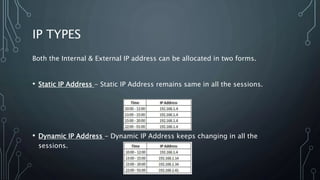
IP TYPES
Both the Internal & External IP address can be allocated in two forms.
• Static IP Address - Static IP Address remains same in all the sessions.
• Dynamic IP Address - Dynamic IP Address keeps changing in all the
sessions.
INTRODUCTION TO
TROJANS
VIRUS & WORMS
Virus, Vital Information Resource Under Seize , is a piece of code
which is meant for the malicious purpose. It can replicate itself In the
same system or also to the external hard drive. It may harm your
system by deleting vital information from your hard drive or by
corrupting the operating system files.
Worms are the virus that replicates itself by resending itself as an e-
mail attachment or as part of a network message. Worms does not
alter files but resides in active memory and duplicates itself. Worm
use parts of an operating system that are automatic and usually
invisible to the user
TROJANS
Trojans are piece of code which is meant for the remote
administration purpose. It may or may not harm your computer
but the hacker can administrate your computer remotely. A
hacker may see the webcam, can get the logs of all the key
strokes and can also delete any file & folders from your system.
Trojans are one of the most dangerous and widely used by
hackers to get into the systems
TYPES OF TROJANS
• Direct Connection Trojan
• Reverse Connection Trojan
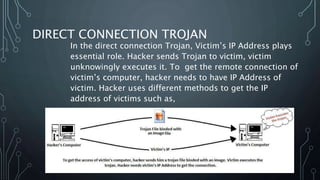
DIRECT CONNECTION TROJAN
In the direct connection Trojan, Victim’s IP Address plays
essential role. Hacker sends Trojan to victim, victim
unknowingly executes it. To get the remote connection of
victim’s computer, hacker needs to have IP Address of
victim. Hacker uses different methods to get the IP
address of victims such as,
• Email Tracing
• IP Grabbing
• Social Engineering
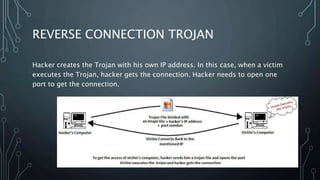
REVERSE CONNECTION TROJAN
Hacker creates the Trojan with his own IP address. In this case, when a victim
executes the Trojan, hacker gets the connection. Hacker needs to open one
port to get the connection.
RAT (REMOTE ADMINISTRATION TOOL)
RAT IS, Remote Administration Tool used to create the Trojans. One
can use their own coding to create the Trojans also but RAT may help
you to create it easily.
• It is also used to control the victim’s computer. After creating and
sending the Trojan, hacker needs to open a port on his own system,
for this a hacker can use RAT.
• RAT is created by the hackers to help the hackers,
• Also after getting the connection hacker can perform various tasks
such as accessing the webcam, file & folder operations, edit the
registry and even can edit the command prompt of the victim using
RAT.
RAT (REMOTE ADMINISTRATION TOOL)
RATs are available for both the types of Trojans. There are
numerous RATs available over the internet such as,
• Cyber Gate
• Dark Comet
• Pro Rat
• Poison Ivy
• Net Bus
Etc, etc, etc, …
INTRODUCTION TO
SOCIAL ENGINEERING
“Cause there’s no PATCH for HUMAN
STUPIDITY”
WHAT IS SOCIAL ENGINEERING??
In context of Information Security, it is the use of
deception to manipulate individuals into divulging
confidential or personal information that may be
used for fraudulent purposes.
TECHNIQUE
• Human Interaction
• Respectable & Known Person or Entity
• Assembling all gathered information together
TYPES OF SOCIAL ENGINEERING
• Quid Pro Quo – Something for something
• Phishing
• Baiting
• Pretexting
• Diversion Theft
WEAKEST LINK??
No matter how strong your:
• Firewalls
• IDS & IPS
• Cryptography
• Anti-Virus Software
• You are the weakest link in computer security. People are more vulnerable
than computers.
• “The weakest link in the security chain is the human element: - Kevin
Mitnick
WAYS TO PREVENT SOCIAL ENGINEERING
• User Awareness
• Policies
• Third party Test
• Be Smart
CONTACT
• Email – apurvsinghgautam@gmail.com
• Mobie No. - +91 9918045500
• Social Name – Apurv Singh Gautam
(Google, Facebook, Twitter, LinkedIn, Quora, etc etc)

Cyber Security Fundamentals

  • 1.
  • 3.
  • 4.
    NEED OF SECURITY •Increasing awareness of technology but not Security • Continuous Development & Competition in IT • Increasing number of Cyber Criminals • Increasing use of Network elements & applications • Decreasing level of skill set
  • 6.
    NEED OF SECURITY •Any Security breach in the website of any person increases the risk of the public image • Any Security breach in the website of any company increases the risk of company reputation • Any Security breach in the government website may increase the risk on project management and government operations
  • 8.
    WHAT IS HACKING?? •Hacking is an art of exploring various security breaches • What people believe: It’s an anti-social activity : All the hackers are bad people • The terms Hacker and Hacking are being misinterpreted and misunderstood with negative sidelines
  • 9.
    COMMUNITIES OF HACKERS •Hackers • Crackers • Phreaks • Script Kiddies
  • 10.
    TYPES OF HACKERS •White Hat Hacker - They use their knowledge and skill set for good constructive intents. They find out new security loopholes and their solutions • Black Hat Hacker - They use their knowledge and skill set for illegal activities and destructive intents • Grey Hat Hacker – They use their knowledge and skill set for legal and illegal purpose. They are white hats in public but internally they do some black hat work
  • 11.
  • 12.
    IP ADDRESS IP Addressis also known as, • Logical Address, or • Unique Identity Address It is used to identify the systems. Whenever any computer connects itself with the internet or with LAN, it gets one IP address, that IP address is always unique in the network. This means, once an IP address is assigned to any system in the network, it cannot be assigned to any other system. The same in the internet, if one IP address has been assigned to one system, it cannot be assigned to anyone else
  • 13.
    IP TYPES • InternalIP - Whenever a computer connects itself with an Internal Network (LAN) , it gets an Internal IP. This IP will be the identity of the particular computer in the network • External IP - Whenever a computer connects itself with the internet , it gets an IP address by ISP. This IP will be the identity of the particular computer over the internet.
  • 14.
    IP TYPES Both theInternal & External IP address can be allocated in two forms. • Static IP Address - Static IP Address remains same in all the sessions. • Dynamic IP Address - Dynamic IP Address keeps changing in all the sessions.
  • 15.
  • 16.
    VIRUS & WORMS Virus,Vital Information Resource Under Seize , is a piece of code which is meant for the malicious purpose. It can replicate itself In the same system or also to the external hard drive. It may harm your system by deleting vital information from your hard drive or by corrupting the operating system files. Worms are the virus that replicates itself by resending itself as an e- mail attachment or as part of a network message. Worms does not alter files but resides in active memory and duplicates itself. Worm use parts of an operating system that are automatic and usually invisible to the user
  • 17.
    TROJANS Trojans are pieceof code which is meant for the remote administration purpose. It may or may not harm your computer but the hacker can administrate your computer remotely. A hacker may see the webcam, can get the logs of all the key strokes and can also delete any file & folders from your system. Trojans are one of the most dangerous and widely used by hackers to get into the systems
  • 18.
    TYPES OF TROJANS •Direct Connection Trojan • Reverse Connection Trojan
  • 19.
    DIRECT CONNECTION TROJAN Inthe direct connection Trojan, Victim’s IP Address plays essential role. Hacker sends Trojan to victim, victim unknowingly executes it. To get the remote connection of victim’s computer, hacker needs to have IP Address of victim. Hacker uses different methods to get the IP address of victims such as, • Email Tracing • IP Grabbing • Social Engineering
  • 20.
    REVERSE CONNECTION TROJAN Hackercreates the Trojan with his own IP address. In this case, when a victim executes the Trojan, hacker gets the connection. Hacker needs to open one port to get the connection.
  • 21.
    RAT (REMOTE ADMINISTRATIONTOOL) RAT IS, Remote Administration Tool used to create the Trojans. One can use their own coding to create the Trojans also but RAT may help you to create it easily. • It is also used to control the victim’s computer. After creating and sending the Trojan, hacker needs to open a port on his own system, for this a hacker can use RAT. • RAT is created by the hackers to help the hackers, • Also after getting the connection hacker can perform various tasks such as accessing the webcam, file & folder operations, edit the registry and even can edit the command prompt of the victim using RAT.
  • 22.
    RAT (REMOTE ADMINISTRATIONTOOL) RATs are available for both the types of Trojans. There are numerous RATs available over the internet such as, • Cyber Gate • Dark Comet • Pro Rat • Poison Ivy • Net Bus Etc, etc, etc, …
  • 23.
    INTRODUCTION TO SOCIAL ENGINEERING “Causethere’s no PATCH for HUMAN STUPIDITY”
  • 24.
    WHAT IS SOCIALENGINEERING?? In context of Information Security, it is the use of deception to manipulate individuals into divulging confidential or personal information that may be used for fraudulent purposes.
  • 26.
    TECHNIQUE • Human Interaction •Respectable & Known Person or Entity • Assembling all gathered information together
  • 27.
    TYPES OF SOCIALENGINEERING • Quid Pro Quo – Something for something • Phishing • Baiting • Pretexting • Diversion Theft
  • 29.
    WEAKEST LINK?? No matterhow strong your: • Firewalls • IDS & IPS • Cryptography • Anti-Virus Software • You are the weakest link in computer security. People are more vulnerable than computers. • “The weakest link in the security chain is the human element: - Kevin Mitnick
  • 30.
    WAYS TO PREVENTSOCIAL ENGINEERING • User Awareness • Policies • Third party Test • Be Smart
  • 32.
    CONTACT • Email –apurvsinghgautam@gmail.com • Mobie No. - +91 9918045500 • Social Name – Apurv Singh Gautam (Google, Facebook, Twitter, LinkedIn, Quora, etc etc)