

An Introduction to Cyber LawbyChetan Bharadwaj
“ The modern thief can steal more with a computer than with a gun. Tomorrow's terrorist may be able to do more damage with a keyboard than with a bomb ”– National Research Council, U S A "Computers at Risk”  (1991)
What is Cyber Law ?Cyber Law is the law governing cyber space.Cyber spaceis a very wide term and includes computers, networks, software, data storage devices (such as hard disks, USB disks etc), the Internet, websites, emails and even electronic devices such as cell phones, ATM machines etc.	Cyber law of India encompasses laws relating toCyber CrimesElectronic and Digital SignaturesIntellectual PropertyData Protection and Privacy
What is Cyber Crime?Cyber crime is the latest and perhaps the most complicated problem in the cyber world. Cyber crimes are unlawful acts where computer is used either as a tool; or a target; or both.
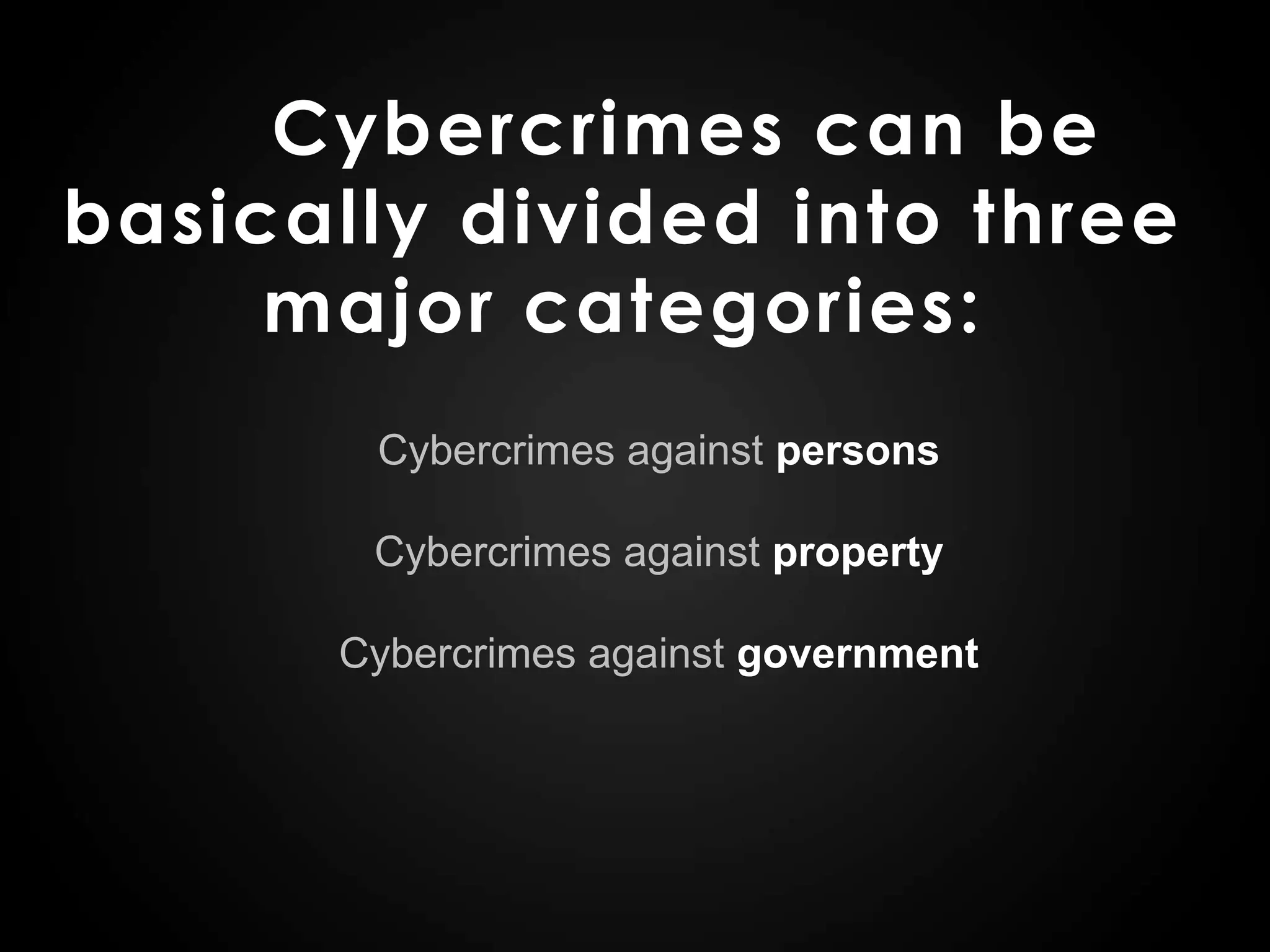
The enormous growth in electronic commerce (e-commerce) and online share trading has led to a phenomenal spurt in incidents of cyber crime.	Cybercrimes can be basically divided into three major categories:Cybercrimes against personsCybercrimes against propertyCybercrimes against government
Cyber crime against personsCybercrimes committed against persons include various crimes like transmission of child-pornography, harassment of any one with the use of a computer such as e-mail. The trafficking, distribution, posting, and dissemination of obscene material including pornography and indecent exposure, is one of the most important Cybercrimes known today in genre.Cyber crime against propertyThese crimes include:Computer vandalism (destruction of others' property);
Transmission of harmful programmes;
Siphoning of funds from financial institutions;
Stealing secret information & data.Cybercrime against governmentCyber terrorism is one distinct kind of crime in this category.
The medium of Cyberspace is used by individuals and groups to threaten the international governments as also to terrorize the citizens of a country.
This crime manifests itself into terrorism when an individual "cracks" into a government or military maintained website.Electronic SignatureElectronic Signatures are used to authenticate electronic records. Digital Signatures are one type of electronic signatures. Digital Signatures satisfy three major legal requirements: Signer authentication;
Message authentication; and
Message integrity. The technology and efficiency of digital signatures makes them more trustworthy than hand written signatures.
Intellectual PropertyIntellectual property refers to creations of the human mind e.g., a story, a song, a painting, a design & etc. The facets of intellectual property that relate to cyber space are covered by Cyber law.Facets of Intellectual PropertyCopyright law in relation to computer software, source code, websites, cell phone content etc.
Licensing in terms of software and source code.
Trademark law with relation to domain names, meta tags, mirroring, framing, linking etc.

An Introduction to Cyber Law - I.T. Act 2000 (India)

  • 2.
    An Introduction toCyber LawbyChetan Bharadwaj
  • 3.
    “ The modernthief can steal more with a computer than with a gun. Tomorrow's terrorist may be able to do more damage with a keyboard than with a bomb ”– National Research Council, U S A "Computers at Risk” (1991)
  • 4.
    What is CyberLaw ?Cyber Law is the law governing cyber space.Cyber spaceis a very wide term and includes computers, networks, software, data storage devices (such as hard disks, USB disks etc), the Internet, websites, emails and even electronic devices such as cell phones, ATM machines etc. Cyber law of India encompasses laws relating toCyber CrimesElectronic and Digital SignaturesIntellectual PropertyData Protection and Privacy
  • 5.
    What is CyberCrime?Cyber crime is the latest and perhaps the most complicated problem in the cyber world. Cyber crimes are unlawful acts where computer is used either as a tool; or a target; or both.
  • 6.
    The enormous growthin electronic commerce (e-commerce) and online share trading has led to a phenomenal spurt in incidents of cyber crime. Cybercrimes can be basically divided into three major categories:Cybercrimes against personsCybercrimes against propertyCybercrimes against government
  • 7.
    Cyber crime againstpersonsCybercrimes committed against persons include various crimes like transmission of child-pornography, harassment of any one with the use of a computer such as e-mail. The trafficking, distribution, posting, and dissemination of obscene material including pornography and indecent exposure, is one of the most important Cybercrimes known today in genre.Cyber crime against propertyThese crimes include:Computer vandalism (destruction of others' property);
  • 8.
  • 9.
    Siphoning of fundsfrom financial institutions;
  • 10.
    Stealing secret information& data.Cybercrime against governmentCyber terrorism is one distinct kind of crime in this category.
  • 11.
    The medium ofCyberspace is used by individuals and groups to threaten the international governments as also to terrorize the citizens of a country.
  • 12.
    This crime manifestsitself into terrorism when an individual "cracks" into a government or military maintained website.Electronic SignatureElectronic Signatures are used to authenticate electronic records. Digital Signatures are one type of electronic signatures. Digital Signatures satisfy three major legal requirements: Signer authentication;
  • 13.
  • 14.
    Message integrity. Thetechnology and efficiency of digital signatures makes them more trustworthy than hand written signatures.
  • 15.
    Intellectual PropertyIntellectual propertyrefers to creations of the human mind e.g., a story, a song, a painting, a design & etc. The facets of intellectual property that relate to cyber space are covered by Cyber law.Facets of Intellectual PropertyCopyright law in relation to computer software, source code, websites, cell phone content etc.
  • 16.
    Licensing in termsof software and source code.
  • 17.
    Trademark law withrelation to domain names, meta tags, mirroring, framing, linking etc.
  • 18.
    Semiconductor law whichrelates to the protection of semiconductor integrated circuits design and layouts.
  • 19.
    Patent law inrelation to computer hardware and software.Data Protection & PrivacyData Protection and Privacy Laws aim to achieve a fair balance between the privacy rights of the individual and the interests of data controllers such as banks, hospitals, email service providers etc.
  • 20.
    These laws seekto address the challenges to privacy caused by collecting, storing and transmitting data using new technologies.IT Act of India, 2000The primary source of cyber law in India is the Information Technology Act , 2000 (IT Act).The main purpose of the Act is to provide legal recognition to electronic commerce and to facilitate filing of electronic records with the Government.Information Technology Act 2000 consisted of 94 sections segregated into 13 chapters.
  • 21.
    Four schedules formpart of the Act.IT Amendment Act, 2008ITA 2008, as the new version of Information Technology Act 2000 is often referred, has provided additional focus on Information Security. It has added several new sections on offences including Cyber Terrorism and Data Protection.The Information Technology Amendment Act, 2008 (IT Act 2008) has been passed by the parliament on 23rd December 2008 and came into force from October 27, 2009 onwards.Thank YouFor more updates, stay tuned to the FOURDY wlog [wlog.thefourdy.com]