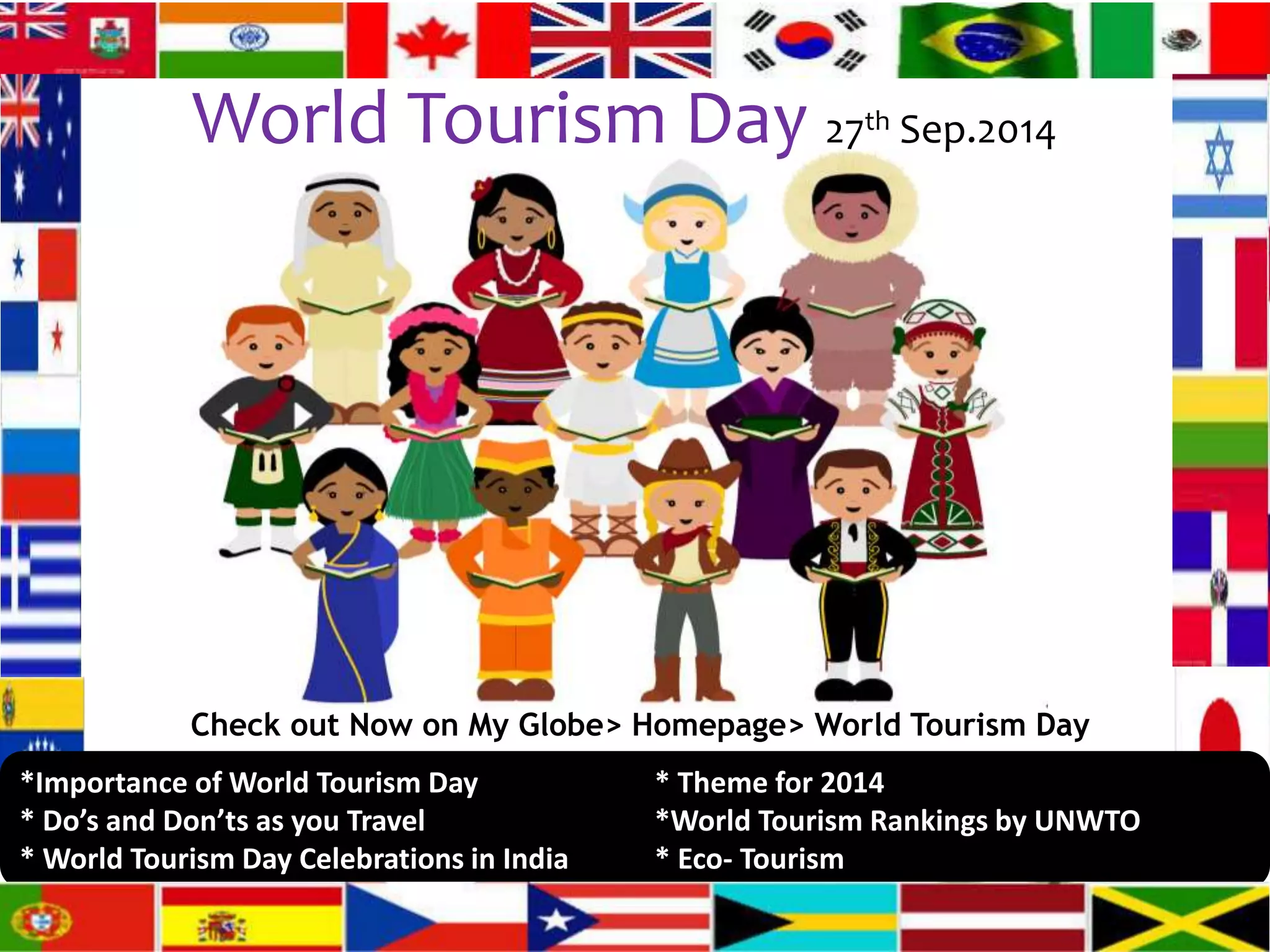
World Tourism Day 27th Sep.2014 
Check out Now on My Globe> Homepage> World Tourism Day 
*Importance of World Tourism Day * Theme for 2014 
* Do’s and Don’ts as you Travel *World Tourism Rankings by UNWTO 
* World Tourism Day Celebrations in India * Eco- Tourism
World Tourism Day 
• World Tourism Day (WTD) is held annually on 27 September. 
• Its purpose is to foster awareness among the international 
community of the importance of tourism and its social, cultural, 
political and economic value. 
• The event seeks to address global challenges outlined in the 
United Nations Millennium Development Goals (MDGs) and to 
highlight the contribution the tourism sector can make in 
reaching these goals.
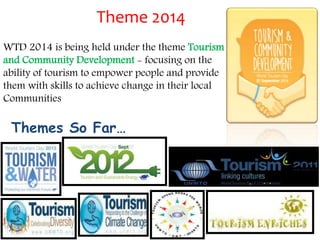
Theme 2014 
WTD 2014 is being held under the theme Tourism 
and Community Development - focusing on the 
ability of tourism to empower people and provide 
them with skills to achieve change in their local 
Communities 
Themes So Far…
Tourism and Community Development 
WTD is the perfect time to reflect upon your responsibilities 
and impact as a traveler visiting other communities. 
Remember: 
• Buy local 
• Respect the culture you are visiting 
• Protect heritage 
• Save energy 
• Protect the surroundings 
• Respect the environment
 Carry back all non-degradable litter such as 
empty bottles, tins, plastic bags etc. These must 
not litter the environment or be buried. They 
must be disposed in municipal dustbins only. 
 Observe the sanctity of holy sites, temples and 
local cultures. 
 Cut noise pollution. Do not blare aloud radios, 
tape recorders or other electronic entertainment 
equipment in nature resorts, sanctuaries and 
wildlife parks. 
 In case temporary toilets are set-up near 
campsites, after defecation, cover with mud or 
sand. Make sure that the spot is at least 30 
meters away from the water source. 
 Respect people's privacy while taking 
photographs. Ask for prior permission before 
taking a photograph. 
 Do not take away flora and fauna in the forms 
of cuttings, seeds or roots. It is illegal. 
 Do not use pollutants such as detergent, in 
streams or springs while washing and bathing. 
 Do not use wood as fuel to cook food at the 
campsite. 
 Do not leave cigarettes butts or make open fires 
in the forests. 
 Do not consume aerated drinks, alcohol, drugs 
or any other intoxicant and throw bottles in the 
wild. 
 Do not tempt the locals, especially children by 
offering them foodstuff or sweets. Respect local 
traditions. 
 Polythene and plastics are non biodegradable 
and unhealthy for the environment and must not 
be used and littered.
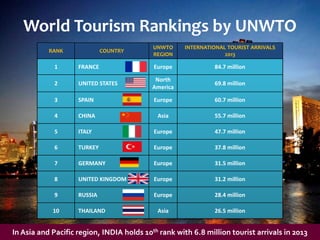
World Tourism Rankings by UNWTO 
RANK COUNTRY 
UNWTO 
REGION 
INTERNATIONAL TOURIST ARRIVALS 
2013 
1 FRANCE Europe 84.7 million 
2 UNITED STATES 
North 
America 
69.8 million 
3 SPAIN Europe 60.7 million 
4 CHINA Asia 55.7 million 
5 ITALY Europe 47.7 million 
6 TURKEY Europe 37.8 million 
7 GERMANY Europe 31.5 million 
8 UNITED KINGDOM Europe 31.2 million 
9 RUSSIA Europe 28.4 million 
10 THAILAND Asia 26.5 million 
In Asia and Pacific region, INDIA holds 10th rank with 6.8 million tourist arrivals in 2013
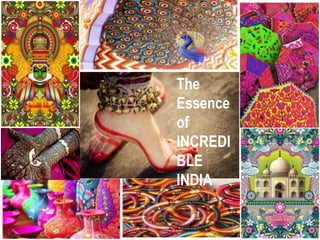
The 
Essence 
of 
INCREDI 
BLE 
INDIA
 It is celebrated with the great interest by the 
various tourism enterprises, organizations, 
government agencies. 
 Varieties of competitions are held at this day such 
as photo competitions promoting the tourism, 
tourism award presentations including free 
entries, discounts/special offers to the general 
public. 
 Tourism has become the continuously growing 
because of the occurrence of various attractive 
and new destinations for the tourists. It has 
become the main source of income for the 
World Todeuverloispimng c Douantyrie Cs.elebrations in INDIA
What is Eco-tourism? 
• eco-tourism means making as little environmental impact 
as possible and encouraging the preservation of wildlife 
and habitats when visiting a place. 
• Eco-tourism activities should follow the following 
principles: 
Minimize impact 
Raise sensitivity to host countries 
Build environmental and cultural awareness 
Provide direct financial benefits for conservation 
Provide financial benefits and empowerment for local people

World tourism day 2014

  • 1.
    World Tourism Day27th Sep.2014 Check out Now on My Globe> Homepage> World Tourism Day *Importance of World Tourism Day * Theme for 2014 * Do’s and Don’ts as you Travel *World Tourism Rankings by UNWTO * World Tourism Day Celebrations in India * Eco- Tourism
  • 2.
    World Tourism Day • World Tourism Day (WTD) is held annually on 27 September. • Its purpose is to foster awareness among the international community of the importance of tourism and its social, cultural, political and economic value. • The event seeks to address global challenges outlined in the United Nations Millennium Development Goals (MDGs) and to highlight the contribution the tourism sector can make in reaching these goals.
  • 3.
    Theme 2014 WTD2014 is being held under the theme Tourism and Community Development - focusing on the ability of tourism to empower people and provide them with skills to achieve change in their local Communities Themes So Far…
  • 4.
    Tourism and CommunityDevelopment WTD is the perfect time to reflect upon your responsibilities and impact as a traveler visiting other communities. Remember: • Buy local • Respect the culture you are visiting • Protect heritage • Save energy • Protect the surroundings • Respect the environment
  • 5.
     Carry backall non-degradable litter such as empty bottles, tins, plastic bags etc. These must not litter the environment or be buried. They must be disposed in municipal dustbins only.  Observe the sanctity of holy sites, temples and local cultures.  Cut noise pollution. Do not blare aloud radios, tape recorders or other electronic entertainment equipment in nature resorts, sanctuaries and wildlife parks.  In case temporary toilets are set-up near campsites, after defecation, cover with mud or sand. Make sure that the spot is at least 30 meters away from the water source.  Respect people's privacy while taking photographs. Ask for prior permission before taking a photograph.  Do not take away flora and fauna in the forms of cuttings, seeds or roots. It is illegal.  Do not use pollutants such as detergent, in streams or springs while washing and bathing.  Do not use wood as fuel to cook food at the campsite.  Do not leave cigarettes butts or make open fires in the forests.  Do not consume aerated drinks, alcohol, drugs or any other intoxicant and throw bottles in the wild.  Do not tempt the locals, especially children by offering them foodstuff or sweets. Respect local traditions.  Polythene and plastics are non biodegradable and unhealthy for the environment and must not be used and littered.
  • 6.
    World Tourism Rankingsby UNWTO RANK COUNTRY UNWTO REGION INTERNATIONAL TOURIST ARRIVALS 2013 1 FRANCE Europe 84.7 million 2 UNITED STATES North America 69.8 million 3 SPAIN Europe 60.7 million 4 CHINA Asia 55.7 million 5 ITALY Europe 47.7 million 6 TURKEY Europe 37.8 million 7 GERMANY Europe 31.5 million 8 UNITED KINGDOM Europe 31.2 million 9 RUSSIA Europe 28.4 million 10 THAILAND Asia 26.5 million In Asia and Pacific region, INDIA holds 10th rank with 6.8 million tourist arrivals in 2013
  • 7.
    The Essence of INCREDI BLE INDIA
  • 8.
     It iscelebrated with the great interest by the various tourism enterprises, organizations, government agencies.  Varieties of competitions are held at this day such as photo competitions promoting the tourism, tourism award presentations including free entries, discounts/special offers to the general public.  Tourism has become the continuously growing because of the occurrence of various attractive and new destinations for the tourists. It has become the main source of income for the World Todeuverloispimng c Douantyrie Cs.elebrations in INDIA
  • 9.
    What is Eco-tourism? • eco-tourism means making as little environmental impact as possible and encouraging the preservation of wildlife and habitats when visiting a place. • Eco-tourism activities should follow the following principles: Minimize impact Raise sensitivity to host countries Build environmental and cultural awareness Provide direct financial benefits for conservation Provide financial benefits and empowerment for local people