Cybercrime / Computer Crime
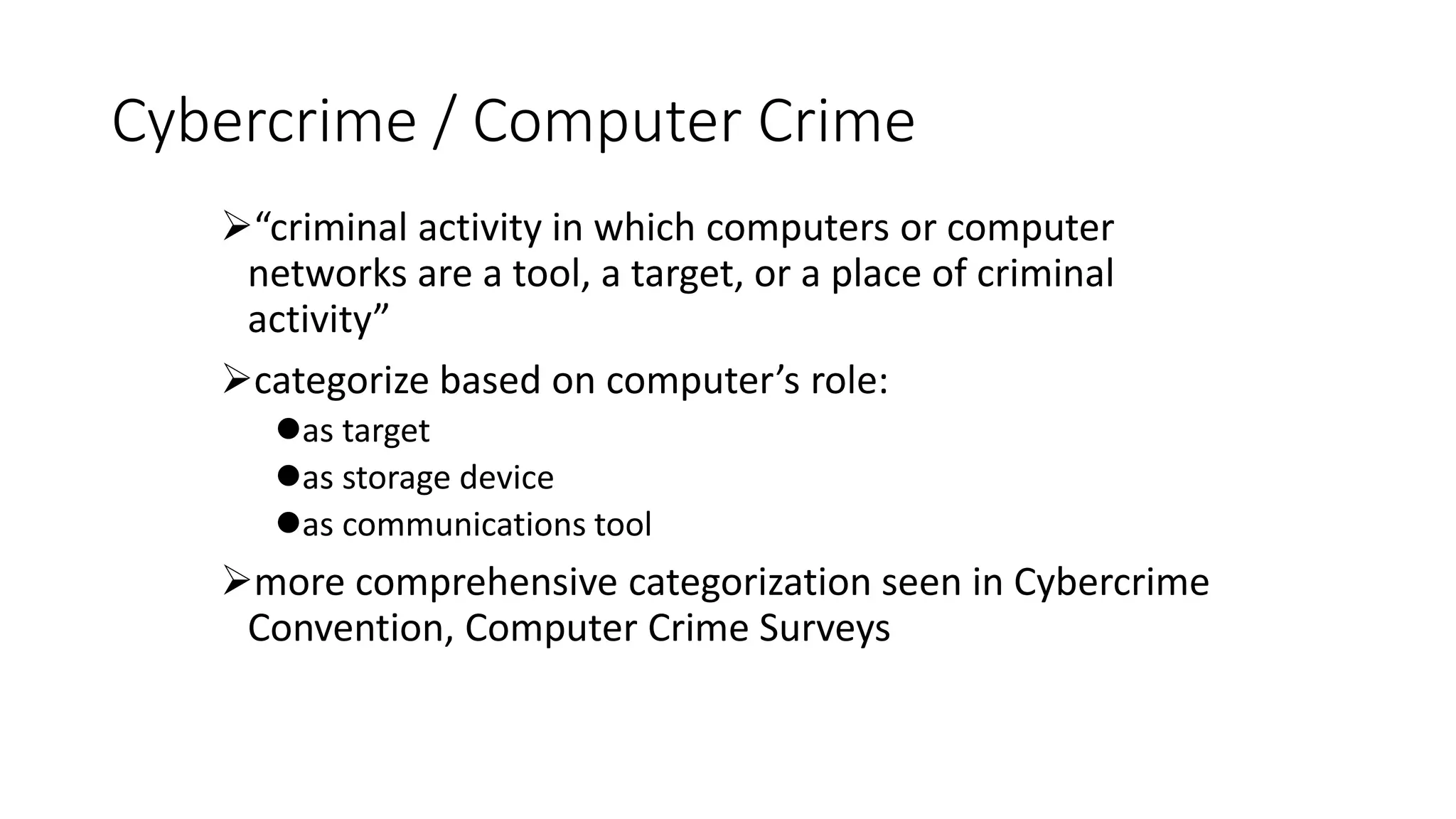
“criminal activity in which computers or computer
networks are a tool, a target, or a place of criminal
activity”
categorize based on computer’s role:
as target
as storage device
as communications tool
more comprehensive categorization seen in Cybercrime
Convention, Computer Crime Surveys
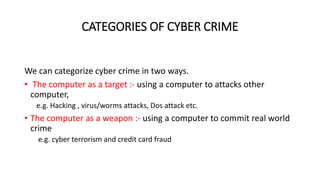
CATEGORIES OF CYBER CRIME
We can categorize cyber crime in two ways.
• The computer as a target :- using a computer to attacks other
computer,
e.g. Hacking , virus/worms attacks, Dos attack etc.
• The computer as a weapon :- using a computer to commit real world
crime
e.g. cyber terrorism and credit card fraud
TYPES OF CYBER CRIME
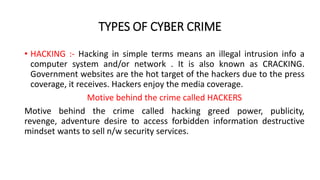
• HACKING :- Hacking in simple terms means an illegal intrusion info a
computer system and/or network . It is also known as CRACKING.
Government websites are the hot target of the hackers due to the press
coverage, it receives. Hackers enjoy the media coverage.
Motive behind the crime called HACKERS
Motive behind the crime called hacking greed power, publicity,
revenge, adventure desire to access forbidden information destructive
mindset wants to sell n/w security services.
TYPES OF CYBER CRIME
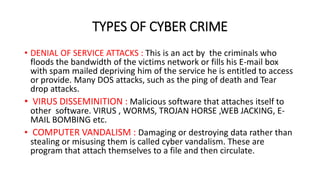
• DENIAL OF SERVICE ATTACKS : This is an act by the criminals who
floods the bandwidth of the victims network or fills his E-mail box
with spam mailed depriving him of the service he is entitled to access
or provide. Many DOS attacks, such as the ping of death and Tear
drop attacks.
• VIRUS DISSEMINITION : Malicious software that attaches itself to
other software. VIRUS , WORMS, TROJAN HORSE ,WEB JACKING, E-
MAIL BOMBING etc.
• COMPUTER VANDALISM : Damaging or destroying data rather than
stealing or misusing them is called cyber vandalism. These are
program that attach themselves to a file and then circulate.
TYPES OF CYBER CRIME
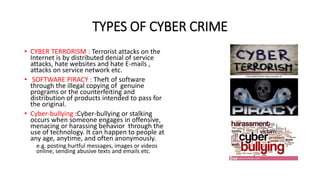
• CYBER TERRORISM : Terrorist attacks on the
Internet is by distributed denial of service
attacks, hate websites and hate E-mails ,
attacks on service network etc.
• SOFTWARE PIRACY : Theft of software
through the illegal copying of genuine
programs or the counterfeiting and
distribution of products intended to pass for
the original.
• Cyber-bullying :Cyber-bullying or stalking
occurs when someone engages in offensive,
menacing or harassing behavior through the
use of technology. It can happen to people at
any age, anytime, and often anonymously.
e.g. posting hurtful messages, images or videos
online, sending abusive texts and emails etc.
TYPES OF CYBER CRIME
• Online trading issues: Online trading
issues involve scammers are geting
people who buy, sell or trade online.
There are many types of scams which
aim to rip off unsuspecting shoppers.
e.g. advertise products for sale at cheap
prices, and once purchased the products
never arrive, offer ‘miracle’ cures for
medical conditions where none exist
(especially for weight loss), attract you with
offers for ‘free’ goods by subscribing to
mobile premium services.
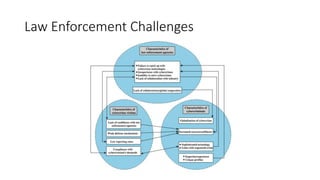
Law Enforcement Challenges
CYBER LAW OF Pakistan
• Prevention of Electronic Crimes Act, 2016.
It extends to the whole of Pakistan.
It shall apply to every citizen of Pakistan wherever he may be and also
to every other person for the time being in Pakistan.
It shall also apply to any act committed outside Pakistan by any
person if the act constitutes an offence under this Act and affects a
person, property, information system or data located in Pakistan.
It shall come into force at once.
Tips to avoid cybercrime
• Be social media savvy:
Make sure your social networking profiles (e.g. Facebook, Twitter,
YouTube, MSN, etc.) are set to private. Check your security settings. Be
careful what information you post online. Once it is on the Internet, it is
extremely difficult to remove.
Tips to avoid cybercrime
• Ignore the unwanted messages or e-mails
• Protect your e-identity (electronic identity)
• Never store your own details on any mobile device (Secure
• mobile devices)
• If in doubt, block
• Ignore pop-ups
• Only shop online on secure sites
• Different site, different passwords (don’t use same key for
• all locks)
• Always make sure that login pages use SSL and that the
• login pages starts with https://

Cybercrime

  • 1.
    Cybercrime / ComputerCrime “criminal activity in which computers or computer networks are a tool, a target, or a place of criminal activity” categorize based on computer’s role: as target as storage device as communications tool more comprehensive categorization seen in Cybercrime Convention, Computer Crime Surveys
  • 2.
    CATEGORIES OF CYBERCRIME We can categorize cyber crime in two ways. • The computer as a target :- using a computer to attacks other computer, e.g. Hacking , virus/worms attacks, Dos attack etc. • The computer as a weapon :- using a computer to commit real world crime e.g. cyber terrorism and credit card fraud
  • 3.
    TYPES OF CYBERCRIME • HACKING :- Hacking in simple terms means an illegal intrusion info a computer system and/or network . It is also known as CRACKING. Government websites are the hot target of the hackers due to the press coverage, it receives. Hackers enjoy the media coverage. Motive behind the crime called HACKERS Motive behind the crime called hacking greed power, publicity, revenge, adventure desire to access forbidden information destructive mindset wants to sell n/w security services.
  • 4.
    TYPES OF CYBERCRIME • DENIAL OF SERVICE ATTACKS : This is an act by the criminals who floods the bandwidth of the victims network or fills his E-mail box with spam mailed depriving him of the service he is entitled to access or provide. Many DOS attacks, such as the ping of death and Tear drop attacks. • VIRUS DISSEMINITION : Malicious software that attaches itself to other software. VIRUS , WORMS, TROJAN HORSE ,WEB JACKING, E- MAIL BOMBING etc. • COMPUTER VANDALISM : Damaging or destroying data rather than stealing or misusing them is called cyber vandalism. These are program that attach themselves to a file and then circulate.
  • 5.
    TYPES OF CYBERCRIME • CYBER TERRORISM : Terrorist attacks on the Internet is by distributed denial of service attacks, hate websites and hate E-mails , attacks on service network etc. • SOFTWARE PIRACY : Theft of software through the illegal copying of genuine programs or the counterfeiting and distribution of products intended to pass for the original. • Cyber-bullying :Cyber-bullying or stalking occurs when someone engages in offensive, menacing or harassing behavior through the use of technology. It can happen to people at any age, anytime, and often anonymously. e.g. posting hurtful messages, images or videos online, sending abusive texts and emails etc.
  • 6.
    TYPES OF CYBERCRIME • Online trading issues: Online trading issues involve scammers are geting people who buy, sell or trade online. There are many types of scams which aim to rip off unsuspecting shoppers. e.g. advertise products for sale at cheap prices, and once purchased the products never arrive, offer ‘miracle’ cures for medical conditions where none exist (especially for weight loss), attract you with offers for ‘free’ goods by subscribing to mobile premium services.
  • 7.
  • 8.
    CYBER LAW OFPakistan • Prevention of Electronic Crimes Act, 2016. It extends to the whole of Pakistan. It shall apply to every citizen of Pakistan wherever he may be and also to every other person for the time being in Pakistan. It shall also apply to any act committed outside Pakistan by any person if the act constitutes an offence under this Act and affects a person, property, information system or data located in Pakistan. It shall come into force at once.
  • 9.
    Tips to avoidcybercrime • Be social media savvy: Make sure your social networking profiles (e.g. Facebook, Twitter, YouTube, MSN, etc.) are set to private. Check your security settings. Be careful what information you post online. Once it is on the Internet, it is extremely difficult to remove.
  • 10.
    Tips to avoidcybercrime • Ignore the unwanted messages or e-mails • Protect your e-identity (electronic identity) • Never store your own details on any mobile device (Secure • mobile devices) • If in doubt, block • Ignore pop-ups • Only shop online on secure sites • Different site, different passwords (don’t use same key for • all locks) • Always make sure that login pages use SSL and that the • login pages starts with https://