Cutting Edge Economic  Techniques for Assessing  Regional Innovations Rose M. Baker David L. Passmore
Penn State Workforce Education & Development Initiative Rose Baker David Passmore Program Manager Workforce Assessment Center &  Assistant Professor of Education Professor & Director Penn State Institute for Research in Training & Development
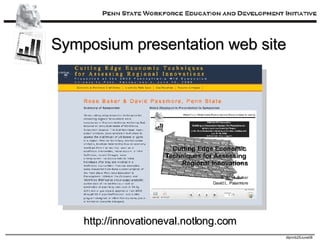
Symposium presentation web site http://innovationeval.notlong.com
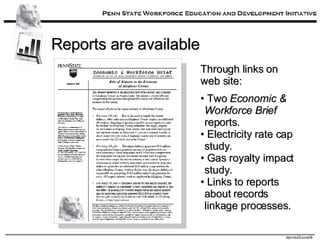
Reports are available Through links on web site: •  Two  Economic & Workforce Brief  reports. •  Electricity rate cap study. •  Gas royalty impact study. •  Links to reports about records linkage processes.
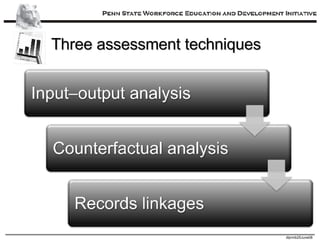
Three assessment techniques
< Input–Output Analysis > •  Economic & Workforce Brief  Series •
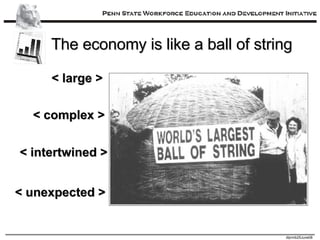
The economy is like a ball of string < complex > < intertwined > < large > < unexpected >
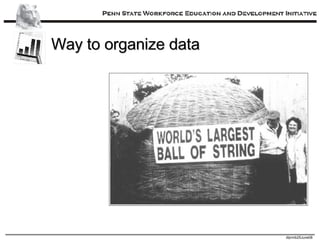
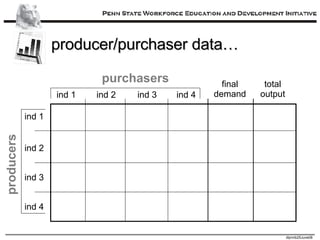
Way to organize data < input-output tables > Summarize production & consumption.
producer/purchaser data… ind 1 ind 2 ind 3 ind 4 ind 1 ind 2 ind 3 ind 4 final demand total output producers purchasers
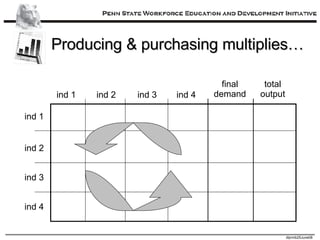
Producing & purchasing multiplies… ind 1 ind 2 ind 3 ind 4 ind 1 ind 2 ind 3 ind 4 final demand total output
Multipliers Economic impact of change in final demand. Calculated for output, income, employment, taxes, and other factors. Show total effects of change on economy. Expressed as a positive number.
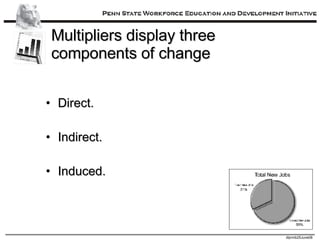
Multipliers display three  components of change Direct. Indirect. Induced.
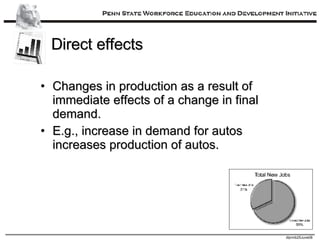
Direct effects Changes in production as a result of immediate effects of a change in final demand. E.g., increase in demand for autos increases production of autos.
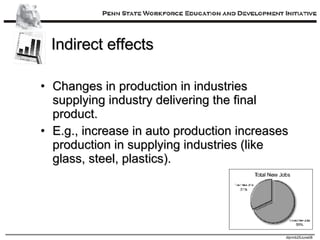
Indirect effects Changes in production in industries supplying industry delivering the final product. E.g., increase in auto production increases production in supplying industries (like glass, steel, plastics).
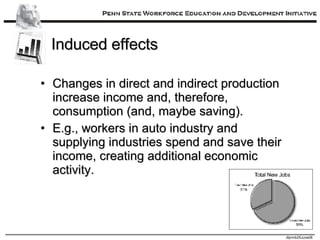
Induced effects Changes in direct and indirect production increase income and, therefore, consumption (and, maybe saving). E.g., workers in auto industry and supplying industries spend and save their income, creating additional economic activity.
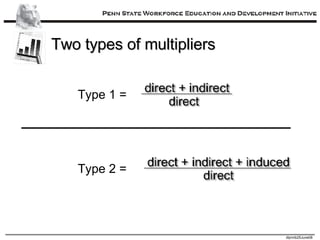
Two types of multipliers Type 1 = Type 2 =
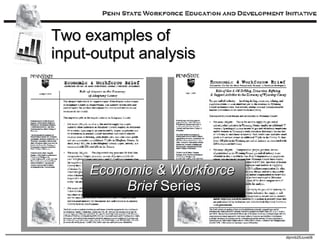
Two examples of  input-output analysis Economic & Workforce  Brief  Series
< Counterfactual Analysis > •  Electricity Rate Caps • •  Gas Royalties •
A counterfactual analysis is… An analysis that goes counter to facts. What would happen if the U.S. invaded Iran? What would have happened if the U.S. did not go to war with Iraq? What would happen if gas prices rose to $6/gal. A “what if” analysis. Counterfactual reasoning reveals implications of counterfactual suppositions to be examined in case what is supposed actually happens.
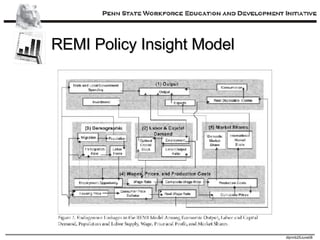
REMI Policy Insight Model
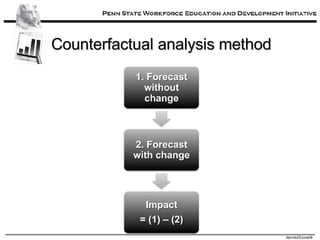
Counterfactual analysis method
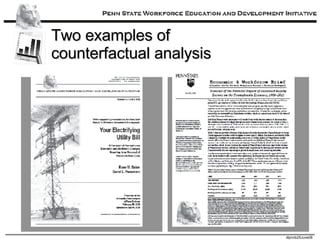
Two examples of  counterfactual analysis
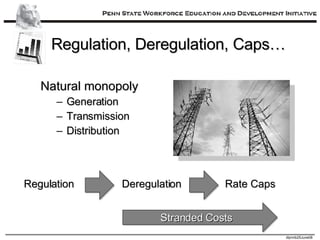
Regulation, Deregulation, Caps… Natural monopoly Generation Transmission Distribution Regulation  Deregulation Rate Caps Stranded Costs
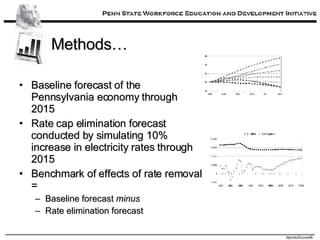
Methods… Baseline forecast of the Pennsylvania economy through 2015 Rate cap elimination forecast conducted by simulating 10% increase in electricity rates through 2015 Benchmark of effects of rate removal = Baseline forecast  minus Rate elimination forecast
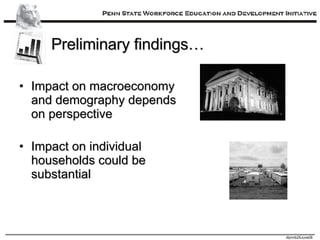
Preliminary findings… Impact on macroeconomy and demography depends on perspective  Impact on individual households could be substantial
Impact on macroeconomy and demography… Substantial, in terms of absolute numbers Small, as a % of total economy and demography
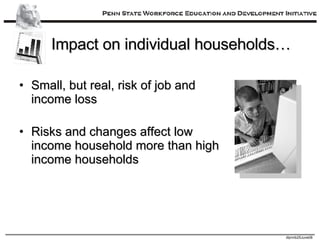
Impact on individual households… Small, but real, risk of job and income loss Risks and changes affect low income household more than high income households
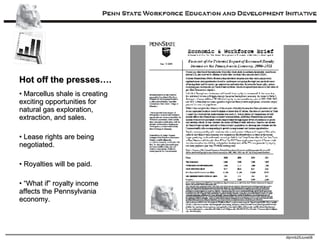
Hot off the presses…. •  Marcellus shale is creating exciting opportunities for natural gas exploration, extraction, and sales. •  Lease rights are being negotiated. •  Royalties will be paid. • “ What if” royalty income affects the Pennsylvania economy.
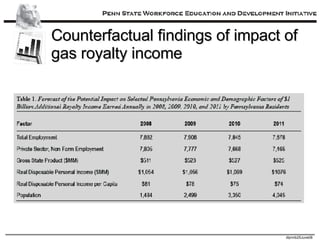
Counterfactual findings of impact of gas royalty income
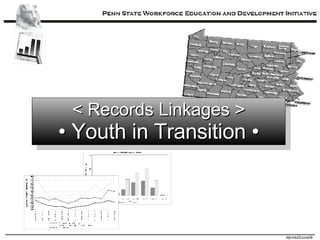
< Records Linkages > •  Youth in Transition •
How do we follow youth in transition from school to work?
Survey-based approaches with out–of–school youth Difficult to find. Difficult to maintain contact. Difficult to stimulate response. Difficult to obtain sensitive data elements.
One solution:  Link youth and unemployment insurance records Employers report quarterly wages by social security number to state unemployment insurance system. Social security numbers of youth and a vector of indicators can be merged with insurance records. Confidentiality is preserved by procedural security buffer as well as by statistical means.

Potential for learning  from records linkages Cross–sectional and longitudinal employment by industry. Cross–sectional and longitudinal wages by industry. Geography and geographic and industrial mobility of youth employment. Youth employment turnover by industry. Correlates of youth employment, wages, and mobility.
Some problems with  implementing records linkages Errors in records of youth or employer Social Security numbers Names Youth not necessarily in covered employment. Censored data Reporting period is 3 months Many transitions can occur within reporting period
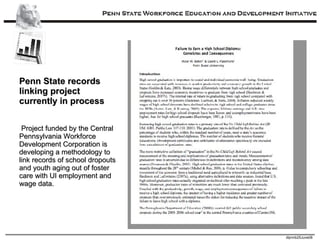
Penn State records linking project currently in process Project funded by the Central Pennsylvania Workforce Development Corporation is developing a methodology to link records of school dropouts and youth aging out of foster care with UI employment and wage data.
Cutting Edge Economic  Techniques for Assessing  Regional Innovations Rose M. Baker David L. Passmore

Cutting Edge Economic Techniques for Assessing Regional Innovations

  • 1.
    Cutting Edge Economic Techniques for Assessing Regional Innovations Rose M. Baker David L. Passmore
  • 2.
    Penn State WorkforceEducation & Development Initiative Rose Baker David Passmore Program Manager Workforce Assessment Center & Assistant Professor of Education Professor & Director Penn State Institute for Research in Training & Development
  • 3.
    Symposium presentation website http://innovationeval.notlong.com
  • 4.
    Reports are availableThrough links on web site: • Two Economic & Workforce Brief reports. • Electricity rate cap study. • Gas royalty impact study. • Links to reports about records linkage processes.
  • 5.
  • 6.
    < Input–Output Analysis> • Economic & Workforce Brief Series •
  • 7.
    The economy islike a ball of string < complex > < intertwined > < large > < unexpected >
  • 8.
    Way to organizedata < input-output tables > Summarize production & consumption.
  • 9.
    producer/purchaser data… ind1 ind 2 ind 3 ind 4 ind 1 ind 2 ind 3 ind 4 final demand total output producers purchasers
  • 10.
    Producing & purchasingmultiplies… ind 1 ind 2 ind 3 ind 4 ind 1 ind 2 ind 3 ind 4 final demand total output
  • 11.
    Multipliers Economic impactof change in final demand. Calculated for output, income, employment, taxes, and other factors. Show total effects of change on economy. Expressed as a positive number.
  • 12.
    Multipliers display three components of change Direct. Indirect. Induced.
  • 13.
    Direct effects Changesin production as a result of immediate effects of a change in final demand. E.g., increase in demand for autos increases production of autos.
  • 14.
    Indirect effects Changesin production in industries supplying industry delivering the final product. E.g., increase in auto production increases production in supplying industries (like glass, steel, plastics).
  • 15.
    Induced effects Changesin direct and indirect production increase income and, therefore, consumption (and, maybe saving). E.g., workers in auto industry and supplying industries spend and save their income, creating additional economic activity.
  • 16.
    Two types ofmultipliers Type 1 = Type 2 =
  • 17.
    Two examples of input-output analysis Economic & Workforce Brief Series
  • 18.
    < Counterfactual Analysis> • Electricity Rate Caps • • Gas Royalties •
  • 19.
    A counterfactual analysisis… An analysis that goes counter to facts. What would happen if the U.S. invaded Iran? What would have happened if the U.S. did not go to war with Iraq? What would happen if gas prices rose to $6/gal. A “what if” analysis. Counterfactual reasoning reveals implications of counterfactual suppositions to be examined in case what is supposed actually happens.
  • 20.
  • 21.
  • 22.
    Two examples of counterfactual analysis
  • 23.
    Regulation, Deregulation, Caps…Natural monopoly Generation Transmission Distribution Regulation Deregulation Rate Caps Stranded Costs
  • 24.
    Methods… Baseline forecastof the Pennsylvania economy through 2015 Rate cap elimination forecast conducted by simulating 10% increase in electricity rates through 2015 Benchmark of effects of rate removal = Baseline forecast minus Rate elimination forecast
  • 25.
    Preliminary findings… Impacton macroeconomy and demography depends on perspective Impact on individual households could be substantial
  • 26.
    Impact on macroeconomyand demography… Substantial, in terms of absolute numbers Small, as a % of total economy and demography
  • 27.
    Impact on individualhouseholds… Small, but real, risk of job and income loss Risks and changes affect low income household more than high income households
  • 28.
    Hot off thepresses…. • Marcellus shale is creating exciting opportunities for natural gas exploration, extraction, and sales. • Lease rights are being negotiated. • Royalties will be paid. • “ What if” royalty income affects the Pennsylvania economy.
  • 29.
    Counterfactual findings ofimpact of gas royalty income
  • 30.
    < Records Linkages> • Youth in Transition •
  • 31.
    How do wefollow youth in transition from school to work?
  • 32.
    Survey-based approaches without–of–school youth Difficult to find. Difficult to maintain contact. Difficult to stimulate response. Difficult to obtain sensitive data elements.
  • 33.
    One solution: Link youth and unemployment insurance records Employers report quarterly wages by social security number to state unemployment insurance system. Social security numbers of youth and a vector of indicators can be merged with insurance records. Confidentiality is preserved by procedural security buffer as well as by statistical means.
  • 34.
    Potential for learning from records linkages Cross–sectional and longitudinal employment by industry. Cross–sectional and longitudinal wages by industry. Geography and geographic and industrial mobility of youth employment. Youth employment turnover by industry. Correlates of youth employment, wages, and mobility.
  • 35.
    Some problems with implementing records linkages Errors in records of youth or employer Social Security numbers Names Youth not necessarily in covered employment. Censored data Reporting period is 3 months Many transitions can occur within reporting period
  • 36.
    Penn State recordslinking project currently in process Project funded by the Central Pennsylvania Workforce Development Corporation is developing a methodology to link records of school dropouts and youth aging out of foster care with UI employment and wage data.
  • 37.
    Cutting Edge Economic Techniques for Assessing Regional Innovations Rose M. Baker David L. Passmore