CXO Advisor
Advise – Innovate – Change

Agile Readiness Assessment
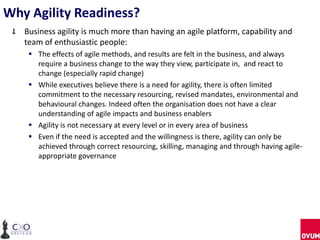
Why Agility Readiness?
Business agility is much more than having an agile platform, capability and
team of enthusiastic people:
 The effects of agile methods, and results are felt in the business, and always
require a business change to the way they view, participate in, and react to
change (especially rapid change)
 While executives believe there is a need for agility, there is often limited
commitment to the necessary resourcing, revised mandates, environmental and
behavioural changes. Indeed often the organisation does not have a clear
understanding of agile impacts and business enablers
 Agility is not necessary at every level or in every area of business
 Even if the need is accepted and the willingness is there, agility can only be
achieved through correct resourcing, skilling, managing and through having agileappropriate governance
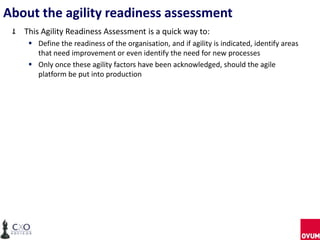
About the agility readiness assessment
This Agility Readiness Assessment is a quick way to:
 Define the readiness of the organisation, and if agility is indicated, identify areas
that need improvement or even identify the need for new processes
 Only once these agility factors have been acknowledged, should the agile
platform be put into production
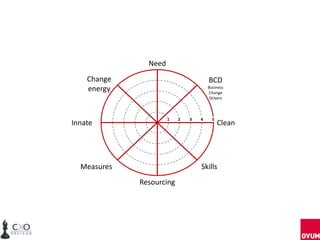
Factors to establish Agile readiness
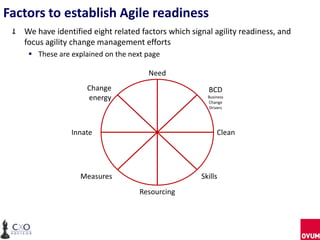
We have identified eight related factors which signal agility readiness, and
focus agility change management efforts
 These are explained on the next page
Need
Change
energy

BCD
Business
Change
Drivers

Innate

Clean

Measures

Skills
Resourcing
Agility Readiness Factors
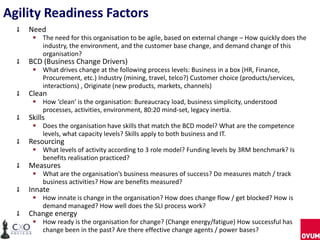
Need

 The need for this organisation to be agile, based on external change – How quickly does the
industry, the environment, and the customer base change, and demand change of this
organisation?

BCD (Business Change Drivers)

 What drives change at the following process levels: Business in a box (HR, Finance,
Procurement, etc.) Industry (mining, travel, telco?) Customer choice (products/services,
interactions) , Originate (new products, markets, channels)

Clean

 How ‘clean’ is the organisation: Bureaucracy load, business simplicity, understood
processes, activities, environment, 80:20 mind-set, legacy inertia.

Skills

 Does the organisation have skills that match the BCD model? What are the competence
levels, what capacity levels? Skills apply to both business and IT.

Resourcing

 What levels of activity according to 3 role model? Funding levels by 3RM benchmark? Is
benefits realisation practiced?

Measures

 What are the organisation’s business measures of success? Do measures match / track
business activities? How are benefits measured?

Innate

 How innate is change in the organisation? How does change flow / get blocked? How is
demand managed? How well does the SLI process work?

Change energy

 How ready is the organisation for change? (Change energy/fatigue) How successful has
change been in the past? Are there effective change agents / power bases?
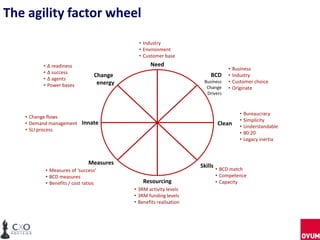
The agility factor wheel
• Industry
• Environment
• Customer base

•
•
•
•

∆ readiness
∆ success
∆ agents
Power bases

Need
BCD

Change
energy

Business
Change
Drivers

• Change flows
• Demand management Innate
• SLI process

Clean

Measures
• Measures of ‘success’
• BCD measures
• Benefits / cost ratios

•
•
•
•

Skills
Resourcing
• 3RM activity levels
• 3RM funding levels
• Benefits realisation

Business
Industry
Customer choice
Originate

•
•
•
•
•

Bureaucracy
Simplicity
Understandable
80:20
Legacy inertia

• BCD match
• Competence
• Capacity
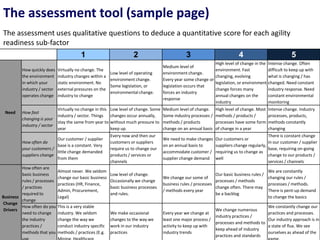
The assessment tool (sample page)
The assessment uses qualitative questions to deduce a quantitative score for each agility
readiness sub-factor
1

2

3

4

5

High level of change in the Intense change. Often
environment. Fast
difficult to keep up with
changing, evolving
what is changing / has
legislation, or environment changed. Need constant
change forces many
industry response. Need
annual changes on the
constant environmental
industry
monitoring

How quickly does
the environment
in which your
industry / sector
operates change

Need

Virtually no change. The
industry changes within a
static environment. No
external pressures on the
industry to change

Low level of operating
environment change.
Some legislation, or
environmental change.

Medium level of
environment change.
Every year some change or
legislation occurs that
forces an industry
response

How fast
changing is your
industry / sector

Virtually no change in this
industry / sector. Things
stay the same from year to
year

Low level of change. Some
changes occur annually,
without much pressure to
keep up.

Medium level of change.
Some industry processes /
methods / products
change on an annual basis

High level of change. Most
methods / products /
processes have some form
of change in a year

Every now and then our
customers or suppliers
require us to change our
products / services or
channels

We need to make changes
on an annual basis to
accommodate customer /
supplier change demand

There is constant change
Our customers or
in our customer / supplier
suppliers change regularly,
base, requiring on-going
requiring us to change as
change to our products /
well
services / channels

Low level of change.
Occasionally we change
basic business processes
and rules.

We are constantly
Our basic business rules /
changing our rules /
We change our some of
processes / methods
business rules / processes
processes / methods.
change often. There may
/ methods every year
There is pent-up demand
be a backlog
to change the basics

We make occasional
changes to the way we
work in our industry
practices

Every year we change at
least one major process /
activity to keep up with
industry trends

Our customer / supplier
How often do
base is a constant. Very
your customers /
little change demanded
suppliers change
from them
How often are
basic business
rules / processes
/ practices
required to
Business
change
Change
How often do you
Drivers
need to change
the industry
practices /
methods that you

Almost never. We seldom
change our basic business
practices (HR, Finance,
Admin, Procurement,
Legal)
This is a very stable
industry. We seldom
change the way we
conduct industry specific
methods / practices (E.g.

We change numerous
industry practices /
processes and methods to
keep ahead of industry
practices and standards

Intense change. Industry
processes, products,
methods constantly
changing

We constantly change our
practices and processes.
Our industry approach is in
a state of flux. We see
ourselves as ahead of the
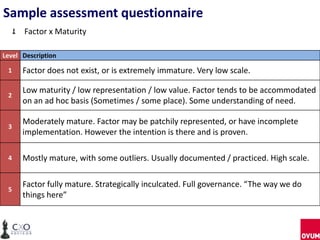
Sample assessment questionnaire
Factor x Maturity
Level Description
1

Factor does not exist, or is extremely immature. Very low scale.

2

Low maturity / low representation / low value. Factor tends to be accommodated
on an ad hoc basis (Sometimes / some place). Some understanding of need.

3

Moderately mature. Factor may be patchily represented, or have incomplete
implementation. However the intention is there and is proven.

4

Mostly mature, with some outliers. Usually documented / practiced. High scale.

5

Factor fully mature. Strategically inculcated. Full governance. “The way we do
things here”
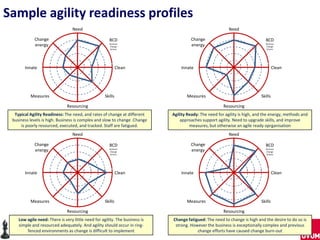
Sample agility readiness profiles
Need

Need

Change
energy

BCD
Business
Change
Drivers

1

Innate

2

3

Measures

4

5

Clean

Skills

Change
energy

Business
Change
Drivers

1

Innate

2

3

Measures

Resourcing

4

5

Clean

Skills
Resourcing

Typical Agility Readiness: The need, and rates of change at different
business levels is high. Business is complex and slow to change .Change
is poorly resourced, executed, and tracked. Staff are fatigued.

Agility Ready: The need for agility is high, and the energy, methods and
approaches support agility. Need to upgrade skills, and improve
measures, but otherwise an agile ready oprganisation

Need

Need

Change
energy

Innate

BCD

BCD
Business
Change
Drivers

1

Measures

2

3

4

5

Clean

Skills
Resourcing

Low agile need: There is very little need for agility. The business is
simple and resourced adequately. And agility should occur in ringfenced environments as change is difficult to implement

Change
energy

Innate

BCD
Business
Change
Drivers

1

Measures

2

3

4

5

Clean

Skills
Resourcing

Change fatigued: The need to change is high and the desire to do so is
strong. However the business is exceptionally complex and previous
change efforts have caused change burn-out
Need
Change
energy

Innate

BCD
Business
Change
Drivers

1

Measures

2

3

4

5

Clean

Skills
Resourcing

Customisable Agile readiness assessment

  • 1.
    CXO Advisor Advise –Innovate – Change Agile Readiness Assessment
  • 2.
    Why Agility Readiness? Businessagility is much more than having an agile platform, capability and team of enthusiastic people:  The effects of agile methods, and results are felt in the business, and always require a business change to the way they view, participate in, and react to change (especially rapid change)  While executives believe there is a need for agility, there is often limited commitment to the necessary resourcing, revised mandates, environmental and behavioural changes. Indeed often the organisation does not have a clear understanding of agile impacts and business enablers  Agility is not necessary at every level or in every area of business  Even if the need is accepted and the willingness is there, agility can only be achieved through correct resourcing, skilling, managing and through having agileappropriate governance
  • 3.
    About the agilityreadiness assessment This Agility Readiness Assessment is a quick way to:  Define the readiness of the organisation, and if agility is indicated, identify areas that need improvement or even identify the need for new processes  Only once these agility factors have been acknowledged, should the agile platform be put into production
  • 4.
    Factors to establishAgile readiness We have identified eight related factors which signal agility readiness, and focus agility change management efforts  These are explained on the next page Need Change energy BCD Business Change Drivers Innate Clean Measures Skills Resourcing
  • 5.
    Agility Readiness Factors Need The need for this organisation to be agile, based on external change – How quickly does the industry, the environment, and the customer base change, and demand change of this organisation? BCD (Business Change Drivers)  What drives change at the following process levels: Business in a box (HR, Finance, Procurement, etc.) Industry (mining, travel, telco?) Customer choice (products/services, interactions) , Originate (new products, markets, channels) Clean  How ‘clean’ is the organisation: Bureaucracy load, business simplicity, understood processes, activities, environment, 80:20 mind-set, legacy inertia. Skills  Does the organisation have skills that match the BCD model? What are the competence levels, what capacity levels? Skills apply to both business and IT. Resourcing  What levels of activity according to 3 role model? Funding levels by 3RM benchmark? Is benefits realisation practiced? Measures  What are the organisation’s business measures of success? Do measures match / track business activities? How are benefits measured? Innate  How innate is change in the organisation? How does change flow / get blocked? How is demand managed? How well does the SLI process work? Change energy  How ready is the organisation for change? (Change energy/fatigue) How successful has change been in the past? Are there effective change agents / power bases?
  • 6.
    The agility factorwheel • Industry • Environment • Customer base • • • • ∆ readiness ∆ success ∆ agents Power bases Need BCD Change energy Business Change Drivers • Change flows • Demand management Innate • SLI process Clean Measures • Measures of ‘success’ • BCD measures • Benefits / cost ratios • • • • Skills Resourcing • 3RM activity levels • 3RM funding levels • Benefits realisation Business Industry Customer choice Originate • • • • • Bureaucracy Simplicity Understandable 80:20 Legacy inertia • BCD match • Competence • Capacity
  • 7.
    The assessment tool(sample page) The assessment uses qualitative questions to deduce a quantitative score for each agility readiness sub-factor 1 2 3 4 5 High level of change in the Intense change. Often environment. Fast difficult to keep up with changing, evolving what is changing / has legislation, or environment changed. Need constant change forces many industry response. Need annual changes on the constant environmental industry monitoring How quickly does the environment in which your industry / sector operates change Need Virtually no change. The industry changes within a static environment. No external pressures on the industry to change Low level of operating environment change. Some legislation, or environmental change. Medium level of environment change. Every year some change or legislation occurs that forces an industry response How fast changing is your industry / sector Virtually no change in this industry / sector. Things stay the same from year to year Low level of change. Some changes occur annually, without much pressure to keep up. Medium level of change. Some industry processes / methods / products change on an annual basis High level of change. Most methods / products / processes have some form of change in a year Every now and then our customers or suppliers require us to change our products / services or channels We need to make changes on an annual basis to accommodate customer / supplier change demand There is constant change Our customers or in our customer / supplier suppliers change regularly, base, requiring on-going requiring us to change as change to our products / well services / channels Low level of change. Occasionally we change basic business processes and rules. We are constantly Our basic business rules / changing our rules / We change our some of processes / methods business rules / processes processes / methods. change often. There may / methods every year There is pent-up demand be a backlog to change the basics We make occasional changes to the way we work in our industry practices Every year we change at least one major process / activity to keep up with industry trends Our customer / supplier How often do base is a constant. Very your customers / little change demanded suppliers change from them How often are basic business rules / processes / practices required to Business change Change How often do you Drivers need to change the industry practices / methods that you Almost never. We seldom change our basic business practices (HR, Finance, Admin, Procurement, Legal) This is a very stable industry. We seldom change the way we conduct industry specific methods / practices (E.g. We change numerous industry practices / processes and methods to keep ahead of industry practices and standards Intense change. Industry processes, products, methods constantly changing We constantly change our practices and processes. Our industry approach is in a state of flux. We see ourselves as ahead of the
  • 8.
    Sample assessment questionnaire Factorx Maturity Level Description 1 Factor does not exist, or is extremely immature. Very low scale. 2 Low maturity / low representation / low value. Factor tends to be accommodated on an ad hoc basis (Sometimes / some place). Some understanding of need. 3 Moderately mature. Factor may be patchily represented, or have incomplete implementation. However the intention is there and is proven. 4 Mostly mature, with some outliers. Usually documented / practiced. High scale. 5 Factor fully mature. Strategically inculcated. Full governance. “The way we do things here”
  • 9.
    Sample agility readinessprofiles Need Need Change energy BCD Business Change Drivers 1 Innate 2 3 Measures 4 5 Clean Skills Change energy Business Change Drivers 1 Innate 2 3 Measures Resourcing 4 5 Clean Skills Resourcing Typical Agility Readiness: The need, and rates of change at different business levels is high. Business is complex and slow to change .Change is poorly resourced, executed, and tracked. Staff are fatigued. Agility Ready: The need for agility is high, and the energy, methods and approaches support agility. Need to upgrade skills, and improve measures, but otherwise an agile ready oprganisation Need Need Change energy Innate BCD BCD Business Change Drivers 1 Measures 2 3 4 5 Clean Skills Resourcing Low agile need: There is very little need for agility. The business is simple and resourced adequately. And agility should occur in ringfenced environments as change is difficult to implement Change energy Innate BCD Business Change Drivers 1 Measures 2 3 4 5 Clean Skills Resourcing Change fatigued: The need to change is high and the desire to do so is strong. However the business is exceptionally complex and previous change efforts have caused change burn-out
  • 11.