



User story points
Why we estimate?
Why story points NOT hours?
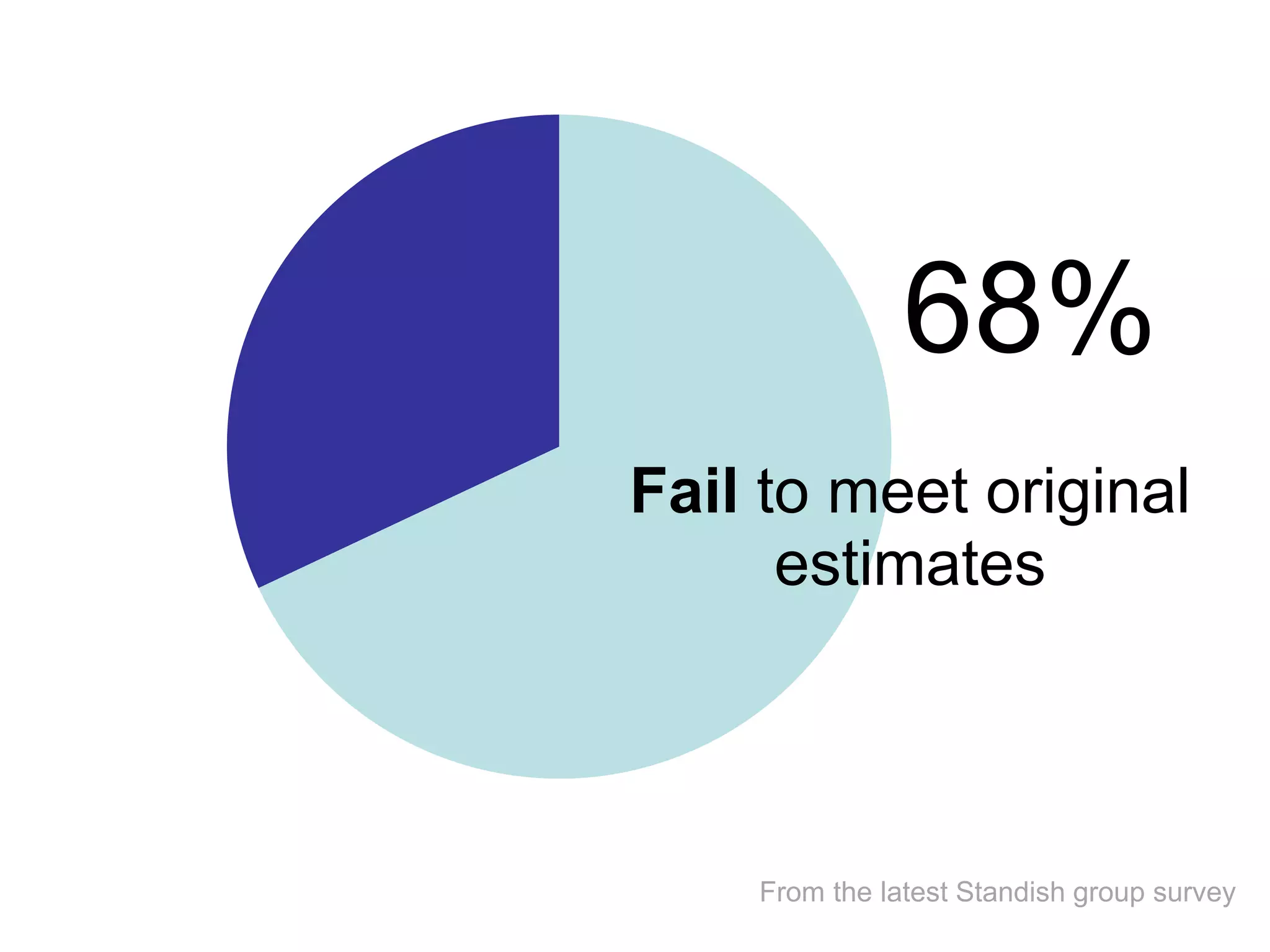
From the latest Standish group survey
68%
Fail to meet original
estimates
We are not good at estimation
Acceptable number
Project is too big
Deception: best/worst case
And also…
Software projects are complex
maintainability
testability
scalability
security
changing requirements
Hours estimation is not good enough
Why story points?
More accurate
Comparing size
11
Less variation
Stable reference stories
13
14
15
70 minutes 30 minutes
VS
Office to People square
140 minutes 60 minutes
Office to the bund
Difference
40 minutes
80 minutes
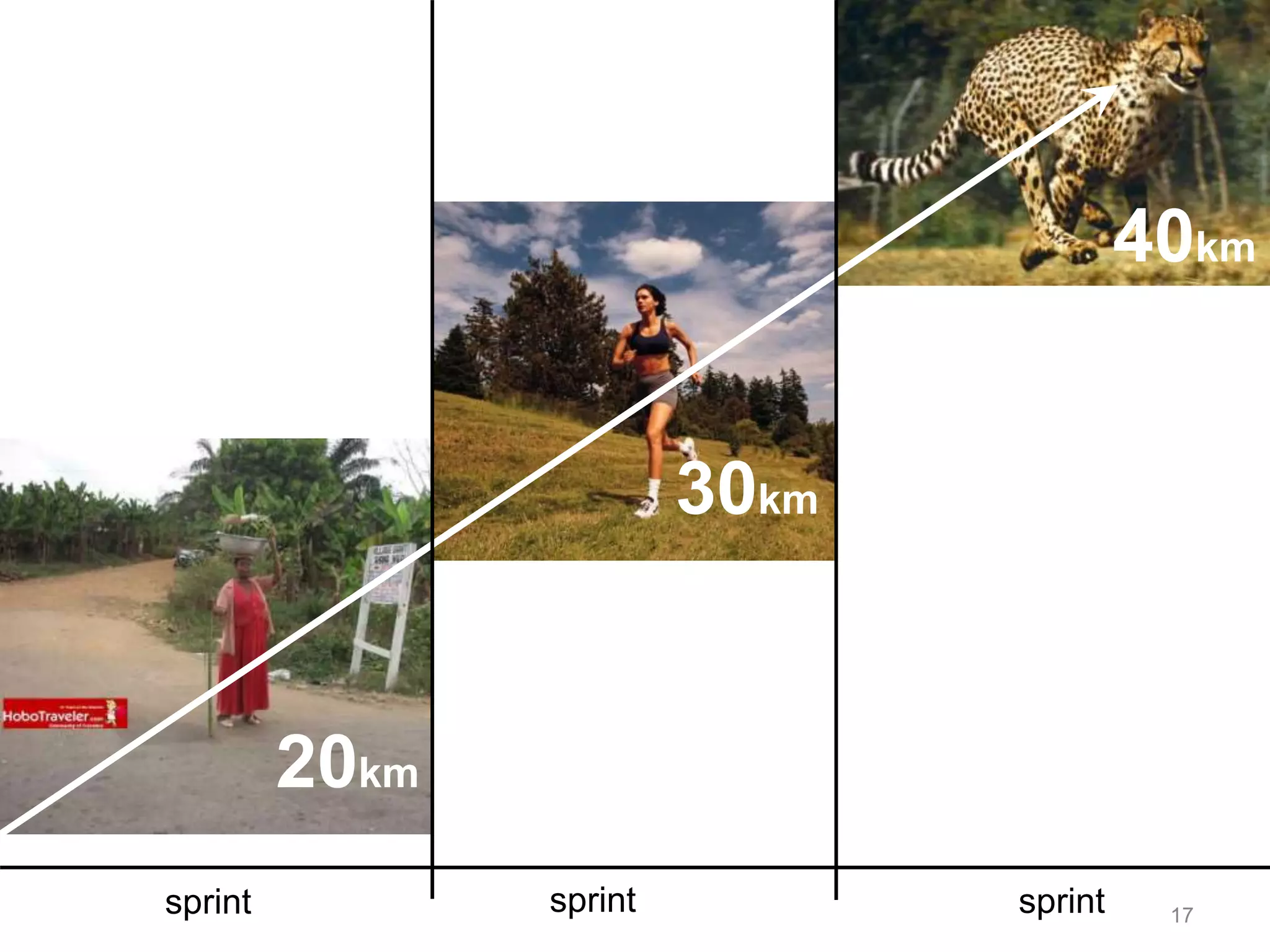
Continuous improvement
17
20km
30km
40km
sprint sprint sprint
Release planning
Velocity
Start using story point?
1 dimension: Effort
2 baseline user stories
“2” & “5”
Compare size to
baseline stories
From start to “Done”
Improve estimation
Inspect & Adaptive
Key take away
• Estimation is a skill. It requires practice
• Baseline stories need to be understood & accepted by all team
members
• Baseline stories should not changed from sprint to sprint till you (the
team) are too fast
• Make comparison based on effort, not complexity, not business value,
etc. 1 thing in a time
24
Try:
estimation exercise
Try:
decide 2 baseline user stories
with your team
26
Thank you!
27

story points v2

Editor's Notes

  • #3 Cost, when, planning, how many feature we can do Estimation is an activity of the right brain: (the right brain being known for emotions and imagination, and ideas about the future and the unknown)
  • #5 About The Standish Group International, Inc. Since 1985 The Standish Group, the leader in spotting future trends, has been helping end users and vendors of technology solutions prepare for the future. The Standish Group delivers fast, consistent and reliable IT advice built on a solid foundation of primary research. For further information on project studies and other trends, visit our website at: www.standishgroup.com.
  • #6 Not that developers are being intentionally deceptive, but we have a tendency to estimate the best case or what we think is the worst case.   No matter how honest a developer tries to be in giving an hours estimate, there is always a tendency for the thought to lodge in the back of his mind that they have to give a number of hours that is acceptable rather than the number of hours he actually thinks the work is going to take.   In addition, especially in the beginning of the project or in the estimation process, the tasks are so large that most just throw a rock in the general direction and call it good because there's no way they can get enough detail to respond with an estimate in time to be considered unless they do. Take longer time to explain what we are not good in hour estimation http://checkedexception.blogspot.com/2011/08/why-story-points-are-more-accurate.html
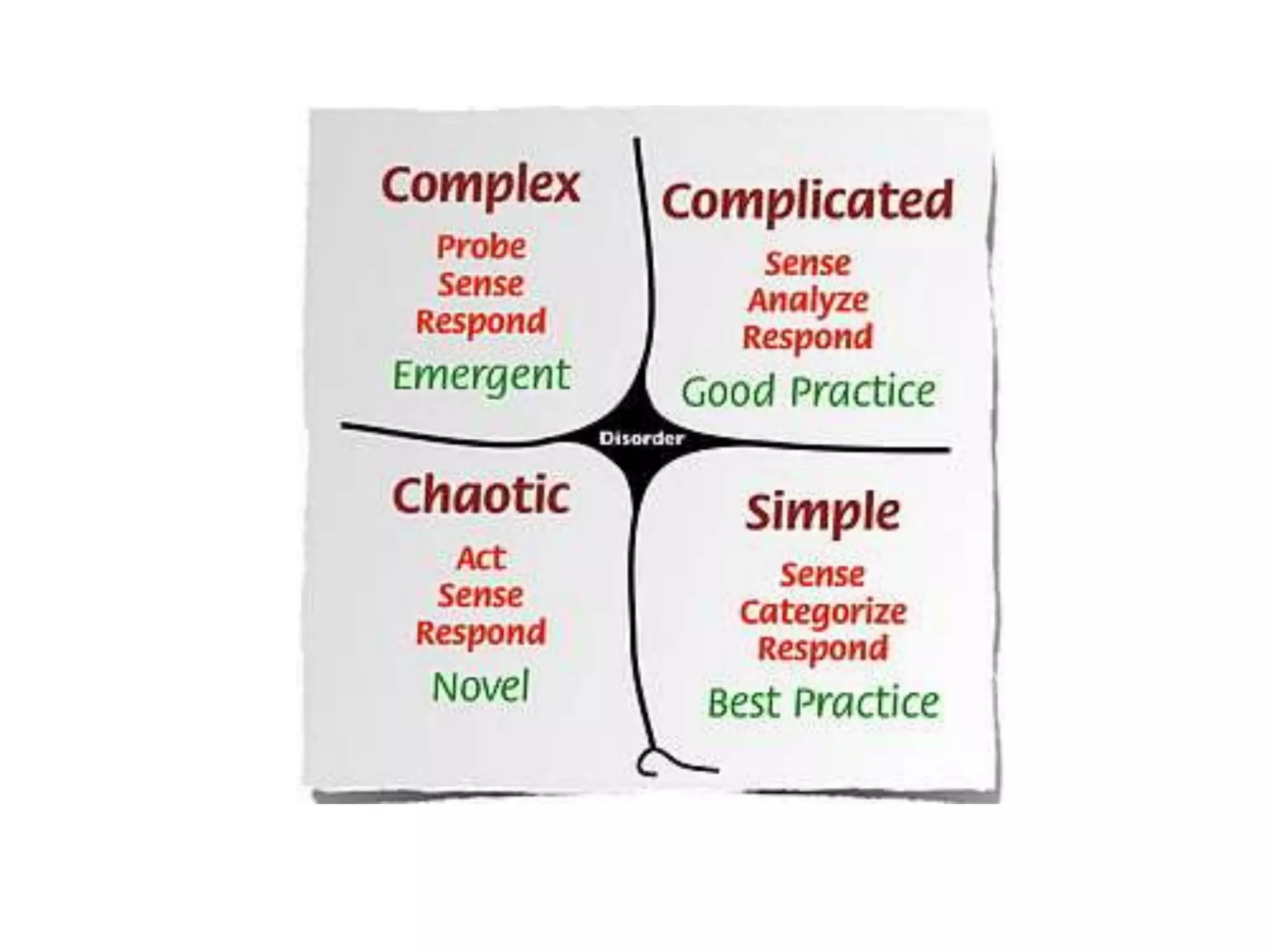
  • #7 Example: how long time it will take to go home? I can travel up and down the same street for twenty years, and things would be different every time. There is no way to fully understand and know what happens around me on the road when I drive, how other drivers operate their vehicles, and how the people in the streets interact. I can make guesses, and I can gain experience in predicting outcomes. But I will never know for sure. http://www.noop.nl/2008/08/simple-vs-complicated-vs-complex-vs-chaotic.html
  • #8 My car key is simple. My car is complicated. Car traffic is complex. Car traffic in Hanoi is chaotic. The Cynefin (pronounced /ˈkʌnɨvɪn/) framework in which the relationship between cause and effect http://en.wikipedia.org/wiki/Cynefin
  • #10 Writing a quality software is a very complex process. It must not only meet all the functional requirements, but also should address non-functional requirements like robustness, responsiveness, maintainability, testability, scalability, security, supportability, monitorability, and disaster recoverability to satisfy not only the immediate business needs, but also flexible enough to adapt to growing and changing business needs. Anyone who has been in the software industry for a while will vouch for how quickly the business priorities can change. They also strongly understand that the following aspects need to be properly thought through from the beginning of a software project.
  • #11 First, estimate related number is more accurate than estimate the absolute number
  • #12 How long it will take to get to Grand cinema How long it will take to get to People square
  • #13 Secondly, Not only about accuracy there is a huge variation in effort needed to complete a task depending on who is doing it. This factor remains whether you do story points or whatever other estimation technique. http://labs.openviewpartners.com/scrum-why-story-points-are-better-than-hours/
  • #17 Thirdly, relating hours to story points causes a huge impediment for the team. If the team in generating continuous process improvement, the hours per story point will be continually decreasing. Assuming a number of hours per story point makes it impossible for the team to show they have improved and fixes in their mind that there is a reasonable number of hours per story point. http://scrum.jeffsutherland.com/2010/04/story-points-why-are-they-better-than.html
  • #19 Fourthly, The number of story points the team can deliver per unit of calendar time
  • #21 Business value? Complexity?
  • #22 Every one, solid understanding on what need to do for the baseline user stories from scratch to “done”