Practical Estimation
Techniques in Agile!
© Benzne. All Rights Reserved.
© Benzne. All rights reserved
AGILE
DEVOPS
AI
DESIGN
THINKING
CULTURE
LEAN
KANBAN
VISUALIZATION
ITSM
CI/CD
SCRUM
SAFE
XP
CLOUD
ANALYTICS
MINDSET
PEOPLE
PROCESS
TECHNOLOGY
DATA
Sudha Madhuri
18+ years of global experience as a
Project/Program management
Trainer
4 years as an Agile coach & a Trainer
© Benzne. All Rights Reserved.
Agenda
● What is agile estimation
● Relative versus absolute estimation
● Various techniques of estimation
● Short introduction to Planning poker technique
● Estimate in Story points  or ideal days?
● When not to re-estimate?
● Common challenges while estimating
● QnA
© Benzne. All rights reserved
What?
• The effort needed to carry out a given task
Why?
• Allows teams make longer term predictions
• Coordinate dependencies and work
• Align priorities and decide on high-value options
• Enables shared understanding through discussions and engagement
When?
• Portfolio backlog planning
• Product backlog refinement
• Sprint Planning
What is Agile Estimation – The three ‘W’s
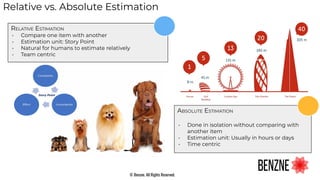
Relative vs. Absolute Estimation
© Benzne. All Rights Reserved.
RELATIVE ESTIMATION
• Compare one item with another
• Estimation unit: Story Point
• Natural for humans to estimate relatively
• Team centric
ABSOLUTE ESTIMATION
• Done in isolation without comparing with
another item
• Estimation unit: Usually in hours or days
• Time centric
© Benzne. All Rights Reserved.
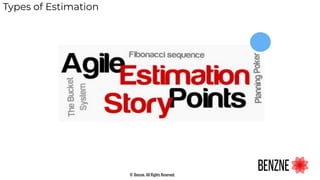
Types of Estimation
© Benzne. All Rights Reserved.
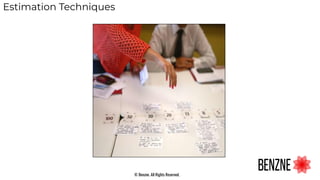
Estimation Techniques
Simplification of the bucket
system.
Especially good in smaller groups
with comparable items
Affinity Mapping
Poker Planning
Big / Uncertain / Small
© Benzne. All Rights Reserved.
Participants use numbered playing
cards to estimate the items – voting
driven.
Works well estimating relatively small
number of items, in small teams
Visibility when teams use different
processes?
How do we manage status?
Based on similarities in estimated items.
Best way is to execute this is a visual way and
order them form small groups to large.
Best with small group of people and relatively
small number of items.
Analogy
.
Compare item with estimated story
Informal, quick way to get feel for
backlog size  
Works well estimating large item
backlogs
Ideal when several concurrent teams
work on the same product.
Items are estimated into t-shirt sizes
Size decided through open, mutual,
collaborative discussions
T-Shirt Sizes
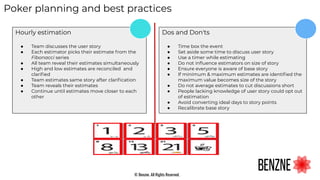
Poker planning and best practices
© Benzne. All Rights Reserved.
Hourly estimation
● Team discusses the user story
● Each estimator picks their estimate from the
Fibonacci series
● All team reveal their estimates simultaneously
● High and low estimates are reconciled  and
clarified
● Team estimates same story after clarification
● Team reveals their estimates
● Continue until estimates move closer to each
other
Dos and Don'ts
● Time box the event
● Set aside some time to discuss user story
● Use a timer while estimating
● Do not influence estimators on size of story
● Ensure everyone is aware of base story
● If minimum & maximum estimates are identified the
maximum value becomes size of the story 
● Do not average estimates to cut discussions short
● People lacking knowledge of user story could opt out
of estimation
● Avoid converting ideal days to story points
● Recalibrate base story
Hourly estimation
● Time to complete a task varies with an individual
● Sometimes tied to performance, leading to
inaccuracy
● Everything needs to be identified upfront when
estimating 
● Estimates tend to decay
● False sense of accuracy from poor predictability rates
© Benzne. All Rights Reserved.
Hourly vs. Story point estimation
Story Point Estimation
● Rewarding as teams focus on value derived not time
spent
● Story points perfect for high level estimation
● Tends to account for dependencies and uncertainties
● Estimates can be provided by anyone irrespective of
competencies
● Faster, more transparent, provides psychological safety
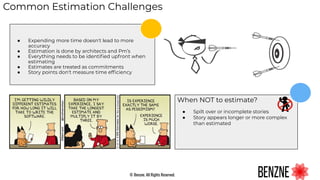
Common Estimation Challenges
● Expending more time doesn't lead to more
accuracy
● Estimation is done by architects and Pm’s
● Everything needs to be identified upfront when
estimating 
● Estimates are treated as commitments
● Story points don't measure time efficiency
When NOT to estimate?
● Spilt over or incomplete stories 
● Story appears longer or more complex
than estimated
© Benzne. All Rights Reserved.
‘Questions’
We might help you :)
© Benzne. All Rights Reserved.
© Benzne. All rights reserved
Thanks for
Listening!
Benzne
BenzneAgile
BenzneAgile
Stay Connected
© Benzne. All rights reserved
THANKS!
www.Benzne.com

Practical estimation techniques

  • 2.
    Practical Estimation Techniques inAgile! © Benzne. All Rights Reserved.
  • 3.
    © Benzne. Allrights reserved AGILE DEVOPS AI DESIGN THINKING CULTURE LEAN KANBAN VISUALIZATION ITSM CI/CD SCRUM SAFE XP CLOUD ANALYTICS MINDSET PEOPLE PROCESS TECHNOLOGY DATA
  • 4.
    Sudha Madhuri 18+ yearsof global experience as a Project/Program management Trainer 4 years as an Agile coach & a Trainer © Benzne. All Rights Reserved.
  • 5.
    © Benzne. AllRights Reserved. Agenda ● What is agile estimation ● Relative versus absolute estimation ● Various techniques of estimation ● Short introduction to Planning poker technique ● Estimate in Story points  or ideal days? ● When not to re-estimate? ● Common challenges while estimating ● QnA
  • 6.
    © Benzne. Allrights reserved What? • The effort needed to carry out a given task Why? • Allows teams make longer term predictions • Coordinate dependencies and work • Align priorities and decide on high-value options • Enables shared understanding through discussions and engagement When? • Portfolio backlog planning • Product backlog refinement • Sprint Planning What is Agile Estimation – The three ‘W’s
  • 7.
    Relative vs. AbsoluteEstimation © Benzne. All Rights Reserved. RELATIVE ESTIMATION • Compare one item with another • Estimation unit: Story Point • Natural for humans to estimate relatively • Team centric ABSOLUTE ESTIMATION • Done in isolation without comparing with another item • Estimation unit: Usually in hours or days • Time centric
  • 8.
    © Benzne. AllRights Reserved. Types of Estimation
  • 9.
    © Benzne. AllRights Reserved. Estimation Techniques
  • 10.
    Simplification of thebucket system. Especially good in smaller groups with comparable items Affinity Mapping Poker Planning Big / Uncertain / Small © Benzne. All Rights Reserved. Participants use numbered playing cards to estimate the items – voting driven. Works well estimating relatively small number of items, in small teams Visibility when teams use different processes? How do we manage status? Based on similarities in estimated items. Best way is to execute this is a visual way and order them form small groups to large. Best with small group of people and relatively small number of items. Analogy . Compare item with estimated story Informal, quick way to get feel for backlog size   Works well estimating large item backlogs Ideal when several concurrent teams work on the same product. Items are estimated into t-shirt sizes Size decided through open, mutual, collaborative discussions T-Shirt Sizes
  • 11.
    Poker planning andbest practices © Benzne. All Rights Reserved. Hourly estimation ● Team discusses the user story ● Each estimator picks their estimate from the Fibonacci series ● All team reveal their estimates simultaneously ● High and low estimates are reconciled  and clarified ● Team estimates same story after clarification ● Team reveals their estimates ● Continue until estimates move closer to each other Dos and Don'ts ● Time box the event ● Set aside some time to discuss user story ● Use a timer while estimating ● Do not influence estimators on size of story ● Ensure everyone is aware of base story ● If minimum & maximum estimates are identified the maximum value becomes size of the story  ● Do not average estimates to cut discussions short ● People lacking knowledge of user story could opt out of estimation ● Avoid converting ideal days to story points ● Recalibrate base story
  • 12.
    Hourly estimation ● Timeto complete a task varies with an individual ● Sometimes tied to performance, leading to inaccuracy ● Everything needs to be identified upfront when estimating  ● Estimates tend to decay ● False sense of accuracy from poor predictability rates © Benzne. All Rights Reserved. Hourly vs. Story point estimation Story Point Estimation ● Rewarding as teams focus on value derived not time spent ● Story points perfect for high level estimation ● Tends to account for dependencies and uncertainties ● Estimates can be provided by anyone irrespective of competencies ● Faster, more transparent, provides psychological safety
  • 13.
    Common Estimation Challenges ●Expending more time doesn't lead to more accuracy ● Estimation is done by architects and Pm’s ● Everything needs to be identified upfront when estimating  ● Estimates are treated as commitments ● Story points don't measure time efficiency When NOT to estimate? ● Spilt over or incomplete stories  ● Story appears longer or more complex than estimated © Benzne. All Rights Reserved.
  • 14.
    ‘Questions’ We might helpyou :) © Benzne. All Rights Reserved.
  • 15.
    © Benzne. Allrights reserved Thanks for Listening! Benzne BenzneAgile BenzneAgile Stay Connected
  • 16.
    © Benzne. Allrights reserved THANKS! www.Benzne.com