
Customer Data Platform
Prasanna Hegde
Introduction
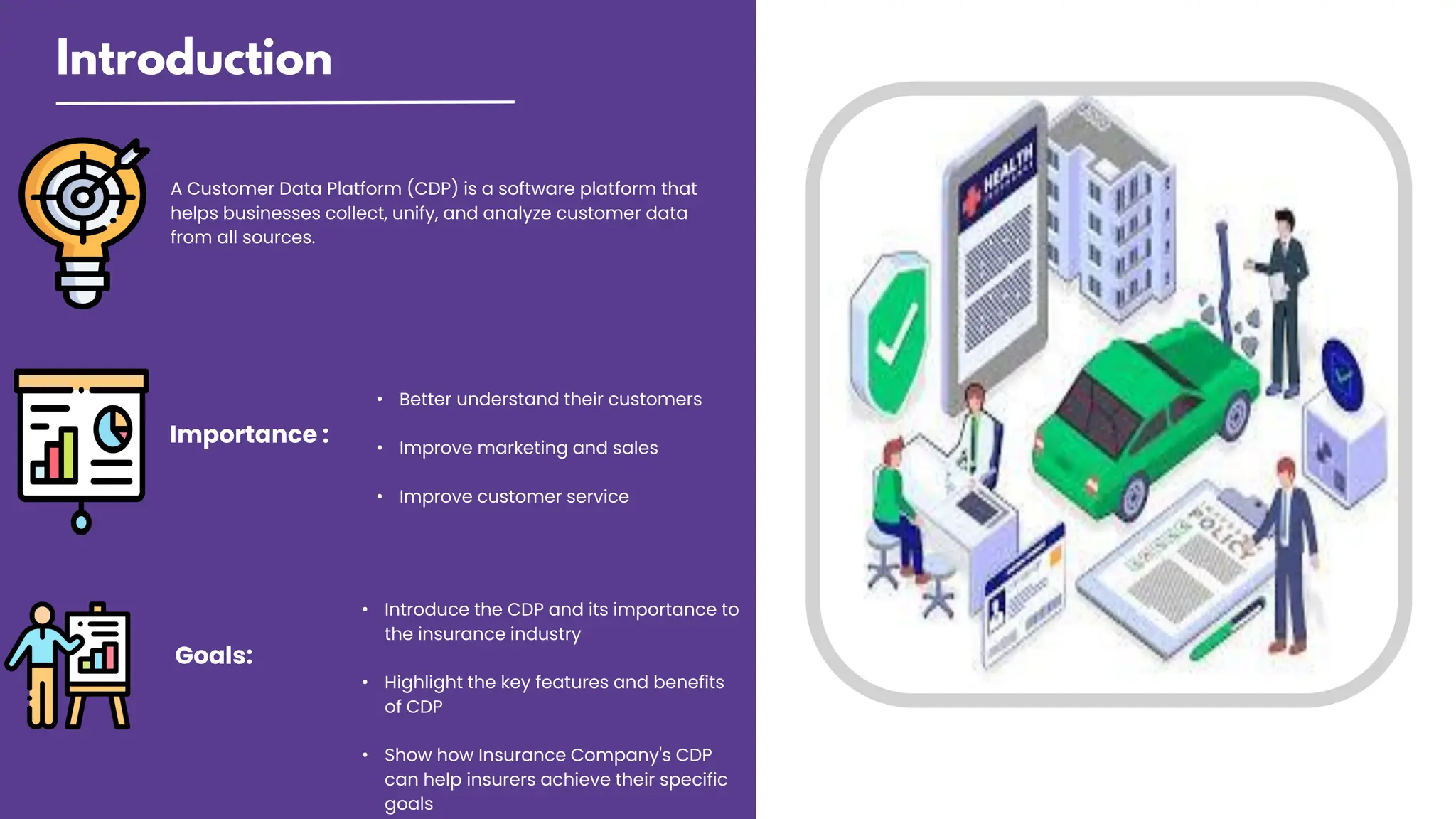
A Customer Data Platform (CDP) is a software platform that
helps businesses collect, unify, and analyze customer data
from all sources.
• Better understand their customers
• Improve marketing and sales
• Improve customer service
Importance :
Goals:
• Introduce the CDP and its importance to
the insurance industry
• Highlight the key features and benefits
of CDP
• Show how Insurance Company's CDP
can help insurers achieve their specific
goals
Insurance Company CDP: Why?
• Insurance companies need data to make better
decisions.
• A CDP helps insurance companies collect, unify, and
analyze customer data.
• This data can be used to improve marketing, sales, and
customer service.
Market Trends and Customer Needs
• Increased demand for personalized customer experiences
• Need to improve operational efficiency
• Growing importance of data-driven decision making
Background and Strategic fit
Insurance Company CDP: Alignment with
Strategy
Insurance Company's CDP will help insurance companies use data to improve their
businesses and deliver a better customer experience, aligning with Insurance
Company's mission and strategy of providing a unified, data-driven platform for all
insurance needs.
How the CDP can help insurers
• Personalize marketing and sales campaigns
• Improve customer service
• Reduce costs
• Develop new products and services
• Improve underwriting and risk selection
Specific Use Cases
Creating Better Insurance Products: The CDP
provides actionable data insights, enabling
insurers to tailor insurance products to specific
customer segments.
Quoting Competitive Premiums: Insurers can
make data-driven decisions on premium pricing,
backed by a comprehensive understanding of
customer risk profiles and market dynamics
Delivering Market-Leading Customer Experiences:
With a unified view of each customer, insurers can
offer personalized services, anticipate customer
needs, and resolve issues promptly.
Scope
How CDP Enhances Decision-Making
Real-time Customer Data: Access to live
customer data, including policies, claims,
and interactions, enhances decision-
making and customer engagement.
Data-Driven Product Development: The
CDP leverages customer insights for
creating tailored insurance products,
addressing market trends, and identifying
risks.
Competitive Premium Quoting: CDP
analytics ensures precise premium
pricing, boosting competitiveness and
accuracy.
Market-Leading Customer Experiences:
A unified view enables personalized
services, faster issue resolution, and
heightened customer satisfaction.
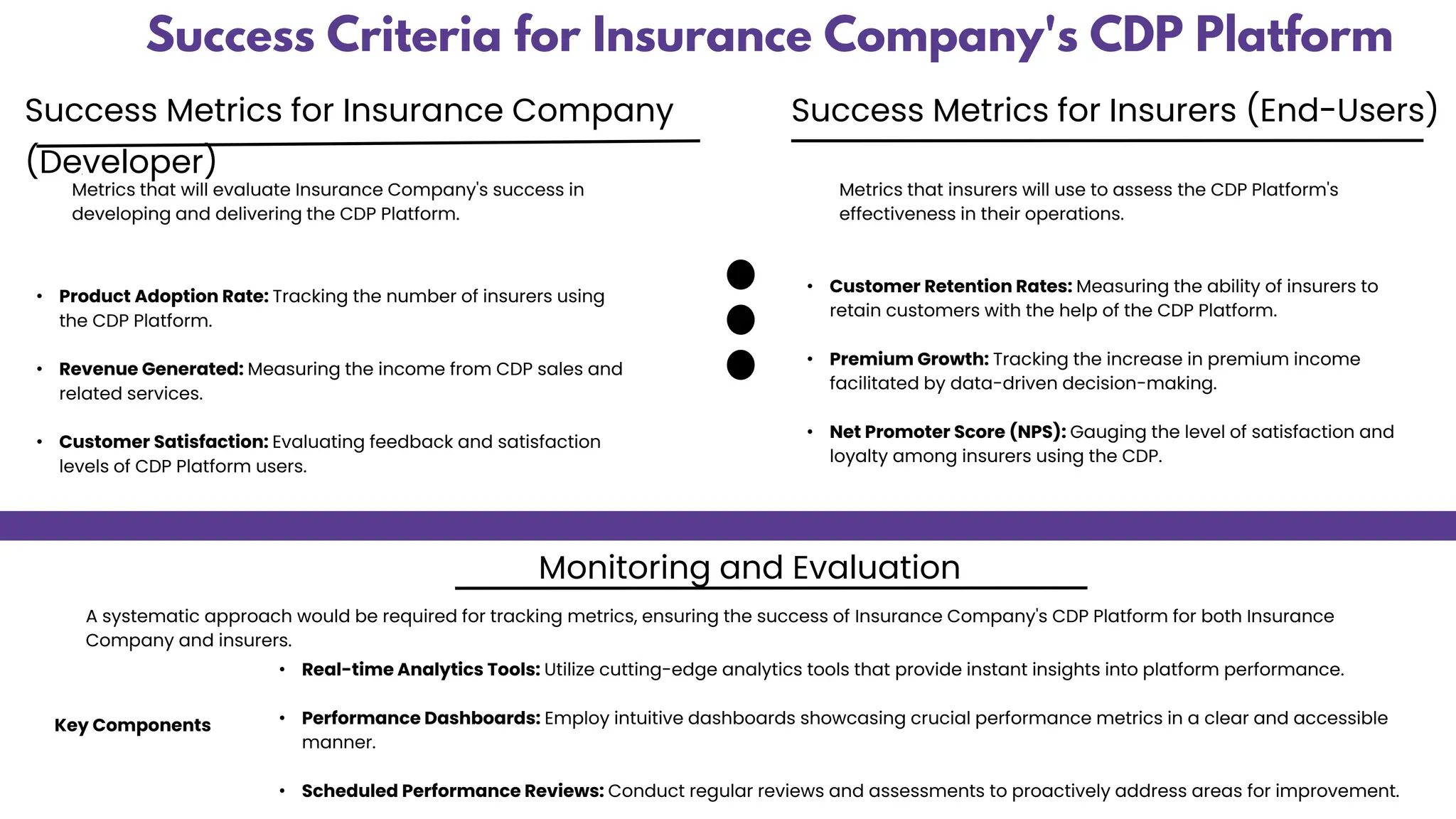
Success Metrics for Insurance Company
(Developer)
Metrics that will evaluate Insurance Company's success in
developing and delivering the CDP Platform.
• Product Adoption Rate: Tracking the number of insurers using
the CDP Platform.
• Revenue Generated: Measuring the income from CDP sales and
related services.
• Customer Satisfaction: Evaluating feedback and satisfaction
levels of CDP Platform users.
A systematic approach would be required for tracking metrics, ensuring the success of Insurance Company's CDP Platform for both Insurance
Company and insurers.
Success Criteria for Insurance Company's CDP Platform
Success Metrics for Insurers (End-Users)
Metrics that insurers will use to assess the CDP Platform's
effectiveness in their operations.
• Customer Retention Rates: Measuring the ability of insurers to
retain customers with the help of the CDP Platform.
• Premium Growth: Tracking the increase in premium income
facilitated by data-driven decision-making.
• Net Promoter Score (NPS): Gauging the level of satisfaction and
loyalty among insurers using the CDP.
Monitoring and Evaluation
• Real-time Analytics Tools: Utilize cutting-edge analytics tools that provide instant insights into platform performance.
• Performance Dashboards: Employ intuitive dashboards showcasing crucial performance metrics in a clear and accessible
manner.
• Scheduled Performance Reviews: Conduct regular reviews and assessments to proactively address areas for improvement.
Key Components
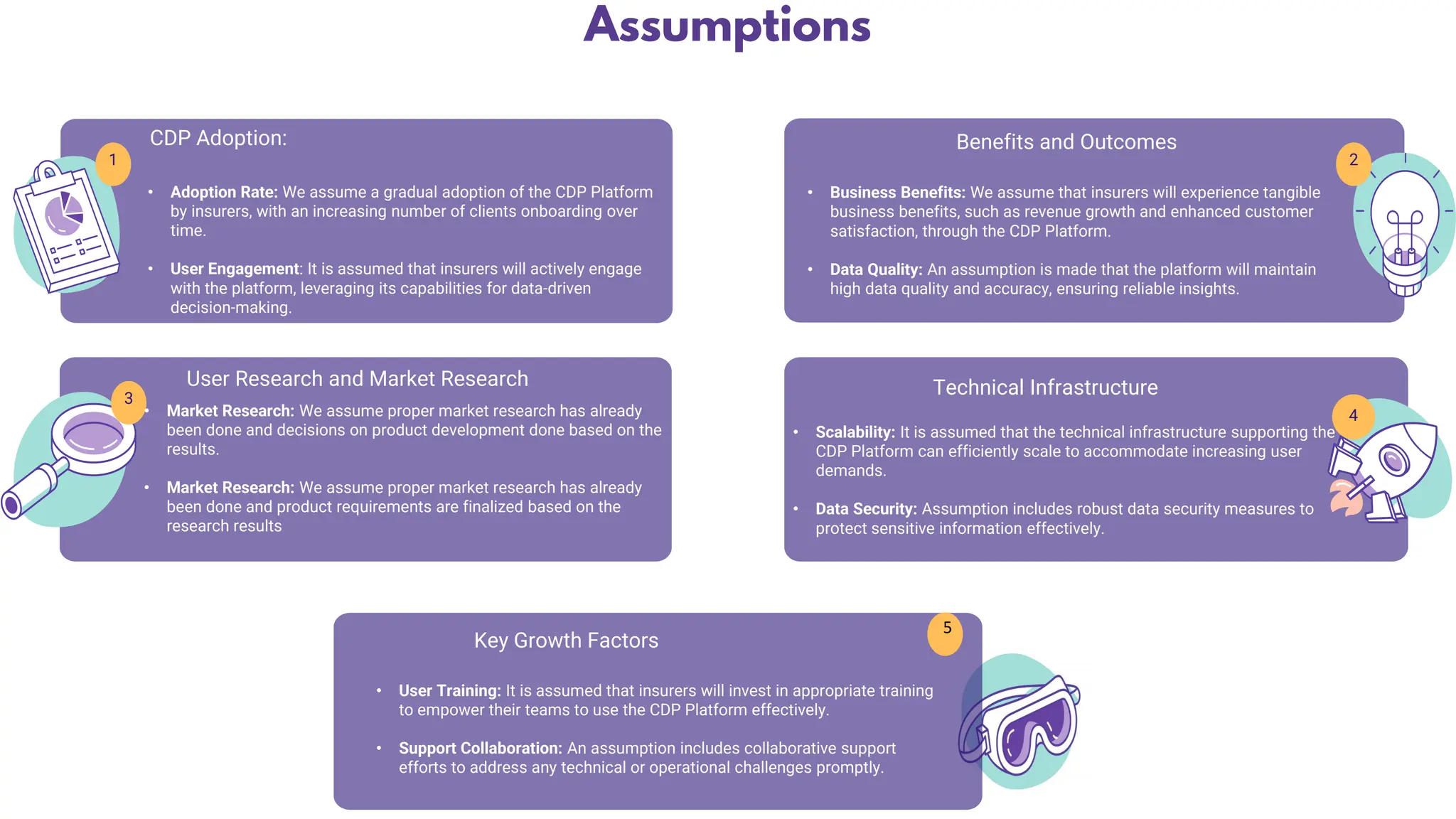
Assumptions
CDP Adoption:
• Adoption Rate: We assume a gradual adoption of the CDP Platform
by insurers, with an increasing number of clients onboarding over
time.
• User Engagement: It is assumed that insurers will actively engage
with the platform, leveraging its capabilities for data-driven
decision-making.
1
Benefits and Outcomes
• Business Benefits: We assume that insurers will experience tangible
business benefits, such as revenue growth and enhanced customer
satisfaction, through the CDP Platform.
• Data Quality: An assumption is made that the platform will maintain
high data quality and accuracy, ensuring reliable insights.
2
User Research and Market Research
• Market Research: We assume proper market research has already
been done and decisions on product development done based on the
results.
• Market Research: We assume proper market research has already
been done and product requirements are finalized based on the
research results
3
Technical Infrastructure
• Scalability: It is assumed that the technical infrastructure supporting the
CDP Platform can efficiently scale to accommodate increasing user
demands.
• Data Security: Assumption includes robust data security measures to
protect sensitive information effectively.
4
5
Key Growth Factors
• User Training: It is assumed that insurers will invest in appropriate training
to empower their teams to use the CDP Platform effectively.
• Support Collaboration: An assumption includes collaborative support
efforts to address any technical or operational challenges promptly.
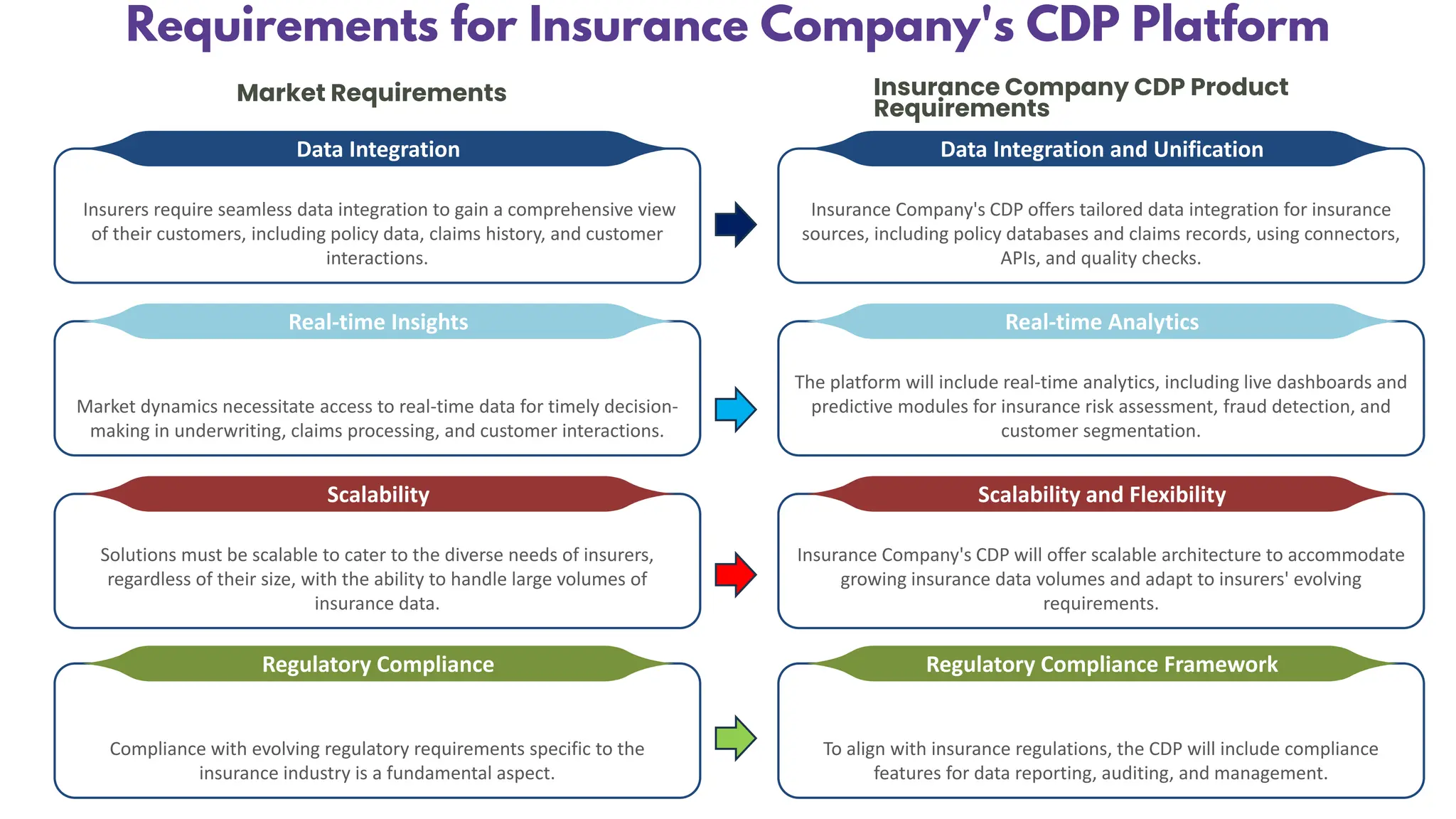
Requirements for Insurance Company's CDP Platform
Market Requirements Insurance Company CDP Product
Requirements
Insurers require seamless data integration to gain a comprehensive view
of their customers, including policy data, claims history, and customer
interactions.
Data Integration
Market dynamics necessitate access to real-time data for timely decision-
making in underwriting, claims processing, and customer interactions.
Real-time Insights
Solutions must be scalable to cater to the diverse needs of insurers,
regardless of their size, with the ability to handle large volumes of
insurance data.
Scalability
Compliance with evolving regulatory requirements specific to the
insurance industry is a fundamental aspect.
Regulatory Compliance
Insurance Company's CDP offers tailored data integration for insurance
sources, including policy databases and claims records, using connectors,
APIs, and quality checks.
Data Integration and Unification
The platform will include real-time analytics, including live dashboards and
predictive modules for insurance risk assessment, fraud detection, and
customer segmentation.
Real-time Analytics
Insurance Company's CDP will offer scalable architecture to accommodate
growing insurance data volumes and adapt to insurers' evolving
requirements.
Scalability and Flexibility
To align with insurance regulations, the CDP will include compliance
features for data reporting, auditing, and management.
Regulatory Compliance Framework
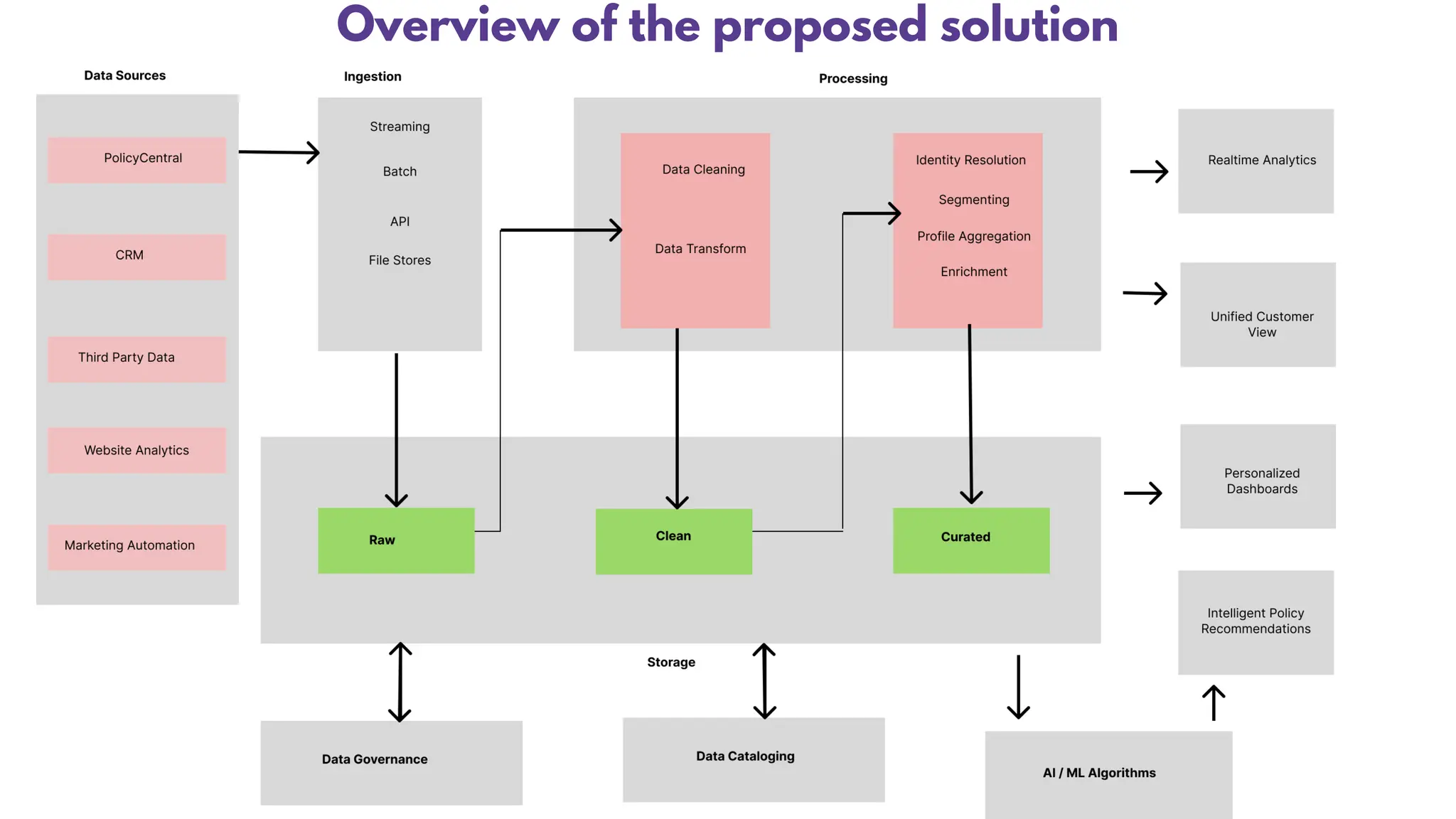
Overview of the proposed solution
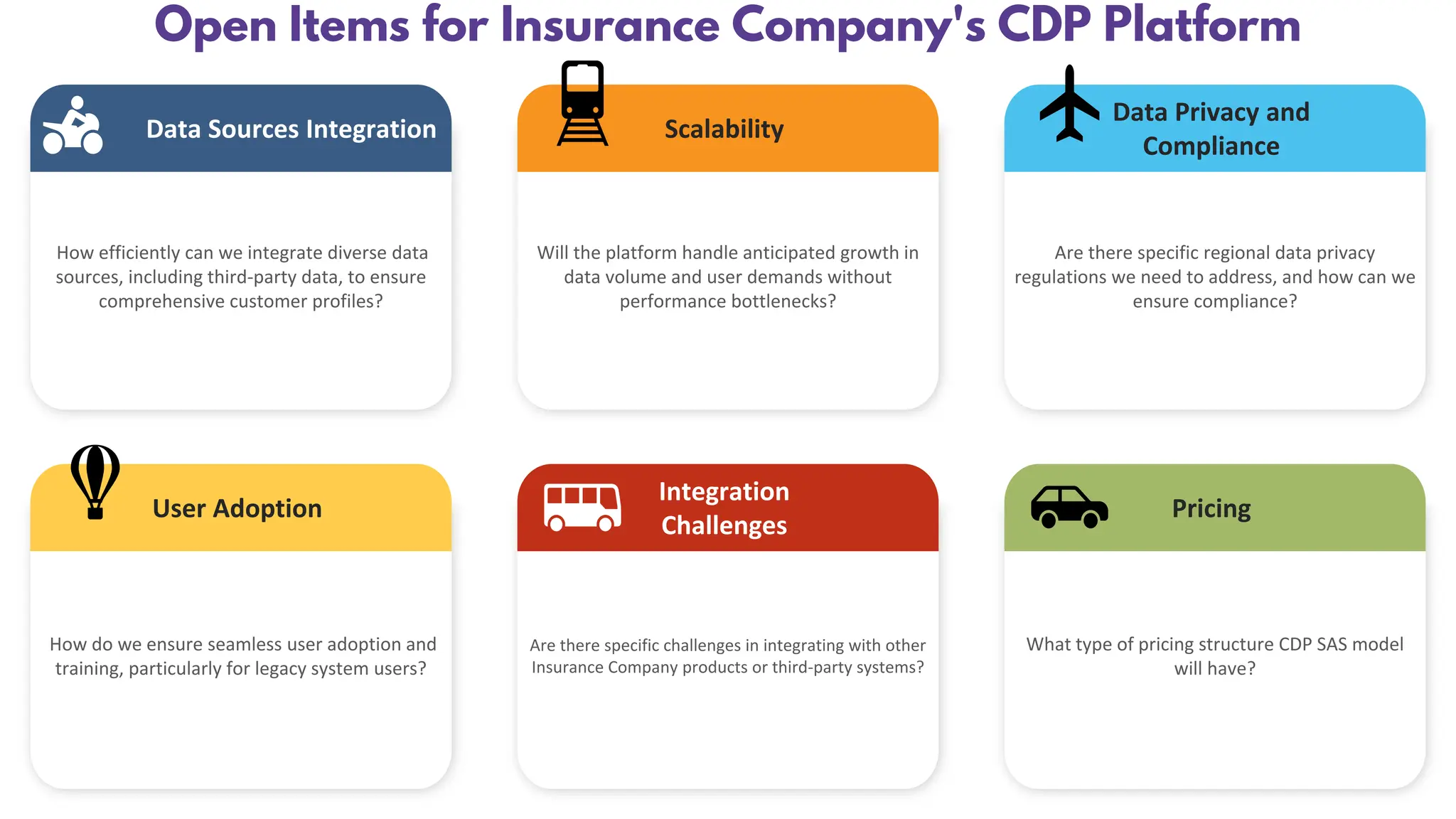
How efficiently can we integrate diverse data
sources, including third-party data, to ensure
comprehensive customer profiles?
Will the platform handle anticipated growth in
data volume and user demands without
performance bottlenecks?
Are there specific regional data privacy
regulations we need to address, and how can we
ensure compliance?
Data Sources Integration Scalability
Data Privacy and
Compliance
How do we ensure seamless user adoption and
training, particularly for legacy system users?
Are there specific challenges in integrating with other
Insurance Company products or third-party systems?
What type of pricing structure CDP SAS model
will have?
User Adoption
Integration
Challenges
Pricing
Open Items for Insurance Company's CDP Platform
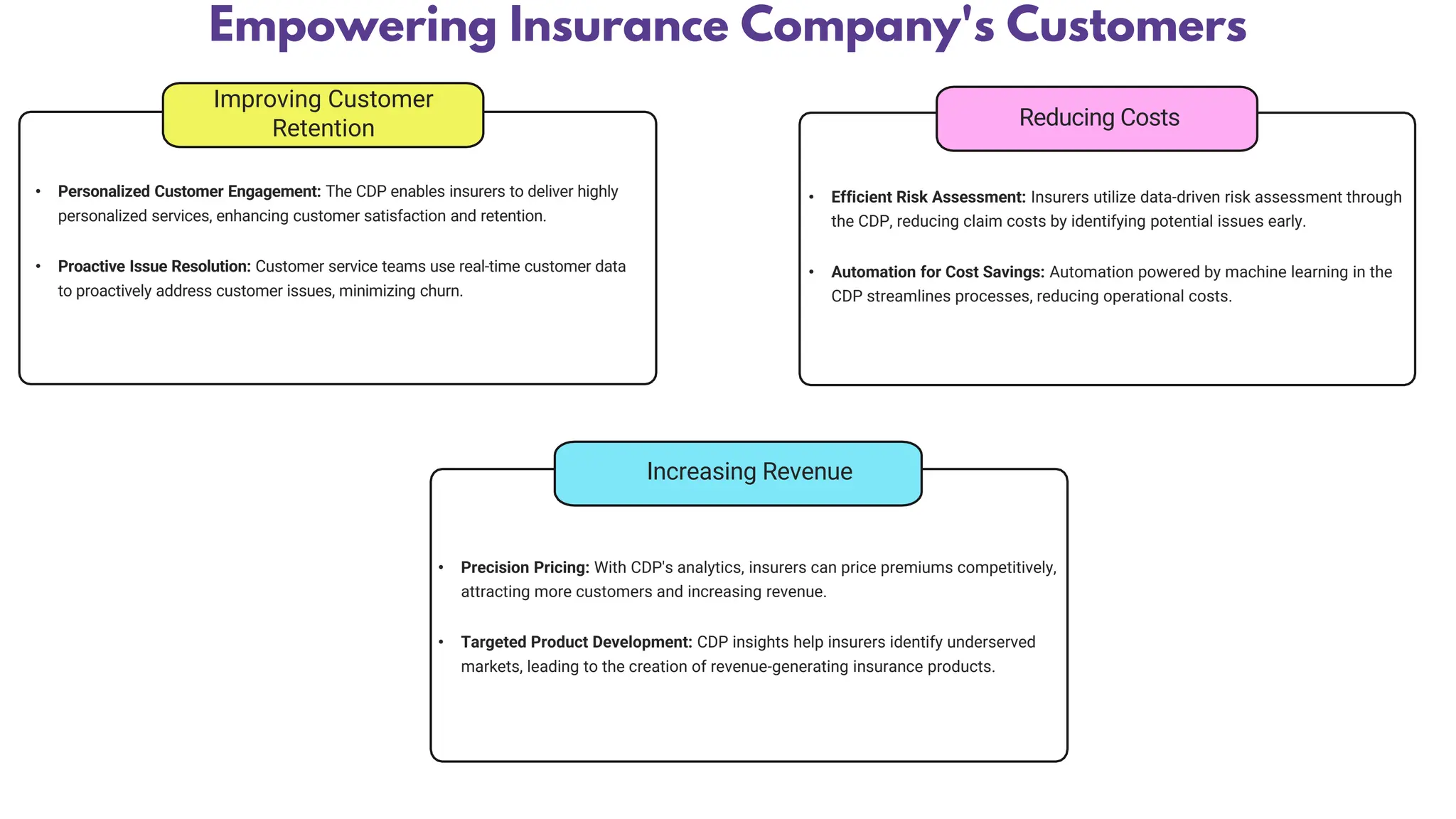
Empowering Insurance Company's Customers
• Personalized Customer Engagement: The CDP enables insurers to deliver highly
personalized services, enhancing customer satisfaction and retention.
• Proactive Issue Resolution: Customer service teams use real-time customer data
to proactively address customer issues, minimizing churn.
Improving Customer
Retention
• Precision Pricing: With CDP's analytics, insurers can price premiums competitively,
attracting more customers and increasing revenue.
• Targeted Product Development: CDP insights help insurers identify underserved
markets, leading to the creation of revenue-generating insurance products.
Increasing Revenue
• Efficient Risk Assessment: Insurers utilize data-driven risk assessment through
the CDP, reducing claim costs by identifying potential issues early.
• Automation for Cost Savings: Automation powered by machine learning in the
CDP streamlines processes, reducing operational costs.
Reducing Costs
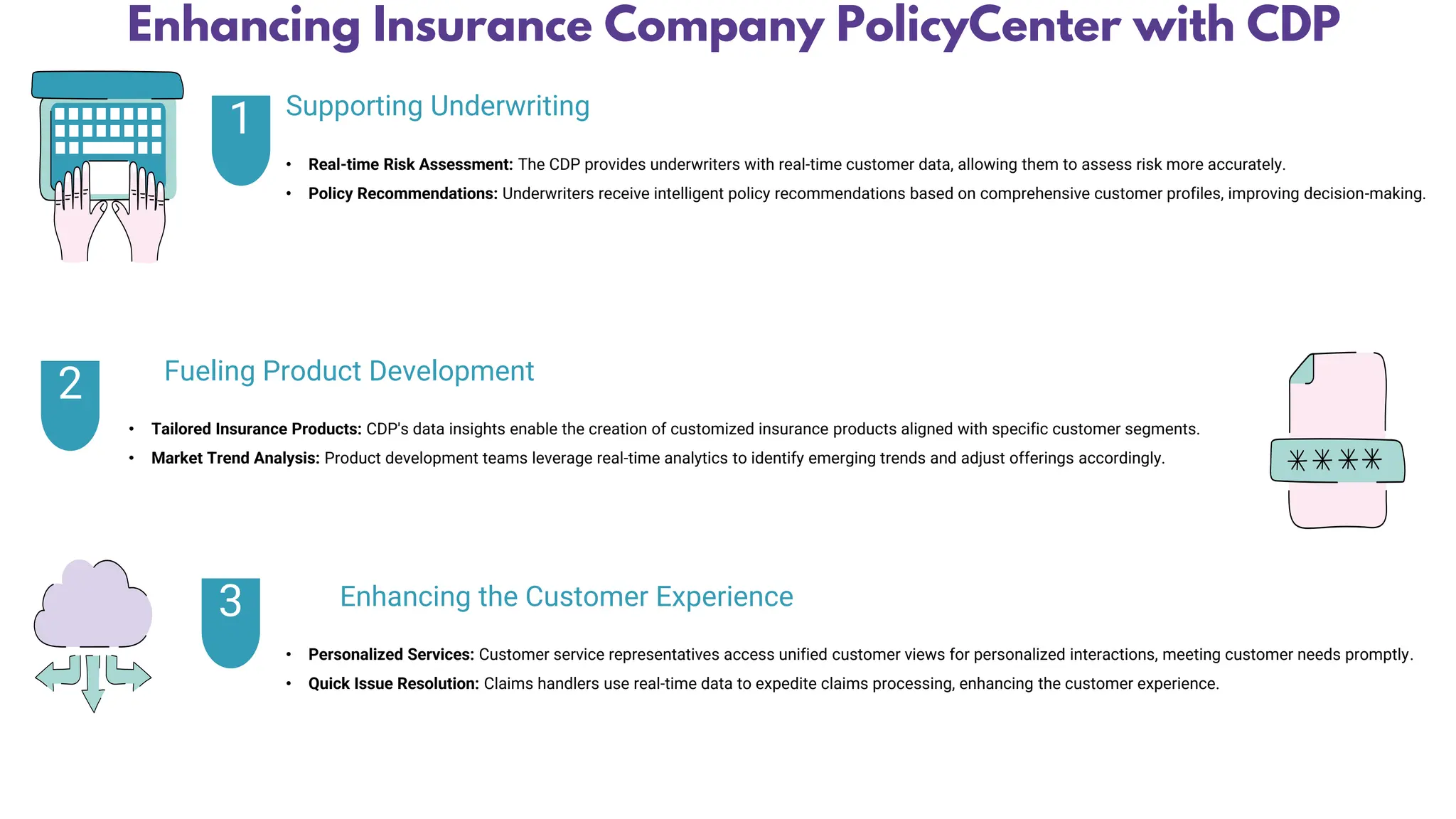
Enhancing Insurance Company PolicyCenter with CDP
1 Supporting Underwriting
• Real-time Risk Assessment: The CDP provides underwriters with real-time customer data, allowing them to assess risk more accurately.
• Policy Recommendations: Underwriters receive intelligent policy recommendations based on comprehensive customer profiles, improving decision-making.
2 Fueling Product Development
• Tailored Insurance Products: CDP's data insights enable the creation of customized insurance products aligned with specific customer segments.
• Market Trend Analysis: Product development teams leverage real-time analytics to identify emerging trends and adjust offerings accordingly.
3 Enhancing the Customer Experience
• Personalized Services: Customer service representatives access unified customer views for personalized interactions, meeting customer needs promptly.
• Quick Issue Resolution: Claims handlers use real-time data to expedite claims processing, enhancing the customer experience.
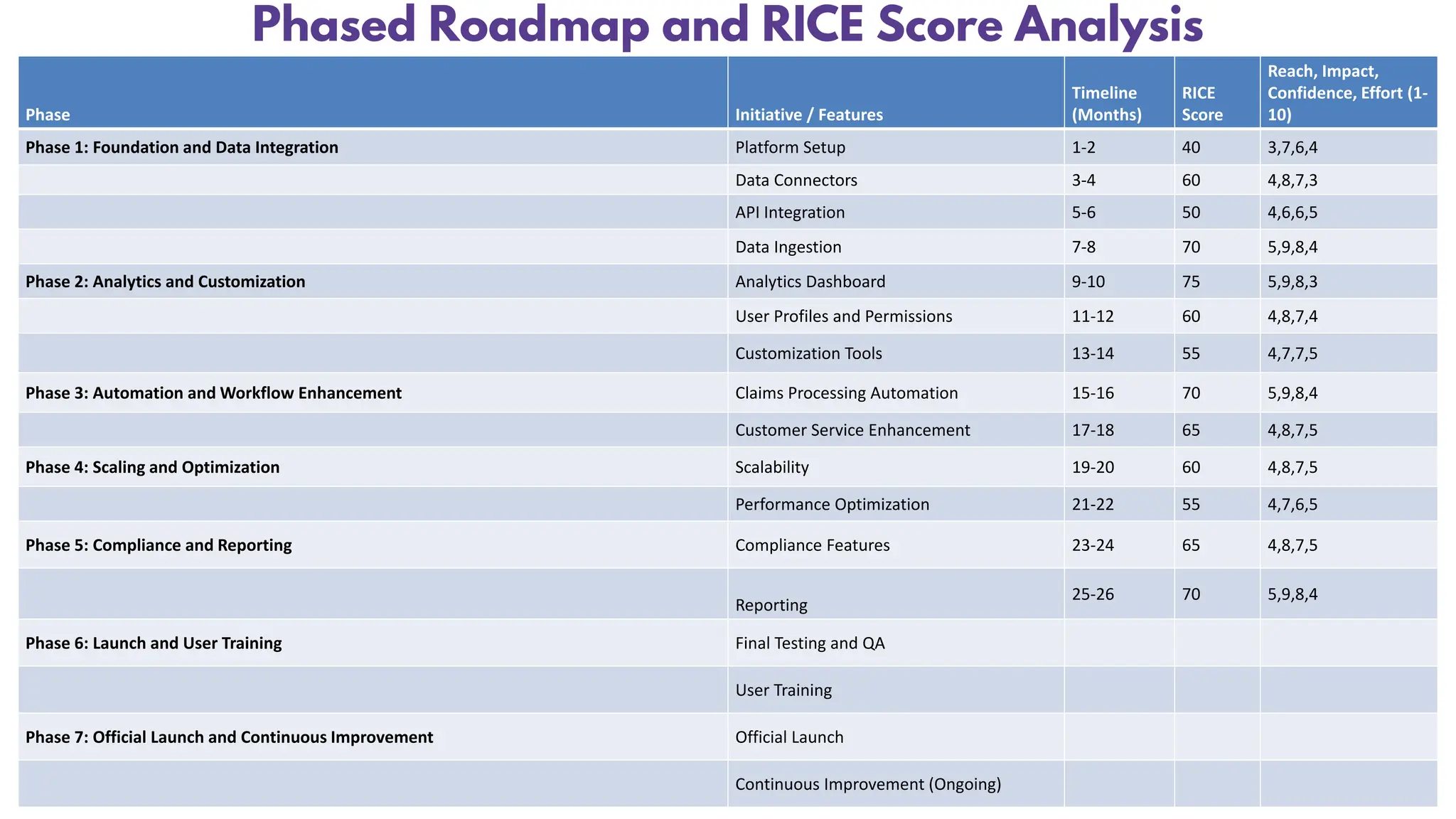
Phased Roadmap and RICE Score Analysis
Phase Initiative / Features
Timeline
(Months)
RICE
Score
Reach, Impact,
Confidence, Effort (1-
10)
Phase 1: Foundation and Data Integration Platform Setup 1-2 40 3,7,6,4
Data Connectors 3-4 60 4,8,7,3
API Integration 5-6 50 4,6,6,5
Data Ingestion 7-8 70 5,9,8,4
Phase 2: Analytics and Customization Analytics Dashboard 9-10 75 5,9,8,3
User Profiles and Permissions 11-12 60 4,8,7,4
Customization Tools 13-14 55 4,7,7,5
Phase 3: Automation and Workflow Enhancement Claims Processing Automation 15-16 70 5,9,8,4
Customer Service Enhancement 17-18 65 4,8,7,5
Phase 4: Scaling and Optimization Scalability 19-20 60 4,8,7,5
Performance Optimization 21-22 55 4,7,6,5
Phase 5: Compliance and Reporting Compliance Features 23-24 65 4,8,7,5
Reporting
25-26 70 5,9,8,4
Phase 6: Launch and User Training Final Testing and QA
User Training
Phase 7: Official Launch and Continuous Improvement Official Launch
Continuous Improvement (Ongoing)
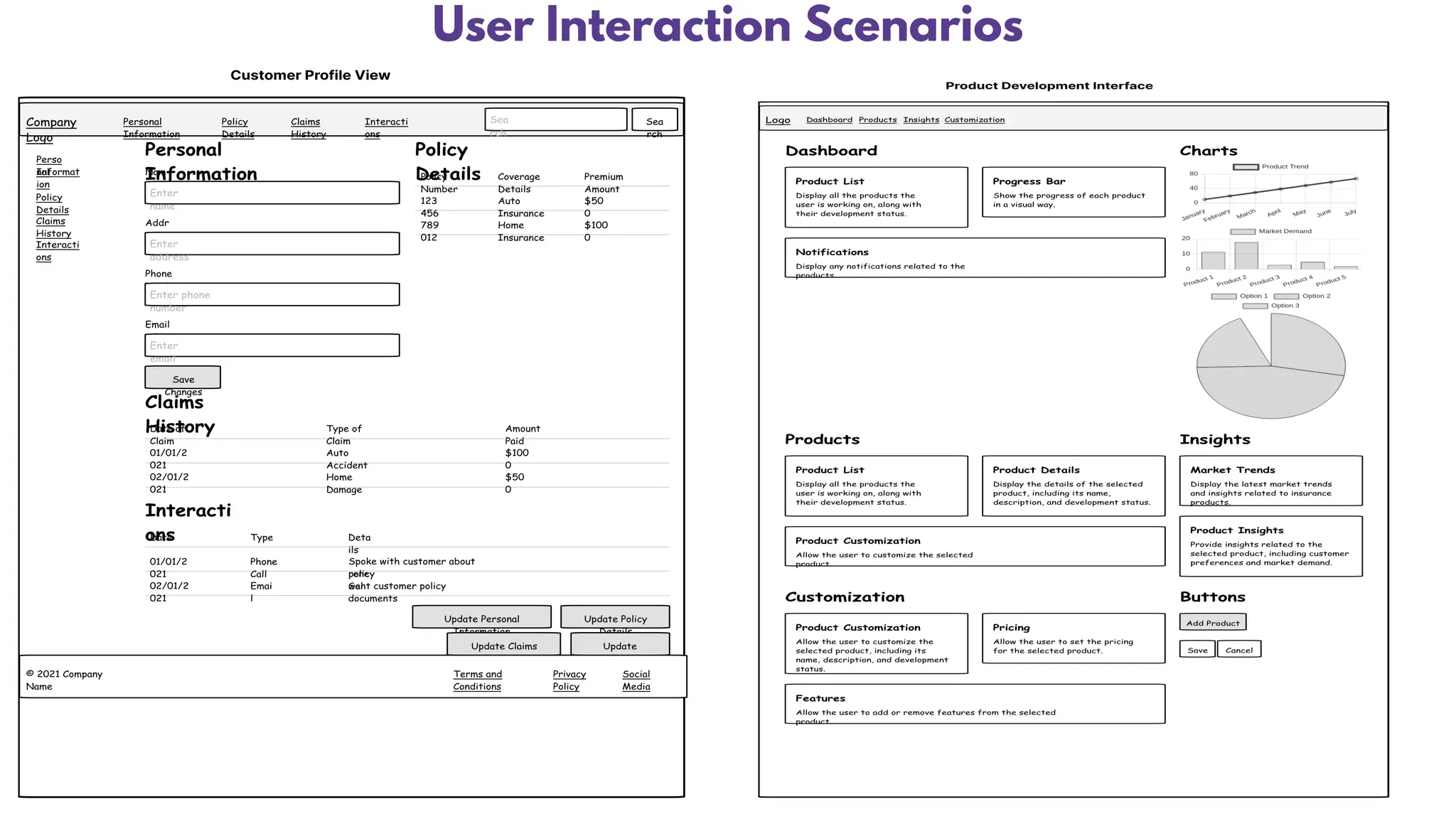
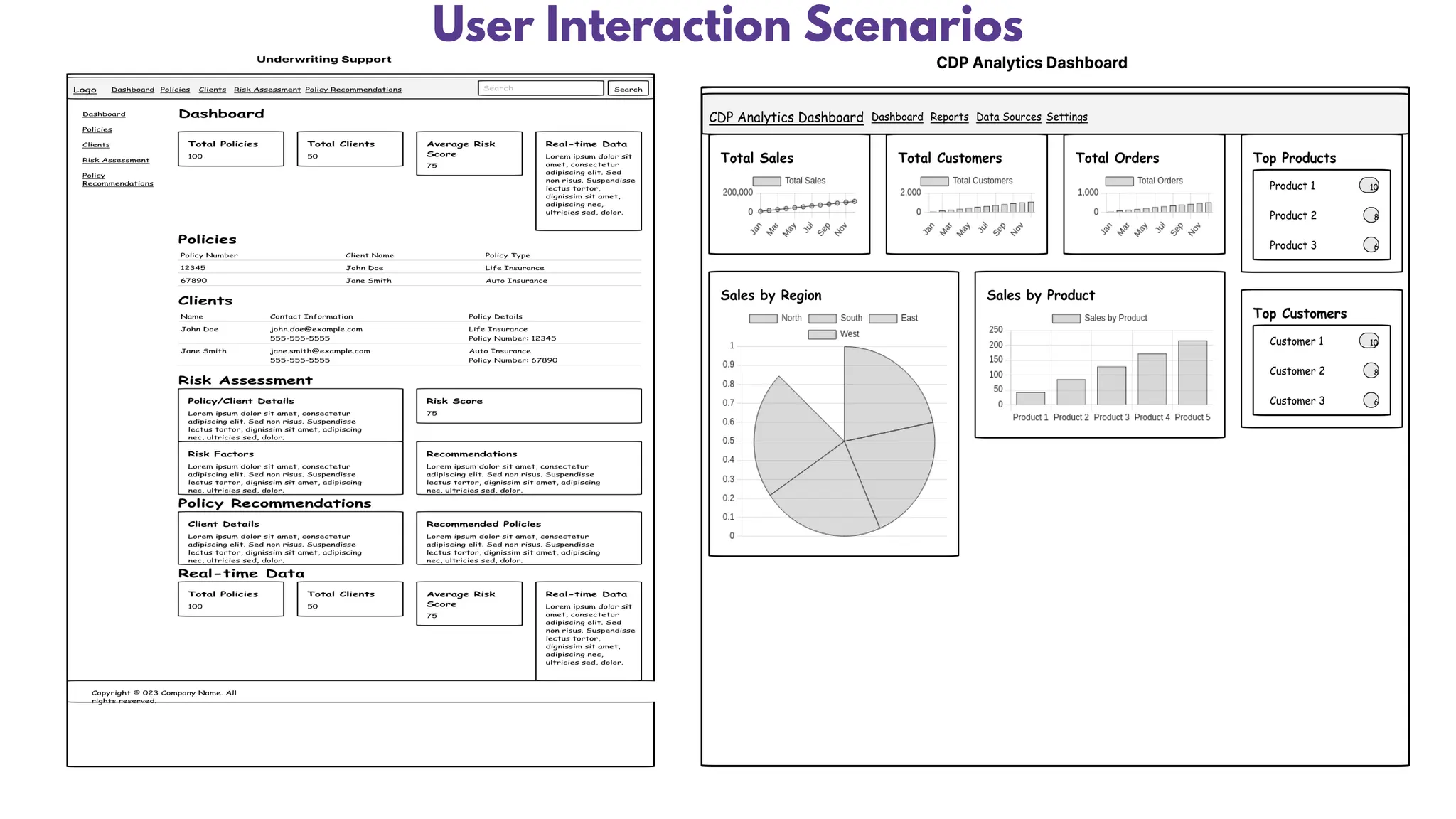
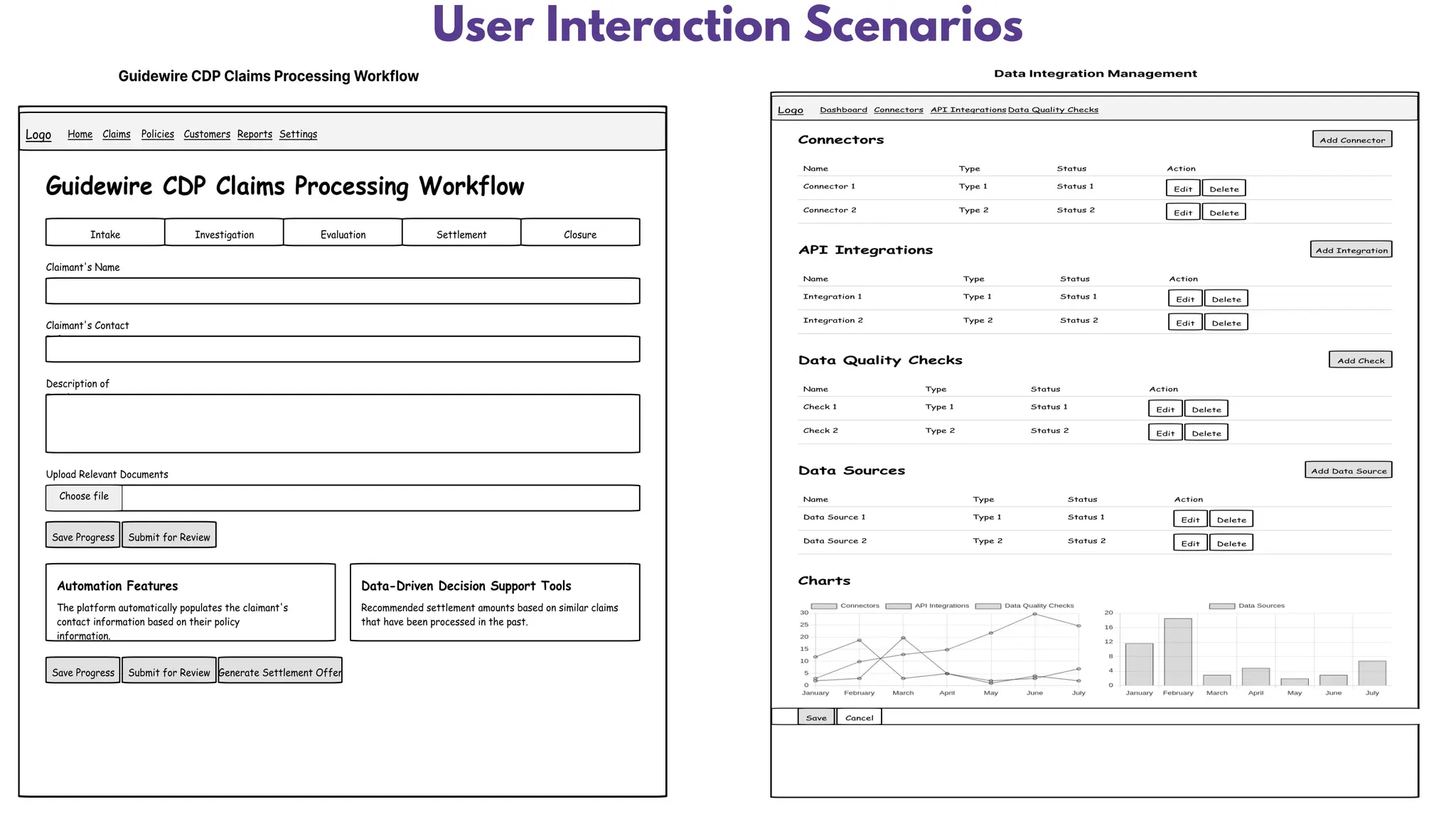
User Interaction Scenarios
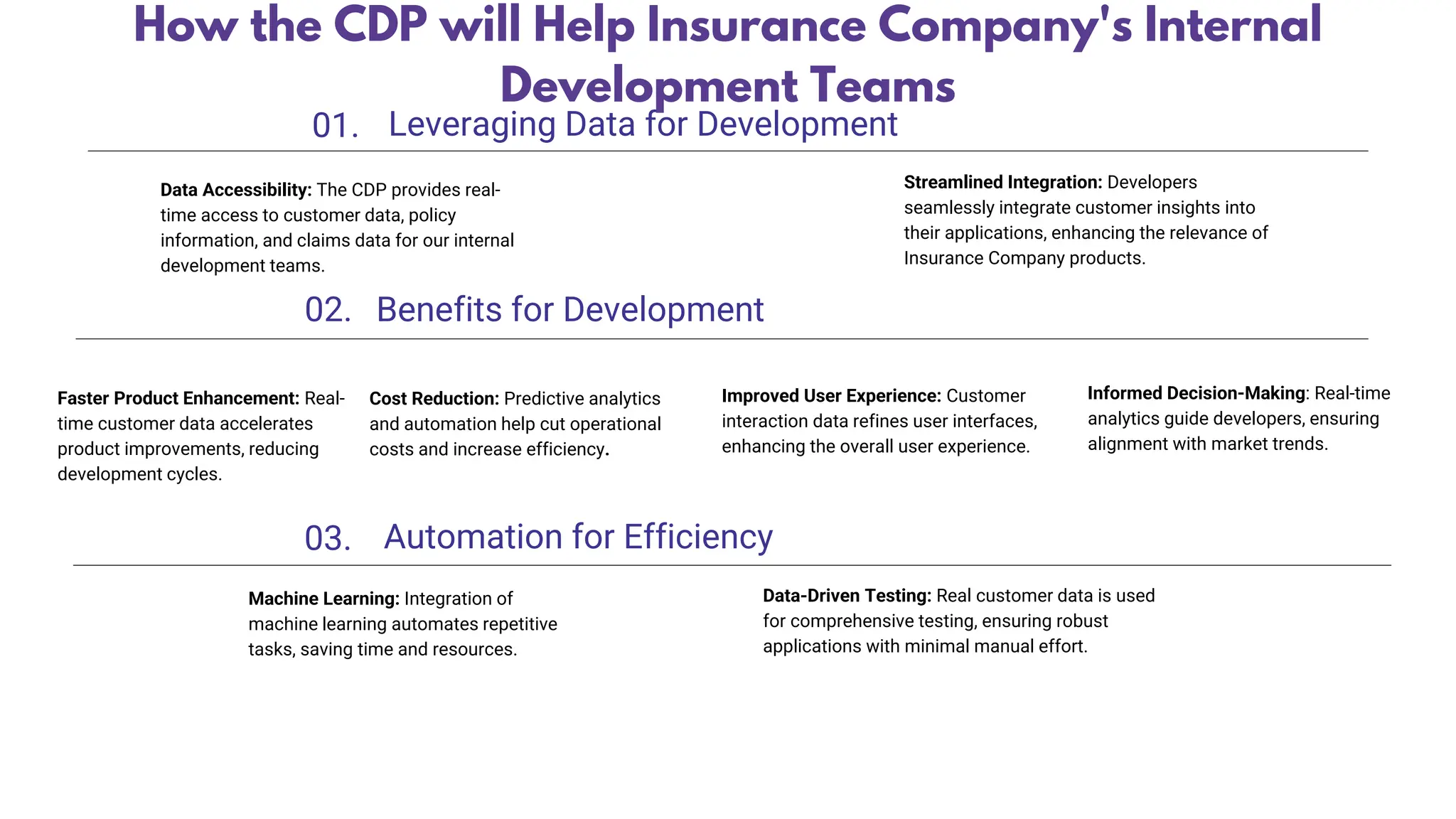
01. Leveraging Data for Development
Streamlined Integration: Developers
seamlessly integrate customer insights into
their applications, enhancing the relevance of
Insurance Company products.
Data Accessibility: The CDP provides real-
time access to customer data, policy
information, and claims data for our internal
development teams.
02. Benefits for Development
Cost Reduction: Predictive analytics
and automation help cut operational
costs and increase efficiency.
Improved User Experience: Customer
interaction data refines user interfaces,
enhancing the overall user experience.
Faster Product Enhancement: Real-
time customer data accelerates
product improvements, reducing
development cycles.
03. Automation for Efficiency
Data-Driven Testing: Real customer data is used
for comprehensive testing, ensuring robust
applications with minimal manual effort.
Machine Learning: Integration of
machine learning automates repetitive
tasks, saving time and resources.
How the CDP will Help Insurance Company's Internal
Development Teams
Informed Decision-Making: Real-time
analytics guide developers, ensuring
alignment with market trends.
• CDP's Vital Role: The Customer Data Platform (CDP) is pivotal in providing
insurers with real-time customer data and data-driven insights.
• Strategic Alignment: It aligns with Insurance Company's mission to transform
the property and casualty insurance industry through data and analytics.
• Enhanced Customer Experiences: The CDP aims to elevate customer
experiences through personalization and quick issue resolution.
• Cost Efficiency: It supports cost reduction by automating
processes and improving risk assessment.
• Revenue Growth: The CDP helps in increasing revenue by enabling
precision pricing and targeted product development.
Summary of Key Points
Reiterating CDP Goals
Conclusion
• Benefits for Insurers: We've seen how the CDP empowers insurers with
personalized services, efficient operations, and revenue growth.
THANK YOU
Prasanna Hegde

Customer Data Platform

  • 1.
  • 2.
    Introduction A Customer DataPlatform (CDP) is a software platform that helps businesses collect, unify, and analyze customer data from all sources. • Better understand their customers • Improve marketing and sales • Improve customer service Importance : Goals: • Introduce the CDP and its importance to the insurance industry • Highlight the key features and benefits of CDP • Show how Insurance Company's CDP can help insurers achieve their specific goals
  • 3.
    Insurance Company CDP:Why? • Insurance companies need data to make better decisions. • A CDP helps insurance companies collect, unify, and analyze customer data. • This data can be used to improve marketing, sales, and customer service. Market Trends and Customer Needs • Increased demand for personalized customer experiences • Need to improve operational efficiency • Growing importance of data-driven decision making Background and Strategic fit Insurance Company CDP: Alignment with Strategy Insurance Company's CDP will help insurance companies use data to improve their businesses and deliver a better customer experience, aligning with Insurance Company's mission and strategy of providing a unified, data-driven platform for all insurance needs. How the CDP can help insurers • Personalize marketing and sales campaigns • Improve customer service • Reduce costs • Develop new products and services • Improve underwriting and risk selection
  • 4.
    Specific Use Cases CreatingBetter Insurance Products: The CDP provides actionable data insights, enabling insurers to tailor insurance products to specific customer segments. Quoting Competitive Premiums: Insurers can make data-driven decisions on premium pricing, backed by a comprehensive understanding of customer risk profiles and market dynamics Delivering Market-Leading Customer Experiences: With a unified view of each customer, insurers can offer personalized services, anticipate customer needs, and resolve issues promptly. Scope How CDP Enhances Decision-Making Real-time Customer Data: Access to live customer data, including policies, claims, and interactions, enhances decision- making and customer engagement. Data-Driven Product Development: The CDP leverages customer insights for creating tailored insurance products, addressing market trends, and identifying risks. Competitive Premium Quoting: CDP analytics ensures precise premium pricing, boosting competitiveness and accuracy. Market-Leading Customer Experiences: A unified view enables personalized services, faster issue resolution, and heightened customer satisfaction.
  • 5.
    Success Metrics forInsurance Company (Developer) Metrics that will evaluate Insurance Company's success in developing and delivering the CDP Platform. • Product Adoption Rate: Tracking the number of insurers using the CDP Platform. • Revenue Generated: Measuring the income from CDP sales and related services. • Customer Satisfaction: Evaluating feedback and satisfaction levels of CDP Platform users. A systematic approach would be required for tracking metrics, ensuring the success of Insurance Company's CDP Platform for both Insurance Company and insurers. Success Criteria for Insurance Company's CDP Platform Success Metrics for Insurers (End-Users) Metrics that insurers will use to assess the CDP Platform's effectiveness in their operations. • Customer Retention Rates: Measuring the ability of insurers to retain customers with the help of the CDP Platform. • Premium Growth: Tracking the increase in premium income facilitated by data-driven decision-making. • Net Promoter Score (NPS): Gauging the level of satisfaction and loyalty among insurers using the CDP. Monitoring and Evaluation • Real-time Analytics Tools: Utilize cutting-edge analytics tools that provide instant insights into platform performance. • Performance Dashboards: Employ intuitive dashboards showcasing crucial performance metrics in a clear and accessible manner. • Scheduled Performance Reviews: Conduct regular reviews and assessments to proactively address areas for improvement. Key Components
  • 6.
    Assumptions CDP Adoption: • AdoptionRate: We assume a gradual adoption of the CDP Platform by insurers, with an increasing number of clients onboarding over time. • User Engagement: It is assumed that insurers will actively engage with the platform, leveraging its capabilities for data-driven decision-making. 1 Benefits and Outcomes • Business Benefits: We assume that insurers will experience tangible business benefits, such as revenue growth and enhanced customer satisfaction, through the CDP Platform. • Data Quality: An assumption is made that the platform will maintain high data quality and accuracy, ensuring reliable insights. 2 User Research and Market Research • Market Research: We assume proper market research has already been done and decisions on product development done based on the results. • Market Research: We assume proper market research has already been done and product requirements are finalized based on the research results 3 Technical Infrastructure • Scalability: It is assumed that the technical infrastructure supporting the CDP Platform can efficiently scale to accommodate increasing user demands. • Data Security: Assumption includes robust data security measures to protect sensitive information effectively. 4 5 Key Growth Factors • User Training: It is assumed that insurers will invest in appropriate training to empower their teams to use the CDP Platform effectively. • Support Collaboration: An assumption includes collaborative support efforts to address any technical or operational challenges promptly.
  • 7.
    Requirements for InsuranceCompany's CDP Platform Market Requirements Insurance Company CDP Product Requirements Insurers require seamless data integration to gain a comprehensive view of their customers, including policy data, claims history, and customer interactions. Data Integration Market dynamics necessitate access to real-time data for timely decision- making in underwriting, claims processing, and customer interactions. Real-time Insights Solutions must be scalable to cater to the diverse needs of insurers, regardless of their size, with the ability to handle large volumes of insurance data. Scalability Compliance with evolving regulatory requirements specific to the insurance industry is a fundamental aspect. Regulatory Compliance Insurance Company's CDP offers tailored data integration for insurance sources, including policy databases and claims records, using connectors, APIs, and quality checks. Data Integration and Unification The platform will include real-time analytics, including live dashboards and predictive modules for insurance risk assessment, fraud detection, and customer segmentation. Real-time Analytics Insurance Company's CDP will offer scalable architecture to accommodate growing insurance data volumes and adapt to insurers' evolving requirements. Scalability and Flexibility To align with insurance regulations, the CDP will include compliance features for data reporting, auditing, and management. Regulatory Compliance Framework
  • 8.
    Overview of theproposed solution
  • 9.
    How efficiently canwe integrate diverse data sources, including third-party data, to ensure comprehensive customer profiles? Will the platform handle anticipated growth in data volume and user demands without performance bottlenecks? Are there specific regional data privacy regulations we need to address, and how can we ensure compliance? Data Sources Integration Scalability Data Privacy and Compliance How do we ensure seamless user adoption and training, particularly for legacy system users? Are there specific challenges in integrating with other Insurance Company products or third-party systems? What type of pricing structure CDP SAS model will have? User Adoption Integration Challenges Pricing Open Items for Insurance Company's CDP Platform
  • 10.
    Empowering Insurance Company'sCustomers • Personalized Customer Engagement: The CDP enables insurers to deliver highly personalized services, enhancing customer satisfaction and retention. • Proactive Issue Resolution: Customer service teams use real-time customer data to proactively address customer issues, minimizing churn. Improving Customer Retention • Precision Pricing: With CDP's analytics, insurers can price premiums competitively, attracting more customers and increasing revenue. • Targeted Product Development: CDP insights help insurers identify underserved markets, leading to the creation of revenue-generating insurance products. Increasing Revenue • Efficient Risk Assessment: Insurers utilize data-driven risk assessment through the CDP, reducing claim costs by identifying potential issues early. • Automation for Cost Savings: Automation powered by machine learning in the CDP streamlines processes, reducing operational costs. Reducing Costs
  • 11.
    Enhancing Insurance CompanyPolicyCenter with CDP 1 Supporting Underwriting • Real-time Risk Assessment: The CDP provides underwriters with real-time customer data, allowing them to assess risk more accurately. • Policy Recommendations: Underwriters receive intelligent policy recommendations based on comprehensive customer profiles, improving decision-making. 2 Fueling Product Development • Tailored Insurance Products: CDP's data insights enable the creation of customized insurance products aligned with specific customer segments. • Market Trend Analysis: Product development teams leverage real-time analytics to identify emerging trends and adjust offerings accordingly. 3 Enhancing the Customer Experience • Personalized Services: Customer service representatives access unified customer views for personalized interactions, meeting customer needs promptly. • Quick Issue Resolution: Claims handlers use real-time data to expedite claims processing, enhancing the customer experience.
  • 12.
    Phased Roadmap andRICE Score Analysis Phase Initiative / Features Timeline (Months) RICE Score Reach, Impact, Confidence, Effort (1- 10) Phase 1: Foundation and Data Integration Platform Setup 1-2 40 3,7,6,4 Data Connectors 3-4 60 4,8,7,3 API Integration 5-6 50 4,6,6,5 Data Ingestion 7-8 70 5,9,8,4 Phase 2: Analytics and Customization Analytics Dashboard 9-10 75 5,9,8,3 User Profiles and Permissions 11-12 60 4,8,7,4 Customization Tools 13-14 55 4,7,7,5 Phase 3: Automation and Workflow Enhancement Claims Processing Automation 15-16 70 5,9,8,4 Customer Service Enhancement 17-18 65 4,8,7,5 Phase 4: Scaling and Optimization Scalability 19-20 60 4,8,7,5 Performance Optimization 21-22 55 4,7,6,5 Phase 5: Compliance and Reporting Compliance Features 23-24 65 4,8,7,5 Reporting 25-26 70 5,9,8,4 Phase 6: Launch and User Training Final Testing and QA User Training Phase 7: Official Launch and Continuous Improvement Official Launch Continuous Improvement (Ongoing)
  • 13.
  • 14.
  • 15.
  • 16.
    01. Leveraging Datafor Development Streamlined Integration: Developers seamlessly integrate customer insights into their applications, enhancing the relevance of Insurance Company products. Data Accessibility: The CDP provides real- time access to customer data, policy information, and claims data for our internal development teams. 02. Benefits for Development Cost Reduction: Predictive analytics and automation help cut operational costs and increase efficiency. Improved User Experience: Customer interaction data refines user interfaces, enhancing the overall user experience. Faster Product Enhancement: Real- time customer data accelerates product improvements, reducing development cycles. 03. Automation for Efficiency Data-Driven Testing: Real customer data is used for comprehensive testing, ensuring robust applications with minimal manual effort. Machine Learning: Integration of machine learning automates repetitive tasks, saving time and resources. How the CDP will Help Insurance Company's Internal Development Teams Informed Decision-Making: Real-time analytics guide developers, ensuring alignment with market trends.
  • 17.
    • CDP's VitalRole: The Customer Data Platform (CDP) is pivotal in providing insurers with real-time customer data and data-driven insights. • Strategic Alignment: It aligns with Insurance Company's mission to transform the property and casualty insurance industry through data and analytics. • Enhanced Customer Experiences: The CDP aims to elevate customer experiences through personalization and quick issue resolution. • Cost Efficiency: It supports cost reduction by automating processes and improving risk assessment. • Revenue Growth: The CDP helps in increasing revenue by enabling precision pricing and targeted product development. Summary of Key Points Reiterating CDP Goals Conclusion • Benefits for Insurers: We've seen how the CDP empowers insurers with personalized services, efficient operations, and revenue growth.
  • 18.