Transforming Partner Onboarding:
Introducing the Partner Management
System Solution
Hegdeprasanna11@gmail.com
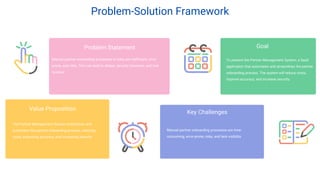
Problem-Solution Framework
Problem Statement
Manual partner onboarding processes in India are inefficient, error-
prone, and risky. This can lead to delays, security breaches, and lost
revenue.
Value Proposition
The Partner Management System streamlines and
automates the partner onboarding process, reducing
costs, improving accuracy, and increasing security.
Goal
To present the Partner Management System, a SaaS
application that automates and streamlines the partner
onboarding process. The system will reduce costs,
improve accuracy, and increase security.
Key Challenges
Manual partner onboarding processes are time-
consuming, error-prone, risky, and lack visibility.
User Research Findings
01. Party A Pain Points
Lack of standardization and compliance:
40% of Party A organizations do not have
a standardized onboarding process in
place. (Source: Forrester)
Inefficient verification and validation:
30% of Party A organizations have
experienced delays due to inaccurate
partner information. (Source: IDC)
Time-consuming manual processes: Manual
onboarding can take 60 days, with 20% of the
organization taking 90+ days. (Source:
Gartner)
02. Party B Pain Points
Lack of visibility and communication:
50% of organizations do not receive
regular updates on their onboarding
status. (Source: G2 Crowd)
Complex and cumbersome onboarding
process: 60% of Party B respondents
found the onboarding process to be
difficult to navigate. (Source: Capterra)
03. Common Requirements for Party A and Party B
Streamlined validation and approval workflow: 70% of organizations that
have implemented a streamlined validation and approval workflow have
seen a reduction in onboarding time by 20% or more. (Source: SAP)
Configurable onboarding forms: 80% of
respondents wanted the ability to customize
onboarding forms. (Source: Cisco).
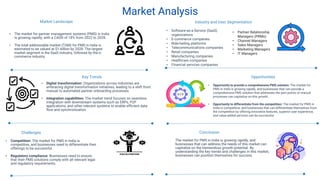
Market Analysis
Market Landscape
• The market for partner management systems (PMS) in India
is growing rapidly, with a CAGR of 18% from 2022 to 2028.
• The total addressable market (TAM) for PMS in India is
estimated to be valued at $1 billion by 2028. The largest
market segment is the SaaS industry, followed by the e-
commerce industry.
Key Trends
• Digital transformation: Organizations across industries are
embracing digital transformation initiatives, leading to a shift from
manual to automated partner onboarding processes.
• Integration capabilities: The market trend focuses on seamless
integration with downstream systems such as ERPs, P2P
applications, and other relevant systems to enable efficient data
flow and synchronization.
Opportunities
• Opportunity to provide a comprehensive PMS solution: The market for
PMS in India is growing rapidly, and businesses that can provide a
comprehensive PMS solution that addresses the pain points of manual
processes can capitalize on this growth.
• Opportunity to differentiate from the competition: The market for PMS in
India is competitive, and businesses that can differentiate themselves from
the competition by offering innovative features, superior user experience,
and value-added services can be successful.
Challenges
• Competition: The market for PMS in India is
competitive, and businesses need to differentiate their
offerings to be successful.
• Regulatory compliance: Businesses need to ensure
that their PMS solutions comply with all relevant legal
and regulatory requirements.
Conclusion
The market for PMS in India is growing rapidly, and
businesses that can address the needs of this market can
capitalize on the tremendous growth potential. By
understanding the key trends and challenges in this market,
businesses can position themselves for success.
Industry and User Segmentation
• Software-as-a-Service (SaaS)
organizations
• E-commerce companies
• Ride-hailing platforms
• Telecommunications companies
• Retail companies
• Manufacturing companies
• Healthcare companies
• Financial services companies
• Partner Relationship
Managers (PRMs)
• Channel Managers
• Sales Managers
• Marketing Managers
• IT Managers
Competitor Analysis
Channelize
SAP PartnerEdge
Oracle
PartnerNetwork
CRM solutions
ERP solutions
Competitors Strengths
Powerful tool, wide range of features,
integrated with other SAP solutions
Well-established, comprehensive suite of
features, strong track record
Widely used, wide range of features for
customer relationships
Comprehensive PMS solution for businesses of
all sizes, integrated with other Oracle solutions
Designed to help businesses manage projects,
which can include partner relationships
Designed to manage all aspects of a
business, including partner relationships
Weaknesses
Expensive, difficult to implement
Expensive, complex UI
Not specifically designed for
partner relationships
Expensive, difficult to implement
Not specifically designed for
managing partner relationships
Complex, expensive to
implement
Market positioning
Comprehensive PMS solution
for large enterprises
Premium PMS solution for
businesses of all sizes
General-purpose tool for managing
customer relationships
Comprehensive PMS solution for
businesses of all sizes
Tool for managing projects
Comprehensive solution for managing
all aspects of a business
Competitor Type
Direct
Direct
Indirect
Direct
Indirect
Indirect
Project management
solutions
Our product can differentiate itself from the competition in a number of ways, being:
• More affordable
• Easier to use
• More features (AI-powered partner recommendations, real-time reporting, automated
workflows)
• More secure
• Focus on simplicity and ease of use
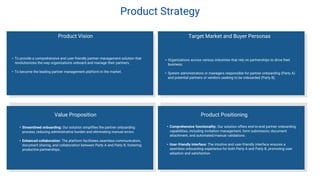
Product Strategy
• Organizations across various industries that rely on partnerships to drive their
business.
• System administrators or managers responsible for partner onboarding (Party A)
and potential partners or vendors seeking to be onboarded (Party B).
Target Market and Buyer Personas
• To provide a comprehensive and user-friendly partner management solution that
revolutionizes the way organizations onboard and manage their partners.
• To become the leading partner management platform in the market.
Product Vision
• Comprehensive functionality: Our solution offers end-to-end partner onboarding
capabilities, including invitation management, form submission, document
attachment, and automated/manual validations.
• User-friendly interface: The intuitive and user-friendly interface ensures a
seamless onboarding experience for both Party A and Party B, promoting user
adoption and satisfaction.
Product Positioning
• Streamlined onboarding: Our solution simplifies the partner onboarding
process, reducing administrative burden and eliminating manual errors.
• Enhanced collaboration: The platform facilitates seamless communication,
document sharing, and collaboration between Party A and Party B, fostering
productive partnerships.
Value Proposition
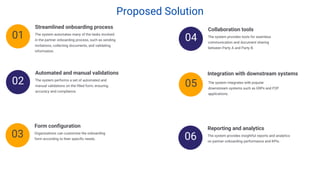
Proposed Solution
Streamlined onboarding process
The system automates many of the tasks involved
in the partner onboarding process, such as sending
invitations, collecting documents, and validating
information.
01
Collaboration tools
The system provides tools for seamless
communication and document sharing
between Party A and Party B.
04
02
Automated and manual validations
The system performs a set of automated and
manual validations on the filled form, ensuring
accuracy and compliance.
05
Integration with downstream systems
The system integrates with popular
downstream systems such as ERPs and P2P
applications.
Form configuration
Organizations can customize the onboarding
form according to their specific needs.
03
Reporting and analytics
The system provides insightful reports and analytics
on partner onboarding performance and KPIs.
06
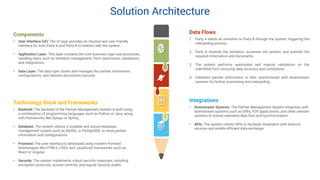
Solution Architecture
Integrations
• Downstream Systems: The Partner Management System integrates with
downstream systems such as ERPs, P2P applications, and other relevant
systems to ensure seamless data flow and synchronization.
• APIs: The system utilizes APIs to facilitate integration with external
services and enable efficient data exchange.
Technology Stack and Frameworks
• Backend: The backend of the Partner Management System is built using
a combination of programming languages such as Python or Java, along
with frameworks like Django or Spring.
• Database: The system utilizes a scalable and secure database
management system such as MySQL or PostgreSQL to store partner
information and configurations.
• Frontend: The user interface is developed using modern frontend
technologies like HTML5, CSS3, and JavaScript frameworks such as
React or Angular.
• Security: The system implements robust security measures, including
encryption protocols, access controls, and regular security audits.
Data Flows
1. Party A sends an invitation to Party B through the system, triggering the
onboarding process.
2. Party B receives the invitation, accesses the system, and submits the
required information and documents.
3. The system performs automated and manual validations on the
submitted form, ensuring data accuracy and compliance.
4. Validated partner information is then synchronized with downstream
systems for further processing and onboarding.
Components
• User Interface (UI): The UI layer provides an intuitive and user-friendly
interface for both Party A and Party B to interact with the system.
• Application Layer: This layer contains the core business logic and processes,
handling tasks such as invitation management, form submission, validations,
and integrations.
• Data Layer: The data layer stores and manages the partner information,
configurations, and relevant documents securely.
User Interface Mockups
Overview
• In this slide, I will provide an overview of the
wireframes that I have created for the partner
onboarding process.
• The wireframes are designed to be simple,
intuitive, and user-friendly.
• They are intended to provide a clear overview of
the process for both Party A and Party B.
Partner
Management System
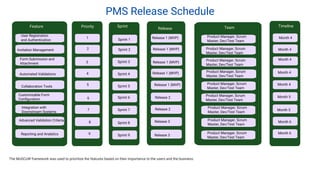
PMS Release Schedule
Low Brand
Awareness
Feature Priority
Low Brand
Awareness
Sprint
Low Brand
Awareness
Release
Low Brand
Awareness
Team
Low Brand
Awareness
Timeline
Low Brand
Awareness
User Registration
and Authentication
Invitation Management
Form Submission and
Attachment
Automated Validations
Collaboration Tools
Customizable Form
Configuration
Integration with
Downstream Systems
Advanced Validation Criteria
Reporting and Analytics
1
2
3
4
5
Sprint 1
8
6
9
Product Manager, Scrum
Master, Dev/Test Team
7
Release 1 (MVP) Month 4
Month 4
Month 4
Month 4
Month 4
Month 5
Month 5
Month 6
Month 6
Sprint 2
Sprint 3
Sprint 4
Sprint 5
Release 1 (MVP)
Release 1 (MVP)
Release 1 (MVP)
Release 1 (MVP)
Sprint 6
Sprint 7
Sprint 8
Sprint 9
Release 2
Release 2
Release 3
Release 3
Product Manager, Scrum
Master, Dev/Test Team
Product Manager, Scrum
Master, Dev/Test Team
Product Manager, Scrum
Master, Dev/Test Team
Product Manager, Scrum
Master, Dev/Test Team
Product Manager, Scrum
Master, Dev/Test Team
Product Manager, Scrum
Master, Dev/Test Team
Product Manager, Scrum
Master, Dev/Test Team
Product Manager, Scrum
Master, Dev/Test Team
The MoSCoW framework was used to prioritize the features based on their importance to the users and the business.
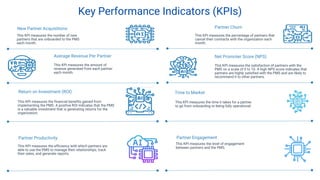
Key Performance Indicators (KPIs)
New Partner Acquisitions
This KPI measures the number of new
partners that are onboarded to the PMS
each month.
Average Revenue Per Partner
This KPI measures the amount of
revenue generated from each partner
each month.
Return on Investment (ROI)
This KPI measures the financial benefits gained from
implementing the PMS. A positive ROI indicates that the PMS
is a valuable investment that is generating returns for the
organization.
Partner Churn
This KPI measures the percentage of partners that
cancel their contracts with the organization each
month.
Net Promoter Score (NPS)
This KPI measures the satisfaction of partners with the
PMS on a scale of 0 to 10. A high NPS score indicates that
partners are highly satisfied with the PMS and are likely to
recommend it to other partners.
Time to Market
This KPI measures the time it takes for a partner
to go from onboarding to being fully operational.
Partner Productivity
This KPI measures the efficiency with which partners are
able to use the PMS to manage their relationships, track
their sales, and generate reports.
Partner Engagement
This KPI measures the level of engagement
between partners and the PMS.
Monetization Strategy
Customers pay a recurring fee to access and use
the PMS. This model provides predictable revenue
streams and allows customers to choose the
subscription plan that best fits their needs.
Subscription-based pricing
We can also offer a variety of customization
options, such as additional modules or add-ons,
white-labeling, and implementation and training
services. These customization options allow
customers to tailor the PMS to their specific
needs.
Customization options
We can offer three-tiered pricing plans: Basic,
Advanced, and Enterprise. Each plan includes a
different set of features and capabilities, so
customers can choose the plan that best meets
their needs.
Tiered pricing plans
We can also offer consulting and support
services, which can be charged separately. These
services can help organizations optimize their
partner management processes and maximize
the benefits of the PMS.
Other monetization approaches
• Number of partners subscribed to the PMS.
• Average monthly revenue per partner.
• Total revenue generated from the PMS.
Measuring the Success of the Monetization Strategy
Go-to-Market (GTM) Strategy
Promotional Activities
We can offer free trials and product demos to allow potential
customers to experience the value and functionality of our
PMS firsthand.
Digital Marketing
We leverage digital marketing channels such as search engine
optimization (SEO), search engine marketing (SEM), and social
media advertising to reach our target audience.
Content Marketing
We will create valuable and informative content, including
blog posts, whitepapers, case studies, and guides, to
establish thought leadership and attract potential
customers.
Referral Programs
We can incentivize existing customers to refer our
PMS to their industry contacts and network.
Email Marketing
We will utilize targeted email campaigns to nurture
leads, communicate product updates, share relevant
content, and convert potential customers into paying
customers.
Events and Webinars
We will participate in industry events, conferences, and
webinars to showcase our PMS, connect with potential
customers, and demonstrate thought leadership in the
partner management space.
Case Studies and Testimonials
We will highlight success stories, case studies, and
testimonials from satisfied customers to build trust
and showcase the effectiveness of our solution.
Distribution Partnerships and Reseller
Programs
We will explore strategic partnerships and reseller
programs to extend our reach and access new customer
segments.
Conclusion
I look forward to working collaboratively to bring
the Partner Management System to fruition and
revolutionizing the way organizations onboard
partners.
To move forward, I recommend gathering feedback from
potential customers, stakeholders, and internal teams;
securing the necessary resources; initiating the project; and
emphasizing the importance of continuous improvement.
The system has the potential to deliver a
positive return on investment (ROI) and a
relatively short payback period.
The system offers significant value and
benefits, including cost savings, increased
efficiency, improved partner experiences, and
a competitive advantage in the market.
The Partner Management System is a
comprehensive solution that can address the
challenges and pain points faced by organizations
in onboarding partners.
Assumptions
1 Roles and Permissions
The system administrator or manager (Party A) has the authority to configure forms, set up validation criteria, and perform manual validations if
required. Potential partners or vendors (Party B) can accept invitations, provide information and documents, and submit onboarding forms.
2 Downstream system integration
The Partner Management System is assumed to integrate with downstream systems (such as ERP, P2P application, CRM ) via APIs or
other integration methods. This allows for seamless data exchange between systems.
3 Validation Criteria
The Partner Management System is assumed to include validation criteria for domains such as GSTN, CIN, and PAN, as well as
additional criteria based on legal, compliance, or industry-specific requirements.
Cost, Benefits, Risks, and Mitigation Strategies
• Development Costs: Estimate the initial investment required for building the
Partner Management System, including software development, infrastructure
setup, and integrations.
• Maintenance and Support Costs: Consider ongoing expenses for system
maintenance, updates, bug fixes, and technical support.
• Operational Costs: Evaluate the operational expenses associated with hosting,
server infrastructure, and data storage.
Cost Estimation
• Integration and data security challenges: The Partner Management System must
be integrated with downstream systems to ensure smooth data exchange. It is
important to address concerns related to data security and privacy by implementing
appropriate encryption and access controls.
• Change management challenges: The Partner Management System will likely
require some changes to existing processes and procedures. It is important to
develop a training and communication plan to ensure a smooth transition and user
acceptance.
Implementation Risks
• Cost savings and efficiency gains: The Partner Management System can help to
save costs and improve efficiency by reducing manual efforts, streamlining
processes, and minimizing errors in partner onboarding.
• Improved partner experiences and competitive advantage: The Partner
Management System can also help to improve partner experiences and provide a
competitive advantage by enabling faster onboarding, improved compliance, and
better partner relationship management.
Potential Benefits
• Risk mitigation: Implement a comprehensive testing process, establish a
support system, conduct regular security audits, and develop contingency
plans to mitigate operational, security, and availability risks.
• Continuous improvement: Proactively monitor the system and make
improvements based on user feedback and experience.
Mitigation Strategies

Partner Management System Solution

  • 1.
    Transforming Partner Onboarding: Introducingthe Partner Management System Solution Hegdeprasanna11@gmail.com
  • 2.
    Problem-Solution Framework Problem Statement Manualpartner onboarding processes in India are inefficient, error- prone, and risky. This can lead to delays, security breaches, and lost revenue. Value Proposition The Partner Management System streamlines and automates the partner onboarding process, reducing costs, improving accuracy, and increasing security. Goal To present the Partner Management System, a SaaS application that automates and streamlines the partner onboarding process. The system will reduce costs, improve accuracy, and increase security. Key Challenges Manual partner onboarding processes are time- consuming, error-prone, risky, and lack visibility.
  • 3.
    User Research Findings 01.Party A Pain Points Lack of standardization and compliance: 40% of Party A organizations do not have a standardized onboarding process in place. (Source: Forrester) Inefficient verification and validation: 30% of Party A organizations have experienced delays due to inaccurate partner information. (Source: IDC) Time-consuming manual processes: Manual onboarding can take 60 days, with 20% of the organization taking 90+ days. (Source: Gartner) 02. Party B Pain Points Lack of visibility and communication: 50% of organizations do not receive regular updates on their onboarding status. (Source: G2 Crowd) Complex and cumbersome onboarding process: 60% of Party B respondents found the onboarding process to be difficult to navigate. (Source: Capterra) 03. Common Requirements for Party A and Party B Streamlined validation and approval workflow: 70% of organizations that have implemented a streamlined validation and approval workflow have seen a reduction in onboarding time by 20% or more. (Source: SAP) Configurable onboarding forms: 80% of respondents wanted the ability to customize onboarding forms. (Source: Cisco).
  • 4.
    Market Analysis Market Landscape •The market for partner management systems (PMS) in India is growing rapidly, with a CAGR of 18% from 2022 to 2028. • The total addressable market (TAM) for PMS in India is estimated to be valued at $1 billion by 2028. The largest market segment is the SaaS industry, followed by the e- commerce industry. Key Trends • Digital transformation: Organizations across industries are embracing digital transformation initiatives, leading to a shift from manual to automated partner onboarding processes. • Integration capabilities: The market trend focuses on seamless integration with downstream systems such as ERPs, P2P applications, and other relevant systems to enable efficient data flow and synchronization. Opportunities • Opportunity to provide a comprehensive PMS solution: The market for PMS in India is growing rapidly, and businesses that can provide a comprehensive PMS solution that addresses the pain points of manual processes can capitalize on this growth. • Opportunity to differentiate from the competition: The market for PMS in India is competitive, and businesses that can differentiate themselves from the competition by offering innovative features, superior user experience, and value-added services can be successful. Challenges • Competition: The market for PMS in India is competitive, and businesses need to differentiate their offerings to be successful. • Regulatory compliance: Businesses need to ensure that their PMS solutions comply with all relevant legal and regulatory requirements. Conclusion The market for PMS in India is growing rapidly, and businesses that can address the needs of this market can capitalize on the tremendous growth potential. By understanding the key trends and challenges in this market, businesses can position themselves for success. Industry and User Segmentation • Software-as-a-Service (SaaS) organizations • E-commerce companies • Ride-hailing platforms • Telecommunications companies • Retail companies • Manufacturing companies • Healthcare companies • Financial services companies • Partner Relationship Managers (PRMs) • Channel Managers • Sales Managers • Marketing Managers • IT Managers
  • 5.
    Competitor Analysis Channelize SAP PartnerEdge Oracle PartnerNetwork CRMsolutions ERP solutions Competitors Strengths Powerful tool, wide range of features, integrated with other SAP solutions Well-established, comprehensive suite of features, strong track record Widely used, wide range of features for customer relationships Comprehensive PMS solution for businesses of all sizes, integrated with other Oracle solutions Designed to help businesses manage projects, which can include partner relationships Designed to manage all aspects of a business, including partner relationships Weaknesses Expensive, difficult to implement Expensive, complex UI Not specifically designed for partner relationships Expensive, difficult to implement Not specifically designed for managing partner relationships Complex, expensive to implement Market positioning Comprehensive PMS solution for large enterprises Premium PMS solution for businesses of all sizes General-purpose tool for managing customer relationships Comprehensive PMS solution for businesses of all sizes Tool for managing projects Comprehensive solution for managing all aspects of a business Competitor Type Direct Direct Indirect Direct Indirect Indirect Project management solutions Our product can differentiate itself from the competition in a number of ways, being: • More affordable • Easier to use • More features (AI-powered partner recommendations, real-time reporting, automated workflows) • More secure • Focus on simplicity and ease of use
  • 6.
    Product Strategy • Organizationsacross various industries that rely on partnerships to drive their business. • System administrators or managers responsible for partner onboarding (Party A) and potential partners or vendors seeking to be onboarded (Party B). Target Market and Buyer Personas • To provide a comprehensive and user-friendly partner management solution that revolutionizes the way organizations onboard and manage their partners. • To become the leading partner management platform in the market. Product Vision • Comprehensive functionality: Our solution offers end-to-end partner onboarding capabilities, including invitation management, form submission, document attachment, and automated/manual validations. • User-friendly interface: The intuitive and user-friendly interface ensures a seamless onboarding experience for both Party A and Party B, promoting user adoption and satisfaction. Product Positioning • Streamlined onboarding: Our solution simplifies the partner onboarding process, reducing administrative burden and eliminating manual errors. • Enhanced collaboration: The platform facilitates seamless communication, document sharing, and collaboration between Party A and Party B, fostering productive partnerships. Value Proposition
  • 7.
    Proposed Solution Streamlined onboardingprocess The system automates many of the tasks involved in the partner onboarding process, such as sending invitations, collecting documents, and validating information. 01 Collaboration tools The system provides tools for seamless communication and document sharing between Party A and Party B. 04 02 Automated and manual validations The system performs a set of automated and manual validations on the filled form, ensuring accuracy and compliance. 05 Integration with downstream systems The system integrates with popular downstream systems such as ERPs and P2P applications. Form configuration Organizations can customize the onboarding form according to their specific needs. 03 Reporting and analytics The system provides insightful reports and analytics on partner onboarding performance and KPIs. 06
  • 8.
    Solution Architecture Integrations • DownstreamSystems: The Partner Management System integrates with downstream systems such as ERPs, P2P applications, and other relevant systems to ensure seamless data flow and synchronization. • APIs: The system utilizes APIs to facilitate integration with external services and enable efficient data exchange. Technology Stack and Frameworks • Backend: The backend of the Partner Management System is built using a combination of programming languages such as Python or Java, along with frameworks like Django or Spring. • Database: The system utilizes a scalable and secure database management system such as MySQL or PostgreSQL to store partner information and configurations. • Frontend: The user interface is developed using modern frontend technologies like HTML5, CSS3, and JavaScript frameworks such as React or Angular. • Security: The system implements robust security measures, including encryption protocols, access controls, and regular security audits. Data Flows 1. Party A sends an invitation to Party B through the system, triggering the onboarding process. 2. Party B receives the invitation, accesses the system, and submits the required information and documents. 3. The system performs automated and manual validations on the submitted form, ensuring data accuracy and compliance. 4. Validated partner information is then synchronized with downstream systems for further processing and onboarding. Components • User Interface (UI): The UI layer provides an intuitive and user-friendly interface for both Party A and Party B to interact with the system. • Application Layer: This layer contains the core business logic and processes, handling tasks such as invitation management, form submission, validations, and integrations. • Data Layer: The data layer stores and manages the partner information, configurations, and relevant documents securely.
  • 9.
    User Interface Mockups Overview •In this slide, I will provide an overview of the wireframes that I have created for the partner onboarding process. • The wireframes are designed to be simple, intuitive, and user-friendly. • They are intended to provide a clear overview of the process for both Party A and Party B. Partner Management System
  • 10.
    PMS Release Schedule LowBrand Awareness Feature Priority Low Brand Awareness Sprint Low Brand Awareness Release Low Brand Awareness Team Low Brand Awareness Timeline Low Brand Awareness User Registration and Authentication Invitation Management Form Submission and Attachment Automated Validations Collaboration Tools Customizable Form Configuration Integration with Downstream Systems Advanced Validation Criteria Reporting and Analytics 1 2 3 4 5 Sprint 1 8 6 9 Product Manager, Scrum Master, Dev/Test Team 7 Release 1 (MVP) Month 4 Month 4 Month 4 Month 4 Month 4 Month 5 Month 5 Month 6 Month 6 Sprint 2 Sprint 3 Sprint 4 Sprint 5 Release 1 (MVP) Release 1 (MVP) Release 1 (MVP) Release 1 (MVP) Sprint 6 Sprint 7 Sprint 8 Sprint 9 Release 2 Release 2 Release 3 Release 3 Product Manager, Scrum Master, Dev/Test Team Product Manager, Scrum Master, Dev/Test Team Product Manager, Scrum Master, Dev/Test Team Product Manager, Scrum Master, Dev/Test Team Product Manager, Scrum Master, Dev/Test Team Product Manager, Scrum Master, Dev/Test Team Product Manager, Scrum Master, Dev/Test Team Product Manager, Scrum Master, Dev/Test Team The MoSCoW framework was used to prioritize the features based on their importance to the users and the business.
  • 11.
    Key Performance Indicators(KPIs) New Partner Acquisitions This KPI measures the number of new partners that are onboarded to the PMS each month. Average Revenue Per Partner This KPI measures the amount of revenue generated from each partner each month. Return on Investment (ROI) This KPI measures the financial benefits gained from implementing the PMS. A positive ROI indicates that the PMS is a valuable investment that is generating returns for the organization. Partner Churn This KPI measures the percentage of partners that cancel their contracts with the organization each month. Net Promoter Score (NPS) This KPI measures the satisfaction of partners with the PMS on a scale of 0 to 10. A high NPS score indicates that partners are highly satisfied with the PMS and are likely to recommend it to other partners. Time to Market This KPI measures the time it takes for a partner to go from onboarding to being fully operational. Partner Productivity This KPI measures the efficiency with which partners are able to use the PMS to manage their relationships, track their sales, and generate reports. Partner Engagement This KPI measures the level of engagement between partners and the PMS.
  • 12.
    Monetization Strategy Customers paya recurring fee to access and use the PMS. This model provides predictable revenue streams and allows customers to choose the subscription plan that best fits their needs. Subscription-based pricing We can also offer a variety of customization options, such as additional modules or add-ons, white-labeling, and implementation and training services. These customization options allow customers to tailor the PMS to their specific needs. Customization options We can offer three-tiered pricing plans: Basic, Advanced, and Enterprise. Each plan includes a different set of features and capabilities, so customers can choose the plan that best meets their needs. Tiered pricing plans We can also offer consulting and support services, which can be charged separately. These services can help organizations optimize their partner management processes and maximize the benefits of the PMS. Other monetization approaches • Number of partners subscribed to the PMS. • Average monthly revenue per partner. • Total revenue generated from the PMS. Measuring the Success of the Monetization Strategy
  • 13.
    Go-to-Market (GTM) Strategy PromotionalActivities We can offer free trials and product demos to allow potential customers to experience the value and functionality of our PMS firsthand. Digital Marketing We leverage digital marketing channels such as search engine optimization (SEO), search engine marketing (SEM), and social media advertising to reach our target audience. Content Marketing We will create valuable and informative content, including blog posts, whitepapers, case studies, and guides, to establish thought leadership and attract potential customers. Referral Programs We can incentivize existing customers to refer our PMS to their industry contacts and network. Email Marketing We will utilize targeted email campaigns to nurture leads, communicate product updates, share relevant content, and convert potential customers into paying customers. Events and Webinars We will participate in industry events, conferences, and webinars to showcase our PMS, connect with potential customers, and demonstrate thought leadership in the partner management space. Case Studies and Testimonials We will highlight success stories, case studies, and testimonials from satisfied customers to build trust and showcase the effectiveness of our solution. Distribution Partnerships and Reseller Programs We will explore strategic partnerships and reseller programs to extend our reach and access new customer segments.
  • 14.
    Conclusion I look forwardto working collaboratively to bring the Partner Management System to fruition and revolutionizing the way organizations onboard partners. To move forward, I recommend gathering feedback from potential customers, stakeholders, and internal teams; securing the necessary resources; initiating the project; and emphasizing the importance of continuous improvement. The system has the potential to deliver a positive return on investment (ROI) and a relatively short payback period. The system offers significant value and benefits, including cost savings, increased efficiency, improved partner experiences, and a competitive advantage in the market. The Partner Management System is a comprehensive solution that can address the challenges and pain points faced by organizations in onboarding partners.
  • 15.
    Assumptions 1 Roles andPermissions The system administrator or manager (Party A) has the authority to configure forms, set up validation criteria, and perform manual validations if required. Potential partners or vendors (Party B) can accept invitations, provide information and documents, and submit onboarding forms. 2 Downstream system integration The Partner Management System is assumed to integrate with downstream systems (such as ERP, P2P application, CRM ) via APIs or other integration methods. This allows for seamless data exchange between systems. 3 Validation Criteria The Partner Management System is assumed to include validation criteria for domains such as GSTN, CIN, and PAN, as well as additional criteria based on legal, compliance, or industry-specific requirements.
  • 16.
    Cost, Benefits, Risks,and Mitigation Strategies • Development Costs: Estimate the initial investment required for building the Partner Management System, including software development, infrastructure setup, and integrations. • Maintenance and Support Costs: Consider ongoing expenses for system maintenance, updates, bug fixes, and technical support. • Operational Costs: Evaluate the operational expenses associated with hosting, server infrastructure, and data storage. Cost Estimation • Integration and data security challenges: The Partner Management System must be integrated with downstream systems to ensure smooth data exchange. It is important to address concerns related to data security and privacy by implementing appropriate encryption and access controls. • Change management challenges: The Partner Management System will likely require some changes to existing processes and procedures. It is important to develop a training and communication plan to ensure a smooth transition and user acceptance. Implementation Risks • Cost savings and efficiency gains: The Partner Management System can help to save costs and improve efficiency by reducing manual efforts, streamlining processes, and minimizing errors in partner onboarding. • Improved partner experiences and competitive advantage: The Partner Management System can also help to improve partner experiences and provide a competitive advantage by enabling faster onboarding, improved compliance, and better partner relationship management. Potential Benefits • Risk mitigation: Implement a comprehensive testing process, establish a support system, conduct regular security audits, and develop contingency plans to mitigate operational, security, and availability risks. • Continuous improvement: Proactively monitor the system and make improvements based on user feedback and experience. Mitigation Strategies