By: Dr. Ahmad Rabah
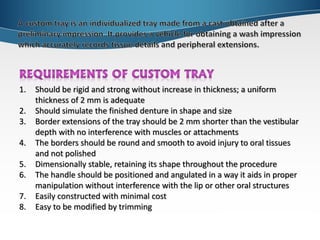
1. Should be rigid and strong without increase in thickness; a uniform
thickness of 2 mm is adequate
2. Should simulate the finished denture in shape and size
3. Border extensions of the tray should be 2 mm shorter than the vestibular
depth with no interference with muscles or attachments
4. The borders should be round and smooth to avoid injury to oral tissues
and not polished
5. Dimensionally stable, retaining its shape throughout the procedure
6. The handle should be positioned and angulated in a way it aids in proper
manipulation without interference with the lip or other oral structures
7. Easily constructed with minimal cost
8. Easy to be modified by trimming
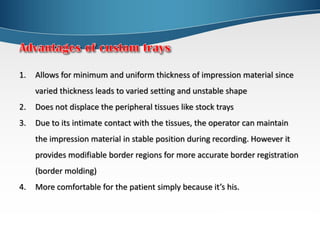
1. Allows for minimum and uniform thickness of impression material since
varied thickness leads to varied setting and unstable shape
2. Does not displace the peripheral tissues like stock trays
3. Due to its intimate contact with the tissues, the operator can maintain
the impression material in stable position during recording. However it
provides modifiable border regions for more accurate border registration
(border molding)
4. More comfortable for the patient simply because it’s his.
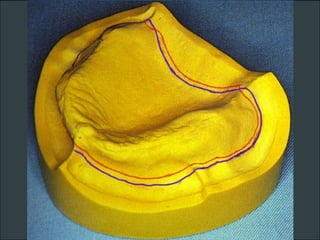
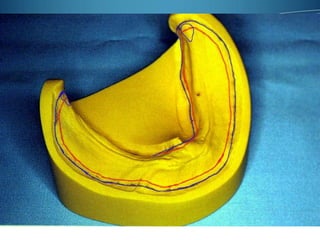
Tray outline
Outlining the study cast following the specific anatomic landmarks in the
maximum extension boundaries, then a 2 mm medial and parallel to this
outline, another line is drawn to which the tray will be fabricated
Relief
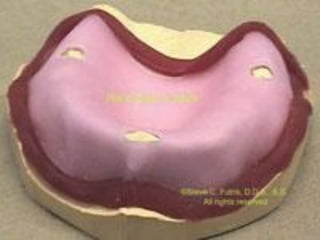
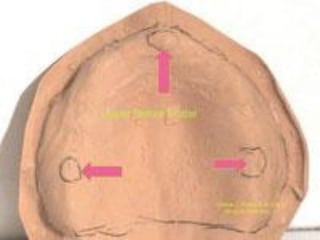
To ensure enough space for the impression material, sometimes a shim or
spacer is made on which the tray is fabricated. The type of impression
material determines the thickness of that spacer according to its minimal
thickness properties. When a spacer is used, often tripod stops are done by
specifying three area one anterior and two posterior on either sides. This
provides a reference for the operator when repositioning of the impression
in the patient’s mouth is needed and act as tissue stops determining the
desired material thickness
Tray extensions
The tray borders should be 2 mm away from the vestibular depth to allow
for enough thickness of the molding compound during border molding. If
there is LESS than 2 mm of modeling compound, it will be difficult for the
material to border mold, and if there is MORE than 3 mm, the amount of
modeling compound needed will be great and it will flow away from the
tissues.
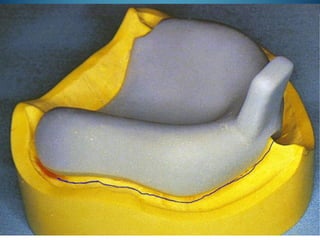
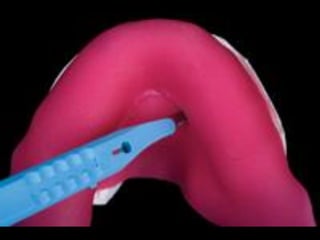
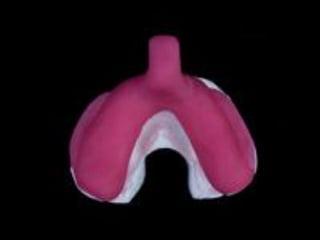
The handle
It should be approximately in the center of the arch in a way not interfering
with lip movement or border molding. It should be around 4 mm thick, 8
mm long and 8 mm wide, biconcave to improve the grip of the tray. For the
maxillary tray 45° angulation will be adequate and more angulation might
be required for the mandibular one.
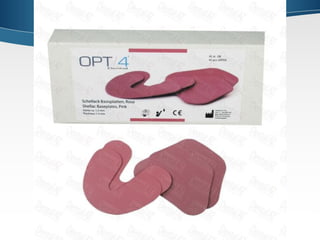
1. Thermoplastic Shellac base plate
2. Auto-polumerizing acrylic resin
3. Visible light-cured resin (composite-acrylic)
4. Thermoplastic vacuum-adapted resin
Advantages of auto-polymerizing acrylic resin
1. Acceptable dimension stability with good fit
2. Can be made thin enough without compromising with rigidity
3. Does not need special equipment
4. Easy to modify by grinding
5. Easy to repair
6. Low cost
Two techniques are used to fabricate a custom tray using acrylic resin:
Sprinkle-on technique and Finger-adapted dough technique
Final impression techniques have been classified in different ways, either
depending on the degree of mouth opening (closed or open mouth) or on the
amount of pressure exerted on the tissues during impression taking.
1. Minimal pressure (muco-static) impression technique
2. Definite pressure (muco-compressive) impression technique
3. Selective pressure impression technique
4. Functional impression technique
 Also called no pressure, passive or open mouth impression technique.
 Static means at rest, so the theory of this technique is to record oral
tissues in its static condition. In order to achieve that a highly flowable
(low viscosity) material is used like plaster of paris or light body
elastomeric material is used under minimal pressure and the oral tissue
are recorded with minimal displacement.
 It’s based on Pascal’s law which states “Pressure in a confined liquid will be
transmitted throughout the liquid in all directions”, according to this, the
mucosa which contains more than 80% water will react like a liquid in a
closed vessel and thus can not be compressed.
 of course this is not true as the mucosa is not a closed vessel and the
tissue fluids can easily escape under the denture borders.
Requirements
1. Needs metal base tray rather than dimensionally unstable acrylic
2. Needs highly fluid material to record the mucosa without distortion so
the finished denture will would fit at all times
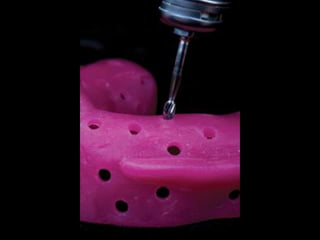
3. Requires a special tray with definite stops with holes to allow excess
material to escape
Advantages
1. Better operator visibility due to it’s an open mouth technique
2. The technique of choice in cases with flabby ridge (increased thickness of
mucosa covering the ridge)
Disadvantages
1. Dimensional changes of impression material and/or casts render the care
used worthless
2. Mucosal typography is not static 24 hrs
3. That technique neglects the value of masticatory force distribution
4. Considered the interfacial surface tension as the only contributing
retentive mechanism
 Also called closed mouth technique. Usually this technique is carried out
under controlled load to the denture bearing area.
 The theory is to record oral tissues under forces resembling forces during
mastication, as a result, the denture will be more stable under occlusal
loads. Such impression would provide an equalized distribution of forces
to the supporting tissue during function.
 It presumes that occlusal loads during impression making is comparable
to that during function.
Requirements
1. Needs a relatively longer setting time material to allow for functional
movements of border tissues
2. Should not be easy flowing under pressure in order to maintain pressure
against tissues, like Zinc-Oxide paste
Advantages
1. Ensures maximum retention of the denture during chewing due to
maximum contact with tissues
2. The ability to form sufficiently the lingual borders as a result of tongue
movements
Disadvantages
1. Dentures made from such technique will not have the same fit during
rest because of the rebound tendency of the distorted tissues
2. Will the long abused tissues (under maximum pressure) maintain the
shape that they assumed to on the impression day?
3. Potentially increased bone resorption due to interference with blood
supply
 A combination technique in which firm areas are recorded with definite
pressure while resilient areas are recorded with little pressure
 Due to the variability in displaceability of oral mucosa, some areas are
believed to withstand more load than other areas like the mucosa
covering the ridge and the primary stress bearing areas, so these areas
should be recorded under heavy force while other softer areas and those
require protection like mid palatal area should be recorded with little
forces; this is the principle of this technique
 It aims to construct a denture base that selectively loads the oral tissues
during function, optimizing the stability and retention of the prosthesis
 It depends on recording the tissues “in function”, thus a provisional
denture is delivered to the patient with its fitting surface relieved all over,
by the aid of a slow set material like tissue conditioner, and after few days
of use, the oral tissues are recorded functionally in various conditions.
Then this layer in converted to hard reline material through laboratory
procedure.
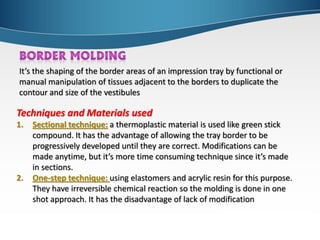
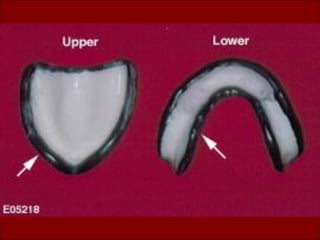
It’s the shaping of the border areas of an impression tray by functional or
manual manipulation of tissues adjacent to the borders to duplicate the
contour and size of the vestibules
Techniques and Materials used
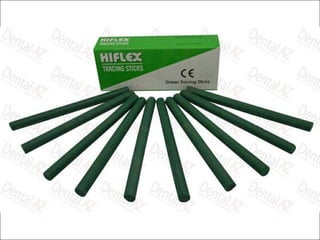
1. Sectional technique: a thermoplastic material is used like green stick
compound. It has the advantage of allowing the tray border to be
progressively developed until they are correct. Modifications can be
made anytime, but it’s more time consuming technique since it’s made
in sections.
2. One-step technique: using elastomers and acrylic resin for this purpose.
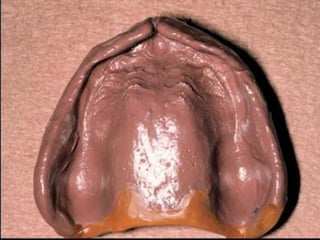
They have irreversible chemical reaction so the molding is done in one
shot approach. It has the disadvantage of lack of modification
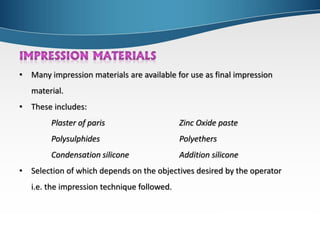
• Many impression materials are available for use as final impression
material.
• These includes:
Plaster of paris Zinc Oxide paste
Polysulphides Polyethers
Condensation silicone Addition silicone
• Selection of which depends on the objectives desired by the operator
i.e. the impression technique followed.
Custom impression cd

Custom impression cd

  • 1.
  • 2.
    1. Should berigid and strong without increase in thickness; a uniform thickness of 2 mm is adequate 2. Should simulate the finished denture in shape and size 3. Border extensions of the tray should be 2 mm shorter than the vestibular depth with no interference with muscles or attachments 4. The borders should be round and smooth to avoid injury to oral tissues and not polished 5. Dimensionally stable, retaining its shape throughout the procedure 6. The handle should be positioned and angulated in a way it aids in proper manipulation without interference with the lip or other oral structures 7. Easily constructed with minimal cost 8. Easy to be modified by trimming
  • 3.
    1. Allows forminimum and uniform thickness of impression material since varied thickness leads to varied setting and unstable shape 2. Does not displace the peripheral tissues like stock trays 3. Due to its intimate contact with the tissues, the operator can maintain the impression material in stable position during recording. However it provides modifiable border regions for more accurate border registration (border molding) 4. More comfortable for the patient simply because it’s his.
  • 4.
    Tray outline Outlining thestudy cast following the specific anatomic landmarks in the maximum extension boundaries, then a 2 mm medial and parallel to this outline, another line is drawn to which the tray will be fabricated Relief To ensure enough space for the impression material, sometimes a shim or spacer is made on which the tray is fabricated. The type of impression material determines the thickness of that spacer according to its minimal thickness properties. When a spacer is used, often tripod stops are done by specifying three area one anterior and two posterior on either sides. This provides a reference for the operator when repositioning of the impression in the patient’s mouth is needed and act as tissue stops determining the desired material thickness
  • 5.
    Tray extensions The trayborders should be 2 mm away from the vestibular depth to allow for enough thickness of the molding compound during border molding. If there is LESS than 2 mm of modeling compound, it will be difficult for the material to border mold, and if there is MORE than 3 mm, the amount of modeling compound needed will be great and it will flow away from the tissues. The handle It should be approximately in the center of the arch in a way not interfering with lip movement or border molding. It should be around 4 mm thick, 8 mm long and 8 mm wide, biconcave to improve the grip of the tray. For the maxillary tray 45° angulation will be adequate and more angulation might be required for the mandibular one.
  • 11.
    1. Thermoplastic Shellacbase plate 2. Auto-polumerizing acrylic resin 3. Visible light-cured resin (composite-acrylic) 4. Thermoplastic vacuum-adapted resin Advantages of auto-polymerizing acrylic resin 1. Acceptable dimension stability with good fit 2. Can be made thin enough without compromising with rigidity 3. Does not need special equipment 4. Easy to modify by grinding 5. Easy to repair 6. Low cost Two techniques are used to fabricate a custom tray using acrylic resin: Sprinkle-on technique and Finger-adapted dough technique
  • 16.
    Final impression techniqueshave been classified in different ways, either depending on the degree of mouth opening (closed or open mouth) or on the amount of pressure exerted on the tissues during impression taking.
  • 17.
    1. Minimal pressure(muco-static) impression technique 2. Definite pressure (muco-compressive) impression technique 3. Selective pressure impression technique 4. Functional impression technique
  • 18.
     Also calledno pressure, passive or open mouth impression technique.  Static means at rest, so the theory of this technique is to record oral tissues in its static condition. In order to achieve that a highly flowable (low viscosity) material is used like plaster of paris or light body elastomeric material is used under minimal pressure and the oral tissue are recorded with minimal displacement.  It’s based on Pascal’s law which states “Pressure in a confined liquid will be transmitted throughout the liquid in all directions”, according to this, the mucosa which contains more than 80% water will react like a liquid in a closed vessel and thus can not be compressed.  of course this is not true as the mucosa is not a closed vessel and the tissue fluids can easily escape under the denture borders.
  • 19.
    Requirements 1. Needs metalbase tray rather than dimensionally unstable acrylic 2. Needs highly fluid material to record the mucosa without distortion so the finished denture will would fit at all times 3. Requires a special tray with definite stops with holes to allow excess material to escape Advantages 1. Better operator visibility due to it’s an open mouth technique 2. The technique of choice in cases with flabby ridge (increased thickness of mucosa covering the ridge) Disadvantages 1. Dimensional changes of impression material and/or casts render the care used worthless 2. Mucosal typography is not static 24 hrs 3. That technique neglects the value of masticatory force distribution 4. Considered the interfacial surface tension as the only contributing retentive mechanism
  • 20.
     Also calledclosed mouth technique. Usually this technique is carried out under controlled load to the denture bearing area.  The theory is to record oral tissues under forces resembling forces during mastication, as a result, the denture will be more stable under occlusal loads. Such impression would provide an equalized distribution of forces to the supporting tissue during function.  It presumes that occlusal loads during impression making is comparable to that during function.
  • 21.
    Requirements 1. Needs arelatively longer setting time material to allow for functional movements of border tissues 2. Should not be easy flowing under pressure in order to maintain pressure against tissues, like Zinc-Oxide paste Advantages 1. Ensures maximum retention of the denture during chewing due to maximum contact with tissues 2. The ability to form sufficiently the lingual borders as a result of tongue movements Disadvantages 1. Dentures made from such technique will not have the same fit during rest because of the rebound tendency of the distorted tissues 2. Will the long abused tissues (under maximum pressure) maintain the shape that they assumed to on the impression day? 3. Potentially increased bone resorption due to interference with blood supply
  • 22.
     A combinationtechnique in which firm areas are recorded with definite pressure while resilient areas are recorded with little pressure  Due to the variability in displaceability of oral mucosa, some areas are believed to withstand more load than other areas like the mucosa covering the ridge and the primary stress bearing areas, so these areas should be recorded under heavy force while other softer areas and those require protection like mid palatal area should be recorded with little forces; this is the principle of this technique  It aims to construct a denture base that selectively loads the oral tissues during function, optimizing the stability and retention of the prosthesis
  • 23.
     It dependson recording the tissues “in function”, thus a provisional denture is delivered to the patient with its fitting surface relieved all over, by the aid of a slow set material like tissue conditioner, and after few days of use, the oral tissues are recorded functionally in various conditions. Then this layer in converted to hard reline material through laboratory procedure.
  • 24.
    It’s the shapingof the border areas of an impression tray by functional or manual manipulation of tissues adjacent to the borders to duplicate the contour and size of the vestibules Techniques and Materials used 1. Sectional technique: a thermoplastic material is used like green stick compound. It has the advantage of allowing the tray border to be progressively developed until they are correct. Modifications can be made anytime, but it’s more time consuming technique since it’s made in sections. 2. One-step technique: using elastomers and acrylic resin for this purpose. They have irreversible chemical reaction so the molding is done in one shot approach. It has the disadvantage of lack of modification
  • 27.
    • Many impressionmaterials are available for use as final impression material. • These includes: Plaster of paris Zinc Oxide paste Polysulphides Polyethers Condensation silicone Addition silicone • Selection of which depends on the objectives desired by the operator i.e. the impression technique followed.