Curriculum representations November 2009
CBM (2009) framework overview 4 views have been identified to represent a course: Pedagogy profile Course map Cost effectiveness Course performance + supporting narrative & good practice principles
Selecting exemplars Faculties are identifying courses that are Pedagogically effective Innovative Deliver high levels of student satisfaction and performance Cost effective Aligned with one or more Strategic Objectives Historical and forward looking – an on-going process.
View 1  Pedagogy profile How we want to teach Deconstructing learning activities Analysing student tasks and time Challenging ‘content heavy’ approaches  Encouraging variety
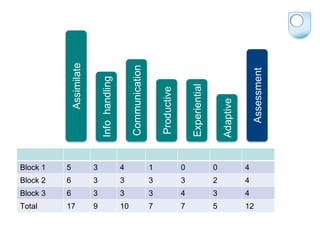
Pedagogy profile Maps types of student tasks against course structure Block 1 Block 2 Block 3 Total
Block 1 Block 2 Block 3 Total Block 1 5 3 4 1 0 0 4 Block 2 6 3 3 3 3 2 4 Block 3 6 3 3 3 4 3 4 Total 17 9 10 7 7 5 12
Pedagogy profile widget
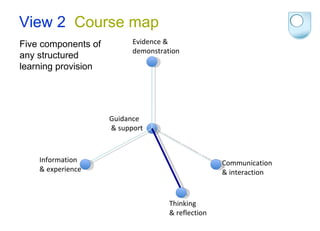
View 2   Course map Five components of any structured learning provision Guidance & support Evidence &  demonstration Communication  & interaction Information  & experience Thinking  & reflection
Guidance & support Evidence & demonstration Information &  experience Communication & interaction Thinking  & reflection
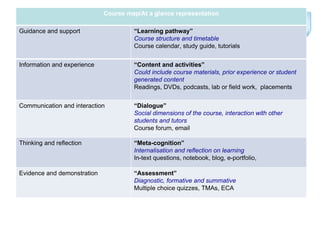
Course map/At a glance representation Guidance and support “ Learning pathway” Course structure and timetable Course calendar, study guide, tutorials Information and experience “ Content and activities” Could include course materials, prior experience or student generated content Readings, DVDs, podcasts, lab or field work,  placements  Communication and interaction “ Dialogue” Social dimensions of the course, interaction with other students and tutors Course forum, email Thinking and reflection “ Meta-cognition” Internalisation and reflection on learning In-text questions, notebook, blog, e-portfolio,  Evidence and demonstration “ Assessment” Diagnostic, formative and summative Multiple choice quizzes, TMAs, ECA
Information & experience PDF resources Links to e-journal articles and other websites Evidence & demonstration 6 TMAs – submitted online (505 of overall score) 3hr examination (50% of overall score) Thinking & reflection Activities throughout learning guides (4-7 per guide) 5 website ‘interactives’ Journal space in MyStuff Core questions, thinking points and summaries in course books Communication & interaction Course-wide Café forum Tutor group forums with sub-forums for each block F2F tutorials near beginning, middle and end of course (some regional variation) Guidance & support Study planner 20 Learning guides General assessment guidance TMA questions Course guide Study calendar KE312 Working Together for Children 60pt course over 32 weeks 3 blocks/20 learning guides Whole weeks devoted to TMAs Consolidation week (week 22) Practice related Aligned to latest prof framework for mult-agency working Rich case studies Read – relate to practice – reflect – write  3 co-published course books (21 chapters/ 960pp) DVD – videos of 3 practice settings + interviews (XXmin) Plus own experience and practice Tutor support  – 1:20; 21 contact hrs; band 7 Course map example
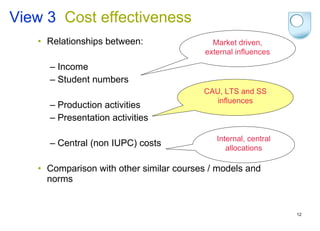
View 3   Cost effectiveness Relationships between: Income Student numbers Production activities Presentation activities Central (non IUPC) costs Comparison with other similar courses / models and norms Market driven, external influences CAU, LTS and SS influences Internal, central allocations
Current data sources Post launch review process General ledger RPT LTS IUPC analysis SS IUPC analysis PLANET (for student numbers) TRAC (for staff resource) CL
Example – K208 Effective practice in youth justice CL
Comparison of course costs CL
View 4   Course performance - basic Derived from IET student survey data
Course performance – basic plus
‘ View 5’   Supporting narrative and good practice principles Under development.  Some examples below: Design decision variable Example Production/pedagogical approach Course guidance: Tutor-directed – student-directed Learning approach: Passive-learning – active-learning Production/content Course team produced: bought in wrap around Reuse: free standing assets – bespoke/contextualised (within faculty & cross-faculty) Production/staff resource Staff resource (academic): 12 months – 18 months Consultancy: 0 -100% Production/timeliness (fit to market) Time scale: 6 months – 2 years Aligns with current subject trends: √ Presentation Tutor/student ratio: N/A , (1-30) – (1-10) Tuition management: centrally managed – hub – regionally managed
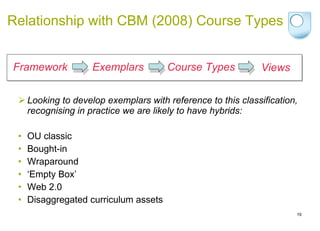
Relationship with CBM (2008) Course Types  Looking to develop exemplars with reference to this classification, recognising in practice we are likely to have hybrids: OU classic Bought-in Wraparound ‘ Empty Box’ Web 2.0 Disaggregated curriculum assets Framework Exemplars Course Types Views
Next steps Developing the 5 th  view which profiles a course in relation to a set of key variables Continue to refine and consolidate all views Finalise list of exemplar courses and check that all course types represented Produce complete set of views for a selection of exemplars Disseminate discussion document, analysis of exemplar courses and toolkit for faculties to use Arrange further workshops and presentations Integrate this work with Stage Gate Process review, PLANET redevelopment and other initiatives

Curriculum Representations

  • 1.
  • 2.
    CBM (2009) frameworkoverview 4 views have been identified to represent a course: Pedagogy profile Course map Cost effectiveness Course performance + supporting narrative & good practice principles
  • 3.
    Selecting exemplars Facultiesare identifying courses that are Pedagogically effective Innovative Deliver high levels of student satisfaction and performance Cost effective Aligned with one or more Strategic Objectives Historical and forward looking – an on-going process.
  • 4.
    View 1 Pedagogy profile How we want to teach Deconstructing learning activities Analysing student tasks and time Challenging ‘content heavy’ approaches Encouraging variety
  • 5.
    Pedagogy profile Mapstypes of student tasks against course structure Block 1 Block 2 Block 3 Total
  • 6.
    Block 1 Block2 Block 3 Total Block 1 5 3 4 1 0 0 4 Block 2 6 3 3 3 3 2 4 Block 3 6 3 3 3 4 3 4 Total 17 9 10 7 7 5 12
  • 7.
  • 8.
    View 2 Course map Five components of any structured learning provision Guidance & support Evidence & demonstration Communication & interaction Information & experience Thinking & reflection
  • 9.
    Guidance & supportEvidence & demonstration Information & experience Communication & interaction Thinking & reflection
  • 10.
    Course map/At aglance representation Guidance and support “ Learning pathway” Course structure and timetable Course calendar, study guide, tutorials Information and experience “ Content and activities” Could include course materials, prior experience or student generated content Readings, DVDs, podcasts, lab or field work, placements Communication and interaction “ Dialogue” Social dimensions of the course, interaction with other students and tutors Course forum, email Thinking and reflection “ Meta-cognition” Internalisation and reflection on learning In-text questions, notebook, blog, e-portfolio, Evidence and demonstration “ Assessment” Diagnostic, formative and summative Multiple choice quizzes, TMAs, ECA
  • 11.
    Information & experiencePDF resources Links to e-journal articles and other websites Evidence & demonstration 6 TMAs – submitted online (505 of overall score) 3hr examination (50% of overall score) Thinking & reflection Activities throughout learning guides (4-7 per guide) 5 website ‘interactives’ Journal space in MyStuff Core questions, thinking points and summaries in course books Communication & interaction Course-wide Café forum Tutor group forums with sub-forums for each block F2F tutorials near beginning, middle and end of course (some regional variation) Guidance & support Study planner 20 Learning guides General assessment guidance TMA questions Course guide Study calendar KE312 Working Together for Children 60pt course over 32 weeks 3 blocks/20 learning guides Whole weeks devoted to TMAs Consolidation week (week 22) Practice related Aligned to latest prof framework for mult-agency working Rich case studies Read – relate to practice – reflect – write 3 co-published course books (21 chapters/ 960pp) DVD – videos of 3 practice settings + interviews (XXmin) Plus own experience and practice Tutor support – 1:20; 21 contact hrs; band 7 Course map example
  • 12.
    View 3 Cost effectiveness Relationships between: Income Student numbers Production activities Presentation activities Central (non IUPC) costs Comparison with other similar courses / models and norms Market driven, external influences CAU, LTS and SS influences Internal, central allocations
  • 13.
    Current data sourcesPost launch review process General ledger RPT LTS IUPC analysis SS IUPC analysis PLANET (for student numbers) TRAC (for staff resource) CL
  • 14.
    Example – K208Effective practice in youth justice CL
  • 15.
  • 16.
    View 4 Course performance - basic Derived from IET student survey data
  • 17.
  • 18.
    ‘ View 5’ Supporting narrative and good practice principles Under development. Some examples below: Design decision variable Example Production/pedagogical approach Course guidance: Tutor-directed – student-directed Learning approach: Passive-learning – active-learning Production/content Course team produced: bought in wrap around Reuse: free standing assets – bespoke/contextualised (within faculty & cross-faculty) Production/staff resource Staff resource (academic): 12 months – 18 months Consultancy: 0 -100% Production/timeliness (fit to market) Time scale: 6 months – 2 years Aligns with current subject trends: √ Presentation Tutor/student ratio: N/A , (1-30) – (1-10) Tuition management: centrally managed – hub – regionally managed
  • 19.
    Relationship with CBM(2008) Course Types Looking to develop exemplars with reference to this classification, recognising in practice we are likely to have hybrids: OU classic Bought-in Wraparound ‘ Empty Box’ Web 2.0 Disaggregated curriculum assets Framework Exemplars Course Types Views
  • 20.
    Next steps Developingthe 5 th view which profiles a course in relation to a set of key variables Continue to refine and consolidate all views Finalise list of exemplar courses and check that all course types represented Produce complete set of views for a selection of exemplars Disseminate discussion document, analysis of exemplar courses and toolkit for faculties to use Arrange further workshops and presentations Integrate this work with Stage Gate Process review, PLANET redevelopment and other initiatives

Editor's Notes

  • #13 Summary to show that cannot look at discreet elements, but the whole picture and the impact on each. However, only influential directly and in the short term are within production and presentation activities. Some of the proposals from these may also impact on other income and costs.
  • #14 Currently, the only source of suitable data is from PLR review. Appreciate there are limitations, but it is one which everyone should be familiar with and able to interpret and interrogate for the sample of courses
  • #16 As a summary of costs – use to compare at a high level, why are there differences in amounts and proportions? Tolerance bands etc? How much variation should we expect?