Focus on Basics I N T H I S I S S U E : 
Curriculum 
Development 
1 
Collaborating with Students 
to Build Curriculum that 
Incorporates Real-Life Materials 
Charissa Ahlstrom 
8 
Values and Beliefs: The World 
View Behind Curriculum 
Amy Prevedel 
14 
A Conversation with FOB 
What Works for Adult ESL Students 
Heide Wrigley 
18 
One Classroom, Two 
Languages: Adult Bilingual 
Curriculum Development 
Kay Taggart and Sara Martinez 
22 
Same Curriculum, 
New Mode of Delivery 
Jane Martel 
26 
Changing a State’s Approach 
to Curriculum: Insight from 
Oregon’s Efforts 
Dennis Clark 
30 
Creating Curricula for 
Challenging Circumstances 
Barbara Garner 
32 
Not By Curriculum Alone 
Mary Lynn Carver 
38 
All About NCSALL 
39 
Blackboard 
40 
New From NCSALL 
CONNECTING RESEARCH & PRACTICE 
Collaborating with Students 
to Build Curriculum that 
Incorporates Real-Life Materials 
by Charissa Ahlstrom 
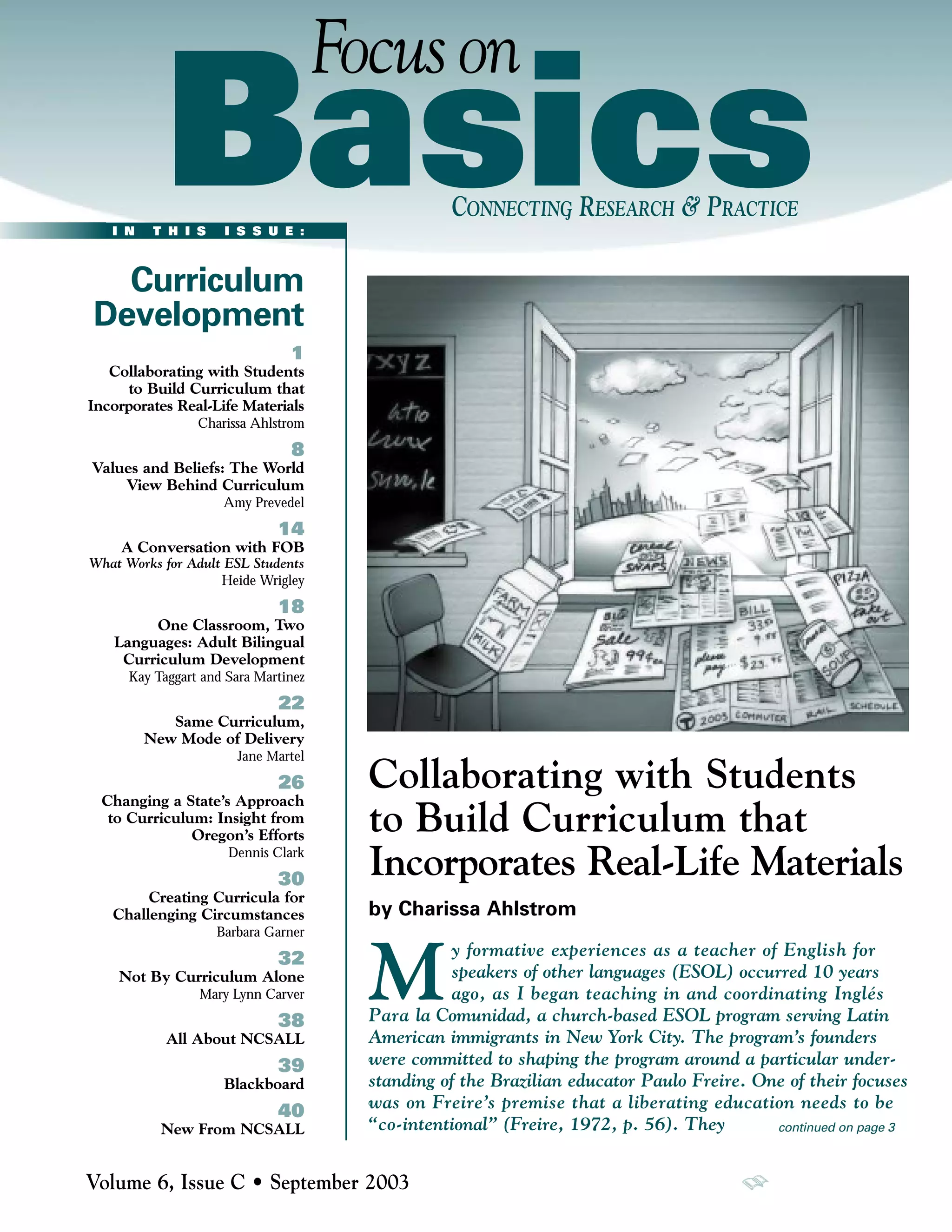
My formative experiences as a teacher of English for 
speakers of other languages (ESOL) occurred 10 years 
ago, as I began teaching in and coordinating Inglés 
Para la Comunidad, a church-based ESOL program serving Latin 
American immigrants in New York City. The program’s founders 
were committed to shaping the program around a particular under-standing 
of the Brazilian educator Paulo Freire. One of their focuses 
was on Freire’s premise that a liberating education needs to be 
“co-intentional” (Freire, 1972, p. 56). They 
continued on page 3 
Volume 6, Issue C • September 2003 WORLD EDUCATION NCSALL
Basics 
Focus on Focus on Basics is the quarterly 
publication of the National 
Center for the Study of Adult 
Learning and Literacy. It presents best 
practices, current research on adult 
learning and literacy, and how research is 
used by adult basic education teachers, 
counselors, program administrators, and 
policymakers. Focus on Basics is dedicated 
to connecting research with practice, to 
connecting teachers with research and 
researchers with the reality of the class-room, 
and by doing so, making adult 
basic education research more relevant 
to the field. 
All subscription and editorial 
correspondence should be sent to: 
Focus On Basics 
World Education 
44 Farnsworth Street 
Boston, MA 02210–1211 
e-mail address: FOB@WorldEd.org 
Focus on Basics is copyrighted, but we 
urge readers to photocopy and circulate 
the publication widely. When reprinting 
articles, please credit Focus on Basics 
and the National Center for the Study 
of Adult Learning and Literacy. 
Editor: Barbara Garner 
Layout: Mary T. White 
Illustrator: Mary T. White 
Proofreader: Celia Hartmann 
Focus on Basics is published by the 
National Center for the Study of Adult 
Learning and Literacy (NCSALL). 
NCSALL is funded by the Educational 
Research and Development Centers 
Program, Award Number R309B60002, 
as administered by the Office of Educa-tional 
Research and Improvement/ 
National Institute of Postsecondary 
Education, Libraries, and Lifelong 
Learning, U.S. Department of Education. 
The contents of Focus on Basics do not 
necessarily represent the positions or 
policies of NCSALL or the National 
Institute on Postsecondary Education, 
Libraries, and Lifelong Learning; World 
Education; the Office of Educational 
Research and Improvement; or the U.S. 
Department of Education, and you 
should not assume endorsement by 
the Federal Government. 
Welcome! 
Curriculum is at the heart of adult basic education. It reflects our educational 
philosophy and beliefs about the goals of education. What are the different philo-sophical 
approaches to curriculum? What does research tell us about curriculum? How 
do teachers, programs, even states go about creating curriculum, and what lesson 
can we learn from them? In this issue of Focus on Basics, we explore those questions. 
In our cover article, Massachusetts teacher Charissa Ahlstrom describes how she 
develops her curriculum as she goes, based on her students’ interests, working within 
a loose framework developed by her program. She brings in “real life” materials that 
connect the classroom to students’ day-to-day lives. The classroom-to-real-life con-nection 
is important, according to research teams led by Victoria Purcell-Gates and 
Heide Spruck Wrigley (see pages 5 and 13). How do you bring the outside into your 
curriculum? 
Different approaches to curriculum reflect different world views, writes Amy 
Prevedel in her overview of key curriculum theories (see page 8). She describes three 
major categories of curriculum — traditional, learner-driven, and critical — and 
the strength and weaknesses of each. Into which category does your approach fall? 
Kay Taggart and Sara Martinez help teachers in El Paso, Texas, understand 
how to optimize the impact of bilingual curricula (see page 18). The judicious use of 
English along with students’ native language leads to conceptual understanding and 
communicative competence. Wrigley’s research (page 13) reinforces this: students in 
classes of English for speakers of other languages had higher gains when they shared 
a language and the teacher used the language to give instructions or to clarify points. 
How does curriculum change when the mode of delivery changes? That’s the 
issue Jane Martel and her colleagues faced when Kentucky’s professional develop-ment 
for adult basic education went online. Benefit from the lessons they learned by 
reading the article that begins on page 22. And while Kentucky was converting its 
professional development curriculum, Oregon was revising its adult basic education 
curriculum. How does a state change curriculum? It takes policy, practice, and pro-fessional 
development. Teacher Dennis Clark shares his experiences as a leader in 
that process in the article that starts on page 26. 
Sometimes the context has a huge impact on the shape a curriculum takes. 
That was the case in Guinea, West Africa, where I worked with World Education 
colleagues to develop a basic literacy program for adults. Turn to page 30 to read about 
how we managed to reflect our educational values in a resource-poor environment. 
When your learners are not making the progress they should, it’s time to look at 
curriculum, writes Mary Lynn Carver, a teacher in Illinois, in the article that begins 
on page 32. Curriculum change in her program spread from individuals to the system, 
and encompassed not just what was taught but how classes were scheduled. 
Whatever your philosophy and approach to curriculum, we hope this issue provides 
you with insights and resources you need to strengthen your program. 
Sincerely, 
Barbara Garner 
Editor 
2 SEPTEMBER 2003 • NCSALL
Focus on Basics 
Real-Life Materials 
continued from page 1 
interpreted this to mean that 
students and teachers should 
engage in dialogue, investigating 
themes as equals and creating 
new understandings of the 
world together. The curriculum 
had to address student needs, 
reflect collaboration between 
the learners and the teachers, 
and include regular student 
evaluation. 
Ever since then, I’ve tried 
to create curricula that reflect 
collaboration between the students 
and me. Today, my curriculum 
includes student-identified themes 
combined with structured language 
practice, and an emphasis on 
communication. Sometimes I use 
the themes in a Freirean way, as 
ways to enter into an examination of 
underlying power structures. I often 
use the themes more simply as a way 
to ensure that students are learning 
content that matters to them. I try 
to use a wide variety of material and 
media, prioritizing student-created 
texts and materials that students 
might encounter in their daily lives. 
In this article, I’ll explain why and 
how I do this. 
The Students’ 
Perspective 
In the orientation we provided to 
volunteers at Inglés Para la Comunidad, 
we shared this story from Pedagogy of 
the Oppressed (Freire, 1972). Freire 
describes an educator who was 
working with Brazilian tenement 
residents and wanted to do a lesson 
on alcoholism. The teacher showed 
the tenement residents a picture of a 
drunken man and three men talking, 
and asked them to comment on 
the picture. Rather than comment 
negatively on the alcoholism, the 
residents said: 
The only one there who is pro-ductive 
and useful to his country is 
the souse who is returning home after 
working all day for low wages and who is 
worried about his family because he can’t 
take care of their needs. He is the only 
worker. He is a decent worker and a 
souse like us” (p. 111). 
Freire used this example to dem-onstrate 
how teachers should begin 
“thematic investigations” (p. 112). I 
like this story because it reminds me 
not to assume that I know my students’ 
perspectives or needs with regard to 
a particular theme. Auerbach (1992) 
also stresses the importance of this 
collaborative process of identifying 
“the real (rather than imagined) 
issues of each group” (p. 1). 
It’s easy to get carried away with 
my own excitement in creating cur-riculum 
or with my own perspective on 
an issue. Once, when I was teaching a 
unit on shopping, I asked the students 
what problems they encountered at 
stores. One student complained that 
cashiers had treated her unkindly 
because she used food stamps. Hearing 
that, I immediately planned to have 
the students practice writing letters 
to a manager. But then I remembered 
that I should pose the question to the 
students and brainstorm ideas so we 
could collaboratively reach solutions. 
They said they were more inclined 
to talk to the manager immediately, 
so we practiced conversations, in 
addition to brainstorming multiple 
ways to respond to the situation. 
At Inglés Para la Comunidad, 
we did not consider formal grammar 
instruction to be ineffectual (Krashen 
& Terrell, 1995), but, at the same 
time, grammar was not an end 
in itself. Communication was the 
primary focus: we worked on grammar 
within the context of the themes 
brought out by the students; and we 
also addressed grammar in its role as 
an aid to effective communication. If 
students had difficulty with the past 
tense, and we were discussing health, 
we had students share past experiences 
at the doctor, in the hospital, and 
how they dealt with illnesses in their 
country. We used these contexts to 
introduce or review past tense forms, 
and examined how grammar issues 
impeded their effective conversation 
and writing. 
Program Framework 
I currently teach ESOL at the 
Adult Learning Program (ALP) of the 
Jamaica Plain Community Centers, in 
Boston, MA. I am teaching a class of 
My Definition of Curriculum 
Underlying my use of the term “curriculum” are two interrelated 
assumptions. First, building on my understanding of Freire (1972), I 
believe that curriculum is not neutral. The curriculum I use supports the 
development of English language skills. It also instills values and political 
views. This transmission of knowledge and values is both explicit and 
implicit. I also agree with Cornbleth’s understanding of curriculum (1990) as 
a “contextualized social process.” Curriculum includes not only the entirety 
of activities, methods, materials, and physical and social environment of 
the whole learning center, but also the dynamic processes that shape and 
change these components. Multiple bodies and forces, for example, the 
staff, the broader sociopolitical forces, a program’s funders, the students 
themselves, as well as community and national or international events, 
shape these processes. While the term “curriculum” can refer to the entirety 
of learning occurring within a center, in my article I often use the term to 
refer to the environment of my class, including students’ input alongside 
the program’s criteria for my level. 
—Charissa Ahlstrom 
NCSALL • SEPTEMBER 2003 3
Focus on Basics 
advanced beginners (level two of six 
levels of ESOL); the lowest ability 
level in the class is SPL 2-3 as 
measured by the Basic English Skills 
Test (BEST) and the Arlington Edu-cation 
Employment Program (REEP) 
writing assessment. My students 
are from Haiti, Somalia, and Latin 
America; their educational levels 
range from some higher education 
to only three years of education. My 
class is held three evenings a week for 
a total of eight hours a week. We have 
classes throughout the year, 
with on-going entry. We do 
not have exact “sessions,” 
although September, January, 
and June emerge as times of 
greater transition for students 
entering, leaving, and advan-cing 
to higher levels within 
the program. 
In our program, the ESOL 
teachers have created level 
guides that identify what 
standards we use to advance 
students to the next level. 
These lists include such items 
as “demonstrates familiarity 
[with] and usage of simple 
present and present progressive” and 
“able to use a bilingual dictionary.” 
Teachers created the original check-lists 
a number of years ago. Each year, 
the teachers work together to “tweak” 
the lists so that they reflect the 
current students’ needs, adjusting 
them if students’ language needs have 
changed significantly. The level 
guides are helpful tools to use when 
talking to students and to other 
teachers about students’ progress, as 
well as for initial placement. We also 
use these lists to guide, but not dic-tate, 
language and skill instruction at 
each level. The teacher and the class 
determine the manner in which a 
class covers these skills and language. 
Soliciting Themes 
from Students 
I build curricula by soliciting 
themes from students and combining 
them with language skills typical of 
our program’s level two, using our 
level guide as the reference. I use a 
variety of structured activities, such 
as checklists (with pictures) or brain-storming, 
to discover what themes are 
interesting or important to students. 
I also gain ideas informally, noticing 
which topics engage students emo-tionally. 
For example, during a recent 
conversation about what people did 
over the weekend, one woman told us 
that her car was stolen. This sparked 
an active discussion, with many 
“I build curricula by 
soliciting themes from 
students and combining 
them with language skills 
typical of our program’s 
level two, using our level 
guide as the reference.” 
students recounting their experiences 
of crime, and sharing advice and 
suggestions on crime prevention. Class 
members were very concerned, so I in-cluded 
crime prevention as a subsequent 
free-writing and conversation topic. 
Once I have ideas about students’ 
wants and needs, I follow the example 
of a colleague and place the themes 
on a list and ask students to vote on 
which topic to cover next. When I 
finish that unit, which may take any-where 
from six to eight weeks, the list 
goes back up, the students add more 
topics if they like, and they vote again. 
(Since they are level two students, 
sometimes I put pictures up next to 
items on the list to help them decipher 
the vocabulary.) This past year, the 
students concluded most thematic units 
with projects. For example, at the end 
of a unit on maps and directions, the 
students composed directions to their 
homes, and we all used one student’s 
work when she invited the class over 
for dinner. At the end of a unit on 
reading the newspaper, the students 
created their own newspaper, writing 
columns, horoscopes, an advice col-umn, 
and drawing cartoons. 
Spontaneous themes sometimes 
emerge from my own reading of our 
class dynamics, or when I want to em-phasize 
alternatives to the dominant 
US culture. For example, I often high-light 
Muslim culture and holidays and 
ask Muslim students if they are willing 
to present their traditions, since their 
peers have expressed a lack of 
knowledge of the words mosque, 
Muslim, and Ramadan, and 
why students leave the room 
to pray. If difficult or large-scale 
political or news events 
occur, I provide time in class to 
discuss and explore them, and 
develop them further as themes 
if students are interested. If a 
difficult issue has arisen in class, 
such as an offensive comment 
or a conflict between students, 
I try to address it quickly 
through the curriculum and 
in a class discussion. 
Materials 
Based on the themes and goals 
the students have chosen, I use what-ever 
materials are needed to build 
students’ abilities to address their 
goals: this often includes what I call 
“real life” material, but not necessarily 
or exclusively. The term “real-life” 
implies to me certain survival-level and 
practical themes related to daily life 
in the community, such as shopping, 
getting jobs, and transportation, which 
are often — but not always — the 
themes students choose. Others use 
the terms “real life” and “authentic” 
fairly interchangeably, and apply them 
to a wider range of materials. Nunan 
(1988) uses the term “authentic” 
materials to describe those that “reflect 
the outside world,” and “have been 
produced for purposes other than to 
teach language” (p. 99). Purcell-Gates 
and colleagues (2001) describe 
authentic materials, or learner- 
4 SEPTEMBER 2003 • NCSALL
Focus on Basics 
contextualized materials, as print 
materials that occur naturally in the 
lives of learners outside of their adult 
education classrooms (p. 19). Some 
obvious examples are newspapers, 
magazines, bills, maps, job applications, 
or novels. Radio broadcasts, music, 
television, or videos can be considered 
authentic “listening” materials, and 
an important element of ESOL. 
I also use technology — mostly 
computers, but occasionally tape 
recorders, cameras, or camcorders as 
well — for real life purposes. While I 
occasionally use an ESOL software pro-gram 
to reinforce a theme or language 
skill in a traditional “school” way (for 
a drill, for example), I focus on creating 
lessons that allow learners to use the 
computer in ways they want to outside 
of the classroom. For example, my 
students have set up e-mail accounts, 
looked up information from their 
countries, examined web sites created 
by other ESOL learners, contacted 
legislators, learned games, practiced 
typing, and typed their own writing 
using the computer. 
I use real life materials to connect 
further the theme the students have 
chosen to their learning goals. 
Widdowson (1990) points out that it 
is not the text or source itself that 
fosters student learning, but rather 
students’ engagement with it. Poorly 
selected or presented authentic — 
real life — materials can be irrelevant 
or inaccessible to students. Collab-orating 
with students to choose themes 
and materials is an important aspect of 
ensuring that materials are meaning-ful 
to the learners, but so is ensuring 
that the materials are accessible. 
What It Looks Like 
Once the class has decided upon 
a topic, I ask the students for more 
details. For example, my students 
recently voted to review maps and 
directions, so I asked them what maps 
they found difficult, and which ones 
they wanted to practice. A few said 
the “T” (Boston subway) map was 
pretty easy, but the Massachusetts or 
The Impact of Use of 
Authentic Materials and Activities 
The Literacy Practices of Adult Learners Study (LPALS), sponsored by 
NCSALL, looked at changes in the literacy practices of adults as a result of 
attending literacy classes. Students who participate in classes that include 
authentic, or learner-contextualized, materials and activities are more likely 
to say they had started new literacy practices or had increased the amount 
of time spent engaging in literacy activities outside of school. This was true 
even when the researchers controlled for (or accounted for) students’ literacy 
levels and the amount of time they had been attending class. 
When one looks closely at the questionnaire and interview data, many of 
the students in the LPALS reported that they began, increased the frequency 
of, or stopped specific reading and writing practices when their lives changed 
in some way. These life changes brought with them different types of texts, 
different purposes and requirements for reading and writing, and different 
inclinations to read and write. New mothers began writing to family members 
for the first time after their children’s births. Immigrants found new types of 
texts available for reading in their new country. When children began school, 
parents began receiving letters and directions from school authorities, many 
of which required written responses. New jobs meant having to learn how 
to read and write different types of materials, including, for example, bus or 
train schedules. Moving away from home meant reading and paying bills for 
the first time. Literacy practices (actual reading and writing in life) are always 
interwoven with peoples’ lives and the ways in which they are lived. Classes 
that were sensitive to the changing nature of students’ lives outside school 
were seen as doing a better job of supporting students in their learning of 
new uses for reading and writing. 
With these findings, the researchers are able to provide empirical 
justification for the beliefs of many adult educators: Bringing the lives, needs, 
and interests of the students into the classroom is an integral part of best 
practice. Creating Authentic Materials and Activities for the Adult Literacy 
Classroom, A Handbook for Practitioners, a book designed to help teachers 
turn these findings into action in the classroom, by the LPALS research team 
of Erik Jacobson, Sophie Degener, and Victoria Purcell-Gates, is available 
now from NCSALL. Access the report online at http://ncsall.gse.harvard.edu, 
or contact Caye Caplan by phone at (617) 482-9485 to order a printed copy 
for a small charge. Additional articles based on this research are available in 
Volumes 4D (pp. 19-22) and 3D (pp. 26-27) of Focus on Basics, also available 
on the NCSALL web site. 
Boston neighborhood maps could be 
very difficult. Since they were familiar 
with the “T” map, I used it to introduce 
and practice new vocabulary and to 
review prepositions, which seemed to 
be difficult for them. I introduced the 
other two maps once they were more 
comfortable with giving and getting 
directions. 
In that example, the students 
used actual “real-life” materials as a 
basis to learn to use more difficult 
authentic materials. But sometimes 
students cannot immediately use the 
materials in the ways that native 
speakers may use them. Widdowson 
(1990) discusses how “meanings are 
achieved by human agency, and are 
negotiable; they are not contained 
in the text.” I need to present the 
materials in a way that students can 
create the most meaning from them, 
and therefore I may need to scaffold 
them into a particular text or media. 
NCSALL • SEPTEMBER 2003 5
Focus on Basics 
For example, when the class and I look 
at bills together, we sometimes examine 
small pieces of the statement at a 
time. We do preliminary brainstorming 
on the parts and difficulties of bills. 
If students want to work together on 
filling out job applications, for example, 
they might create work and education 
time lines as a first step before jumping 
to the format of actual applications. 
We might do some games, activities, 
or exercises to reinforce new concepts 
or vocabulary found in the materials. 
Last year, students wanted 
to read newspapers, such as the 
Boston Globe, the Metro, and 
the Boston Herald. Yet my 
students find even News for You, 
a newspaper written for adult 
learners and published by New 
Readers Press (see www.news-for- 
you.com), very challenging, 
and, for a few learners, over-whelming. 
Many students, for 
example, have difficulty under-standing 
the difference between 
struggle when students 
“article” and “advertisement,” 
and differentiating an article from an 
advertisement in the newspaper. Many 
do not know how to use the index or 
list of contents. I scoured the popular 
papers for articles that were short and 
accessible to some, and also conducted 
activities that familiarized students with 
the formats of newspapers. In addition, 
I provided them with opportunities to 
discuss and build their knowledge of 
current events, by watching the TV 
news or reading newspapers from their 
home countries online and reporting 
on the articles in English in class or 
small groups. So although they did 
not use the newspapers as full reading 
texts, they increased their abilities to 
navigate and understand the media, as 
well as to discuss current news topics. 
Practicing 
Conversation 
“Authentically” 
Using authentic materials can be 
a struggle when students want to focus 
on conversation. This past fall, students 
chose the theme “conversations with 
the doctor.” How can I replicate 
individual doctor conversations? I 
can’t bring their individual doctors 
in, so I created situations to sim-ulate 
conversations, and had them 
practice with each other. After they 
chose health topics they wanted 
to practice discussing, they used 
“authentic materials” to do some 
research. The medical pamphlets, 
encyclopedias, and health books 
were often too difficult, so a 
“Using authentic 
materials can be a 
want to focus on 
conversation.” 
volunteer tutor and I simplified a 
few passages, and provided videos 
and children’s health books on the 
topics as well. Then they used tape 
recorders to tape spontaneous dia-logues 
on their topics. The students 
transcribed and edited their dialogue, 
then retaped them in a more re-hearsed 
way. We used these tapes 
as the texts for listening and compre-hension, 
as well as the transcripts for 
reading texts. 
This undertaking was our project-based 
component. In between these 
activities, we had conversations about 
problems people had with the doctor, 
and we compared American hospitals 
and concepts of health and medicine 
with those of the students’ native 
countries. The students read photo-stories 
(created by adult learners) and 
short books (created for adult learners) 
on breast cancer and debated the 
question of prescribing medicine for 
children diagnosed as hyperactive. 
They also shared opinions and stories 
on these issues, and gave presentations 
on their stories. 
Student-Created 
Materials 
My students often create 
things, such as the transcriptions 
of dialogues described above, as well 
as newsletters, tapes, or stories that, 
with permission, I can use in future 
classes. Sometimes, students take 
pictures at work, or bring in objects 
from their home as sources for 
conversation or writing. I use 
learner-created materials to provide 
texts that are relevant and 
meaningful to my students. 
The materials are usually 
accessible to others in my class, 
and they create a base of 
learning that is centered on 
the class’s own knowledge. 
Students appreciate reading 
the work of their peers, and I 
want to use the inherent 
power of my position as a 
teacher to validate students’ 
work as rich texts. 
Integrating Specific 
Language Skills 
When students need to review 
specific language skills, I inten-tionally 
integrate activities that 
focus on those skills. For example, 
I present the structures, and then 
incorporate activities for students to 
self-edit, paying attention to these 
particular structures in their own 
texts. I lead a few drills and games 
to practice an isolated pattern, and 
I try to draw on the students’ native 
language knowledge to help them 
understand or analyze a particular 
language structure. To the extent 
possible, I use students’ own work as 
well as the thematic topic as the point 
of departure for work with grammar. 
Old Favorites 
Regardless of what themes or 
language topics learners choose, I 
always assign dialogue journals, which 
involve correspondence between 
individual students and me. The 
6 SEPTEMBER 2003 • NCSALL
Focus on Basics 
journals help students to develop 
their abilities and provide more 
individualized opportunities for skill 
development than activities that are 
more collectively created. They are by 
nature on-going and run concurrently 
to the shorter-term thematic units. I 
don’t mark the journals, but provide 
students with feedback via the questions 
I pose. I also model correct spelling or 
structures within my response letter. 
The students also keep free-writing 
journals, in which, twice a month, they 
write without any restrictions on topic, 
without any editing or correction of 
grammar. Both journals give students 
an opportunity to reflect and explore 
about personal topics that might 
interest or concern them. For example, 
sometimes students write about why 
their work day was difficult, or that 
it’s their child’s birthday. Their entries 
provide me with insight into 
what shapes or affects them 
as learners. 
I also have students 
engage in reading circles or 
specialized circles throughout 
the year. In the former, stu-dents 
choose from a list of 
some longer books to read 
(often texts created by 
and/or for adult learners), 
and separate into groups 
based on their choices. 
The books can take up to 
10 weeks for the students 
to finish. These groups meet 
once a week during class to 
read and discuss the books 
together, with pre-reading 
or post-reading activities 
specific for their book. When 
students finish these reading 
circles, I introduce specialized 
circles, for which students 
choose an area of focus: 
speaking and listening, reading, or 
writing. These groups then meet once 
a week and focus on activities for 
their specific needs, often ending with 
a small project or presentation to share 
with the class. Individual spelling or 
vocabulary cards provide students 
with reinforcement for spelling or 
word issues — not theme-based — 
that have been difficult for them. 
Some students have fewer cards, and 
some students do not need the same 
amount of review. All these activities 
provide more individualized oppor-tunities 
for students to focus on 
vocabulary or topics that are difficult 
or interesting for them. 
In Conclusion 
One of my highest priorities in 
building curriculum is that the material 
is drawn from learners’ lives, and that 
the students are continually part of 
shaping the curriculum. As a result, 
I have an emergent, theme-based 
curriculum, where I integrate student-created 
and authentic materials on a 
regular basis. I use authentic — real-life 
— materials in multiple ways, and 
I also integrate other sources such 
as stories created for adult learners, 
student-created texts, poetry, as well 
as some workbook, but more often 
teacher-created, activities. Sometimes 
I forget to go to the students for 
further ideas, and sometimes I get too 
focused on a student’s ability to do 
isolated skills. Yet the structures I have 
set in place for building curriculum 
keep bringing me back to students for 
ideas and focus. 
Collaborating with students to 
create a theme-based curriculum is 
always dynamic. Each class has slightly 
different needs and goals. New facets 
of a familiar topic emerge as indivi-duals 
bring their own experiences to 
the discussions that shape our agenda. 
Each year brings new topics and 
interests as well. When I approach a 
new or repeated topic, the collective 
process makes each unit unique. 
References 
Auerbach, E. (1992). Making Meaning 
Making Change. Washington, DC & 
McHenry, IL: Center for Applied 
Linguistics & Delta Systems. 
Cornbleth, C. (1990). Curriculum in Context. 
Briston, PA: The Falmer Press. 
Freire, P. (1972). Pedagogy of the 
Oppressed. (M. B. Ramos, Trans.) 
New York: Herder and Herder 
(Original work published 1968, 
copyrighted 1970). 
Krashen, S., & Terrell, T. (1995). 
The Natural Approach: Language 
Acquisition in the Classroom. New 
York: Prentice Hall. 
Nunan, D. (1988). The Learner- 
Centered Curriculum. New York: 
Cambridge University Press. 
Purcell-Gates, V., Degener, S., 
Jacobson, E., & Soler, M. (2001). 
“Taking literacy skills home.” 
Focus on Basics, 4D. 19-22. 
Widdowson, H. (1990). Aspects 
of Language Teaching. Oxford, 
UK: Oxford University Press. 
About the Author 
Charissa Ahlstrom has taught in 
and coordinated community-based 
ESOL programs in New York City 
and Boston for more than 10 years. She 
just completed the Applied Linguistics 
graduate program at the University of 
Massachusetts, Boston. She is also deeply 
grateful for the support and integrity of 
her colleagues at the Adult Learning 
Program in Jamaica Plain, where she has 
worked for six years.v 
NCSALL • SEPTEMBER 2003 7
Focus on Basics 
Values and Beliefs: TheWorld 
View Behind Curriculum 
by Amy Prevedel 
Most simply put, a 
curriculum is a guide 
for learning. Many 
adult basic education teachers 
and literacy tutors pick up 
existing texts or curriculum 
packets and start teaching, with-out 
knowing why they’re using 
the curriculum or what philo-sophy 
of education it reflects. 
But “curriculum always repre-sents 
somebody’s version of what 
constitutes knowledge and a 
legitimate worldview” (Sleeter 
& Grant, 1991, p. 80). Every-one 
who chooses or creates 
curriculum needs to develop a 
personal philosophy of teaching 
and learning, examine the 
values and beliefs behind that 
philosophy, and design or select 
a curriculum that reflects 
those beliefs and values. In 
doing so, they must also rec-ognize 
that they exercise a lot 
of power: their choices will 
convey to students a particular 
world view. 
This article is designed to provide 
adult basic education (ABE) practi-tioners 
with an introduction to three 
approaches to curriculum develop-ment, 
as a starting point for greater 
awareness about curriculum choices. 
The first approach, “traditional,” 
is borrowed from the K-12 school 
setting. The second, “learner-driven,” 
incorporates theories specific to adult 
literacy education as well as recent 
research about teaching and learning. 
The third approach, “critical,” sees 
education as a distinctly political act, 
and curriculum development as func-tioning 
in personally or politically 
empowering ways. These three 
approaches to curriculum develop-ment 
emphasize different beliefs about 
education, but in practice the lines 
between them are blurring more and 
more. None of them represents a fixed 
ideology or body of 
thought. Each func-tions 
more as an 
“One of the advantages 
organizing tool. Some 
of the research and 
theory used to explain 
one approach may 
appear in more than 
one category depending 
on the purposes and 
contexts in which they 
are being used. In the 
same way, teachers and 
tutors may find that, in 
the classroom, they draw 
from all three approaches when they 
create curriculum. The important point 
is that teachers be conscious of why 
they are choosing to use each approach. 
The Traditional 
Approach 
approach is that students 
like it: they’re used to it 
and it fits their idea of 
what school should be.” 
The traditional model was laid 
out by Ralph Tyler in 1949 in his 
seminal book, Basic Principles of 
Curriculum and Instruction, and is 
generally considered the mainstream 
way to conceptualize curriculum de-velopment. 
Many educators and adult 
literacy students find it familiar because 
of its wide use in public schools in the 
United States. The approach has a 
“subject-centered” orientation: students 
gain mastery of subject matter predeter-mined 
by a set of “experts.” Curriculum 
is organized around content units and 
the sequence of what is taught follows 
the logic of the subject matter 
(Knowles, 1984). The organizing prin-ciples, 
laid out in the introduction to 
Tyler’s book, identify the school as the 
holder of power in decision making 
about what gets taught: 
1. “What educational purposes should 
the school seek to attain? 
2. How can learning experiences be 
selected which are likely to be 
useful in attaining these objectives? 
3. How can learning experiences be or-ganized 
for effective instruction? and 
4. How can the effectiveness of 
learning experiences be evaluated?” 
(1949, p. v-vi). 
In Tyler’s view, curriculum is a 
of the traditional 
cumulative process: over the course of 
the schooling years, educational exper-iences 
accumulate to exert profound 
changes in the learner, “in the ways 
water dripping upon a stone wears it 
away.” (1949, p. 83). Knowledge and 
skills are not duplicated, but instead, 
are taught sequentially over time. One 
spiral approach, in which learners re-turn 
to topics, in more complexity over 
time, can also be considered a tradi-tional 
approach. Skills-based or com-petency- 
based instruction, common 
in adult basic education, often draws 
upon a traditionalist approach to 
curriculum, with students mastering 
a given set of skills or procedures in 
a logical instructional sequence. 
Advantages 
One of the advantages of the 
traditional approach is that students 
like it: they’re used to it and it fits 
8 SEPTEMBER 2003 • NCSALL
Focus on Basics 
their idea of what school should be. 
Learning discrete skills in a step-by-step 
fashion lends itself to traditional 
testing. Test scores can be easily 
quantified and explained to funders as 
program outputs. Program administrators 
can use the results of traditional tests 
to justify their programs’ achieve-ments. 
Students, tutors and teachers 
can point to quantifiable progress, 
and that is certainly motivating. 
Traditional curriculum also lends 
itself well to mass production: pub-lishers 
can produce workbooks that 
break down reading or math into 
subskills and processes, which students 
and teachers can easily navigate. The 
traditional approach is efficient in a 
field in which resources for staff develop-ment 
are scant. While teachers can 
create their own materials using a 
traditionalist approach, they can also 
draw upon commercially or locally 
developed materials and methods. 
Volunteer tutors and adult basic 
education teachers without much 
training or time can easily teach from 
an existing curriculum. 
The traditional approach is also 
accessible. Commercially produced 
traditional curricula and materials, via 
workbook or computer, are widely avail-able 
to learners who are interested in 
studying on their own. They don’t have 
to wait for a class to start or fit it into 
their schedules. Since National Center 
for the Study of Adult Learning and 
Literacy (NCSALL) research (Reder & 
Strawn, 2001) finds more people with 
low literacy skills engaged in self study 
than we might have assumed, the avail-ability 
of these materials is important. 
Disadvantages 
In the traditional approach to 
curriculum, someone other than the 
student controls what is taught and 
when: the state, which has mandated 
a curriculum framework; the program, 
the teacher, or the book publisher. 
This perpetuates a power dynamic in 
which the teacher has a more valued 
form of knowledge, and more control, 
than the student. The student’s role is 
passive, and serves as an example of 
“banking education,” in which the 
expert teachers deposit knowledge 
into the student who lacks knowledge 
(Freire, 1970). Whether conscious or 
not, this approach supports the view 
that low literacy skills are the burden 
and/or the responsibility of the 
individual as opposed to the result 
of a complex interaction involving 
culture, race, class, language, gender, 
families, communities, economies and 
institutions of learning. 
In its most extreme, the traditional 
model omits the importance of learner 
Issue Traditional Approach Learner-Driven Approach Critical Approach 
Who determines 
curriculum? 
What does 
knowledge look 
like? 
What are the 
underlying 
assumptions? 
What might this 
look like in 
action? 
How is learning 
assessed? 
Three Approaches to Curriculum 
• Curriculum developer 
(publisher, state, institution) 
sets goals and chooses 
learning experiences, 
evaluates, plans and 
proposes curriculum 
• Appears neutral and 
equitable in its availability 
• Exists “out there,” can be 
organized and transmitted 
• Is observable and 
measurable 
• Pre-determined goals 
• Learning happens in a 
linear, step-by-step fashion 
• Expert knowledge is important 
• A classroom with lesson 
plans, homework, grades 
possibly 
• Skills-based/sequenced text-books 
or workbook with pre-determined 
learning goals 
• Objective, observable 
“scientific” means 
• Can provide comparative 
scores 
• Students articulate learning goals 
that spring from their real-world 
roles 
• Students help plan curriculum 
• Created through the interaction 
of student and text 
• Builds on what learners already 
know 
• Relevant to students’ real-life 
context 
• Learning happens in social contexts 
• Instruction is transparent and based 
on purposes students determine 
• Learners actively build on 
knowledge and experience 
• Apolitical on the surface 
• Drawn from adults’ lives in their 
everyday contexts 
• Performance of the student’s 
contextualized goal 
• Continuing, involving metacog-nitive 
strategies 
• Teacher leads the class while following 
the lead of learners 
• Students, rather than “outsiders,” 
become experts 
• Not fixed — dependent upon inter-action 
among students, text, and teacher 
• Autobiographic – depends on the 
politics of identity brought to learning 
• Complex interaction between text, the 
teacher, and what is taught 
• Knowledge is created, rather than taken in 
• Education is political 
• Language and power are connected 
• Abandons technician mentality 
• Addresses social and community 
issues of importance 
• Curriculum not set in advance; 
emerges from “action and interaction of 
the participants” (Doll, 1993) 
• Portfolios, self-assessment instruments 
• Measures of social and personal change 
• Levels of critical consciousness reached 
• External performance levels do not apply 
NCSALL • SEPTEMBER 2003 9
Focus on Basics 
experience, requiring a learner to 
accept, rather than challenge, the 
information being transmitted. In 
addition to insinuating to the adult 
learner that he is not capable of 
determining what it is he needs to 
learn, the cumulative element of the 
traditional approach can work 
against an adult’s needs. Adults 
often have immediate needs and 
motivations for learning and 
may not have time to accumu-late 
years of knowledge and 
skills to apply in the future. 
Discrete skills can be taught 
under the assumption that they 
will automatically transfer to 
any variety of situations outside 
the classroom. 
The Learner- 
Driven Approach 
In his theory of adult 
learning, Malcolm Knowles, often 
considered the father of adult 
education, says that adults come to 
education “with a life-centered, task-centered, 
or problem-centered 
approach to curriculum 
by definition gives power 
to the learners: they are 
identified as the experts in 
knowing what they need 
orientation to learning. For the most 
part, adults do not learn for the sake 
of learning” (1984, p. 12). This view 
acknowledges the possible motives for 
learning that students bring to literacy 
education. A NCSALL study has 
shown that making progress toward 
self-determined learning goals is a 
major factor in adult learner per-sistence 
in ABE programs (Comings, 
Parrella, & Soricone, 2000). These 
two perspectives show adult learners 
as a dynamic force in ABE orientation 
to curriculum. 
The term learner-driven is tricky. 
It suggests that the adult learner — 
not the subject matter — plays a cen-tral 
role in determining curriculum. 
Almost everyone I’ve spoken to who 
works in literacy says they work in 
a learner-centered program, where 
presumably everyone uses a learner-centered 
curriculum. However, some-one’s 
definition of learner-centered may 
mean that students get to pick out a 
skills workbook or decide where to sit 
in the library. I prefer the pithy and 
challenging definition coined by 
Fingeret (2000, p. 14): students are 
involved in “developing instructional 
materials that respond to students’ 
interests and respect their culture and 
prior learning.” This definition sees 
“A learner-driven 
to know.” 
students taking an active role in de-veloping 
curriculum; the curriculum 
is based on their reasons for learning 
as well as what they bring with them 
into a learning situation. A more 
recent term, “learner-driven,” better 
describes the dynamic nature students 
bring to curriculum and instruction, 
which is why I chose it for this article. 
Learner-driven approaches draw 
upon constructivism, a theory of 
learning in which “people learn when 
they relate new information and skills 
to what they already know, actively 
practice the new information and 
skills in a supportive environment, and 
get feedback on their performance. 
Learners construct their own under-standing 
from what they are exposed 
to in the classroom and what they 
have experienced in the rest of their 
lives” (Cromley, 2000, p. 10). Lev 
Vgotsky’s socio-cultural theory 
of cognition posits that mental 
functioning has its origins in social life; 
the very act of processing information 
goes beyond the direct functioning 
of the brain’s structure (Wertsch & 
Kanner, 1992). Historical, social, and 
cultural influences play major roles in 
shaping the way individuals think and 
learn, and a learner-driven curriculum 
acknowledges these influences. The 
learner-driven approach also draws upon 
the work of contextual theorists, who 
believe that effective learning is situated 
within the social context of real 
surroundings and situations. Learning 
skills means applying skills, which 
involves practice with the real 
activities and materials that 
come out of real-life situations 
(Bransford et al., 2000). 
To develop learner-driven 
curriculum, teachers need to 
view learners as active inquirers 
who use previous experiences — 
both mental and social — to 
make meaning of the world. 
Curriculum springs from students’ 
purposes for learning and uses 
real-life materials and contexts. 
To identify and address students’ 
goals and purposes for learning, 
teachers ask adults what they 
want to learn more about or be able to 
do better. Literacy education becomes 
less about attaining a discrete set of 
skills and more about gaining expertise 
in the literacy activities of everyday 
life. Students learn basic, mechanical, 
reading and writing skills in the pro-cess. 
As researcher Marilyn Gillespie 
writes about this approach in dis-cussing 
the Equipped for the Future 
initiative from the National Institute 
for Literacy, “Teachers begin with 
tasks learners need immediately in 
their daily lives and then ‘back into’ 
the knowledge, skills and strategies 
required to perform those tasks. This 
does not mean that basic skills are not 
covered, but they are addressed in 
an iterative rather than a sequential 
manner” (2002, p. 4). 
Advantages 
A learner-driven approach to 
curriculum by definition gives power 
to the learners: they are identified as 
the experts in knowing what they 
need to know. Students see their needs 
clearly reflected in the classroom, 
which is very motivating. The learner-driven 
approach creates a direct link 
between in-class work and learners’ 
10 SEPTEMBER 2003 • NCSALL
Focus on Basics 
need for literacy outside the classroom. 
As a result, learners can more easily 
transfer new skills to day-to-day use 
(Purcell-Gates, et al., 2001). The 
immediacy of this transfer of skills at 
home, at work, and in communities 
also encourages learner persistence. 
The constructivist element of 
this approach honors the social and 
cultural context of the learner. Given 
that adult basic education learners are 
predominantly from marginalized groups 
in American society (D’Amico, in 
press), respecting learners’ perspec-tives 
is a bold political act. Learner-driven 
curriculum development pro-vides 
a rich picture of adult learning 
and moves beyond the image of ABE 
merely as “school for big people.” 
Disadvantages 
A learner-driven approach often 
relies on the teacher’s ability to create 
or select materials appropriate to 
learners’ expressed needs. This requires 
skill on the part of the teacher, 
as well as time and resources: 
at a minimum, texts brought 
in from real life, a wide pool 
of commercially available 
materials from which to draw, 
and a reliable photocopier. 
Given the reality of teachers’ 
professional preparation and 
working conditions (Smith, et 
al., 2001), lack of skill, time 
and resources makes creating 
curriculum with this approach 
difficult. 
Teachers may also find it 
difficult to strike an acceptable 
balance among the competing 
needs and interests of students. 
Students are often initially un-comfortable 
with the seemingly 
ambiguous nature of a curricu-lum 
that is molded jointly by 
teacher and learners. Teachers, too, 
are often uncomfortable with asking 
students to share issues in their lives, 
they struggle with the balance between 
skills instruction and content necessary 
in this approach. In addition, while 
this approach recognizes the indivi-dual 
backgrounds of students, it does 
not explicitly address political and 
power issues that cause and perpetuate 
marginalization and low literacy skills. 
Finally, adult basic education 
programs, pushed to produce concrete 
outputs such as test scores, may feel 
that the creation of learner-driven 
curriculum is a luxury that they can 
not afford. 
The Critical 
Approach 
Those who embrace the critical 
approach consider education a politi-cal 
act, one that should function in 
emancipatory ways (Pinar, 1978). 
The pioneer of this approach was 
Paolo Freire (1985), a Brazilian adult 
literacy educator who worked with 
laborers, peasants, and fishermen and 
was greatly influenced by his experi-ences 
with these economically 
marginalized social classes. He 
believed that “illiteracy is one of the 
concrete expressions of an unjust 
“The critical approach 
to curriculum is, by 
definition, political, putting 
power issues front and 
center. It doesn’t ignore the 
difficulties that learners 
face in life but provides a 
way for learners together 
to meet them head on.” 
social reality” (1985, p. 10). Instead 
of the traditional “banking” model of 
adult education in which the teacher 
deposits politically neutral, technical 
knowledge into students, critical 
pedagogy assumes that education is a 
value-laden process. Learners actively 
create knowledge as they participate 
in learning by taking a “critical look” 
at who has power and what impact 
that power has on the lives of those 
without it, recognizing the causal and 
circumstantial relationships that cause 
social injustice. Gaining power with 
words translates into gaining personal 
power and making change in the world. 
Freire’s theories, and the curricula 
that spring from them, promote critical 
thinking, dialogue, and decision-making 
activities that support demo-cratic 
ideals and move toward socially 
critical consciousness. In developing 
critical curriculum, teachers must first 
learn about important issues in their 
students’ lives through conversations, 
journaling, discussions, and lots of 
listening. This research enables 
teachers to identify issues that relate 
to the experiences and concerns stu-dents 
identify. Reading and writing 
skills develop in tandem with critical 
thinking skills, and ultimately, literacy 
learning becomes a means of trans-forming 
students’ lives and commu-nities. 
Often, a unit of curriculum 
ends with meaningful action 
that addresses a community need. 
Within Freire’s activities 
and overarching goals, however, 
other theorists have located 
areas to further develop. For 
example, feminists point out 
that critical theory does not 
explicitly include gender issues, 
even though women often 
experience low literacy skills, 
or marginalization, in different 
ways and in different situations 
than men do. While Freire’s 
ideas take aim at disparities in 
social class, theorists writing 
after Freire have expressed a 
“sharpened interest in power 
and language, with an emphasis 
on a multiplicity of perspectives 
that include race, class, gender, and 
culture.” (Hemphill, 1999, p. 2). 
Curriculum design — and adult 
education in general — needs to 
move beyond the concept of a 
universal adult learner and have the 
flexibility to include adults’ diverse 
identities and experiences. 
NCSALL • SEPTEMBER 2003 11
Focus on Basics 
In this third approach, students are 
central to the process of constructing 
and interpreting knowledge. Critical 
curriculum activities include journals, 
portfolios, and other autobiographical, 
literary and artistic methodologies 
(Slattery, 1995) that focus less on 
external objectives than on internal 
experiences. William Doll, a theorist 
who views curriculum as a means of 
gaining personal emancipation (1993), 
sees opportunity for two powerful 
actions in critical curriculum: self-organization 
and transformation. He 
writes, “Plans arise from action and 
are modified through actions...., this 
translates into course syllabi or lesson 
plans written in a general, loose, some-what 
indeterminate manner. As the 
course or lesson proceeds, specificity 
becomes more appropriate and is 
worked out conjointly—among 
teacher, students, text” (1993, p. 171). 
The negotiation that takes place 
engages both students and teachers in 
decision-making; students see them-selves 
as equal partners in solving 
problems in the classroom and beyond. 
Advantages 
The critical approach to curricu-lum 
is, by definition, political, putting 
power issues front and center. It does 
not ignore the difficulties that learners 
face in life but provides a way for 
learners together to meet them head 
on. By doing so, it does not create a 
separation between learners’ lives and 
what they are learning, which, as in 
the learner-driven approach, is motiva-ting. 
In addition, the call to action in-herent 
in this approach helps learners 
bridge the “classroom/real world” 
divide. This method is rooted in the 
social justice movement. Teachers 
who believe in adult literacy as an 
element of social justice embrace the 
premises underlying this method. 
Disadvantages 
The critical approach to curricu-lum 
has many of same disadvantages 
of the learner-driven approach. It 
takes time. Teachers need a particular 
set of facilitation skills in addition to 
the skills needed to teach reading and 
writing, or English for speakers of 
other languages. Learners are not 
usually familiar with this approach, 
and may be uneasy with it. They may 
initially have trouble understanding 
how a class taught using this approach 
will help them, for example, pass the 
tests of General Educational Develop-ment 
(GED). 
Since taking action is a crucial 
element of the curriculum, teachers 
need to recognize the potential that 
learners’ actions may cause backlash 
from powers that are being questioned 
or threatened. The teacher and 
program need to be committed to 
supporting learners, rather than 
abandoning them if, for example, a 
landlord decides to evict students 
rather than rectify housing problems. 
Conclusion 
Many teachers are not free to 
choose their curriculum: the state, 
funder, or program has made that 
choice, or time and resources present 
so many restrictions that the choice 
is virtually made for them. In recog-nizing 
that curriculum design always 
reflects someone’s values and beliefs, 
those who have the luxury of making 
decisions about curricula have the 
responsibility to ensure that their 
choices reflect their views about the 
goals and purposes of education. That 
said, it is true that the lines between 
the approaches have blurred consid-erably. 
Many textbook series were 
developed with extensive input from 
learners. Some pose critical questions 
about issues of power; others include 
activities that help learners bridge 
the classroom/real life divide. Many 
teachers find ways to use traditional 
texts in learner-driven classrooms; and 
learner-driven curriculum can be a 
means of explicitly taking action for 
social change. My guess is that, like 
most teachers, you will draw from the 
best of each approach, creating your 
own, eclectic curriculum. 
References 
Bransford, J., Brown, A., & Cocking, R., 
(eds.) (2000). How People Learn: 
Bridging Research and Practice. The 
National Academy Press. (http://www. 
nap.edu/openbook/0309065364/html) 
Comings, J., Parella, A., & Soricone, L. 
(2000, March). “Helping adults persist: 
Four supports.” Focus on Basics, 4A, 1-6. 
Cromley, J. (2000). “Learning with 
computers: The theory behind the prac-tice.” 
Focus on Basics, 4C, 6-11. 
D’Amico, D. (in press). “Race, Class, 
Gender, and Sexual Orientation in 
ABE.” In J. Comings, B. Garner, & C. 
Smith, (eds.) Review of Adult Learning 
and Literacy. Hillsdale, NJ: Laurence J. 
Erlbaum. 
One Topic, Three Approaches to Curriculum 
A class that uses a traditional approach to curriculum might cover 
the topic “housing” in a series of lessons nested within a workbook that 
focuses on “life skills.” In a learner-driven class, a student might indicate 
interest in better understanding a rental agreement. The teacher might 
first find out what the students already know about contracts and rental 
agreements. Then the teacher might use the rental agreement to help 
learners build reading skills and develop reading strategies. In a class 
that uses a critical approach to curriculum, if students indicate that 
housing is an issue, a teacher might display pictures of types of housing, 
and lead a discussion about the kinds of housing with which students 
are familiar, the differences in housing, the underlying policies and 
power structures that lead to substandard housing. Reading and writing 
activities might center around writing letters to protest current housing 
policies, or discrimination in certain housing markets. 
12 SEPTEMBER 2003 • NCSALL
Focus on Basics 
Doll, W. (1993). “Constructing a 
curriculum matrix.” A Post-Modern 
Perspective on Curriculum. New York: 
Teachers College Press. 
Doll, W., & Alcazar, A., (1998). 
“Curriculum and concepts of control.” 
In W. Pinar (ed.) Curriculum: Toward 
New Identities. New York: Garland 
Publishing, Inc. 
Fingeret, H. (1992, 2000). Adult 
Literacy: Politics, Policy and Practice. A 
Background Paper Prepared for The 
Pew Charitable Trusts. Literacy South. 
Friere, P. (1970). Pedagogy of the Oppressed. 
New York: Herder and Herder. 
Freire, P. (1985). The Politics of Education: 
Culture, Power, and Liberation. Critical 
Studies in Education Series (eds. Freire, 
P. and Giroux H.). New York: Bergin 
and Garvey. 
Gillespie, M. (2002). “EFF research 
principle: A contextualized approach 
to curriculum and instruction,” 
EFF Research to Practice Note 3, 
Washington, D.C.: National Institute 
for Literacy. 
Hemphill, D. (1999). “Incorporating 
postmodernist perspectives into adult 
education.” In V. Sheared & P. Sissel 
(eds.), Making Space: Reframing Theory 
and Practice in Adult Education, A 
Grassroots Approach. New York: 
Greenwood Publishing Group. 
Knowles, M. (1984). “Introduction: The 
art and science of helping adults learn.” 
In M. Knowles and associates (eds.). 
Andragogy in Action: Applying Modern 
Principles of Adult Learning. San 
Francisco: Jossey-Bass Publishers. 
Parkay, F. W. & Hass, G. (2000). Curricu-lum 
Planning: A Contemporary Approach. 
Needham Heights, MA: Allyn and 
Bacon-Longwood 
Pinar., W., (1978). “The reconceptualiza-tion 
of curriculum studies.” Journal of 
Curriculum Studies 10, no.3, pp.205-14. 
Pinar, W. (ed.) (1998). Curriculum: 
Toward New Identities. New York and 
London: Garland Publishing, Inc. 
Purcell-Gates, V., Degener, S., Jacobson, 
E., & Soler, M (2001). “Taking literacy 
skills home.” Focus on Basics, 4D, 19-22. 
Reder, S. & Strawn, C. (2001). “Program 
participation and self-directed learning 
to improve basic skills.” Focus on Basics, 
4D, 15-18. 
Slattery, P. (1995). “The reconceptual-ization 
of curriculum and instruction.” 
Curriculum Development in the Post-modern 
Era. New York: Garland 
Reference Library of Social Science. 
Sleeter, C.E., Grant, C.A., (1991). “Race, 
class, gender, and disability in current 
textbooks.” In M. Apple & L. Christian 
Smith (eds.), The Politics of the Textbook. 
New York: Routledge Publications. 
Smith, C., Gillespie, M., & Hofer, J. 
(2001). “The working conditions of 
adulat literacy teachers.” Focus on Basics 
4D, 1-7. 
Tyler, R. (1949). “How Can Learning 
Experiences be Organized for Effective 
Instruction?” Basic Principles of 
Curriculum and Instruction. Chicago: 
University of Chicago Press. 
Wertsch, J. and Kanner, B. (1992). “A 
sociocultural approach to intellectual 
development.” In Sternberg & Bert 
(eds.), Intellectual Development. New 
York: Cambridge University Press. 
About the Author 
Amy Prevedel coordinates Berkeley Reads, 
the adult literacy program of the Berkeley 
Public Library. She has worked in volun-teer- 
based adult literacy settings for the 
past 10 years and holds a master’s degree 
in Adult Education from San Francisco 
State University. She is working toward 
certification as a national trainer for the 
Equipped for the Future initiative. v 
National Center for the Study of Adult Learning and Literacy 
The Annual Review of Adult Learning and Literacy, Volume 3 
John Comings, Barbara Garner, and Cristine Smith, Editors 
National Center for the Study of Adult Learning and Literacy (NCSALL) 
The latest edition of this essential resource for policymakers, scholars, and practitioners presents the 
major issues, important research, and best practices in the field of adult learning and literacy. 
Topics: The Year in Review; The Rise of Adult Education and Literacy in the United States; Adults with 
Learning Disabilities; Literacy Assessment; Numeracy; Professionalization and Certification for Teachers; 
Family Literacy (plus an annotated bibliography of resources). 
Own All Three Volumes! 
Articles in Volumes 1 and 2 are as relevant today as when first published. This is your opportunity to 
purchase the complete set at a low price. Or choose a single volume to round out your collection. 
Volume 1 Topics: Lessons from Preventing Reading Difficulties in Young Children; Youth in Adult Literacy 
Programs; Adult Literacy and Postsecondary Education Students; Health and Literacy; Assessment in Adult 
ESOL Instruction; Adult Learning and Literacy in the United Kingdom; Using Electronic Technology (plus 
useful resources). 
Volume 2 Topics: Critical Pedagogy; Research in Writing; Correctional Education; Building Professional De-velopment 
Systems; Adult Learning and Literacy in Canada; Organizational Development (plus useful resources). 
Save! 
Buy all three volumes 
Only $7500 
OR PURCHASE 
VOLUMES INDIVIDUALLY 
Volume 3: $3000 each 
Volume 2: $2450 each 
Volume 1: $2450 each 
To place an order, or to get more information, call Caye Caplan at 617-482-9485, ext. 278 
NCSALL • SEPTEMBER 2003 13
Focus on Basics 
What Works for Adult 
ESL Students 
Heide Spruck Wrigley 
was the content 
specialist on “What 
Works for Adult ESL Literacy 
Students,” a study funded by 
the US Department of Educa-tion 
and carried out jointly by 
the American Institutes for 
Research and Aguirre Inter-national. 
The two principal 
researchers on the study were 
Larry Condelli (AIR) and 
Heide Wrigley (Aguirre Inter-national). 
Heide discussed the 
study, its findings, and their 
implications for curriculum 
with Focus on Basics. 
FOB: Can you briefly describe 
the study for us? 
HEIDE: The study was designed 
to take a look at what helps literacy 
students who are new to English 
develop their English reading skills as 
well as their oral interaction skills in 
English. These are students who have 
fewer than six years of schooling in 
their home countries and who, by 
definition, don’t have strong literacy 
skills in their home language nor do 
they generally have strong skills in 
English. But we do know that literacy 
students have strong skills that 
a curriculum can build on. They 
negotiate their daily lives in an 
environment that is both English- 
speaking and print-rich; they often 
have developed a score of sight words 
they rely on; and they use compen-sation 
strategies by drawing on their 
background knowledge and life 
experience to help them make sense 
of things. They all speak at least one 
language fluently and are now in 
ESOL [English for speakers of other 
languages] classes in an effort to pick 
up English and learn the basic skills 
they missed by not having been able 
to complete their 
schooling in their 
home countries. 
The study is 
particularly per-tinent 
now that 
immigration from 
poorer countries is 
increasing and in-cludes 
many more 
individuals who had 
to leave school early 
because they had to 
work or their country 
was in the midst of 
civil strife. The lar-gest 
group of these 
“One of the key findings 
for reading development was 
that students learned more, as 
measured in movement on 
standardized tests, in classes 
where the teacher made the 
connection between life outside 
the classroom and what was 
learned in the classroom than 
new immigrants 
comes from Mexico, 
where educational opportunities are 
limited for much of the population 
(two-thirds of immigrants from 
Mexico haven’t completed high 
school), but refugees from Southeast 
Asia (primarily Hmong) and from 
Africa (Somalia, Sudan, and a 
number of West African countries) 
are also among the literacy students. 
These groups have not been well 
served in conventional ESOL classes 
where the class starts with a book and 
the curriculum assumes that students 
have a certain level of literacy. These 
students — with limited literacy — 
have trouble in these ESOL classes, 
since students with higher levels 
of education drive the speed of the 
class and basic literacy is seldom 
taught. That was the concern 
behind the study. 
It’s an observational study, 
involving about 500 students who 
spoke more than 20 languages, with 
the majority being Spanish speakers. 
It was grounded in a framework 
that looked at literacy and language 
acquisition as a multidimensional 
construct. ESOL literacy involves 
learning how to deal with different 
kinds of text, and learning how to 
write for different reasons (for self-expression 
and functional literacy, for 
example). ESOL literacy also requires 
learning English, understanding it and 
producing it; learning grammar, 
in other classes.” 
vocabulary, pronunciation, and the 
other subskills. We developed a 
framework that identified the compo-nents 
of ESOL literacy, starting with 
print awareness, so that we could 
observe the classes to see to what 
extent are teachers are working with 
these different forms of literacy: 
14 SEPTEMBER 2003 • NCSALL
Focus on Basics 
narrative, document prose, etc. We 
looked at literacy development, 
second language development, and 
ways of connecting oral and written 
language. 
We also looked at learning 
opportunities: to what extent did 
people get to interact with each other 
and to what extent did students get a 
chance to talk about their own lives, 
be involved in spon-taneous 
conversations, 
or deal with problem 
solving? We wanted 
to see to what extent 
teachers used authentic 
materials or materials 
that reflect the literacy 
demands of the world 
outside, beyond the 
classroom. We noted 
the language (English 
or the native language) 
used by the teacher 
during the ESOL 
literacy classes. The 
study used a multi-variable 
statistical 
model of analysis, 
looking at intraclass variation, 
holding various factors constant to 
see what kind of teaching made a dif-ference. 
The model allowed us to look 
at complex relationships among lit-eracy, 
teaching, and learning. That is 
what learning literacy while you are 
trying to learn a second language is: a 
complex relationship. 
FOB: What were the study’s 
key findings? 
HEIDE: One of the key findings 
for reading development was that 
students learned more, as measured 
in movement on standardized tests, 
in classes where the teacher made the 
connection between life outside the 
classroom and what was learned in 
the classroom than in classes that did 
not. So, for example, if teachers led 
field trips where students had to use 
English; or brought in grocery fliers or 
catalogues to read and discuss; or used 
as literacy materials cereal boxes or 
soup cans to figure out calories, all of 
which are materials and information 
that reflected the literacy that stu-dents 
deal with in their everyday 
lives, the impact was stronger. We 
called this “bringing in the outside.” 
Bringing in the outside made a sig-nificant 
difference in reading gains 
on standardized tests. 
In one class, for example, the 
teacher helped a group of displaced 
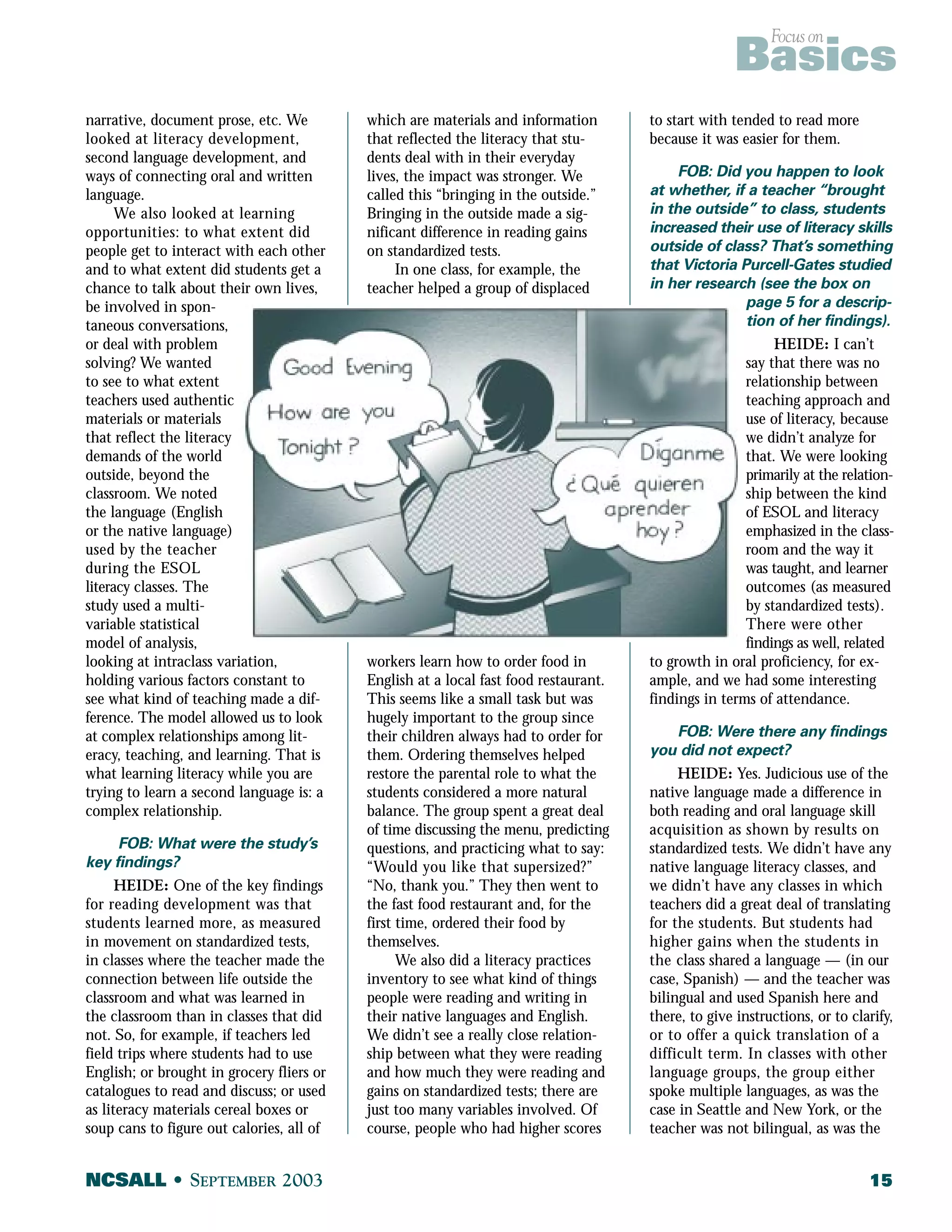
workers learn how to order food in 
English at a local fast food restaurant. 
This seems like a small task but was 
hugely important to the group since 
their children always had to order for 
them. Ordering themselves helped 
restore the parental role to what the 
students considered a more natural 
balance. The group spent a great deal 
of time discussing the menu, predicting 
questions, and practicing what to say: 
“Would you like that supersized?” 
“No, thank you.” They then went to 
the fast food restaurant and, for the 
first time, ordered their food by 
themselves. 
We also did a literacy practices 
inventory to see what kind of things 
people were reading and writing in 
their native languages and English. 
We didn’t see a really close relation-ship 
between what they were reading 
and how much they were reading and 
gains on standardized tests; there are 
just too many variables involved. Of 
course, people who had higher scores 
to start with tended to read more 
because it was easier for them. 
FOB: Did you happen to look 
at whether, if a teacher “brought 
in the outside” to class, students 
increased their use of literacy skills 
outside of class? That’s something 
that Victoria Purcell-Gates studied 
in her research (see the box on 
page 5 for a descrip-tion 
of her findings). 
HEIDE: I can’t 
say that there was no 
relationship between 
teaching approach and 
use of literacy, because 
we didn’t analyze for 
that. We were looking 
primarily at the relation-ship 
between the kind 
of ESOL and literacy 
emphasized in the class-room 
and the way it 
was taught, and learner 
outcomes (as measured 
by standardized tests). 
There were other 
findings as well, related 
to growth in oral proficiency, for ex-ample, 
and we had some interesting 
findings in terms of attendance. 
FOB: Were there any findings 
you did not expect? 
HEIDE: Yes. Judicious use of the 
native language made a difference in 
both reading and oral language skill 
acquisition as shown by results on 
standardized tests. We didn’t have any 
native language literacy classes, and 
we didn’t have any classes in which 
teachers did a great deal of translating 
for the students. But students had 
higher gains when the students in 
the class shared a language — (in our 
case, Spanish) — and the teacher was 
bilingual and used Spanish here and 
there, to give instructions, or to clarify, 
or to offer a quick translation of a 
difficult term. In classes with other 
language groups, the group either 
spoke multiple languages, as was the 
case in Seattle and New York, or the 
teacher was not bilingual, as was the 
NCSALL • SEPTEMBER 2003 15
Focus on Basics 
case with Somali and Hmong classes. 
The classes where the teacher 
used the native language here and 
there had higher gains. This makes 
sense, particularly for literacy students 
who had little English, because their 
brains are busy trying to speak, to 
figure out print, to understand what 
the teacher wants, all while dealing 
with a new language and a new 
culture. Many of the students had not 
been in a classroom since they were 
small children, so school tasks were 
new to them as well. In these cases, 
where you are cognitively taxed to 
your fullest extent, if someone comes 
in and explains it to you, it really 
frees up mental space to focus on the 
task itself. In ESOL classes that are 
all in English, so much of students’ 
time and energy is spent trying to 
figure out what it is the teacher wants 
them to do. Once the instructions are 
clear, the task becomes manageable. 
Something else new, although 
not totally unexpected, was that stu-dents 
need practice and they need 
variety. I think in our emphasis on 
communicative competence we 
sometimes forget how much practice 
is needed before literacy and 
English take hold and become 
internalized or “automatized.” 
On the other hand, if language 
input and language tasks be-come 
repetitive and boring, 
the brain shuts down and 
learning slows way down. 
Students who experienced 
mainly skill and drill in their 
classes didn’t do as well as 
other groups who had more 
varied experiences. By the 
same token, if everything was 
new all the time, and lots of 
different activities came at the 
students without a clear focus 
on what they needed to learn, they 
didn’t do as well either. 
The students who got both 
sufficient time on task with a par-ticular 
component and a chance to 
encounter that component in various 
ways (reading, writing, hands-on 
activities, talking about they were 
reading) showed higher gains than 
the rest. Students need a chance to 
interact with print, to practice, and to 
“get it down.” At the same time, they 
benefit from different kinds of exper-iences 
that reinforce language and 
literacy skills. This kind of balance 
between routine and variety made a 
difference in their scores on stan-dardized 
testing. 
FOB: The two findings seem 
like they may be related: judicious 
use of native language, to intro-duce 
procedures and to clarify 
complex points, for example, and 
the need for routine. Both indicate 
that time should be spent on the 
content — on the learning — 
rather than on the procedures. 
HEIDE: I think a certain amount 
of routine is good, particularly for 
adults who have little experience 
with schooling and who often doubt 
their own ability to learn. School-based 
learning is important to them 
and they want to get the basic skills 
that they have missed. But they 
often really come alive when they get 
a chance to work with important 
“Judicious use of 
the native language made 
a difference in both 
reading and oral language 
skill acquisition as 
shown by results on 
standardized tests.” 
concepts, such as figuring out what all 
the charges on a phone bill are for or 
whether buying vegetables at a farmer’s 
market or in a supermarket is a better 
deal. The finding also points to the 
importance of giving instructions that 
are simple and clear, and of demon-strating 
and modeling so that 
frustration and anxiety are reduced 
and students can focus on “meaning-making.” 
And that can be done 
in English as well as in the native 
language. 
FOB: Any other findings to 
share? 
HEIDE: The basic attendance 
finding was that it didn’t matter how 
many hours for class that students 
came but the percentage of class time 
they came. Rate of attendance matters 
more than the hours per se. For example, 
a student who comes to class almost 
every day and then drops out after 
three and a half months ends up 
doing better than a student who only 
attends sporadically but stays for the 
full six months of the course. This is 
true even when the total number of 
class hours attended are the same. 
FOB: What are the implica-tions 
of the findings of your study 
for curriculum? 
HEIDE: We found that building 
on what students are interested in out-side 
of the classroom results in success. 
This supports the idea that you want 
to have a curriculum that con-nects 
literacy development with 
oral language development and 
connects it back to students’ 
lives. You can’t read in English 
if you don’t know English. We 
didn’t see that a narrow ap-proach 
that focused solely on 
narrow notions of reading was 
successful, although spending 
time on some of the subskills 
related to fluency and decoding 
certainly is necessary for students 
who don’t have these skills. As 
we keep hearing, these subskills 
are necessary but not sufficient 
and I think our study shows that. 
The findings speak for building 
a rich curriculum that makes a con-nection 
between the language and 
literacy used inside and outside of the 
classroom and lets these students see 
that they are gaining skills that reflect 
what’s needed in daily life. Use of 
objects (real foods, household items), 
16 SEPTEMBER 2003 • NCSALL
Focus on Basics 
environmental print (flyers, labels, 
signs), mail (including notes from 
schools), and trips to neighborhood 
spots where literacy is needed are 
not the only materials that are useful. 
Language experience stories, personal 
writings, and stories and songs build 
engagement and can become the 
starting point for discussions and 
further language use. These materials 
also form the basis for building fluency, 
discovering patterns, developing 
vocabulary, and practicing various 
subskills. Their use ties back in with 
the finding about practice and variety. 
“Varied interaction and practice” 
is important. We do need to draw 
students’ attention to what it is we 
want them to learn. There needs to 
be focus, engagement, and practice if 
language and literacy learning is to 
take place. A lot of times in ESOL 
teaching we’re doing way too many 
things that don’t connect to each 
other. Tightening the connections, 
doing fewer things, focusing on what 
students need to get in order to move 
forward is important. 
In terms of the native language, 
we do need to rethink that “English 
only” idea, and that fear that any 
minute spent in native language takes 
away from English learning. That is 
actually not true. We need to really 
think about how to provide oppor-tunities 
for students to have enough 
time on task really to become fluent 
in English. This calls for multiple 
opportunities to use English while 
facilitating learning by using the native 
language here or there or, if that is not 
possible, taking time out to demon-strate 
or model the tasks or use visual 
information to get our point across. 
I mentioned before that language 
learners need enough energy in terms 
of cognitive resource to focus on lang-uage 
learning. If tasks are constantly 
changing or if instructions contain new 
words and phrases, learning is really 
inhibited. So I like to encourage 
teachers to keep a certain amount of 
classroom interaction routine when 
they are introducing new concepts. 
That lets people focus on the learning 
rather than on the procedures. But 
overall, in terms of curriculum, the 
findings suggest a rich language and 
literacy learning curriculum that pro-vides 
opportunities for students to use 
English outside of the classroom, both 
through interactions with English 
speakers and through engagement with 
various forms of print. But the study 
also points toward the need to provide 
a sufficient focus on structure and 
practice. We can’t just assume that 
literacy students will pick up reading 
and writing skills on their own, through 
mere exposure and continued acqui-sition 
of English. This may be true for 
students who have a sound foundation 
in literacy in the native language, but 
it’s not true for students who lack these 
skills. Through our curriculum, we will 
need to give ESOL literacy students 
practice in acquiring basic reading and 
writing skills within the context of 
their lives without making these skills 
the primary focus of the curriculum. 
FOB: Thanks for sharing all 
this with us. Where can readers 
go for your full report? 
HEIDE: The report is still under 
review by the Department of Edu-cation. 
It’s difficult to tell when it will 
be released. As soon as the study is 
released, it will be available on the 
web. We will announce its avail-ability 
in various newsletters and list 
serves, including the Focus on Basics 
electronic discussion list (to subscribe, 
see the box on this page). 
Focus on Basics 
Electronic 
Discussion List 
Focus on Basics electronic dis-cussion 
list is a forum for discussion 
about the articles published in Focus 
on Basics. It is a place to converse 
with colleagues about the themes 
examined in the publication; to 
get questions answered and to pose 
them; to critique issues raised in the 
publication; and to share relevant 
experiences and resources. 
To participate in the Focus on 
Basics discussion list (it’s free!), go to 
the LINCS homepage at http://nifl.gov. 
Choose “Discussions.” Scroll down to 
and click on “Focus on Basics.” Then 
click on“Subscribe,” which is to 
the left, and follow the instructions. 
Or, send an e-mail message to 
LISTPROC@LITERACY.NIFL.GOV 
with the following request in the body 
of the message: SUBSCRIBE NIFL– 
FOBasics firstname lastname. Spell 
your first and last names exactly as 
you would like them to appear. For 
example, Sue Smith would type: 
subscribe NIFL–FOBasics Sue Smith 
There should be no other text 
in the message. Give it a couple of 
minutes to respond. You should receive 
a return mail message welcoming you 
to NIFL–FOBasics. 
The manager of this list is 
Barbara Garner, editor of Focus 
on Basics. She can be reached at 
Barbara_Garner@WorldEd.org. Please 
DO NOT send subscription requests 
to this address.v 
Editorial Board 
Volume 6C 
September 2003 
Miriam Burt, Center for Applied 
Linguistics, Washington, DC 
Yvonne Lerew, LSS-SD Refugee and 
Immigration Programs, Sioux Falls, SD 
Jessica Mortensen, World Education, 
Boston, MA 
Andy Nash, World Education, 
Boston, MA 
Norene Peterson, Billings Adult 
Education Center, Billings, MT 
Karen J. Seay, Adult Learning 
Programs of Alaska, Fairbanks, AK 
Resources 
Wrigley, H. (1993). “One size does 
not fit all: Educational perspectives 
and program practices in the U.S.” 
TESOL Quarterly, 27, (3). 
Wrigley, H. (2004). “We are the world: 
Serving language minority adults in 
family literacy programs.” In B.H 
Wasik (ed.) Handbook on Family 
Literacy: Research and Services. Mawah, 
NJ: Lawrence Erlbaum Associates. 
Spruck, H., & Guth, G. (1992). Bringing 
Literacy to Life: Issues and Options in 
Adult ESL Literacy. San Mateo, CA: 
Aguirre International.v 
NCSALL • SEPTEMBER 2003 17
Focus on Basics 
One Classroom, Two 
Languages: Adult Bilingual 
Curriculum Development 
How should ESOL programs use learners’ first 
language to build their acquisition of the second? 
by Kay Taggart and Sara Martinez 
Over the past 10 years, 
in programs involving 
more than a dozen 
companies in El Paso, Texas, 
workplace literacy classes have 
focused on rudimentary English 
language skills that employers 
perceived that workers needed 
while working in their current 
jobs. However, in homogeneous 
bilingual communities, indivi-duals 
in entry-level jobs often 
do not need much English to 
do a job well. We found that 
employees attended instruction 
either because their employer 
asked them to attend and they 
felt obligated or because they 
hoped to acquire English skills 
they could use at home with 
their children who were 
learning English in school. 
When curricula and instruc-tion 
focused on workplace 
themes (which workers had 
said they did not feel they 
needed), students consistently 
dropped out. It was not un-common 
to lose more than half 
of the class enrollment before 
the end of the course. How 
could we change this? 
In 2001, Johns Hopkins 
University conducted observations, 
interviews, and surveys of instructors 
working in retraining programs for 
dislocated workers in El Paso. These 
programs serve mostly women who 
have been dislocated from the gar-ment 
industry, and others who work 
but need to increase their skills 
to advance within their places of 
employment. Typical students are 
Mexican immigrants who attended 
three to eight years of schooling in 
Mexico as children. They possess 
high-beginning to high-intermediate 
levels of literacy in Spanish and 
beginning to low-intermediate levels 
of literacy in English. Dislocated 
workers receive federal retraining 
dollars and attend school 20 to 30 
hours per week for periods up to 18 
months. Those involved in workplace 
instruction at their places of employ-ment 
attend instruction four to 12 
hours weekly. Instruction for both 
groups includes job-specific skill 
training, computer technology 
training, and related English skills 
development. 
We observed instructors using 
Spanish for a variety of purposes: 
orally translating job-specific material 
written above the eighth grade level; 
providing oral explanations when 
students “appeared” confused; giving 
directions and instructions; and 
encouraging students. We also ob-served 
some instructors expecting 
students to engage in activities that 
required high-level, work-specific 
critical and creative thinking tasks 
using English only. When students 
Native Language Use 
Using the adult learners’ native language in the workforce-training 
classroom is not a new concept in our community or around 
the nation. Beginning in the latter half of the 1970s and continuing 
through the mid-1990s, the US Department of Education funded a 
number of Bilingual Vocational Training (BVT) projects under the 
Carl D. Perkins Vocational Education Act. Some of these projects 
developed native-language instructional materials and used Spanish, 
Chinese, or another language to teach job-specific skills; related 
vocational English for speakers of other languages (ESOL) helped 
students learn English related to the work area. Other programs 
simply used bilingual assistants to provide supportive one-on-one 
tutorials as needed when students did not understand content 
provided in English (Gillespie, 1996). 
Formal and informal bilingual programs continue to operate in 
various venues. Adult ESOL/literacy and workforce/workplace skill 
instructors who are themselves bilingual and work within homo-genous 
bilingual communities have used informal bilingual strategies 
in the classroom for many years. Many instructors move between 
the two languages with little thought as to why and when to use the 
native rather than the targeted language. 
18 SEPTEMBER 2003 • NCSALL
Focus on Basics 
Curriculum Example 1: 
Computer Office Skills Program 
Computer Skills Training 
Students receive instructions in Spanish covering 
computer functions and use of common office 
programs. Students learn key computer terminology 
in English. Students will also create documents 
using English. 
English for the Office Environment 
Instructors teach bilingually. Students explore critical 
themes in Spanish. These themes “bridge” into 
English as students learn English vocabulary and 
language structures they will need to communicate 
effectively while working. 
GED Test Preparation 
Instructors teach strategies and content 
knowledge in Spanish. Students take 
the test in Spanish. 
Staff collaborates to develop curriculum activities relevant to common office themes. For example, a thematic unit 
relating to “Office Supplies” includes the following activities, framed with Equipped for the Future Standards. EFF is 
a framework for adult literacy curriculum and program development, developed over the past ten years under the 
National Institute for Literacy (Stein, 2000). 
Instructional Theme: Office Supplies 
Use Information and Communications Technology 
Students learn to use Excel Spreadsheets by reading Spanish-language instructional manuals and receiving oral 
instruction and coaching in Spanish. However, the software used is the English-language version, and students 
create a spreadsheet to track office supplies inventory using English supply terms. 
Listen Actively & Speak So Others Can Understand 
Students learn the English vocabulary they need to understand verbal requests for office supplies and to make 
verbal requests for office supplies. Students engage in total physical response activities, which requires then to 
perform actions in response to verbal cues, such as “put the paper in the printer” and role-playing. 
Solve Problems and Make Decisions 
Students use Spanish to discuss related critical issues, such as: What do you do when you cannot access the 
supplies you require to complete a work task? What do you do if your boss expects you to complete the task 
anyway? This activity bridges into more English vocabulary and language development with role-playing as 
students deal with the final questions: To whom do you speak? What do you say? How do you say it? 
Read with Understanding & Convey Ideas in Writing 
Students use Spanish to discuss the organization of supply catalogs, to learn about the rationale for the use of purchase 
orders, and the path these documents take through a company to a vendor. They work in pairs or groups to read 
supply catalogs (in English), to compare products and prices from different vendors, and to complete purchase orders. 
The lesson—lasting over the course of about 20 hours of instruction—culminates in a comprehensive bilingual 
debriefing, during which students reflect on the entirety of the experience and delineate what they have learned, 
and why, and project ahead to their future roles as workers. 
Developed by Gail Slater, instructor for the Texas Technology Pilot Project, operated under the AdEdge Computer Training Center; 
and Kay Taggart, Johns Hopkins University. Additional input provided by Andy Nash, Equipped for the Future. Project funded by the 
Texas Workforce Commission. 
NCSALL • SEPTEMBER 2003 19
Focus on Basics 
struggled to report on small group 
work using English, one instructor 
remarked, “They can’t even think!” 
Written surveys indicated that 
instructors had difficulty determining 
what type of activities might best be 
implemented bilingually, and what 
type might best be implemented in 
English only. Students’ comments 
reflected this confusion. It was 
common to hear “The instructor 
speaks too much English” and “The 
instructor doesn’t speak enough 
English” uttered by students in the 
same classroom. 
We hypothesized that by using 
Spanish and English for specific and 
different purposes within areas of 
curriculum and instruction, students 
could develop both English and job 
skills simultaneously. As we worked 
to design and implement effective 
workforce and workplace training 
programs for dislocated as well as 
incumbent workers, we sought to 
answer the following questions: 
• If students are not able to use their 
native language to relate prior 
knowledge to classroom contexts, 
express ideas and opinions, and 
develop higher-order thinking skills 
relating to their targeted career 
field, will they fully benefit and 
thrive from the educational 
experience? 
• How can we maximize learning of 
English and job skills by using both 
languages in the classroom? 
Bilingual Strategies 
for Contextual 
Curricula 
Bilingual curricula and 
instruction do not mean direct 
translation of all course content. 
They mean using students’ native 
language to build conceptual under-standing 
and to process knowledge 
and skills, while developing inter-personal 
communicative competence 
in English. Instructors must be clear 
about when and how to use Spanish 
and English in the classroom (Baker, 
1997). Our observations indicated 
that instructors who use too much 
Spanish can slow student language 
acquisition to a crawl; instructors who 
use too much English can quash the 
development of higher-order thinking 
skills. For bilingual instruction to be 
effective, we have found it critical 
that course developers, teachers, and 
students agree on what components 
should implemented in English 
and what components should be 
implemented in Spanish for the 
maximum benefit of the student. 
Instructors and students may move 
between the two languages at some 
points. For instance, students work 
with their teachers to analyze the 
similarities and differences between 
the two languages. This process helps 
to demystify the second language. 
Following the research described 
above, we spent six months working 
with a group of 12 bilingual instructors. 
We met weekly for three months for 
training and collaboration, focusing 
on bilingual teaching strategies for 
reading, writing, listening, speaking, 
and cooperative learning. 
The curriculum developers and 
teachers we work with begin devel-oping 
a program by pinpointing a 
work-relevant theme. To do so, they 
first collect information from company 
personnel or from more general infor-mation 
gathered about the target job. 
They ask the following questions and 
reach the following conclusions about 
use of first and second language in in-struction 
(Taggart & Martinez, 2002): 
• What pieces do students just need 
to “know” in order to carry out 
tasks relating to this theme? We can 
teach much of this in the students’ 
native language. 
• What will students need to read, 
listen to, write, and talk about 
in English related to those tasks? 
To whom will they need to speak? 
We must teach the English 
vocabulary and language struc-tures 
students need to be able 
to communicate in work-related 
contexts. 
• When students engage on the job, 
what critical issues may arise around 
this theme? We can use the stu-dents’ 
native language to explore 
these issues, and then move to 
English to develop any additional 
language skills that emerge as a 
result of these discussions. 
Input from business and industry 
is important during this phase of cur-riculum 
development and instructional 
planning. Individuals who perform 
related tasks in the workplace are inval-uable 
in helping us determine which 
components to teach in English and 
which to teach in Spanish. Interviews, 
focus groups, and observations help 
us answer the questions posed above. 
Bilingual instructional curricula 
and strategies are integral to our 
instructional programs for retraining 
dislocated workers, and to programs 
providing on-site instruction for 
incumbent workers seeking to move 
up within their work environment. 
The programs have multiple com-ponents; 
students participate in work-specific 
training, related vocational 
ESOL instruction, and computer 
technology training. Some also attend 
preparation classes to take the tests 
of General Educational Development 
(GED) in Spanish. See pages 19 and 
21 for examples of curriculum from 
projects underway. 
Challenges 
Our initial inquiry revealed that 
instructors did not make choices about 
language of instruction based on any 
explicit criteria. Even when they are 
trained in concepts of bilingual edu-cation, 
and practical strategies for 
using two languages in the classroom, 
teachers have a tendency to fall back 
on prior practice. Even when teachers 
understand the advantages of strategic 
language use, it is only with con-tinuing 
professional development and 
20 SEPTEMBER 2003 • NCSALL
Curriculum Example 2: 
Leadership and Communications 
Workplace Leadership and Communication 
Leadership Concepts 
Students receive instruction in Spanish covering such 
topics as group dynamics, team collaboration, and org-anizational 
models. They participate in a great deal of 
role playing and collaborative problem solving. The in-structor 
also introduces key concepts in oral English and 
provides English handouts to reinforce this vocabulary. 
Focus on Basics 
Communicating for Leadership 
Students develop the vocabulary knowledge and 
language usage skills necessary to engage in effective 
interpersonal communications in English on the job. 
Students participate in Spanish-language discussion 
that relates communication themes back to leader-ship 
concepts. 
Technology Skills 
Students receive instructions in Spanish covering 
computer functions and use of common office pro-grams. 
Students learn key computer terminology in 
English. Students also create documents using English. 
“Communicating for Leadership” provides opportunities for students to do the following: 
• Examine a communication challenge that exists in the workplace. A short dialogue introduces the challenge. For 
instance, employers report that workers are reticent to request clarification when they do not understand instructions. 
The introductory scenario is in English and focuses on an employee who does not understand, but tells his boss he 
does. The scenario provides a way for students to begin to connect with the communication challenge. It is a jumping 
off point for discussion and learning activities. 
• Students then work in small groups to examine the communication challenge, discussing why workers are reticent 
to admit they do not understand, including listing potential repercussions that could result if an employee admits 
she does not understand, and if an employee does not admit it. Discussion may diverge to address questions such 
as: What happens if you ask for clarification and your boss does not want to bother explaining again? What happens 
if your boss decides you are not qualified to do your job, since you do not understand? What do you do? What do 
you say? How do you defend yourself? This discussion is undertaken in Spanish and connects to leadership themes, 
as students critically examine the challenge from the point of view of a supervisor trying to lead his or her employees. 
• Instructors help students to develop English vocabulary and phrases needed to request clarification, address 
related situations (discussed above), and help elicit clarification questions from other individuals (whom they may 
supervise in the future). 
• Students rewrite the original dialogue in English and effectively “turn around” the situation. For instance, in the 
rewritten scenario, the employee might ask for clarification after his or her supervisor provides a prompt and some 
encouragement. Other dialogues may focus on related challenges that could occur. Instructors circulate and help 
student with English constructions. Instructors may interject mini-lessons covering specific language usage points. 
Students practice the scenario and “perform” in front of their peers. 
• Students engage in peer critique designed to help the actors in the dialogue refine their language production. This critique 
usually will occur bilingually, as students analyze the situation and work to help each other improve on multiple levels. 
These activities are from a larger module framed under the Equipped for the Future standard called Listen Actively. “Leadership 
Concepts” course conceived, developed, and taught by Rosa Valenzuela. Lesson example from the “Communication for Leadership” 
program component developed by Kay Taggart, Johns Hopkins University, with input from Sara Martinez and instructor Virginia 
Rascon, for the Workforce Adult Literacy Project operated under the El Paso Community College. Project funded by the Texas 
Workforce Commission. Lesson format based on a model developed in 1994 by Luz Taboada and Kay Taggart (1994). 
NCSALL • SEPTEMBER 2003 21
Focus on Basics 
Same Curriculum, 
New Mode of Delivery 
Adapting ABE Professional 
Development to the Internet 
by Jane Martel 
Before December, 2000, 
Kentucky’s Department 
for Adult Education 
and Literacy (DAEL) had de-livered 
all professional develop-ment 
opportunities to its 900 
adult educators in face-to-face 
workshops. The best attended of 
these was usually the two-day 
Orientation to Adult Education, 
required of new instructors and 
program managers (Kentucky 
has approximately 120 new 
adult educators each year) and 
typically offered four times a 
year in various locations around 
the state. In May, 2001, we 
piloted our first “blended” 
professional development (PD) 
course: part delivered face-to-face 
and part delivered via the 
Internet. This quickly became 
our professional development 
branch’s preferred format for 
nearly all of our professional 
development opportunities. 
Getting to this stage, how-ever, 
many hard lessons were 
learned along the way, which 
we share in this article. 
Reasons to Change 
Kentucky ventured into the 
online PD world via a blended format 
for a number of reasons. First, in 
April, 2000, Senate Bill 1, also 
known in Kentucky as the Adult 
Education Act, passed. Kentucky’s 
professional development system 
needed to prepare to support prac-titioners 
serving 300,000 adult 
learners a year by the year 2020 in 
comparison to the approximately 
50,000 served in FY 2001 (Kestner, 
2002). As a result of the Adult Educa-tion 
Strategic Agenda that grew out 
of Senate Bill 1, Kentucky’s adult 
education programs are accountable 
for meeting increasingly challenging 
performance indicators. DAEL Com-missioner 
Dr. Cheryl King wants prac-titioners 
to maximize the time they 
spend assisting learners in meeting 
their goals and minimize the time spent 
traveling to attend PD workshops. PD 
delivered online makes it possible to 
offer orientation information without 
interfering with teaching and learning 
activities at adult learning centers. 
The time new teachers needed to 
spend away from their learning centers 
to attend the two-day orientation 
training was halved by one-day face-to- 
face training supplemented with 
online work. 
Improved consistency and reduced 
travel expenses for trainers and par-ticipants 
were other good reasons for 
trying what we termed “e-PD.” One of 
the most compelling factors supporting 
the use of web-delivered training was 
the opportunity to offer orientation 
information any time, day or night. 
Our online courses could be started at 
any time of year using any computer 
connected to the Internet; new 
instructors no longer had to wait for 
our next scheduled face-to-face session 
to be introduced to their roles and 
responsibilities. Also, the foundation 
for relationships with DAEL staff and 
support have they been able to imple-ment 
it effectively. 
As the Hispanic population grows 
in the United States (Guzman, 2001), 
and as the need for “thinking” workers 
increases, adult bilingual workforce 
training holds great potential for 
helping individuals advance on 
multiple levels simultaneously. 
About the Authors 
Kay Taggart has worked in education, 
including community, family and work-force 
literacy, for nearly 20 years. She 
teaches, develops curricula, trains teachers, 
and writes grants in El Paso, Texas. 
Sara Martinez manages Workplace Lit-eracy 
at El Paso Community College. In 
partnership with Fortune 500 companies, 
she has been implementing instruction for 
incumbent workers for the past 13 years. In 
partnership with Motivation, Education, 
and Training (MET), Ms. Martinez also 
oversees integrated bilingual programs for 
the advancement of migrant and seasonal 
farm workers in the area. 
References 
Baker, C. (1997). Foundations of Bilingual 
Education and Bilingualism. Bristol, PA: 
Multilingual Matters. 
Gillespie, M. (1996). Learning to Work in 
a New Land: A Review and Sourcebook 
for Vocational and Workplace ESL. 
Washington, DC: Center for Applied 
Linguistics. 
Guzmán, B. (2001). The Hispanic Pop-ulation: 
Census 2000 Brief. Washington, 
DC: U.S. Census Bureau. (C2KBR/01-3). 
Stein, S. (2000). Equipped for the Future 
Content Standards. Washington, DC: 
National Institute for Literacy 
Taboada, L. & Taggart, K. (1994). 
Workplace Communications. El Paso, 
TX: El Paso Community College. 
Taggart, K., & Martinez, S. (2002). Adult 
Bilingual Curriculum Institute: Core 
Instructor Training. El Paso, TX: Johns 
Hopkins University. v 
22 SEPTEMBER 2003 • NCSALL
Focus on Basics 
with peers across the state could be 
built immediately. 
Before adopting this blended 
approach, we had burdened new-comers 
with reams of paper that they 
probably never read. No matter how 
excited participants are after a work-shop, 
few have the time to research 
further and read materials taken 
home. With our new approach, 
participants are asked to complete 
online modules in advance of a 
workshop. This let us raise the 
incoming level of knowledge and 
expect higher quality interactions in 
the face-to-face components of the 
training. 
From information 
gleaned at regional professional de-velopment 
meetings with peer PD pro-fessionals, 
it seemed that few states 
had ventured very far into online PD 
delivery. At the time, much had been 
written about both online education 
and face-to-face training. Only now 
do we see a proliferation of material 
on the topic of blending the two 
formats. Our interpretation of the 
merits and challenges of the online 
environment combined with what 
we knew about face-to-face realities 
suggested that blended courses offered 
the best opportunity to capture the 
strengths of both delivery methods. 
Testing Our Theory 
Plans were underway by May, 
2001, to create a web site and “portal” 
for virtual adult education with the 
assistance of our new partner, Kentucky 
Virtual University (KYVU). Without 
a strong tech partner, such bold efforts 
in new territory would probably not 
have happened as soon as they did. Our 
challenge was to convert our two-day 
Orientation to Adult Education to a 
blend of one-day of face-to-face training 
followed by five units of online informa-tion. 
We embraced online course 
creation as an opportunity to use a new 
tool, make background material and 
facts “come alive,” and differentiate 
cognitive information from behavioral 
changes. Using the Internet, we were 
able to link users immediately to ex-citing 
sites related to the information 
presented and to generate profes-sional 
discourse by creating 
online discussions. 
PD branch members 
met to adapt 
curriculum to this new instructional 
environment. To determine which 
topics to deliver in a workshop and 
which to post online, we reviewed 
what we knew at the time: “Cog-nitive 
objectives are the most easily 
adaptable to distance education” 
(Thach, 1996, p. 11). Performance-based 
and attitudinal objectives and 
those requiring use of interpersonal 
skills were determined most appro-priate 
for classroom delivery (Thach, 
1996, p. 11; Brown, 2000). 
We also considered the com-plexity 
of the material and its relative 
importance to new practitioners. 
Those topics deemed complex and/or 
vital to adult education — recruit-ment 
(45 minutes), orientation and 
goal setting (two hours), assessment 
(two hours), and professional develop-ment 
(15 minutes) — were covered 
in our one-day face-to-face training. 
We expected that those topics would 
generate many questions and would 
require the explanation of concepts 
and procedures in a variety of ways. 
Topics that were primarily infor-mation 
only (cognitive objectives) 
and that were less likely to require 
discussion (e.g., an overview of adult 
education, the adult learner, learner 
support and retention, and legal issues) 
were converted for online delivery. 
Creating an interactive group 
environment online differs from 
creating it in a face-to-face environ-ment. 
In the latter, other group 
members tend to assist, or at least 
serve as catalysts, in the effort to 
draw out communication 
from reticent partici-pants. 
Based on our 
experience and on 
discussions with 
facilitators of 
other online 
courses, how-ever, 
in an online 
environment, this 
responsibility seems 
to fall entirely on the 
facilitator. Each partici-pant 
was encouraged to post 
comments about the online material 
to a discussion board. More difficult, 
however, was ensuring that the dis-cussion 
board would contain con-versations 
among participants, not 
simply postings of reactions by in-dividuals. 
Schweizer (1999) iden-tifies 
numerous ideas on maximizing 
the use of the online environment. 
Among them are linking web sites 
to the content, bringing course mem-bers 
together for face-to-face inter-action 
to build group cohesiveness, 
communicating regularly with course 
members in an informal and clear 
writing style, being responsive 
to questions and concerns, using 
separate discussion boards for each 
group, and using the discussion board 
NCSALL • SEPTEMBER 2003 23
Focus on Basics 
Since our Orientation to Adult 
Education pilot, we have 
developed and delivered 
11 other e-PD courses, most in a 
blended format. The lessons we 
have learned are obvious when 
viewed in retrospect. At the time, 
however, the choice was either to 
do it right or do it now. We chose 
the latter and learned much from 
doing so. 
All participants need to have the 
minimum hardware, software, Internet 
connectivity, and the technical support 
needed to access and participate in an 
online course. Course developers often 
fail to consider that many educators use 
computers less sophisticated than those 
on which the materials are developed; 
they also often face the challenges 
of firewalls, proxy servers, etc. Such 
issues should be addressed before an 
educator registers for an online course 
or unit. 
Courses must be built with the low-est 
common technology denominator 
in mind. Posting huge files, such as 
video-streaming, long audio clips, and 
PowerPoint presentations, which take 
several minutes to download using a 
56K modem, results only in frustration 
for low-end users. Lower-tech options 
should be offered for low end users. For 
example, if an audio clip is included, then 
a written script should also be available. 
Beyond hardware considerations, 
participants must have the requisite 
computer skills prior to taking an online 
course. It was sobering for me to realize 
how many of our educators had never 
accessed the Internet or used a compu-ter. 
We now list prerequisite computer 
skills in our course publicity and in reg-istration 
confirmation letters, although 
we do not offer training through the 
DAEL. Participants must be able to start 
a computer, connect to and navigate the 
Internet, manipulate windows, be able 
to print, scroll through, and read and 
reply to e-mail. 
All participants should have their 
own personal e-mail address. Not all 
employers give part-time instructors 
e-mail accounts. Free e-mail services 
exist; however, many adult education 
centers function within restrictive 
environments that do not allow for the 
receipt of e-mail from free account sites. 
Without an ability to communicate by e-mail, 
much of the potential benefit of an 
online course is lost. As in a face-to-face 
environment, the communication that 
occurs among participants, and be-tween 
the instructor and the learner, 
is critical. Some course management 
systems offer an internal messaging 
interface that operates independently of 
e-mail and can be used for individual or 
group communication. 
What if an instructor cannot meet 
the first three conditions of participation? 
Despite the requirement that literacy pro-viders 
have access to computers and the 
Internet, and that new staff must complete 
the Orientation in whatever format it is 
offered (e-PD), not all do. Those without 
computer skills, access to the Internet, and 
e-mail had no alternative way to partake of 
our PD offerings. 
Pilot testing a new course with a 
limited number of participants is preferable 
to immediately launching it statewide. 
Running a pilot, or field test, allows for the 
identification and correction of problems, 
errors, and areas of confusion in the course 
in a relatively controlled environment. In 
the long run, it saves time. 
Experienced current practitioners 
should be consulted every step of the way, 
from creating the course outline, to pro-viding 
content or editing drafts, pilot testing 
the course, providing feedback, and per-haps 
facilitating online discussion. The 
idealistic vision of state department staff 
must be tempered with the realistic per-spectives 
of those in the field if online course 
curriculum development is to be successful. 
Ample time must be allotted for 
course development and delivery. The 
amount of time required to create and 
manage an online course should be gen-erously 
estimated, and then tripled. Creation 
of the course is but a small segment of the 
time required. We grossly underestimated 
how time consuming it would be to teach 
or facilitate a course. 
What do facilitators do? Facilitators 
answer learners’ questions about navi-gating 
the course, reveal content at 
appropriate times during the course (to 
keep learners more or less together, we 
displayed two modules a week so that 
learners would not bound ahead and 
finish), respond to submitted assignments, 
start discussions and moderate the course 
discussion board, monitor learner partici-pation, 
and fix broken web links (Schweizer, 
1999). Without adequate facilitation time, 
a course threatens to become a stale 
repository of content and more of a self-paced 
tutorial than a place and reason 
for lively exchange and sharing among 
participants. Our instructors so loved their 
time together in workshops that 
we wanted to keep this as-pect 
of sharing and 
exchange of ideas 
alive online as well 
as in the workshop. 
What takes so 
much time? Responding to 
myriad e-mails from partici-pants. 
And, unlike a workshop, 
answering once does not instantly 
benefit the entire class (although a 
message board or posted announce-ment 
can be used to avoid answering 
the same question from multiple partici-pants). 
Monitoring the discussion board 
can take hours. Inappropriate messages 
must be dealt with, erroneous infor-mation 
must be corrected, and partici-pation 
by non-responding students 
must be elicited repeatedly. Then there 
are the technical problems to be cor-rected: 
a file won’t open, a participant 
can’t log in, the font is too small and 
the content too long to comfortably 
read on the screen, a participant needs 
assistance printing material. It all takes 
time, and lots of it. 
Advance promotion of the online 
concept is a must. Learning online is 
foreign territory for many. Given the 
opportunity, many would choose to re-main 
off-line. Offering strong material, 
sharing testimonials from your pilot 
participants — their respected peers — 
and promoting the new venture in a 
positive and exciting way in advance 
will do much to dispel initial resistance. 
As with any marketing endeavor, the 
benefits must be clearly presented. 
Delivery and support partners 
should be selected with care. Work out 
in detail and in advance exactly what 
role each party will play. 
• Who will provide technical support 
to learners and to course instructors 
and what, exactly, does that mean? 
During what hours and days of the 
week will support be provided? In 
what form may users request help 
(e.g., e-mail, telephone, web form)? 
• Where will you place your courses? 
What platform will you use? Who 
controls it? Will it disappear at the 
end of a one-year contract? What 
happens to your courses then? Who 
will be responsible for maintaining 
and updating the content? 
• Will you build a “front end” system 
for information and registration? 
Why? Is the process designed 
primarily to benefit the learner or 
management? Be wary of the latter, 
if it interferes with the consumer’s 
experience. v 
24 SEPTEMBER 2003 • NCSALL
Focus on Basics 
to summarize discussions and raise 
new questions. We used these ideas as 
guidelines when building our course. 
Our first restructured Orientation 
to Adult Education was offered to a 
pilot group of 21 new instructors from 
throughout the state. All 120 of the 
ABE program managers in Kentucky 
were notified via e-mail of this pilot 
and were asked to encourage their new 
instructors (hired within six months) to 
participate. All new adult educators 
who expressed interest were allowed to 
participate. We started by gathering the 
group for a day of face-to-face training. 
Thereafter, participants had three 
weeks to complete the online units. 
We had several goals for the course. 
As course developers, we wanted the 
pilot to answer the following ques-tions 
about the online component: 
• What was the average amount 
of time it took to complete the 
course? This would allow us to 
award professional development 
credit appropriately. 
• What was confusing about each 
module? This would allow us to 
improve upon it for future course 
delivery, such as identifying 
modules that lent themselves 
better to face-to-face delivery (e.g., 
data collection and reporting). 
• What suggestions did users have 
for improving the course? This 
allowed us to improve future 
course delivery. 
Upon completion of a unit, the 
participant was required to e-mail 
answers to four questions to the online 
instructor. This let us know whether 
they mastered — or even looked at — 
the material. Three subject matter 
experts contributed content for the on-line 
course but only one (JM) facili-tated 
the online course. I forwarded 
the module evaluations to the subject 
matter expert who had provided its 
content. The questions were subjective, 
prompting opinions of what material 
was most important and most con-fusing, 
and allowing participants to 
offer suggestions for improvement and 
to identify the amount of time they 
spent on the unit. At the end of the 
three-week course, we asked several of 
the participants to join the DAEL PD 
staff for a focus group. Notes taken on 
their likes, dislikes, and suggestions 
were used in conjunction with the e-mail 
responses to improve the course 
for its next delivery. 
Results of the Pilot 
Reactions to our blended orienta-tion 
were, for the most part, very positive. 
Some summed the experience up with 
“It was fun.” Other supportive adjectives 
used by participants included “conven-ient” 
and “informative.” They liked 
the tasks and wanted more optional 
activities added to the course and more 
information added about the topics 
that were introduced. They liked the 
quizzes and research requirements. 
The negative responses included 
those from participants who preferred 
in-person discussions to the “discussion 
board responses that seemed fabri-cated 
to complete the assignment.” 
Some were frustrated by the amount of 
supplemental resources offered online; 
although these readings were optional, 
they wanted to read all of the materials 
and explore all of the links but did 
not have the time to do so. Others 
experienced technical difficulties 
accessing some of the online materials 
or had no access to the Internet at 
work, requiring them to complete the 
course from home on their own time. 
Based on the evaluations of each module 
and the focus group, we determined 
that some topics warranted coverage 
both online and face-to-face. For 
example, data collection and reporting 
were too important and too confusing 
to deliver solely online. As a result of 
the pilot, we split this unit so that it is 
covered using both delivery methods. 
The focus group suggested that we 
reverse the order of the blend: instruc-tors 
should be allowed to go online 
immediately upon hire to receive an 
introduction to every unit. The day 
of training would follow the online 
experience, allowing face-to-face 
discussion and an activity to reinforce 
the material presented online. 
We have offered all of our blended 
courses this way since the field test. 
Starting with the online portion allows 
for learning on demand shortly after 
hire, but our online participation rate 
has suffered as a result. In our field 
test, 10 percent of participants did not 
complete the online course require-ments 
in the time allotted, compared 
to closer to 30 percent failing to com-plete 
it now. Practitioners are more 
confused as to how to get started. 
Also, participants seem more reluctant 
to participate in online discussions, 
perhaps because they have never met 
their online peers. In our pilot, we did 
not create groups, but we plan to do 
so in the future in an effort to stim-ulate 
discussion within a more 
intimately sized unit. 
“Like any other instructional tool, 
technology can serve to perpetuate 
poor educational practice or it can 
become a means for transforming 
learning” (Imel, 1998a). Using tech-nology 
for PD is not magic; principles 
of adult learning must still be applied 
and built into any PD curriculum. 
These include involving the target 
audience in planning and implemen-tation; 
using participants’ experience as 
a resource; encouraging self-directed 
learning and collaboration; creating a 
supportive learning environment; 
using materials relevant to the world 
of the learner; and incorporating the 
use of small groups in learning 
activities (Imel, 1998b). 
Conclusion 
Despite setbacks, Kentucky per-sists 
in its commitment to blended PD. 
We are offering three new blended 
courses. We envision an increased use 
of webcasts and, perhaps, materials 
available on CDs (to reduce total re-liance 
on the Internet for those with 
slow or limited access), and a strength-ened 
resolve for fostering interaction 
in our blended courses. Never satis-fied, 
we look forward to new lessons 
to be learned and to using them to 
improve our e-PD program for years 
to come. 
NCSALL • SEPTEMBER 2003 25
Focus on Basics 
References 
Adult Education Action Agenda, 
February 9, 2003. http://adulted.state. 
ky.us/CPE_adult_education_action_ 
plan.htm 
Brown, B. (2000). “Web-based training.” 
ERIC Digest, No. 218, EDO-CE-OO- 
218. http://www.ericfacility.net/ 
databases/ERIC_Digests/ed445234.html 
Columbus, OH: The Ohio State 
University Center on Education and 
Training for Employment. 
Imel, S. (1998a). “Technology and adult 
learning: Current perspectives,” ERIC 
Digest No. 197, ED421639, http://www. 
ed.gov/databases/ERIC_Digests/ed421639. 
html. Columbus, OH: ERIC Clearing-house 
on Adult Career, and Vocational 
Education. 
Imel, S. (1998b). “Using adult learning 
principles in adult basic and literacy 
education.” ERIC Practice Application 
Brief. ERIC Clearinghouse on Adult, 
Career, and Vocational Education. 
Columbus, OH: The Ohio State Univer-sity 
Center on Education and Training 
for Employment, College of Education. 
Kentucky Virtual Adult Education 
(2002). Home page. February 9, 2003. 
http://www.kyvae.org 
Kestner, S. (2002). “New directions for 
professional development: Kentucky’s 
journey.” Focus on Basics, 5D, 23-28. 
Schweizer, H. (1999). Designing and 
Teaching an On-line Course. Needham 
Heights, MA: Allyn & Bacon. 
Senate Bill No. 1. (2000). SB 1. General 
Assembly, Commonwealth of Kentucky. 
February 9, 2003. http://www.lrc.state. 
ky.us/Statrev/ACTS2000/0526.pdf 
Thach, E. (1996). “Effective distance 
learning,” INFO-LINE, Issue 9607. 
Alexandria, VA: American Society for 
Training and Development. 
About the Author 
Jane Martel was a consultant for profes-sional 
development at Kentucky’s DAEL for 
two years. She chaired the virtual resource 
database development team, created and 
facilitated online PD courses, and managed 
launches of web-delivered curricula for 
adult learners. She is now an instructional 
designer for the Verizon Literacy Univer-sity 
Project at the National Center for 
Family Literacy in Louisville. v 
Changing a State’s Approach 
to Curriculum: Insight from 
Oregon’s Efforts 
by Dennis Clark 
With approval from 
state and program 
administrators, a 
group of practitioners in Oregon 
began a statewide curriculum 
change process. Even with 
a “top-down” mandate and 
“bottom-up” participation, 
the process moved slowly. 
What steps are necessary for 
effective curriculum change? 
What lessons can be learned 
from Oregon’s experience? 
Practitioner Dennis Clark, a 
key participant in the effort, 
reflects on the process as it 
appeared from his perspective. 
In 1997, Oregon was awash 
in educational reform. The public 
schools had developed a 10th grade 
Certificate of Initial Mastery (CIM) 
and were working on a 12th grade 
Certificate of Advanced Mastery 
(CAM). The university system 
was promoting a Proficiency-based 
Admission Standards System (PASS), 
while community colleges were 
constructing a set of proficiency 
expectations for entry into programs. 
Oregon’s existing Adult High School 
Diploma (AHSD) curriculum guide-lines 
needed updating. In Oregon, 
basic skills programs are housed in 
17 community colleges, which are 
two-year colleges created as com-prehensive 
adult educational institu-tions. 
Skills enhancement is a core 
element of the system. Some of us 
in adult basic education (ABE) 
feared that, without similar educa-tional 
reform in ABE, the AHSD 
diploma and General Educational 
Development (GED) options might 
be seen as lower tier credentials 
than the CAM, out of step with the 
growing expectations of education in 
our state. 
Oregon had AHSD and 
ABE/GED curriculum committees, 
sponsored and supported by state 
and local program directors. I was 
teaching at the time in our local adult 
high school, and was chairing the 
AHSD curriculum committee. A new 
curriculum specialist at the state office 
joined our group in the spring of 1997. 
After familiarizing herself with our 
curricula, and taking into account the 
other state and national curriculum 
efforts that loomed large, she was 
convinced of the need for something 
other than the incremental curricular 
updates that had been done over the 
past decade. In December, four of 
us — myself, two other basic skills 
instructors, and a program director — 
from the AHSD curriculum com-mittee 
met with her to brainstorm 
what might be done. We hoped to 
create some short- and long-term 
objectives that would address changing 
curriculum needs in the state and 
help us to find a place in this new 
educational landscape. 
Someone suggested that we work 
backwards from our desired outcomes, 
creating a plan based on what we 
wanted to achieve. We did not rec-ognize 
the symbology of this act. 
Our choice mimicked the standards-based 
curriculum paradigm that 
was sweeping the rest of Oregon’s 
educational system. We sketched 
out a timeline for the transition. We 
estimated two years to complete, 
three years at the most. 
26 SEPTEMBER 2003 • NCSALL
Focus on Basics 
Proposal to the State 
After the December, 1997, 
meeting, we created a proposal — 
which was accepted — to the state 
basic skills program directors for 
moving ahead on state curriculum 
reforms. The state directors agreed to 
support one or two instructors from 
each of their colleges to be on the 
working group. The activity had wide-spread 
support: our committee was 
originally created with state-level 
approval, the state curriculum specialist 
was involved, and program-supported 
instructors were included. We set up 
a liaison system through which 
information would be 
channeled. Each effort 
would inform and be 
informed by the efforts 
of the other levels. I 
was particularly excited 
because I saw this as 
curriculum change from 
the bottom up: instruc-tors 
being a moving force 
behind it. Policy would 
emerge in parallel and the 
feeling of compliance from 
above would not be an issue. 
Yes, an “official” decision to 
change had been made, but 
it was left to teachers to de-termine 
what that change 
would be. We did have to solve 
several dilemmas: ensure what we 
did fit with state secondary level 
curriculum guidelines, the changing 
GED, emerging Equipped for the 
Future (EFF, the National Institute for 
Literacy’s change project) standards, 
and existing secondary guidelines. 
Although the impetus for change came 
from the outside, the creation of a 
new approach was under the direction 
of instructors. Isn’t that the ideal? 
Developing the 
Guidelines 
Our next step was to recruit the 
instructors whom the programs agreed 
to support. To broaden the circle of 
grass-roots-level participation, we 
gathered likely “early implementers” 
of change: instructors who were 
considered leaders in the state adult 
education field. About 20 people 
joined our working group, which 
came to be known as Cohort One. 
After examining a variety of curricu-lum 
ideas, we decided on a standards 
format. We set out to learn more 
about standards, acting as a loose 
study circle, reviewing everything 
we could find on standards. We also 
reviewed lessons, units, and courses 
currently in use in Oregon’s adult 
basic education system, and 
considered 
how they could be 
adapted to a standards-based approach. 
We thought that we could cross-reference 
the variety of standards-based 
systems such as EFF, SCANS 
(the Department of Labor’s list of 
standards required for workplace 
success), and CIM/CAM (the Oregon 
High School’s sets of secondary stan-dards). 
We wanted to create a large 
chart that displayed the correlations 
among them, allowing people using 
one set of standards to see how they 
related to the others. We considered 
it important for our secondary stan-dards 
to align with the Oregon public 
high schools because the latter would 
only refer people to our alternative 
programs if they believed that our 
programs would be meeting the state’s 
intended secondary requirements. 
I attempted to create the matrix, 
as did a graduate student at Oregon 
State. We both found that each 
group that created a set of curriculum 
standards used a different conceptual 
structure and vocabulary. For example, 
what a student should be able to do, 
which is the first element of many 
curriculum standards guidelines, 
might be accomplished by reaching 
a benchmark (Oregon’s Educational 
Act for the 21st Century); meeting 
specific criteria (PASS); being 
deemed proficient (PREP); or demon-strating 
performance at 
a benchmark along a 
continuum (EFF). The 
matrix task was both 
frustrating and ulti-mately 
impossible. 
We finally 
arrived at a list of 
general content 
areas for Oregon’s 
GED/AHSD sec-ondary 
standards 
curriculum: lang-uage 
arts, math-ematics, 
science, 
social studies, 
workplace skills, 
and life skills. 
Course content stan-dards 
detail the required knowledge 
and skills necessary for each subject 
area. We also developed a list of tasks 
through which mastery of a standard 
could be demonstrated, and ways in 
which to assess a student’s successful 
demonstration of the task. 
Once the standards guidelines 
had been created, I started making 
small changes in the way I taught. By 
the time I was reassigned to the skills 
center of a one-stop workforce de-velopment 
center, in 1999, I was 
starting to function from an outcomes 
perspective. A lot of my old curricu-lum 
was of the “understand” and 
“know” variety, concepts that are pretty 
subjective in nature. The teacher 
decides if the student knows it or 
understands it. Standards-based 
curricula provide more clarity about 
what students need to know and be 
able to do, what tasks they can do to 
NCSALL • SEPTEMBER 2003 27
Focus on Basics 
demonstrate their ability, and how 
they will be assessed. In many stan-dards- 
based assessments, a matrix is 
used to display what constitutes a 
developing performance level, what 
meets the standard, and what pro-ficiency 
exceeds the level required. 
Introducing the 
Work to Others 
In Oregon, significant 
professional development takes place 
at summer conferences; they are also 
a place where ideas can germinate. 
One of our strategies was to share our 
emerging set of curriculum standards 
at the Adult Secondary Standards 
Retreat, held in July, 1997. The three 
day event was attended by about 
80 people, about half of whom had 
elected to come because, 
we hope, of interest. The 
other half were sent by 
their program directors. 
We introduced how to use 
a standards-based curricu-lum, 
how to do unit 
planning, and how to 
create and use scoring 
guides. We provided some 
planning forms the cohort 
had developed that in-structors 
could use to create 
curriculum using a standards 
paradigm, and included time for 
teacher reflection. At the end, small 
groups shared examples of classroom 
activities that they had created at 
the retreat. 
Over the next year, the standards 
were refined further, public comment 
was solicited, policy issues were ad-dressed, 
and a second cohort of 
instructors was trained. A second, 
larger conference, “Equipped for the 
Future: A Promise to Oregon,” held 
in August, 1999, familiarized more of 
Oregon’s ABE practitioners with stan-dards- 
based curriculum and connected 
us with the emerging energy of the 
national EFF movement. We led two 
sessions: an open house that featured 
information on standards-based projects 
and materials developed and imple-mented 
by members of our group; and 
a workshop in which the state of our 
curriculum work was explained. Reviews 
of the sessions were positive, but a 
general attitude of “wait and see” pre-vailed. 
They wanted to see the policy 
guidelines before they made personal 
changes in their method of instruction. 
In a video about paradigm pioneers, 
“wait and see” folks are called settlers: 
defined as those who will not go into 
the new frontier until the explorers and 
the paradigm pioneers tell them that 
it is safe. I think change is difficult for 
many people, and time for curriculum 
development is not always compensated 
for. It was becoming clear that systemic 
change would not be successful without 
support being provided for staff 
training. 
Policy 
Development 
While our group of instructors was 
working, albeit more slowly than we ex-pected, 
a group of program directors 
and state officials — a subcommittee 
of the Oregon Council of Adult Basic 
Skills Development — met quarterly 
to create the policy guidelines that 
would make our standards-based 
curriculum official. I was the liaison 
between the instructor group and the 
policy group. 
This group tackled several major 
issues and many smaller ones as well. 
For example, a big issue was whether 
GED preparation and AHSD courses 
should have the same set of outcome 
standards. The discussion was philo-sophical 
and challenged many of us to 
think differently about what we want 
to provide for our students. Did we 
want to simply prepare students to 
pass their GED exams, thereby re-sponding 
to the voiced goal of just 
about almost every adult who comes 
to us for GED preparation? Or, do we 
have a greater responsibility to pre-pare 
them for higher education or 
for their roles as workers, community 
members, and family members? In the 
end, we agreed that furthering life 
skills is as important as helping people 
get a secondary certificate and there-fore 
the same standards for curriculum 
should apply to both activities. To 
get to this decision, however, took 
more time. 
Another stumbling block was 
unanticipated. Community colleges 
are the home base for ABE programs 
in Oregon. We have 
two types of high school 
programs in them. In 
one, the ABE/GED 
department provides the 
instruction using the state 
curriculum guidelines. 
The other type supports 
learners who, although 
they dropped out of high 
school, can pass the local 
college entrance exams 
and go straight into college 
classes. But these students 
want high school diplomas. Several 
colleges had a correlation system, so 
that an adult getting an associates 
degree could meet the high school 
requirement at the same time. It 
sounds good and, for a small number 
of students, it is great. The dilemma 
occurred when we realized that, in 
28 SEPTEMBER 2003 • NCSALL
Focus on Basics 
shifting to a stan-dards- 
based approach, we were saying 
that students needed to be able to know 
and do certain things within their 
course work, but these students were 
not subject to the same outcome require-ments 
in college classes. Dealing with 
this dilemma took time: everyone’s 
needs had to be represented in the 
policies. 
And, of course, all along the way 
we were discovering that many schools 
had developed their own ways of 
doing things. For example, we tradi-tionally 
allow learners to bring credits 
from an accredited program into the 
adult high school. But what if some-one 
comes in with a “D”? In a stan-dards- 
based system, it is unlikely that 
that person demonstrated an adequate 
level of knowledge and skills in a 
course while achieving a D grade. 
Many such challenges emerged to slow 
down the policy development process. 
A draft set of guidelines, titled 
Oregon’s Adult Secondary Program 
Manual, was published in June, 2000, 
after being approved by the State 
Board of Education. A slightly revised 
and improved version was released 
in 2002. While the guidelines were 
created, field tested, and revised, the 
state office 
continued to 
conduct training 
around the state 
on an individual 
program or re-gional 
basis. One 
such effort explored 
what our new sec-ondary 
standards 
had in common 
with EFF. A state-wide 
electronic 
discussion list was created 
on which practitioners 
could share information, 
curriculum ideas, and 
read working committee 
reports. The list was 
very helpful for sharing 
information and reports, 
but for some reason did 
not generate the curriculum-sharing 
chatter that we had anticipated. 
Theory and 
Practice Today 
Policy guidelines are in place, and 
the project is moving to another stage. 
On paper, the systemic changes have 
been achieved, but much more work 
remains to bring the standards-based 
curriculum approach into the classroom. 
An intensive professional development 
training is planned for two 
colleges this calendar year. 
A set of trainers will work 
closely with program 
instructors over six to 
eight weeks to support 
individual and group 
transition. 
My own teaching has 
development support 
has also proven to be an 
integral aspect of this 
changed. On a daily basis, 
I am conscious of what I 
hope students will be able 
to learn and demonstrate that they 
have learned while I have them. In 
the past I had a curriculum outline: 
I went from a to b to z. Now I focus 
more on “today we’re doing "x" and 
"what I want you to come away with 
is …” For example, in a workshop on 
workplace culture, I might say that an 
outcome is that everyone learns at 
least two new ways to determine the 
culture of a business where they are 
applying for a job. At the end of the 
activity, I ask each student what new 
perspectives he or she had acquired as 
a result of this class related to under-standing 
workplace culture as a job 
seeker. I get an informal assessment 
immediately from each session. 
Lessons Learned 
The past five years have been an 
interesting, crazy journey. We certainly 
learned a lot. A major curricular 
change takes longer than we ever 
imagined: collaborative work and 
systemic change involve hard work. 
We tried to involve as many people as 
possible, at different levels, from the 
beginning. We also tried to keep stake-holders 
informed at every step of the 
way. Perhaps we did not do a good 
enough job early on making sure that 
the need for change was well under-stood 
by teachers. 
I still think that the best way to 
make a major curriculum change is 
to start at the classroom level, with 
teachers, discovering their issues and 
fears, and then enlisting them as the 
agents of change. That scenario was 
difficult to put into practice. At some 
point, we understood that change was 
“Professional 
change effort.” 
not going to occur until the policy 
guidelines did. 
Professional development support 
has also proven to be an integral 
aspect of this change effort. What 
I think we did in Oregon was try to 
bring in new — although not radical 
— ideas and make them our own as we 
NCSALL • SEPTEMBER 2003 29
Focus on Basics 
created the supporting policy system. 
Teachers are meeting now, since the 
guidelines have moved to a compliance 
phase, to share curriculum and ex-change 
ideas for teaching in this new 
way. As one early participant men-tioned 
recently, “I suppose none of 
us could have predicted where we are 
now, how long the project would take, 
or how our roles in supporting it would 
change. I’m so glad that we’re still 
carrying the project forward.” 
About the Author 
Dennis Clark is a workplace skills 
instructor at Lane Community College 
in Eugene, Oregon. He now teaches at a 
One Stop Skills Center leading classes 
and workshops in basic computer skills, 
becoming a more valuable employee, 
and creating your future. He is also an 
Equipped for the Future field researcher 
and life strategies coach. v 
Creating Curricula for 
Challenging Circumstances 
by Barbara Garner 
Ithink of curriculum as a 
combination of scope and 
sequence: what will be 
taught, and in what order. 
I differentiate among curricu-lum, 
materials, and methods, 
although I recognize that 
together they result in what 
gets taught, how it gets taught, 
and, perhaps, what gets learned. 
As a classroom teacher, my 
preferred curriculum is one 
that emerges from the inter-action 
between me and my 
students. That’s a luxury 
we had to forgo in Guinea, 
West Africa. 
World Education/Guinea staff 
members and I had to create a basic 
Pulaar literacy curriculum to be used 
by more than 1,000 adult basic 
education teachers who have no 
access to computers, photocopiers, 
or even flipcharts and markers. The 
restraints of the environment required 
that the materials be created for the 
teachers: no last minute rushing to 
a photocopier in a community 40 
miles of unpaved road from the 
nearest electricity. The teachers 
would be volunteers chosen for their 
literacy skills and for their standing 
in their communities rather than for 
their professional status; most turned 
out to be farmers with two to five 
years of formal schooling. They 
would receive only two weeks of 
teacher training, so the methodology 
had to be predetermined as well. The 
task became developing a learners’ 
book and a teachers’ manual: cur-riculum, 
materials, and methods 
rolled into one. 
Scope 
The scope of the curriculum was 
easy. This literacy course is a compo-nent 
of a larger project that focuses 
on the community’s role in improving 
the quality of public education at the 
local level. The project strengthens 
parent associations that, among other 
tasks, build schools, recruit teachers, 
dig latrines, and encourage families 
to send girls as well as boys to school. 
The topics covered in the course 
would be the same as those covered 
in the training given to the parent 
association board members. The 
reading skills covered would be letter 
recognition, sound/symbol identification, 
decoding, and comprehension. 
The writing skills would move from 
gripping a pencil to writing letters, 
words, and sentences. We did not 
worry about capital letters, punctu-ation 
— except for the lowly period 
— or grammar until the second phase 
of the literacy course, and the second 
phase of curriculum development. 
The parameters of the project 
dictated the topics to be covered in 
the curriculum. The content — what 
to teach about each topic — had 
restraints as well. It had to be a man-ageable 
amount of information that the 
teachers either already knew or could 
master easily. A team of 30 Guineans 
responsible for training the parent 
associations reviewed each training 
topic to determine the three points 
about the topic that they considered 
to be the most important to convey. 
These points became the content. 
Sequence 
The sequence of the material was 
trickier. It would be determined as 
much by the methodology as by any 
Resources on 
Standards-Based 
Curriculum 
Harris, D., & Carr, J. (1996). How 
to Use Standards in the Classroom. 
Alexandria, VA: Association for 
Supervision and Curriculum 
Development. 
Marzano, R., & Kendall, J. (1996). A 
Comprehensive Guide To: Designing 
Standards-Based Districts, Schools, 
and Classrooms. Aurora, CO: Mid- 
Continent Regional Educational 
Laboratory. 
Stein, S. (2001). Equipped for the 
Future Content Standards: What 
Adults Need to Know and Be Able 
to Do in the 21st Century, 3rd ed. 
Washington, DC: National 
Institute for Literacy. 
Woodard, K. (ed.) (1999). Alignment 
of National and State Standards: A 
Report by the GED Testing Service. 
Washington, DC: American 
Council on Education, GED 
Testing Service. 
Also see Focus on Basics, Volume 3, 
Issue C, 1999, devoted to standards-based 
education. Available online 
at http://ncsall.gse.harvard.edu 
30 SEPTEMBER 2003 • NCSALL
Focus on Basics 
logical unfolding of topics. We would 
use a modified version of the lesson 
plan used in many World Education 
literacy programs around the world. 
Each lesson starts the same way: the 
learners work in small groups to 
analyze a picture that illustrates a 
problem related to the theme and 
content of the curriculum. Following 
the analysis and discussion, the 
teacher introduces a word or phrase 
related to the discussion, and, via that 
word, a letter, or sometimes two. The 
new letter or letters form the focus of 
the literacy skills part of the lesson. 
For example, the theme of one lesson 
is the value of having water available 
at a school. The illustration shows 
children outside a school, a hot sun 
blazing above, and everyone looking 
very thirsty. The related word is “water.” 
Why start with analysis of a pic-ture? 
One reason is that it’s interesting. 
Learners in Guinea practice new literacy skills. 
The learners are men and women 
who come to class after doing hard 
physical labor, gathering water and 
wood, cooking, and cultivating. It’s 
hot outside, and even hotter in the 
classroom. The benches are hard. 
Knowing that class starts with an 
engaging, stimulating activity is 
motivating for students. Another 
reason is that it gets the participants 
accustomed to analyzing and finding 
solutions for community problems 
they often have not realized that they 
can change. 
The literacy part of the lessons 
hinges on what World Education calls 
a “key” word or phrase and the new 
letters therein. The image analysis 
and key word approach is an adapta-tion 
of the Frierien concept of codes: 
pictures and words used to initiate a 
critical analysis of a situation. In the 
classes in Guinea, however, because 
of the focus of the project and the 
limited amount of teacher training 
time available, the analysis rarely 
goes beyond the surface to the more 
political underpinnings of a problem. 
Teaching words that relate to 
issues in the learners’ civic lives is 
another deliberate choice borrowed 
from Friere; it also honors the tradition 
of the Citizenship Schools, in which 
African Americans learned to read 
and write to pass the voter registra-tion 
test, using the Constitution, 
among other texts. These schools 
emphasized problem solving and the 
idea that there is no such thing as a 
“hard” word: words that represent 
substantive issues in learners’ lives are 
words worth teaching, regardless of 
their length or unfamiliar meaning. 
In addition, World Education’s 
method doesn’t make learners wait 
to read real words while they learn 
the alphabet. Moving directly into 
reading and writing words before the 
full alphabet is learned — a story, 
using words that include only the 
letters taught in lessons one to 
eight, begins in lesson eight — 
is motivating as well. 
As for sequence, the challenge 
becomes determining what words 
or phrases to use to represent each 
topic, and in what sequence to put 
the topics. Each key word is the 
source of one or, at the most, two new 
letters. The sequencing of each word 
is of paramount importance. It’s like 
doing three-dimensional tic-tac-toe. 
For example, the phrase in the first 
lesson is “be soodii defte,” which 
means “purchase books.” The first two 
letters are i and t. The phrase for the 
second lesson, “mahen suturaaji ka 
lekkol,” which means “construct a 
latrine at school,” contains i and t, 
and introduces two new letters: u and 
l. And so on. The same team of 30 
teacher trainers and teachers worked 
with me to come up with appro-priate 
illustrations and key words to 
introduce all the topics and all the 
letters of the alphabet. We shuffled 
and reshuffled words, moving words 
that provided high-frequency letters 
to early spots in the sequence, and 
moving those words with letters used 
less frequently in common vocabulary 
to later spots. Since we were actually 
creating the same curriculum in two 
languages, Pulaar and Malinke, we did 
it twice. 
Results 
Once we were done, we had a 
curriculum: a scope and sequence — 
what would be taught and in what 
order. We also had materials, in the 
form of a learner’s book, and methods, 
captured in the teachers’ book. The 
NCSALL • SEPTEMBER 2003 31
Focus on Basics 
course is being given now in more 
than 200 villages. I’m writing this 
article in Dabola, Guinea, during a 
week of in-service workshops for 29 of 
the volunteer teachers and 11 teacher 
trainers responsible for supporting 
all the volunteer teachers. The 
impact of the course on communities 
and community members is already 
noticeable. Parents are giving their 
daughters less housework and more 
time to do homework, some girls have 
been enrolled in school based on 
what their parents learned in class, 
among other effects. Literacy skills 
have been put to use: tailors report 
writing down measurements (we 
also created a math course), parent 
association boards are keeping min-utes 
of meetings, parents are checking 
their children’s notebooks to make 
sure their children are being diligent 
in school. 
While this approach to curriculum 
may not be my favorite — subject 
rather than learner focused, work-book- 
based rather than authentic — 
the curriculum, materials, and meth-ods 
respond to the conditions in 
which they are used and to the 
resources of those who use them. 
In addition, the content of the 
curriculum is just what the learners 
want. Many of them are members 
of parent association boards. Their 
pleas for a literacy course that would 
enable them to do their jobs as par-ent 
association members were what 
caused us to create the course in the 
first place. 
About the Author 
Barbara Garner is the editor of Focus 
on Basics and a co-editor of NCSALL’s 
Annual Review of Adult learning and 
Literacy. A former ABE and ESOL 
teacher, teacher trainer, and materials 
development specialist, she is also respon-sible 
for World Education’s literacy work 
in Africa. v 
Not By Curriculum Alone 
This ABE program found that the class schedule 
needed to change to support curriculum changes 
by Mary Lynn Carver 
Over the past decade, as 
a teacher of beginning 
level adult basic edu-cation 
(ABE), I rarely had a 
semester in which I didn’t feel 
frustrated. The students just 
weren’t “getting it.” I work 
for the College of Lake County 
(CLC) in Grayslake, Illinois, 
and for the Waukegan Public 
Library Literacy program’s 
Adult Learning Connection 
(ALC). Adult Learning Con-nection 
is a coalition of the 
Waukegan Public Library, CLC, 
and the Literacy Volunteers of 
Lake County. For years, CLC’s 
ABE classes followed a very 
general curriculum. CLC 
developed a loosely organized 
set of competencies in 1995, 
but never turned them into a 
full curriculum. We teachers 
were free to be as creative 
as we wanted, with minimal 
guidance as to specific materials 
or methodologies. We used the 
best methods available to us, 
but we all had high drop out 
rates and saw little measurable 
student progress, especially with 
learners who tested into our be-ginning 
level (0.0 to 3.9 grade 
level equivalent on the Test of 
Adult Basic Education [TABE]). 
We wanted to address the drop 
out rate and find a more effec-tive 
way to serve beginning 
level reading students. 
Teachers were not the only ones 
feeling frustrated. The ALC-trained 
volunteer tutors, who worked one on 
one with students or in classrooms, 
expressed concern that their students 
were not progressing quickly enough. 
The literacy program staff decided to 
start looking for ways to improve, 
thereby embarking on a reflective 
process in which we are still engaged. 
Learning from Others 
We started, about eight years ago, 
by talking to people who seemed to 
succeed where we were failing. At the 
Illinois New Readers for New Life con-ference, 
we connected with students 
from other programs who had success 
in learning to read. We participated 
in electronic discussion lists on the 
Internet and began networking with 
other programs. An awareness of what 
we might be missing began to grow. 
We met John Corcoran, author of The 
Teacher Who Couldn’t Read, on a guest 
author visit at the Waukegan Public 
Library. John overcame his decades-long 
struggle to become a reader using 
the techniques featured in the Wilson 
Reading System methodologies and the 
Lindamood-Bell Learning Processes. 
He attended our annual tutor con-ference 
as a guest, and directed us to 
Meg Schofield, of the Chula Vista 
Public Library in California. Meg is a 
literacy practitioner who was trained 
in both the Wilson Reading System 
and the Lindamood-Bell Learning 
Processes. She has effectively trans-lated 
both those systems into her 
practice with adults who have low 
literacy levels. Another former lit-eracy 
student who has become an 
activist in the field of adult literacy, 
Archie Willard, also pointed us 
32 SEPTEMBER 2003 • NCSALL
Focus on Basics 
towards the Wilson Reading System 
when we met at a conference later 
that year. 
ALC staff began to read the work 
of Dr. Reid Lyon, Chief of the Child 
Development and Behavior Branch of 
the National Institute of Child Health 
and Human Development. In a 1997 
address before Congress, Dr. Lyon 
stated: “What our NICHD research 
has taught us is that in order for a 
beginning reader to learn how to 
connect or translate printed symbols 
(letters and letter patterns) 
into sound, the would-be 
reader must understand that 
our speech can be segmented 
or broken into small sounds 
(phoneme awareness) and 
that the segmented units of 
speech can be represented by 
printed forms (phonics). This 
understanding that written 
spellings systematically rep-resent 
the phonemes of 
spoken words (termed the 
alphabetic principle) is ab-solutely 
necessary for the 
development of accurate and rapid 
word reading skills.” Since his 
research focuses on how a beginning 
reader acquires the reading process, 
we wondered if it would apply to 
adults. In 1995, the research on how 
adults learn to read was sparse at best, 
so we were exploring new territory 
when it came to what might work 
for them. The research on children 
provided a glimpse into what we 
wanted, but it wasn’t enough. 
We asked our students: “What 
do you think we aren’t doing?” As 
coassessors of their learning, they 
knew what they didn’t know, which 
was how to “figure out words right.” 
As we learned more about the sub-skills 
of reading and specific techniques 
for teaching those with learning 
disabilities, we began to understand 
what they meant. Financed by a com-bination 
of personal, grant-funded, 
and volunteer donations, various staff 
members participated in such training 
opportunities as attending sessions 
on the Orton-Gillingham method, a 
phonemics-based program; partici-pating 
in an overview of the Wilson 
Reading System, a multisensory, 
phonemics-based program organized 
around the six syllable types; and 
spending two weeks in California at a 
training on the Lindamood-Bell system, 
useful for helping students acquire an 
awareness of individual sounds in words. 
Over the years, staff turned to 
the National Institute for Literacy’s 
web site (www.nifl.gov) for reliable 
resources on reading research; we also 
“We started... 
by talking to people 
who seemed to 
succeed where 
we were failing.” 
scoured professional reading and 
learning disability journals such as the 
Journal of Reading and Journal of Ado-lescent 
& Adult Literacy. We looked at 
information provided by Equipped for 
the Future and NCSALL’s Focus on 
Basics. One staff member participated 
in the “Bridges to Practice” training 
offered by the National Adult Lit-eracy 
and Learning Disabilities Center, 
which covered assessment of learning 
disabilities, planning, teaching, and 
fundamentals of the teaching and 
learning process. 
Changes Begin 
In 1997, the ALC offered experi-enced 
tutors two 2-day seminars with 
Meg Schofield. She came to Illinois 
from California in the middle of a 
Chicago winter to share her expertise 
on specific strategies to incorporate 
phonemic awareness into our teaching. 
Four of our literacy program staff are 
also employed by the college to teach 
the beginning level ABE classes. This 
creates consistency between the two 
organizations and also coordinates 
much of what the ALC does with 
the CLC ABE program. About 20 
volunteer tutors and two or three 
CLC ABE teachers who taught the 
lowest-level ABE classes and ALC 
staff attended the sessions. Our goal 
was to pull together everything we 
had learned to this point and effec-tively 
revise our program so that we 
could move students from one-on-one 
tutoring sessions into our ABE classes. 
We wanted the learners to be 
able to transition smoothly and 
have consistency between the 
literacy program methods and 
the techniques used in the 
classes. At that time, we were 
looking at phonemic awareness 
as an additional tool to use in 
the classes. The reaction of 
the tutors to the training was 
positive and their enthusiasm 
and conviction that this 
was the missing piece of our 
instruction helped the learners 
accept the “new” methods we 
started to incorporate. 
Two or three years later, we realized 
that a curriculum change needed to 
be our next step. The ALC tutors and 
staff were having success with their 
individual students. It was time to 
expand. One of the first changes ALC 
staff incorporated was how we think 
about what we teach (in class and in 
tutor training). Since 1997, we have 
been working to incorporate the 
development of phonemic awareness 
skills into the beginning reading 
(lowest) level classes and into the 
new tutor training program. With 
input from teachers at each level, we 
are beginning to implement these 
skills into the subsequent (midlevel) 
classes, another step towards our 
original goal of smoothing transitions 
for our learners. 
The college agreed that it was 
necessary to update the curriculum for 
all ABE and General Educational De-velopment 
(GED) levels. We now 
have three curriculum teams, each 
serving two levels of class. Each team 
NCSALL • SEPTEMBER 2003 33
Focus on Basics 
meets with the teams from the levels 
above and below them to discuss what 
skills should be covered at each level, 
what content is appropriate at each 
level, and what methods should be 
used at each level. The ABE cur-riculum 
teams consist of ALC staff 
who are teachers, and two midlevel 
ABE teachers who attended either 
the Meg Schofield or Wilson Over-view 
training. They understand the 
underlying reasons behind what we 
are trying to do. The third team 
is made up of pre-GED and GED 
teachers who automatically have a 
more defined curriculum because of 
what they teach. By the time 
students reach those GED 
class levels, they should not 
need the same focus as lower 
ABE class levels. 
Implementing 
Change 
Going from being able to 
teach whatever you want to 
becoming structured and 
consistent has been a big 
change for teachers and tutors. 
Many students come in 
wanting to get their GED and find 
out that first they must learn to be 
better readers. It is still hard for me 
as a teacher to say, “You aren’t ready 
yet, let’s try this step first.” Not 
everything has changed, however. 
Although my approach is more 
structured now, I still base my lesson 
plans on content in which my 
students have expressed interest. 
First we cover concepts, skills, and 
vocabulary, and then we apply it to 
that day’s material. I get help from 
colleagues: with a small core of 
teachers, we find it easy to meet and 
brainstorm together, share materials 
and techniques, and help each other 
to refine ways in which to present 
different concepts. 
“Going from being 
able to teach whatever 
you want to becoming 
structured and consistent 
has been a big change for 
teachers and tutors.” 
Some learners are reluctant to try 
the multisensory techniques we now 
use, and a few students each term 
drop out. They often decide to try 
again. If they test back into my class, 
I try to persuade them to stay and give 
these techniques a try. Other students 
tell them that these techniques are 
the best things that ever happened 
to them. The reluctant participants 
usually find that this approach to 
learning makes sense and provides 
them with the skills they need in 
order to progress. 
Changes to 
Assessment 
Some students come to us through 
the college’s placement testing system, 
and many are referred to the literacy 
program by their local library, via the 
Illinois Employment and Training 
Center, or by word of mouth. ALC 
staff administer the state-mandated 
Slosson Oral Reading Test (SORT). 
Based on our new knowledge, if a 
student seems to struggle with vowel 
sounds and decoding, we decided to 
administer a modified version of the 
Wilson Assessment of Decoding and 
Encoding (WADE). This gives us 
an idea if the student understands 
sound/symbol relationships. If they 
do not understand them, we match 
them with a specially trained “Quick 
Start” tutor, who works to familiarize 
them with the alphabetic principle, 
short vowels, and consonants. When 
a student has an understanding of 
how the sound/symbol system works, 
we match them with another tutor. 
Our goal is to move them eventually 
into a beginning-level ABE class. We 
find that students experience the most 
success if they come into class aware 
of the 44+ phonemes, six syllable 
types, and other fundamentals of 
the Wilson and Lindamood systems. 
When students leave the beginning 
reading level, they should have 
mastered all 44+ phonemes and 
closed syllables, and be familiar with 
the other syllable types. For some 
students, this may take only eight to 
16 weeks. For others, who may have 
undiagnosed learning differences, it 
may take years. 
In the next three class levels, 
(roughly equal to levels 2.0 to 7.4 
on the TABE), students continue to 
master the remaining syllable 
types, prefixes, and suffixes. 
For students continuing from 
the beginning reading level, it 
provides an easier transition; 
for newer students, it is an 
introduction to the concepts. 
Included in all levels of cur-riculum 
are strategies for 
reading, writing, infographic 
interpretation, sight words, 
critical thinking, and com-puter 
skills. Students apply 
the phonemic awareness and 
word structure principles to 
reading materials in all class levels. 
Delivery System 
Change 
The ABE classes offered through 
the college are traditionally 48 or 96 
classroom hours per semester. This 
translates to two classes a week, for 
three hours each, for eight or 16 weeks, 
with a five-day gap between weekly 
classes. By the time beginning reading 
level students returned the next week, 
they had forgotten much of what was 
covered. The Lindamood-Bell model 
requires a minimum of two hours a day, 
for five days a week, for extended periods 
of time. A curriculum change wasn’t 
going to be enough; we needed to re-examine 
our delivery system. While 
we could never provide the intensity 
required by Lindamood-Bell, we won-dered 
if a four-morning format would 
improve our learners’ success rates. 
34 SEPTEMBER 2003 • NCSALL
Focus on Basics 
Beginning in the fall semester of 
2002, for one beginning reading class 
section, the college approved a pilot 
class with an intensive format. We 
changed the morning beginning 
reading level class to a six-week, four-morning 
per week, two-hour per day 
session. Since we still had to work 
within the 48-hour parameters, we re-quested 
two six-week sessions per sem-ester 
for a total of 96 instructional hours. 
Results 
These changes seem to have 
been successful. The attendance rates 
of the students have increased (see 
Student Retention graph). The stan-dardized 
SORT assessments have shown 
improvements over the test class’s six 
month period from September, 2002, 
to March, 2003 (see Pre/Post test 
graph). Aside from quantitative 
measurements, the learners give us 
feedback on how well this format is 
working for them. Coming every day 
gives them a feeling of belonging, in 
addition to providing repetition and 
reinforcement of what they are 
learning. The work they do in a 
structured, predictable format helps 
them to build on their own achieve-ments. 
Their self-confidence has in-creased 
as evidenced by their writing 
and reading. They write about being 
more confident at work, helping their 
kids with homework, even volun-teering 
to read in public. These are 
students with 0.0 to 3.9 reading levels 
(as measured by the TABE), who 
have struggled for decades to hide 
what they didn’t know. They are now 
willing to take more risks with their 
learning, and they decide what 
topics we will learn about next. 
They are truly partners in their own 
educational process. 
It has not been easy to implement 
such a substantial change. The amount 
of material we want staff and vol-unteers 
to know requires significant 
Student Retention 
10 
GE 0.0-1.9 (ABE Literacy) 
20 
LEVEL GE 2.0-3.9 (Beginning ABE) 
Spring ’02 (2 day/week format) Fall ’02 (4 day/week format) 
STUDENT RETENTION 
100.0% 
90.0% 
80.0% 
70.0% 
60.0% 
50.0% 
40.0% 
30.0% 
20.0% 
10.0% 
0.0% 
This compares attendance information from this class (24 students total) in the Spring Semester to the same class with the 
four-day-a-week format in the fall, 2002. While we were using phonemic awareness principles in the two-day class, too much 
time elapsed between sessions and students were not feeling (or testing) progress. By switching to the four-day format, we 
were able to provide more intensity and students reported they felt like they were learning more. 
NCSALL • SEPTEMBER 2003 35
Focus on Basics 
training time. Three hours of our pro-gram’s 
initial tutor training introduces 
phonemic awareness. Tutors are also 
offered phonemic awareness work-shops 
as part of a series of monthly 
tutor in-service training sessions run 
by ALC staff. Our staff has learned 
that the volunteer tutors need con-tinuing 
support to facilitate or main-tain 
confidence and consistency in 
their tutoring. Many tutors start out 
in a classroom with one of the paid 
instructors for extra training and 
practice, before being confident 
enough to work one on one with a 
student. We have invested in books 
and materials, including sets of the 
Wilson Reading System, magnetic 
journals, sound cards, and 8 x 11 
inch white boards and markers for 
classroom use. 
Developing a curriculum that 
works is an evolutionary process. 
Eight years ago, we had no long-range 
plan. ALC was committed to imple-menting 
a new program component 
and, as resources became available, 
took each subsequent step. We have 
found that direct, systematic teaching 
of phonemic awareness and word 
structure seems to be an essential com-ponent 
of ABE curriculum. A change 
in schedule was also important. We 
are currently mapping out our new 
curriculum. Our final document will 
provide the skills, strategies, methods, 
and materials appropriate for each 
level of student instruction, and be 
the basis for teachers to plan their 
lessons. We hope that specific skills 
and competencies will be taught using 
student-generated topics of interest. 
Even when it is done, we will continue 
to attend professional development 
events and adult literacy conferences 
and incorporate new information as it 
becomes available. 
Students have repeatedly remarked, 
“Why didn’t someone show us this a 
long time ago?” We remind them we 
are all learning together. A successful 
curriculum is not static. It must keep 
changing as we learn new ways to 
present information and as we build 
on new research findings. Since 
including phonemic awareness in 
every aspect of my teaching, and since 
Test Scores (SORT) 
A B C D E F G H I J 
INDIVIDUAL STUDENTS 
Pre-Test Data 8/02 Post-Test Data 4/03 
GRADE LEVEL EQUIVALENTS 
7.0 
6.8 
6.6 
6.4 
6.2 
6.0 
5.8 
5.6 
5.4 
5.2 
5.0 
4.8 
4.6 
4.4 
4.2 
4.0 
3.8 
3.6 
3.4 
3.2 
3.0 
2.8 
2.6 
2.4 
2.2 
2.0 
1.8 
1.6 
1.4 
1.2 
1.0 
0.8 
0.6 
0.4 
0.2 
0.0 
Data compares individual students pre/post test scores in one semester of the four-morning per week format. 
These are results over two semesters for this class only. 
36 SEPTEMBER 2003 • NCSALL
Focus on Basics 
changing our calendar, I have not felt 
as frustrated. The students are getting 
it. We are all disappointed that the 
end of term comes so quickly. 
References 
Corcoran, J., Carlson, C. (1994). The 
Teacher Who Couldn’t Read. Colorado 
Springs, CO: Focus on the Family 
Publishers. 
The National Adult Literacy and 
Learning Disabilities Center (1999). 
Bridges to Practice: A Research Based 
Guide for Literacy Practitioners Serving 
Adults with Learning Disabilities. 
Washington, DC: National Institute for 
Literacy. http://www.nifl.gov/lincs 
The Orton-Gillingham Program, 
Academy of Orton-Gillingham, P.O Box 
234, Amenia, NY 12051-0234. 
The Wilson Reading System, Wilson 
Language Training, 175 West Main St., 
Millbury, MA 01527-1441; telephone 
(508) 865-5699; fax (508) 865-9644. 
http://www.wilsonlanguage.com 
LiPS- Phoneme Sequencing Program, 
Lindamood-Bell San Luis Obispo, 416 
Higuera Street, San Luis Obispo, CA 
93401; telephone (800) 233-1819; fax 
(805) 541-8756 http://www.lblp.com 
See Focus on Basics Volume 5A, August, 
2001, on First Level Learners, for more 
information on the methods the CLC 
incorporated into its curricula. 
About the Author 
Mary Lynn Carver has been a part-time 
faculty member at the College of Lake 
County, Grayslake, IL, since 1990. After 
completing a Masters in Adult Education 
in 2001, she joined the Adult Learning 
Connection (ALC) as the Assistant 
Literacy Coordinator at the Waukegan 
Public Library. On the ABE curriculum 
development team for CLC, she is on-site 
staff at the Library’s Adult Learning and 
Technology Center in Waukegan and 
offers monthly tutor training workshops 
for ALC volunteer tutors. v 
Acknowledgment 
The author offers deepest gratitude 
to Paula Phipps and Barbara Babb 
for all their information, input, and 
patience in the development of 
this article. 
NCSALL Publications 
NCSALL Reports — studies that 
inform policy makers and practi-tioners 
on up-to-date research 
findings on key topics in the field. 
Reports #23: The First Five Years: 
National Center for the Study of Adult 
Learning and Literacy 1996–2001. 
(2002) $10 
Reports #22a & #22: Connecting 
Practitioners and Researchers: An 
Evaluation of NCSALL’s Practitioner 
Dissemination Research Network. 
Smith, C., Bingman, B., Hofer, J., Medina, 
P. & Practitioner Leaders. (2002) Report 
Summary (#22a) $2.50, Full Report 
(#22) $10 
Reports #21: Open to Interpretation: 
Multiple Intelligences Theory in Adult 
Literacy Education. Findings from the 
Adult Multiple Intelligences Study. 
Kallenbach, S. & Viens, J. (2002) $10 
Reports #20: Documenting Outcomes 
for Learners and Their Communities: A 
Report on a NCSALL Action Research 
Project. Bingman, B. with Ebert, O. & 
Bell, B. (2002) $5 
Reports #19a & #19: Toward a New 
Pluralism in ABE/ESOL Classrooms: 
Teaching to Multiple “Cultures of 
Mind.” Executive Summary. Kegan, 
R., Broderick, M., Drago-Severson, E., 
Helsing, D., Popp, N. & Portnow, K. 
(2001) Executive Summary (#19a) $5, 
Research Monograph (#19) $35 
Reports #18a & #18: Classroom 
Dynamics in Adult Literacy Education. 
Beder, H. & Medina, P. (2001) Report 
Summary (#18a) $5, Full Report (#18) $10 
Reports #17: Affecting Change in the 
Literacy Practice of Adult Learners: 
Impact of Two Dimensions of Instruc-tion. 
Purcell-Gates, V., Degener, S., 
Jacobson, E. & Soler, M. (2000) $10 
Reports #16: The Devil is in the Details: 
Evidence from the GED on the Role of 
Examination System Details in 
Determining Who Passes. Tyler, J., 
Murnane, R. & Willett, J. (2000) $5 
Reports #15: Cognitive Skills Matter in 
the Labor Market, Even for School 
Dropouts. Tyler, J., Murnane, R. & 
Willett, J. (2000) $5 
Reports #14: An Overview of Medical 
and Public Health Literature Addressing 
Literacy Issues: An Annotated Biblio-graphy. 
Rudd, R., Colton, T. & Schacht, R. 
(2000) $5 
Reports #13: “I’ve Come A Long Way”: 
Learner-Identified Outcomes of Partici-pation 
in Adult Literacy Programs. 
Bingman, B. & Ebert, O. (2000) $10 
Reports #12: Persistence Among Adult 
Basic Education Students in Pre-GED 
Classes. Comings, J., Parrella, A. & 
Soricone, L. (1999) $10 
Reports #11: Changes in Learners’ Lives 
One Year After Enrollment in Literacy 
Programs: An Analysis from the 
Longitudinal Study of Adult Literacy 
Participants in Tennessee. Bingman, B., 
Ebert, O. & Smith, M. (1999) $5 
Reports #10: The Impact of Welfare 
Reform on Adult Literacy Education: 
Conference Papers and Themes from 
Small Group Sessions. D’Amico, D., 
Levenson, A. & White, C. (1999) $5 
Reports #9: Findings from a National 
Survey of State Directors of Adult 
Education. Rudd, R., Zahner, L. & Banh, 
M. (1999) $5 
Reports #8: Adult Educators’ Percep-tions 
of Health Issues and Topics in 
Adult Basic Education Programs. Rudd, 
R. & Moeykens, B. (2000) $5 
Reports #6: The Outcomes and Impacts 
of Adult Literacy Education in the 
United States. Beder, H. (1999) $10 
Reports #6A: The Outcomes and Impacts 
of Adult Literacy Education in the 
United States—Appendix A: Abstracts of 
Studies Reviewed. Medina, P. (1999) $5 
NCSALL Teaching and Training 
Materials — including Study 
Circle Guides, are designed for use 
by teachers and professional devel-opment 
staff working in adult basic 
education. 
How Are We Doing? An Inquiry Guide 
for Adult Education Programs. 
Bingman, B. with Ebert, O. (2001) $10 
Beyond the GED: Making Conscious 
Choices About the GED and Your 
Future. Lesson Plans and Material for 
the GED Classroom. Fass, S. & Garner, 
B. (2000) $5 
NCSALL Study Circle Guide: 
Performance Accountability in Adult 
Basic Education. (2000) $10 
TO ORDER, CALL CAYE CAPLAN AT (617) 482-9485 
OR GO TO HTTP://NCSALL.GSE.HARVARD.EDU 
NCSALL • SEPTEMBER 2003 37
Focus on Basics 
All About 
NCSALL 
n NCSALL works to improve the 
quality of practice in adult basic 
education programs nationwide 
through basic and applied 
research; by building partnerships 
among researchers, policymakers, 
and practitioners; and through 
dissemination of research results. 
A joint effort of World Education, 
the Harvard Graduate School 
of Education, Portland State 
University, Rutgers University, 
and the Center for Literacy 
Studies at The University of 
Tennessee, NCSALL is funded 
by the US Department of 
Education’s Office of Educational 
Research and Improvement. 
NCSALL 
Publications 
n http://ncsall.gse.harvard.edu 
Most NCSALL publications can 
be downloaded from our web site 
or call Caye Caplan at World 
Education, (617) 482-9485, to 
purchase them for a nominal fee. 
NCSALL Labsites 
n NCSALL has established two lab-sites, 
an ESOL labsite in Portland, 
OR, and an ABE labsite in New 
Brunswick, NJ. The labsites provide 
stable environments in which to 
conduct research; facilitate close 
collaborations between re-searchers 
and practitioners; 
allow for systematic innovation, 
experimentation, and evaluation 
of promising new instructional 
methods, materials, and tech-nologies; 
and create knowledge 
that increases our understanding 
of adult learning and literacy and 
improves practice. For more 
information, visit http://www. 
labschool.pdx.edu and http:// 
ncsall-ru.gse.rutgers.edu 
Subscribing to 
Focus on Basics 
n Focus on Basics is distributed free 
through most state ABE systems 
to many ABE programs. All issues 
are available and indexed on 
NCSALL’s web site: http://ncsall. 
gse.harvard.edu. 
To receive your own printed 
copy, please subscribe, for $8 a 
year, by sending a check or money 
order for the appropriate amount, 
payable to World Education. We 
also accept purchase orders. We 
publish four issues each year and 
encourage multiple year orders. 
Please send your check, money 
order, or purchase order to: Focus 
on Basics, World Education, 44 
Farnsworth Street, Boston, MA 
02210-1211. To discuss discount 
rates for bulk orders, call Caye 
Caplan at World Education, 
(617) 482-9485, or e-mail her 
at fob@worlded.org. 
Reprint Permission 
n Feel free to reprint articles from 
our publication, but please credit 
Focus on Basics and NCSALL, 
and send a copy of the reprint 
to NCSALL, World Education. 
Thanks! 
Back Issues 
Available 
n Order back issues for $2/copy from: 
Focus on Basics, World Education, 
44 Farnsworth St., Boston, MA 
02210-1211, or call Caye Caplan 
at (617) 482-9485. Topics 
available: 
• Research 
• Reading 
• Multilevel Classrooms 
• Content-Based Instruction 
• Learner Motivation 
• The GED 
• Change 
• Project-Based Learning 
• Adult Multiple Intelligences 
• Accountability 
• Standards-Based Education 
• Writing Instruction 
• Learning from Research 
• Mathematics Instruction 
• Technology 
• Research to Practice 
• First-Level Learners 
• Adult Development 
• Literacy and Health 
• Staff Development 
• Counseling 
• -isms v 
Tired 
of being the last one 
in your program to 
see Focus on Basics? 
A personal 
subscription is only 
$8.00 a year. 
Contact 
Caye Caplan 
at (617) 482-9485 
to subscribe. 
38 SEPTEMBER 2003 • NCSALL
ABE/ESOL 
Curricula on 
the Web 
A good place to start is 
NIFL’s Web site, LINCS. It 
features multimedia curricula 
developed by practitioners, 
special collections on major 
literacy topics, the latest 
literacy-related research and 
statistics, opportunities for 
communicating with col-leagues 
directly and through 
on-line discussion groups, and 
the best peer-reviewed ABE 
and ESOL literacy sites in the 
United States and beyond. 
http://www.nifl. gov/lincs/ 
homepage.html. The Equipped 
for the Future (EFF) special 
collection is accessible via 
LINCS, or go directly to it: 
http://www.nifl.gov/ lincs/ 
collections/eff/ 
With LINCS as a starting 
point, you can also go, via 
regional LINCS, to individual 
state’s Web sites, many of 
which have curricula available 
to download. Maine’s ABE 
staff development center’s 
Website has a report on their 
statewide curriculum develop-ment 
process, including a 
rubric on what constitutes 
quality curriculum. http://www. 
umaine.edu/call/profdev/ 
curriculumdev.html 
Articles on 
Curriculum 
Development 
Previously 
Published in 
Focus on Basics 
(all available on the Web via 
NCSALL’s Web site, http://ncsall. 
gse.harvard.edu) 
Multicultural Education 
Connecting Theory to Practice 
Allison Cumming-McCann 
(Volume 6, Issue B, February 2003) 
YES! A Literacy Program’s 
Antiracist Journey 
Margery Freeman & Lou Johnson 
(Volume 6, Issue B, February 2003) 
Struggles: Writing as Healing 
Leslie Ridgway & Dale Griffith 
(Volume 5, Issue C, February 2002) 
ESOL Teachers: 
Helpers in Health Care 
Kate Singleton 
(Volume 5, Issue C, February 2002) 
Teaching ESOL Using Word 
Processing: A Communicative 
Approach 
Steve Quann & Diana Satin 
(Volume 4, Issue C, December 2000) 
Beginning Math for 
Beginning Readers 
Linda Huntington 
(Volume 4, Issue B, September 2000) 
Developing Adults’ 
Numerate Thinking 
Mary Jane Schmitt 
(Volume 4, Issue B, September 2000) 
Focus on Basics 
Reversing Reading Failure 
in Young Adults 
Mary E. Curtis and 
Ann Marie Longo 
(Volume 1, Issue B, May 1997) 
Developing Materials 
and Curriculum 
Char Ullman and Aliza Becker 
(Volume 1, Issue D, December 
1997) 
Additional 
Resources on 
ESOL and 
Curriculum by 
Heide Wrigley 
Wrigley, H. (1993). “One size 
does not fit all: Educational 
perspectives and program 
practices in the U.S.” TESOL 
Quarterly, Vol. 27, No. 3, 
Autumn, 49-465. 
Wrigley, H. (2004, in press). 
“We are the world: Serving 
language minority adults in 
family literacy programs.” In 
Wasik, B.H. (ed.), Handbook 
on Family Literacy: Research 
and Services. Mawhaw, NJ: 
Lawrence Erlbaum Associates. 
Spruck, H. & Guth, G. (1992) 
Bringing Literacy to Life: Issues 
and Options in Adult ESL 
Literacy. San Mateo, CA: 
Aguirre International. 
NCSALL • SEPTEMBER 2003 39
Focus on Basics 
NCSALL on the Web 
Do you want or need to. . . 
• plan a professional development activity? 
• learn about the latest research on a 
particular topic in the field? 
• find a new teaching technique or idea? 
• prepare a proposal to seek additional 
funding? 
Our Subject Index, located on the NCSALL 
home page (ncsall.hse.harvard.edu), allows you 
to access easily all NCSALL publications by 
topic, such as Accountability, GED, Learner 
Motivation, Curriculum Development, 
Assessment, Technology, Family Literacy, 
Math, Program Design, Practitioner Re-search, 
Writing, and more — the Subject 
Index includes more than 50 topics. 
Sign up for the NCSALL mailing list from 
the NCSALL home page to receive printed 
copies of NCSALL Research Briefs and quart-erly 
electronic postings, including two-page 
updates on activities at the NCSALL lab sites. 
NCSALL Professional 
Development Opportunities 
Connect research to practice by conducting 
study circles with your colleagues or staff. 
NCSALL uses the term “study circle” to 
describe a group of colleagues who read a set 
of materials on an issue and meet several 
times to talk about that issue, with the goal 
World Education 
44 Farnsworth Street 
Boston, MA 02210-1211 
RETURN SERVICE REQUESTED 
Nonprofit Org. 
U.S. Postage 
PAID 
Boston, MA 
Permit No. 50157 
Focus on Basics 
of deepening their knowledge of that topic 
and thinking through ways to apply it to 
practice. NCSALL Study Circle Guides 
provide you with the information and 
materials you need to carry out a study circle. 
NCSALL Study Circle Guides are designed 
for practitioners who work in adult basic edu-cation 
programs: teachers, program directors, 
counselors, volunteers, or others. Most of the 
Study Circles deal with topics that are broad 
enough to be of interest to ABE, GED, and 
ESOL practitioners in a variety of delivery 
settings: community-based organizations, 
local educational authorities, libraries, 
workplaces, or correctional facilities. 
New NCSALL Study 
Circles Guides 
NCSALL has published three new Study Cir-cle 
Guides. Please visit the NCSALL website 
at http://ncsall.gse.harvard.edu (see Teaching 
and Training Materials section) to download 
these publications for free or to order printed, 
bound copies. 
Learner Persistence in Adult Basic Education 
This NCSALL Study Circle addresses learner 
persistence, motivation, and retention in 
adult basic education. It includes findings of 
NCSALL’s research on learner persistence 
and articles on practice from Focus on Basics. 
Research-Based Adult Reading Instruction 
This NCSALL / NIFL Study Circle is based 
on a review of adult reading research 
conducted by a panel of experts called the 
Reading Research Working Group. The result 
of their work is published in a report by John 
Kruidenier entitled Research-Based Principles 
for Adult Basic Education Reading Instruction. 
Teaching and Learning in Authentic Contexts 
This NCSALL Study Circle is based on 
research conducted by a team led by Victoria 
Purcell-Gates. Their research examines the 
relationships between two dimensions of 
literacy instruction (the degree of authen-ticity 
of activities and texts and the degree of 
student/teacher collaboration) and changes in 
the literacy practices of students outside the 
classroom. 
NCSALL Reports 
Living with it: Federal Policy Implementation 
in Adult Basic Education. The Cases of the 
Workforce Investment Act and Welfare Reform, 
by Alisa Belzer. 
The author gathered data from six states 
through in-depth interviews on practitioners' 
perceptions of how WIA and welfare reform 
changed their practices. The data provide 
hypotheses that can be explored through 
analysis of other data now available from the 
National Reporting System (NRS). The 
report also provide insights that will be 
helpful to policy makers. 
NCSALL Web Site 
http://ncsall.gse.harvard.edu 
Focus on Basics is printed on recycled paper.

Designing adult curriculum

  • 1.
    Focus on BasicsI N T H I S I S S U E : Curriculum Development 1 Collaborating with Students to Build Curriculum that Incorporates Real-Life Materials Charissa Ahlstrom 8 Values and Beliefs: The World View Behind Curriculum Amy Prevedel 14 A Conversation with FOB What Works for Adult ESL Students Heide Wrigley 18 One Classroom, Two Languages: Adult Bilingual Curriculum Development Kay Taggart and Sara Martinez 22 Same Curriculum, New Mode of Delivery Jane Martel 26 Changing a State’s Approach to Curriculum: Insight from Oregon’s Efforts Dennis Clark 30 Creating Curricula for Challenging Circumstances Barbara Garner 32 Not By Curriculum Alone Mary Lynn Carver 38 All About NCSALL 39 Blackboard 40 New From NCSALL CONNECTING RESEARCH & PRACTICE Collaborating with Students to Build Curriculum that Incorporates Real-Life Materials by Charissa Ahlstrom My formative experiences as a teacher of English for speakers of other languages (ESOL) occurred 10 years ago, as I began teaching in and coordinating Inglés Para la Comunidad, a church-based ESOL program serving Latin American immigrants in New York City. The program’s founders were committed to shaping the program around a particular under-standing of the Brazilian educator Paulo Freire. One of their focuses was on Freire’s premise that a liberating education needs to be “co-intentional” (Freire, 1972, p. 56). They continued on page 3 Volume 6, Issue C • September 2003 WORLD EDUCATION NCSALL
  • 2.
    Basics Focus onFocus on Basics is the quarterly publication of the National Center for the Study of Adult Learning and Literacy. It presents best practices, current research on adult learning and literacy, and how research is used by adult basic education teachers, counselors, program administrators, and policymakers. Focus on Basics is dedicated to connecting research with practice, to connecting teachers with research and researchers with the reality of the class-room, and by doing so, making adult basic education research more relevant to the field. All subscription and editorial correspondence should be sent to: Focus On Basics World Education 44 Farnsworth Street Boston, MA 02210–1211 e-mail address: FOB@WorldEd.org Focus on Basics is copyrighted, but we urge readers to photocopy and circulate the publication widely. When reprinting articles, please credit Focus on Basics and the National Center for the Study of Adult Learning and Literacy. Editor: Barbara Garner Layout: Mary T. White Illustrator: Mary T. White Proofreader: Celia Hartmann Focus on Basics is published by the National Center for the Study of Adult Learning and Literacy (NCSALL). NCSALL is funded by the Educational Research and Development Centers Program, Award Number R309B60002, as administered by the Office of Educa-tional Research and Improvement/ National Institute of Postsecondary Education, Libraries, and Lifelong Learning, U.S. Department of Education. The contents of Focus on Basics do not necessarily represent the positions or policies of NCSALL or the National Institute on Postsecondary Education, Libraries, and Lifelong Learning; World Education; the Office of Educational Research and Improvement; or the U.S. Department of Education, and you should not assume endorsement by the Federal Government. Welcome! Curriculum is at the heart of adult basic education. It reflects our educational philosophy and beliefs about the goals of education. What are the different philo-sophical approaches to curriculum? What does research tell us about curriculum? How do teachers, programs, even states go about creating curriculum, and what lesson can we learn from them? In this issue of Focus on Basics, we explore those questions. In our cover article, Massachusetts teacher Charissa Ahlstrom describes how she develops her curriculum as she goes, based on her students’ interests, working within a loose framework developed by her program. She brings in “real life” materials that connect the classroom to students’ day-to-day lives. The classroom-to-real-life con-nection is important, according to research teams led by Victoria Purcell-Gates and Heide Spruck Wrigley (see pages 5 and 13). How do you bring the outside into your curriculum? Different approaches to curriculum reflect different world views, writes Amy Prevedel in her overview of key curriculum theories (see page 8). She describes three major categories of curriculum — traditional, learner-driven, and critical — and the strength and weaknesses of each. Into which category does your approach fall? Kay Taggart and Sara Martinez help teachers in El Paso, Texas, understand how to optimize the impact of bilingual curricula (see page 18). The judicious use of English along with students’ native language leads to conceptual understanding and communicative competence. Wrigley’s research (page 13) reinforces this: students in classes of English for speakers of other languages had higher gains when they shared a language and the teacher used the language to give instructions or to clarify points. How does curriculum change when the mode of delivery changes? That’s the issue Jane Martel and her colleagues faced when Kentucky’s professional develop-ment for adult basic education went online. Benefit from the lessons they learned by reading the article that begins on page 22. And while Kentucky was converting its professional development curriculum, Oregon was revising its adult basic education curriculum. How does a state change curriculum? It takes policy, practice, and pro-fessional development. Teacher Dennis Clark shares his experiences as a leader in that process in the article that starts on page 26. Sometimes the context has a huge impact on the shape a curriculum takes. That was the case in Guinea, West Africa, where I worked with World Education colleagues to develop a basic literacy program for adults. Turn to page 30 to read about how we managed to reflect our educational values in a resource-poor environment. When your learners are not making the progress they should, it’s time to look at curriculum, writes Mary Lynn Carver, a teacher in Illinois, in the article that begins on page 32. Curriculum change in her program spread from individuals to the system, and encompassed not just what was taught but how classes were scheduled. Whatever your philosophy and approach to curriculum, we hope this issue provides you with insights and resources you need to strengthen your program. Sincerely, Barbara Garner Editor 2 SEPTEMBER 2003 • NCSALL
  • 3.
    Focus on Basics Real-Life Materials continued from page 1 interpreted this to mean that students and teachers should engage in dialogue, investigating themes as equals and creating new understandings of the world together. The curriculum had to address student needs, reflect collaboration between the learners and the teachers, and include regular student evaluation. Ever since then, I’ve tried to create curricula that reflect collaboration between the students and me. Today, my curriculum includes student-identified themes combined with structured language practice, and an emphasis on communication. Sometimes I use the themes in a Freirean way, as ways to enter into an examination of underlying power structures. I often use the themes more simply as a way to ensure that students are learning content that matters to them. I try to use a wide variety of material and media, prioritizing student-created texts and materials that students might encounter in their daily lives. In this article, I’ll explain why and how I do this. The Students’ Perspective In the orientation we provided to volunteers at Inglés Para la Comunidad, we shared this story from Pedagogy of the Oppressed (Freire, 1972). Freire describes an educator who was working with Brazilian tenement residents and wanted to do a lesson on alcoholism. The teacher showed the tenement residents a picture of a drunken man and three men talking, and asked them to comment on the picture. Rather than comment negatively on the alcoholism, the residents said: The only one there who is pro-ductive and useful to his country is the souse who is returning home after working all day for low wages and who is worried about his family because he can’t take care of their needs. He is the only worker. He is a decent worker and a souse like us” (p. 111). Freire used this example to dem-onstrate how teachers should begin “thematic investigations” (p. 112). I like this story because it reminds me not to assume that I know my students’ perspectives or needs with regard to a particular theme. Auerbach (1992) also stresses the importance of this collaborative process of identifying “the real (rather than imagined) issues of each group” (p. 1). It’s easy to get carried away with my own excitement in creating cur-riculum or with my own perspective on an issue. Once, when I was teaching a unit on shopping, I asked the students what problems they encountered at stores. One student complained that cashiers had treated her unkindly because she used food stamps. Hearing that, I immediately planned to have the students practice writing letters to a manager. But then I remembered that I should pose the question to the students and brainstorm ideas so we could collaboratively reach solutions. They said they were more inclined to talk to the manager immediately, so we practiced conversations, in addition to brainstorming multiple ways to respond to the situation. At Inglés Para la Comunidad, we did not consider formal grammar instruction to be ineffectual (Krashen & Terrell, 1995), but, at the same time, grammar was not an end in itself. Communication was the primary focus: we worked on grammar within the context of the themes brought out by the students; and we also addressed grammar in its role as an aid to effective communication. If students had difficulty with the past tense, and we were discussing health, we had students share past experiences at the doctor, in the hospital, and how they dealt with illnesses in their country. We used these contexts to introduce or review past tense forms, and examined how grammar issues impeded their effective conversation and writing. Program Framework I currently teach ESOL at the Adult Learning Program (ALP) of the Jamaica Plain Community Centers, in Boston, MA. I am teaching a class of My Definition of Curriculum Underlying my use of the term “curriculum” are two interrelated assumptions. First, building on my understanding of Freire (1972), I believe that curriculum is not neutral. The curriculum I use supports the development of English language skills. It also instills values and political views. This transmission of knowledge and values is both explicit and implicit. I also agree with Cornbleth’s understanding of curriculum (1990) as a “contextualized social process.” Curriculum includes not only the entirety of activities, methods, materials, and physical and social environment of the whole learning center, but also the dynamic processes that shape and change these components. Multiple bodies and forces, for example, the staff, the broader sociopolitical forces, a program’s funders, the students themselves, as well as community and national or international events, shape these processes. While the term “curriculum” can refer to the entirety of learning occurring within a center, in my article I often use the term to refer to the environment of my class, including students’ input alongside the program’s criteria for my level. —Charissa Ahlstrom NCSALL • SEPTEMBER 2003 3
  • 4.
    Focus on Basics advanced beginners (level two of six levels of ESOL); the lowest ability level in the class is SPL 2-3 as measured by the Basic English Skills Test (BEST) and the Arlington Edu-cation Employment Program (REEP) writing assessment. My students are from Haiti, Somalia, and Latin America; their educational levels range from some higher education to only three years of education. My class is held three evenings a week for a total of eight hours a week. We have classes throughout the year, with on-going entry. We do not have exact “sessions,” although September, January, and June emerge as times of greater transition for students entering, leaving, and advan-cing to higher levels within the program. In our program, the ESOL teachers have created level guides that identify what standards we use to advance students to the next level. These lists include such items as “demonstrates familiarity [with] and usage of simple present and present progressive” and “able to use a bilingual dictionary.” Teachers created the original check-lists a number of years ago. Each year, the teachers work together to “tweak” the lists so that they reflect the current students’ needs, adjusting them if students’ language needs have changed significantly. The level guides are helpful tools to use when talking to students and to other teachers about students’ progress, as well as for initial placement. We also use these lists to guide, but not dic-tate, language and skill instruction at each level. The teacher and the class determine the manner in which a class covers these skills and language. Soliciting Themes from Students I build curricula by soliciting themes from students and combining them with language skills typical of our program’s level two, using our level guide as the reference. I use a variety of structured activities, such as checklists (with pictures) or brain-storming, to discover what themes are interesting or important to students. I also gain ideas informally, noticing which topics engage students emo-tionally. For example, during a recent conversation about what people did over the weekend, one woman told us that her car was stolen. This sparked an active discussion, with many “I build curricula by soliciting themes from students and combining them with language skills typical of our program’s level two, using our level guide as the reference.” students recounting their experiences of crime, and sharing advice and suggestions on crime prevention. Class members were very concerned, so I in-cluded crime prevention as a subsequent free-writing and conversation topic. Once I have ideas about students’ wants and needs, I follow the example of a colleague and place the themes on a list and ask students to vote on which topic to cover next. When I finish that unit, which may take any-where from six to eight weeks, the list goes back up, the students add more topics if they like, and they vote again. (Since they are level two students, sometimes I put pictures up next to items on the list to help them decipher the vocabulary.) This past year, the students concluded most thematic units with projects. For example, at the end of a unit on maps and directions, the students composed directions to their homes, and we all used one student’s work when she invited the class over for dinner. At the end of a unit on reading the newspaper, the students created their own newspaper, writing columns, horoscopes, an advice col-umn, and drawing cartoons. Spontaneous themes sometimes emerge from my own reading of our class dynamics, or when I want to em-phasize alternatives to the dominant US culture. For example, I often high-light Muslim culture and holidays and ask Muslim students if they are willing to present their traditions, since their peers have expressed a lack of knowledge of the words mosque, Muslim, and Ramadan, and why students leave the room to pray. If difficult or large-scale political or news events occur, I provide time in class to discuss and explore them, and develop them further as themes if students are interested. If a difficult issue has arisen in class, such as an offensive comment or a conflict between students, I try to address it quickly through the curriculum and in a class discussion. Materials Based on the themes and goals the students have chosen, I use what-ever materials are needed to build students’ abilities to address their goals: this often includes what I call “real life” material, but not necessarily or exclusively. The term “real-life” implies to me certain survival-level and practical themes related to daily life in the community, such as shopping, getting jobs, and transportation, which are often — but not always — the themes students choose. Others use the terms “real life” and “authentic” fairly interchangeably, and apply them to a wider range of materials. Nunan (1988) uses the term “authentic” materials to describe those that “reflect the outside world,” and “have been produced for purposes other than to teach language” (p. 99). Purcell-Gates and colleagues (2001) describe authentic materials, or learner- 4 SEPTEMBER 2003 • NCSALL
  • 5.
    Focus on Basics contextualized materials, as print materials that occur naturally in the lives of learners outside of their adult education classrooms (p. 19). Some obvious examples are newspapers, magazines, bills, maps, job applications, or novels. Radio broadcasts, music, television, or videos can be considered authentic “listening” materials, and an important element of ESOL. I also use technology — mostly computers, but occasionally tape recorders, cameras, or camcorders as well — for real life purposes. While I occasionally use an ESOL software pro-gram to reinforce a theme or language skill in a traditional “school” way (for a drill, for example), I focus on creating lessons that allow learners to use the computer in ways they want to outside of the classroom. For example, my students have set up e-mail accounts, looked up information from their countries, examined web sites created by other ESOL learners, contacted legislators, learned games, practiced typing, and typed their own writing using the computer. I use real life materials to connect further the theme the students have chosen to their learning goals. Widdowson (1990) points out that it is not the text or source itself that fosters student learning, but rather students’ engagement with it. Poorly selected or presented authentic — real life — materials can be irrelevant or inaccessible to students. Collab-orating with students to choose themes and materials is an important aspect of ensuring that materials are meaning-ful to the learners, but so is ensuring that the materials are accessible. What It Looks Like Once the class has decided upon a topic, I ask the students for more details. For example, my students recently voted to review maps and directions, so I asked them what maps they found difficult, and which ones they wanted to practice. A few said the “T” (Boston subway) map was pretty easy, but the Massachusetts or The Impact of Use of Authentic Materials and Activities The Literacy Practices of Adult Learners Study (LPALS), sponsored by NCSALL, looked at changes in the literacy practices of adults as a result of attending literacy classes. Students who participate in classes that include authentic, or learner-contextualized, materials and activities are more likely to say they had started new literacy practices or had increased the amount of time spent engaging in literacy activities outside of school. This was true even when the researchers controlled for (or accounted for) students’ literacy levels and the amount of time they had been attending class. When one looks closely at the questionnaire and interview data, many of the students in the LPALS reported that they began, increased the frequency of, or stopped specific reading and writing practices when their lives changed in some way. These life changes brought with them different types of texts, different purposes and requirements for reading and writing, and different inclinations to read and write. New mothers began writing to family members for the first time after their children’s births. Immigrants found new types of texts available for reading in their new country. When children began school, parents began receiving letters and directions from school authorities, many of which required written responses. New jobs meant having to learn how to read and write different types of materials, including, for example, bus or train schedules. Moving away from home meant reading and paying bills for the first time. Literacy practices (actual reading and writing in life) are always interwoven with peoples’ lives and the ways in which they are lived. Classes that were sensitive to the changing nature of students’ lives outside school were seen as doing a better job of supporting students in their learning of new uses for reading and writing. With these findings, the researchers are able to provide empirical justification for the beliefs of many adult educators: Bringing the lives, needs, and interests of the students into the classroom is an integral part of best practice. Creating Authentic Materials and Activities for the Adult Literacy Classroom, A Handbook for Practitioners, a book designed to help teachers turn these findings into action in the classroom, by the LPALS research team of Erik Jacobson, Sophie Degener, and Victoria Purcell-Gates, is available now from NCSALL. Access the report online at http://ncsall.gse.harvard.edu, or contact Caye Caplan by phone at (617) 482-9485 to order a printed copy for a small charge. Additional articles based on this research are available in Volumes 4D (pp. 19-22) and 3D (pp. 26-27) of Focus on Basics, also available on the NCSALL web site. Boston neighborhood maps could be very difficult. Since they were familiar with the “T” map, I used it to introduce and practice new vocabulary and to review prepositions, which seemed to be difficult for them. I introduced the other two maps once they were more comfortable with giving and getting directions. In that example, the students used actual “real-life” materials as a basis to learn to use more difficult authentic materials. But sometimes students cannot immediately use the materials in the ways that native speakers may use them. Widdowson (1990) discusses how “meanings are achieved by human agency, and are negotiable; they are not contained in the text.” I need to present the materials in a way that students can create the most meaning from them, and therefore I may need to scaffold them into a particular text or media. NCSALL • SEPTEMBER 2003 5
  • 6.
    Focus on Basics For example, when the class and I look at bills together, we sometimes examine small pieces of the statement at a time. We do preliminary brainstorming on the parts and difficulties of bills. If students want to work together on filling out job applications, for example, they might create work and education time lines as a first step before jumping to the format of actual applications. We might do some games, activities, or exercises to reinforce new concepts or vocabulary found in the materials. Last year, students wanted to read newspapers, such as the Boston Globe, the Metro, and the Boston Herald. Yet my students find even News for You, a newspaper written for adult learners and published by New Readers Press (see www.news-for- you.com), very challenging, and, for a few learners, over-whelming. Many students, for example, have difficulty under-standing the difference between struggle when students “article” and “advertisement,” and differentiating an article from an advertisement in the newspaper. Many do not know how to use the index or list of contents. I scoured the popular papers for articles that were short and accessible to some, and also conducted activities that familiarized students with the formats of newspapers. In addition, I provided them with opportunities to discuss and build their knowledge of current events, by watching the TV news or reading newspapers from their home countries online and reporting on the articles in English in class or small groups. So although they did not use the newspapers as full reading texts, they increased their abilities to navigate and understand the media, as well as to discuss current news topics. Practicing Conversation “Authentically” Using authentic materials can be a struggle when students want to focus on conversation. This past fall, students chose the theme “conversations with the doctor.” How can I replicate individual doctor conversations? I can’t bring their individual doctors in, so I created situations to sim-ulate conversations, and had them practice with each other. After they chose health topics they wanted to practice discussing, they used “authentic materials” to do some research. The medical pamphlets, encyclopedias, and health books were often too difficult, so a “Using authentic materials can be a want to focus on conversation.” volunteer tutor and I simplified a few passages, and provided videos and children’s health books on the topics as well. Then they used tape recorders to tape spontaneous dia-logues on their topics. The students transcribed and edited their dialogue, then retaped them in a more re-hearsed way. We used these tapes as the texts for listening and compre-hension, as well as the transcripts for reading texts. This undertaking was our project-based component. In between these activities, we had conversations about problems people had with the doctor, and we compared American hospitals and concepts of health and medicine with those of the students’ native countries. The students read photo-stories (created by adult learners) and short books (created for adult learners) on breast cancer and debated the question of prescribing medicine for children diagnosed as hyperactive. They also shared opinions and stories on these issues, and gave presentations on their stories. Student-Created Materials My students often create things, such as the transcriptions of dialogues described above, as well as newsletters, tapes, or stories that, with permission, I can use in future classes. Sometimes, students take pictures at work, or bring in objects from their home as sources for conversation or writing. I use learner-created materials to provide texts that are relevant and meaningful to my students. The materials are usually accessible to others in my class, and they create a base of learning that is centered on the class’s own knowledge. Students appreciate reading the work of their peers, and I want to use the inherent power of my position as a teacher to validate students’ work as rich texts. Integrating Specific Language Skills When students need to review specific language skills, I inten-tionally integrate activities that focus on those skills. For example, I present the structures, and then incorporate activities for students to self-edit, paying attention to these particular structures in their own texts. I lead a few drills and games to practice an isolated pattern, and I try to draw on the students’ native language knowledge to help them understand or analyze a particular language structure. To the extent possible, I use students’ own work as well as the thematic topic as the point of departure for work with grammar. Old Favorites Regardless of what themes or language topics learners choose, I always assign dialogue journals, which involve correspondence between individual students and me. The 6 SEPTEMBER 2003 • NCSALL
  • 7.
    Focus on Basics journals help students to develop their abilities and provide more individualized opportunities for skill development than activities that are more collectively created. They are by nature on-going and run concurrently to the shorter-term thematic units. I don’t mark the journals, but provide students with feedback via the questions I pose. I also model correct spelling or structures within my response letter. The students also keep free-writing journals, in which, twice a month, they write without any restrictions on topic, without any editing or correction of grammar. Both journals give students an opportunity to reflect and explore about personal topics that might interest or concern them. For example, sometimes students write about why their work day was difficult, or that it’s their child’s birthday. Their entries provide me with insight into what shapes or affects them as learners. I also have students engage in reading circles or specialized circles throughout the year. In the former, stu-dents choose from a list of some longer books to read (often texts created by and/or for adult learners), and separate into groups based on their choices. The books can take up to 10 weeks for the students to finish. These groups meet once a week during class to read and discuss the books together, with pre-reading or post-reading activities specific for their book. When students finish these reading circles, I introduce specialized circles, for which students choose an area of focus: speaking and listening, reading, or writing. These groups then meet once a week and focus on activities for their specific needs, often ending with a small project or presentation to share with the class. Individual spelling or vocabulary cards provide students with reinforcement for spelling or word issues — not theme-based — that have been difficult for them. Some students have fewer cards, and some students do not need the same amount of review. All these activities provide more individualized oppor-tunities for students to focus on vocabulary or topics that are difficult or interesting for them. In Conclusion One of my highest priorities in building curriculum is that the material is drawn from learners’ lives, and that the students are continually part of shaping the curriculum. As a result, I have an emergent, theme-based curriculum, where I integrate student-created and authentic materials on a regular basis. I use authentic — real-life — materials in multiple ways, and I also integrate other sources such as stories created for adult learners, student-created texts, poetry, as well as some workbook, but more often teacher-created, activities. Sometimes I forget to go to the students for further ideas, and sometimes I get too focused on a student’s ability to do isolated skills. Yet the structures I have set in place for building curriculum keep bringing me back to students for ideas and focus. Collaborating with students to create a theme-based curriculum is always dynamic. Each class has slightly different needs and goals. New facets of a familiar topic emerge as indivi-duals bring their own experiences to the discussions that shape our agenda. Each year brings new topics and interests as well. When I approach a new or repeated topic, the collective process makes each unit unique. References Auerbach, E. (1992). Making Meaning Making Change. Washington, DC & McHenry, IL: Center for Applied Linguistics & Delta Systems. Cornbleth, C. (1990). Curriculum in Context. Briston, PA: The Falmer Press. Freire, P. (1972). Pedagogy of the Oppressed. (M. B. Ramos, Trans.) New York: Herder and Herder (Original work published 1968, copyrighted 1970). Krashen, S., & Terrell, T. (1995). The Natural Approach: Language Acquisition in the Classroom. New York: Prentice Hall. Nunan, D. (1988). The Learner- Centered Curriculum. New York: Cambridge University Press. Purcell-Gates, V., Degener, S., Jacobson, E., & Soler, M. (2001). “Taking literacy skills home.” Focus on Basics, 4D. 19-22. Widdowson, H. (1990). Aspects of Language Teaching. Oxford, UK: Oxford University Press. About the Author Charissa Ahlstrom has taught in and coordinated community-based ESOL programs in New York City and Boston for more than 10 years. She just completed the Applied Linguistics graduate program at the University of Massachusetts, Boston. She is also deeply grateful for the support and integrity of her colleagues at the Adult Learning Program in Jamaica Plain, where she has worked for six years.v NCSALL • SEPTEMBER 2003 7
  • 8.
    Focus on Basics Values and Beliefs: TheWorld View Behind Curriculum by Amy Prevedel Most simply put, a curriculum is a guide for learning. Many adult basic education teachers and literacy tutors pick up existing texts or curriculum packets and start teaching, with-out knowing why they’re using the curriculum or what philo-sophy of education it reflects. But “curriculum always repre-sents somebody’s version of what constitutes knowledge and a legitimate worldview” (Sleeter & Grant, 1991, p. 80). Every-one who chooses or creates curriculum needs to develop a personal philosophy of teaching and learning, examine the values and beliefs behind that philosophy, and design or select a curriculum that reflects those beliefs and values. In doing so, they must also rec-ognize that they exercise a lot of power: their choices will convey to students a particular world view. This article is designed to provide adult basic education (ABE) practi-tioners with an introduction to three approaches to curriculum develop-ment, as a starting point for greater awareness about curriculum choices. The first approach, “traditional,” is borrowed from the K-12 school setting. The second, “learner-driven,” incorporates theories specific to adult literacy education as well as recent research about teaching and learning. The third approach, “critical,” sees education as a distinctly political act, and curriculum development as func-tioning in personally or politically empowering ways. These three approaches to curriculum develop-ment emphasize different beliefs about education, but in practice the lines between them are blurring more and more. None of them represents a fixed ideology or body of thought. Each func-tions more as an “One of the advantages organizing tool. Some of the research and theory used to explain one approach may appear in more than one category depending on the purposes and contexts in which they are being used. In the same way, teachers and tutors may find that, in the classroom, they draw from all three approaches when they create curriculum. The important point is that teachers be conscious of why they are choosing to use each approach. The Traditional Approach approach is that students like it: they’re used to it and it fits their idea of what school should be.” The traditional model was laid out by Ralph Tyler in 1949 in his seminal book, Basic Principles of Curriculum and Instruction, and is generally considered the mainstream way to conceptualize curriculum de-velopment. Many educators and adult literacy students find it familiar because of its wide use in public schools in the United States. The approach has a “subject-centered” orientation: students gain mastery of subject matter predeter-mined by a set of “experts.” Curriculum is organized around content units and the sequence of what is taught follows the logic of the subject matter (Knowles, 1984). The organizing prin-ciples, laid out in the introduction to Tyler’s book, identify the school as the holder of power in decision making about what gets taught: 1. “What educational purposes should the school seek to attain? 2. How can learning experiences be selected which are likely to be useful in attaining these objectives? 3. How can learning experiences be or-ganized for effective instruction? and 4. How can the effectiveness of learning experiences be evaluated?” (1949, p. v-vi). In Tyler’s view, curriculum is a of the traditional cumulative process: over the course of the schooling years, educational exper-iences accumulate to exert profound changes in the learner, “in the ways water dripping upon a stone wears it away.” (1949, p. 83). Knowledge and skills are not duplicated, but instead, are taught sequentially over time. One spiral approach, in which learners re-turn to topics, in more complexity over time, can also be considered a tradi-tional approach. Skills-based or com-petency- based instruction, common in adult basic education, often draws upon a traditionalist approach to curriculum, with students mastering a given set of skills or procedures in a logical instructional sequence. Advantages One of the advantages of the traditional approach is that students like it: they’re used to it and it fits 8 SEPTEMBER 2003 • NCSALL
  • 9.
    Focus on Basics their idea of what school should be. Learning discrete skills in a step-by-step fashion lends itself to traditional testing. Test scores can be easily quantified and explained to funders as program outputs. Program administrators can use the results of traditional tests to justify their programs’ achieve-ments. Students, tutors and teachers can point to quantifiable progress, and that is certainly motivating. Traditional curriculum also lends itself well to mass production: pub-lishers can produce workbooks that break down reading or math into subskills and processes, which students and teachers can easily navigate. The traditional approach is efficient in a field in which resources for staff develop-ment are scant. While teachers can create their own materials using a traditionalist approach, they can also draw upon commercially or locally developed materials and methods. Volunteer tutors and adult basic education teachers without much training or time can easily teach from an existing curriculum. The traditional approach is also accessible. Commercially produced traditional curricula and materials, via workbook or computer, are widely avail-able to learners who are interested in studying on their own. They don’t have to wait for a class to start or fit it into their schedules. Since National Center for the Study of Adult Learning and Literacy (NCSALL) research (Reder & Strawn, 2001) finds more people with low literacy skills engaged in self study than we might have assumed, the avail-ability of these materials is important. Disadvantages In the traditional approach to curriculum, someone other than the student controls what is taught and when: the state, which has mandated a curriculum framework; the program, the teacher, or the book publisher. This perpetuates a power dynamic in which the teacher has a more valued form of knowledge, and more control, than the student. The student’s role is passive, and serves as an example of “banking education,” in which the expert teachers deposit knowledge into the student who lacks knowledge (Freire, 1970). Whether conscious or not, this approach supports the view that low literacy skills are the burden and/or the responsibility of the individual as opposed to the result of a complex interaction involving culture, race, class, language, gender, families, communities, economies and institutions of learning. In its most extreme, the traditional model omits the importance of learner Issue Traditional Approach Learner-Driven Approach Critical Approach Who determines curriculum? What does knowledge look like? What are the underlying assumptions? What might this look like in action? How is learning assessed? Three Approaches to Curriculum • Curriculum developer (publisher, state, institution) sets goals and chooses learning experiences, evaluates, plans and proposes curriculum • Appears neutral and equitable in its availability • Exists “out there,” can be organized and transmitted • Is observable and measurable • Pre-determined goals • Learning happens in a linear, step-by-step fashion • Expert knowledge is important • A classroom with lesson plans, homework, grades possibly • Skills-based/sequenced text-books or workbook with pre-determined learning goals • Objective, observable “scientific” means • Can provide comparative scores • Students articulate learning goals that spring from their real-world roles • Students help plan curriculum • Created through the interaction of student and text • Builds on what learners already know • Relevant to students’ real-life context • Learning happens in social contexts • Instruction is transparent and based on purposes students determine • Learners actively build on knowledge and experience • Apolitical on the surface • Drawn from adults’ lives in their everyday contexts • Performance of the student’s contextualized goal • Continuing, involving metacog-nitive strategies • Teacher leads the class while following the lead of learners • Students, rather than “outsiders,” become experts • Not fixed — dependent upon inter-action among students, text, and teacher • Autobiographic – depends on the politics of identity brought to learning • Complex interaction between text, the teacher, and what is taught • Knowledge is created, rather than taken in • Education is political • Language and power are connected • Abandons technician mentality • Addresses social and community issues of importance • Curriculum not set in advance; emerges from “action and interaction of the participants” (Doll, 1993) • Portfolios, self-assessment instruments • Measures of social and personal change • Levels of critical consciousness reached • External performance levels do not apply NCSALL • SEPTEMBER 2003 9
  • 10.
    Focus on Basics experience, requiring a learner to accept, rather than challenge, the information being transmitted. In addition to insinuating to the adult learner that he is not capable of determining what it is he needs to learn, the cumulative element of the traditional approach can work against an adult’s needs. Adults often have immediate needs and motivations for learning and may not have time to accumu-late years of knowledge and skills to apply in the future. Discrete skills can be taught under the assumption that they will automatically transfer to any variety of situations outside the classroom. The Learner- Driven Approach In his theory of adult learning, Malcolm Knowles, often considered the father of adult education, says that adults come to education “with a life-centered, task-centered, or problem-centered approach to curriculum by definition gives power to the learners: they are identified as the experts in knowing what they need orientation to learning. For the most part, adults do not learn for the sake of learning” (1984, p. 12). This view acknowledges the possible motives for learning that students bring to literacy education. A NCSALL study has shown that making progress toward self-determined learning goals is a major factor in adult learner per-sistence in ABE programs (Comings, Parrella, & Soricone, 2000). These two perspectives show adult learners as a dynamic force in ABE orientation to curriculum. The term learner-driven is tricky. It suggests that the adult learner — not the subject matter — plays a cen-tral role in determining curriculum. Almost everyone I’ve spoken to who works in literacy says they work in a learner-centered program, where presumably everyone uses a learner-centered curriculum. However, some-one’s definition of learner-centered may mean that students get to pick out a skills workbook or decide where to sit in the library. I prefer the pithy and challenging definition coined by Fingeret (2000, p. 14): students are involved in “developing instructional materials that respond to students’ interests and respect their culture and prior learning.” This definition sees “A learner-driven to know.” students taking an active role in de-veloping curriculum; the curriculum is based on their reasons for learning as well as what they bring with them into a learning situation. A more recent term, “learner-driven,” better describes the dynamic nature students bring to curriculum and instruction, which is why I chose it for this article. Learner-driven approaches draw upon constructivism, a theory of learning in which “people learn when they relate new information and skills to what they already know, actively practice the new information and skills in a supportive environment, and get feedback on their performance. Learners construct their own under-standing from what they are exposed to in the classroom and what they have experienced in the rest of their lives” (Cromley, 2000, p. 10). Lev Vgotsky’s socio-cultural theory of cognition posits that mental functioning has its origins in social life; the very act of processing information goes beyond the direct functioning of the brain’s structure (Wertsch & Kanner, 1992). Historical, social, and cultural influences play major roles in shaping the way individuals think and learn, and a learner-driven curriculum acknowledges these influences. The learner-driven approach also draws upon the work of contextual theorists, who believe that effective learning is situated within the social context of real surroundings and situations. Learning skills means applying skills, which involves practice with the real activities and materials that come out of real-life situations (Bransford et al., 2000). To develop learner-driven curriculum, teachers need to view learners as active inquirers who use previous experiences — both mental and social — to make meaning of the world. Curriculum springs from students’ purposes for learning and uses real-life materials and contexts. To identify and address students’ goals and purposes for learning, teachers ask adults what they want to learn more about or be able to do better. Literacy education becomes less about attaining a discrete set of skills and more about gaining expertise in the literacy activities of everyday life. Students learn basic, mechanical, reading and writing skills in the pro-cess. As researcher Marilyn Gillespie writes about this approach in dis-cussing the Equipped for the Future initiative from the National Institute for Literacy, “Teachers begin with tasks learners need immediately in their daily lives and then ‘back into’ the knowledge, skills and strategies required to perform those tasks. This does not mean that basic skills are not covered, but they are addressed in an iterative rather than a sequential manner” (2002, p. 4). Advantages A learner-driven approach to curriculum by definition gives power to the learners: they are identified as the experts in knowing what they need to know. Students see their needs clearly reflected in the classroom, which is very motivating. The learner-driven approach creates a direct link between in-class work and learners’ 10 SEPTEMBER 2003 • NCSALL
  • 11.
    Focus on Basics need for literacy outside the classroom. As a result, learners can more easily transfer new skills to day-to-day use (Purcell-Gates, et al., 2001). The immediacy of this transfer of skills at home, at work, and in communities also encourages learner persistence. The constructivist element of this approach honors the social and cultural context of the learner. Given that adult basic education learners are predominantly from marginalized groups in American society (D’Amico, in press), respecting learners’ perspec-tives is a bold political act. Learner-driven curriculum development pro-vides a rich picture of adult learning and moves beyond the image of ABE merely as “school for big people.” Disadvantages A learner-driven approach often relies on the teacher’s ability to create or select materials appropriate to learners’ expressed needs. This requires skill on the part of the teacher, as well as time and resources: at a minimum, texts brought in from real life, a wide pool of commercially available materials from which to draw, and a reliable photocopier. Given the reality of teachers’ professional preparation and working conditions (Smith, et al., 2001), lack of skill, time and resources makes creating curriculum with this approach difficult. Teachers may also find it difficult to strike an acceptable balance among the competing needs and interests of students. Students are often initially un-comfortable with the seemingly ambiguous nature of a curricu-lum that is molded jointly by teacher and learners. Teachers, too, are often uncomfortable with asking students to share issues in their lives, they struggle with the balance between skills instruction and content necessary in this approach. In addition, while this approach recognizes the indivi-dual backgrounds of students, it does not explicitly address political and power issues that cause and perpetuate marginalization and low literacy skills. Finally, adult basic education programs, pushed to produce concrete outputs such as test scores, may feel that the creation of learner-driven curriculum is a luxury that they can not afford. The Critical Approach Those who embrace the critical approach consider education a politi-cal act, one that should function in emancipatory ways (Pinar, 1978). The pioneer of this approach was Paolo Freire (1985), a Brazilian adult literacy educator who worked with laborers, peasants, and fishermen and was greatly influenced by his experi-ences with these economically marginalized social classes. He believed that “illiteracy is one of the concrete expressions of an unjust “The critical approach to curriculum is, by definition, political, putting power issues front and center. It doesn’t ignore the difficulties that learners face in life but provides a way for learners together to meet them head on.” social reality” (1985, p. 10). Instead of the traditional “banking” model of adult education in which the teacher deposits politically neutral, technical knowledge into students, critical pedagogy assumes that education is a value-laden process. Learners actively create knowledge as they participate in learning by taking a “critical look” at who has power and what impact that power has on the lives of those without it, recognizing the causal and circumstantial relationships that cause social injustice. Gaining power with words translates into gaining personal power and making change in the world. Freire’s theories, and the curricula that spring from them, promote critical thinking, dialogue, and decision-making activities that support demo-cratic ideals and move toward socially critical consciousness. In developing critical curriculum, teachers must first learn about important issues in their students’ lives through conversations, journaling, discussions, and lots of listening. This research enables teachers to identify issues that relate to the experiences and concerns stu-dents identify. Reading and writing skills develop in tandem with critical thinking skills, and ultimately, literacy learning becomes a means of trans-forming students’ lives and commu-nities. Often, a unit of curriculum ends with meaningful action that addresses a community need. Within Freire’s activities and overarching goals, however, other theorists have located areas to further develop. For example, feminists point out that critical theory does not explicitly include gender issues, even though women often experience low literacy skills, or marginalization, in different ways and in different situations than men do. While Freire’s ideas take aim at disparities in social class, theorists writing after Freire have expressed a “sharpened interest in power and language, with an emphasis on a multiplicity of perspectives that include race, class, gender, and culture.” (Hemphill, 1999, p. 2). Curriculum design — and adult education in general — needs to move beyond the concept of a universal adult learner and have the flexibility to include adults’ diverse identities and experiences. NCSALL • SEPTEMBER 2003 11
  • 12.
    Focus on Basics In this third approach, students are central to the process of constructing and interpreting knowledge. Critical curriculum activities include journals, portfolios, and other autobiographical, literary and artistic methodologies (Slattery, 1995) that focus less on external objectives than on internal experiences. William Doll, a theorist who views curriculum as a means of gaining personal emancipation (1993), sees opportunity for two powerful actions in critical curriculum: self-organization and transformation. He writes, “Plans arise from action and are modified through actions...., this translates into course syllabi or lesson plans written in a general, loose, some-what indeterminate manner. As the course or lesson proceeds, specificity becomes more appropriate and is worked out conjointly—among teacher, students, text” (1993, p. 171). The negotiation that takes place engages both students and teachers in decision-making; students see them-selves as equal partners in solving problems in the classroom and beyond. Advantages The critical approach to curricu-lum is, by definition, political, putting power issues front and center. It does not ignore the difficulties that learners face in life but provides a way for learners together to meet them head on. By doing so, it does not create a separation between learners’ lives and what they are learning, which, as in the learner-driven approach, is motiva-ting. In addition, the call to action in-herent in this approach helps learners bridge the “classroom/real world” divide. This method is rooted in the social justice movement. Teachers who believe in adult literacy as an element of social justice embrace the premises underlying this method. Disadvantages The critical approach to curricu-lum has many of same disadvantages of the learner-driven approach. It takes time. Teachers need a particular set of facilitation skills in addition to the skills needed to teach reading and writing, or English for speakers of other languages. Learners are not usually familiar with this approach, and may be uneasy with it. They may initially have trouble understanding how a class taught using this approach will help them, for example, pass the tests of General Educational Develop-ment (GED). Since taking action is a crucial element of the curriculum, teachers need to recognize the potential that learners’ actions may cause backlash from powers that are being questioned or threatened. The teacher and program need to be committed to supporting learners, rather than abandoning them if, for example, a landlord decides to evict students rather than rectify housing problems. Conclusion Many teachers are not free to choose their curriculum: the state, funder, or program has made that choice, or time and resources present so many restrictions that the choice is virtually made for them. In recog-nizing that curriculum design always reflects someone’s values and beliefs, those who have the luxury of making decisions about curricula have the responsibility to ensure that their choices reflect their views about the goals and purposes of education. That said, it is true that the lines between the approaches have blurred consid-erably. Many textbook series were developed with extensive input from learners. Some pose critical questions about issues of power; others include activities that help learners bridge the classroom/real life divide. Many teachers find ways to use traditional texts in learner-driven classrooms; and learner-driven curriculum can be a means of explicitly taking action for social change. My guess is that, like most teachers, you will draw from the best of each approach, creating your own, eclectic curriculum. References Bransford, J., Brown, A., & Cocking, R., (eds.) (2000). How People Learn: Bridging Research and Practice. The National Academy Press. (http://www. nap.edu/openbook/0309065364/html) Comings, J., Parella, A., & Soricone, L. (2000, March). “Helping adults persist: Four supports.” Focus on Basics, 4A, 1-6. Cromley, J. (2000). “Learning with computers: The theory behind the prac-tice.” Focus on Basics, 4C, 6-11. D’Amico, D. (in press). “Race, Class, Gender, and Sexual Orientation in ABE.” In J. Comings, B. Garner, & C. Smith, (eds.) Review of Adult Learning and Literacy. Hillsdale, NJ: Laurence J. Erlbaum. One Topic, Three Approaches to Curriculum A class that uses a traditional approach to curriculum might cover the topic “housing” in a series of lessons nested within a workbook that focuses on “life skills.” In a learner-driven class, a student might indicate interest in better understanding a rental agreement. The teacher might first find out what the students already know about contracts and rental agreements. Then the teacher might use the rental agreement to help learners build reading skills and develop reading strategies. In a class that uses a critical approach to curriculum, if students indicate that housing is an issue, a teacher might display pictures of types of housing, and lead a discussion about the kinds of housing with which students are familiar, the differences in housing, the underlying policies and power structures that lead to substandard housing. Reading and writing activities might center around writing letters to protest current housing policies, or discrimination in certain housing markets. 12 SEPTEMBER 2003 • NCSALL
  • 13.
    Focus on Basics Doll, W. (1993). “Constructing a curriculum matrix.” A Post-Modern Perspective on Curriculum. New York: Teachers College Press. Doll, W., & Alcazar, A., (1998). “Curriculum and concepts of control.” In W. Pinar (ed.) Curriculum: Toward New Identities. New York: Garland Publishing, Inc. Fingeret, H. (1992, 2000). Adult Literacy: Politics, Policy and Practice. A Background Paper Prepared for The Pew Charitable Trusts. Literacy South. Friere, P. (1970). Pedagogy of the Oppressed. New York: Herder and Herder. Freire, P. (1985). The Politics of Education: Culture, Power, and Liberation. Critical Studies in Education Series (eds. Freire, P. and Giroux H.). New York: Bergin and Garvey. Gillespie, M. (2002). “EFF research principle: A contextualized approach to curriculum and instruction,” EFF Research to Practice Note 3, Washington, D.C.: National Institute for Literacy. Hemphill, D. (1999). “Incorporating postmodernist perspectives into adult education.” In V. Sheared & P. Sissel (eds.), Making Space: Reframing Theory and Practice in Adult Education, A Grassroots Approach. New York: Greenwood Publishing Group. Knowles, M. (1984). “Introduction: The art and science of helping adults learn.” In M. Knowles and associates (eds.). Andragogy in Action: Applying Modern Principles of Adult Learning. San Francisco: Jossey-Bass Publishers. Parkay, F. W. & Hass, G. (2000). Curricu-lum Planning: A Contemporary Approach. Needham Heights, MA: Allyn and Bacon-Longwood Pinar., W., (1978). “The reconceptualiza-tion of curriculum studies.” Journal of Curriculum Studies 10, no.3, pp.205-14. Pinar, W. (ed.) (1998). Curriculum: Toward New Identities. New York and London: Garland Publishing, Inc. Purcell-Gates, V., Degener, S., Jacobson, E., & Soler, M (2001). “Taking literacy skills home.” Focus on Basics, 4D, 19-22. Reder, S. & Strawn, C. (2001). “Program participation and self-directed learning to improve basic skills.” Focus on Basics, 4D, 15-18. Slattery, P. (1995). “The reconceptual-ization of curriculum and instruction.” Curriculum Development in the Post-modern Era. New York: Garland Reference Library of Social Science. Sleeter, C.E., Grant, C.A., (1991). “Race, class, gender, and disability in current textbooks.” In M. Apple & L. Christian Smith (eds.), The Politics of the Textbook. New York: Routledge Publications. Smith, C., Gillespie, M., & Hofer, J. (2001). “The working conditions of adulat literacy teachers.” Focus on Basics 4D, 1-7. Tyler, R. (1949). “How Can Learning Experiences be Organized for Effective Instruction?” Basic Principles of Curriculum and Instruction. Chicago: University of Chicago Press. Wertsch, J. and Kanner, B. (1992). “A sociocultural approach to intellectual development.” In Sternberg & Bert (eds.), Intellectual Development. New York: Cambridge University Press. About the Author Amy Prevedel coordinates Berkeley Reads, the adult literacy program of the Berkeley Public Library. She has worked in volun-teer- based adult literacy settings for the past 10 years and holds a master’s degree in Adult Education from San Francisco State University. She is working toward certification as a national trainer for the Equipped for the Future initiative. v National Center for the Study of Adult Learning and Literacy The Annual Review of Adult Learning and Literacy, Volume 3 John Comings, Barbara Garner, and Cristine Smith, Editors National Center for the Study of Adult Learning and Literacy (NCSALL) The latest edition of this essential resource for policymakers, scholars, and practitioners presents the major issues, important research, and best practices in the field of adult learning and literacy. Topics: The Year in Review; The Rise of Adult Education and Literacy in the United States; Adults with Learning Disabilities; Literacy Assessment; Numeracy; Professionalization and Certification for Teachers; Family Literacy (plus an annotated bibliography of resources). Own All Three Volumes! Articles in Volumes 1 and 2 are as relevant today as when first published. This is your opportunity to purchase the complete set at a low price. Or choose a single volume to round out your collection. Volume 1 Topics: Lessons from Preventing Reading Difficulties in Young Children; Youth in Adult Literacy Programs; Adult Literacy and Postsecondary Education Students; Health and Literacy; Assessment in Adult ESOL Instruction; Adult Learning and Literacy in the United Kingdom; Using Electronic Technology (plus useful resources). Volume 2 Topics: Critical Pedagogy; Research in Writing; Correctional Education; Building Professional De-velopment Systems; Adult Learning and Literacy in Canada; Organizational Development (plus useful resources). Save! Buy all three volumes Only $7500 OR PURCHASE VOLUMES INDIVIDUALLY Volume 3: $3000 each Volume 2: $2450 each Volume 1: $2450 each To place an order, or to get more information, call Caye Caplan at 617-482-9485, ext. 278 NCSALL • SEPTEMBER 2003 13
  • 14.
    Focus on Basics What Works for Adult ESL Students Heide Spruck Wrigley was the content specialist on “What Works for Adult ESL Literacy Students,” a study funded by the US Department of Educa-tion and carried out jointly by the American Institutes for Research and Aguirre Inter-national. The two principal researchers on the study were Larry Condelli (AIR) and Heide Wrigley (Aguirre Inter-national). Heide discussed the study, its findings, and their implications for curriculum with Focus on Basics. FOB: Can you briefly describe the study for us? HEIDE: The study was designed to take a look at what helps literacy students who are new to English develop their English reading skills as well as their oral interaction skills in English. These are students who have fewer than six years of schooling in their home countries and who, by definition, don’t have strong literacy skills in their home language nor do they generally have strong skills in English. But we do know that literacy students have strong skills that a curriculum can build on. They negotiate their daily lives in an environment that is both English- speaking and print-rich; they often have developed a score of sight words they rely on; and they use compen-sation strategies by drawing on their background knowledge and life experience to help them make sense of things. They all speak at least one language fluently and are now in ESOL [English for speakers of other languages] classes in an effort to pick up English and learn the basic skills they missed by not having been able to complete their schooling in their home countries. The study is particularly per-tinent now that immigration from poorer countries is increasing and in-cludes many more individuals who had to leave school early because they had to work or their country was in the midst of civil strife. The lar-gest group of these “One of the key findings for reading development was that students learned more, as measured in movement on standardized tests, in classes where the teacher made the connection between life outside the classroom and what was learned in the classroom than new immigrants comes from Mexico, where educational opportunities are limited for much of the population (two-thirds of immigrants from Mexico haven’t completed high school), but refugees from Southeast Asia (primarily Hmong) and from Africa (Somalia, Sudan, and a number of West African countries) are also among the literacy students. These groups have not been well served in conventional ESOL classes where the class starts with a book and the curriculum assumes that students have a certain level of literacy. These students — with limited literacy — have trouble in these ESOL classes, since students with higher levels of education drive the speed of the class and basic literacy is seldom taught. That was the concern behind the study. It’s an observational study, involving about 500 students who spoke more than 20 languages, with the majority being Spanish speakers. It was grounded in a framework that looked at literacy and language acquisition as a multidimensional construct. ESOL literacy involves learning how to deal with different kinds of text, and learning how to write for different reasons (for self-expression and functional literacy, for example). ESOL literacy also requires learning English, understanding it and producing it; learning grammar, in other classes.” vocabulary, pronunciation, and the other subskills. We developed a framework that identified the compo-nents of ESOL literacy, starting with print awareness, so that we could observe the classes to see to what extent are teachers are working with these different forms of literacy: 14 SEPTEMBER 2003 • NCSALL
  • 15.
    Focus on Basics narrative, document prose, etc. We looked at literacy development, second language development, and ways of connecting oral and written language. We also looked at learning opportunities: to what extent did people get to interact with each other and to what extent did students get a chance to talk about their own lives, be involved in spon-taneous conversations, or deal with problem solving? We wanted to see to what extent teachers used authentic materials or materials that reflect the literacy demands of the world outside, beyond the classroom. We noted the language (English or the native language) used by the teacher during the ESOL literacy classes. The study used a multi-variable statistical model of analysis, looking at intraclass variation, holding various factors constant to see what kind of teaching made a dif-ference. The model allowed us to look at complex relationships among lit-eracy, teaching, and learning. That is what learning literacy while you are trying to learn a second language is: a complex relationship. FOB: What were the study’s key findings? HEIDE: One of the key findings for reading development was that students learned more, as measured in movement on standardized tests, in classes where the teacher made the connection between life outside the classroom and what was learned in the classroom than in classes that did not. So, for example, if teachers led field trips where students had to use English; or brought in grocery fliers or catalogues to read and discuss; or used as literacy materials cereal boxes or soup cans to figure out calories, all of which are materials and information that reflected the literacy that stu-dents deal with in their everyday lives, the impact was stronger. We called this “bringing in the outside.” Bringing in the outside made a sig-nificant difference in reading gains on standardized tests. In one class, for example, the teacher helped a group of displaced workers learn how to order food in English at a local fast food restaurant. This seems like a small task but was hugely important to the group since their children always had to order for them. Ordering themselves helped restore the parental role to what the students considered a more natural balance. The group spent a great deal of time discussing the menu, predicting questions, and practicing what to say: “Would you like that supersized?” “No, thank you.” They then went to the fast food restaurant and, for the first time, ordered their food by themselves. We also did a literacy practices inventory to see what kind of things people were reading and writing in their native languages and English. We didn’t see a really close relation-ship between what they were reading and how much they were reading and gains on standardized tests; there are just too many variables involved. Of course, people who had higher scores to start with tended to read more because it was easier for them. FOB: Did you happen to look at whether, if a teacher “brought in the outside” to class, students increased their use of literacy skills outside of class? That’s something that Victoria Purcell-Gates studied in her research (see the box on page 5 for a descrip-tion of her findings). HEIDE: I can’t say that there was no relationship between teaching approach and use of literacy, because we didn’t analyze for that. We were looking primarily at the relation-ship between the kind of ESOL and literacy emphasized in the class-room and the way it was taught, and learner outcomes (as measured by standardized tests). There were other findings as well, related to growth in oral proficiency, for ex-ample, and we had some interesting findings in terms of attendance. FOB: Were there any findings you did not expect? HEIDE: Yes. Judicious use of the native language made a difference in both reading and oral language skill acquisition as shown by results on standardized tests. We didn’t have any native language literacy classes, and we didn’t have any classes in which teachers did a great deal of translating for the students. But students had higher gains when the students in the class shared a language — (in our case, Spanish) — and the teacher was bilingual and used Spanish here and there, to give instructions, or to clarify, or to offer a quick translation of a difficult term. In classes with other language groups, the group either spoke multiple languages, as was the case in Seattle and New York, or the teacher was not bilingual, as was the NCSALL • SEPTEMBER 2003 15
  • 16.
    Focus on Basics case with Somali and Hmong classes. The classes where the teacher used the native language here and there had higher gains. This makes sense, particularly for literacy students who had little English, because their brains are busy trying to speak, to figure out print, to understand what the teacher wants, all while dealing with a new language and a new culture. Many of the students had not been in a classroom since they were small children, so school tasks were new to them as well. In these cases, where you are cognitively taxed to your fullest extent, if someone comes in and explains it to you, it really frees up mental space to focus on the task itself. In ESOL classes that are all in English, so much of students’ time and energy is spent trying to figure out what it is the teacher wants them to do. Once the instructions are clear, the task becomes manageable. Something else new, although not totally unexpected, was that stu-dents need practice and they need variety. I think in our emphasis on communicative competence we sometimes forget how much practice is needed before literacy and English take hold and become internalized or “automatized.” On the other hand, if language input and language tasks be-come repetitive and boring, the brain shuts down and learning slows way down. Students who experienced mainly skill and drill in their classes didn’t do as well as other groups who had more varied experiences. By the same token, if everything was new all the time, and lots of different activities came at the students without a clear focus on what they needed to learn, they didn’t do as well either. The students who got both sufficient time on task with a par-ticular component and a chance to encounter that component in various ways (reading, writing, hands-on activities, talking about they were reading) showed higher gains than the rest. Students need a chance to interact with print, to practice, and to “get it down.” At the same time, they benefit from different kinds of exper-iences that reinforce language and literacy skills. This kind of balance between routine and variety made a difference in their scores on stan-dardized testing. FOB: The two findings seem like they may be related: judicious use of native language, to intro-duce procedures and to clarify complex points, for example, and the need for routine. Both indicate that time should be spent on the content — on the learning — rather than on the procedures. HEIDE: I think a certain amount of routine is good, particularly for adults who have little experience with schooling and who often doubt their own ability to learn. School-based learning is important to them and they want to get the basic skills that they have missed. But they often really come alive when they get a chance to work with important “Judicious use of the native language made a difference in both reading and oral language skill acquisition as shown by results on standardized tests.” concepts, such as figuring out what all the charges on a phone bill are for or whether buying vegetables at a farmer’s market or in a supermarket is a better deal. The finding also points to the importance of giving instructions that are simple and clear, and of demon-strating and modeling so that frustration and anxiety are reduced and students can focus on “meaning-making.” And that can be done in English as well as in the native language. FOB: Any other findings to share? HEIDE: The basic attendance finding was that it didn’t matter how many hours for class that students came but the percentage of class time they came. Rate of attendance matters more than the hours per se. For example, a student who comes to class almost every day and then drops out after three and a half months ends up doing better than a student who only attends sporadically but stays for the full six months of the course. This is true even when the total number of class hours attended are the same. FOB: What are the implica-tions of the findings of your study for curriculum? HEIDE: We found that building on what students are interested in out-side of the classroom results in success. This supports the idea that you want to have a curriculum that con-nects literacy development with oral language development and connects it back to students’ lives. You can’t read in English if you don’t know English. We didn’t see that a narrow ap-proach that focused solely on narrow notions of reading was successful, although spending time on some of the subskills related to fluency and decoding certainly is necessary for students who don’t have these skills. As we keep hearing, these subskills are necessary but not sufficient and I think our study shows that. The findings speak for building a rich curriculum that makes a con-nection between the language and literacy used inside and outside of the classroom and lets these students see that they are gaining skills that reflect what’s needed in daily life. Use of objects (real foods, household items), 16 SEPTEMBER 2003 • NCSALL
  • 17.
    Focus on Basics environmental print (flyers, labels, signs), mail (including notes from schools), and trips to neighborhood spots where literacy is needed are not the only materials that are useful. Language experience stories, personal writings, and stories and songs build engagement and can become the starting point for discussions and further language use. These materials also form the basis for building fluency, discovering patterns, developing vocabulary, and practicing various subskills. Their use ties back in with the finding about practice and variety. “Varied interaction and practice” is important. We do need to draw students’ attention to what it is we want them to learn. There needs to be focus, engagement, and practice if language and literacy learning is to take place. A lot of times in ESOL teaching we’re doing way too many things that don’t connect to each other. Tightening the connections, doing fewer things, focusing on what students need to get in order to move forward is important. In terms of the native language, we do need to rethink that “English only” idea, and that fear that any minute spent in native language takes away from English learning. That is actually not true. We need to really think about how to provide oppor-tunities for students to have enough time on task really to become fluent in English. This calls for multiple opportunities to use English while facilitating learning by using the native language here or there or, if that is not possible, taking time out to demon-strate or model the tasks or use visual information to get our point across. I mentioned before that language learners need enough energy in terms of cognitive resource to focus on lang-uage learning. If tasks are constantly changing or if instructions contain new words and phrases, learning is really inhibited. So I like to encourage teachers to keep a certain amount of classroom interaction routine when they are introducing new concepts. That lets people focus on the learning rather than on the procedures. But overall, in terms of curriculum, the findings suggest a rich language and literacy learning curriculum that pro-vides opportunities for students to use English outside of the classroom, both through interactions with English speakers and through engagement with various forms of print. But the study also points toward the need to provide a sufficient focus on structure and practice. We can’t just assume that literacy students will pick up reading and writing skills on their own, through mere exposure and continued acqui-sition of English. This may be true for students who have a sound foundation in literacy in the native language, but it’s not true for students who lack these skills. Through our curriculum, we will need to give ESOL literacy students practice in acquiring basic reading and writing skills within the context of their lives without making these skills the primary focus of the curriculum. FOB: Thanks for sharing all this with us. Where can readers go for your full report? HEIDE: The report is still under review by the Department of Edu-cation. It’s difficult to tell when it will be released. As soon as the study is released, it will be available on the web. We will announce its avail-ability in various newsletters and list serves, including the Focus on Basics electronic discussion list (to subscribe, see the box on this page). Focus on Basics Electronic Discussion List Focus on Basics electronic dis-cussion list is a forum for discussion about the articles published in Focus on Basics. It is a place to converse with colleagues about the themes examined in the publication; to get questions answered and to pose them; to critique issues raised in the publication; and to share relevant experiences and resources. To participate in the Focus on Basics discussion list (it’s free!), go to the LINCS homepage at http://nifl.gov. Choose “Discussions.” Scroll down to and click on “Focus on Basics.” Then click on“Subscribe,” which is to the left, and follow the instructions. Or, send an e-mail message to LISTPROC@LITERACY.NIFL.GOV with the following request in the body of the message: SUBSCRIBE NIFL– FOBasics firstname lastname. Spell your first and last names exactly as you would like them to appear. For example, Sue Smith would type: subscribe NIFL–FOBasics Sue Smith There should be no other text in the message. Give it a couple of minutes to respond. You should receive a return mail message welcoming you to NIFL–FOBasics. The manager of this list is Barbara Garner, editor of Focus on Basics. She can be reached at Barbara_Garner@WorldEd.org. Please DO NOT send subscription requests to this address.v Editorial Board Volume 6C September 2003 Miriam Burt, Center for Applied Linguistics, Washington, DC Yvonne Lerew, LSS-SD Refugee and Immigration Programs, Sioux Falls, SD Jessica Mortensen, World Education, Boston, MA Andy Nash, World Education, Boston, MA Norene Peterson, Billings Adult Education Center, Billings, MT Karen J. Seay, Adult Learning Programs of Alaska, Fairbanks, AK Resources Wrigley, H. (1993). “One size does not fit all: Educational perspectives and program practices in the U.S.” TESOL Quarterly, 27, (3). Wrigley, H. (2004). “We are the world: Serving language minority adults in family literacy programs.” In B.H Wasik (ed.) Handbook on Family Literacy: Research and Services. Mawah, NJ: Lawrence Erlbaum Associates. Spruck, H., & Guth, G. (1992). Bringing Literacy to Life: Issues and Options in Adult ESL Literacy. San Mateo, CA: Aguirre International.v NCSALL • SEPTEMBER 2003 17
  • 18.
    Focus on Basics One Classroom, Two Languages: Adult Bilingual Curriculum Development How should ESOL programs use learners’ first language to build their acquisition of the second? by Kay Taggart and Sara Martinez Over the past 10 years, in programs involving more than a dozen companies in El Paso, Texas, workplace literacy classes have focused on rudimentary English language skills that employers perceived that workers needed while working in their current jobs. However, in homogeneous bilingual communities, indivi-duals in entry-level jobs often do not need much English to do a job well. We found that employees attended instruction either because their employer asked them to attend and they felt obligated or because they hoped to acquire English skills they could use at home with their children who were learning English in school. When curricula and instruc-tion focused on workplace themes (which workers had said they did not feel they needed), students consistently dropped out. It was not un-common to lose more than half of the class enrollment before the end of the course. How could we change this? In 2001, Johns Hopkins University conducted observations, interviews, and surveys of instructors working in retraining programs for dislocated workers in El Paso. These programs serve mostly women who have been dislocated from the gar-ment industry, and others who work but need to increase their skills to advance within their places of employment. Typical students are Mexican immigrants who attended three to eight years of schooling in Mexico as children. They possess high-beginning to high-intermediate levels of literacy in Spanish and beginning to low-intermediate levels of literacy in English. Dislocated workers receive federal retraining dollars and attend school 20 to 30 hours per week for periods up to 18 months. Those involved in workplace instruction at their places of employ-ment attend instruction four to 12 hours weekly. Instruction for both groups includes job-specific skill training, computer technology training, and related English skills development. We observed instructors using Spanish for a variety of purposes: orally translating job-specific material written above the eighth grade level; providing oral explanations when students “appeared” confused; giving directions and instructions; and encouraging students. We also ob-served some instructors expecting students to engage in activities that required high-level, work-specific critical and creative thinking tasks using English only. When students Native Language Use Using the adult learners’ native language in the workforce-training classroom is not a new concept in our community or around the nation. Beginning in the latter half of the 1970s and continuing through the mid-1990s, the US Department of Education funded a number of Bilingual Vocational Training (BVT) projects under the Carl D. Perkins Vocational Education Act. Some of these projects developed native-language instructional materials and used Spanish, Chinese, or another language to teach job-specific skills; related vocational English for speakers of other languages (ESOL) helped students learn English related to the work area. Other programs simply used bilingual assistants to provide supportive one-on-one tutorials as needed when students did not understand content provided in English (Gillespie, 1996). Formal and informal bilingual programs continue to operate in various venues. Adult ESOL/literacy and workforce/workplace skill instructors who are themselves bilingual and work within homo-genous bilingual communities have used informal bilingual strategies in the classroom for many years. Many instructors move between the two languages with little thought as to why and when to use the native rather than the targeted language. 18 SEPTEMBER 2003 • NCSALL
  • 19.
    Focus on Basics Curriculum Example 1: Computer Office Skills Program Computer Office Skills Program Computer Skills Training Students receive instructions in Spanish covering computer functions and use of common office programs. Students learn key computer terminology in English. Students will also create documents using English. English for the Office Environment Instructors teach bilingually. Students explore critical themes in Spanish. These themes “bridge” into English as students learn English vocabulary and language structures they will need to communicate effectively while working. GED Test Preparation Instructors teach strategies and content knowledge in Spanish. Students take the test in Spanish. Staff collaborates to develop curriculum activities relevant to common office themes. For example, a thematic unit relating to “Office Supplies” includes the following activities, framed with Equipped for the Future Standards. EFF is a framework for adult literacy curriculum and program development, developed over the past ten years under the National Institute for Literacy (Stein, 2000). Instructional Theme: Office Supplies Use Information and Communications Technology Students learn to use Excel Spreadsheets by reading Spanish-language instructional manuals and receiving oral instruction and coaching in Spanish. However, the software used is the English-language version, and students create a spreadsheet to track office supplies inventory using English supply terms. Listen Actively & Speak So Others Can Understand Students learn the English vocabulary they need to understand verbal requests for office supplies and to make verbal requests for office supplies. Students engage in total physical response activities, which requires then to perform actions in response to verbal cues, such as “put the paper in the printer” and role-playing. Solve Problems and Make Decisions Students use Spanish to discuss related critical issues, such as: What do you do when you cannot access the supplies you require to complete a work task? What do you do if your boss expects you to complete the task anyway? This activity bridges into more English vocabulary and language development with role-playing as students deal with the final questions: To whom do you speak? What do you say? How do you say it? Read with Understanding & Convey Ideas in Writing Students use Spanish to discuss the organization of supply catalogs, to learn about the rationale for the use of purchase orders, and the path these documents take through a company to a vendor. They work in pairs or groups to read supply catalogs (in English), to compare products and prices from different vendors, and to complete purchase orders. The lesson—lasting over the course of about 20 hours of instruction—culminates in a comprehensive bilingual debriefing, during which students reflect on the entirety of the experience and delineate what they have learned, and why, and project ahead to their future roles as workers. Developed by Gail Slater, instructor for the Texas Technology Pilot Project, operated under the AdEdge Computer Training Center; and Kay Taggart, Johns Hopkins University. Additional input provided by Andy Nash, Equipped for the Future. Project funded by the Texas Workforce Commission. NCSALL • SEPTEMBER 2003 19
  • 20.
    Focus on Basics struggled to report on small group work using English, one instructor remarked, “They can’t even think!” Written surveys indicated that instructors had difficulty determining what type of activities might best be implemented bilingually, and what type might best be implemented in English only. Students’ comments reflected this confusion. It was common to hear “The instructor speaks too much English” and “The instructor doesn’t speak enough English” uttered by students in the same classroom. We hypothesized that by using Spanish and English for specific and different purposes within areas of curriculum and instruction, students could develop both English and job skills simultaneously. As we worked to design and implement effective workforce and workplace training programs for dislocated as well as incumbent workers, we sought to answer the following questions: • If students are not able to use their native language to relate prior knowledge to classroom contexts, express ideas and opinions, and develop higher-order thinking skills relating to their targeted career field, will they fully benefit and thrive from the educational experience? • How can we maximize learning of English and job skills by using both languages in the classroom? Bilingual Strategies for Contextual Curricula Bilingual curricula and instruction do not mean direct translation of all course content. They mean using students’ native language to build conceptual under-standing and to process knowledge and skills, while developing inter-personal communicative competence in English. Instructors must be clear about when and how to use Spanish and English in the classroom (Baker, 1997). Our observations indicated that instructors who use too much Spanish can slow student language acquisition to a crawl; instructors who use too much English can quash the development of higher-order thinking skills. For bilingual instruction to be effective, we have found it critical that course developers, teachers, and students agree on what components should implemented in English and what components should be implemented in Spanish for the maximum benefit of the student. Instructors and students may move between the two languages at some points. For instance, students work with their teachers to analyze the similarities and differences between the two languages. This process helps to demystify the second language. Following the research described above, we spent six months working with a group of 12 bilingual instructors. We met weekly for three months for training and collaboration, focusing on bilingual teaching strategies for reading, writing, listening, speaking, and cooperative learning. The curriculum developers and teachers we work with begin devel-oping a program by pinpointing a work-relevant theme. To do so, they first collect information from company personnel or from more general infor-mation gathered about the target job. They ask the following questions and reach the following conclusions about use of first and second language in in-struction (Taggart & Martinez, 2002): • What pieces do students just need to “know” in order to carry out tasks relating to this theme? We can teach much of this in the students’ native language. • What will students need to read, listen to, write, and talk about in English related to those tasks? To whom will they need to speak? We must teach the English vocabulary and language struc-tures students need to be able to communicate in work-related contexts. • When students engage on the job, what critical issues may arise around this theme? We can use the stu-dents’ native language to explore these issues, and then move to English to develop any additional language skills that emerge as a result of these discussions. Input from business and industry is important during this phase of cur-riculum development and instructional planning. Individuals who perform related tasks in the workplace are inval-uable in helping us determine which components to teach in English and which to teach in Spanish. Interviews, focus groups, and observations help us answer the questions posed above. Bilingual instructional curricula and strategies are integral to our instructional programs for retraining dislocated workers, and to programs providing on-site instruction for incumbent workers seeking to move up within their work environment. The programs have multiple com-ponents; students participate in work-specific training, related vocational ESOL instruction, and computer technology training. Some also attend preparation classes to take the tests of General Educational Development (GED) in Spanish. See pages 19 and 21 for examples of curriculum from projects underway. Challenges Our initial inquiry revealed that instructors did not make choices about language of instruction based on any explicit criteria. Even when they are trained in concepts of bilingual edu-cation, and practical strategies for using two languages in the classroom, teachers have a tendency to fall back on prior practice. Even when teachers understand the advantages of strategic language use, it is only with con-tinuing professional development and 20 SEPTEMBER 2003 • NCSALL
  • 21.
    Curriculum Example 2: Leadership and Communications Workplace Leadership and Communication Leadership Concepts Students receive instruction in Spanish covering such topics as group dynamics, team collaboration, and org-anizational models. They participate in a great deal of role playing and collaborative problem solving. The in-structor also introduces key concepts in oral English and provides English handouts to reinforce this vocabulary. Focus on Basics Communicating for Leadership Students develop the vocabulary knowledge and language usage skills necessary to engage in effective interpersonal communications in English on the job. Students participate in Spanish-language discussion that relates communication themes back to leader-ship concepts. Technology Skills Students receive instructions in Spanish covering computer functions and use of common office pro-grams. Students learn key computer terminology in English. Students also create documents using English. “Communicating for Leadership” provides opportunities for students to do the following: • Examine a communication challenge that exists in the workplace. A short dialogue introduces the challenge. For instance, employers report that workers are reticent to request clarification when they do not understand instructions. The introductory scenario is in English and focuses on an employee who does not understand, but tells his boss he does. The scenario provides a way for students to begin to connect with the communication challenge. It is a jumping off point for discussion and learning activities. • Students then work in small groups to examine the communication challenge, discussing why workers are reticent to admit they do not understand, including listing potential repercussions that could result if an employee admits she does not understand, and if an employee does not admit it. Discussion may diverge to address questions such as: What happens if you ask for clarification and your boss does not want to bother explaining again? What happens if your boss decides you are not qualified to do your job, since you do not understand? What do you do? What do you say? How do you defend yourself? This discussion is undertaken in Spanish and connects to leadership themes, as students critically examine the challenge from the point of view of a supervisor trying to lead his or her employees. • Instructors help students to develop English vocabulary and phrases needed to request clarification, address related situations (discussed above), and help elicit clarification questions from other individuals (whom they may supervise in the future). • Students rewrite the original dialogue in English and effectively “turn around” the situation. For instance, in the rewritten scenario, the employee might ask for clarification after his or her supervisor provides a prompt and some encouragement. Other dialogues may focus on related challenges that could occur. Instructors circulate and help student with English constructions. Instructors may interject mini-lessons covering specific language usage points. Students practice the scenario and “perform” in front of their peers. • Students engage in peer critique designed to help the actors in the dialogue refine their language production. This critique usually will occur bilingually, as students analyze the situation and work to help each other improve on multiple levels. These activities are from a larger module framed under the Equipped for the Future standard called Listen Actively. “Leadership Concepts” course conceived, developed, and taught by Rosa Valenzuela. Lesson example from the “Communication for Leadership” program component developed by Kay Taggart, Johns Hopkins University, with input from Sara Martinez and instructor Virginia Rascon, for the Workforce Adult Literacy Project operated under the El Paso Community College. Project funded by the Texas Workforce Commission. Lesson format based on a model developed in 1994 by Luz Taboada and Kay Taggart (1994). NCSALL • SEPTEMBER 2003 21
  • 22.
    Focus on Basics Same Curriculum, New Mode of Delivery Adapting ABE Professional Development to the Internet by Jane Martel Before December, 2000, Kentucky’s Department for Adult Education and Literacy (DAEL) had de-livered all professional develop-ment opportunities to its 900 adult educators in face-to-face workshops. The best attended of these was usually the two-day Orientation to Adult Education, required of new instructors and program managers (Kentucky has approximately 120 new adult educators each year) and typically offered four times a year in various locations around the state. In May, 2001, we piloted our first “blended” professional development (PD) course: part delivered face-to-face and part delivered via the Internet. This quickly became our professional development branch’s preferred format for nearly all of our professional development opportunities. Getting to this stage, how-ever, many hard lessons were learned along the way, which we share in this article. Reasons to Change Kentucky ventured into the online PD world via a blended format for a number of reasons. First, in April, 2000, Senate Bill 1, also known in Kentucky as the Adult Education Act, passed. Kentucky’s professional development system needed to prepare to support prac-titioners serving 300,000 adult learners a year by the year 2020 in comparison to the approximately 50,000 served in FY 2001 (Kestner, 2002). As a result of the Adult Educa-tion Strategic Agenda that grew out of Senate Bill 1, Kentucky’s adult education programs are accountable for meeting increasingly challenging performance indicators. DAEL Com-missioner Dr. Cheryl King wants prac-titioners to maximize the time they spend assisting learners in meeting their goals and minimize the time spent traveling to attend PD workshops. PD delivered online makes it possible to offer orientation information without interfering with teaching and learning activities at adult learning centers. The time new teachers needed to spend away from their learning centers to attend the two-day orientation training was halved by one-day face-to- face training supplemented with online work. Improved consistency and reduced travel expenses for trainers and par-ticipants were other good reasons for trying what we termed “e-PD.” One of the most compelling factors supporting the use of web-delivered training was the opportunity to offer orientation information any time, day or night. Our online courses could be started at any time of year using any computer connected to the Internet; new instructors no longer had to wait for our next scheduled face-to-face session to be introduced to their roles and responsibilities. Also, the foundation for relationships with DAEL staff and support have they been able to imple-ment it effectively. As the Hispanic population grows in the United States (Guzman, 2001), and as the need for “thinking” workers increases, adult bilingual workforce training holds great potential for helping individuals advance on multiple levels simultaneously. About the Authors Kay Taggart has worked in education, including community, family and work-force literacy, for nearly 20 years. She teaches, develops curricula, trains teachers, and writes grants in El Paso, Texas. Sara Martinez manages Workplace Lit-eracy at El Paso Community College. In partnership with Fortune 500 companies, she has been implementing instruction for incumbent workers for the past 13 years. In partnership with Motivation, Education, and Training (MET), Ms. Martinez also oversees integrated bilingual programs for the advancement of migrant and seasonal farm workers in the area. References Baker, C. (1997). Foundations of Bilingual Education and Bilingualism. Bristol, PA: Multilingual Matters. Gillespie, M. (1996). Learning to Work in a New Land: A Review and Sourcebook for Vocational and Workplace ESL. Washington, DC: Center for Applied Linguistics. Guzmán, B. (2001). The Hispanic Pop-ulation: Census 2000 Brief. Washington, DC: U.S. Census Bureau. (C2KBR/01-3). Stein, S. (2000). Equipped for the Future Content Standards. Washington, DC: National Institute for Literacy Taboada, L. & Taggart, K. (1994). Workplace Communications. El Paso, TX: El Paso Community College. Taggart, K., & Martinez, S. (2002). Adult Bilingual Curriculum Institute: Core Instructor Training. El Paso, TX: Johns Hopkins University. v 22 SEPTEMBER 2003 • NCSALL
  • 23.
    Focus on Basics with peers across the state could be built immediately. Before adopting this blended approach, we had burdened new-comers with reams of paper that they probably never read. No matter how excited participants are after a work-shop, few have the time to research further and read materials taken home. With our new approach, participants are asked to complete online modules in advance of a workshop. This let us raise the incoming level of knowledge and expect higher quality interactions in the face-to-face components of the training. From information gleaned at regional professional de-velopment meetings with peer PD pro-fessionals, it seemed that few states had ventured very far into online PD delivery. At the time, much had been written about both online education and face-to-face training. Only now do we see a proliferation of material on the topic of blending the two formats. Our interpretation of the merits and challenges of the online environment combined with what we knew about face-to-face realities suggested that blended courses offered the best opportunity to capture the strengths of both delivery methods. Testing Our Theory Plans were underway by May, 2001, to create a web site and “portal” for virtual adult education with the assistance of our new partner, Kentucky Virtual University (KYVU). Without a strong tech partner, such bold efforts in new territory would probably not have happened as soon as they did. Our challenge was to convert our two-day Orientation to Adult Education to a blend of one-day of face-to-face training followed by five units of online informa-tion. We embraced online course creation as an opportunity to use a new tool, make background material and facts “come alive,” and differentiate cognitive information from behavioral changes. Using the Internet, we were able to link users immediately to ex-citing sites related to the information presented and to generate profes-sional discourse by creating online discussions. PD branch members met to adapt curriculum to this new instructional environment. To determine which topics to deliver in a workshop and which to post online, we reviewed what we knew at the time: “Cog-nitive objectives are the most easily adaptable to distance education” (Thach, 1996, p. 11). Performance-based and attitudinal objectives and those requiring use of interpersonal skills were determined most appro-priate for classroom delivery (Thach, 1996, p. 11; Brown, 2000). We also considered the com-plexity of the material and its relative importance to new practitioners. Those topics deemed complex and/or vital to adult education — recruit-ment (45 minutes), orientation and goal setting (two hours), assessment (two hours), and professional develop-ment (15 minutes) — were covered in our one-day face-to-face training. We expected that those topics would generate many questions and would require the explanation of concepts and procedures in a variety of ways. Topics that were primarily infor-mation only (cognitive objectives) and that were less likely to require discussion (e.g., an overview of adult education, the adult learner, learner support and retention, and legal issues) were converted for online delivery. Creating an interactive group environment online differs from creating it in a face-to-face environ-ment. In the latter, other group members tend to assist, or at least serve as catalysts, in the effort to draw out communication from reticent partici-pants. Based on our experience and on discussions with facilitators of other online courses, how-ever, in an online environment, this responsibility seems to fall entirely on the facilitator. Each partici-pant was encouraged to post comments about the online material to a discussion board. More difficult, however, was ensuring that the dis-cussion board would contain con-versations among participants, not simply postings of reactions by in-dividuals. Schweizer (1999) iden-tifies numerous ideas on maximizing the use of the online environment. Among them are linking web sites to the content, bringing course mem-bers together for face-to-face inter-action to build group cohesiveness, communicating regularly with course members in an informal and clear writing style, being responsive to questions and concerns, using separate discussion boards for each group, and using the discussion board NCSALL • SEPTEMBER 2003 23
  • 24.
    Focus on Basics Since our Orientation to Adult Education pilot, we have developed and delivered 11 other e-PD courses, most in a blended format. The lessons we have learned are obvious when viewed in retrospect. At the time, however, the choice was either to do it right or do it now. We chose the latter and learned much from doing so. All participants need to have the minimum hardware, software, Internet connectivity, and the technical support needed to access and participate in an online course. Course developers often fail to consider that many educators use computers less sophisticated than those on which the materials are developed; they also often face the challenges of firewalls, proxy servers, etc. Such issues should be addressed before an educator registers for an online course or unit. Courses must be built with the low-est common technology denominator in mind. Posting huge files, such as video-streaming, long audio clips, and PowerPoint presentations, which take several minutes to download using a 56K modem, results only in frustration for low-end users. Lower-tech options should be offered for low end users. For example, if an audio clip is included, then a written script should also be available. Beyond hardware considerations, participants must have the requisite computer skills prior to taking an online course. It was sobering for me to realize how many of our educators had never accessed the Internet or used a compu-ter. We now list prerequisite computer skills in our course publicity and in reg-istration confirmation letters, although we do not offer training through the DAEL. Participants must be able to start a computer, connect to and navigate the Internet, manipulate windows, be able to print, scroll through, and read and reply to e-mail. All participants should have their own personal e-mail address. Not all employers give part-time instructors e-mail accounts. Free e-mail services exist; however, many adult education centers function within restrictive environments that do not allow for the receipt of e-mail from free account sites. Without an ability to communicate by e-mail, much of the potential benefit of an online course is lost. As in a face-to-face environment, the communication that occurs among participants, and be-tween the instructor and the learner, is critical. Some course management systems offer an internal messaging interface that operates independently of e-mail and can be used for individual or group communication. What if an instructor cannot meet the first three conditions of participation? Despite the requirement that literacy pro-viders have access to computers and the Internet, and that new staff must complete the Orientation in whatever format it is offered (e-PD), not all do. Those without computer skills, access to the Internet, and e-mail had no alternative way to partake of our PD offerings. Pilot testing a new course with a limited number of participants is preferable to immediately launching it statewide. Running a pilot, or field test, allows for the identification and correction of problems, errors, and areas of confusion in the course in a relatively controlled environment. In the long run, it saves time. Experienced current practitioners should be consulted every step of the way, from creating the course outline, to pro-viding content or editing drafts, pilot testing the course, providing feedback, and per-haps facilitating online discussion. The idealistic vision of state department staff must be tempered with the realistic per-spectives of those in the field if online course curriculum development is to be successful. Ample time must be allotted for course development and delivery. The amount of time required to create and manage an online course should be gen-erously estimated, and then tripled. Creation of the course is but a small segment of the time required. We grossly underestimated how time consuming it would be to teach or facilitate a course. What do facilitators do? Facilitators answer learners’ questions about navi-gating the course, reveal content at appropriate times during the course (to keep learners more or less together, we displayed two modules a week so that learners would not bound ahead and finish), respond to submitted assignments, start discussions and moderate the course discussion board, monitor learner partici-pation, and fix broken web links (Schweizer, 1999). Without adequate facilitation time, a course threatens to become a stale repository of content and more of a self-paced tutorial than a place and reason for lively exchange and sharing among participants. Our instructors so loved their time together in workshops that we wanted to keep this as-pect of sharing and exchange of ideas alive online as well as in the workshop. What takes so much time? Responding to myriad e-mails from partici-pants. And, unlike a workshop, answering once does not instantly benefit the entire class (although a message board or posted announce-ment can be used to avoid answering the same question from multiple partici-pants). Monitoring the discussion board can take hours. Inappropriate messages must be dealt with, erroneous infor-mation must be corrected, and partici-pation by non-responding students must be elicited repeatedly. Then there are the technical problems to be cor-rected: a file won’t open, a participant can’t log in, the font is too small and the content too long to comfortably read on the screen, a participant needs assistance printing material. It all takes time, and lots of it. Advance promotion of the online concept is a must. Learning online is foreign territory for many. Given the opportunity, many would choose to re-main off-line. Offering strong material, sharing testimonials from your pilot participants — their respected peers — and promoting the new venture in a positive and exciting way in advance will do much to dispel initial resistance. As with any marketing endeavor, the benefits must be clearly presented. Delivery and support partners should be selected with care. Work out in detail and in advance exactly what role each party will play. • Who will provide technical support to learners and to course instructors and what, exactly, does that mean? During what hours and days of the week will support be provided? In what form may users request help (e.g., e-mail, telephone, web form)? • Where will you place your courses? What platform will you use? Who controls it? Will it disappear at the end of a one-year contract? What happens to your courses then? Who will be responsible for maintaining and updating the content? • Will you build a “front end” system for information and registration? Why? Is the process designed primarily to benefit the learner or management? Be wary of the latter, if it interferes with the consumer’s experience. v 24 SEPTEMBER 2003 • NCSALL
  • 25.
    Focus on Basics to summarize discussions and raise new questions. We used these ideas as guidelines when building our course. Our first restructured Orientation to Adult Education was offered to a pilot group of 21 new instructors from throughout the state. All 120 of the ABE program managers in Kentucky were notified via e-mail of this pilot and were asked to encourage their new instructors (hired within six months) to participate. All new adult educators who expressed interest were allowed to participate. We started by gathering the group for a day of face-to-face training. Thereafter, participants had three weeks to complete the online units. We had several goals for the course. As course developers, we wanted the pilot to answer the following ques-tions about the online component: • What was the average amount of time it took to complete the course? This would allow us to award professional development credit appropriately. • What was confusing about each module? This would allow us to improve upon it for future course delivery, such as identifying modules that lent themselves better to face-to-face delivery (e.g., data collection and reporting). • What suggestions did users have for improving the course? This allowed us to improve future course delivery. Upon completion of a unit, the participant was required to e-mail answers to four questions to the online instructor. This let us know whether they mastered — or even looked at — the material. Three subject matter experts contributed content for the on-line course but only one (JM) facili-tated the online course. I forwarded the module evaluations to the subject matter expert who had provided its content. The questions were subjective, prompting opinions of what material was most important and most con-fusing, and allowing participants to offer suggestions for improvement and to identify the amount of time they spent on the unit. At the end of the three-week course, we asked several of the participants to join the DAEL PD staff for a focus group. Notes taken on their likes, dislikes, and suggestions were used in conjunction with the e-mail responses to improve the course for its next delivery. Results of the Pilot Reactions to our blended orienta-tion were, for the most part, very positive. Some summed the experience up with “It was fun.” Other supportive adjectives used by participants included “conven-ient” and “informative.” They liked the tasks and wanted more optional activities added to the course and more information added about the topics that were introduced. They liked the quizzes and research requirements. The negative responses included those from participants who preferred in-person discussions to the “discussion board responses that seemed fabri-cated to complete the assignment.” Some were frustrated by the amount of supplemental resources offered online; although these readings were optional, they wanted to read all of the materials and explore all of the links but did not have the time to do so. Others experienced technical difficulties accessing some of the online materials or had no access to the Internet at work, requiring them to complete the course from home on their own time. Based on the evaluations of each module and the focus group, we determined that some topics warranted coverage both online and face-to-face. For example, data collection and reporting were too important and too confusing to deliver solely online. As a result of the pilot, we split this unit so that it is covered using both delivery methods. The focus group suggested that we reverse the order of the blend: instruc-tors should be allowed to go online immediately upon hire to receive an introduction to every unit. The day of training would follow the online experience, allowing face-to-face discussion and an activity to reinforce the material presented online. We have offered all of our blended courses this way since the field test. Starting with the online portion allows for learning on demand shortly after hire, but our online participation rate has suffered as a result. In our field test, 10 percent of participants did not complete the online course require-ments in the time allotted, compared to closer to 30 percent failing to com-plete it now. Practitioners are more confused as to how to get started. Also, participants seem more reluctant to participate in online discussions, perhaps because they have never met their online peers. In our pilot, we did not create groups, but we plan to do so in the future in an effort to stim-ulate discussion within a more intimately sized unit. “Like any other instructional tool, technology can serve to perpetuate poor educational practice or it can become a means for transforming learning” (Imel, 1998a). Using tech-nology for PD is not magic; principles of adult learning must still be applied and built into any PD curriculum. These include involving the target audience in planning and implemen-tation; using participants’ experience as a resource; encouraging self-directed learning and collaboration; creating a supportive learning environment; using materials relevant to the world of the learner; and incorporating the use of small groups in learning activities (Imel, 1998b). Conclusion Despite setbacks, Kentucky per-sists in its commitment to blended PD. We are offering three new blended courses. We envision an increased use of webcasts and, perhaps, materials available on CDs (to reduce total re-liance on the Internet for those with slow or limited access), and a strength-ened resolve for fostering interaction in our blended courses. Never satis-fied, we look forward to new lessons to be learned and to using them to improve our e-PD program for years to come. NCSALL • SEPTEMBER 2003 25
  • 26.
    Focus on Basics References Adult Education Action Agenda, February 9, 2003. http://adulted.state. ky.us/CPE_adult_education_action_ plan.htm Brown, B. (2000). “Web-based training.” ERIC Digest, No. 218, EDO-CE-OO- 218. http://www.ericfacility.net/ databases/ERIC_Digests/ed445234.html Columbus, OH: The Ohio State University Center on Education and Training for Employment. Imel, S. (1998a). “Technology and adult learning: Current perspectives,” ERIC Digest No. 197, ED421639, http://www. ed.gov/databases/ERIC_Digests/ed421639. html. Columbus, OH: ERIC Clearing-house on Adult Career, and Vocational Education. Imel, S. (1998b). “Using adult learning principles in adult basic and literacy education.” ERIC Practice Application Brief. ERIC Clearinghouse on Adult, Career, and Vocational Education. Columbus, OH: The Ohio State Univer-sity Center on Education and Training for Employment, College of Education. Kentucky Virtual Adult Education (2002). Home page. February 9, 2003. http://www.kyvae.org Kestner, S. (2002). “New directions for professional development: Kentucky’s journey.” Focus on Basics, 5D, 23-28. Schweizer, H. (1999). Designing and Teaching an On-line Course. Needham Heights, MA: Allyn & Bacon. Senate Bill No. 1. (2000). SB 1. General Assembly, Commonwealth of Kentucky. February 9, 2003. http://www.lrc.state. ky.us/Statrev/ACTS2000/0526.pdf Thach, E. (1996). “Effective distance learning,” INFO-LINE, Issue 9607. Alexandria, VA: American Society for Training and Development. About the Author Jane Martel was a consultant for profes-sional development at Kentucky’s DAEL for two years. She chaired the virtual resource database development team, created and facilitated online PD courses, and managed launches of web-delivered curricula for adult learners. She is now an instructional designer for the Verizon Literacy Univer-sity Project at the National Center for Family Literacy in Louisville. v Changing a State’s Approach to Curriculum: Insight from Oregon’s Efforts by Dennis Clark With approval from state and program administrators, a group of practitioners in Oregon began a statewide curriculum change process. Even with a “top-down” mandate and “bottom-up” participation, the process moved slowly. What steps are necessary for effective curriculum change? What lessons can be learned from Oregon’s experience? Practitioner Dennis Clark, a key participant in the effort, reflects on the process as it appeared from his perspective. In 1997, Oregon was awash in educational reform. The public schools had developed a 10th grade Certificate of Initial Mastery (CIM) and were working on a 12th grade Certificate of Advanced Mastery (CAM). The university system was promoting a Proficiency-based Admission Standards System (PASS), while community colleges were constructing a set of proficiency expectations for entry into programs. Oregon’s existing Adult High School Diploma (AHSD) curriculum guide-lines needed updating. In Oregon, basic skills programs are housed in 17 community colleges, which are two-year colleges created as com-prehensive adult educational institu-tions. Skills enhancement is a core element of the system. Some of us in adult basic education (ABE) feared that, without similar educa-tional reform in ABE, the AHSD diploma and General Educational Development (GED) options might be seen as lower tier credentials than the CAM, out of step with the growing expectations of education in our state. Oregon had AHSD and ABE/GED curriculum committees, sponsored and supported by state and local program directors. I was teaching at the time in our local adult high school, and was chairing the AHSD curriculum committee. A new curriculum specialist at the state office joined our group in the spring of 1997. After familiarizing herself with our curricula, and taking into account the other state and national curriculum efforts that loomed large, she was convinced of the need for something other than the incremental curricular updates that had been done over the past decade. In December, four of us — myself, two other basic skills instructors, and a program director — from the AHSD curriculum com-mittee met with her to brainstorm what might be done. We hoped to create some short- and long-term objectives that would address changing curriculum needs in the state and help us to find a place in this new educational landscape. Someone suggested that we work backwards from our desired outcomes, creating a plan based on what we wanted to achieve. We did not rec-ognize the symbology of this act. Our choice mimicked the standards-based curriculum paradigm that was sweeping the rest of Oregon’s educational system. We sketched out a timeline for the transition. We estimated two years to complete, three years at the most. 26 SEPTEMBER 2003 • NCSALL
  • 27.
    Focus on Basics Proposal to the State After the December, 1997, meeting, we created a proposal — which was accepted — to the state basic skills program directors for moving ahead on state curriculum reforms. The state directors agreed to support one or two instructors from each of their colleges to be on the working group. The activity had wide-spread support: our committee was originally created with state-level approval, the state curriculum specialist was involved, and program-supported instructors were included. We set up a liaison system through which information would be channeled. Each effort would inform and be informed by the efforts of the other levels. I was particularly excited because I saw this as curriculum change from the bottom up: instruc-tors being a moving force behind it. Policy would emerge in parallel and the feeling of compliance from above would not be an issue. Yes, an “official” decision to change had been made, but it was left to teachers to de-termine what that change would be. We did have to solve several dilemmas: ensure what we did fit with state secondary level curriculum guidelines, the changing GED, emerging Equipped for the Future (EFF, the National Institute for Literacy’s change project) standards, and existing secondary guidelines. Although the impetus for change came from the outside, the creation of a new approach was under the direction of instructors. Isn’t that the ideal? Developing the Guidelines Our next step was to recruit the instructors whom the programs agreed to support. To broaden the circle of grass-roots-level participation, we gathered likely “early implementers” of change: instructors who were considered leaders in the state adult education field. About 20 people joined our working group, which came to be known as Cohort One. After examining a variety of curricu-lum ideas, we decided on a standards format. We set out to learn more about standards, acting as a loose study circle, reviewing everything we could find on standards. We also reviewed lessons, units, and courses currently in use in Oregon’s adult basic education system, and considered how they could be adapted to a standards-based approach. We thought that we could cross-reference the variety of standards-based systems such as EFF, SCANS (the Department of Labor’s list of standards required for workplace success), and CIM/CAM (the Oregon High School’s sets of secondary stan-dards). We wanted to create a large chart that displayed the correlations among them, allowing people using one set of standards to see how they related to the others. We considered it important for our secondary stan-dards to align with the Oregon public high schools because the latter would only refer people to our alternative programs if they believed that our programs would be meeting the state’s intended secondary requirements. I attempted to create the matrix, as did a graduate student at Oregon State. We both found that each group that created a set of curriculum standards used a different conceptual structure and vocabulary. For example, what a student should be able to do, which is the first element of many curriculum standards guidelines, might be accomplished by reaching a benchmark (Oregon’s Educational Act for the 21st Century); meeting specific criteria (PASS); being deemed proficient (PREP); or demon-strating performance at a benchmark along a continuum (EFF). The matrix task was both frustrating and ulti-mately impossible. We finally arrived at a list of general content areas for Oregon’s GED/AHSD sec-ondary standards curriculum: lang-uage arts, math-ematics, science, social studies, workplace skills, and life skills. Course content stan-dards detail the required knowledge and skills necessary for each subject area. We also developed a list of tasks through which mastery of a standard could be demonstrated, and ways in which to assess a student’s successful demonstration of the task. Once the standards guidelines had been created, I started making small changes in the way I taught. By the time I was reassigned to the skills center of a one-stop workforce de-velopment center, in 1999, I was starting to function from an outcomes perspective. A lot of my old curricu-lum was of the “understand” and “know” variety, concepts that are pretty subjective in nature. The teacher decides if the student knows it or understands it. Standards-based curricula provide more clarity about what students need to know and be able to do, what tasks they can do to NCSALL • SEPTEMBER 2003 27
  • 28.
    Focus on Basics demonstrate their ability, and how they will be assessed. In many stan-dards- based assessments, a matrix is used to display what constitutes a developing performance level, what meets the standard, and what pro-ficiency exceeds the level required. Introducing the Work to Others In Oregon, significant professional development takes place at summer conferences; they are also a place where ideas can germinate. One of our strategies was to share our emerging set of curriculum standards at the Adult Secondary Standards Retreat, held in July, 1997. The three day event was attended by about 80 people, about half of whom had elected to come because, we hope, of interest. The other half were sent by their program directors. We introduced how to use a standards-based curricu-lum, how to do unit planning, and how to create and use scoring guides. We provided some planning forms the cohort had developed that in-structors could use to create curriculum using a standards paradigm, and included time for teacher reflection. At the end, small groups shared examples of classroom activities that they had created at the retreat. Over the next year, the standards were refined further, public comment was solicited, policy issues were ad-dressed, and a second cohort of instructors was trained. A second, larger conference, “Equipped for the Future: A Promise to Oregon,” held in August, 1999, familiarized more of Oregon’s ABE practitioners with stan-dards- based curriculum and connected us with the emerging energy of the national EFF movement. We led two sessions: an open house that featured information on standards-based projects and materials developed and imple-mented by members of our group; and a workshop in which the state of our curriculum work was explained. Reviews of the sessions were positive, but a general attitude of “wait and see” pre-vailed. They wanted to see the policy guidelines before they made personal changes in their method of instruction. In a video about paradigm pioneers, “wait and see” folks are called settlers: defined as those who will not go into the new frontier until the explorers and the paradigm pioneers tell them that it is safe. I think change is difficult for many people, and time for curriculum development is not always compensated for. It was becoming clear that systemic change would not be successful without support being provided for staff training. Policy Development While our group of instructors was working, albeit more slowly than we ex-pected, a group of program directors and state officials — a subcommittee of the Oregon Council of Adult Basic Skills Development — met quarterly to create the policy guidelines that would make our standards-based curriculum official. I was the liaison between the instructor group and the policy group. This group tackled several major issues and many smaller ones as well. For example, a big issue was whether GED preparation and AHSD courses should have the same set of outcome standards. The discussion was philo-sophical and challenged many of us to think differently about what we want to provide for our students. Did we want to simply prepare students to pass their GED exams, thereby re-sponding to the voiced goal of just about almost every adult who comes to us for GED preparation? Or, do we have a greater responsibility to pre-pare them for higher education or for their roles as workers, community members, and family members? In the end, we agreed that furthering life skills is as important as helping people get a secondary certificate and there-fore the same standards for curriculum should apply to both activities. To get to this decision, however, took more time. Another stumbling block was unanticipated. Community colleges are the home base for ABE programs in Oregon. We have two types of high school programs in them. In one, the ABE/GED department provides the instruction using the state curriculum guidelines. The other type supports learners who, although they dropped out of high school, can pass the local college entrance exams and go straight into college classes. But these students want high school diplomas. Several colleges had a correlation system, so that an adult getting an associates degree could meet the high school requirement at the same time. It sounds good and, for a small number of students, it is great. The dilemma occurred when we realized that, in 28 SEPTEMBER 2003 • NCSALL
  • 29.
    Focus on Basics shifting to a stan-dards- based approach, we were saying that students needed to be able to know and do certain things within their course work, but these students were not subject to the same outcome require-ments in college classes. Dealing with this dilemma took time: everyone’s needs had to be represented in the policies. And, of course, all along the way we were discovering that many schools had developed their own ways of doing things. For example, we tradi-tionally allow learners to bring credits from an accredited program into the adult high school. But what if some-one comes in with a “D”? In a stan-dards- based system, it is unlikely that that person demonstrated an adequate level of knowledge and skills in a course while achieving a D grade. Many such challenges emerged to slow down the policy development process. A draft set of guidelines, titled Oregon’s Adult Secondary Program Manual, was published in June, 2000, after being approved by the State Board of Education. A slightly revised and improved version was released in 2002. While the guidelines were created, field tested, and revised, the state office continued to conduct training around the state on an individual program or re-gional basis. One such effort explored what our new sec-ondary standards had in common with EFF. A state-wide electronic discussion list was created on which practitioners could share information, curriculum ideas, and read working committee reports. The list was very helpful for sharing information and reports, but for some reason did not generate the curriculum-sharing chatter that we had anticipated. Theory and Practice Today Policy guidelines are in place, and the project is moving to another stage. On paper, the systemic changes have been achieved, but much more work remains to bring the standards-based curriculum approach into the classroom. An intensive professional development training is planned for two colleges this calendar year. A set of trainers will work closely with program instructors over six to eight weeks to support individual and group transition. My own teaching has development support has also proven to be an integral aspect of this changed. On a daily basis, I am conscious of what I hope students will be able to learn and demonstrate that they have learned while I have them. In the past I had a curriculum outline: I went from a to b to z. Now I focus more on “today we’re doing "x" and "what I want you to come away with is …” For example, in a workshop on workplace culture, I might say that an outcome is that everyone learns at least two new ways to determine the culture of a business where they are applying for a job. At the end of the activity, I ask each student what new perspectives he or she had acquired as a result of this class related to under-standing workplace culture as a job seeker. I get an informal assessment immediately from each session. Lessons Learned The past five years have been an interesting, crazy journey. We certainly learned a lot. A major curricular change takes longer than we ever imagined: collaborative work and systemic change involve hard work. We tried to involve as many people as possible, at different levels, from the beginning. We also tried to keep stake-holders informed at every step of the way. Perhaps we did not do a good enough job early on making sure that the need for change was well under-stood by teachers. I still think that the best way to make a major curriculum change is to start at the classroom level, with teachers, discovering their issues and fears, and then enlisting them as the agents of change. That scenario was difficult to put into practice. At some point, we understood that change was “Professional change effort.” not going to occur until the policy guidelines did. Professional development support has also proven to be an integral aspect of this change effort. What I think we did in Oregon was try to bring in new — although not radical — ideas and make them our own as we NCSALL • SEPTEMBER 2003 29
  • 30.
    Focus on Basics created the supporting policy system. Teachers are meeting now, since the guidelines have moved to a compliance phase, to share curriculum and ex-change ideas for teaching in this new way. As one early participant men-tioned recently, “I suppose none of us could have predicted where we are now, how long the project would take, or how our roles in supporting it would change. I’m so glad that we’re still carrying the project forward.” About the Author Dennis Clark is a workplace skills instructor at Lane Community College in Eugene, Oregon. He now teaches at a One Stop Skills Center leading classes and workshops in basic computer skills, becoming a more valuable employee, and creating your future. He is also an Equipped for the Future field researcher and life strategies coach. v Creating Curricula for Challenging Circumstances by Barbara Garner Ithink of curriculum as a combination of scope and sequence: what will be taught, and in what order. I differentiate among curricu-lum, materials, and methods, although I recognize that together they result in what gets taught, how it gets taught, and, perhaps, what gets learned. As a classroom teacher, my preferred curriculum is one that emerges from the inter-action between me and my students. That’s a luxury we had to forgo in Guinea, West Africa. World Education/Guinea staff members and I had to create a basic Pulaar literacy curriculum to be used by more than 1,000 adult basic education teachers who have no access to computers, photocopiers, or even flipcharts and markers. The restraints of the environment required that the materials be created for the teachers: no last minute rushing to a photocopier in a community 40 miles of unpaved road from the nearest electricity. The teachers would be volunteers chosen for their literacy skills and for their standing in their communities rather than for their professional status; most turned out to be farmers with two to five years of formal schooling. They would receive only two weeks of teacher training, so the methodology had to be predetermined as well. The task became developing a learners’ book and a teachers’ manual: cur-riculum, materials, and methods rolled into one. Scope The scope of the curriculum was easy. This literacy course is a compo-nent of a larger project that focuses on the community’s role in improving the quality of public education at the local level. The project strengthens parent associations that, among other tasks, build schools, recruit teachers, dig latrines, and encourage families to send girls as well as boys to school. The topics covered in the course would be the same as those covered in the training given to the parent association board members. The reading skills covered would be letter recognition, sound/symbol identification, decoding, and comprehension. The writing skills would move from gripping a pencil to writing letters, words, and sentences. We did not worry about capital letters, punctu-ation — except for the lowly period — or grammar until the second phase of the literacy course, and the second phase of curriculum development. The parameters of the project dictated the topics to be covered in the curriculum. The content — what to teach about each topic — had restraints as well. It had to be a man-ageable amount of information that the teachers either already knew or could master easily. A team of 30 Guineans responsible for training the parent associations reviewed each training topic to determine the three points about the topic that they considered to be the most important to convey. These points became the content. Sequence The sequence of the material was trickier. It would be determined as much by the methodology as by any Resources on Standards-Based Curriculum Harris, D., & Carr, J. (1996). How to Use Standards in the Classroom. Alexandria, VA: Association for Supervision and Curriculum Development. Marzano, R., & Kendall, J. (1996). A Comprehensive Guide To: Designing Standards-Based Districts, Schools, and Classrooms. Aurora, CO: Mid- Continent Regional Educational Laboratory. Stein, S. (2001). Equipped for the Future Content Standards: What Adults Need to Know and Be Able to Do in the 21st Century, 3rd ed. Washington, DC: National Institute for Literacy. Woodard, K. (ed.) (1999). Alignment of National and State Standards: A Report by the GED Testing Service. Washington, DC: American Council on Education, GED Testing Service. Also see Focus on Basics, Volume 3, Issue C, 1999, devoted to standards-based education. Available online at http://ncsall.gse.harvard.edu 30 SEPTEMBER 2003 • NCSALL
  • 31.
    Focus on Basics logical unfolding of topics. We would use a modified version of the lesson plan used in many World Education literacy programs around the world. Each lesson starts the same way: the learners work in small groups to analyze a picture that illustrates a problem related to the theme and content of the curriculum. Following the analysis and discussion, the teacher introduces a word or phrase related to the discussion, and, via that word, a letter, or sometimes two. The new letter or letters form the focus of the literacy skills part of the lesson. For example, the theme of one lesson is the value of having water available at a school. The illustration shows children outside a school, a hot sun blazing above, and everyone looking very thirsty. The related word is “water.” Why start with analysis of a pic-ture? One reason is that it’s interesting. Learners in Guinea practice new literacy skills. The learners are men and women who come to class after doing hard physical labor, gathering water and wood, cooking, and cultivating. It’s hot outside, and even hotter in the classroom. The benches are hard. Knowing that class starts with an engaging, stimulating activity is motivating for students. Another reason is that it gets the participants accustomed to analyzing and finding solutions for community problems they often have not realized that they can change. The literacy part of the lessons hinges on what World Education calls a “key” word or phrase and the new letters therein. The image analysis and key word approach is an adapta-tion of the Frierien concept of codes: pictures and words used to initiate a critical analysis of a situation. In the classes in Guinea, however, because of the focus of the project and the limited amount of teacher training time available, the analysis rarely goes beyond the surface to the more political underpinnings of a problem. Teaching words that relate to issues in the learners’ civic lives is another deliberate choice borrowed from Friere; it also honors the tradition of the Citizenship Schools, in which African Americans learned to read and write to pass the voter registra-tion test, using the Constitution, among other texts. These schools emphasized problem solving and the idea that there is no such thing as a “hard” word: words that represent substantive issues in learners’ lives are words worth teaching, regardless of their length or unfamiliar meaning. In addition, World Education’s method doesn’t make learners wait to read real words while they learn the alphabet. Moving directly into reading and writing words before the full alphabet is learned — a story, using words that include only the letters taught in lessons one to eight, begins in lesson eight — is motivating as well. As for sequence, the challenge becomes determining what words or phrases to use to represent each topic, and in what sequence to put the topics. Each key word is the source of one or, at the most, two new letters. The sequencing of each word is of paramount importance. It’s like doing three-dimensional tic-tac-toe. For example, the phrase in the first lesson is “be soodii defte,” which means “purchase books.” The first two letters are i and t. The phrase for the second lesson, “mahen suturaaji ka lekkol,” which means “construct a latrine at school,” contains i and t, and introduces two new letters: u and l. And so on. The same team of 30 teacher trainers and teachers worked with me to come up with appro-priate illustrations and key words to introduce all the topics and all the letters of the alphabet. We shuffled and reshuffled words, moving words that provided high-frequency letters to early spots in the sequence, and moving those words with letters used less frequently in common vocabulary to later spots. Since we were actually creating the same curriculum in two languages, Pulaar and Malinke, we did it twice. Results Once we were done, we had a curriculum: a scope and sequence — what would be taught and in what order. We also had materials, in the form of a learner’s book, and methods, captured in the teachers’ book. The NCSALL • SEPTEMBER 2003 31
  • 32.
    Focus on Basics course is being given now in more than 200 villages. I’m writing this article in Dabola, Guinea, during a week of in-service workshops for 29 of the volunteer teachers and 11 teacher trainers responsible for supporting all the volunteer teachers. The impact of the course on communities and community members is already noticeable. Parents are giving their daughters less housework and more time to do homework, some girls have been enrolled in school based on what their parents learned in class, among other effects. Literacy skills have been put to use: tailors report writing down measurements (we also created a math course), parent association boards are keeping min-utes of meetings, parents are checking their children’s notebooks to make sure their children are being diligent in school. While this approach to curriculum may not be my favorite — subject rather than learner focused, work-book- based rather than authentic — the curriculum, materials, and meth-ods respond to the conditions in which they are used and to the resources of those who use them. In addition, the content of the curriculum is just what the learners want. Many of them are members of parent association boards. Their pleas for a literacy course that would enable them to do their jobs as par-ent association members were what caused us to create the course in the first place. About the Author Barbara Garner is the editor of Focus on Basics and a co-editor of NCSALL’s Annual Review of Adult learning and Literacy. A former ABE and ESOL teacher, teacher trainer, and materials development specialist, she is also respon-sible for World Education’s literacy work in Africa. v Not By Curriculum Alone This ABE program found that the class schedule needed to change to support curriculum changes by Mary Lynn Carver Over the past decade, as a teacher of beginning level adult basic edu-cation (ABE), I rarely had a semester in which I didn’t feel frustrated. The students just weren’t “getting it.” I work for the College of Lake County (CLC) in Grayslake, Illinois, and for the Waukegan Public Library Literacy program’s Adult Learning Connection (ALC). Adult Learning Con-nection is a coalition of the Waukegan Public Library, CLC, and the Literacy Volunteers of Lake County. For years, CLC’s ABE classes followed a very general curriculum. CLC developed a loosely organized set of competencies in 1995, but never turned them into a full curriculum. We teachers were free to be as creative as we wanted, with minimal guidance as to specific materials or methodologies. We used the best methods available to us, but we all had high drop out rates and saw little measurable student progress, especially with learners who tested into our be-ginning level (0.0 to 3.9 grade level equivalent on the Test of Adult Basic Education [TABE]). We wanted to address the drop out rate and find a more effec-tive way to serve beginning level reading students. Teachers were not the only ones feeling frustrated. The ALC-trained volunteer tutors, who worked one on one with students or in classrooms, expressed concern that their students were not progressing quickly enough. The literacy program staff decided to start looking for ways to improve, thereby embarking on a reflective process in which we are still engaged. Learning from Others We started, about eight years ago, by talking to people who seemed to succeed where we were failing. At the Illinois New Readers for New Life con-ference, we connected with students from other programs who had success in learning to read. We participated in electronic discussion lists on the Internet and began networking with other programs. An awareness of what we might be missing began to grow. We met John Corcoran, author of The Teacher Who Couldn’t Read, on a guest author visit at the Waukegan Public Library. John overcame his decades-long struggle to become a reader using the techniques featured in the Wilson Reading System methodologies and the Lindamood-Bell Learning Processes. He attended our annual tutor con-ference as a guest, and directed us to Meg Schofield, of the Chula Vista Public Library in California. Meg is a literacy practitioner who was trained in both the Wilson Reading System and the Lindamood-Bell Learning Processes. She has effectively trans-lated both those systems into her practice with adults who have low literacy levels. Another former lit-eracy student who has become an activist in the field of adult literacy, Archie Willard, also pointed us 32 SEPTEMBER 2003 • NCSALL
  • 33.
    Focus on Basics towards the Wilson Reading System when we met at a conference later that year. ALC staff began to read the work of Dr. Reid Lyon, Chief of the Child Development and Behavior Branch of the National Institute of Child Health and Human Development. In a 1997 address before Congress, Dr. Lyon stated: “What our NICHD research has taught us is that in order for a beginning reader to learn how to connect or translate printed symbols (letters and letter patterns) into sound, the would-be reader must understand that our speech can be segmented or broken into small sounds (phoneme awareness) and that the segmented units of speech can be represented by printed forms (phonics). This understanding that written spellings systematically rep-resent the phonemes of spoken words (termed the alphabetic principle) is ab-solutely necessary for the development of accurate and rapid word reading skills.” Since his research focuses on how a beginning reader acquires the reading process, we wondered if it would apply to adults. In 1995, the research on how adults learn to read was sparse at best, so we were exploring new territory when it came to what might work for them. The research on children provided a glimpse into what we wanted, but it wasn’t enough. We asked our students: “What do you think we aren’t doing?” As coassessors of their learning, they knew what they didn’t know, which was how to “figure out words right.” As we learned more about the sub-skills of reading and specific techniques for teaching those with learning disabilities, we began to understand what they meant. Financed by a com-bination of personal, grant-funded, and volunteer donations, various staff members participated in such training opportunities as attending sessions on the Orton-Gillingham method, a phonemics-based program; partici-pating in an overview of the Wilson Reading System, a multisensory, phonemics-based program organized around the six syllable types; and spending two weeks in California at a training on the Lindamood-Bell system, useful for helping students acquire an awareness of individual sounds in words. Over the years, staff turned to the National Institute for Literacy’s web site (www.nifl.gov) for reliable resources on reading research; we also “We started... by talking to people who seemed to succeed where we were failing.” scoured professional reading and learning disability journals such as the Journal of Reading and Journal of Ado-lescent & Adult Literacy. We looked at information provided by Equipped for the Future and NCSALL’s Focus on Basics. One staff member participated in the “Bridges to Practice” training offered by the National Adult Lit-eracy and Learning Disabilities Center, which covered assessment of learning disabilities, planning, teaching, and fundamentals of the teaching and learning process. Changes Begin In 1997, the ALC offered experi-enced tutors two 2-day seminars with Meg Schofield. She came to Illinois from California in the middle of a Chicago winter to share her expertise on specific strategies to incorporate phonemic awareness into our teaching. Four of our literacy program staff are also employed by the college to teach the beginning level ABE classes. This creates consistency between the two organizations and also coordinates much of what the ALC does with the CLC ABE program. About 20 volunteer tutors and two or three CLC ABE teachers who taught the lowest-level ABE classes and ALC staff attended the sessions. Our goal was to pull together everything we had learned to this point and effec-tively revise our program so that we could move students from one-on-one tutoring sessions into our ABE classes. We wanted the learners to be able to transition smoothly and have consistency between the literacy program methods and the techniques used in the classes. At that time, we were looking at phonemic awareness as an additional tool to use in the classes. The reaction of the tutors to the training was positive and their enthusiasm and conviction that this was the missing piece of our instruction helped the learners accept the “new” methods we started to incorporate. Two or three years later, we realized that a curriculum change needed to be our next step. The ALC tutors and staff were having success with their individual students. It was time to expand. One of the first changes ALC staff incorporated was how we think about what we teach (in class and in tutor training). Since 1997, we have been working to incorporate the development of phonemic awareness skills into the beginning reading (lowest) level classes and into the new tutor training program. With input from teachers at each level, we are beginning to implement these skills into the subsequent (midlevel) classes, another step towards our original goal of smoothing transitions for our learners. The college agreed that it was necessary to update the curriculum for all ABE and General Educational De-velopment (GED) levels. We now have three curriculum teams, each serving two levels of class. Each team NCSALL • SEPTEMBER 2003 33
  • 34.
    Focus on Basics meets with the teams from the levels above and below them to discuss what skills should be covered at each level, what content is appropriate at each level, and what methods should be used at each level. The ABE cur-riculum teams consist of ALC staff who are teachers, and two midlevel ABE teachers who attended either the Meg Schofield or Wilson Over-view training. They understand the underlying reasons behind what we are trying to do. The third team is made up of pre-GED and GED teachers who automatically have a more defined curriculum because of what they teach. By the time students reach those GED class levels, they should not need the same focus as lower ABE class levels. Implementing Change Going from being able to teach whatever you want to becoming structured and consistent has been a big change for teachers and tutors. Many students come in wanting to get their GED and find out that first they must learn to be better readers. It is still hard for me as a teacher to say, “You aren’t ready yet, let’s try this step first.” Not everything has changed, however. Although my approach is more structured now, I still base my lesson plans on content in which my students have expressed interest. First we cover concepts, skills, and vocabulary, and then we apply it to that day’s material. I get help from colleagues: with a small core of teachers, we find it easy to meet and brainstorm together, share materials and techniques, and help each other to refine ways in which to present different concepts. “Going from being able to teach whatever you want to becoming structured and consistent has been a big change for teachers and tutors.” Some learners are reluctant to try the multisensory techniques we now use, and a few students each term drop out. They often decide to try again. If they test back into my class, I try to persuade them to stay and give these techniques a try. Other students tell them that these techniques are the best things that ever happened to them. The reluctant participants usually find that this approach to learning makes sense and provides them with the skills they need in order to progress. Changes to Assessment Some students come to us through the college’s placement testing system, and many are referred to the literacy program by their local library, via the Illinois Employment and Training Center, or by word of mouth. ALC staff administer the state-mandated Slosson Oral Reading Test (SORT). Based on our new knowledge, if a student seems to struggle with vowel sounds and decoding, we decided to administer a modified version of the Wilson Assessment of Decoding and Encoding (WADE). This gives us an idea if the student understands sound/symbol relationships. If they do not understand them, we match them with a specially trained “Quick Start” tutor, who works to familiarize them with the alphabetic principle, short vowels, and consonants. When a student has an understanding of how the sound/symbol system works, we match them with another tutor. Our goal is to move them eventually into a beginning-level ABE class. We find that students experience the most success if they come into class aware of the 44+ phonemes, six syllable types, and other fundamentals of the Wilson and Lindamood systems. When students leave the beginning reading level, they should have mastered all 44+ phonemes and closed syllables, and be familiar with the other syllable types. For some students, this may take only eight to 16 weeks. For others, who may have undiagnosed learning differences, it may take years. In the next three class levels, (roughly equal to levels 2.0 to 7.4 on the TABE), students continue to master the remaining syllable types, prefixes, and suffixes. For students continuing from the beginning reading level, it provides an easier transition; for newer students, it is an introduction to the concepts. Included in all levels of cur-riculum are strategies for reading, writing, infographic interpretation, sight words, critical thinking, and com-puter skills. Students apply the phonemic awareness and word structure principles to reading materials in all class levels. Delivery System Change The ABE classes offered through the college are traditionally 48 or 96 classroom hours per semester. This translates to two classes a week, for three hours each, for eight or 16 weeks, with a five-day gap between weekly classes. By the time beginning reading level students returned the next week, they had forgotten much of what was covered. The Lindamood-Bell model requires a minimum of two hours a day, for five days a week, for extended periods of time. A curriculum change wasn’t going to be enough; we needed to re-examine our delivery system. While we could never provide the intensity required by Lindamood-Bell, we won-dered if a four-morning format would improve our learners’ success rates. 34 SEPTEMBER 2003 • NCSALL
  • 35.
    Focus on Basics Beginning in the fall semester of 2002, for one beginning reading class section, the college approved a pilot class with an intensive format. We changed the morning beginning reading level class to a six-week, four-morning per week, two-hour per day session. Since we still had to work within the 48-hour parameters, we re-quested two six-week sessions per sem-ester for a total of 96 instructional hours. Results These changes seem to have been successful. The attendance rates of the students have increased (see Student Retention graph). The stan-dardized SORT assessments have shown improvements over the test class’s six month period from September, 2002, to March, 2003 (see Pre/Post test graph). Aside from quantitative measurements, the learners give us feedback on how well this format is working for them. Coming every day gives them a feeling of belonging, in addition to providing repetition and reinforcement of what they are learning. The work they do in a structured, predictable format helps them to build on their own achieve-ments. Their self-confidence has in-creased as evidenced by their writing and reading. They write about being more confident at work, helping their kids with homework, even volun-teering to read in public. These are students with 0.0 to 3.9 reading levels (as measured by the TABE), who have struggled for decades to hide what they didn’t know. They are now willing to take more risks with their learning, and they decide what topics we will learn about next. They are truly partners in their own educational process. It has not been easy to implement such a substantial change. The amount of material we want staff and vol-unteers to know requires significant Student Retention 10 GE 0.0-1.9 (ABE Literacy) 20 LEVEL GE 2.0-3.9 (Beginning ABE) Spring ’02 (2 day/week format) Fall ’02 (4 day/week format) STUDENT RETENTION 100.0% 90.0% 80.0% 70.0% 60.0% 50.0% 40.0% 30.0% 20.0% 10.0% 0.0% This compares attendance information from this class (24 students total) in the Spring Semester to the same class with the four-day-a-week format in the fall, 2002. While we were using phonemic awareness principles in the two-day class, too much time elapsed between sessions and students were not feeling (or testing) progress. By switching to the four-day format, we were able to provide more intensity and students reported they felt like they were learning more. NCSALL • SEPTEMBER 2003 35
  • 36.
    Focus on Basics training time. Three hours of our pro-gram’s initial tutor training introduces phonemic awareness. Tutors are also offered phonemic awareness work-shops as part of a series of monthly tutor in-service training sessions run by ALC staff. Our staff has learned that the volunteer tutors need con-tinuing support to facilitate or main-tain confidence and consistency in their tutoring. Many tutors start out in a classroom with one of the paid instructors for extra training and practice, before being confident enough to work one on one with a student. We have invested in books and materials, including sets of the Wilson Reading System, magnetic journals, sound cards, and 8 x 11 inch white boards and markers for classroom use. Developing a curriculum that works is an evolutionary process. Eight years ago, we had no long-range plan. ALC was committed to imple-menting a new program component and, as resources became available, took each subsequent step. We have found that direct, systematic teaching of phonemic awareness and word structure seems to be an essential com-ponent of ABE curriculum. A change in schedule was also important. We are currently mapping out our new curriculum. Our final document will provide the skills, strategies, methods, and materials appropriate for each level of student instruction, and be the basis for teachers to plan their lessons. We hope that specific skills and competencies will be taught using student-generated topics of interest. Even when it is done, we will continue to attend professional development events and adult literacy conferences and incorporate new information as it becomes available. Students have repeatedly remarked, “Why didn’t someone show us this a long time ago?” We remind them we are all learning together. A successful curriculum is not static. It must keep changing as we learn new ways to present information and as we build on new research findings. Since including phonemic awareness in every aspect of my teaching, and since Test Scores (SORT) A B C D E F G H I J INDIVIDUAL STUDENTS Pre-Test Data 8/02 Post-Test Data 4/03 GRADE LEVEL EQUIVALENTS 7.0 6.8 6.6 6.4 6.2 6.0 5.8 5.6 5.4 5.2 5.0 4.8 4.6 4.4 4.2 4.0 3.8 3.6 3.4 3.2 3.0 2.8 2.6 2.4 2.2 2.0 1.8 1.6 1.4 1.2 1.0 0.8 0.6 0.4 0.2 0.0 Data compares individual students pre/post test scores in one semester of the four-morning per week format. These are results over two semesters for this class only. 36 SEPTEMBER 2003 • NCSALL
  • 37.
    Focus on Basics changing our calendar, I have not felt as frustrated. The students are getting it. We are all disappointed that the end of term comes so quickly. References Corcoran, J., Carlson, C. (1994). The Teacher Who Couldn’t Read. Colorado Springs, CO: Focus on the Family Publishers. The National Adult Literacy and Learning Disabilities Center (1999). Bridges to Practice: A Research Based Guide for Literacy Practitioners Serving Adults with Learning Disabilities. Washington, DC: National Institute for Literacy. http://www.nifl.gov/lincs The Orton-Gillingham Program, Academy of Orton-Gillingham, P.O Box 234, Amenia, NY 12051-0234. The Wilson Reading System, Wilson Language Training, 175 West Main St., Millbury, MA 01527-1441; telephone (508) 865-5699; fax (508) 865-9644. http://www.wilsonlanguage.com LiPS- Phoneme Sequencing Program, Lindamood-Bell San Luis Obispo, 416 Higuera Street, San Luis Obispo, CA 93401; telephone (800) 233-1819; fax (805) 541-8756 http://www.lblp.com See Focus on Basics Volume 5A, August, 2001, on First Level Learners, for more information on the methods the CLC incorporated into its curricula. About the Author Mary Lynn Carver has been a part-time faculty member at the College of Lake County, Grayslake, IL, since 1990. After completing a Masters in Adult Education in 2001, she joined the Adult Learning Connection (ALC) as the Assistant Literacy Coordinator at the Waukegan Public Library. On the ABE curriculum development team for CLC, she is on-site staff at the Library’s Adult Learning and Technology Center in Waukegan and offers monthly tutor training workshops for ALC volunteer tutors. v Acknowledgment The author offers deepest gratitude to Paula Phipps and Barbara Babb for all their information, input, and patience in the development of this article. NCSALL Publications NCSALL Reports — studies that inform policy makers and practi-tioners on up-to-date research findings on key topics in the field. Reports #23: The First Five Years: National Center for the Study of Adult Learning and Literacy 1996–2001. (2002) $10 Reports #22a & #22: Connecting Practitioners and Researchers: An Evaluation of NCSALL’s Practitioner Dissemination Research Network. Smith, C., Bingman, B., Hofer, J., Medina, P. & Practitioner Leaders. (2002) Report Summary (#22a) $2.50, Full Report (#22) $10 Reports #21: Open to Interpretation: Multiple Intelligences Theory in Adult Literacy Education. Findings from the Adult Multiple Intelligences Study. Kallenbach, S. & Viens, J. (2002) $10 Reports #20: Documenting Outcomes for Learners and Their Communities: A Report on a NCSALL Action Research Project. Bingman, B. with Ebert, O. & Bell, B. (2002) $5 Reports #19a & #19: Toward a New Pluralism in ABE/ESOL Classrooms: Teaching to Multiple “Cultures of Mind.” Executive Summary. Kegan, R., Broderick, M., Drago-Severson, E., Helsing, D., Popp, N. & Portnow, K. (2001) Executive Summary (#19a) $5, Research Monograph (#19) $35 Reports #18a & #18: Classroom Dynamics in Adult Literacy Education. Beder, H. & Medina, P. (2001) Report Summary (#18a) $5, Full Report (#18) $10 Reports #17: Affecting Change in the Literacy Practice of Adult Learners: Impact of Two Dimensions of Instruc-tion. Purcell-Gates, V., Degener, S., Jacobson, E. & Soler, M. (2000) $10 Reports #16: The Devil is in the Details: Evidence from the GED on the Role of Examination System Details in Determining Who Passes. Tyler, J., Murnane, R. & Willett, J. (2000) $5 Reports #15: Cognitive Skills Matter in the Labor Market, Even for School Dropouts. Tyler, J., Murnane, R. & Willett, J. (2000) $5 Reports #14: An Overview of Medical and Public Health Literature Addressing Literacy Issues: An Annotated Biblio-graphy. Rudd, R., Colton, T. & Schacht, R. (2000) $5 Reports #13: “I’ve Come A Long Way”: Learner-Identified Outcomes of Partici-pation in Adult Literacy Programs. Bingman, B. & Ebert, O. (2000) $10 Reports #12: Persistence Among Adult Basic Education Students in Pre-GED Classes. Comings, J., Parrella, A. & Soricone, L. (1999) $10 Reports #11: Changes in Learners’ Lives One Year After Enrollment in Literacy Programs: An Analysis from the Longitudinal Study of Adult Literacy Participants in Tennessee. Bingman, B., Ebert, O. & Smith, M. (1999) $5 Reports #10: The Impact of Welfare Reform on Adult Literacy Education: Conference Papers and Themes from Small Group Sessions. D’Amico, D., Levenson, A. & White, C. (1999) $5 Reports #9: Findings from a National Survey of State Directors of Adult Education. Rudd, R., Zahner, L. & Banh, M. (1999) $5 Reports #8: Adult Educators’ Percep-tions of Health Issues and Topics in Adult Basic Education Programs. Rudd, R. & Moeykens, B. (2000) $5 Reports #6: The Outcomes and Impacts of Adult Literacy Education in the United States. Beder, H. (1999) $10 Reports #6A: The Outcomes and Impacts of Adult Literacy Education in the United States—Appendix A: Abstracts of Studies Reviewed. Medina, P. (1999) $5 NCSALL Teaching and Training Materials — including Study Circle Guides, are designed for use by teachers and professional devel-opment staff working in adult basic education. How Are We Doing? An Inquiry Guide for Adult Education Programs. Bingman, B. with Ebert, O. (2001) $10 Beyond the GED: Making Conscious Choices About the GED and Your Future. Lesson Plans and Material for the GED Classroom. Fass, S. & Garner, B. (2000) $5 NCSALL Study Circle Guide: Performance Accountability in Adult Basic Education. (2000) $10 TO ORDER, CALL CAYE CAPLAN AT (617) 482-9485 OR GO TO HTTP://NCSALL.GSE.HARVARD.EDU NCSALL • SEPTEMBER 2003 37
  • 38.
    Focus on Basics All About NCSALL n NCSALL works to improve the quality of practice in adult basic education programs nationwide through basic and applied research; by building partnerships among researchers, policymakers, and practitioners; and through dissemination of research results. A joint effort of World Education, the Harvard Graduate School of Education, Portland State University, Rutgers University, and the Center for Literacy Studies at The University of Tennessee, NCSALL is funded by the US Department of Education’s Office of Educational Research and Improvement. NCSALL Publications n http://ncsall.gse.harvard.edu Most NCSALL publications can be downloaded from our web site or call Caye Caplan at World Education, (617) 482-9485, to purchase them for a nominal fee. NCSALL Labsites n NCSALL has established two lab-sites, an ESOL labsite in Portland, OR, and an ABE labsite in New Brunswick, NJ. The labsites provide stable environments in which to conduct research; facilitate close collaborations between re-searchers and practitioners; allow for systematic innovation, experimentation, and evaluation of promising new instructional methods, materials, and tech-nologies; and create knowledge that increases our understanding of adult learning and literacy and improves practice. For more information, visit http://www. labschool.pdx.edu and http:// ncsall-ru.gse.rutgers.edu Subscribing to Focus on Basics n Focus on Basics is distributed free through most state ABE systems to many ABE programs. All issues are available and indexed on NCSALL’s web site: http://ncsall. gse.harvard.edu. To receive your own printed copy, please subscribe, for $8 a year, by sending a check or money order for the appropriate amount, payable to World Education. We also accept purchase orders. We publish four issues each year and encourage multiple year orders. Please send your check, money order, or purchase order to: Focus on Basics, World Education, 44 Farnsworth Street, Boston, MA 02210-1211. To discuss discount rates for bulk orders, call Caye Caplan at World Education, (617) 482-9485, or e-mail her at fob@worlded.org. Reprint Permission n Feel free to reprint articles from our publication, but please credit Focus on Basics and NCSALL, and send a copy of the reprint to NCSALL, World Education. Thanks! Back Issues Available n Order back issues for $2/copy from: Focus on Basics, World Education, 44 Farnsworth St., Boston, MA 02210-1211, or call Caye Caplan at (617) 482-9485. Topics available: • Research • Reading • Multilevel Classrooms • Content-Based Instruction • Learner Motivation • The GED • Change • Project-Based Learning • Adult Multiple Intelligences • Accountability • Standards-Based Education • Writing Instruction • Learning from Research • Mathematics Instruction • Technology • Research to Practice • First-Level Learners • Adult Development • Literacy and Health • Staff Development • Counseling • -isms v Tired of being the last one in your program to see Focus on Basics? A personal subscription is only $8.00 a year. Contact Caye Caplan at (617) 482-9485 to subscribe. 38 SEPTEMBER 2003 • NCSALL
  • 39.
    ABE/ESOL Curricula on the Web A good place to start is NIFL’s Web site, LINCS. It features multimedia curricula developed by practitioners, special collections on major literacy topics, the latest literacy-related research and statistics, opportunities for communicating with col-leagues directly and through on-line discussion groups, and the best peer-reviewed ABE and ESOL literacy sites in the United States and beyond. http://www.nifl. gov/lincs/ homepage.html. The Equipped for the Future (EFF) special collection is accessible via LINCS, or go directly to it: http://www.nifl.gov/ lincs/ collections/eff/ With LINCS as a starting point, you can also go, via regional LINCS, to individual state’s Web sites, many of which have curricula available to download. Maine’s ABE staff development center’s Website has a report on their statewide curriculum develop-ment process, including a rubric on what constitutes quality curriculum. http://www. umaine.edu/call/profdev/ curriculumdev.html Articles on Curriculum Development Previously Published in Focus on Basics (all available on the Web via NCSALL’s Web site, http://ncsall. gse.harvard.edu) Multicultural Education Connecting Theory to Practice Allison Cumming-McCann (Volume 6, Issue B, February 2003) YES! A Literacy Program’s Antiracist Journey Margery Freeman & Lou Johnson (Volume 6, Issue B, February 2003) Struggles: Writing as Healing Leslie Ridgway & Dale Griffith (Volume 5, Issue C, February 2002) ESOL Teachers: Helpers in Health Care Kate Singleton (Volume 5, Issue C, February 2002) Teaching ESOL Using Word Processing: A Communicative Approach Steve Quann & Diana Satin (Volume 4, Issue C, December 2000) Beginning Math for Beginning Readers Linda Huntington (Volume 4, Issue B, September 2000) Developing Adults’ Numerate Thinking Mary Jane Schmitt (Volume 4, Issue B, September 2000) Focus on Basics Reversing Reading Failure in Young Adults Mary E. Curtis and Ann Marie Longo (Volume 1, Issue B, May 1997) Developing Materials and Curriculum Char Ullman and Aliza Becker (Volume 1, Issue D, December 1997) Additional Resources on ESOL and Curriculum by Heide Wrigley Wrigley, H. (1993). “One size does not fit all: Educational perspectives and program practices in the U.S.” TESOL Quarterly, Vol. 27, No. 3, Autumn, 49-465. Wrigley, H. (2004, in press). “We are the world: Serving language minority adults in family literacy programs.” In Wasik, B.H. (ed.), Handbook on Family Literacy: Research and Services. Mawhaw, NJ: Lawrence Erlbaum Associates. Spruck, H. & Guth, G. (1992) Bringing Literacy to Life: Issues and Options in Adult ESL Literacy. San Mateo, CA: Aguirre International. NCSALL • SEPTEMBER 2003 39
  • 40.
    Focus on Basics NCSALL on the Web Do you want or need to. . . • plan a professional development activity? • learn about the latest research on a particular topic in the field? • find a new teaching technique or idea? • prepare a proposal to seek additional funding? Our Subject Index, located on the NCSALL home page (ncsall.hse.harvard.edu), allows you to access easily all NCSALL publications by topic, such as Accountability, GED, Learner Motivation, Curriculum Development, Assessment, Technology, Family Literacy, Math, Program Design, Practitioner Re-search, Writing, and more — the Subject Index includes more than 50 topics. Sign up for the NCSALL mailing list from the NCSALL home page to receive printed copies of NCSALL Research Briefs and quart-erly electronic postings, including two-page updates on activities at the NCSALL lab sites. NCSALL Professional Development Opportunities Connect research to practice by conducting study circles with your colleagues or staff. NCSALL uses the term “study circle” to describe a group of colleagues who read a set of materials on an issue and meet several times to talk about that issue, with the goal World Education 44 Farnsworth Street Boston, MA 02210-1211 RETURN SERVICE REQUESTED Nonprofit Org. U.S. Postage PAID Boston, MA Permit No. 50157 Focus on Basics of deepening their knowledge of that topic and thinking through ways to apply it to practice. NCSALL Study Circle Guides provide you with the information and materials you need to carry out a study circle. NCSALL Study Circle Guides are designed for practitioners who work in adult basic edu-cation programs: teachers, program directors, counselors, volunteers, or others. Most of the Study Circles deal with topics that are broad enough to be of interest to ABE, GED, and ESOL practitioners in a variety of delivery settings: community-based organizations, local educational authorities, libraries, workplaces, or correctional facilities. New NCSALL Study Circles Guides NCSALL has published three new Study Cir-cle Guides. Please visit the NCSALL website at http://ncsall.gse.harvard.edu (see Teaching and Training Materials section) to download these publications for free or to order printed, bound copies. Learner Persistence in Adult Basic Education This NCSALL Study Circle addresses learner persistence, motivation, and retention in adult basic education. It includes findings of NCSALL’s research on learner persistence and articles on practice from Focus on Basics. Research-Based Adult Reading Instruction This NCSALL / NIFL Study Circle is based on a review of adult reading research conducted by a panel of experts called the Reading Research Working Group. The result of their work is published in a report by John Kruidenier entitled Research-Based Principles for Adult Basic Education Reading Instruction. Teaching and Learning in Authentic Contexts This NCSALL Study Circle is based on research conducted by a team led by Victoria Purcell-Gates. Their research examines the relationships between two dimensions of literacy instruction (the degree of authen-ticity of activities and texts and the degree of student/teacher collaboration) and changes in the literacy practices of students outside the classroom. NCSALL Reports Living with it: Federal Policy Implementation in Adult Basic Education. The Cases of the Workforce Investment Act and Welfare Reform, by Alisa Belzer. The author gathered data from six states through in-depth interviews on practitioners' perceptions of how WIA and welfare reform changed their practices. The data provide hypotheses that can be explored through analysis of other data now available from the National Reporting System (NRS). The report also provide insights that will be helpful to policy makers. NCSALL Web Site http://ncsall.gse.harvard.edu Focus on Basics is printed on recycled paper.