CURRICULUM
APPROACHES
Group II
IV-14 AB/BSE Literature
Introduction
O Bago (2008) said that the
analysis of an approach provides
information about personal and
collective commitments to a
particular viewpoint and the
values deemed important by
individuals, school and society.
2 broad contrasting categories:
OTechnical-Scientific
reflecting the traditional orientation about
education and formal methods of
schooling
O Non-technical-Non-scientific
tend to challenge the traditional theories
and practices in education, rendering it
as a progressive approach in education
A. Technical/Scientific
O This type of approach view curriculum
development as something similar to
engineering or architecture.
O use instruments and empirical methods
in preparing a blueprint with well –
defined elements, orderly sequenced
procedures, and quality control
measures to increase the probability of
success in its implementation
Behavioral-Rational Approach
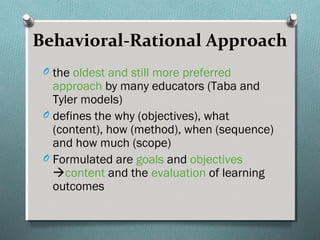
O the oldest and still more preferred
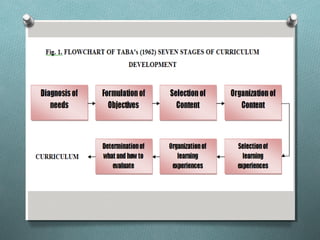
approach by many educators (Taba and
Tyler models)
O defines the why (objectives), what
(content), how (method), when (sequence)
and how much (scope)
O Formulated are goals and objectives
content and the evaluation of learning
outcomes
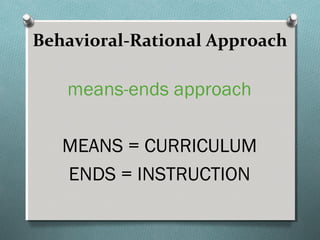
means-ends approach
MEANS = CURRICULUM
ENDS = INSTRUCTION
Behavioral-Rational Approach
O This means-end view focuses on
the need for behavioural
objectives to serve as guides to
instruction and to determine
whether its desired ends are
realized.
Behavioral-Rational Approach
Learning Experiences
O Taba:
“Perhaps the first important consideration
in achieving a wider range of objectives
is the fact that the learning experiences
and not the content as such, are the
means for achieving all objectives
besides those of knowledge and
understanding.”
O Ornstein and Hunkins consider
curriculum experiences as the
instructional component of curriculum
which indicates the interaction
between teacher, learner and
instructional materials for the purpose
of achieving the goals of the school.
Learning Experiences
O Learning does not takes place in a vacuum;
it takes place through experiencing content
oftentimes mediated by social processes.
There will always be variations in the
knowledge and understanding of objects,
people and events as well as their
relationships even when reading the same
book.
Learning Experiences
O Learning experiences may ensue
from teaching methods and
activities chosen as the vehicles
of instruction.
Learning Experiences
System-Managerial Approach
O considers the major interconnected
elements of inputs, throughputs
(process) and outputs that comprise
the educational system
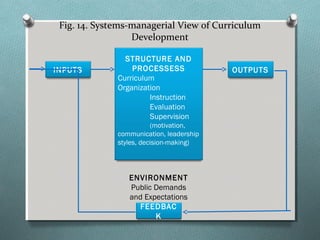
Fig. 14. Systems-managerial View of Curriculum
Development
STRUCTURE AND
PROCESSESS
Curriculum
Organization
Instruction
Evaluation
Supervision
(motivation,
communication, leadership
styles, decision-making)
INPUTS
FEEDBAC
K
OUTPUTS
ENVIRONMENT
Public Demands
and Expectations
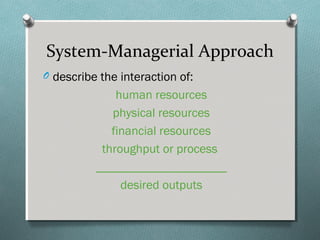
System-Managerial Approach
O describe the interaction of:
human resources
physical resources
financial resources
throughput or process
_____________________
desired outputs
System-Managerial Approach
O This approach emphasizes the
managerial/leadership and supervisory
aspect of the curriculum especially in the
implementation and organization process.
O There are certain roles that the leader
must exercise which require interpersonal,
academic and technical skills.
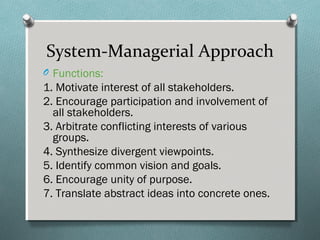
System-Managerial Approach
O Functions:
1. Motivate interest of all stakeholders.
2. Encourage participation and involvement of
all stakeholders.
3. Arbitrate conflicting interests of various
groups.
4. Synthesize divergent viewpoints.
5. Identify common vision and goals.
6. Encourage unity of purpose.
7. Translate abstract ideas into concrete ones.
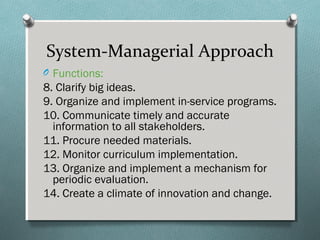
System-Managerial Approach
O Functions:
8. Clarify big ideas.
9. Organize and implement in-service programs.
10. Communicate timely and accurate
information to all stakeholders.
11. Procure needed materials.
12. Monitor curriculum implementation.
13. Organize and implement a mechanism for
periodic evaluation.
14. Create a climate of innovation and change.
System-Managerial Approach
O It may be viewed as a never-ending
process which requires incremental
or even major changes in some
elements of the system, as a matter
of course.
System-Managerial Approach
O Ornstein and Hunkins grouped the
innovations focused on organizations
under five categories:
1)personnel
2)instructional media
3)instructional groups
4)grading
5)schools
System-Managerial Approach
O Ornstein and Hunkins grouped the
innovations focused on organizations
under five categories:
1)personnel
2)instructional media
3)instructional groups
4)grading
5)schools
System-Managerial Approach
O The model is a cyclical process. It is an
offshoot of the linear behavioral-rational
approach.
O Curriculum is viewed as the major system and
the other processes related to it such as
supervision, instruction and evaluation are
subsystems.
O The success of the system depends on the
close monitoring by administrators who
provide interventions and corrective
measures whenever possible problems are
detected.

Curriculum approaches

  • 1.
  • 2.
    Introduction O Bago (2008)said that the analysis of an approach provides information about personal and collective commitments to a particular viewpoint and the values deemed important by individuals, school and society.
  • 3.
    2 broad contrastingcategories: OTechnical-Scientific reflecting the traditional orientation about education and formal methods of schooling O Non-technical-Non-scientific tend to challenge the traditional theories and practices in education, rendering it as a progressive approach in education
  • 4.
    A. Technical/Scientific O Thistype of approach view curriculum development as something similar to engineering or architecture. O use instruments and empirical methods in preparing a blueprint with well – defined elements, orderly sequenced procedures, and quality control measures to increase the probability of success in its implementation
  • 5.
    Behavioral-Rational Approach O theoldest and still more preferred approach by many educators (Taba and Tyler models) O defines the why (objectives), what (content), how (method), when (sequence) and how much (scope) O Formulated are goals and objectives content and the evaluation of learning outcomes
  • 6.
    means-ends approach MEANS =CURRICULUM ENDS = INSTRUCTION Behavioral-Rational Approach
  • 7.
    O This means-endview focuses on the need for behavioural objectives to serve as guides to instruction and to determine whether its desired ends are realized. Behavioral-Rational Approach
  • 9.
    Learning Experiences O Taba: “Perhapsthe first important consideration in achieving a wider range of objectives is the fact that the learning experiences and not the content as such, are the means for achieving all objectives besides those of knowledge and understanding.”
  • 10.
    O Ornstein andHunkins consider curriculum experiences as the instructional component of curriculum which indicates the interaction between teacher, learner and instructional materials for the purpose of achieving the goals of the school. Learning Experiences
  • 11.
    O Learning doesnot takes place in a vacuum; it takes place through experiencing content oftentimes mediated by social processes. There will always be variations in the knowledge and understanding of objects, people and events as well as their relationships even when reading the same book. Learning Experiences
  • 12.
    O Learning experiencesmay ensue from teaching methods and activities chosen as the vehicles of instruction. Learning Experiences
  • 13.
    System-Managerial Approach O considersthe major interconnected elements of inputs, throughputs (process) and outputs that comprise the educational system
  • 14.
    Fig. 14. Systems-managerialView of Curriculum Development STRUCTURE AND PROCESSESS Curriculum Organization Instruction Evaluation Supervision (motivation, communication, leadership styles, decision-making) INPUTS FEEDBAC K OUTPUTS ENVIRONMENT Public Demands and Expectations
  • 15.
    System-Managerial Approach O describethe interaction of: human resources physical resources financial resources throughput or process _____________________ desired outputs
  • 16.
    System-Managerial Approach O Thisapproach emphasizes the managerial/leadership and supervisory aspect of the curriculum especially in the implementation and organization process. O There are certain roles that the leader must exercise which require interpersonal, academic and technical skills.
  • 17.
    System-Managerial Approach O Functions: 1.Motivate interest of all stakeholders. 2. Encourage participation and involvement of all stakeholders. 3. Arbitrate conflicting interests of various groups. 4. Synthesize divergent viewpoints. 5. Identify common vision and goals. 6. Encourage unity of purpose. 7. Translate abstract ideas into concrete ones.
  • 18.
    System-Managerial Approach O Functions: 8.Clarify big ideas. 9. Organize and implement in-service programs. 10. Communicate timely and accurate information to all stakeholders. 11. Procure needed materials. 12. Monitor curriculum implementation. 13. Organize and implement a mechanism for periodic evaluation. 14. Create a climate of innovation and change.
  • 19.
    System-Managerial Approach O Itmay be viewed as a never-ending process which requires incremental or even major changes in some elements of the system, as a matter of course.
  • 20.
    System-Managerial Approach O Ornsteinand Hunkins grouped the innovations focused on organizations under five categories: 1)personnel 2)instructional media 3)instructional groups 4)grading 5)schools
  • 21.
    System-Managerial Approach O Ornsteinand Hunkins grouped the innovations focused on organizations under five categories: 1)personnel 2)instructional media 3)instructional groups 4)grading 5)schools
  • 22.
    System-Managerial Approach O Themodel is a cyclical process. It is an offshoot of the linear behavioral-rational approach. O Curriculum is viewed as the major system and the other processes related to it such as supervision, instruction and evaluation are subsystems. O The success of the system depends on the close monitoring by administrators who provide interventions and corrective measures whenever possible problems are detected.