DEVELOPMENT ADMINISTRATION IN THE
PHILIPPINE BUREAUCRACY
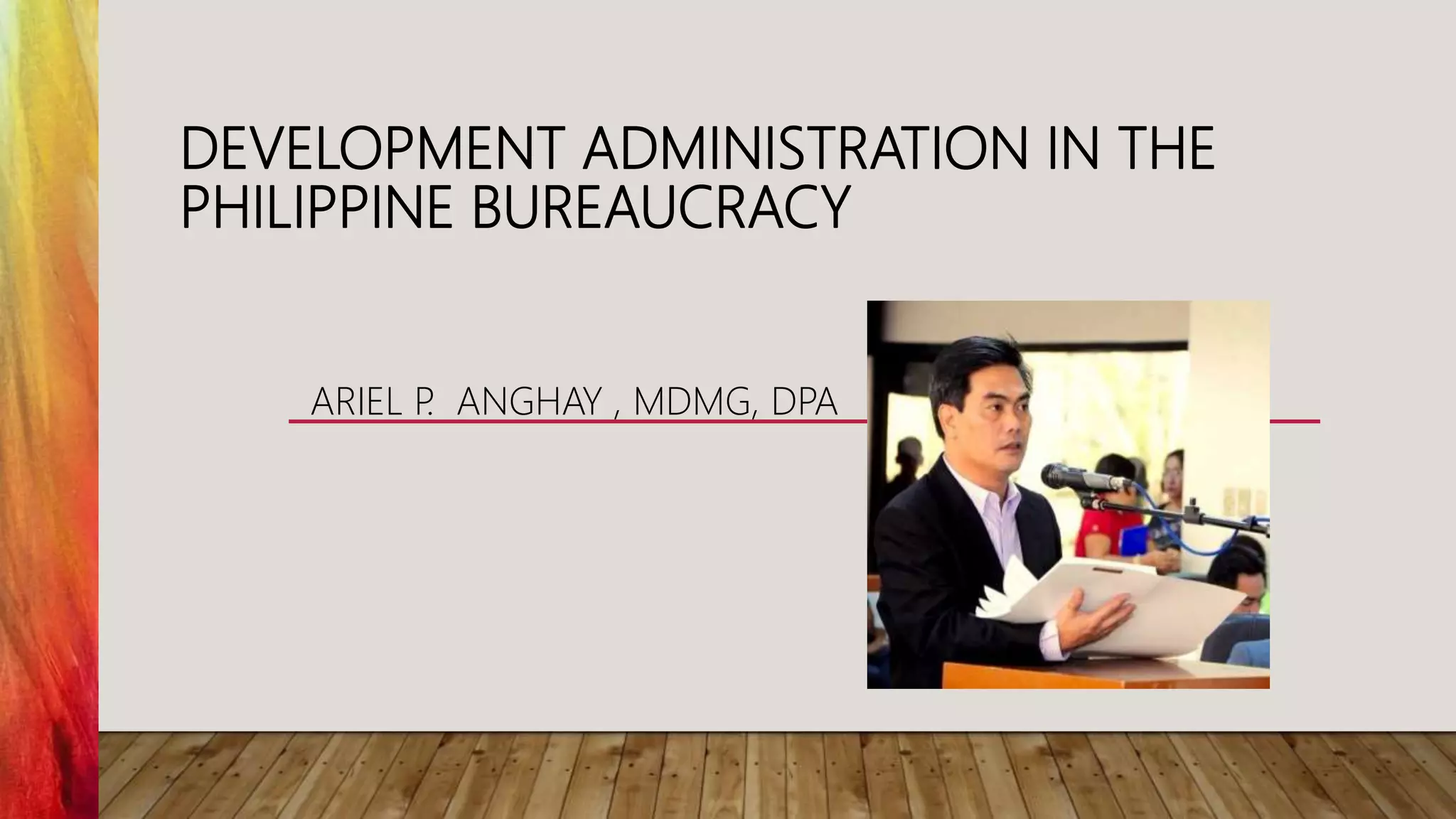
ARIEL P
. ANGHAY , MDMG, DPA
• I. Concepts of Development
• Understanding Development: An approach integrating the concepts, meaning
and various perspectives of development and underdevelopment, the models
of development in view of understanding economic development
• Development – traditionally associated with economic growth, advancement
and expansion
• However, economic growth in itself is not always good, considering that
even as the economy grows, it is entirely possible for poverty and
in the society to continue, or worse to be exacerbated
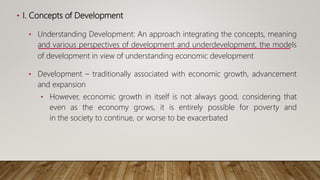
As “the development of development (Andres, Gunder Frank, 1966).
Thus, development to be “real development” – must address – poverty,
inequity and social justice – it should redistributive (Brillantes)
• Elite – dominated political economy of society – reason for poverty and
inequities
This Photo by Unknown Author is licensed under CC BY-SA
• “development” to be abuse exploitation of the non-renewable and finite
natural resources, degrading the environment through deforestation and
pollution
• “sustainable development” is the process of meeting the needs of the
present without sacrificing the needs of future generations
• Thus, “development” to be sustainable and authentic – not only address
concerns of inequity and social justice – but also ecological security –
clean air, water, and fertile soil, taking into consideration the needs of
succeeding generation
A MODEL OF DEVELOPMENT ADMINISTRATION MUST
CONTAIN THE FOLLOWING POINTS.
It should reject status quo and be directed towards change and more so
towards results. It is result oriented at its core and every development function
should have a defined objective.
Planning is essential to decide the framework of resources and time to be
allotted for a development function.
Innovation. It is dynamic in approach and encourages new and better ways to
achieve objectives.
It should focus on planning for the people as well as with the people. It is
people-centered, must empower society as a whole and not product or profit-
centered.
“Prachi Juneja” and Reviewed By Management Study Guide Content Team.
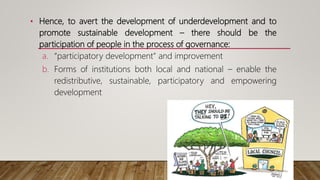
• Hence, to avert the development of underdevelopment and to
promote sustainable development – there should be the
participation of people in the process of governance:
a. “participatory development” and improvement
b. Forms of institutions both local and national – enable the
redistributive, sustainable, participatory and empowering
development
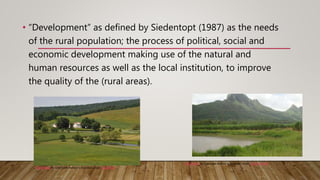
• “Development” as defined by Siedentopt (1987) as the needs
of the rural population; the process of political, social and
economic development making use of the natural and
human resources as well as the local institution, to improve
the quality of the (rural areas).
This Photo by Unknown Author is licensed under CC BY-SA-NC
This Photo by Unknown Author is licensed under CC BY-SA
II. SITUATING DEVELOPMENT IN THE PHILIPPINE CONTEXT
• De Guzman –argued that fundamental infrastructure must be in place
including physical and social infrastructure
• Basic requirement:
a. Law and order
b. Physical infrastructure, including roads, bridges, airports, wharves,
dams, irrigation system etc.
c. Power and electricity
d. Water system for agriculture, industry commerce
e. Transportation network
f. Communication, telecommunication system
g. Social infrastructure, education facilities and
services, health facilities and services
h. Appropriate technology
i. Manpower – managerial, technical/skilled and
the support technology
j. Capital, funds, credit
• De Guzman cited some constraints and obstacles to
development
a. Lack of political will
b. Problems in the bureaucracy ranging from graft and
corruption to red tape, lack of skilled managers,
entrepreneurs
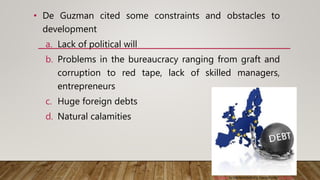
c. Huge foreign debts
d. Natural calamities
This Photo by Unknown Author is licensed under CC BY-NC-
• De Guzman argued that the attainment of development – employ
comprehensive and far-reaching strategy
a. Reform efforts in the politico-administrative machinery structural,
behavioral and cultural dimensions
b. Address concerns – national unity, national consciousness and
national identity
• The need to achieve unity in cultural diversity
• Development of “Filipino” national language
• Development of physical infrastructure
c. Improving communication and telecommunication
d. Decentralization and strengthening of local level institutions
This Photo by Unknown Author is licensed under CC
BY
• III. Historical Perspective of Development Administration
• Development Administration school is the variety or type of public
administration theory
• Aimed to identify administrative behavior and patterns of countries to
effectively ran their government and to attain economic development
• The concept of development administration was coined by Goswani (1955)
popularized by (Riggs & Weildner)
• Exclusively used in Asia, Africa and Latin America
• Its conceptual foundation were western
• Influenced largely by scientific management theory and administrative
reform (traditional public admin theory)
• Joint impact of great depression (US)
• World War II reconstruction of national economies devastated by the
war, and the power struggle between the US & USSR for hegemony
• Subscribing to the Marshal Plan reconstruction model exported by the US to
war town Europe, development administration infused the Asian African and
Latin American countries with western capital, technology and management
tools
• Development Administration closely linked to foreign aid and western
models of development (Neff & Dwivide, 1981)pid “
• DA was guided by emphasis on internal aspects administration, conventional
techniques and the values of economy and efficiency
• DA was applied at a time in a process of nation building and grappling with
social and economic problems
Thus, DA aimed to develop the administrative capability if
governments to enable them to achieve development
- DA focuses on the support and management of
development
- DA refers to the complex of agencies, management
systems and processes a government – established to
achieve its development goals (Gant, 1979)
- DA is characterized according to its purposes, loyalties,
and attitudes
• IV. Development Administration in the Philippines: Bureaucratic Reforms
A. Issues and Concerns
• Bureaucracy and the Civil Service
• Scope and role of public administration and governance
• Technology and bureaucratic traditions
• Governance in a global community
• Public Accountability and Graft and Corruption
• Civil society and Non-Government Organization
B. Development Administration in the Philippine
Bureaucracy
Development Administration under the New
Administration (Carlos)
1. Corruption/ Rule of Law and Justice Reform
Good housekeeping should be the first priority of new leadership
in implementing reforms
Achieving respect for the rule of law
2. Insurgencies
Peace is a pre-requisite to development
Unless there is peace in the various regions development is difficult
Vast potentials for development remain untapped
3.. Public-Private Sector Partnership
“development” takes place if there is a sound working relationship
between the government and the private sector
4. Local – National Relations
There should be clear cut delineation between National and local
functional jurisdiction
• Implementing policy for development and delivery of
basic services must be carried at various levels of
government down to barangays
5. Political / Electoral Reforms
• Ensure that there is a reconfiguration of the political
party system
• Pursuit electoral reform – party-based leadership in
contrast to purely personality-based leadership
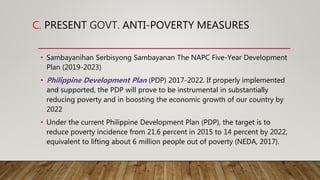
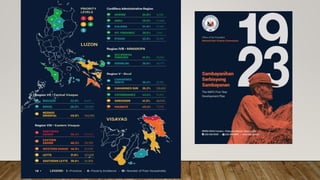
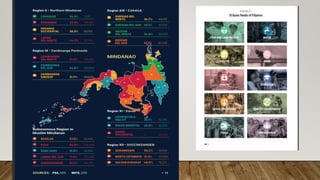
C. PRESENT GOVT. ANTI-POVERTY MEASURES
• Sambayanihan Serbisyong Sambayanan The NAPC Five-Year Development
Plan (2019-2023)
• Philippine Development Plan (PDP) 2017-2022. If properly implemented
and supported, the PDP will prove to be instrumental in substantially
reducing poverty and in boosting the economic growth of our country by
2022
• Under the current Philippine Development Plan (PDP), the target is to
reduce poverty incidence from 21.6 percent in 2015 to 14 percent by 2022,
equivalent to lifting about 6 million people out of poverty (NEDA, 2017).
References:
1. Brillantes, A. Jr. and Fernandez, M. (2008) IS THERE A PHILIPPINE PUBLIC ADMINISTRATION? OR
BETTER STILL, FOR WHOM IS PHILIPPINE PUBLIC ADMINISTRATION? UP National College of
Public Administration and Governance (UP NCPAG)
2. Cariño, L. V. (2000) “The Concept of Governance” From Government to Governance. Quezon City:
Eastern Regional Organization for Public Administration (EROPA.)
3. Cruz, R. B. (2011). Unraveling Public Administration in Five-Thirteenths of Southeast Asia. International
Review of Public Administration, 16(2), 191
4. Gaylord, G. C. (2014). The study of Public Administration in India, the Philippines, Canada, and
Australia: The universal struggle against epistemic colonization, and toward critical assimilation. Revista
De Administração Pública, 48(5), 1073-1092
5. Hout, W. (2004). Good Governance and the Political Economy of Selectivity. Asia Research Centre
6. Hutchcroft, P. D. (2000). Colonial masters, national politicos, and provincial lords:
Central authority and local autonomy in the american philippines, 1900-1913. The Journal of Asian
Studies, 59(2), 277-306
7. The NAPC Five-Year Development Plan 2019-2023 © 2019 by the National Anti-Poverty Commission
Secretariat (Project Development and Operations Oversight Unit (PDOOU) headed by Fernando Cao and
which included Jon Vincent Marin, Anjo Bacarisas, Marjo Busto, Nikkin Beronilla, Jake Sabdao, Sanny Boy
Afable, Jennifer Padilla, Jiru Nikko Rada, John Eric Nicolas, Mabelle Lao, Annabelle Batingan, and John
Henry Yuson. Dario Cubelo
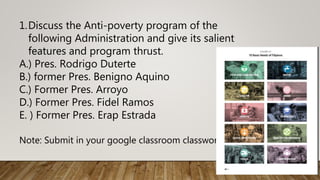
1.Discuss the Anti-poverty program of the
following Administration and give its salient
features and program thrust.
A.) Pres. Rodrigo Duterte
B.) former Pres. Benigno Aquino
C.) Former Pres. Arroyo
D.) Former Pres. Fidel Ramos
E. ) Former Pres. Erap Estrada
Note: Submit in your google classroom classwork

Development administration in the

  • 1.
    DEVELOPMENT ADMINISTRATION INTHE PHILIPPINE BUREAUCRACY ARIEL P . ANGHAY , MDMG, DPA
  • 2.
    • I. Conceptsof Development • Understanding Development: An approach integrating the concepts, meaning and various perspectives of development and underdevelopment, the models of development in view of understanding economic development • Development – traditionally associated with economic growth, advancement and expansion • However, economic growth in itself is not always good, considering that even as the economy grows, it is entirely possible for poverty and in the society to continue, or worse to be exacerbated
  • 3.
    As “the developmentof development (Andres, Gunder Frank, 1966). Thus, development to be “real development” – must address – poverty, inequity and social justice – it should redistributive (Brillantes) • Elite – dominated political economy of society – reason for poverty and inequities This Photo by Unknown Author is licensed under CC BY-SA
  • 4.
    • “development” tobe abuse exploitation of the non-renewable and finite natural resources, degrading the environment through deforestation and pollution • “sustainable development” is the process of meeting the needs of the present without sacrificing the needs of future generations • Thus, “development” to be sustainable and authentic – not only address concerns of inequity and social justice – but also ecological security – clean air, water, and fertile soil, taking into consideration the needs of succeeding generation
  • 5.
    A MODEL OFDEVELOPMENT ADMINISTRATION MUST CONTAIN THE FOLLOWING POINTS. It should reject status quo and be directed towards change and more so towards results. It is result oriented at its core and every development function should have a defined objective. Planning is essential to decide the framework of resources and time to be allotted for a development function. Innovation. It is dynamic in approach and encourages new and better ways to achieve objectives. It should focus on planning for the people as well as with the people. It is people-centered, must empower society as a whole and not product or profit- centered. “Prachi Juneja” and Reviewed By Management Study Guide Content Team.
  • 6.
    • Hence, toavert the development of underdevelopment and to promote sustainable development – there should be the participation of people in the process of governance: a. “participatory development” and improvement b. Forms of institutions both local and national – enable the redistributive, sustainable, participatory and empowering development
  • 7.
    • “Development” asdefined by Siedentopt (1987) as the needs of the rural population; the process of political, social and economic development making use of the natural and human resources as well as the local institution, to improve the quality of the (rural areas). This Photo by Unknown Author is licensed under CC BY-SA-NC This Photo by Unknown Author is licensed under CC BY-SA
  • 8.
    II. SITUATING DEVELOPMENTIN THE PHILIPPINE CONTEXT • De Guzman –argued that fundamental infrastructure must be in place including physical and social infrastructure • Basic requirement: a. Law and order b. Physical infrastructure, including roads, bridges, airports, wharves, dams, irrigation system etc. c. Power and electricity d. Water system for agriculture, industry commerce e. Transportation network
  • 9.
    f. Communication, telecommunicationsystem g. Social infrastructure, education facilities and services, health facilities and services h. Appropriate technology i. Manpower – managerial, technical/skilled and the support technology j. Capital, funds, credit
  • 10.
    • De Guzmancited some constraints and obstacles to development a. Lack of political will b. Problems in the bureaucracy ranging from graft and corruption to red tape, lack of skilled managers, entrepreneurs c. Huge foreign debts d. Natural calamities This Photo by Unknown Author is licensed under CC BY-NC-
  • 11.
    • De Guzmanargued that the attainment of development – employ comprehensive and far-reaching strategy a. Reform efforts in the politico-administrative machinery structural, behavioral and cultural dimensions b. Address concerns – national unity, national consciousness and national identity • The need to achieve unity in cultural diversity • Development of “Filipino” national language • Development of physical infrastructure c. Improving communication and telecommunication d. Decentralization and strengthening of local level institutions This Photo by Unknown Author is licensed under CC BY
  • 12.
    • III. HistoricalPerspective of Development Administration • Development Administration school is the variety or type of public administration theory • Aimed to identify administrative behavior and patterns of countries to effectively ran their government and to attain economic development • The concept of development administration was coined by Goswani (1955) popularized by (Riggs & Weildner) • Exclusively used in Asia, Africa and Latin America
  • 13.
    • Its conceptualfoundation were western • Influenced largely by scientific management theory and administrative reform (traditional public admin theory) • Joint impact of great depression (US) • World War II reconstruction of national economies devastated by the war, and the power struggle between the US & USSR for hegemony
  • 14.
    • Subscribing tothe Marshal Plan reconstruction model exported by the US to war town Europe, development administration infused the Asian African and Latin American countries with western capital, technology and management tools • Development Administration closely linked to foreign aid and western models of development (Neff & Dwivide, 1981)pid “ • DA was guided by emphasis on internal aspects administration, conventional techniques and the values of economy and efficiency • DA was applied at a time in a process of nation building and grappling with social and economic problems
  • 15.
    Thus, DA aimedto develop the administrative capability if governments to enable them to achieve development - DA focuses on the support and management of development - DA refers to the complex of agencies, management systems and processes a government – established to achieve its development goals (Gant, 1979) - DA is characterized according to its purposes, loyalties, and attitudes
  • 16.
    • IV. DevelopmentAdministration in the Philippines: Bureaucratic Reforms A. Issues and Concerns • Bureaucracy and the Civil Service • Scope and role of public administration and governance • Technology and bureaucratic traditions • Governance in a global community • Public Accountability and Graft and Corruption • Civil society and Non-Government Organization
  • 17.
    B. Development Administrationin the Philippine Bureaucracy Development Administration under the New Administration (Carlos) 1. Corruption/ Rule of Law and Justice Reform Good housekeeping should be the first priority of new leadership in implementing reforms Achieving respect for the rule of law
  • 18.
    2. Insurgencies Peace isa pre-requisite to development Unless there is peace in the various regions development is difficult Vast potentials for development remain untapped 3.. Public-Private Sector Partnership “development” takes place if there is a sound working relationship between the government and the private sector 4. Local – National Relations There should be clear cut delineation between National and local functional jurisdiction
  • 19.
    • Implementing policyfor development and delivery of basic services must be carried at various levels of government down to barangays 5. Political / Electoral Reforms • Ensure that there is a reconfiguration of the political party system • Pursuit electoral reform – party-based leadership in contrast to purely personality-based leadership
  • 20.
    C. PRESENT GOVT.ANTI-POVERTY MEASURES • Sambayanihan Serbisyong Sambayanan The NAPC Five-Year Development Plan (2019-2023) • Philippine Development Plan (PDP) 2017-2022. If properly implemented and supported, the PDP will prove to be instrumental in substantially reducing poverty and in boosting the economic growth of our country by 2022 • Under the current Philippine Development Plan (PDP), the target is to reduce poverty incidence from 21.6 percent in 2015 to 14 percent by 2022, equivalent to lifting about 6 million people out of poverty (NEDA, 2017).
  • 23.
    References: 1. Brillantes, A.Jr. and Fernandez, M. (2008) IS THERE A PHILIPPINE PUBLIC ADMINISTRATION? OR BETTER STILL, FOR WHOM IS PHILIPPINE PUBLIC ADMINISTRATION? UP National College of Public Administration and Governance (UP NCPAG) 2. Cariño, L. V. (2000) “The Concept of Governance” From Government to Governance. Quezon City: Eastern Regional Organization for Public Administration (EROPA.) 3. Cruz, R. B. (2011). Unraveling Public Administration in Five-Thirteenths of Southeast Asia. International Review of Public Administration, 16(2), 191 4. Gaylord, G. C. (2014). The study of Public Administration in India, the Philippines, Canada, and Australia: The universal struggle against epistemic colonization, and toward critical assimilation. Revista De Administração Pública, 48(5), 1073-1092 5. Hout, W. (2004). Good Governance and the Political Economy of Selectivity. Asia Research Centre 6. Hutchcroft, P. D. (2000). Colonial masters, national politicos, and provincial lords: Central authority and local autonomy in the american philippines, 1900-1913. The Journal of Asian Studies, 59(2), 277-306 7. The NAPC Five-Year Development Plan 2019-2023 © 2019 by the National Anti-Poverty Commission Secretariat (Project Development and Operations Oversight Unit (PDOOU) headed by Fernando Cao and which included Jon Vincent Marin, Anjo Bacarisas, Marjo Busto, Nikkin Beronilla, Jake Sabdao, Sanny Boy Afable, Jennifer Padilla, Jiru Nikko Rada, John Eric Nicolas, Mabelle Lao, Annabelle Batingan, and John Henry Yuson. Dario Cubelo
  • 24.
    1.Discuss the Anti-povertyprogram of the following Administration and give its salient features and program thrust. A.) Pres. Rodrigo Duterte B.) former Pres. Benigno Aquino C.) Former Pres. Arroyo D.) Former Pres. Fidel Ramos E. ) Former Pres. Erap Estrada Note: Submit in your google classroom classwork

Editor's Notes

  • #25 1. Discuss the Anti-poverty program of A.) Pres. Rordrigo Duterte B.) former Pres. Benigno Aquino C.) Former Pres. Arroyo D.) Former Pres. Fidel Ramos E. ) Former Pres. Erap Estrada