Being curious, creative & courageous:
or why research is fun
@solentlearning
@tansyjtweets
Tansy Jessop
21 February 2018
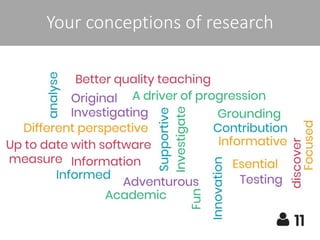
Your conceptions of research
Agree
Research provides a scientific view of
reality
Disagree
Agree
Research is the art of interpreting reality
Disagree
Agree
Research needs to be impartial
Disagree
Agree
Stories shed light on phenomena in a way
that statistics can’t do
Disagree
Agree
You need a large sample to do research
Disagree
Agree
Truth is relative so research is a bit
pointless
Disagree
Agree
Research needs to be objective, scientific
& neutral
Disagree
Pause
• Turn to the person next to you
• Which statement did you feel most strongly
about or most interested in?
• Chat to the person next to you about why this
struck a chord with you
Making sense of data: what’s going on
• Groups A and C: take the TESTA quant data and
work on it for ten minutes to find out what you
think is going on. Write down your conclusions.
What don’t you know from the data?
• Groups B and D: take the TESTA qual data and work
on it for ten minutes to find out what you think is
going on. Write down your conclusions. What don’t
you know from the data?
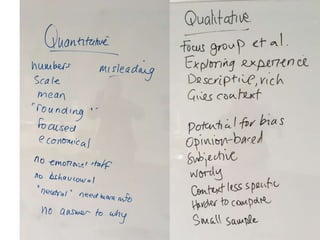
The characteristics of quantitative data
• List the main characteristics of
quantitative data
• What are the strengths of quant
data?
• What are its limitations? What
doesn’t it tell you?
The characteristics of qualitative data
• List the main characteristics
of qualitative data
• What are the strengths of
qual data?
• What are its limitations?
What doesn’t it tell you?
Mixing it up
• Mix it up to see if the data makes more sense when
you join qualitative and quantitative forces.
• Group A and B meet together to find out why
scores are low.
• Group C and D meet together to find out why
scores are low.
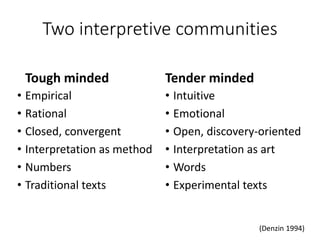
Two interpretive communities
Tough minded
• Empirical
• Rational
• Closed, convergent
• Interpretation as method
• Numbers
• Traditional texts
Tender minded
• Intuitive
• Emotional
• Open, discovery-oriented
• Interpretation as art
• Words
• Experimental texts
(Denzin 1994)
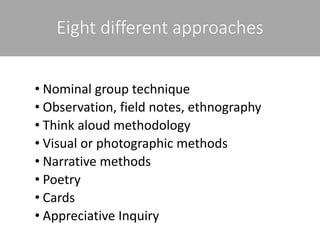
Eight different approaches
• Nominal group technique
• Observation, field notes, ethnography
• Think aloud methodology
• Visual or photographic methods
• Narrative methods
• Poetry
• Cards
• Appreciative Inquiry
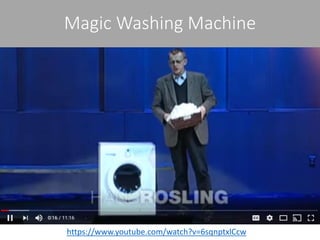
Magic Washing Machine
https://www.youtube.com/watch?v=6sqnptxlCcw
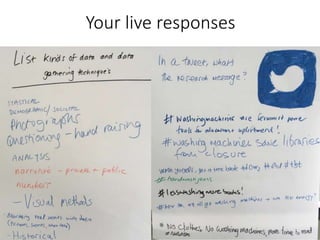
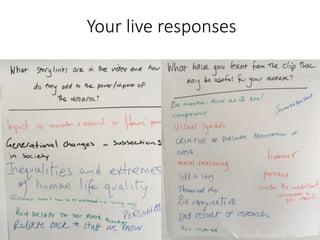
Your live responses
Your live responses
Collecting some observational data
• What’s your research question?
• What will you observe and how will you write or map
your observations?
• What contextual factors might you notice?
• Expressions, tone of voice, body language,
movement etc….
Trigger questions…make up your own
or choose or adapt
• What are people’s drinking preferences in the
afternoon?
• What is the predominant use of the Deli in relation to
consumption and conversation? (eating and drinking
vs social) and how do you know?
• What’s the nature of activity on the Spark stairwells?
• How do people use the social spaces in the Spark?
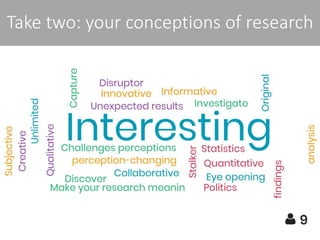
Take two: your conceptions of research

Curious creative and courageous: or why research is fun

  • 1.
    Being curious, creative& courageous: or why research is fun @solentlearning @tansyjtweets Tansy Jessop 21 February 2018
  • 2.
  • 3.
    Agree Research provides ascientific view of reality Disagree
  • 4.
    Agree Research is theart of interpreting reality Disagree
  • 5.
    Agree Research needs tobe impartial Disagree
  • 6.
    Agree Stories shed lighton phenomena in a way that statistics can’t do Disagree
  • 7.
    Agree You need alarge sample to do research Disagree
  • 8.
    Agree Truth is relativeso research is a bit pointless Disagree
  • 9.
    Agree Research needs tobe objective, scientific & neutral Disagree
  • 10.
    Pause • Turn tothe person next to you • Which statement did you feel most strongly about or most interested in? • Chat to the person next to you about why this struck a chord with you
  • 11.
    Making sense ofdata: what’s going on • Groups A and C: take the TESTA quant data and work on it for ten minutes to find out what you think is going on. Write down your conclusions. What don’t you know from the data? • Groups B and D: take the TESTA qual data and work on it for ten minutes to find out what you think is going on. Write down your conclusions. What don’t you know from the data?
  • 12.
    The characteristics ofquantitative data • List the main characteristics of quantitative data • What are the strengths of quant data? • What are its limitations? What doesn’t it tell you?
  • 14.
    The characteristics ofqualitative data • List the main characteristics of qualitative data • What are the strengths of qual data? • What are its limitations? What doesn’t it tell you?
  • 15.
    Mixing it up •Mix it up to see if the data makes more sense when you join qualitative and quantitative forces. • Group A and B meet together to find out why scores are low. • Group C and D meet together to find out why scores are low.
  • 16.
    Two interpretive communities Toughminded • Empirical • Rational • Closed, convergent • Interpretation as method • Numbers • Traditional texts Tender minded • Intuitive • Emotional • Open, discovery-oriented • Interpretation as art • Words • Experimental texts (Denzin 1994)
  • 17.
    Eight different approaches •Nominal group technique • Observation, field notes, ethnography • Think aloud methodology • Visual or photographic methods • Narrative methods • Poetry • Cards • Appreciative Inquiry
  • 18.
  • 19.
  • 20.
  • 21.
    Collecting some observationaldata • What’s your research question? • What will you observe and how will you write or map your observations? • What contextual factors might you notice? • Expressions, tone of voice, body language, movement etc….
  • 22.
    Trigger questions…make upyour own or choose or adapt • What are people’s drinking preferences in the afternoon? • What is the predominant use of the Deli in relation to consumption and conversation? (eating and drinking vs social) and how do you know? • What’s the nature of activity on the Spark stairwells? • How do people use the social spaces in the Spark?
  • 23.
    Take two: yourconceptions of research

Editor's Notes