INTRODUCTION TO QUALITATIVE
I • RESEARCH DESIGN
•
•
I
By:
S. Bahar Ali
QUALITATIVE RESEARCH: GROWING IN
POPULARITY IN HEALTH AND MEDICINE
o Qualitative methods are becoming increasingly
prevalent in medical and related research. They
provide additional ways for health researchers to
explore and explain the contexts in which they
and their patients function, enabling a more
comprehensive understanding of many aspects of
the healthcare system. (Kuper et al, 2006: 406)
o Experiences in qualitative research?
WHAT IS QUALITATIVE RESEARCH?
o The goal of Qualitative research is the
development of concepts which helps to
understand social phenomena in natural (rather
then experimental) setting, giving due to
emphasis to the meanings, experiences, and
views of all the participants. (Pope & Mays,1995).
WHAT IS QUALITATIVE RESEARCH?
Bryman's (1998) characteristics of qualitative
research:
o Seeing through eyes
o Describing the details of everyday settings
o Understanding actions and meaning in their
social context
QUALITATIVE RESEARCH
o Qualitative research, also called field research,
typically involves fieldwork in which the researcher
observes and records behavior and events in their
natural setting.
o The researcher physically goes to the people, setting,
or site in order to observe the subject as it normally
and naturally occurs or behaves.
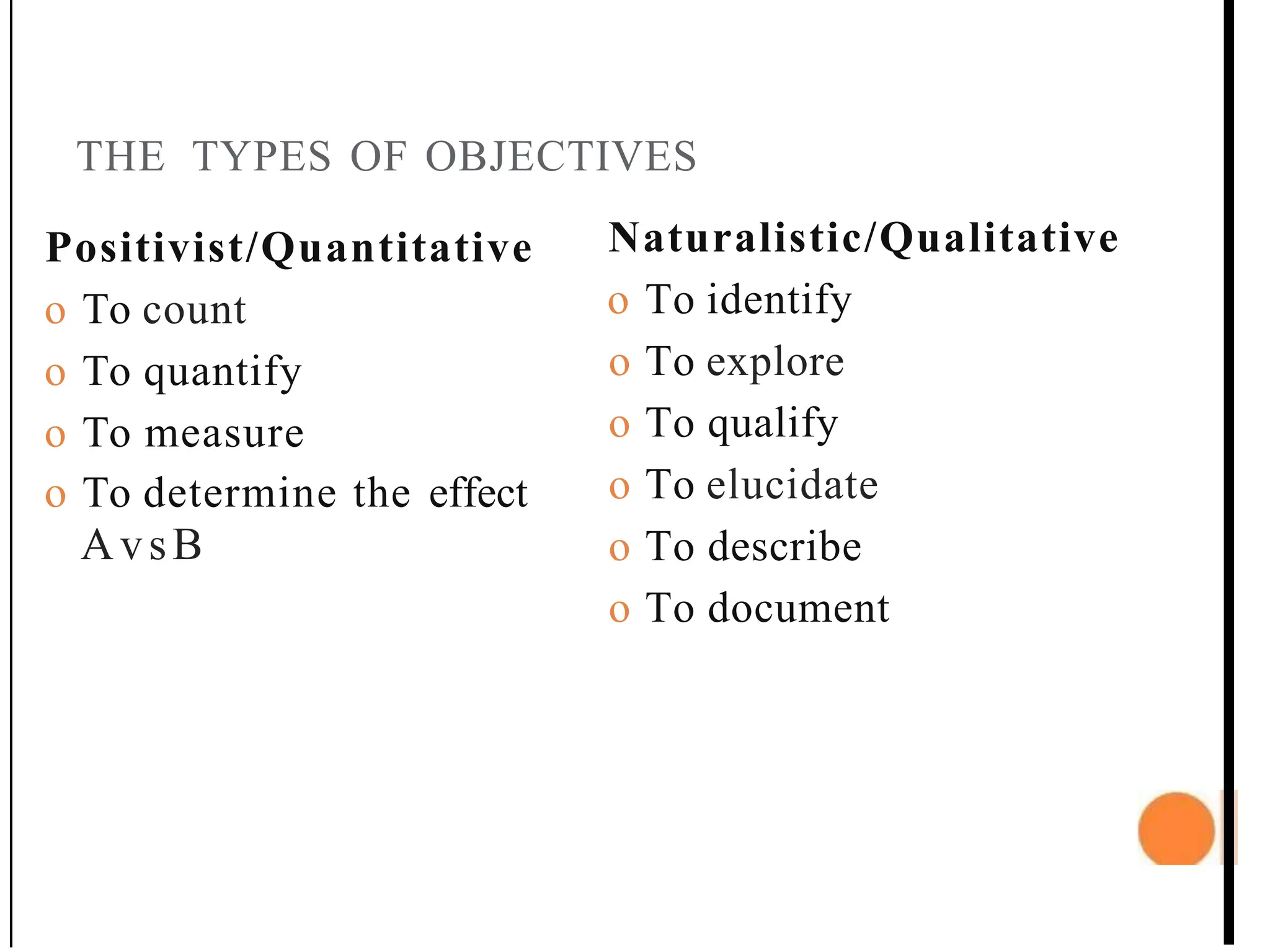
THE TYPES OF OBJECTIVES
Positivist/Quantitative
o To count
o To quantify
o To measure
o To determine the effect
AvsB
Naturalistic/Qualitative
o To identify
o To explore
o To qualify
o To elucidate
o To describe
o To document
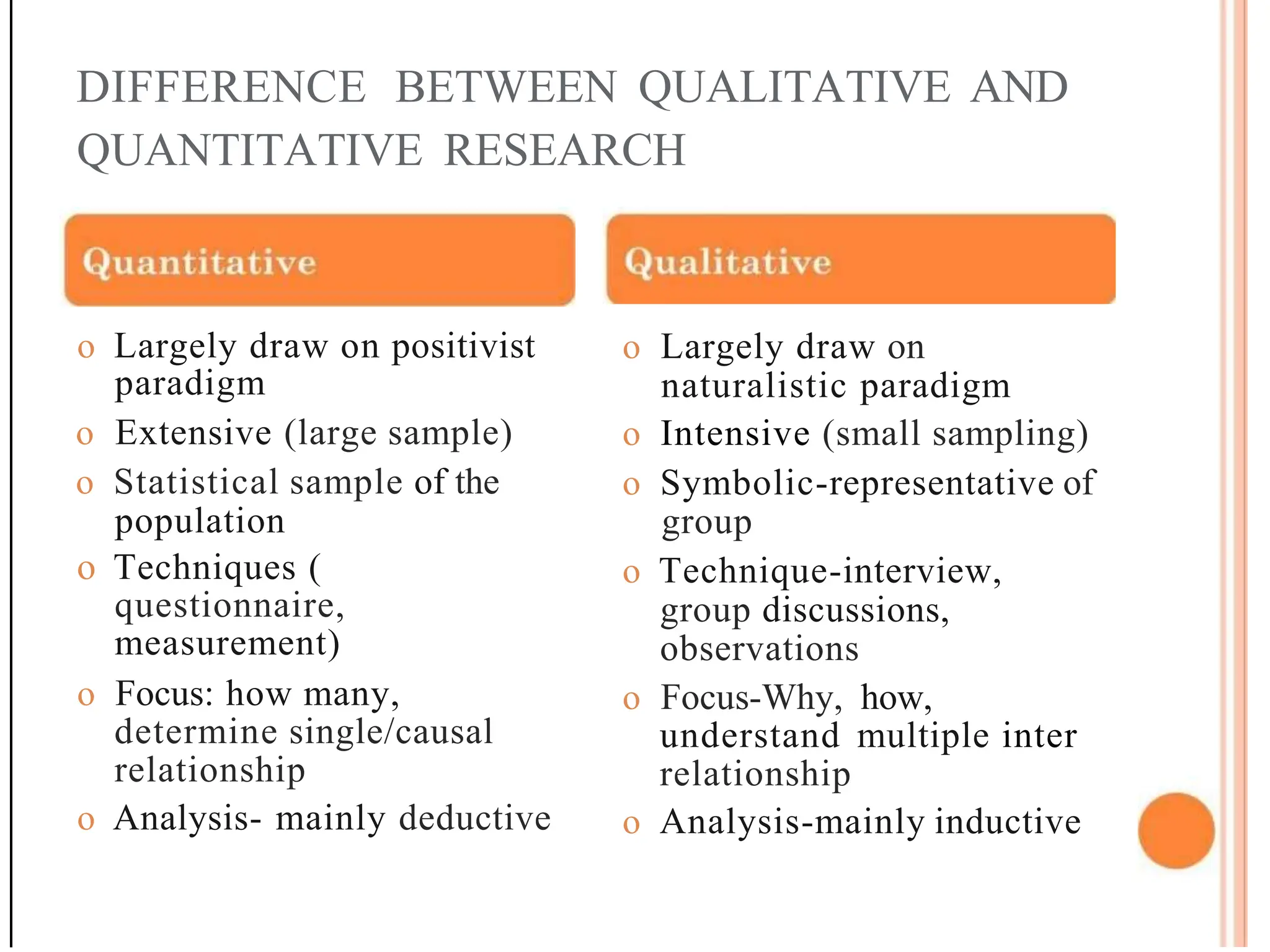
DIFFERENCE BETWEEN QUALITATIVE AND
QUANTITATIVE RESEARCH
o Largely draw on positivist
paradigm
o Extensive (large sample)
o Statistical sample of the
population
o Techniques (
questionnaire,
measurement)
o Focus: how many,
determine single/causal
relationship
o Analysis- mainly deductive
o Largely draw on
naturalistic paradigm
o Intensive (small sampling)
o Symbolic-representative of
group
o Technique-interview,
group discussions,
observations
o Focus-Why, how,
understand multiple inter
relationship
o Analysis-mainly inductive
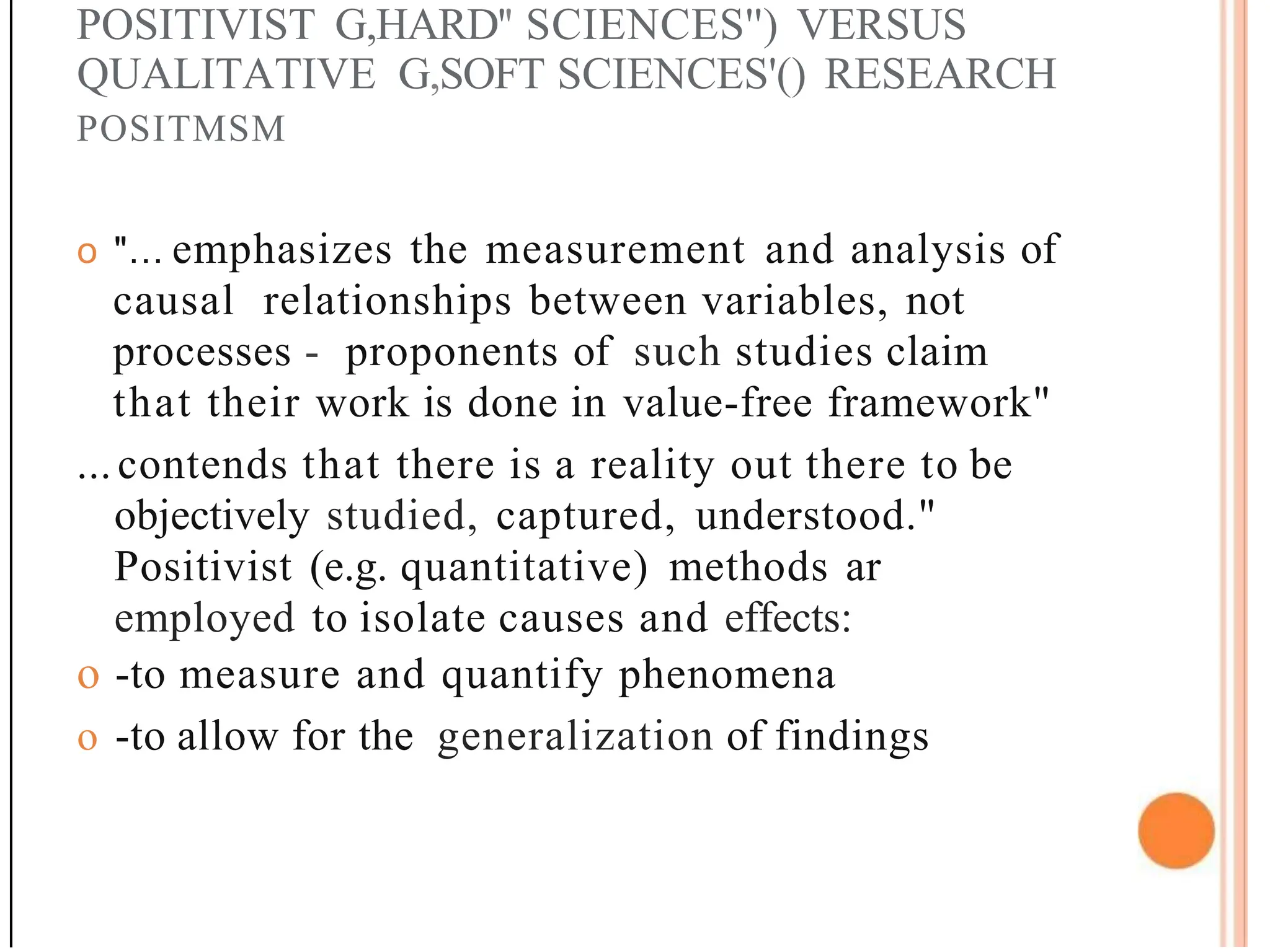
POSITIVIST G,HARD'' SCIENCES'') VERSUS
QUALITATIVE G,SOFT SCIENCES'() RESEARCH
POSITMSM
o "... emphasizes the measurement and analysis of
causal relationships between variables, not
processes - proponents of such studies claim
that their work is done in value-free framework"
...contends that there is a reality out there to be
objectively studied, captured, understood."
Positivist (e.g. quantitative) methods ar
employed to isolate causes and effects:
o -to measure and quantify phenomena
o -to allow for the generalization of findings
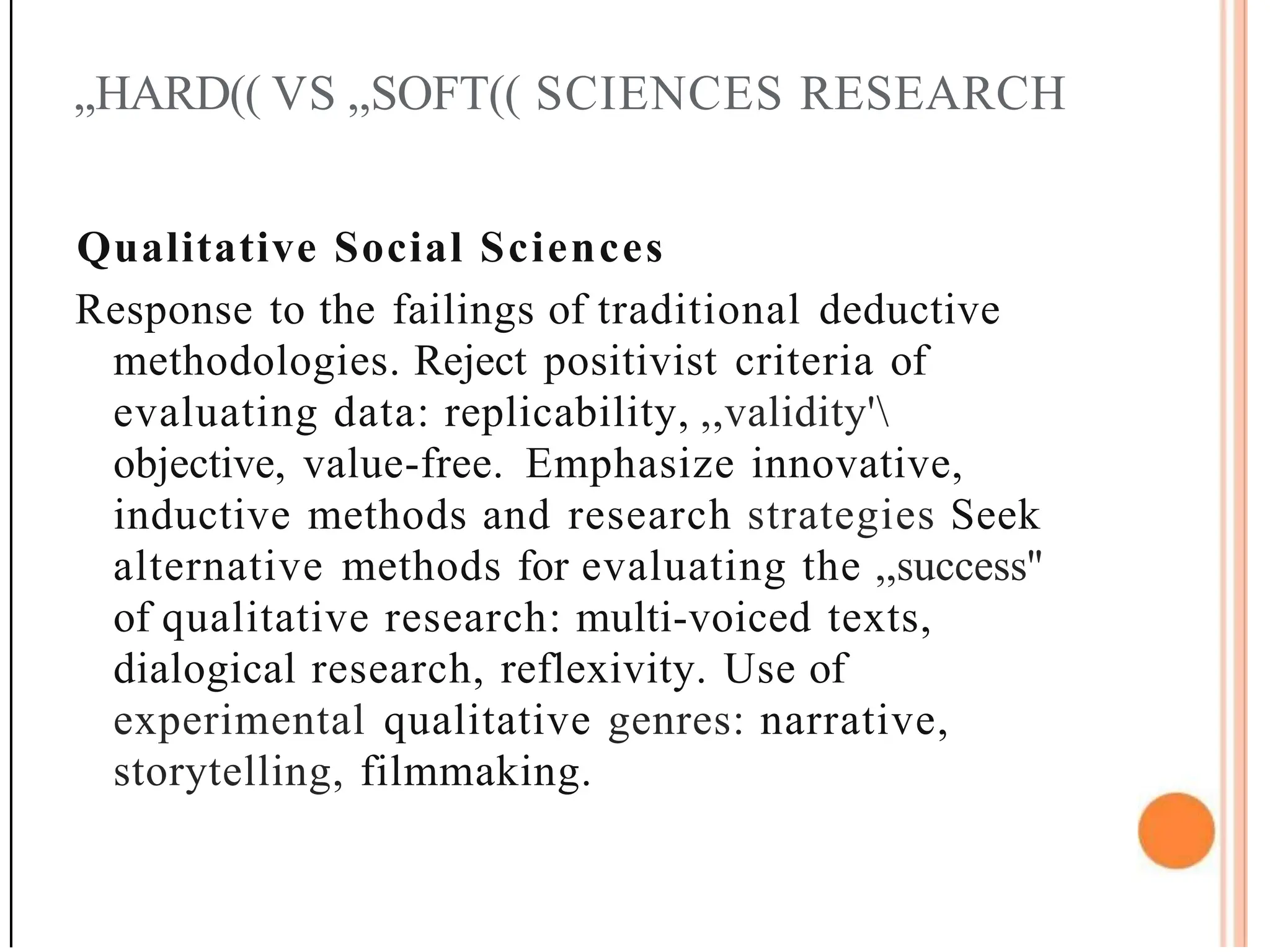
,,HARD(( VS ,,SOFT(( SCIENCES RESEARCH
Qualitative Social Sciences
Response to the failings of traditional deductive
methodologies. Reject positivist criteria of
evaluating data: replicability, ,,validity'
objective, value-free. Emphasize innovative,
inductive methods and research strategies Seek
alternative methods for evaluating the ,,success''
of qualitative research: multi-voiced texts,
dialogical research, reflexivity. Use of
experimental qualitative genres: narrative,
storytelling, filmmaking.
DEDUCTIVE VERSUS INDUCTIVE
PROCESSES
Deductive process in quantitative studies begins with
theory
Examines hypothetical relationships within it
Hypothesis - tested
Inductive process in qualitative studies begins with
observations
Open questions which are applied to guide initial
research
Research is refined over the course of fieldwork and the
collection and preliminary thematic analysis of data
Inductive research drives the identification of situation
specific analytical approaches, or, the formulation of
theory generated from study observations and
findings (grounded theory)
DEDUCTIVE REASONING
o Associated with positivist/experimental approach
o Researcher begins with acceptance of a general
principle or belief and then apply that principle
to explain a specific case or phenomenon. (DePoy
& Gitlin, 1994)
CORE ACTIVITIES IN QUALITATIVE RESEARCH
o Literature Review- a cursory review may be done initially to
focus the study, otherwise it is conducted after the data has
been collected and analyzed.
o Rationale for delaying the L.R. is to avoid leading the
participants in the direction of what has already been
discovered.
o Purpose of L.R. is to show how current findings fit into what
is already known
o Bracketing - setting aside one's biases and personal
views on a topic
o Investigator keeps a diary of personal thoughts and
feelings about the topic
o Purpose is to make known to the researcher her/his
beliefs about the topic so that the researcher may
approach the topic honestly
The field is the natural world where participants live
o The field requires reciprocity in terms of decision making
o The participant & researcher determine what data will be
shared
o Participants must understand & be willing to share their
thoughts & feelings about the phenomenon
o Contrast this with quantitative studies where data are
collected in controlled settings & the researcher is removed
from the subject
o Participant or informant refers to the individual
who informs the research study (vs subjects or
respondents)
o They are active participants & equal partners
o Must have 1st hand experience with research
phenomenon (vs random selection)
o They want to help others understand their lives &
the social contexts in which they live & create
.
meaning
o Participants must have first hand experience with the
research experience and be able to talk about it
o Researcher establishes clear criteria & rationale for sample
selection
o Goal is not generalization of findings but rich descriptions
of phenomenon by those who have experienced it
o A situation in data collection in which
participants' descriptions become repetitive &
confirm previously collected data
o An indication that data collection is complete
o Similar to adequate sample size in quantitative
research
o Researcher immerses self in data to bring order & meaning
to vast narrative
o Begins with 1st data collection episode
o Reading, rereading, intuiting, analyzing, synthesizing &
reporting on data
o Cyclical & recursive process that requires an extensive
amount of time
oRIGOR in qualitative
research is less about the
adherence to rules and more
about fidelity to the spirit
and standards of qualitative
work (Sandelowski, 1993)
o Data from interviews are continuously reviewed to
identify additional questions
o Data from earlier interviews are routinely returned
to participants for clarification/elaboration
o Investigator must look for meaning in the data as it
is reviewed
o At conclusion of study a protracted period of data
immersion in which conclusions are reviewed in
the context of the whole study
o Data similar in meaning are clustered together
into preliminary categories
oCredibility
oTransferability
oDependability
oConfirmability
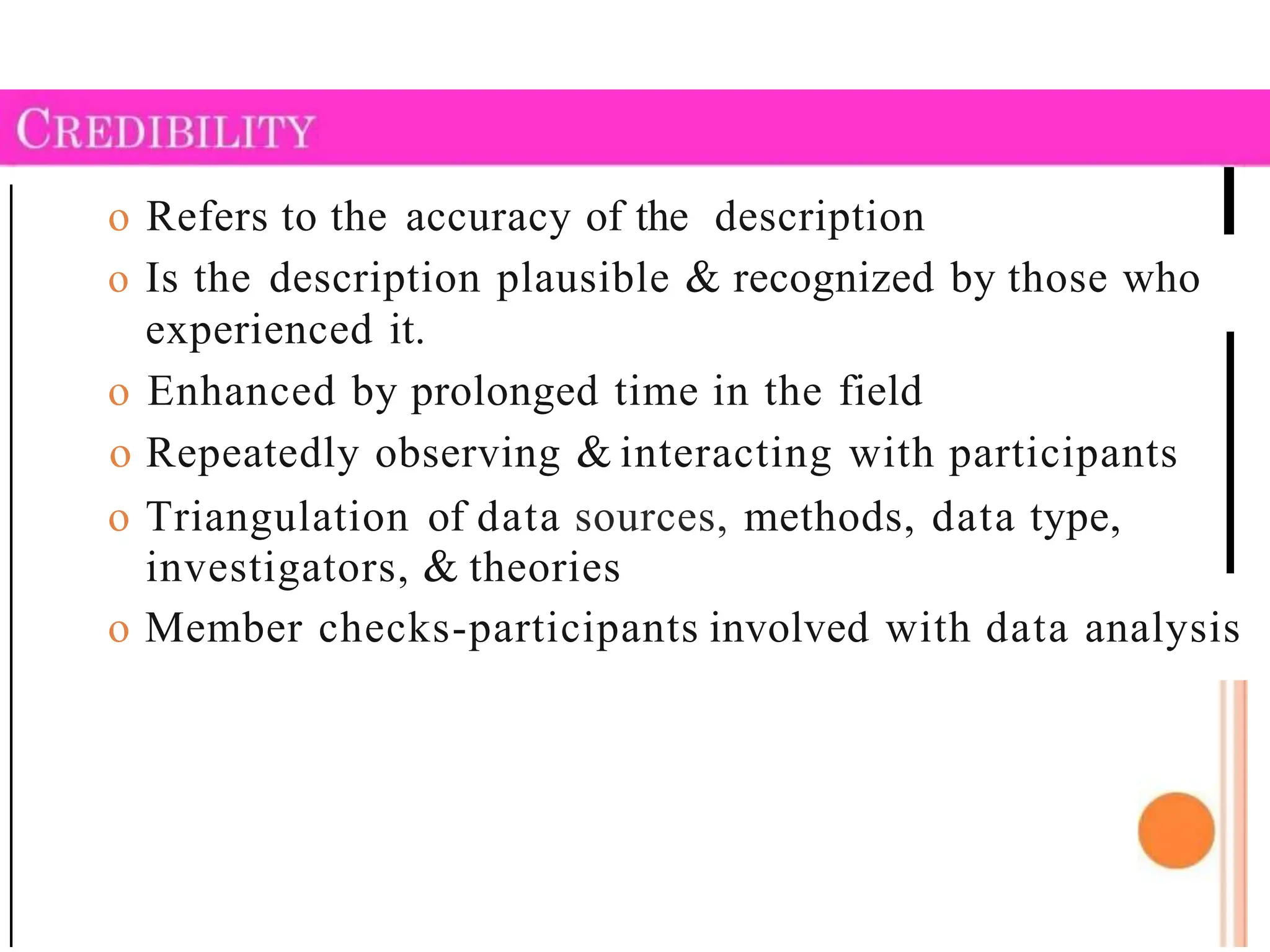
o Refers to the accuracy of the description
o Is the description plausible & recognized by those who
experienced it.
o Enhanced by prolonged time in the field
o Repeatedly observing & interacting with participants
o Triangulation of data sources, methods, data type,
investigators, & theories
o Member checks-participants involved with data analysis
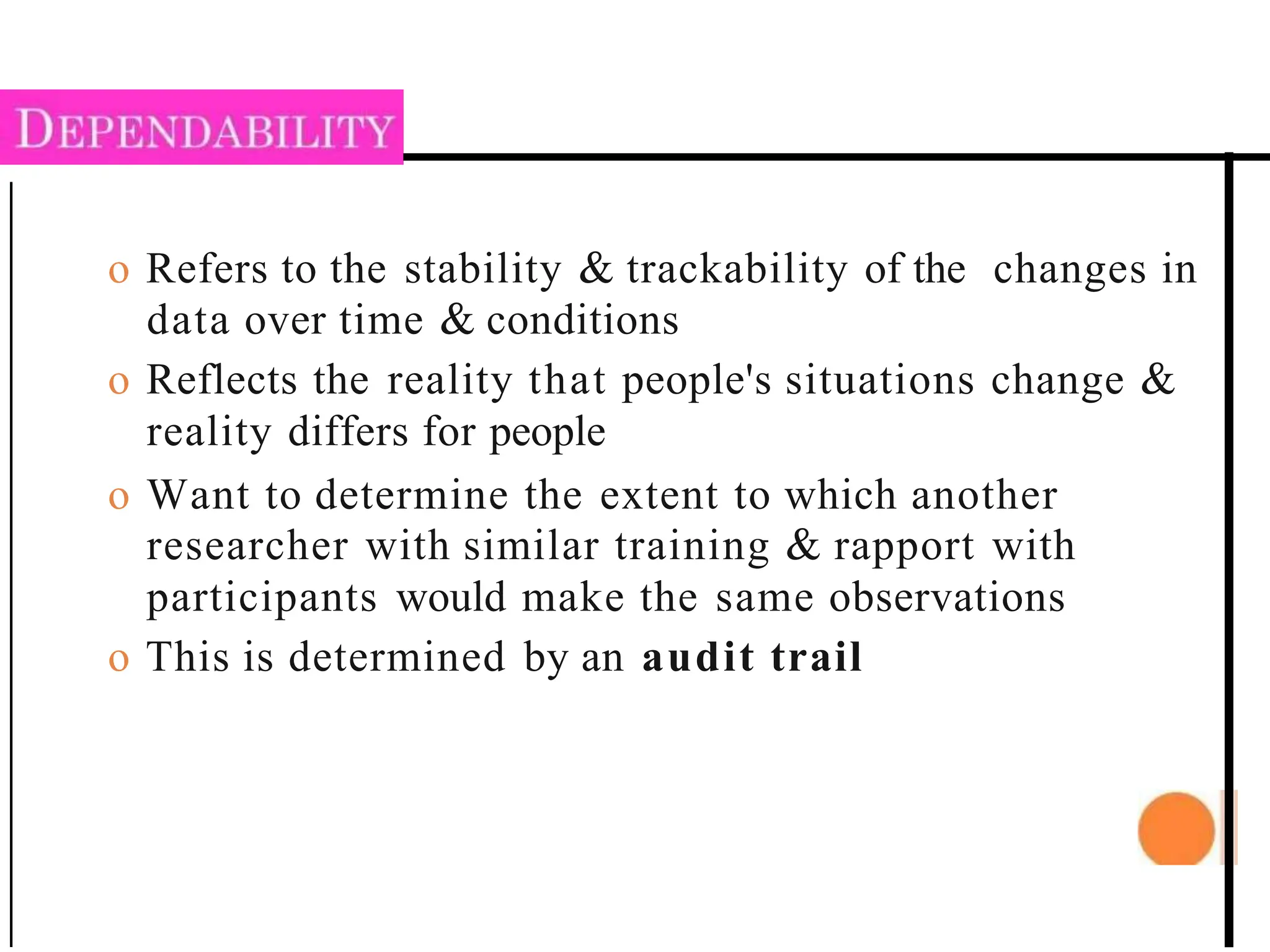
o Refers to the stability & trackability of the changes in
data over time & conditions
o Reflects the reality that people's situations change &
reality differs for people
o Want to determine the extent to which another
researcher with similar training & rapport with
participants would make the same observations
o This is determined by an audit trail
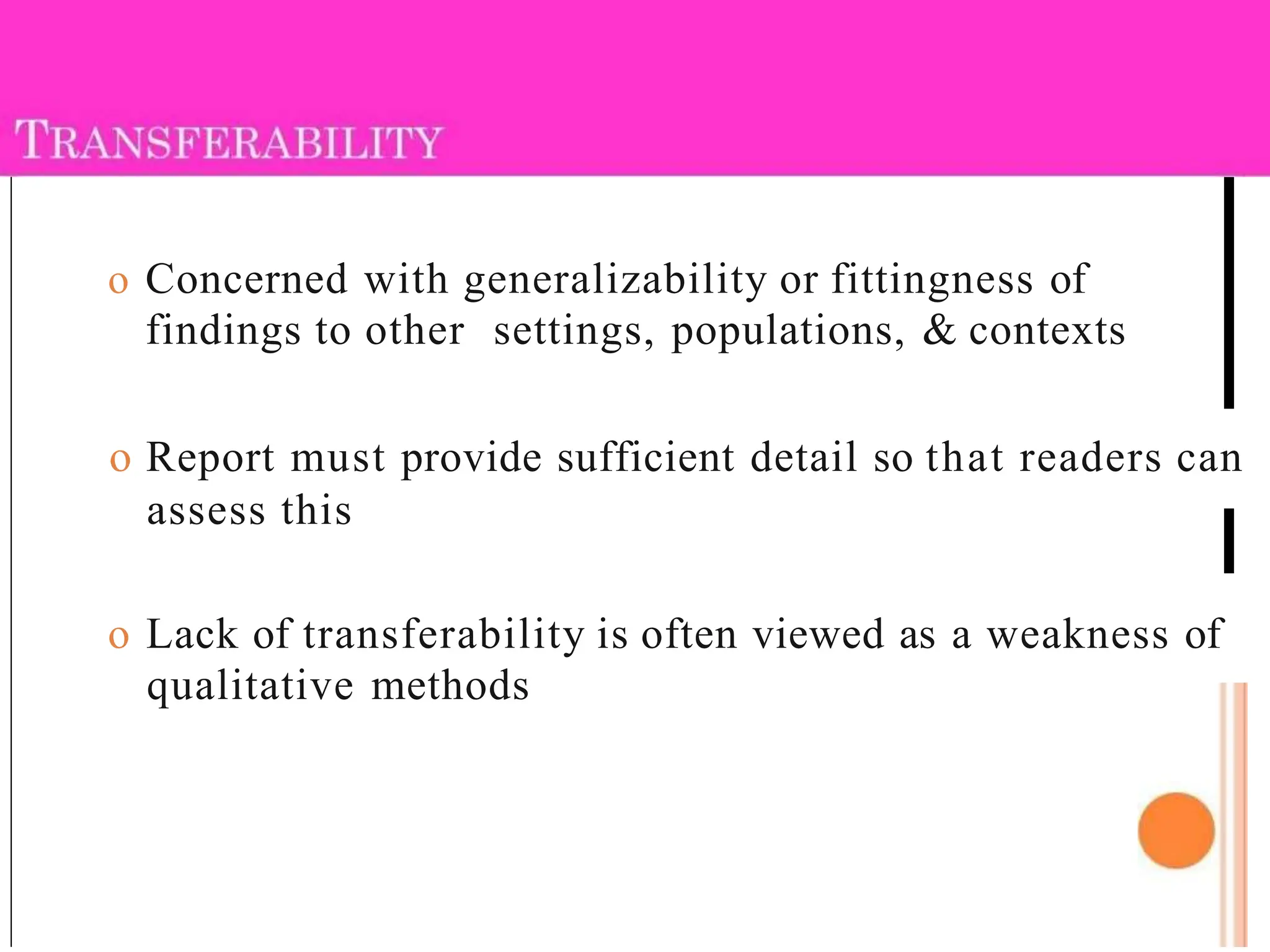
o Concerned with generalizability or fittingness of
findings to other settings, populations, & contexts
o Report must provide sufficient detail so that readers can
assess this
o Lack of transferability is often viewed as a weakness of
qualitative methods
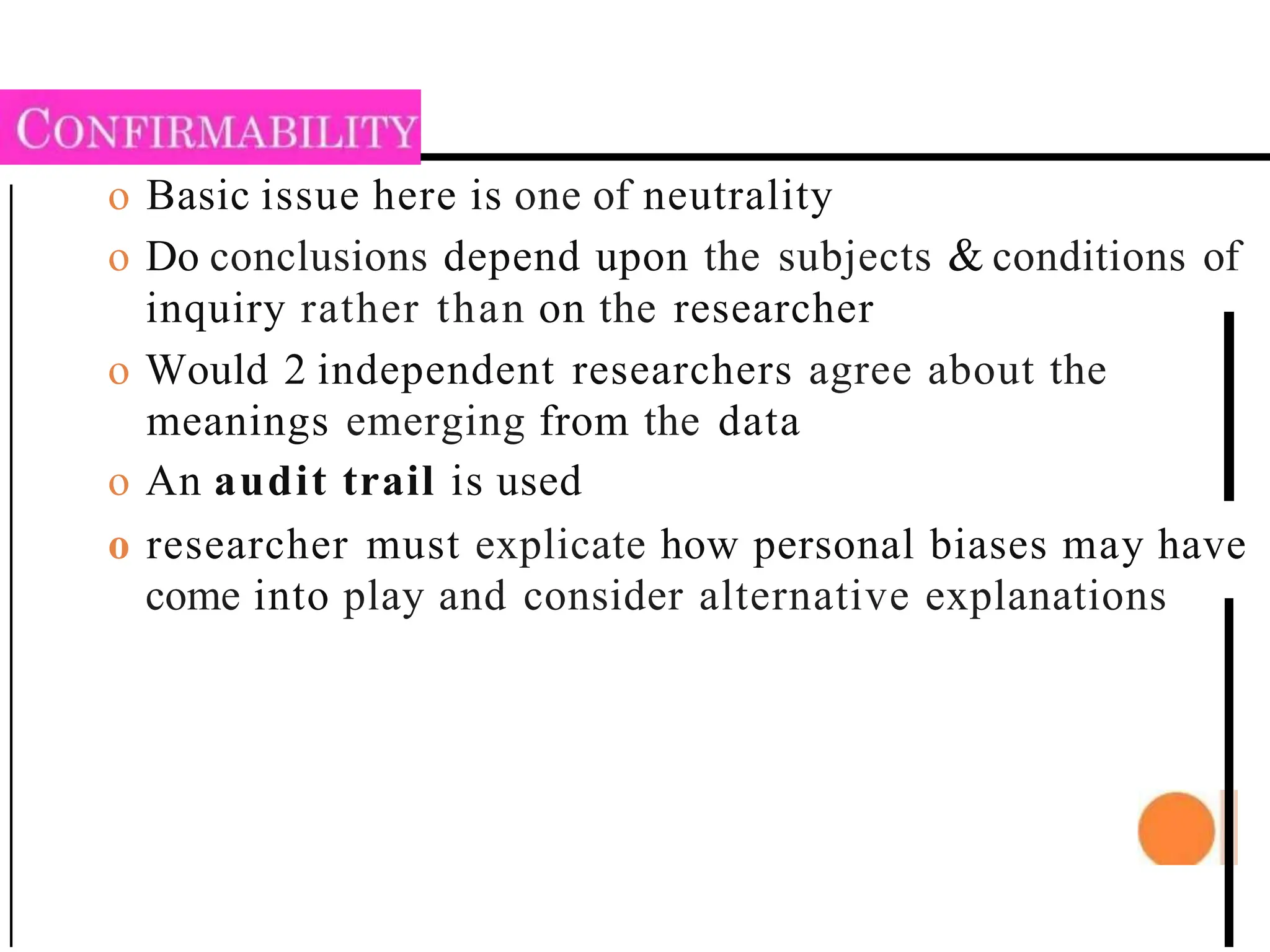
o Basic issue here is one of neutrality
o Do conclusions depend upon the subjects & conditions of
inquiry rather than on the researcher
o Would 2 independent researchers agree about the
meanings emerging from the data
o An audit trail is used
o researcher must explicate how personal biases may have
come into play and consider alternative explanations
o Focus on the whole of the human experience & the
meanings ascribed to them by participants they provide
nurses with deep insights that would not be possible
using quantitative methods exclusively
o The major strength of qualitative work is the validity of
the data it produces
o Participants true reality is likely to be reflected
ADVANTAGES &LIMITATIONS (CONT'D)1
o Major limitation is its perceived lack of objectivity &
generalizability
o Researchers become the research tools and may lack
objectivity
o Focus is to describe the meaning of the lived
experience from the perspective of the participant
o Broad question: "What is the meaning of one's lived
experience?"
o Central overarching question & subquestions
ROLE OF RESEARCHER
o Is the instrument for data collection
o Establishes good rapport with participants
o Explicates beliefs through bracketing
o The meaning of the lived experience is interpreted
from the participants' stories
SAMPLE
o Small purposive sample
o Participants are able & willing to talk about their
experience and describe their feelings
o Large enough to get a rich description of the
research phenomenon
o In-depth interviews
o Written descriptions of experiences in diaries &
journals
o Observations
o Multiple interviews with same participants to
reflect the meaning of the lived experience from
the participants' perspective
o Immersion with the data
o Read, re-read transcripts, may return to participants for
clarification or description
o Comparative analysis to identify themes in data
o Look for similarities & differences in data to identify
themes
o Reduce data into smaller & smaller number of categories
to arrive at a consistent description of the meaning of the
lived experience
o Share description with participants for verification
o Conducted after data collection & analysis are
complete
o Places findings within the context of what is
known about the phenomenon
o reports the essence of the experience
o reader should get an understanding of what it is
like to experience the phenomenon
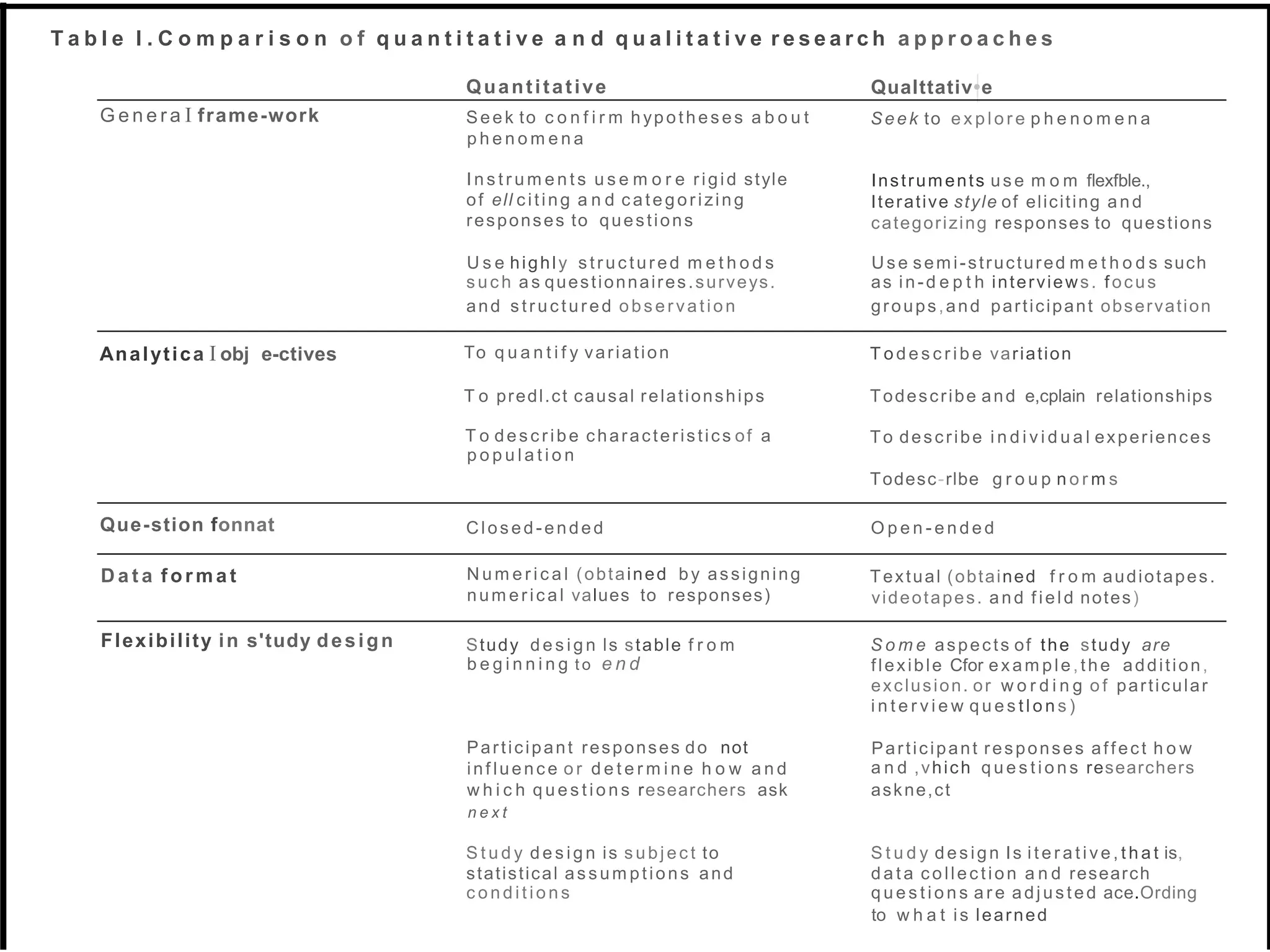
T a b l e l . C o m p a r i s o n o f q u a n t i t a t i v e a n d q u a l i t a t i v e r e s e a r c h a p p r o a c h e s
Quantitative Qualttativ•e
G e n e r a I frame-work Seek to c o n f i r m hypothes es a b o u t
p h e n o m e n a
Seek to e x p lo r e p h e n o m e n a
I n s t r u m e n t s u s e m o r e rigid style
of ell citing a n d categorizing
responses to questions
Instruments use m o m flexfble.,
Iterative style of eliciting and
categorizing responses to questions
U s e highly structured m e t h o d s
such a s questionnaires.surveys.
Use sem i-structured m e t h o d s such
as in-d e p t h interviews. focus
and structured obs ervation groups,and participant observation
Analytica I obj e-ctives To q u a n t i f y variation T o d e s c r ib e variation
T o predl.ct causal relationships Todescribe and e,cplain relationships
T o describe characteristics of a
p o p u l a t i o n
To describe i n d i v i d u a l experiences
Todesc-rlbe g r o u p n o r m s
Que-stion fonnat Closed-ended O p e n - e n d e d
D a t a f or m at N u m e r ic a l (obtained by assigning
num erical values to responses)
Textual (obtained f r o m audiotapes.
videotapes. and f ield notes)
Flexibility in s'tudy design Study d e s ig n ls stable f r o m
b e g i n n i n g t o e n d
S o m e aspects of the study are
flexible Cfor exam ple,the addition,
exclusion. or w o r d i n g o f particular
i n t e r v i e w q u e s t lo n s )
Participant responses do not
inf luence o r d e t e r m i n e h o w a n d
Participant responses affect h o w
a n d ,vhich q u e s t io n s researchers
w h i c h q u e s t io n s researchers ask askne,ct
n e x t
S t u d y d e s ig n is s ubjec t to S t u d y design Is it e r a t ive , t h a t is,
statistical assum ptions and
c o n d it io n s
d a t a collection a n d research
q u e s t io n s a r e adjusted ace.Ording
to w h a t is learned
INTRODUCTION TO QUALITATIVE RESEARCH DESIGN.pptx

INTRODUCTION TO QUALITATIVE RESEARCH DESIGN.pptx

  • 1.
    INTRODUCTION TO QUALITATIVE I• RESEARCH DESIGN • • I By: S. Bahar Ali
  • 2.
    QUALITATIVE RESEARCH: GROWINGIN POPULARITY IN HEALTH AND MEDICINE o Qualitative methods are becoming increasingly prevalent in medical and related research. They provide additional ways for health researchers to explore and explain the contexts in which they and their patients function, enabling a more comprehensive understanding of many aspects of the healthcare system. (Kuper et al, 2006: 406) o Experiences in qualitative research?
  • 3.
    WHAT IS QUALITATIVERESEARCH? o The goal of Qualitative research is the development of concepts which helps to understand social phenomena in natural (rather then experimental) setting, giving due to emphasis to the meanings, experiences, and views of all the participants. (Pope & Mays,1995).
  • 4.
    WHAT IS QUALITATIVERESEARCH? Bryman's (1998) characteristics of qualitative research: o Seeing through eyes o Describing the details of everyday settings o Understanding actions and meaning in their social context
  • 5.
    QUALITATIVE RESEARCH o Qualitativeresearch, also called field research, typically involves fieldwork in which the researcher observes and records behavior and events in their natural setting. o The researcher physically goes to the people, setting, or site in order to observe the subject as it normally and naturally occurs or behaves.
  • 6.
    THE TYPES OFOBJECTIVES Positivist/Quantitative o To count o To quantify o To measure o To determine the effect AvsB Naturalistic/Qualitative o To identify o To explore o To qualify o To elucidate o To describe o To document
  • 7.
    DIFFERENCE BETWEEN QUALITATIVEAND QUANTITATIVE RESEARCH o Largely draw on positivist paradigm o Extensive (large sample) o Statistical sample of the population o Techniques ( questionnaire, measurement) o Focus: how many, determine single/causal relationship o Analysis- mainly deductive o Largely draw on naturalistic paradigm o Intensive (small sampling) o Symbolic-representative of group o Technique-interview, group discussions, observations o Focus-Why, how, understand multiple inter relationship o Analysis-mainly inductive
  • 8.
    POSITIVIST G,HARD'' SCIENCES'')VERSUS QUALITATIVE G,SOFT SCIENCES'() RESEARCH POSITMSM o "... emphasizes the measurement and analysis of causal relationships between variables, not processes - proponents of such studies claim that their work is done in value-free framework" ...contends that there is a reality out there to be objectively studied, captured, understood." Positivist (e.g. quantitative) methods ar employed to isolate causes and effects: o -to measure and quantify phenomena o -to allow for the generalization of findings
  • 9.
    ,,HARD(( VS ,,SOFT((SCIENCES RESEARCH Qualitative Social Sciences Response to the failings of traditional deductive methodologies. Reject positivist criteria of evaluating data: replicability, ,,validity' objective, value-free. Emphasize innovative, inductive methods and research strategies Seek alternative methods for evaluating the ,,success'' of qualitative research: multi-voiced texts, dialogical research, reflexivity. Use of experimental qualitative genres: narrative, storytelling, filmmaking.
  • 10.
    DEDUCTIVE VERSUS INDUCTIVE PROCESSES Deductiveprocess in quantitative studies begins with theory Examines hypothetical relationships within it Hypothesis - tested Inductive process in qualitative studies begins with observations Open questions which are applied to guide initial research Research is refined over the course of fieldwork and the collection and preliminary thematic analysis of data Inductive research drives the identification of situation specific analytical approaches, or, the formulation of theory generated from study observations and findings (grounded theory)
  • 11.
    DEDUCTIVE REASONING o Associatedwith positivist/experimental approach o Researcher begins with acceptance of a general principle or belief and then apply that principle to explain a specific case or phenomenon. (DePoy & Gitlin, 1994)
  • 12.
    CORE ACTIVITIES INQUALITATIVE RESEARCH o Literature Review- a cursory review may be done initially to focus the study, otherwise it is conducted after the data has been collected and analyzed. o Rationale for delaying the L.R. is to avoid leading the participants in the direction of what has already been discovered. o Purpose of L.R. is to show how current findings fit into what is already known
  • 13.
    o Bracketing -setting aside one's biases and personal views on a topic o Investigator keeps a diary of personal thoughts and feelings about the topic o Purpose is to make known to the researcher her/his beliefs about the topic so that the researcher may approach the topic honestly
  • 14.
    The field isthe natural world where participants live o The field requires reciprocity in terms of decision making o The participant & researcher determine what data will be shared o Participants must understand & be willing to share their thoughts & feelings about the phenomenon o Contrast this with quantitative studies where data are collected in controlled settings & the researcher is removed from the subject
  • 15.
    o Participant orinformant refers to the individual who informs the research study (vs subjects or respondents) o They are active participants & equal partners o Must have 1st hand experience with research phenomenon (vs random selection) o They want to help others understand their lives & the social contexts in which they live & create . meaning
  • 16.
    o Participants musthave first hand experience with the research experience and be able to talk about it o Researcher establishes clear criteria & rationale for sample selection o Goal is not generalization of findings but rich descriptions of phenomenon by those who have experienced it
  • 17.
    o A situationin data collection in which participants' descriptions become repetitive & confirm previously collected data o An indication that data collection is complete o Similar to adequate sample size in quantitative research
  • 18.
    o Researcher immersesself in data to bring order & meaning to vast narrative o Begins with 1st data collection episode o Reading, rereading, intuiting, analyzing, synthesizing & reporting on data o Cyclical & recursive process that requires an extensive amount of time
  • 19.
    oRIGOR in qualitative researchis less about the adherence to rules and more about fidelity to the spirit and standards of qualitative work (Sandelowski, 1993)
  • 20.
    o Data frominterviews are continuously reviewed to identify additional questions o Data from earlier interviews are routinely returned to participants for clarification/elaboration o Investigator must look for meaning in the data as it is reviewed
  • 21.
    o At conclusionof study a protracted period of data immersion in which conclusions are reviewed in the context of the whole study o Data similar in meaning are clustered together into preliminary categories
  • 22.
  • 23.
    o Refers tothe accuracy of the description o Is the description plausible & recognized by those who experienced it. o Enhanced by prolonged time in the field o Repeatedly observing & interacting with participants o Triangulation of data sources, methods, data type, investigators, & theories o Member checks-participants involved with data analysis
  • 24.
    o Refers tothe stability & trackability of the changes in data over time & conditions o Reflects the reality that people's situations change & reality differs for people o Want to determine the extent to which another researcher with similar training & rapport with participants would make the same observations o This is determined by an audit trail
  • 25.
    o Concerned withgeneralizability or fittingness of findings to other settings, populations, & contexts o Report must provide sufficient detail so that readers can assess this o Lack of transferability is often viewed as a weakness of qualitative methods
  • 26.
    o Basic issuehere is one of neutrality o Do conclusions depend upon the subjects & conditions of inquiry rather than on the researcher o Would 2 independent researchers agree about the meanings emerging from the data o An audit trail is used o researcher must explicate how personal biases may have come into play and consider alternative explanations
  • 27.
    o Focus onthe whole of the human experience & the meanings ascribed to them by participants they provide nurses with deep insights that would not be possible using quantitative methods exclusively o The major strength of qualitative work is the validity of the data it produces o Participants true reality is likely to be reflected
  • 28.
    ADVANTAGES &LIMITATIONS (CONT'D)1 oMajor limitation is its perceived lack of objectivity & generalizability o Researchers become the research tools and may lack objectivity
  • 29.
    o Focus isto describe the meaning of the lived experience from the perspective of the participant o Broad question: "What is the meaning of one's lived experience?" o Central overarching question & subquestions
  • 30.
    ROLE OF RESEARCHER oIs the instrument for data collection o Establishes good rapport with participants o Explicates beliefs through bracketing o The meaning of the lived experience is interpreted from the participants' stories
  • 31.
    SAMPLE o Small purposivesample o Participants are able & willing to talk about their experience and describe their feelings o Large enough to get a rich description of the research phenomenon
  • 32.
    o In-depth interviews oWritten descriptions of experiences in diaries & journals o Observations o Multiple interviews with same participants to reflect the meaning of the lived experience from the participants' perspective
  • 33.
    o Immersion withthe data o Read, re-read transcripts, may return to participants for clarification or description o Comparative analysis to identify themes in data o Look for similarities & differences in data to identify themes o Reduce data into smaller & smaller number of categories to arrive at a consistent description of the meaning of the lived experience o Share description with participants for verification
  • 34.
    o Conducted afterdata collection & analysis are complete o Places findings within the context of what is known about the phenomenon
  • 35.
    o reports theessence of the experience o reader should get an understanding of what it is like to experience the phenomenon
  • 36.
    T a bl e l . C o m p a r i s o n o f q u a n t i t a t i v e a n d q u a l i t a t i v e r e s e a r c h a p p r o a c h e s Quantitative Qualttativ•e G e n e r a I frame-work Seek to c o n f i r m hypothes es a b o u t p h e n o m e n a Seek to e x p lo r e p h e n o m e n a I n s t r u m e n t s u s e m o r e rigid style of ell citing a n d categorizing responses to questions Instruments use m o m flexfble., Iterative style of eliciting and categorizing responses to questions U s e highly structured m e t h o d s such a s questionnaires.surveys. Use sem i-structured m e t h o d s such as in-d e p t h interviews. focus and structured obs ervation groups,and participant observation Analytica I obj e-ctives To q u a n t i f y variation T o d e s c r ib e variation T o predl.ct causal relationships Todescribe and e,cplain relationships T o describe characteristics of a p o p u l a t i o n To describe i n d i v i d u a l experiences Todesc-rlbe g r o u p n o r m s Que-stion fonnat Closed-ended O p e n - e n d e d D a t a f or m at N u m e r ic a l (obtained by assigning num erical values to responses) Textual (obtained f r o m audiotapes. videotapes. and f ield notes) Flexibility in s'tudy design Study d e s ig n ls stable f r o m b e g i n n i n g t o e n d S o m e aspects of the study are flexible Cfor exam ple,the addition, exclusion. or w o r d i n g o f particular i n t e r v i e w q u e s t lo n s ) Participant responses do not inf luence o r d e t e r m i n e h o w a n d Participant responses affect h o w a n d ,vhich q u e s t io n s researchers w h i c h q u e s t io n s researchers ask askne,ct n e x t S t u d y d e s ig n is s ubjec t to S t u d y design Is it e r a t ive , t h a t is, statistical assum ptions and c o n d it io n s d a t a collection a n d research q u e s t io n s a r e adjusted ace.Ording to w h a t is learned