4.5: Culture techniques
4.5.1: Preparation of cells / organs for
culture
4.5.2: Cover slip, Flask and Tube culture
4.5.3: Primary and established cell lines
4.5.4: Hybridoma technology
4.5.1: Preparation of cells / organs for culture
Preparation of cells / organs for culture
For primary culture, cells are usually isolated from its parental tissue or organ. This
procedure involves three steps:
1. Isolation of cells
2. Disaggregation of tissue
3. Separation of viable/nonviable cells
1) Isolation of Cells
 For isolation of the cell, the site of dissection is sterilized with 70% alcohol and the
tissue is removed from the animal body. After removal, the tissue is placed in basal
salt solution as soon as possible.
 Animal should not be dissected in animal tissue culture laboratory because they
may carry microbial contamination.
2) Disaggregation of tissue
 There are several methods for disaggregation of tissue. Mostly it is carried out by
mechanical and enzymatic methods.
 Mechanical disaggregation: It involves disaggregation of cells with some form of
maceration. It is mainly preferred for soft tissues. It is much quicker than
enzymatic disaggregation. Here cells are passed either through the sieves or
forced out through a syringe or pipette.
 Enzymatic disaggregation : Cell-cell adhesion in tissue is mediated mostly by
different glycoproteins. The enzymatic disaggregation is carried out with the
help of enzyme, either trypsin or collagenase.
a) Disaggregation with trypsin : Enzymatic dissaggregation with trypsin is known
as Trypsinization. It is of two types i) warm and ii) cold trypsinization.
i. Warm trypsinization: In this technique, tissue is chopped and stirred in
trypsin for few hours at 37°C. Later the dissociated cells are collected by
centifugation, and trypsin is removed and the cell suspension is
neutralized with serum. This method is mainly useful for disaggregation of
large amount of tissues in a relatively short time.
ii. Cold trypsinization: Tissue is soaked in cold trypsin for 4 to 6 hr or even
overnight to allow its penetration. Afterwards trypsin is removed and
tissue is incubated at 36.5°C for 20-30 min. After trypsinization, serum is
added to the cells to nullify the traces of trypsin. This is done because
leftover trypsin can lyse the cells if it remains in the culture for a long time.
b) Disaggregation with enzyme collagenase : Sometimes trypsin can damage the
tissues or is ineffective for fibrous tissues. The intracellular matrix between
cells contains collagen. Therefore collagenase proves effective for several
normal and malignant tissues which are sensitive to trypsin Collagenase is
used with finely chopped tissues in complete medium. After disaggregation
collagenase is removed by centrifugation.
3) Separation of viable and nonviable cells
 The separated cells which are obtained after disaggregation are called as the
primary cells.
 They grow well and proliferate quickly in the culture media.
 The cells which grow and proliferate are called as viable cells while the cells which
do not grow are called as nonviable cells.
 Therefore the nonviable cells are removed during the change of medium.
 Primary cultures can also be maintained in suspension by removing the nonviable
cells through centrifugation.
4.5.2: Cover slip (Slide culture), Flask and Tube culture
 A variety of approaches exist that use either closed or open systems to grow the
cells in tubes, flasks, slide chambers, or on coverslips in Petri dishes. These
traditional techniques are known as Primary Explantation Techniques (cultivation of
pieces of tissues, fresh from organs). These techniques are similar in principle,
however, the main differences lie in the vessels used for growing the tissues.
 Good-quality, rapid results can be obtained with any of these techniques, but a
closed-tube system has the advantage of robustness, simplicity, and minimal use of
resources.
 Most tissue culture is performed on a small scale where relatively small numbers of
cells are required for experiments.
 At this scale cells are usually grown in T flasks ranging from 25cm2 to 175cm2.
Typical cell yields from a T175 flask range from 1x10⁷ for an attached line to 1x10⁸
for a suspension line. However, exact yields will vary depending on the cell line.
 It is not practical to produce much larger quantities of cells using standard T flasks,
due to the amount of time required for repeated passaging of the cells, demand on
incubator space and cost.
Slide or coverslip Culture
The cultures or coverslip cultures are made by explanting a very small fragment of tissues
on the coverslip. Then the coverslip is subsequently inverted over the cavity of
depression side. This method is useful for the morphological studies of cells cultured.
Modifications in this method are valuable in time-lapse cinemicrographic investigations.
Advantages and Disadvantages of Slide Culture
Advantages Disadvantages
Relatively simple and inexpensive Small supply of O2 & nutrients exhaust rapidly
causing medium acidic and necessitating rapid
transfer of growing tissue
The spreading of cells can be observed
microscopically and photographed in living state
Difficult to maintain sterility for long periods
resulting in small amount of tissue being cultured
Cells grown directly on the coverslip can easily be
fixed and stained for permanent preparation
Application of slide culture method is limited
Types of Slide Culture
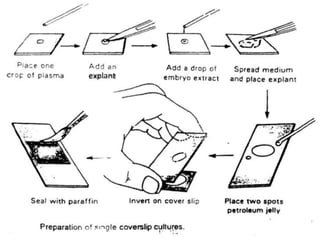
1. Single coverslip with plasma clot (Harrison)
2. Double coverslip with plasma clot (Maximow)
3. Single coverslip with fluid hanging drop (Lewis and Lewis)
4. Double cover slip with perforated cellophane (Schilling and Earle)
5. Thin drilled metal or glass slide with plasma and fluid medium (Gey)
6. Special Slide with a circulating fluid medium-perfusion chamber (Promerat)
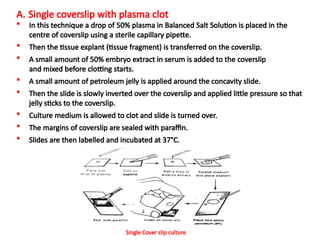
A. Single coverslip with plasma clot
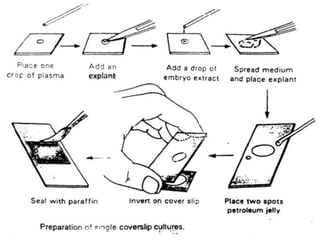
 In this technique a drop of 50% plasma in Balanced Salt Solution is placed in the
centre of coverslip using a sterile capillary pipette.
 Then the tissue explant (tissue fragment) is transferred on the coverslip.
 A small amount of 50% embryo extract in serum is added to the coverslip
and mixed before clotting starts.
 A small amount of petroleum jelly is applied around the concavity slide.
 Then the slide is slowly inverted over the coverslip and applied little pressure so that
jelly sticks to the coverslip.
 Culture medium is allowed to clot and slide is turned over.
 The margins of coverslip are sealed with paraffin.
 Slides are then labelled and incubated at 37°C.
Single Cover slip culture
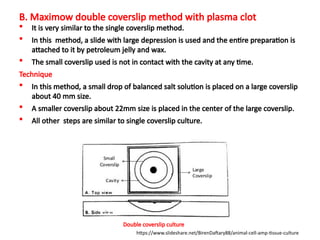
B. Maximow double coverslip method with plasma clot
 It is very similar to the single coverslip method.
 In this method, a slide with large depression is used and the entire preparation is
attached to it by petroleum jelly and wax.
 The small coverslip used is not in contact with the cavity at any time.
Technique
 In this method, a small drop of balanced salt solution is placed on a large coverslip
about 40 mm size.
 A smaller coverslip about 22mm size is placed in the center of the large coverslip.
 All other steps are similar to single coverslip culture.
Double coverslip culture
https://www.slideshare.net/BirenDaftary88/animal-cell-amp-tissue-culture
Flask Culture
 The flask culture technique is used for establishment of strain from fresh explants of
tissue because it has excellent optical properties for microscopic examination.
 For flask culture Carrel flasks or Polystyrene flasks can be used.
 There are two kinds of flask techniques:
a) Thick clot culture – It allows rapid growth suitable for short term cultures, and
b) Thin clot culture – It can be maintained for a considerable period.
 By using flask culture technique, tissue can be maintained in the same flask for
months or years.
 Also a large amount of tissue or cells can be grown with large amount of medium.
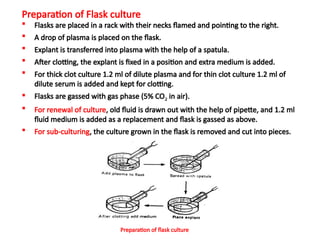
Preparation of Flask culture
 Flasks are placed in a rack with their necks flamed and pointing to the right.
 A drop of plasma is placed on the flask.
 Explant is transferred into plasma with the help of a spatula.
 After clotting, the explant is fixed in a position and extra medium is added.
 For thick clot culture 1.2 ml of dilute plasma and for thin clot culture 1.2 ml of
dilute serum is added and kept for clotting.
 Flasks are gassed with gas phase (5% CO2 in air).
 For renewal of culture, old fluid is drawn out with the help of pipette, and 1.2 ml
fluid medium is added as a replacement and flask is gassed as above.
 For sub-culturing, the culture grown in the flask is removed and cut into pieces.
Preparation of flask culture
Spinner Flask Culture
 This is the method of choice for suspension lines including hybridomas and
attached lines that have been adapted to growth in suspension e.g. HeLa S3.
 Spinner flasks are either plastic or glass bottles with a central magnetic stirrer shaft
and side arms for the addition and removal of cells and medium, and gassing with
CO2 enriched air.
 Inoculated spinner flasks are placed on a stirrer and incubated under the culture
conditions appropriate for the cell line.
 Cultures should be stirred at 100-250 revolutions per minute.
Handling Bottles and Flasks
 When working on an open bench, do not keep bottles vertical when open; instead,
keep them at an angle as shallow as possible without risking spillage.
 A bottle rack can be used to keep the bottles or flasks tilted.
 Culture flasks should be laid down horizontally when open and, like bottles, held at
an angle during manipulations.
 When working in laminar flow, bottles can be left open and vertical, but do not let
your hands or any other items come between an open vessel or sterile pipette and
the HEPA filter.
 Flasks with angled necks facilitate pipetting when the flask is lying flat (Invitrogen–
Gibco).
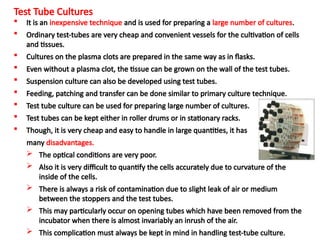
Test Tube Cultures
 It is an inexpensive technique and is used for preparing a large number of cultures.
 Ordinary test-tubes are very cheap and convenient vessels for the cultivation of cells
and tissues.
 Cultures on the plasma clots are prepared in the same way as in flasks.
 Even without a plasma clot, the tissue can be grown on the wall of the test tubes.
 Suspension culture can also be developed using test tubes.
 Feeding, patching and transfer can be done similar to primary culture technique.
 Test tube culture can be used for preparing large number of cultures.
 Test tubes can be kept either in roller drums or in stationary racks.
 Though, it is very cheap and easy to handle in large quantities, it has
many disadvantages.
 The optical conditions are very poor.
 Also it is very difficult to quantify the cells accurately due to curvature of the
inside of the cells.
 There is always a risk of contamination due to slight leak of air or medium
between the stoppers and the test tubes.
 This may particularly occur on opening tubes which have been removed from the
incubator when there is almost invariably an inrush of the air.
 This complication must always be kept in mind in handling test-tube culture.
4.5.3: Primary and established cell lines
Primary and established cell lines
A cell line is a permanently established cell culture that will proliferate indefinitely if
appropriate fresh medium and space is provided.
Lineage of cells originating from the primary culture is called a cell strain. A cell line or cell
strain may be finite or continuous depending upon life span of the culture
a) Primary cell lines
Primary cell culture is the disassociation of cells from a parental animal tissue through
enzymatic or mechanical measures and maintaining the growth of cells in a suitable
substrate in glass or plastic containers under controlled environmental conditions.
The source of primary cultures is excised animal tissue that is cultured either as an
explant culture, suspension or as monolayer and maintained in vitro. The excised tissue
is subjected to enzyme treatment. The dissociated cells are cultured under appropriate
conditions in culture medium till they reach adequate numbers.
The isolated primary cells are of two types:
Adherent cells/ Anchorage Dependent Cells – Cells that attach to surfaces in vivo
require a surface to attach to in vitro. Cells that require attachment for growth are
called anchorage dependent cells. The adherent cells are mostly derived from tissues of
organs where they are immobile and embedded in connective tissue. E.g. Kidney cells.
Suspension cells / Anchorage Independent cells – Cells which do not require
attachment for growth or do not attach to the surface of the culture vessels are called
as anchorage independent cells / suspension cells. All suspension cultures are derived
from cells of the blood system.
a) Primary cell lines---contd.
The most popular primary cells used in research are epithelial cells, fibroblasts,
keratinocytes, melanocytes, endothelial cells, muscle cells, hematopoietic and
mesenchymal stem cells. The cultures are initially heterogeneous and can be maintained
in vitro only for a limited period of time.
Primary cells may be manipulated for indefinite subculture through an in vitro process
called transformation. Transformation may be spontaneous or can be induced chemically
or virally. When a primary culture undergoes genetic transformation, they divide
indefinitely and become immortalized. Transformed cells may not require attachment
Primary cultures are advantageous as they essentially mimic the natural function of the
cell, tissue or organ. Primary culture are generally mortal. Cells undergo an aging
process. They multiply for only 50 to 100 generations. After that, the rate of cell
multiplication decreases markedly.
b) Established cell lines (Immortal cell lines)
Established cell lines grow indefinitely. Such cell lines are generally derived from tumor
biopsies (e.g. HeLa) from patients. Although some of the very earliest lines were
established from natural embryonic tissues (e.g. 3T3, CHO) and from normal human
tissue such as WI-38. Established cell lines may also be generated from primary cells that
have undergone mutations and have continued replications. The cell lines which become
immortal can continue to divide indefinitely and are called continuous cell lines.
When a “normal” finite cell line becomes immortal, it undergoes a fundamental
irreversible change or “transformation”. This can occur spontaneously or can be brought
about intentionally using drugs, radiation or viruses. Transformed Cells are usually fast
growing often with extra or abnormal chromosomes.
There are many advantages to use immortalized cell lines because these are standard
lines used by many different labs.
The major disadvantage in using immortalized cells is that these cells cannot be
considered normal because they divide indefinitely and sometimes express unique gene
patterns which are not found in any cell type in vivo. Therefore, they might not have the
relevant attributes or functions of normal cells. Also, after several passages, cell
characteristics can change and become even more different from those of a normal cell.
Thus, it is important to periodically validate the characteristics of cultured cells and not
use cells that have been passage too many times.
4.5.4: Hybridoma Technology
Hybridoma Technology – An application of Cell culture incorporate
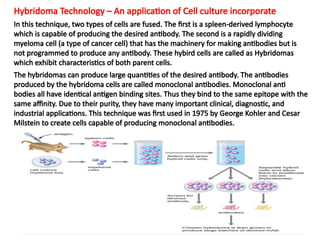
In this technique, two types of cells are fused. The first is a spleen-derived lymphocyte
which is capable of producing the desired antibody. The second is a rapidly dividing
myeloma cell (a type of cancer cell) that has the machinery for making antibodies but is
not programmed to produce any antibody. These hybird cells are called as Hybridomas
which exhibit characteristics of both parent cells.
The hybridomas can produce large quantities of the desired antibody. The antibodies
produced by the hybridoma cells are called monoclonal antibodies. Monoclonal anti
bodies all have identical antigen binding sites. Thus they bind to the same epitope with the
same affinity. Due to their purity, they have many important clinical, diagnostic, and
industrial applications. This technique was first used in 1975 by George Kohler and Cesar
Milstein to create cells capable of producing monoclonal antibodies.
The production of Monoclonal Antibodies using Hybridoma Technology
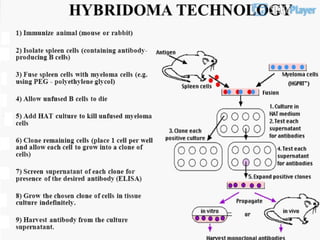
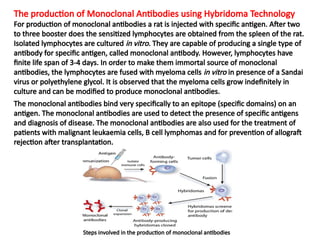
For production of monoclonal antibodies a rat is injected with specific antigen. After two
to three booster does the sensitized lymphocytes are obtained from the spleen of the rat.
Isolated lymphocytes are cultured in vitro. They are capable of producing a single type of
antibody for specific antigen, called monoclonal antibody. However, lymphocytes have
finite life span of 3-4 days. In order to make them immortal source of monoclonal
antibodies, the lymphocytes are fused with myeloma cells in vitro in presence of a Sandai
virus or polyethylene glycol. It is observed that the myeloma cells grow indefinitely in
culture and can be modified to produce monoclonal antibodies.
The monoclonal antibodies bind very specifically to an epitope (specific domains) on an
antigen. The monoclonal antibodies are used to detect the presence of specific antigens
and diagnosis of disease. The monoclonal antibodies are also used for the treatment of
patients with malignant leukaemia cells, B cell lymphomas and for prevention of allograft
rejection after transplantation.
Steps involved in the production of monoclonal antibodies
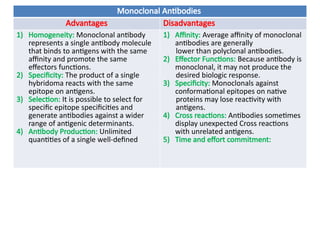
Monoclonal Antibodies
Advantages Disadvantages
1) Homogeneity: Monoclonal antibody
represents a single antibody molecule
that binds to antigens with the same
affinity and promote the same
effectors functions.
2) Specificity: The product of a single
hybridoma reacts with the same
epitope on antigens.
3) Selection: It is possible to select for
specific epitope specificities and
generate antibodies against a wider
range of antigenic determinants.
4) Antibody Production: Unlimited
quantities of a single well-defined
1) Affinity: Average affinity of monoclonal
antibodies are generally
lower than polyclonal antibodies.
2) Effector Functions: Because antibody is
monoclonal, it may not produce the
desired biologic response.
3) Specificity: Monoclonals against
conformational epitopes on native
proteins may lose reactivity with
antigens.
4) Cross reactions: Antibodies sometimes
display unexpected Cross reactions
with unrelated antigens.
5) Time and effort commitment:
Use of HGPRT-HAT selection media for Hybirdoma
Hybridoma selection after fusion of myelomas and spleen cells is a critical step in
monoclonal antibody production. Often scientists use the HAT (hypoxanthine-
aminoprotein-thymidine) method to accomplish this task. When the parental tumor
cells lack an enzyme hypoxanthine guanine phosphoribosyl tranferase (HGPRT) or
thymidine kinase (TK), selection is accomplished by culturing the fusion mixture in HAT
medium. Amino protein blocks the de novo synthesis of DNA. To survive in HAT medium,
cells must make DNA via the so called salvage pathway, in which hyoxanthine and
thymidine are incorporated into DNA by means of HGPRT and TK, respectively.
Therefore, tumor cells lacking either of these enzymes cannot grow in HAT medium,
unless they fuse with normal cells provided with the required enzymes, Thus, the only
cells able to grow in HAT medium are the normal-tumor hybirds. Hybridomas inherit a
functioning HGPRT enzyme from the spleen cells, so even though the de novo pathway
is blocked, they can still use the salvage pathway to replicate.
https://www.slideshare.net/biologyexams4u/hybridoma-technology
Myeloma cells have been genetically engineered such that they cannot use hypoxanthine,
aminoprotein and thymidine (HAT medium) as a source for nucleic acid biosynthesis and will die
in culture (lack HGPRT).
Spleen cells (B cells) have limited life span. Only B cells that have fused with the engineered
myeloma cells will survive in culture when grown in HAT medium.
Hybridomas Cells
• Using cell fusion techniques, it is possible to obtain hybrid cells by fusing cells from two different
parents.
• These may exhibit characteristics of either parents or both parents.
• This technique was used in 1975 to create cells capable of producing custom tailored
monoclonal antibodies.
• These hybrid cells (called hybridomas) are formed by fusing two different but related cells.
Hybridomas have hybrid lines retaining characteristics of immortal myeloma and differentiated
plasma cell fusion partners .
• The first is the spleen-derived lymphocyte that is capable of producing the desired antibody.
• The second is rapidly dividing myeloma cell (a type of cancer cell) that has the machinery for
making antibodies but is not programmed to produce any anti- body.
• The resulting hybridomas can produce large quantities of the desired antibody.
• These antibodies, called Monoclonal Antibodies due to their purity, have many important
clinical, diagnostic, and industrial applications.
• Although the majority of monoclonal antibodies produced are of mouse or rat origin, human
monoclonal antibodies have been obtained by immortalization of lymphocytes immunized in
vitro and include antibodies to HIV-1 envelope glycoprotein, hepatitis surface antigen,
cytomegalovirus and rubella.
• Hybridomas can be produced either in suspension e.g. in roller bottles, stirred reactors or airlift
reactors, or immobilized using a suitable matrix e.g. hollow fibres, microbeads, or
microcapsules.
• Even though most cells used in cell culture are hybridomas and are said to have the ability to
divide infinitely, most take on odd morphologies and unwanted characteristics over time.
Production of Hybridomas
 Hybridomas are produced by fusing a nonsecreting myeloma cell with an
antibody-producing B-lymphocyte in the presence of polyethylene glycol.
 The myeloma cell is deficient in hypoxanthine-guanine phosphoribosyl
transferase (HGPRT) or thymidine kinase (TK), necessary for DNA synthesis, and
cannot survive in selection medium containing hypoxanthine, aminopterin, and
thymidine.
 Any unfused B-lymphocytes from the spleen cannot survive in culture for more
than a few days.
 Any B-cell-myeloma hybrids should contain the genetic information from both
parent cells and are thus able to survive in the HAT selection medium.
 They can be cultured indefinitely and will produce unlimited quantities of
antibody. Supernates from surviving hybridomas are screened for antibody by
ELISA.
 Those hybridomas selected are then subcloned to ensure that they are
producing antibody that is specific for a single epitope.
 Antibody production can be scaled up in vivo as ascites in mice or in vitro as a
suspension culture.
Each normal B lymphocyte in a mammal is capable of producing a single type of
antibody directed against (can bind to) a specific chemical structure (called a
determinant or epitope) on an antigen molecule.
If an animal is injected with an antigen, B lymphocytes that make antibodies
recognizing the antigen are stimulated to grow and secrete the antibodies.
Each antigen-activated B lymphocyte forms a clone of cells in the spleen or lymph
nodes, with each cell of the clone producing the identical antibody—that is, a
monoclonal antibody.
Because most natural antigens contain multiple epitopes, exposure of an
animal to an antigen usually stimulates the formation of multiple different B-
lymphocyte clones, each producing a different antibody.
The resulting mixture of antibodies that recognize different epitopes on the same
antigen is said to be polyclonal.
1) Because of their limited life span, primary cultures of normal B lymphocytes are of
limited usefulness for the production of monoclonal antibody.
Thus the first step in producing a monoclonal antibody is to generate immortal,
antibody-producing cells.
This immortality is achieved by fusing normal B lymphocytes from an immunized
animal with transformed, immortal lymphocytes called myeloma cells.
Treatment with certain viral glycoproteins or the chemical polyethylene glycol
promotes cell fusion.
The hybrid cell has novel characteristics.
The fusion of a myeloma cell with a normal antibody producing cell from a rat or
mouse spleen yields a hybrid that proliferates into a clone called a hybridoma.
Like myeloma cells, hybridoma cells grow rapidly and are immortal.
Each hybridoma produces the monoclonal antibody encoded by its B-lymphocyte
parent.
2) The second step in this procedure for producing monoclonal antibody is to separate,
or select, the hybridoma cells from the unfused parental cells and the self-fused cells
generated by the fusion reaction.
This selection is usually performed by incubating the mixture of cells in a special
culture medium, called selection medium, that permits the growth of only the
hybridoma cells because of their novel characteristics.
Such a selection is readily performed if the myeloma cells used for the fusion carry a
mutation that blocks a metabolic pathway and renders them, but not their lymphocyte
fusion partners that do not have the mutation, sensitive to killing by the selection
medium.
In the immortal hybrid cells, the functional gene from the lymphocyte can supply the
gene product missing because of the mutation in the myeloma cell, and thus the
hybridoma cells but not the myeloma cells, will be able to grow in the selection
medium.
Normal B lymphocytes are fused with myeloma cells that cannot grow in HAT medium,
the most common selection medium used in the production of hybridomas.
Only the myeloma-lymphocyte hybrids can survive and grow for an extended
period in HAT medium??? REASON???
Thus, this selection medium permits the separation of hybridoma cells from both types
of parental cells and any self-fused cells.
Finally, each selected hybridoma is then tested for the production of the desired
antibody; any clone producing that antibody is then grown in large cultures,
from which a substantial quantity of pure monoclonal antibody can be obtained.
PRINCIPLE UNDERLYING HAT SELECTION:
HAT medium contains hypoxanthine (a purine), aminopterin, and thymidine.
Most animal cells can synthesize the purine and pyrimidine nucleotide from simpler
carbon and nitrogen compounds.
The folic acid antagonists amethopterin and aminopterin interfere with the donation of
methyl and formyl groups by tetrahydrofolic acid in the early stages of the synthesis of
glycine, purine nucleoside monophosphates, and thymidine monophosphate.
These drugs are called antifolates because they block reactions of tetrahydrofolate, an
active form of folic acid.
Many cells, however, are resistant to antifolates because they contain enzymes that
can synthesize the necessary nucleotides from purine bases and thymidine.
Two key enzymes in these nucleotide salvage pathways are thymidine kinase (TK) and
hypoxanthine-guanine phosphoribosyl transferase (HGPRT).
Cells that produce these enzymes can grow on HAT medium, which supplies a
salvageable purine and thymidine, whereas those lacking one of them cannot.
Cells lacking the HGPRT enzyme, such as the HGPRT myeloma cell lines used in
producing hybridomas, can be isolated because they are resistant to the otherwise
toxic guanine analog 6-thioguanine.
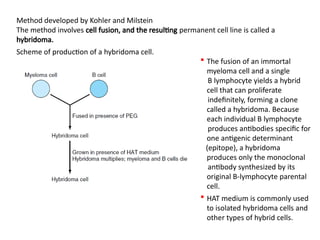
Method developed by Kohler and Milstein
The method involves cell fusion, and the resulting permanent cell line is called a
hybridoma.
Scheme of production of a hybridoma cell.
 The fusion of an immortal
myeloma cell and a single
B lymphocyte yields a hybrid
cell that can proliferate
indefinitely, forming a clone
called a hybridoma. Because
each individual B lymphocyte
produces antibodies specific for
one antigenic determinant
(epitope), a hybridoma
produces only the monoclonal
antibody synthesized by its
original B-lymphocyte parental
cell.
 HAT medium is commonly used
to isolated hybridoma cells and
other types of hybrid cells.
The myeloma cells are immortalized, do not produce antibody, and are HGPRT–
(rendering the salvage pathway of purine synthesis inactive).
The B cells are not immortalized, each produces a specific antibody, and they are
HGPRT+.
Polyethylene glycol (PEG) stimulates cell fusion.
The resulting hybridoma cells are immortalized (via the parental myeloma cells),
produce antibody, and are HGPRT+ (both latter properties gained from the parental B
cells).
The B cells will die in the medium because they are not immortalized.
In the presence of HAT, the myeloma cells will also die, since the aminopterin in HAT
suppresses purine synthesis by the de novo pathway by inhibiting reutilization of
tetrahydrofolate.
However, the hybridoma cells will survive, grow (because they are HGPRT+), and—if
cloned—produce monoclonal antibody.
(HAT - hypoxanthine, aminopterin, and thymidine;
HGPRT - hypoxanthine guanine phosphoribosyl transferase.)
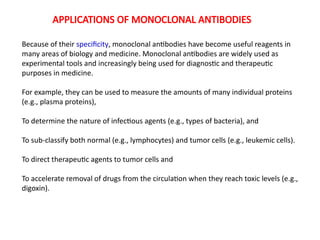
Because of their specificity, monoclonal antibodies have become useful reagents in
many areas of biology and medicine. Monoclonal antibodies are widely used as
experimental tools and increasingly being used for diagnostic and therapeutic
purposes in medicine.
For example, they can be used to measure the amounts of many individual proteins
(e.g., plasma proteins),
To determine the nature of infectious agents (e.g., types of bacteria), and
To sub-classify both normal (e.g., lymphocytes) and tumor cells (e.g., leukemic cells).
To direct therapeutic agents to tumor cells and
To accelerate removal of drugs from the circulation when they reach toxic levels (e.g.,
digoxin).
APPLICATIONS OF MONOCLONAL ANTIBODIES
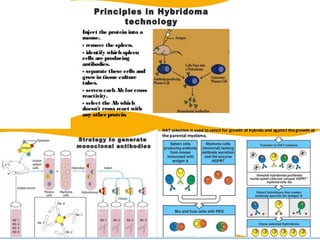
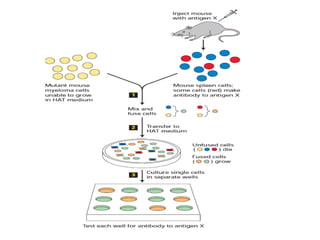
Use of cell fusion and selection to obtain hybridomas producing
monoclonal antibody to a specific protein
Step 1 :
Immortal myeloma cells that lack HGPRT, an enzyme required for growth on HAT
selection medium, are fused with normal antibody-producing spleen cells from an
animal that was immunized with antigen X. The spleen cells can make HGPRT.
Step 2 :
When plated in HAT medium, the unfused cells do not grow; neither do the mutant
myeloma cells, because they cannot make purines through an HGPRT-dependent
metabolic “salvage” pathway, and the spleen cells, because they have a limited life
span in culture.
Thus only fused cells formed from a myeloma cell and a spleen cell survive on HAT
medium, proliferating into clones called hybridomas. Each hybridoma produces a
single antibody.
Step 3 :
Testing of individual clones identifies those that recognize antigen X.
After a hybridoma that produces a desired antibody has been identified, the clone can
be cultured to yield large amounts of that antibody.
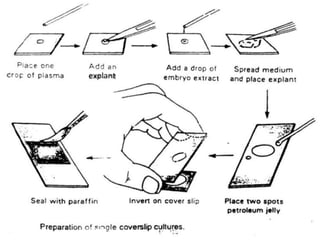
Preparation of Slide Cultures
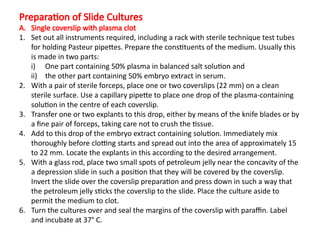
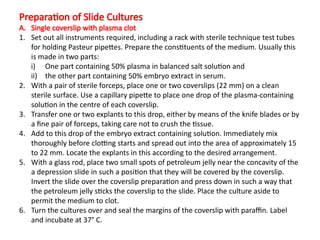
A. Single coverslip with plasma clot
1. Set out all instruments required, including a rack with sterile technique test tubes
for holding Pasteur pipettes. Prepare the constituents of the medium. Usually this
is made in two parts:
i) One part containing 50% plasma in balanced salt solution and
ii) the other part containing 50% embryo extract in serum.
2. With a pair of sterile forceps, place one or two coverslips (22 mm) on a clean
sterile surface. Use a capillary pipette to place one drop of the plasma-containing
solution in the centre of each coverslip.
3. Transfer one or two explants to this drop, either by means of the knife blades or by
a fine pair of forceps, taking care not to crush the tissue.
4. Add to this drop of the embryo extract containing solution. Immediately mix
thoroughly before clotting starts and spread out into the area of approximately 15
to 22 mm. Locate the explants in this according to the desired arrangement.
5. With a glass rod, place two small spots of petroleum jelly near the concavity of the
a depression slide in such a position that they will be covered by the coverslip.
Invert the slide over the coverslip preparation and press down in such a way that
the petroleum jelly sticks the coverslip to the slide. Place the culture aside to
permit the medium to clot.
6. Turn the cultures over and seal the margins of the coverslip with paraffin. Label
and incubate at 37° C.
Polyclonal antibodies
 If an animal is immunized with a protein, a wide array of B cells will be stimulated
to produce anti-protein antibodies.
 Antibodies may be made to a number of different epitopes of the protein.
 Even antibodies that bind to the same epitope may have different antigen-binding
sites and bind the epitope with different affinity.
 The mixture of antibodies produced in response to an antigen are referred to as
polyclonal antibodies (they are produced by many different clones of B cells).
 Polyclonal antibodies are a mixture of antibodies with different antigen binding
sites that may bind to different epitopes or antigens of the immunizing agent with
varying affinities. They may be of different antibody classes.
 The serum obtained from an immunized animal is referred to as a polyclonal
antiserum.
 A polyclonal antiserum contains antibody to different epitopes and different
antigens that were present in the immunizing inoculum.
Preparation of Slide Cultures
A. Single coverslip with plasma clot
1. Set out all instruments required, including a rack with sterile technique test tubes
for holding Pasteur pipettes. Prepare the constituents of the medium. Usually this
is made in two parts:
i) One part containing 50% plasma in balanced salt solution and
ii) the other part containing 50% embryo extract in serum.
2. With a pair of sterile forceps, place one or two coverslips (22 mm) on a clean
sterile surface. Use a capillary pipette to place one drop of the plasma-containing
solution in the centre of each coverslip.
3. Transfer one or two explants to this drop, either by means of the knife blades or by
a fine pair of forceps, taking care not to crush the tissue.
4. Add to this drop of the embryo extract containing solution. Immediately mix
thoroughly before clotting starts and spread out into the area of approximately 15
to 22 mm. Locate the explants in this according to the desired arrangement.
5. With a glass rod, place two small spots of petroleum jelly near the concavity of the
a depression slide in such a position that they will be covered by the coverslip.
Invert the slide over the coverslip preparation and press down in such a way that
the petroleum jelly sticks the coverslip to the slide. Place the culture aside to
permit the medium to clot.
6. Turn the cultures over and seal the margins of the coverslip with paraffin. Label
and incubate at 37° C.
Preparation of Slide Cultures
A. Single coverslip with plasma clot
1. Set out all instruments required, including a rack with sterile technique test tubes
for holding Pasteur pipettes. Prepare the constituents of the medium. Usually this
is made in two parts:
i) One part containing 50% plasma in balanced salt solution and
ii) the other part containing 50% embryo extract in serum.
2. With a pair of sterile forceps, place one or two coverslips (22 mm) on a clean
sterile surface. Use a capillary pipette to place one drop of the plasma-containing
solution in the centre of each coverslip.
3. Transfer one or two explants to this drop, either by means of the knife blades or by
a fine pair of forceps, taking care not to crush the tissue.
4. Add to this drop of the embryo extract containing solution. Immediately mix
thoroughly before clotting starts and spread out into the area of approximately 15
to 22 mm. Locate the explants in this according to the desired arrangement.
5. With a glass rod, place two small spots of petroleum jelly near the concavity of the
a depression slide in such a position that they will be covered by the coverslip.
Invert the slide over the coverslip preparation and press down in such a way that
the petroleum jelly sticks the coverslip to the slide. Place the culture aside to
permit the medium to clot.
6. Turn the cultures over and seal the margins of the coverslip with paraffin. Label
and incubate at 37° C.
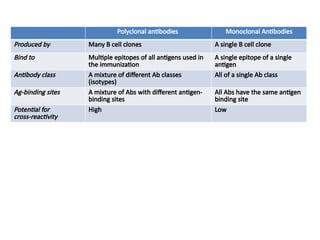
Polyclonal antibodies Monoclonal Antibodies
Produced by Many B cell clones A single B cell clone
Bind to Multiple epitopes of all antigens used in
the immunization
A single epitope of a single
antigen
Antibody class A mixture of different Ab classes
(isotypes)
All of a single Ab class
Ag-binding sites A mixture of Abs with different antigen-
binding sites
All Abs have the same antigen
binding site
Potential for
cross-reactivity
High Low

Culture techniques presentation by veena

  • 1.
    4.5: Culture techniques 4.5.1:Preparation of cells / organs for culture 4.5.2: Cover slip, Flask and Tube culture 4.5.3: Primary and established cell lines 4.5.4: Hybridoma technology
  • 2.
    4.5.1: Preparation ofcells / organs for culture
  • 3.
    Preparation of cells/ organs for culture For primary culture, cells are usually isolated from its parental tissue or organ. This procedure involves three steps: 1. Isolation of cells 2. Disaggregation of tissue 3. Separation of viable/nonviable cells 1) Isolation of Cells  For isolation of the cell, the site of dissection is sterilized with 70% alcohol and the tissue is removed from the animal body. After removal, the tissue is placed in basal salt solution as soon as possible.  Animal should not be dissected in animal tissue culture laboratory because they may carry microbial contamination. 2) Disaggregation of tissue  There are several methods for disaggregation of tissue. Mostly it is carried out by mechanical and enzymatic methods.  Mechanical disaggregation: It involves disaggregation of cells with some form of maceration. It is mainly preferred for soft tissues. It is much quicker than enzymatic disaggregation. Here cells are passed either through the sieves or forced out through a syringe or pipette.
  • 4.
     Enzymatic disaggregation: Cell-cell adhesion in tissue is mediated mostly by different glycoproteins. The enzymatic disaggregation is carried out with the help of enzyme, either trypsin or collagenase. a) Disaggregation with trypsin : Enzymatic dissaggregation with trypsin is known as Trypsinization. It is of two types i) warm and ii) cold trypsinization. i. Warm trypsinization: In this technique, tissue is chopped and stirred in trypsin for few hours at 37°C. Later the dissociated cells are collected by centifugation, and trypsin is removed and the cell suspension is neutralized with serum. This method is mainly useful for disaggregation of large amount of tissues in a relatively short time. ii. Cold trypsinization: Tissue is soaked in cold trypsin for 4 to 6 hr or even overnight to allow its penetration. Afterwards trypsin is removed and tissue is incubated at 36.5°C for 20-30 min. After trypsinization, serum is added to the cells to nullify the traces of trypsin. This is done because leftover trypsin can lyse the cells if it remains in the culture for a long time. b) Disaggregation with enzyme collagenase : Sometimes trypsin can damage the tissues or is ineffective for fibrous tissues. The intracellular matrix between cells contains collagen. Therefore collagenase proves effective for several normal and malignant tissues which are sensitive to trypsin Collagenase is used with finely chopped tissues in complete medium. After disaggregation collagenase is removed by centrifugation.
  • 5.
    3) Separation ofviable and nonviable cells  The separated cells which are obtained after disaggregation are called as the primary cells.  They grow well and proliferate quickly in the culture media.  The cells which grow and proliferate are called as viable cells while the cells which do not grow are called as nonviable cells.  Therefore the nonviable cells are removed during the change of medium.  Primary cultures can also be maintained in suspension by removing the nonviable cells through centrifugation.
  • 6.
    4.5.2: Cover slip(Slide culture), Flask and Tube culture
  • 7.
     A varietyof approaches exist that use either closed or open systems to grow the cells in tubes, flasks, slide chambers, or on coverslips in Petri dishes. These traditional techniques are known as Primary Explantation Techniques (cultivation of pieces of tissues, fresh from organs). These techniques are similar in principle, however, the main differences lie in the vessels used for growing the tissues.  Good-quality, rapid results can be obtained with any of these techniques, but a closed-tube system has the advantage of robustness, simplicity, and minimal use of resources.  Most tissue culture is performed on a small scale where relatively small numbers of cells are required for experiments.  At this scale cells are usually grown in T flasks ranging from 25cm2 to 175cm2. Typical cell yields from a T175 flask range from 1x10⁷ for an attached line to 1x10⁸ for a suspension line. However, exact yields will vary depending on the cell line.  It is not practical to produce much larger quantities of cells using standard T flasks, due to the amount of time required for repeated passaging of the cells, demand on incubator space and cost.
  • 8.
    Slide or coverslipCulture The cultures or coverslip cultures are made by explanting a very small fragment of tissues on the coverslip. Then the coverslip is subsequently inverted over the cavity of depression side. This method is useful for the morphological studies of cells cultured. Modifications in this method are valuable in time-lapse cinemicrographic investigations. Advantages and Disadvantages of Slide Culture Advantages Disadvantages Relatively simple and inexpensive Small supply of O2 & nutrients exhaust rapidly causing medium acidic and necessitating rapid transfer of growing tissue The spreading of cells can be observed microscopically and photographed in living state Difficult to maintain sterility for long periods resulting in small amount of tissue being cultured Cells grown directly on the coverslip can easily be fixed and stained for permanent preparation Application of slide culture method is limited Types of Slide Culture 1. Single coverslip with plasma clot (Harrison) 2. Double coverslip with plasma clot (Maximow) 3. Single coverslip with fluid hanging drop (Lewis and Lewis) 4. Double cover slip with perforated cellophane (Schilling and Earle) 5. Thin drilled metal or glass slide with plasma and fluid medium (Gey) 6. Special Slide with a circulating fluid medium-perfusion chamber (Promerat)
  • 9.
    A. Single coverslipwith plasma clot  In this technique a drop of 50% plasma in Balanced Salt Solution is placed in the centre of coverslip using a sterile capillary pipette.  Then the tissue explant (tissue fragment) is transferred on the coverslip.  A small amount of 50% embryo extract in serum is added to the coverslip and mixed before clotting starts.  A small amount of petroleum jelly is applied around the concavity slide.  Then the slide is slowly inverted over the coverslip and applied little pressure so that jelly sticks to the coverslip.  Culture medium is allowed to clot and slide is turned over.  The margins of coverslip are sealed with paraffin.  Slides are then labelled and incubated at 37°C. Single Cover slip culture
  • 10.
    B. Maximow doublecoverslip method with plasma clot  It is very similar to the single coverslip method.  In this method, a slide with large depression is used and the entire preparation is attached to it by petroleum jelly and wax.  The small coverslip used is not in contact with the cavity at any time. Technique  In this method, a small drop of balanced salt solution is placed on a large coverslip about 40 mm size.  A smaller coverslip about 22mm size is placed in the center of the large coverslip.  All other steps are similar to single coverslip culture. Double coverslip culture https://www.slideshare.net/BirenDaftary88/animal-cell-amp-tissue-culture
  • 11.
    Flask Culture  Theflask culture technique is used for establishment of strain from fresh explants of tissue because it has excellent optical properties for microscopic examination.  For flask culture Carrel flasks or Polystyrene flasks can be used.  There are two kinds of flask techniques: a) Thick clot culture – It allows rapid growth suitable for short term cultures, and b) Thin clot culture – It can be maintained for a considerable period.  By using flask culture technique, tissue can be maintained in the same flask for months or years.  Also a large amount of tissue or cells can be grown with large amount of medium.
  • 12.
    Preparation of Flaskculture  Flasks are placed in a rack with their necks flamed and pointing to the right.  A drop of plasma is placed on the flask.  Explant is transferred into plasma with the help of a spatula.  After clotting, the explant is fixed in a position and extra medium is added.  For thick clot culture 1.2 ml of dilute plasma and for thin clot culture 1.2 ml of dilute serum is added and kept for clotting.  Flasks are gassed with gas phase (5% CO2 in air).  For renewal of culture, old fluid is drawn out with the help of pipette, and 1.2 ml fluid medium is added as a replacement and flask is gassed as above.  For sub-culturing, the culture grown in the flask is removed and cut into pieces. Preparation of flask culture
  • 13.
    Spinner Flask Culture This is the method of choice for suspension lines including hybridomas and attached lines that have been adapted to growth in suspension e.g. HeLa S3.  Spinner flasks are either plastic or glass bottles with a central magnetic stirrer shaft and side arms for the addition and removal of cells and medium, and gassing with CO2 enriched air.  Inoculated spinner flasks are placed on a stirrer and incubated under the culture conditions appropriate for the cell line.  Cultures should be stirred at 100-250 revolutions per minute.
  • 14.
    Handling Bottles andFlasks  When working on an open bench, do not keep bottles vertical when open; instead, keep them at an angle as shallow as possible without risking spillage.  A bottle rack can be used to keep the bottles or flasks tilted.  Culture flasks should be laid down horizontally when open and, like bottles, held at an angle during manipulations.  When working in laminar flow, bottles can be left open and vertical, but do not let your hands or any other items come between an open vessel or sterile pipette and the HEPA filter.  Flasks with angled necks facilitate pipetting when the flask is lying flat (Invitrogen– Gibco).
  • 15.
    Test Tube Cultures It is an inexpensive technique and is used for preparing a large number of cultures.  Ordinary test-tubes are very cheap and convenient vessels for the cultivation of cells and tissues.  Cultures on the plasma clots are prepared in the same way as in flasks.  Even without a plasma clot, the tissue can be grown on the wall of the test tubes.  Suspension culture can also be developed using test tubes.  Feeding, patching and transfer can be done similar to primary culture technique.  Test tube culture can be used for preparing large number of cultures.  Test tubes can be kept either in roller drums or in stationary racks.  Though, it is very cheap and easy to handle in large quantities, it has many disadvantages.  The optical conditions are very poor.  Also it is very difficult to quantify the cells accurately due to curvature of the inside of the cells.  There is always a risk of contamination due to slight leak of air or medium between the stoppers and the test tubes.  This may particularly occur on opening tubes which have been removed from the incubator when there is almost invariably an inrush of the air.  This complication must always be kept in mind in handling test-tube culture.
  • 16.
    4.5.3: Primary andestablished cell lines
  • 17.
    Primary and establishedcell lines A cell line is a permanently established cell culture that will proliferate indefinitely if appropriate fresh medium and space is provided. Lineage of cells originating from the primary culture is called a cell strain. A cell line or cell strain may be finite or continuous depending upon life span of the culture a) Primary cell lines Primary cell culture is the disassociation of cells from a parental animal tissue through enzymatic or mechanical measures and maintaining the growth of cells in a suitable substrate in glass or plastic containers under controlled environmental conditions. The source of primary cultures is excised animal tissue that is cultured either as an explant culture, suspension or as monolayer and maintained in vitro. The excised tissue is subjected to enzyme treatment. The dissociated cells are cultured under appropriate conditions in culture medium till they reach adequate numbers. The isolated primary cells are of two types: Adherent cells/ Anchorage Dependent Cells – Cells that attach to surfaces in vivo require a surface to attach to in vitro. Cells that require attachment for growth are called anchorage dependent cells. The adherent cells are mostly derived from tissues of organs where they are immobile and embedded in connective tissue. E.g. Kidney cells. Suspension cells / Anchorage Independent cells – Cells which do not require attachment for growth or do not attach to the surface of the culture vessels are called as anchorage independent cells / suspension cells. All suspension cultures are derived from cells of the blood system.
  • 18.
    a) Primary celllines---contd. The most popular primary cells used in research are epithelial cells, fibroblasts, keratinocytes, melanocytes, endothelial cells, muscle cells, hematopoietic and mesenchymal stem cells. The cultures are initially heterogeneous and can be maintained in vitro only for a limited period of time. Primary cells may be manipulated for indefinite subculture through an in vitro process called transformation. Transformation may be spontaneous or can be induced chemically or virally. When a primary culture undergoes genetic transformation, they divide indefinitely and become immortalized. Transformed cells may not require attachment Primary cultures are advantageous as they essentially mimic the natural function of the cell, tissue or organ. Primary culture are generally mortal. Cells undergo an aging process. They multiply for only 50 to 100 generations. After that, the rate of cell multiplication decreases markedly.
  • 19.
    b) Established celllines (Immortal cell lines) Established cell lines grow indefinitely. Such cell lines are generally derived from tumor biopsies (e.g. HeLa) from patients. Although some of the very earliest lines were established from natural embryonic tissues (e.g. 3T3, CHO) and from normal human tissue such as WI-38. Established cell lines may also be generated from primary cells that have undergone mutations and have continued replications. The cell lines which become immortal can continue to divide indefinitely and are called continuous cell lines. When a “normal” finite cell line becomes immortal, it undergoes a fundamental irreversible change or “transformation”. This can occur spontaneously or can be brought about intentionally using drugs, radiation or viruses. Transformed Cells are usually fast growing often with extra or abnormal chromosomes. There are many advantages to use immortalized cell lines because these are standard lines used by many different labs. The major disadvantage in using immortalized cells is that these cells cannot be considered normal because they divide indefinitely and sometimes express unique gene patterns which are not found in any cell type in vivo. Therefore, they might not have the relevant attributes or functions of normal cells. Also, after several passages, cell characteristics can change and become even more different from those of a normal cell. Thus, it is important to periodically validate the characteristics of cultured cells and not use cells that have been passage too many times.
  • 20.
  • 21.
    Hybridoma Technology –An application of Cell culture incorporate In this technique, two types of cells are fused. The first is a spleen-derived lymphocyte which is capable of producing the desired antibody. The second is a rapidly dividing myeloma cell (a type of cancer cell) that has the machinery for making antibodies but is not programmed to produce any antibody. These hybird cells are called as Hybridomas which exhibit characteristics of both parent cells. The hybridomas can produce large quantities of the desired antibody. The antibodies produced by the hybridoma cells are called monoclonal antibodies. Monoclonal anti bodies all have identical antigen binding sites. Thus they bind to the same epitope with the same affinity. Due to their purity, they have many important clinical, diagnostic, and industrial applications. This technique was first used in 1975 by George Kohler and Cesar Milstein to create cells capable of producing monoclonal antibodies.
  • 23.
    The production ofMonoclonal Antibodies using Hybridoma Technology For production of monoclonal antibodies a rat is injected with specific antigen. After two to three booster does the sensitized lymphocytes are obtained from the spleen of the rat. Isolated lymphocytes are cultured in vitro. They are capable of producing a single type of antibody for specific antigen, called monoclonal antibody. However, lymphocytes have finite life span of 3-4 days. In order to make them immortal source of monoclonal antibodies, the lymphocytes are fused with myeloma cells in vitro in presence of a Sandai virus or polyethylene glycol. It is observed that the myeloma cells grow indefinitely in culture and can be modified to produce monoclonal antibodies. The monoclonal antibodies bind very specifically to an epitope (specific domains) on an antigen. The monoclonal antibodies are used to detect the presence of specific antigens and diagnosis of disease. The monoclonal antibodies are also used for the treatment of patients with malignant leukaemia cells, B cell lymphomas and for prevention of allograft rejection after transplantation. Steps involved in the production of monoclonal antibodies
  • 24.
    Monoclonal Antibodies Advantages Disadvantages 1)Homogeneity: Monoclonal antibody represents a single antibody molecule that binds to antigens with the same affinity and promote the same effectors functions. 2) Specificity: The product of a single hybridoma reacts with the same epitope on antigens. 3) Selection: It is possible to select for specific epitope specificities and generate antibodies against a wider range of antigenic determinants. 4) Antibody Production: Unlimited quantities of a single well-defined 1) Affinity: Average affinity of monoclonal antibodies are generally lower than polyclonal antibodies. 2) Effector Functions: Because antibody is monoclonal, it may not produce the desired biologic response. 3) Specificity: Monoclonals against conformational epitopes on native proteins may lose reactivity with antigens. 4) Cross reactions: Antibodies sometimes display unexpected Cross reactions with unrelated antigens. 5) Time and effort commitment:
  • 25.
    Use of HGPRT-HATselection media for Hybirdoma Hybridoma selection after fusion of myelomas and spleen cells is a critical step in monoclonal antibody production. Often scientists use the HAT (hypoxanthine- aminoprotein-thymidine) method to accomplish this task. When the parental tumor cells lack an enzyme hypoxanthine guanine phosphoribosyl tranferase (HGPRT) or thymidine kinase (TK), selection is accomplished by culturing the fusion mixture in HAT medium. Amino protein blocks the de novo synthesis of DNA. To survive in HAT medium, cells must make DNA via the so called salvage pathway, in which hyoxanthine and thymidine are incorporated into DNA by means of HGPRT and TK, respectively. Therefore, tumor cells lacking either of these enzymes cannot grow in HAT medium, unless they fuse with normal cells provided with the required enzymes, Thus, the only cells able to grow in HAT medium are the normal-tumor hybirds. Hybridomas inherit a functioning HGPRT enzyme from the spleen cells, so even though the de novo pathway is blocked, they can still use the salvage pathway to replicate. https://www.slideshare.net/biologyexams4u/hybridoma-technology Myeloma cells have been genetically engineered such that they cannot use hypoxanthine, aminoprotein and thymidine (HAT medium) as a source for nucleic acid biosynthesis and will die in culture (lack HGPRT). Spleen cells (B cells) have limited life span. Only B cells that have fused with the engineered myeloma cells will survive in culture when grown in HAT medium.
  • 26.
    Hybridomas Cells • Usingcell fusion techniques, it is possible to obtain hybrid cells by fusing cells from two different parents. • These may exhibit characteristics of either parents or both parents. • This technique was used in 1975 to create cells capable of producing custom tailored monoclonal antibodies. • These hybrid cells (called hybridomas) are formed by fusing two different but related cells. Hybridomas have hybrid lines retaining characteristics of immortal myeloma and differentiated plasma cell fusion partners . • The first is the spleen-derived lymphocyte that is capable of producing the desired antibody. • The second is rapidly dividing myeloma cell (a type of cancer cell) that has the machinery for making antibodies but is not programmed to produce any anti- body. • The resulting hybridomas can produce large quantities of the desired antibody. • These antibodies, called Monoclonal Antibodies due to their purity, have many important clinical, diagnostic, and industrial applications. • Although the majority of monoclonal antibodies produced are of mouse or rat origin, human monoclonal antibodies have been obtained by immortalization of lymphocytes immunized in vitro and include antibodies to HIV-1 envelope glycoprotein, hepatitis surface antigen, cytomegalovirus and rubella. • Hybridomas can be produced either in suspension e.g. in roller bottles, stirred reactors or airlift reactors, or immobilized using a suitable matrix e.g. hollow fibres, microbeads, or microcapsules. • Even though most cells used in cell culture are hybridomas and are said to have the ability to divide infinitely, most take on odd morphologies and unwanted characteristics over time.
  • 27.
    Production of Hybridomas Hybridomas are produced by fusing a nonsecreting myeloma cell with an antibody-producing B-lymphocyte in the presence of polyethylene glycol.  The myeloma cell is deficient in hypoxanthine-guanine phosphoribosyl transferase (HGPRT) or thymidine kinase (TK), necessary for DNA synthesis, and cannot survive in selection medium containing hypoxanthine, aminopterin, and thymidine.  Any unfused B-lymphocytes from the spleen cannot survive in culture for more than a few days.  Any B-cell-myeloma hybrids should contain the genetic information from both parent cells and are thus able to survive in the HAT selection medium.  They can be cultured indefinitely and will produce unlimited quantities of antibody. Supernates from surviving hybridomas are screened for antibody by ELISA.  Those hybridomas selected are then subcloned to ensure that they are producing antibody that is specific for a single epitope.  Antibody production can be scaled up in vivo as ascites in mice or in vitro as a suspension culture.
  • 28.
    Each normal Blymphocyte in a mammal is capable of producing a single type of antibody directed against (can bind to) a specific chemical structure (called a determinant or epitope) on an antigen molecule. If an animal is injected with an antigen, B lymphocytes that make antibodies recognizing the antigen are stimulated to grow and secrete the antibodies. Each antigen-activated B lymphocyte forms a clone of cells in the spleen or lymph nodes, with each cell of the clone producing the identical antibody—that is, a monoclonal antibody. Because most natural antigens contain multiple epitopes, exposure of an animal to an antigen usually stimulates the formation of multiple different B- lymphocyte clones, each producing a different antibody. The resulting mixture of antibodies that recognize different epitopes on the same antigen is said to be polyclonal.
  • 29.
    1) Because oftheir limited life span, primary cultures of normal B lymphocytes are of limited usefulness for the production of monoclonal antibody. Thus the first step in producing a monoclonal antibody is to generate immortal, antibody-producing cells. This immortality is achieved by fusing normal B lymphocytes from an immunized animal with transformed, immortal lymphocytes called myeloma cells. Treatment with certain viral glycoproteins or the chemical polyethylene glycol promotes cell fusion. The hybrid cell has novel characteristics. The fusion of a myeloma cell with a normal antibody producing cell from a rat or mouse spleen yields a hybrid that proliferates into a clone called a hybridoma. Like myeloma cells, hybridoma cells grow rapidly and are immortal. Each hybridoma produces the monoclonal antibody encoded by its B-lymphocyte parent.
  • 30.
    2) The secondstep in this procedure for producing monoclonal antibody is to separate, or select, the hybridoma cells from the unfused parental cells and the self-fused cells generated by the fusion reaction. This selection is usually performed by incubating the mixture of cells in a special culture medium, called selection medium, that permits the growth of only the hybridoma cells because of their novel characteristics. Such a selection is readily performed if the myeloma cells used for the fusion carry a mutation that blocks a metabolic pathway and renders them, but not their lymphocyte fusion partners that do not have the mutation, sensitive to killing by the selection medium. In the immortal hybrid cells, the functional gene from the lymphocyte can supply the gene product missing because of the mutation in the myeloma cell, and thus the hybridoma cells but not the myeloma cells, will be able to grow in the selection medium.
  • 31.
    Normal B lymphocytesare fused with myeloma cells that cannot grow in HAT medium, the most common selection medium used in the production of hybridomas. Only the myeloma-lymphocyte hybrids can survive and grow for an extended period in HAT medium??? REASON??? Thus, this selection medium permits the separation of hybridoma cells from both types of parental cells and any self-fused cells. Finally, each selected hybridoma is then tested for the production of the desired antibody; any clone producing that antibody is then grown in large cultures, from which a substantial quantity of pure monoclonal antibody can be obtained. PRINCIPLE UNDERLYING HAT SELECTION: HAT medium contains hypoxanthine (a purine), aminopterin, and thymidine. Most animal cells can synthesize the purine and pyrimidine nucleotide from simpler carbon and nitrogen compounds. The folic acid antagonists amethopterin and aminopterin interfere with the donation of methyl and formyl groups by tetrahydrofolic acid in the early stages of the synthesis of glycine, purine nucleoside monophosphates, and thymidine monophosphate. These drugs are called antifolates because they block reactions of tetrahydrofolate, an active form of folic acid.
  • 32.
    Many cells, however,are resistant to antifolates because they contain enzymes that can synthesize the necessary nucleotides from purine bases and thymidine. Two key enzymes in these nucleotide salvage pathways are thymidine kinase (TK) and hypoxanthine-guanine phosphoribosyl transferase (HGPRT). Cells that produce these enzymes can grow on HAT medium, which supplies a salvageable purine and thymidine, whereas those lacking one of them cannot. Cells lacking the HGPRT enzyme, such as the HGPRT myeloma cell lines used in producing hybridomas, can be isolated because they are resistant to the otherwise toxic guanine analog 6-thioguanine.
  • 33.
    Method developed byKohler and Milstein The method involves cell fusion, and the resulting permanent cell line is called a hybridoma. Scheme of production of a hybridoma cell.  The fusion of an immortal myeloma cell and a single B lymphocyte yields a hybrid cell that can proliferate indefinitely, forming a clone called a hybridoma. Because each individual B lymphocyte produces antibodies specific for one antigenic determinant (epitope), a hybridoma produces only the monoclonal antibody synthesized by its original B-lymphocyte parental cell.  HAT medium is commonly used to isolated hybridoma cells and other types of hybrid cells.
  • 34.
    The myeloma cellsare immortalized, do not produce antibody, and are HGPRT– (rendering the salvage pathway of purine synthesis inactive). The B cells are not immortalized, each produces a specific antibody, and they are HGPRT+. Polyethylene glycol (PEG) stimulates cell fusion. The resulting hybridoma cells are immortalized (via the parental myeloma cells), produce antibody, and are HGPRT+ (both latter properties gained from the parental B cells). The B cells will die in the medium because they are not immortalized. In the presence of HAT, the myeloma cells will also die, since the aminopterin in HAT suppresses purine synthesis by the de novo pathway by inhibiting reutilization of tetrahydrofolate. However, the hybridoma cells will survive, grow (because they are HGPRT+), and—if cloned—produce monoclonal antibody. (HAT - hypoxanthine, aminopterin, and thymidine; HGPRT - hypoxanthine guanine phosphoribosyl transferase.)
  • 35.
    Because of theirspecificity, monoclonal antibodies have become useful reagents in many areas of biology and medicine. Monoclonal antibodies are widely used as experimental tools and increasingly being used for diagnostic and therapeutic purposes in medicine. For example, they can be used to measure the amounts of many individual proteins (e.g., plasma proteins), To determine the nature of infectious agents (e.g., types of bacteria), and To sub-classify both normal (e.g., lymphocytes) and tumor cells (e.g., leukemic cells). To direct therapeutic agents to tumor cells and To accelerate removal of drugs from the circulation when they reach toxic levels (e.g., digoxin). APPLICATIONS OF MONOCLONAL ANTIBODIES
  • 37.
    Use of cellfusion and selection to obtain hybridomas producing monoclonal antibody to a specific protein Step 1 : Immortal myeloma cells that lack HGPRT, an enzyme required for growth on HAT selection medium, are fused with normal antibody-producing spleen cells from an animal that was immunized with antigen X. The spleen cells can make HGPRT. Step 2 : When plated in HAT medium, the unfused cells do not grow; neither do the mutant myeloma cells, because they cannot make purines through an HGPRT-dependent metabolic “salvage” pathway, and the spleen cells, because they have a limited life span in culture. Thus only fused cells formed from a myeloma cell and a spleen cell survive on HAT medium, proliferating into clones called hybridomas. Each hybridoma produces a single antibody. Step 3 : Testing of individual clones identifies those that recognize antigen X. After a hybridoma that produces a desired antibody has been identified, the clone can be cultured to yield large amounts of that antibody.
  • 38.
    Preparation of SlideCultures A. Single coverslip with plasma clot 1. Set out all instruments required, including a rack with sterile technique test tubes for holding Pasteur pipettes. Prepare the constituents of the medium. Usually this is made in two parts: i) One part containing 50% plasma in balanced salt solution and ii) the other part containing 50% embryo extract in serum. 2. With a pair of sterile forceps, place one or two coverslips (22 mm) on a clean sterile surface. Use a capillary pipette to place one drop of the plasma-containing solution in the centre of each coverslip. 3. Transfer one or two explants to this drop, either by means of the knife blades or by a fine pair of forceps, taking care not to crush the tissue. 4. Add to this drop of the embryo extract containing solution. Immediately mix thoroughly before clotting starts and spread out into the area of approximately 15 to 22 mm. Locate the explants in this according to the desired arrangement. 5. With a glass rod, place two small spots of petroleum jelly near the concavity of the a depression slide in such a position that they will be covered by the coverslip. Invert the slide over the coverslip preparation and press down in such a way that the petroleum jelly sticks the coverslip to the slide. Place the culture aside to permit the medium to clot. 6. Turn the cultures over and seal the margins of the coverslip with paraffin. Label and incubate at 37° C.
  • 41.
    Polyclonal antibodies  Ifan animal is immunized with a protein, a wide array of B cells will be stimulated to produce anti-protein antibodies.  Antibodies may be made to a number of different epitopes of the protein.  Even antibodies that bind to the same epitope may have different antigen-binding sites and bind the epitope with different affinity.  The mixture of antibodies produced in response to an antigen are referred to as polyclonal antibodies (they are produced by many different clones of B cells).  Polyclonal antibodies are a mixture of antibodies with different antigen binding sites that may bind to different epitopes or antigens of the immunizing agent with varying affinities. They may be of different antibody classes.  The serum obtained from an immunized animal is referred to as a polyclonal antiserum.  A polyclonal antiserum contains antibody to different epitopes and different antigens that were present in the immunizing inoculum.
  • 42.
    Preparation of SlideCultures A. Single coverslip with plasma clot 1. Set out all instruments required, including a rack with sterile technique test tubes for holding Pasteur pipettes. Prepare the constituents of the medium. Usually this is made in two parts: i) One part containing 50% plasma in balanced salt solution and ii) the other part containing 50% embryo extract in serum. 2. With a pair of sterile forceps, place one or two coverslips (22 mm) on a clean sterile surface. Use a capillary pipette to place one drop of the plasma-containing solution in the centre of each coverslip. 3. Transfer one or two explants to this drop, either by means of the knife blades or by a fine pair of forceps, taking care not to crush the tissue. 4. Add to this drop of the embryo extract containing solution. Immediately mix thoroughly before clotting starts and spread out into the area of approximately 15 to 22 mm. Locate the explants in this according to the desired arrangement. 5. With a glass rod, place two small spots of petroleum jelly near the concavity of the a depression slide in such a position that they will be covered by the coverslip. Invert the slide over the coverslip preparation and press down in such a way that the petroleum jelly sticks the coverslip to the slide. Place the culture aside to permit the medium to clot. 6. Turn the cultures over and seal the margins of the coverslip with paraffin. Label and incubate at 37° C.
  • 44.
    Preparation of SlideCultures A. Single coverslip with plasma clot 1. Set out all instruments required, including a rack with sterile technique test tubes for holding Pasteur pipettes. Prepare the constituents of the medium. Usually this is made in two parts: i) One part containing 50% plasma in balanced salt solution and ii) the other part containing 50% embryo extract in serum. 2. With a pair of sterile forceps, place one or two coverslips (22 mm) on a clean sterile surface. Use a capillary pipette to place one drop of the plasma-containing solution in the centre of each coverslip. 3. Transfer one or two explants to this drop, either by means of the knife blades or by a fine pair of forceps, taking care not to crush the tissue. 4. Add to this drop of the embryo extract containing solution. Immediately mix thoroughly before clotting starts and spread out into the area of approximately 15 to 22 mm. Locate the explants in this according to the desired arrangement. 5. With a glass rod, place two small spots of petroleum jelly near the concavity of the a depression slide in such a position that they will be covered by the coverslip. Invert the slide over the coverslip preparation and press down in such a way that the petroleum jelly sticks the coverslip to the slide. Place the culture aside to permit the medium to clot. 6. Turn the cultures over and seal the margins of the coverslip with paraffin. Label and incubate at 37° C.
  • 46.
    Polyclonal antibodies MonoclonalAntibodies Produced by Many B cell clones A single B cell clone Bind to Multiple epitopes of all antigens used in the immunization A single epitope of a single antigen Antibody class A mixture of different Ab classes (isotypes) All of a single Ab class Ag-binding sites A mixture of Abs with different antigen- binding sites All Abs have the same antigen binding site Potential for cross-reactivity High Low