 There are mainly three types of cell culture
system:
 1. Primary cell culture
 2. Secondary cell culture
 3. Continuous cell culture
 Advantages:
 more representative of the cell types in the tissues from which
theses are derived
 expression of Tissues
 Disadvantages:
 Mixture of cell population are present (i.e., heterogeneous cells).
 There may be presence of contaminating viruses originating from
animal source from where it has been taken.
 Requires recurrent animal sacrifice for preparation of fresh primary
monolayer cell culture
 Easy availability, maintenance and growth.
 Useful in virological, immunological and
toxicological research
advantages:-
• It has increased growth rate
• Reduced serum dependence
• Reduced anchorage dependence
• Has increased cloning efficiency.
Disadvantages
• It has greater chromosomal instability
• It has loss of tissue specific markers and
• Has altered cyto-morphology
It is the stage of the culture after isolation of
the cells but before the first subculture
 There are four stages :
 (1) acquisition of the sample,
 (2) isolation of the tissue,
 (3) dissection and/or disaggregation,
 (4) culture after seeding into the culture
vessel.
 trypsin,
 collagenase,
 elastase,
 pronase, dispase,
 DNase, and hyaluronidase,
 alone or in various combinations,
 Trypsin and pronase give the most complete
disaggregation, but may damage the cells.
 Collagenase and dispase, on the other hand, give
incomplete disaggregation, but are less harmful.
 Hyaluronidase can be used in conjunction with
collagenase to digest the intracellular matrix
(1)Fat and necrotic tissue are removed during dissection.
(2) The tissue should be chopped finely with sharp
instruments to cause minimum damage.
(3) Enzymes used for disaggregation should be removed
.
(4) The concentration of cells in the primary culture
should be much higher than that normally used for
subculture
(5) A rich medium like F12 is preferred.
(6) Embryonic tissue disaggregates more readily, yields
more viable cells, and proliferates more rapidly in
primary culture than does adult tissue.
 Work fits within medical ethical rules or current
legislation on experimentation with animals
 Sterilize the site of the dissection with 70%
alcohol
 Remove the tissue aseptically and transfer it to
the tissue culture laboratory in medium
 Do not dissect animals in the tissue culture
laboratory
 Incubate the eggs at 38.5◦C in a humid
atmosphere, and turn the eggs through 180◦
daily.
 8-10 day old embryo was taken
 Swab the egg with 70% alcohol
 Crack the top of the shell from the air sac side.
 Pierce the CAM with sterile curved forceps and
lift out the embryo
 Transfer the embryo to Petri dish containing
DBSS for subsequent dissection and culture,
 Disaggregation of tissue isolated for primary
culture by two main techniques:
 Mechanical techniques: works well with soft
tissues, but viability decreases
 Enzymatic disaggregation: gives a better yield
when more tissue is available
 Original method developed by Harrison &Carrel
 A fragment of tissue embedded in blood plasma or lymph
 Mixed with heterologous serum and embryo extract
 A coverslip was placed inverted over a concavity slide.
 Heterologous serum induced clotting of the plasma, to hold the
tissue in place
 Embryo extract and serum, together with the plasma, supplied
nutrients and growth factors and stimulated cell migration from the
explant.
Explant and early stage of outgrowth after
3 days
Outgrowth after removal of explant,
after 7 days
Adherence and migration may be stimulated:
 by placing a glass cover slip on top of the explant
 by treating the plastic with poly lysine or
fibronectin, extracellular matrix or feeder layers
 plasma clots can be used to promote attachment.
 purified fibrinogen and thrombin can be used
 Advantages: useful for small amounts of tissue,
such as skin biopsies,
 Loss of tissue is minimum which occurred in
mechanical or enzymatic disaggregation
 Disadvantages : poor adhesiveness of some
tissues
 The selection of cells in the outgrowth.
 Cell–cell adhesion in tissues is mediated by a variety
of cell adhesion molecules, some of which are
calcium dependent (cadherins) and hence are
sensitive to chelating agents such as EDTA.
 Intercellular matrix and basement membranes contain
 glycoproteins, such as fibronectin and laminin, which
are protease sensitive
 proteoglycans, which are degraded by
hyaluronidase or heparinase.
 Proceed from a simple disaggregation solution
to a more complex solution
 with trypsin alone or trypsin/EDTA as a
starting point
 adding other proteases to improve
disaggregation
 deleting trypsin to increase viability
 Increasing the purity of an enzyme will give
better control and less toxicity with increased
specificity but may result in less
disaggregation activity.
 Embryonic tissue disperses more readily and
gives a higher yield of proliferating cells than
newborn or adult tissue because of:
 (a) onset of differentiation in adult tissue,
 (b) an increase in fibrous connective tissue
and extracellular matrix,
 (c)and a reduction of the undifferentiated
proliferating cell pool.
 Minimize the exposure of cells to active trypsin
in order to preserve maximum viability
 When whole tissue is being trypsinized at 37◦C,
 dissociated cells should be collected every half
hour, and
 the trypsin should be removed by centrifugation
and neutralized with serum in medium.
 Useful for the disaggregation of large
amounts of tissue in a relatively short time
 It does not work well with adult tissue, in which
there is a lot of fibrous connective tissue
 Mechanical agitation can damage some of the
more sensitive cell types, such as epithelium
cells
 Cells damaged from prolonged exposure to the
tissue to trypsin at 37◦C
 Soak the tissue in trypsin (0.25% ) at 4◦C for
6–18 h to allow penetration of the enzyme
with little tryptic activity
 Following this procedure, the tissue will only
require 20–30 min at 37◦C for disaggregation
Cold
Trypsinization
 The cold trypsin method usually gives a higher
yield of viable cells, with improved survival
after 24 h culture
 preserves more different cell types than the
warm method
 convenient, as no stirring or centrifugation is
required and the incubation at 4◦C may be
done overnight.
 It takes longer time.
 Not suitable for large amount of tissue
 It is of greatest benefit when the tissue is either too
fibrous or too sensitive to allow the successful use
of trypsin.
 The process is gentle and requires no mechanical
agitation or special equipment.
 It can be expensive with more than 1 gm tissue
because of the amount of collagen
required.(200units/ml)
 It will also release most of the connective tissue
cells, thus the problem of fibroblastic outgrowth
which can be removed by using selective media.
E.g. breast and skin cultures by using MCDB 170
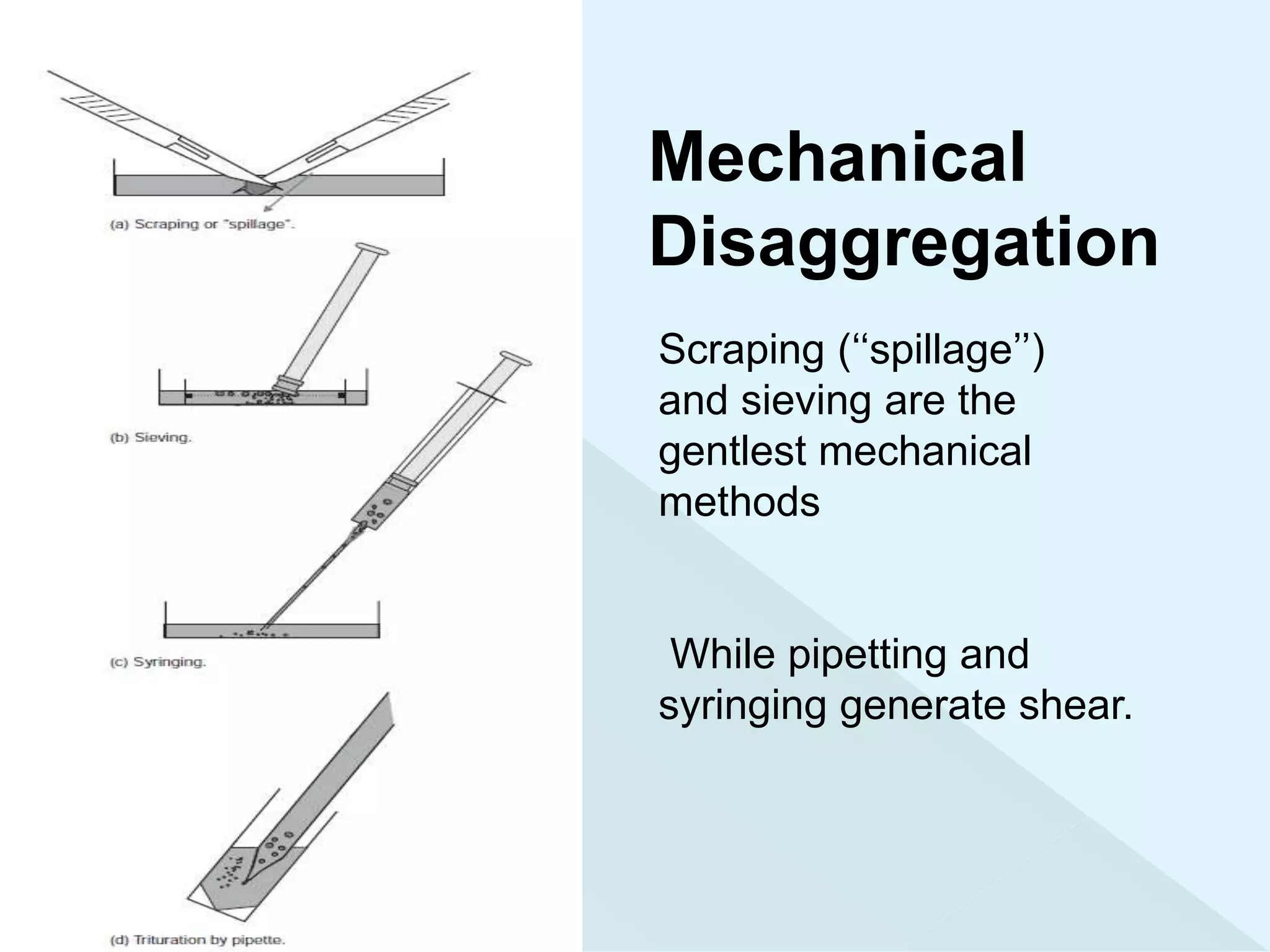
 Collection of the cells that spill out when the
tissue is carefully sliced . It can be done by:
 Teasing the tissue with needle and forceps
 Pressing the dissected tissue through a
stainless steel sieves by glass syringe barrel
 Forcing the tissue fragments through a
syringe (with or without a wide-gauge needle)
 simply pipetting it repeatedly
Mechanical
Disaggregation
Scraping (‘‘spillage’’)
and sieving are the
gentlest mechanical
methods
While pipetting and
syringing generate shear.
 Gives a cell suspension more quickly than does
enzymatic digestion
 Successful with soft tissues, such as spleen,
embryonic liver, embryonic and adult brain, and
some human and animal soft tumors.
 May cause mechanical damage.
 Viability of the resulting suspension is lower than
that achieved with enzymatic digestion
 At the expense of very much more tissue, in a short
time, many viable cells can be obtained with
mechanical disaggregation as with enzymatic
digestion
 Nonviable cells are removed at the first change
of medium.
 Nonviable cells may be removed from the
primary disaggregate by centrifuging the cells
on a mixture of Ficoll and sodium metrizoate
THE END
THANK YOU

Primary cell culture anjana.pptx

  • 2.
     There aremainly three types of cell culture system:  1. Primary cell culture  2. Secondary cell culture  3. Continuous cell culture
  • 3.
     Advantages:  morerepresentative of the cell types in the tissues from which theses are derived  expression of Tissues  Disadvantages:  Mixture of cell population are present (i.e., heterogeneous cells).  There may be presence of contaminating viruses originating from animal source from where it has been taken.  Requires recurrent animal sacrifice for preparation of fresh primary monolayer cell culture
  • 4.
     Easy availability,maintenance and growth.  Useful in virological, immunological and toxicological research
  • 5.
    advantages:- • It hasincreased growth rate • Reduced serum dependence • Reduced anchorage dependence • Has increased cloning efficiency. Disadvantages • It has greater chromosomal instability • It has loss of tissue specific markers and • Has altered cyto-morphology
  • 6.
    It is thestage of the culture after isolation of the cells but before the first subculture  There are four stages :  (1) acquisition of the sample,  (2) isolation of the tissue,  (3) dissection and/or disaggregation,  (4) culture after seeding into the culture vessel.
  • 7.
     trypsin,  collagenase, elastase,  pronase, dispase,  DNase, and hyaluronidase,  alone or in various combinations,  Trypsin and pronase give the most complete disaggregation, but may damage the cells.  Collagenase and dispase, on the other hand, give incomplete disaggregation, but are less harmful.  Hyaluronidase can be used in conjunction with collagenase to digest the intracellular matrix
  • 8.
    (1)Fat and necrotictissue are removed during dissection. (2) The tissue should be chopped finely with sharp instruments to cause minimum damage. (3) Enzymes used for disaggregation should be removed . (4) The concentration of cells in the primary culture should be much higher than that normally used for subculture (5) A rich medium like F12 is preferred. (6) Embryonic tissue disaggregates more readily, yields more viable cells, and proliferates more rapidly in primary culture than does adult tissue.
  • 9.
     Work fitswithin medical ethical rules or current legislation on experimentation with animals  Sterilize the site of the dissection with 70% alcohol  Remove the tissue aseptically and transfer it to the tissue culture laboratory in medium  Do not dissect animals in the tissue culture laboratory
  • 10.
     Incubate theeggs at 38.5◦C in a humid atmosphere, and turn the eggs through 180◦ daily.  8-10 day old embryo was taken  Swab the egg with 70% alcohol  Crack the top of the shell from the air sac side.  Pierce the CAM with sterile curved forceps and lift out the embryo  Transfer the embryo to Petri dish containing DBSS for subsequent dissection and culture,
  • 12.
     Disaggregation oftissue isolated for primary culture by two main techniques:  Mechanical techniques: works well with soft tissues, but viability decreases  Enzymatic disaggregation: gives a better yield when more tissue is available
  • 14.
     Original methoddeveloped by Harrison &Carrel  A fragment of tissue embedded in blood plasma or lymph  Mixed with heterologous serum and embryo extract  A coverslip was placed inverted over a concavity slide.  Heterologous serum induced clotting of the plasma, to hold the tissue in place  Embryo extract and serum, together with the plasma, supplied nutrients and growth factors and stimulated cell migration from the explant.
  • 16.
    Explant and earlystage of outgrowth after 3 days Outgrowth after removal of explant, after 7 days
  • 17.
    Adherence and migrationmay be stimulated:  by placing a glass cover slip on top of the explant  by treating the plastic with poly lysine or fibronectin, extracellular matrix or feeder layers  plasma clots can be used to promote attachment.  purified fibrinogen and thrombin can be used
  • 18.
     Advantages: usefulfor small amounts of tissue, such as skin biopsies,  Loss of tissue is minimum which occurred in mechanical or enzymatic disaggregation  Disadvantages : poor adhesiveness of some tissues  The selection of cells in the outgrowth.
  • 19.
     Cell–cell adhesionin tissues is mediated by a variety of cell adhesion molecules, some of which are calcium dependent (cadherins) and hence are sensitive to chelating agents such as EDTA.  Intercellular matrix and basement membranes contain  glycoproteins, such as fibronectin and laminin, which are protease sensitive  proteoglycans, which are degraded by hyaluronidase or heparinase.
  • 20.
     Proceed froma simple disaggregation solution to a more complex solution  with trypsin alone or trypsin/EDTA as a starting point  adding other proteases to improve disaggregation  deleting trypsin to increase viability  Increasing the purity of an enzyme will give better control and less toxicity with increased specificity but may result in less disaggregation activity.
  • 21.
     Embryonic tissuedisperses more readily and gives a higher yield of proliferating cells than newborn or adult tissue because of:  (a) onset of differentiation in adult tissue,  (b) an increase in fibrous connective tissue and extracellular matrix,  (c)and a reduction of the undifferentiated proliferating cell pool.
  • 22.
     Minimize theexposure of cells to active trypsin in order to preserve maximum viability  When whole tissue is being trypsinized at 37◦C,  dissociated cells should be collected every half hour, and  the trypsin should be removed by centrifugation and neutralized with serum in medium.
  • 24.
     Useful forthe disaggregation of large amounts of tissue in a relatively short time  It does not work well with adult tissue, in which there is a lot of fibrous connective tissue  Mechanical agitation can damage some of the more sensitive cell types, such as epithelium cells  Cells damaged from prolonged exposure to the tissue to trypsin at 37◦C
  • 25.
     Soak thetissue in trypsin (0.25% ) at 4◦C for 6–18 h to allow penetration of the enzyme with little tryptic activity  Following this procedure, the tissue will only require 20–30 min at 37◦C for disaggregation
  • 26.
  • 27.
     The coldtrypsin method usually gives a higher yield of viable cells, with improved survival after 24 h culture  preserves more different cell types than the warm method  convenient, as no stirring or centrifugation is required and the incubation at 4◦C may be done overnight.  It takes longer time.  Not suitable for large amount of tissue
  • 28.
     It isof greatest benefit when the tissue is either too fibrous or too sensitive to allow the successful use of trypsin.  The process is gentle and requires no mechanical agitation or special equipment.  It can be expensive with more than 1 gm tissue because of the amount of collagen required.(200units/ml)  It will also release most of the connective tissue cells, thus the problem of fibroblastic outgrowth which can be removed by using selective media. E.g. breast and skin cultures by using MCDB 170
  • 29.
     Collection ofthe cells that spill out when the tissue is carefully sliced . It can be done by:  Teasing the tissue with needle and forceps  Pressing the dissected tissue through a stainless steel sieves by glass syringe barrel  Forcing the tissue fragments through a syringe (with or without a wide-gauge needle)  simply pipetting it repeatedly
  • 30.
    Mechanical Disaggregation Scraping (‘‘spillage’’) and sievingare the gentlest mechanical methods While pipetting and syringing generate shear.
  • 31.
     Gives acell suspension more quickly than does enzymatic digestion  Successful with soft tissues, such as spleen, embryonic liver, embryonic and adult brain, and some human and animal soft tumors.  May cause mechanical damage.  Viability of the resulting suspension is lower than that achieved with enzymatic digestion  At the expense of very much more tissue, in a short time, many viable cells can be obtained with mechanical disaggregation as with enzymatic digestion
  • 32.
     Nonviable cellsare removed at the first change of medium.  Nonviable cells may be removed from the primary disaggregate by centrifuging the cells on a mixture of Ficoll and sodium metrizoate
  • 34.