Journey To Lean Making Operational Change Stick
Drew J Mccallum B download
https://ebookbell.com/product/journey-to-lean-making-operational-
change-stick-drew-j-mccallum-b-1564380
Explore and download more ebooks at ebookbell.com
Here are some recommended products that we believe you will be
interested in. You can click the link to download.
Journey To Lean Making Operational Change Stick John Drew Blair
Mccallum
https://ebookbell.com/product/journey-to-lean-making-operational-
change-stick-john-drew-blair-mccallum-5353062
A Publicsector Journey To Lean Fighting Muda In Times Of Muri First
Edition Mcgovern
https://ebookbell.com/product/a-publicsector-journey-to-lean-fighting-
muda-in-times-of-muri-first-edition-mcgovern-9951948
A Public Sector Journey To Operational Excellence Applying Lean
Principles To Public Policy Kate Mcgovern
https://ebookbell.com/product/a-public-sector-journey-to-operational-
excellence-applying-lean-principles-to-public-policy-kate-
mcgovern-51350528
Lean Design In Healthcare A Journey To Improve Quality And Process Of
Care Ward
https://ebookbell.com/product/lean-design-in-healthcare-a-journey-to-
improve-quality-and-process-of-care-ward-9953538
Leading The Lean Healthcare Journey Driving Culture Change To Increase
Value Joan Wellman Pat Hagan Howard Jeffries
https://ebookbell.com/product/leading-the-lean-healthcare-journey-
driving-culture-change-to-increase-value-joan-wellman-pat-hagan-
howard-jeffries-4138136
Leading The Lean Healthcare Journey Driving Culture Change To Increase
Value Second Edition Second Edition Bailey
https://ebookbell.com/product/leading-the-lean-healthcare-journey-
driving-culture-change-to-increase-value-second-edition-second-
edition-bailey-5744104
Continuous Improvement In Higher Educationhow To Begin Your
Institutions Lean Journey 1st Edition Bonnie Slykhuis Author
https://ebookbell.com/product/continuous-improvement-in-higher-
educationhow-to-begin-your-institutions-lean-journey-1st-edition-
bonnie-slykhuis-author-11909686
The Road To Learn React Your Journey To Master Plain Yet Pragmatic
Reactjs Robin Wieruch
https://ebookbell.com/product/the-road-to-learn-react-your-journey-to-
master-plain-yet-pragmatic-reactjs-robin-wieruch-6997492
Secret Journey To Planet Serpo Len Kasten
https://ebookbell.com/product/secret-journey-to-planet-serpo-len-
kasten-4057026
John Drew, Blair McCallum
and Stefan Roggenhofer
Journey to Lean
Making Operational Change Stick
Journey to Lean
Journey to Lean
Making Operational
Change Stick
John Drew,
Blair McCallum
and
Stefan Roggenhofer
© John Drew, Blair McCallum and Stefan Roggenhofer 2004
All rights reserved. No reproduction, copy or transmission of this publication may be
made without written permission.
No paragraph of this publication may be reproduced, copied or transmitted save
with written permission or in accordance with the provisions of the Copyright,
Designs and Patents Act 1988, or under the terms of any licence permitting limited
copying issued by the Copyright Licensing Agency, 90 Tottenham Court Road,
London W1T 4LP.
Any person who does any unauthorised act in relation to this publication may be
liable to criminal prosecution and civil claims for damages.
The authors have asserted their rights to be identified as the authors of this work in
accordance with the Copyright, Designs and Patents Act 1988.
First published 2004 by
PALGRAVE MACMILLAN
Houndmills, Basingstoke, Hampshire RG21 6XS and
175 Fifth Avenue, New York, N.Y. 10010
Companies and representatives throughout the world
PALGRAVE MACMILLAN is the global academic imprint of the Palgrave Macmillan
division of St. Martin’s Press, LLC and of Palgrave Macmillan Ltd. Macmillan®
is a
registered trademark in the United States, United Kingdom and other countries.
Palgrave is a registered trademark in the European Union and other countries.
ISBN 1–4039–1307–2
This book is printed on paper suitable for recycling and made from fully managed
and sustained forest sources.
A catalogue record for this book is available from the British Library.
A catalog record for this book is available from the Library of Congress.
10 9 8 7 6 5 4 3 2 1
13 12 11 10 09 08 07 06 05 04
Printed and bound in Great Britain by
Creative Print & Design (Wales), Ebbw Vale
This book is dedicated to our clients and colleagues who have
made the journey to lean with us
CONTENTS
List of figures xi
Acknowledgements xiii
About this book xv
Chapter 1 The challenge of lean 1
Lean’s great promise 2
Toyota: the lean pioneer 4
A difficult journey 7
Setting out on the journey 9
Part I The lean landscape 13
Chapter 2 The essence of lean 15
Extracting hidden potential 16
The operating system 18
Management infrastructure 19
Mindsets and behaviours 20
There are no shortcuts 21
Lean as an integrated approach 23
Chapter 3 The lean operating system 25
Lean by design 26
Core principles of a lean operating system 36
Putting it all together 44
Chapter 4 Management infrastructure 47
Organisation structure 49
Performance management system 52
Continuous improvement infrastructure 56
Processes for developing operational skills 59
Management of key functional support processes 60
Chapter 5 Mindsets and behaviours 65
The lean mindset 67
Lean behaviours 69
vii
Matching mindsets and behaviours to the
operating system 71
Breaking the vicious cycle of operational problems 74
Part II The lean journey 79
Chapter 6 Deciding to embark 81
A market leader under pressure 81
Weighing up the options 84
Learning from others’experience 85
Making plans to get started 90
Chapter 7 Exploring the opportunity 93
Troubleshooting the three aspects of operations 97
Planning the assessment 99
Ensuring management ownership 104
Evaluating the operating system 108
Interpreting the findings 113
Communicating the findings 120
Chapter 8 Engaging the leadership 123
Recognising different perspectives 125
Moving from current-state findings to future-state design 128
Building alignment within the team 131
Reconciling business need, improvement potential
and change capability 136
Reconnecting senior managers with the front line 139
Communicating to the wider organisation 143
Chapter 9 Demonstrating the change 147
Creating a stable platform 150
Establishing a performance culture 153
Tackling deep-seated problems 156
Keeping senior managers involved 159
Dealing with setbacks 163
Implementing a pull system 166
Chapter 10 Embedding the change 169
Exploding the myth of ‘pilot and roll out’ 173
Developing the conditions for lasting change 181
Developing a continuous improvement culture 186
Contents
viii
Cast of characters 189
Postscript 191
Appendix: Types of loss, symptoms, possible causes, key tools
and techniques 193
About the authors 199
Index 201
Contents ix
xi
LIST OF FIGURES
2.1 The three aspects of sustainable operational improvement 17
3.1 The smoothing effect of production levelling 28
3.2 The impact on inventory 29
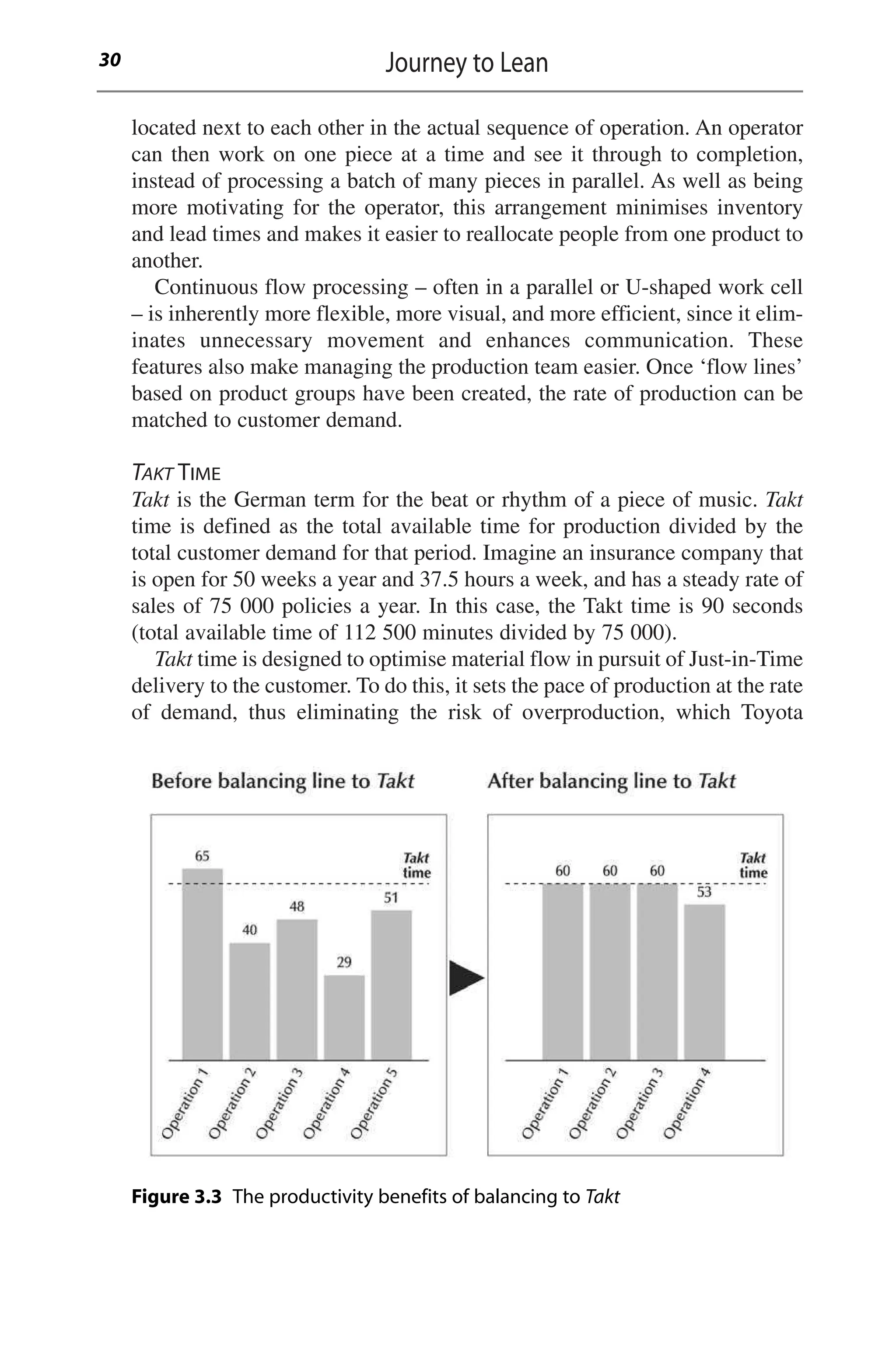
3.3 The productivity benefits of balancing to Takt 30
3.4 Matching people to demand 35
3.5 Adjusting staffing across two production lines to match demand 35
4.1 The five elements of management infrastructure 49
4.2 Drivers of team size in operations 50
4.3 Models for organisation of support functions 61
5.1 How mindset drives behaviours 69
5.2 Example of role of mindsets and behaviours 73
6.1 ExCo, Arboria Europe 82
6.2 Important lessons 89
7.1 Management organisation, Arboria UK 95
7.2 Example of a value tree 101
7.3 Philip’s draft work plan 103
7.4 Lean diagnostic team 105
7.5 Philip’s MIFA sketch 106
7.6 Seven steps to create a MIFA 107
8.1 Objectives 133
8.2 Lean programme objectives, 2005 134
8.3 Capturing impact 135
8.4 Evaluating change capability 137
10.1 Key success factors from the pilot 172
10.2 Assessing change readiness at the front line 177
10.3 Conditions for lasting behavioural change 182
ACKNOWLEDGEMENTS
This book has truly been a team effort. In particular, the authors would like
to thank the following people for their important contributions:
Our families for their support and forbearance.
Many colleagues who read early drafts and provided valuable feedback.
Annie Stogdale for helping us with the early stages of the book.
Jill Willder for her rigour and attention to detail in copy-editing.
Fred Chevalier for drawing the cartoons.
Pom Somkabcharti and Martin Liu at Cyan Communications.
xiii
ABOUT THIS BOOK
These days, it seems that most industrial enterprises and many service
companies claim to apply lean thinking in their operations. Many of them
do indeed apply lean tools, but few have managed to reap the benefits that
Toyota and others have achieved. This is odd, because Toyota welcomes
executives from other companies who want to learn about the famous
Toyota Production System. Thousands of visitors have toured its plants, yet
it isn’t afraid of giving away competitive advantage. The reason is that very
few visitors understand the full story behind what they see, and even fewer
can begin to emulate Toyota’s approach in their own operations.
Toyota can be so confident because it knows that lean goes way beyond
the application of lean tools. Its system has taken 50 years to develop, and
has been shaped by historical constraints. After the Second World War,
stringent labour regulations made it much harder for Japanese employers to
lay people off. Toyota found a way to turn this apparent problem to its
advantage. Guaranteeing lifetime employment allowed it to establish rigor-
ous performance management processes and create the conditions for
continuous improvement. The organisational culture that exists at Toyota
today is the product of this long evolution.
So lean is much more than a combination of tools, methods and prin-
ciples. The mindset and behaviour of the people operating the system are
fundamental. Toyota’s ability to align these intangible factors with its
operating system is probably the aspect of its success that is most often
overlooked; yet it is a key source of advantage. It is precisely this inter-
dependency between structural and organisational features on the one
hand and human aspects on the other that makes lean one of the most
difficult management techniques to apply.
Our aim in writing this book is to help managers embark on the journey
towards a truly lean system. Having witnessed at first hand the tremendous
impact it can make on the bottom line, and the profound changes it can
achieve in the motivation and effectiveness of managers and front-line
staff, we hope to convince you that the journey is an exciting one.
Stefan Roggenhofer
Before I joined Toyota’s UK plant at Burnaston in 1991, I’d heard a lot about
the company’s reputation for excellence. After a few weeks, I travelled to
Japan to be inducted by the world-renowned operations management
consulting division, the part of Toyota that created and continues to develop
xv
the Toyota Production System. I found the theory behind lean tools and
methods logical and compelling, but it was their impact that most impressed
me: very high productivity, very short lead times and exceptional product
quality.
Returning to the United Kingdom as a technical specialist, I was
involved in introducing the Toyota Production System to Europe. We
started with a number of suppliers that were keen to build a relationship
with Toyota and had offered to undertake pilot programmes. As soon as we
started working with them, we were able to diagnose areas of waste and
inefficiency in their operations and put corrective measures in place. The
managers were astounded: within a few days, we had achieved far more
than any previous improvement programme, and at almost zero cost. It
looked like a miracle: huge improvements in labour productivity, inventory
and quality, and all for free.
But the euphoria soon faded. When we returned to the sites a few weeks
later, it was business as usual. Extra people were back on the line, inven-
tory levels had soared and quality problems were slipping through once
again. When we asked management why they had allowed performance to
deteriorate, they were incredulous; most hadn’t even realised that gains had
been eroded. So we set about helping them to rebuild the system. But by
our next visit, performance had again slumped back to the old level.
So what had gone wrong? Weren’t the suppliers committed? Were they
merely playing lip service to a major customer? Or was their management
to blame? In the end, we managed to put things right, but it took a long time
and extraordinary efforts to re-establish what had originally been achieved
in a matter of days.
Our experience was far from unique. For all the energy that companies
have invested in implementing lean over the past 20 years, the rewards
have often proved to be short lived. What was missing? What was the
secret ingredient that would help to deliver impact combined with
sustainability? Those were the questions I tried to answer; you’ll find the
conclusions I have drawn within these pages.
Blair McCallum
Working in manufacturing for a number of years has taught me that opera-
tional improvement work must be done through people, rather than to
people. I’ve also learned that people are seldom persuaded to change the
way they work because of a manual, a presentation or a briefing. Of course,
logical explanations and clear instructions have their place, but they must
be backed up by practical demonstrations. People need proof that a new
approach works: ‘I’ll believe it when I see it.’
Journey to Lean
xvi
Now, as a consultant working at the interface between operational and
behavioural change, I find that sharing our experience of changing mind-
sets and behaviours with managers is difficult. Written documents and
conventional presentations aren’t that helpful. They can do a good job of
explaining the theory underpinning lean operations, but they can’t give
people an understanding of what lean feels like, of the difference it makes
in their everyday working lives.
So why then write a book about lean operations? The answer is that we
have tried to do two different things in this book. In Part I, The Lean Land-
scape, we have provided a structured introduction to the aspects that any
company contemplating a lean transformation will need to work on. In
Part II, The Lean Journey, we portray the transition to lean operations from
the point of view of a company involved in the messy reality of everyday
operations. This part takes the form of a drama documentary, with events
interspersed with commentary and analysis. We hope readers will be able
to engage with Arboria’s management team and front-line workers as they
grapple with the problems and frustrations of implementing lean, and
glimpse the rewards it offers. That way, they can start to experience a little
of this challenging yet rewarding journey for themselves.
John Drew
About this book xvii
1
ᔢ Lean can transform operations in any sector, opening up new
strategic opportunities.
ᔢ Lean is far more than a set of tools; it is a radically different way of
working.
ᔢ Implementing lean is a journey, not a process.
Excellence is inspiring. Watching Tiger Woods can spur us to dust off our
golf clubs and get down to our local course. Full of good intentions, we
promise we’ll go the full 18 holes, work on our handicap and spend more
time on the green and less in the bar. We may even sign up for lessons with
a pro, or splash out on a new set of clubs in the hope they will lift our game.
But we all know that good intentions aren’t enough. Once the initial rush
of enthusiasm has subsided, we need to follow through with determination
and sheer hard work. Time after time, we find that achieving our goals is
much harder than we ever imagined.
It’s just the same for corporations and their improvement programmes.
Often inspired by Japanese car makers, countless companies throughout
the world have endeavoured to boost their performance by adopting a
lean approach, changing shop-floor practices to eliminate waste from
their operations. But for the vast majority, improvements have been short
lived. Any gains they have won came at the expense of special efforts and
additional resources. As soon as managers let up, even for a moment, the
improvements vanish into thin air.
Part of the reason is that shop floors tend to be unpredictable places.
Such is the habitual state of any system; nature prefers chaos. No improve-
ment can be sustained unless effort is put into maintaining it. Indeed, in a
highly unpredictable environment, so much effort is needed merely to
maintain the status quo that doing work to improve the process is out of the
question. As one manager put it, implementing change in such conditions
is ‘like trying to pitch a tent in a hurricane’. The challenge is all the more
CHAPTER 1
The Challenge of Lean
acute when the responsibility for quality, cost and delivery to the customer
is delegated down the organisation to managers at the front line.
Having worked closely with many managers on improvement initiatives
as well as having worked in industry ourselves, we are under no illusion
about the difficulty of achieving sustainable change. Firefighting is the
norm in many organisations, and is a symptom of an operation that is
fundamentally unstable. Such instability is an inevitable characteristic of
mass production.
Even when sophisticated scheduling systems such as manufacturing
requirements planning (MRP) are in place, the vagaries of demand and
supply virtually guarantee that the two are continually out of synch. The
problem lies with the notion of scheduling itself: people are never willing or
able to comply with schedules for long. Customers change their orders at the
last minute, deliveries don’t arrive on time, parts run out, and machines break
down. As soon as a problem arises, scheduling is likely to go awry, and
operators have to be creative and cut corners to keep production running.
Though well intentioned, these unplanned interventions compound the
problem. Relatively small deviations at a given stage in the process can
quickly be amplified to create wild fluctuations in supply and demand
along the value chain. It’s no accident that the central planning of the old
Soviet economy failed catastrophically. Scheduling relies on compliance
and predictability, but no operation ever runs that smoothly.
This leaves us with a conundrum. If variability is inherent in mass
production and if it inevitably leads to instability and fire fighting, can any
change programme ever have lasting impact? Won’t instability eventually
blow down the tent of any new system as employees are forced to revert to
the old ways of doing things?
Lean’s Great Promise
Lean has entered management consciousness in a big way in recent
years. No longer regarded as an arcane set of Japanese methods and
tools, it appeals because it holds out a promise no other approach can
make: not only does it cut costs and improve quality, but it also
stabilises operations and matches supply with demand. It even promises
to end firefighting for good and establish the necessary conditions for
continuous improvement.
When lean becomes a way of life rather than a project, it can make an
enormous impact, surpassing managers’ expectations and conferring enor-
mous competitive advantage. By applying lean principles, Dell turned over
its inventory 64 times in 2001, 50 times more than its nearest rival, while
Journey to Lean
2
incurring operating costs that were less than half those of its closest
competitor. Dell’s founder, Michael Dell, says the principles of its success
are simple: ‘What’s the point in having a monitor put on a truck to Austin,
Texas, and then taken off the truck and sent on a little tour around the ware-
house, only to be put back on another truck? That’s just a big waste of time
and money.’
Many other companies have made the same transition. By adopting lean
principles, Airbus UK, which manufactures wings for assembly at plants in
France and Germany, was able to release substantial latent capacity that
obviated the need for major capital expenditure. By 1999, an extended
period of demand growth was creating severe capacity constraints, and
Airbus was experiencing increasing difficulty in meeting performance
targets. Adherence to schedules was critical, since missed delivery dates to
partner companies incurred financial penalties.
Airbus UK started its transformation in two pilot areas: machining and
single-aisle wing assembly. In the machine shop, the adoption of lean
methods boosted internal schedule adherence from around 30 per cent to
over 75 per cent in three months. In assembly, new production methods
and logistics systems delivered productivity savings of more than 25 per
cent, a reduction in production cycle time of around 20 per cent, and
improvements in quality of over 40 per cent within six months. By 2003,
the company had achieved impressive results: 100 per cent delivery on
schedule, with less recourse to outsourcing; productivity up by over 25
per cent; minor quality issues down by over 50 per cent. Airbus UK is
now recognised as one of the top performing business units within
Airbus.
The US insurer Jefferson Pilot Financial (JPF) is another company that
has achieved radical improvements in performance by applying lean prin-
ciples.1
In late 2000, JPF began looking for ways to break free from the
slow growth that characterises the life insurance industry. The challenges it
faced were daunting. Product proliferation, driven by rising customer
expectations, was ratcheting up complexity and costs for full-service play-
ers. At the same time, specialist niche players boasting lower costs and
faster policy handling were creating unprecedented pressure to improve
service levels and cut costs.
Jefferson Pilot was among the first to realise that lean principles and
tools could be applied to the processes of a financial services company.
The Challenge of Lean 3
1 See Cynthia Karen Swank, ‘The lean service machine’, Harvard Business
Review, October 2003.
Adopting them brought it substantial gains: the time it took to turn around
a new application fell by 70 per cent, the labour cost per policy by nearly
30 per cent, and the number of policies reissued due to error by 40 per cent.
A leading European telecommunications provider successfully applied
lean to counter pressure on its margins in a regulated and slowing market.
It focused initially on an area that was prompting many customers to switch
to other providers: the repair of faults in fixed lines.
The team found that the three stages in the repair process – call centre,
diagnosis and field force – operated in such a disconnected way that they
were like three rival companies. They even worked different hours. The
result was an average repair time of roughly 19 hours, of which only about
an hour was work that benefited the customer. Some 20 per cent of the field
force’s time was spent waiting for work to be allocated, for instance, and
another 20 per cent went on travelling between jobs.
By using lean principles first to find the leaks in the value stream, and
then to realign the organisation and invest in team leaders, the telecoms
company achieved impressive results. In the first few months of the pilot,
productivity rose by 40 per cent, and the rate of recurring failures fell
by 50 per cent. This success was subsequently replicated across the
company’s entire national network. What began as a productivity
improvement programme ended as a veritable cultural transformation. As
the COO put it, ‘We have surpassed the goals of this programme. The
most important success is that the organisation has learned and grown. It
is now implementing on its own.’
We will return to these examples in later chapters to show how lean can
transform operations in any industry. We have seen businesses from many
sectors – chemicals, paper, mining, steel, consumer goods, pharmaceuti-
cals, retail and financial institutions – reap rewards by applying lean to
their operations.
Toyota:The Lean Pioneer
Such companies are applying ideas first introduced by Toyota, the founder
of lean. Toyota’s approach to manufacturing has enabled it to earn higher
profits and sustain faster growth than any of its competitors over the past
30 years, with total return to shareholders increasing at a compound annual
growth rate of 14 per cent. By 2003, Toyota was the world’s third largest
automobile manufacturer, with a global market share of just over 10 per
cent, up from 5 per cent in 1970. It recently announced its aim to increase
this share to 15 per cent by 2010. If it succeeds, it will become the biggest
car maker in the world.
Journey to Lean
4
Even in today’s difficult climate, Toyota achieved a return on sales of 8
per cent in 2003. Yet it isn’t known as a pioneer of innovative products, or
a cutting-edge market strategist. Rather, the key to its success is the world’s
most efficient operating system: the Toyota Production System.
Toyota’s journey to lean started when it began to develop new operat-
ing principles in response to the business challenges it faced in the Japan
of the 1950s. Following the destruction of the country’s economy in the
Second World War, capital was scarce, limiting access to corporate
finance. Low incomes meant the home market for cars was tiny, so
Toyota didn’t have the scale of demand to justify mass production. More-
over, its models were yet to be tried and tested, so heavy investment in
tooling up was out of the question. And the company needed to cut costs,
but was prevented from laying off workers by stringent legislation intro-
duced to protect employment. Its attempts to improve efficiency met only
with strikes and deteriorating industrial relations.
A lesser company might well have given up at this point. But this inaus-
picious set of circumstances was the impetus for Toyota to develop a more
flexible production process that would be less dependent on long produc-
tion runs. To reduce capital costs, it purchased second-hand machinery
from the United States. This lower level of investment meant that the
small-batch production Toyota needed to satisfy its limited market was
now theoretically feasible. The practical obstacle that stood in the way was
the enormous cost and complexity of retooling machines to switch between
multiple short runs. In mass production, retooling was a massive job that
could involve closing down a line for days, retraining employees and even
introducing new machines into the line.
So Toyota developed a production system that enabled frequent and
rapid changeovers. Instead of using single-purpose machines, it introduced
equipment that could take interchangeable tools. It worked on reducing the
complexity of machine set-ups and the physical distance tools needed to be
moved. Above all, it invested in its employees. They had to be able to
change over tools when needed, to do a range of different jobs and to move
from one line to another, so they had to be trained to much higher levels
than usual. But Toyota knew the investment would pay for itself because
the employees would stay with the company for a long time, perhaps their
whole careers.
Having a highly skilled workforce brought a second benefit: the
company was able to involve its staff in continually improving the
changeover process. By shifting the balance of its investment away from
capital equipment and towards people, it had found a way of increasing its
flexibility. Toyota’s short production runs now became a benefit rather than
The Challenge of Lean 5
a burden, as it was able to respond much more rapidly to changes in
demand by quickly switching production from one model to another.
Over time, all these elements were consolidated into a new approach to
operations that formed the basis of what we now know as lean.2
As this
brief history suggests, lean is an alternative to mass production, not a
complement to it. It calls for a completely different way of operating, and
for a completely different way of thinking about operations. Lean is not
compatible with large-batch production; instead the pace, mix and quantity
of production is set by the customer. Mass producers set themselves limited
goals: an acceptable number of defects, a tolerable level of inventories, and
a narrow range of standardised products. Lean producers, on the other
hand, aim for perfection: continually declining costs, zero defects, zero
inventories and endless product variety.
What Toyota did was to develop an operating system that didn’t
depend on the economies of scale of the huge American market. Instead,
it developed a culture, organisation and operating system that relentlessly
pursue the elimination of waste, variability and inflexibility. To achieve
this end, it focuses its operating system on responding to demand – and
nothing else. This in turn means it has to be flexible; when there are
changes in demand, the operating system must respond immediately.
Underpinning the whole system is a stable workforce that is required to
be much more skilled and much more flexible than those in most mass
production systems. True flexibility requires stability; you can’t have one
without the other.
Toyota’s operating system has made a virtue out of a necessity. All its
key attributes can be traced back to the market conditions of the 1950s. But
if Toyota developed lean as a response to a specific set of problems at a
specific moment, can it be the answer for companies operating in today’s
very different conditions?
The current environment is in many ways diametrically opposed to that of
1950s Japan. Capital is abundant and global, so it seldom represents a source
of competitive advantage, whether in terms of access to finance or manu-
facturing scale. Nor is it a barrier to entry: as memory-chip manufacturers
found to their cost, competitors can spring up almost overnight, despite the
amount of capital required. As a result, companies can’t rely on scale to win
market share. Moreover, if scale isn’t a source of advantage, then mass
production systems are a potential liability, not an asset.
Journey to Lean
6
2 See James P. Womack, Daniel T. Jones and Daniel Roos, The Machine That
Changed The World, New York: Rawson Associates, 1990.
The uncertainty of today’s globalised economy demands an agile oper-
ating system that is able to respond to rapid shifts in demand and changes
in taste. The last thing a company wants is an inflexible production system
that relies on shed-loads of inventory to protect it from changes in demand
and market conditions, and that is about as manoeuvrable as an oil tanker
on the high seas.
So we would argue that the flexibility of the Toyota Production System
makes it well suited to the current economic environment. Indeed, it has
become a powerful asset for its originator. Toyota’s very short production
runs are able to marry high quality with abundant product variety – a
combination that is otherwise difficult to achieve and appears to bewilder
competitors as much as it pleases customers.
The challenge that other companies face in adopting lean principles is
that Toyota’s system has years of collective learning built into it. Lean
systems are inherently knowledge-intensive. Much of this knowledge is
captured within highly refined systems and processes, but a good deal more
resides in the skills of the people who operate them. Toyota people have a
Toyota mindset. They know how to respond and when to respond to
changes in production.
It’s revealing to look at the way Toyota handles its overseas operations.
When it sets up production in a new country it doesn’t expect to find a
fully established local system of components supply. Lean has to be
taught to its new suppliers one by one. So though the local Toyota factory
might start out lean internally, it will not be as efficient, initially at least,
as the plants in Japan. To achieve parity, its suppliers will have to be both
lean and local.
At first, the company has to manage the batch delivery of components –
either imported from Japan or bought in from local suppliers – to its new
overseas factory. However, the resulting lower levels of efficiency don’t
deter the company from making such overseas investments because it
knows that productivity will increase over time as it gradually spreads lean
throughout its supply base. As it does so, component supply becomes more
and more local.
Toyota treats each new overseas operation as the start of a new journey to
lean. Despite its years of experience in running lean operations, it doesn’t
expect to reach its goal in a single bound.
A Difficult Journey
If lean is such a powerful approach and Toyota models it so well, why is
it that so few companies are able to implement it successfully? We might
The Challenge of Lean 7
just as well ask why we struggle to improve our golf handicap, even
though it seems so worthwhile. Part of the reason, no doubt, is that the
appeal of a better handicap fades as the task proves tougher than we had
imagined. Time pressures get in the way, bad weather keeps us off the
course, family commitments intervene, or more attractive opportunities
come along to distract us. In much the same way, many companies’
attempts to ‘do lean’ peter out before they ever take hold. Good intentions
are swamped by day-to-day demands. Priorities change as the organisa-
tion responds to external pressures. This is why we look on lean as a
journey. It calls for able leadership, a reliable vehicle, a skilled and
enthusiastic crew, adequate supplies, a reliable map and frequent checks
on progress along the way.
The journey to lean is not for the timid, and there are no stopping
places along the way. You can’t hope to reap half the benefits of lean by
being half-hearted. Making the transition is highly challenging, and
many fall by the wayside. You need to be completely committed before
you set out.
A lean transformation should not be seen as a technical process that’s
best left to technical people. In our experience, most companies that try
to replicate the success of lean role models fail because they don’t see
the whole picture. When visitors tour a Toyota plant, for example, they
see a set of tools and techniques that optimise operations, but not the
infrastructure and behaviours that support them.
It’s rather like watching a play at the theatre. We see the actors move
around and hear them speak, but we don’t know what happened during
rehearsals, what the director asked them to do, how they prepared for their
parts, how the playwright revised the script, or how tonight’s performance
may differ from yesterday’s or tomorrow’s. Like a stage play, too, lean
operations aren’t static, but evolve dynamically over time.
Staying the course of the lean journey calls for strong leadership. All
change programmes need the commitment of senior management if they
are to succeed; for lean transformations, this is doubly so. Because lean is
a radically different way of operating, few people will immediately under-
stand it. Until they see its benefits for themselves, they may well react
against it because it challenges and undermines customary practices such
as accumulating inventory to protect against problems. Especially in the
early stages, experienced operations managers in particular are likely to
feel threatened as they see cherished ways of working overturned.
Senior management needs to share the vision not only for what is to be
achieved, but how. People involved in the change need to be given a
degree of security and support, especially if lean is introduced in the
Journey to Lean
8
context of a radical reduction in costs. Many companies that have
successfully introduced lean have provided some form of employment
guarantee to the employees who remain after the initial reduction in
labour that lean usually makes possible. Without such assurances,
employees may suspect that lean principles are just another way of
putting them out of a job – hardly an inducement for them to participate
actively in the change process.
The journey to lean is also a long haul. If a company is to become fully
lean, it must be able to keep up its efforts over time. Although lean does
yield immediate results, the full benefits come only when it becomes the
basis for a process of continuous improvement. Accommodating such a
long-term perspective presents a challenge to modern businesses. Today’s
short-term focus on quarterly results, coupled with short tenures at senior
level, indicates that lean can’t be sustained by the willpower of individual
senior managers alone. Companies need to institutionalise lean practices
and perspectives as part of their capability building. In short, everyone in
the organisation needs to think lean.
Setting Out on the Journey
Lean principles aren’t intuitive; indeed, they run counter to the experience of
most operations professionals. So a company embarking on a lean journey
will need the support and guidance of people with substantial experience of
lean implementation.
Some companies have hired directly from Toyota and other lean
companies and nominated their new recruits as change agents. Whoever
you choose to work with, the right people for the job will be those who
have previously helped to design and introduce a lean operating system.
Many claim to have designed a lean system, but few have successfully
implemented a sustainable one.
The journey to lean is by its nature a collaboration in which everyone in
the organisation will eventually have to play his or her part. Change agents
and lean guides are facilitators of change, helping others to make the jour-
ney and develop lean expertise of their own. If the journey is successful, all
those involved will find themselves achieving things they would never
have thought themselves capable of.
For many managers, embracing lean means venturing into unknown
territory. The same is true for front-line employees, but in a different
way. Through their day-to-day experience on the shop floor or with
customers, they know the operational landscape inside out: not the theory
of how things should work, but what actually happens, what the problems
The Challenge of Lean 9
are, and how to keep things running. Implementing lean will challenge
the perceptions managers and shop-floor staff have of one another. Both
must learn to trust each other much more than ever before.
Although the lean journey is different for every organisation, most
companies travel through five phases.
First comes a preparatory phase in which leaders assess whether lean can
deliver their operations strategy, and make an informed decision to embark
on the journey.
In the next phase, companies explore the opportunity for improvement
by conducting a comprehensive assessment of the current state of opera-
tions, including the management infrastructure and employees’motivations
and perspectives.
The third phase involves managers in defining the desired future state,
aligning around a shared vision and committing to achieving it.
One of the toughest parts of the journey, phase four consists of implement-
ing a pilot to demonstrate change to managers and front-line employees, test
the design of the future state, and refine it as necessary.
In the final phase, change must be embedded in and spread throughout the
whole organisation as a platform for achieving continuous improvement
in all operations.
Although it may be tempting to turn these phases into a project plan or
a process to be followed, the reality of the journey isn’t like that. There’s
no ‘right’ way to approach a lean transformation. It could take months or
even years for the leaders of one company to decide to embark on the
journey, whereas others might do so in weeks. Equally, the sequence of
events often isn’t as neat as we have suggested. In some cases, a clear
picture of the future state of operations may not emerge until after the
pilot implementation, rather than before it.
Our aim in this book is to investigate what lean operations are, and how
they work. We’ll show how a comprehensive lean transformation, properly
implemented, can create value for shareholders and customers. We’ll also
show what it feels like to be part of a lean transformation, giving an
insider’s view of what can be a turbulent and uncomfortable, as well as
challenging and rewarding, transition.
Part I of the book – The Lean Landscape – outlines the three key aspects
of lean and shows how they fit together (Chapter 2), before examining each
of them in more detail (Chapters 3, 4 and 5). Part II – The Lean Journey –
documents the progress of a fictional company on the journey to lean, with
a chapter devoted to each of the five phases (Chapters 6 to 10).
Parts I and II are self-contained and can be read separately or consecu-
tively. For people who like to have a clear structure in which to anchor their
Journey to Lean
10
thinking, it probably makes sense to understand the landscape before
making the journey. If, on the other hand, you prefer to immerse yourself
in new experiences and then reflect on them, the lean journey may be a
better place to start.
Wherever you start from, enjoy the journey!
The Challenge of Lean 11
PART I
The Lean Landscape
ᔢ Lean is not a project, but an ongoing quest for perfection through
the elimination of all sources of loss.
ᔢ Taken to its fullest extent,lean is as much a strategy as an approach
to improving operations.
ᔢ Lean requires the integration of three elements: operating system,
management infrastructure and mindsets and behaviours.
‘Lean’ has entered the everyday language of operations – so much so that
a whole range of operational improvement processes are commonly
labelled as lean. As a result, lean means different things to different people.
Many associate lean with the production system invented at Toyota, but
believe it is confined to the eradication of waste in order to cut cost. In fact,
there is much more to lean than that.
Put simply, lean is an integrated set of principles, practices, tools and
techniques designed to address the root causes of operational underperfor-
mance. It is a systematic approach to eliminating the sources of loss from
entire value streams in order to close the gap between actual performance
and the requirements of customers and shareholders. Its objective is to opti-
mise cost, quality and delivery while improving safety. To meet this objec-
tive, it tries to eliminate three key sources of loss from the operating
system: waste, variability and inflexibility.
Waste is anything that adds cost but not value. Traditionally, seven types
of waste have been identified: overproduction, waiting, transportation,
over-processing, inventory, motion and rework. (See the Appendix for a list
of sources of loss with symptoms, possible causes and key tools and tech-
niques.) An eighth category is often added: the failure to use people’s skills
and contributions to enhance the performance of any business process.
Toyota cite overproduction as the worst type of waste, since it both causes
and hides the other losses. Whenever any type of waste is found in an
operation, it is a sign that unnecessary cost is being incurred.
CHAPTER 2
The Essence of Lean
15
Variability is any deviation from the standard that detracts from the
quality of a service or product delivered to the customer. In raw materials,
for example, variability can lead to the production of defective parts or to
equipment failures. In skills, it can lead to productivity losses or process
bottlenecks that prolong lead times.
Inflexibility is any barrier to meeting changing customer requirements
that can be overcome without incurring extraordinary cost.1
Imagine you
go to a furniture store to choose a new sofa, and the retailer tells you
delivery will take 12 weeks. Making the sofa probably takes 10 or 20
hours. The rest of the time results from inflexibility caused, for example,
by waiting for parts to arrive or batches of cloth to be cut and dyed. If you
are shopping in November and want your sofa by Christmas, you will
probably decide to take your custom to another retailer that can supply it
in time.
There are obvious links between the three objectives and the three
sources of loss. Eliminating waste helps to reduce cost; eliminating vari-
ability improves quality; and eliminating inflexibility optimises delivery.
But this is an oversimplification; in practice, the interrelationships between
objectives and sources of loss are rather more complex.
A successful lean transformation programme is holistic in nature and
addresses all three sources of loss simultaneously, no matter where they
might be found within the organisation. Instead of optimising individual
parts or processes, it seeks to improve the whole system.
In this chapter, we explain how a lean transformation works and exam-
ine what it requires of an organisation. We also point out the hidden
dangers encountered by businesses that try to take shortcuts on the journey
to lean.
Extracting Hidden Potential
Extracting the hidden value in a company’s operations is like drilling for
oil. Every company has unrealised operational potential that can be readily
identified in principle, but often proves remarkably difficult to capture in
practice. As with oil, the first step is to quantify the rewards and understand
the peculiarities of the terrain. Once you know how much potential lies
hidden and you have determined that extracting it is economic, you need a
stable platform to bring it to the surface. It is the capability to design and
Journey to Lean
16
1 The emphasis on changing customer requirements is one of the features that
distinguish the lean approach from other forms of operations improvement.
operate this platform that separates the winners from the also-rans in the
field of operational change.
Our experience in many different sectors has convinced us that to
develop an effective change platform, companies need to tackle three
aspects of an organisation simultaneously: the operating system, the
management infrastructure, and the mindsets and behaviours of the staff.
They are like the three legs of a platform: all three need to be securely in
place and linked to one another if it is not to fall over (see Figure 2.1).
Operating system. Properly understood in terms of its purpose rather
than merely as a system of execution, an operating system is the way in
which assets, resources and people are managed in order to create value
and flow it to the customer. An ideal configuration optimises the flow and
minimises losses. In manufacturing, the operating system includes standard
procedures, production control methods, process layout, equipment utilisa-
tion, inventory and manning levels. In a service industry such as banking,
the components include information flows, IT systems, procedures and
office layout.
Management infrastructure. Management processes, capability-building
mechanisms and organisation structure need to be closely aligned with the
The Essence of Lean 17
Figure 2.1 The three aspects of sustainable operational improvement
operating system so that lean ways of working become standard practice, not
something that requires heroic efforts or exceptional teamwork. The entire
management infrastructure must be designed to complement and sustain the
operating system so as to achieve a high level of performance and foster an
ethic of continuous improvement.
Mindsets and behaviours. The way people think about what they do,
their attitudes towards their work, their aspirations and goals, and the
effect these factors have on their actions need to be consistent with lean
principles if improvement efforts aren’t to unravel in the long run. It’s
imperative to engage people’s hearts and minds: to ensure that staff at
every level of the organisation understand the reason for change, know
where it is heading, and commit themselves to working to get there.
Provided these three elements are linked together into an integrated
whole, the change platform will be durable and robust.
The Operating System
The operating system lies at the heart of a lean company. It’s the vehicle for
adding value for the customer, and everything else in the organisation is
there to support it. A good operating system takes an end-to-end view of a
value stream in order to create flow to the customer and minimises the
sources of loss that can occur within it.
Imagine a stream of water flowing downhill, with thirsty people in the
valley below. This is like the flow of value towards the customer. In both
cases, there are obstacles, leaks and sources of contamination along the
way. If work is done upstream to remove a barrier or plug a leak, it will
have negligible effect on the customer so long as other problems hamper
the flow; indeed, it might even make things worse.
So the operations flow needs to be treated as a system – a complete
progression from start to finish. If our valley dwellers get polluted water
instead of fresh, they won’t care whether the river was contaminated at source
or in the last few yards.As far as they are concerned, the end result is the same.
In much the same way, the entire value stream needs to be completely
pure to optimise the flow of value to the customer. Eliminating each source
of waste will remove blockages, smooth the flow and make it more
manageable and less unpredictable.
In some environments, such as assembly, creating flow is in itself the
main goal, and can yield major improvements. In others, particularly bulk
chemicals, consumer goods and other high-volume, capital-intensive sectors,
flow is already inherent in the process, and the scope for improvement lies
in eliminating losses.
Journey to Lean
18
The operations flow shouldn’t be thought of as fixed. An organisation
may well need to adapt it in order to cope with customers’ changing
demands. To take a simple example, a bank branch has to cope with peaks
and troughs in customer demand throughout the day while at the same time
maintaining service levels and productivity.
Management Infrastructure
The right management infrastructure will reinforce the lean operating
system and ensure that performance objectives can be achieved and
sustained. What the ‘right’management infrastructure is will depend on the
operating system it is intended to support; there is no universal solution that
can be applied to every company.
Each element of the infrastructure needs to be tailored to fit the
demands of the lean programme. Take the structure of the organisation:
its design will involve decisions about team size, leadership, levels of
hierarchy and the allocation of functional support. The criteria managers
use in making these decisions will depend on the nature of the operating
system. Complex processes generally call for small front-line teams with
narrow spans of control. So do complex departments with unstable
processes or poorly trained subordinates. A function such as maintenance
should be integrated into a value stream if unplanned line stops are
frequent. Planned maintenance, on the other hand, may need to be shared
between multiple value streams, particularly if it draws on scarce
specialist skills.
Similarly, performance management processes must be designed to
ensure that employees have clear, measurable targets aligned with overall
business objectives, and that performance against these targets is tracked in
a completely transparent manner.
Airbus UK supported its lean transformation by strengthening manage-
ment systems throughout its plant at Broughton in Cheshire. It focused on
creating a new performance management system and redefining roles and
responsibilities. Team-based performance targets were used to encourage
cooperation among production employees both within and between shifts.
In addition, clear service-level agreements were established to improve the
performance of support functions such as logistics, quality, engineering
and site maintenance.
For a lean operating system to bear fruit, front-line staff will need the
skills and tools to track and manage operating performance. These must
be embedded as a routine part of the organisation so as to link front-line
activities to business objectives and set in motion the learning cycle that
The Essence of Lean 19
drives improved performance. Simple procedures such as holding a
short team meeting around a performance board at the start of every
shift can be much more powerful than any number of analyses and
written reports.
Once an organisation has achieved a step-change in performance
through lean, it enters a phase of continuous improvement that requires its
own infrastructure. The nature of this infrastructure will change over time.
Early on, substantial support will be needed at plant level. Later in the lean
journey, the skills required to maintain the improvement programme will
be transferred to the front line, and a smaller central team will be needed to
act as guardians of the approach and developers of core materials and
resources.
Mindsets and Behaviours
In any organisation, whether or not change sticks has a lot to do with how
those involved perceive it. Do they trust their leaders and feel motivated,
or fear for their jobs and suspect management is out to get them? Few
managers are used to thinking about employees’ mindsets, since they are
hidden from view and hard to understand and influence. To work on them
effectively calls for a set of skills that may not form part of the usual
management repertoire.
The mindsets and behaviours of staff – or organisational culture – help
determine whether changes can be sustained over time. Just as work must
be done to develop the future operating system and management infra-
structure, so effort must be devoted to defining and developing the
behavioural state that will support them.
A lean operating system usually defines standard ways of carrying out
certain tasks, for instance. These standards ensure that work is carried out
safely, consistently and productively, and act as the basis for labour plan-
ning. If they are to be implemented successfully, front-line employees
will need to respect them and comply with them in a disciplined way.
And if the standards are to be fully effective in the long term, employees
need to be able to use their experience to help refine them to meet
changing circumstances.
This can present a challenge to middle managers. Issuing instructions
won’t be enough; rather, they will need to act as coaches to help their teams
make the move to the new way of working. But many front-line managers
find coaching an alien concept. Among other things, they must learn to
welcome the identification of problems, rather than punish those who point
them out.
Journey to Lean
20
Such changes don’t happen overnight. Indeed, they won’t happen at all
without strong leadership. The senior team must shape the culture by
setting expectations about employees’ behaviour. In any organisation,
most people take their cue from those with power and influence, and are
much more likely to modify their behaviour if they see change being
modelled by those at the top. For this to work employees need to see their
leaders on a regular basis; part of the lean challenge is that senior
management must be much closer to front-line operations than ever
before.
At Jefferson Pilot, the highly visible participation and commitment of
senior leaders was key to the success of the lean transformation. The head
of operations took part in periodic walk-throughs of the new process, and
the vice-presidents were active in redesigning it. Their behaviour served to
reinforce the importance of the effort and paved the way for its wider
acceptance within the organisation.
Helping shape employees’ outlook on their work is an important activ-
ity for managers undertaking any lean journey. If people aren’t
convinced that the extra trouble they have been put to is valued, they are
unlikely to perform well. Managers who want their employees to engage
in the change effort must first be willing to engage with them. This calls
for a dialogue that explores employees’ feelings about the change,
including any frustration or scepticism. What surfaces during the
dialogue should not be dismissed as carping, but should be translated
into positive action, with employees encouraged to help devise solutions
to the issues they raise.
There are No Shortcuts
Most lean programmes include three ingredients: kaizen (Japanese for
continuous improvement) workshops, benchmarking visits and the recruit-
ment of employees from successful lean companies. Although all three can
make valuable contributions, they need to form part of an integrated trans-
formation programme to succeed. Wrongly applied, they can cause damage
and lead to disappointment and cynicism.
Taken in isolation, each has its drawbacks. Workshops teach tools and
techniques rather than help create a company-wide system for running a
business. In benchmarking visits, observers tend to see only the physical
aspects of lean operations; the underlying principles remain hidden and
unexplained. And people who have worked in a lean environment don’t
necessarily know how to create one.
Let’s look at each ingredient in turn.
The Essence of Lean 21
Kaizen Workshops
Imagine a simple business system with six process steps. A typical kaizen
workshop would focus on just one of these steps, and seek to make a dramatic
change in it through a focused effort over a week or two. A multi-disciplinary
team would be assembled specifically for the workshop. They would look for
inefficiencies (too many people, excess stock, problems with quality) and
suggest changes that could be carried out quickly using a ‘just do it’approach.
By drawing together a handful of people from various functions for a short
period of intense activity, such workshops create a temporary organisational
form focused on a single narrow task. When the workshop members go back
to their everyday jobs, the process operators – the people actually responsible
for implementation – lose the support they need. None of the business systems
have really changed, and the process quickly reverts to its former state.
Benchmark Visits
In our experience, it can be very difficult to make sense of what you see on
a benchmark visit. Take a tool such as kanban. (For more on kanban, see
Chapter 3.) You may know that the kanban is designed to trigger upstream
production and delivery, but what you see is simply a small card attached to
a box of parts. What you don’t see is how the flow through the operating
system is regulated.
Benchmark visits can’t give you a complete understanding of all the
technical aspects of the system, let alone show you how people’s roles and
responsibilities are defined, how they approach tasks, or what attitude of
mind they need to perform them consistently. Moreover, a visit is just a
snapshot, not a moving picture. It can’t show you how things got to be this
way, or how they are likely to change over time.
Lean practices are not things that can be copied from one place and
pasted into another. A lean system is more like a living body than an inan-
imate object. It links all the various parts of an operating system into a
coherent whole. This is why isolated lean initiatives so often fail. For
managers who are keen to transplant the practices they have seen on bench-
marking visits into their own organisation, it’s frustrating to discover that
their efforts have no lasting impact.
Recruitment from Lean Companies
Employees with hands-on experience of lean operations tend to come
from production environments. They are often production operators or
Journey to Lean
22
team leaders in companies with great pedigrees. Though they possess
relevant knowledge and expertise, what they know best is how to carry
out a lean operation as part of an integrated process. Very few know how
to set about modifying a value stream or business system to enable a new
way of working, or have experience of putting in place the infrastructure
to support and sustain a business system. It’s a mistake to expect builders
to act as architects.
The idea of recruiting from lean companies is part of a now widespread
tendency to approach operations improvement from the bottom up. This
may be a reaction to the laborious top-down programmes of 10 or 15 years
ago such as TQM (total quality management), which began with the CEO
and filtered slowly down through the hierarchy to the rest of the organisa-
tion. Starting from the shop floor probably seems like a better bet to
managers tired of waiting for real bottom-line business benefits to flow
from these top-down programmes.
What’s often missing from the newer bottom-up approaches, though, is
the right perspective, level of support and infrastructure to ensure that prac-
tical changes can be sustained. Imagine you reconfigure a production line
to minimise the space it takes up. You may then be able to hold only a very
small amount of line-side stock. But if your whole logistics system is still
geared up to deliver components weekly in pallet-loads, you’ll soon be in
chaos. Failures such as this all stems from a lack of understanding of what
the transformation from a traditional operating system to a lean operation
actually involves.
Lean as an Integrated Approach
It simply isn’t possible to close the gap between your actual performance
and what your customers and shareholders require just by improving the
physical aspects of your operations. True lean programmes challenge the
organisational structures and formal management processes that surround
operations. They seek to diagnose and tackle cultural and behavioural
barriers to change both on the shop floor and in the management suite.
Imagine that a supermarket sets up a team to improve the way it goes
about filling shelves so that it can free up more time for serving customers.
What will it take to create sustainable change?
In terms of the operation itself, what is needed is a clearly defined shelf-
filling process, supported by simple standards and practical training. In terms
of management infrastructure, the team may decide to add visual tools such
as a magnetic board with coloured counters that tracks who is working on
which tasks and acts as a guide to decisions on labour allocation. A few key
The Essence of Lean 23
indicators – say, cases handled per hour and time taken to unload a delivery
– can be tracked on a daily basis and discussed during a brief team meeting
every morning to review performance and agree priorities for the day ahead.
Finally, staff will need to be engaged with the effort from the start so
that they understand the reasons behind it and know what will happen
and what roles they will be expected to play. As the work progresses, it’s
vital that front-line staff derive their own benefits from the new way of
working, perhaps by being able to spend more time with customers and
less time behind the scenes performing mundane tasks or dealing with
unplanned events. If staff don’t benefit, management is unlikely to
sustain the extra commitment and involvement that will be needed to
make lean work.
The way that people think and act and the systems within which they
work need to change at the same time. If systems don’t change to address
the root causes of operational problems, people will quickly become frus-
trated by the gulf between what they are being asked to do and the real-
ity of their everyday experience. On the other hand, if the operating
system and management infrastructure have been redesigned but people
aren’t fully engaged with the effort, any improvements will eventually
unravel.
As we have shown in this chapter, our approach to lean transformation
is to create a stable change platform by working on all three elements of
the business simultaneously: operating system, management infrastruc-
ture and mindsets and behaviours. A failure to take account of any one of
these is not just inadvisable but impossible, since working on one dimen-
sion will have a knock-on effect on the other two, leading to an unstable
change platform.
In the next three chapters, we explore these three features of the lean
landscape in more detail.
Journey to Lean
24
25
ᔢ A lean operating system follows certain principles to flow value to
the customer while minimising all forms of loss.
ᔢ Each value stream within the operating system must be optimised
individually from end to end.
ᔢ Lean tools and techniques are applied selectively to eliminate the
three sources of loss: waste, variability and inflexibility.
On a recent visit to a factory, the operations manager told us that the company
had ‘done lean’a few years ago. The results had been great at first, but people
had gradually reverted to their old way of doing things and the benefits had
slipped away. This is a pattern we see repeated all too often.
The effectiveness of the lean operating system comes from the inte-
grated nature of its practices and methods. Yet many organisations
assume they can accomplish a lean transformation merely by applying
a few lean tools. Not so. Such attempts are doomed to failure because
there is no lean operating system in place to coordinate and drive
improvements.
One company we know devoted its efforts to changeover reduction
(SMED)1
across its entire operation; another sought to apply the principles
of workplace organisation (5S) as the basis for its improvement effort. The
problem with such approaches is twofold. First, lean tools are being applied
without reference to business needs. Second, they are being used outside
the context of a coherent operating system that can enable the organisation
to meet these needs.
For most companies, their operating system evolves haphazardly as
their business grows. Imagine an entrepreneur who sets up a small
bakery. She has few assets (just her premises, a mixing machine and an
oven) and few resources or people to organise. Without realising it, she
CHAPTER 3
The Lean Operating System
1 Single Minute Exchange of Dies.
probably has a fairly lean operating system. It’s flexible, and there is
little waste.
Now imagine that because this woman’s bread is very good, the busi-
ness begins to grow, and she decides to invest in automated equipment to
satisfy demand. Things go well, and after a while her bankers lend her the
money to buy a run-down bakery. A few years later, the business has
developed into a medium-sized business with several sites, a range of
products, thousands of customers and hundreds of employees.
Whereas configuring assets and resources was once a simple matter
(there are only so many ways to arrange an oven and a mixer), it has now
become quite complicated. Once the woman received a few phone calls in
the afternoon that enabled her to plan her production for the following
morning; now she relies on other people and an IT system to tell her what
she needs to make. Before, she had just one van that she drove herself;
today she has a fleet of trucks that deliver fresh bread and other products
to a range of outlets.
A growing business like this will probably see the main operating ques-
tion it faces as ‘How do we continue to satisfy growing demand at mini-
mum cost?’Seldom does a management team in this situation have the time
or skills to ensure that new capacity is added in a coherent way. For the
most part, the configuration of assets, resources and people just happens; it
is by accident rather than design.
Lean by Design
Our bakery example illustrated how a simple operation can be lean by
accident; we now turn to a complex operation that became lean by design.
We have already touched on the Toyota Production System (TPS), the first
– and still the pre-eminent – example of lean. Many books have been writ-
ten on its history, distinctiveness and influence, and we don’t propose to
replicate their findings here. But it does deserve further attention, for two
reasons. First, it has stood the test of time, having delivered superior
performance over almost half a century. Second, it offers useful lessons for
companies operating in sectors other than automotive manufacture.
The Toyota Production System has three key elements: Just-in-Time
production, Autonomation (a transliteration of the Japanese Jidoka, or
‘automation with a human touch’) and flexible staffing systems.
Just-In-Time Production
The objective of Just-in-Time production is to produce and transport just
Journey to Lean
26
what is needed, just when it is needed, in just the amount needed, within
the shortest possible lead time.
Many companies claim to respond to their customers ‘just in time’ when
what they are actually doing is holding extra stock in order to meet
customers’ orders faster than their competitors can in the hope of gaining
market share. This is a risky strategy. It incurs an inventory-holding cost
and a consequent risk of obsolescence; it also fails to display true respon-
siveness to customer demand. Far from embracing lean, these companies
are missing the whole point, substantially increasing waste rather than
minimising it.
True Just-in-Time capability is achieved when the products delivered
have actually been manufactured in response to customer demand, not
just delivered from stock. The process holds the smallest amount of stock
needed to meet the delivery lead times customers require, thereby
minimising the waste associated with inventory, reducing the risk of
obsolescence, and providing a much more responsive system. In practice,
inventory needs to be seen as the lubricant needed to ensure that the
system keeps flowing.
In order to implement Just-in-Time production, a company must create
continuous flow processing, match the rate of production to the rate of
customer demand by means of Takt, and control production through a ‘pull’
system. These building blocks depend on the foundation of levelled
production, which smoothes the workload over time. Let’s look at each of
these in turn.
LEVELLED PRODUCTION
In an ideal world, Toyota would build cars to order in exactly the sequence
that it received the orders. The reality is that variable work content – or
differences in the total amount of time it takes to build different products –
makes this impossible and demands a compromise, which is achieved
through production levelling. In production levelling, true demand is arti-
ficially smoothed within a production period in order to create a steady
‘pull’ rate and product mix.
Figure 3.1 shows production cycles for three cars, L, M and H, each with
different work content. Product L is a basic ‘low specification’ model;
product H is a high-specification vehicle with extras that require additional
work, such as a sunroof and air conditioning; and product M is a mid-range
model. Most manufacturers would group similar products into batches to
capitalise on economies of scale; Toyota does the opposite. The reason is
apparent from the left-hand graph in the figure. Creating a batch of prod-
uct L will mean that the production line is under-loaded; conversely,
The Lean Operating System 27
producing a batch of product H will mean that people have to struggle to
cope with the extra work.
Levelling products over time, as in the right-hand graph, smoothes out
these differences in work content, just as a ‘rolling average’ graph smoothes
out peaks and troughs in data. Such a method relies on standardised work and
a highly skilled and adaptable workforce. To achieve this quality of work-
force is no easy task, and attests to the crucial role played by management
infrastructure in supporting the Toyota Production System.
As Figure 3.1 shows, levelling production normally increases the
frequency of production of any one product, thereby allowing the total
inventory to be reduced. Figure 3.2 explains this effect. Imagine that two
products, A and B, are made on the same line. If product A runs for a week
before changing over, then it follows that a safety stock of one week’s
worth of demand for product B must be held to ensure that the customer
won’t be left without any product. This leads to a minimum average stock
level of roughly half a week.
Now imagine that production runs are reduced to a day rather than a
week, as we see on the right-hand side of the exhibit. With each product
made every other day, it’s possible to satisfy customer demand while
holding a maximum of just one day’s worth of inventory. This repre-
sents a reduction in average inventory of about two-thirds. However,
this outcome does depend on customer demand being steady. If there
are spikes in the demand profile, some sort of buffer stock will be
required.
Journey to Lean
28
Figure 3.1 The smoothing effect of production levelling
CONTINUOUS FLOW PROCESSING
In mass production, manufacturers have traditionally tended to organise
their operations by grouping together similar processes to create ‘process
villages’ that are geared to batch production. Within a machining shop, for
example, lathes and mills are housed in two separate groups. Although such
an arrangement makes it possible for one person to operate several similar
machines, the product tends to collect and stagnate between processes. This
blocks material flow, which causes uncontrolled work in progress (WIP) to
accumulate and prolongs lead times. It also hinders communication
between processes and increases the risk of quality problems that affect
whole batches, since defects will be discovered only when the new batch is
used in the downstream process.
The alternative solution developed and practised by Toyota is to dedicate
equipment and functions to a particular product or product family (or
‘value stream’). Wherever it is safe and feasible to do so, processes are
The Lean Operating System 29
Figure 3.2 The impact on inventory
located next to each other in the actual sequence of operation. An operator
can then work on one piece at a time and see it through to completion,
instead of processing a batch of many pieces in parallel. As well as being
more motivating for the operator, this arrangement minimises inventory
and lead times and makes it easier to reallocate people from one product to
another.
Continuous flow processing – often in a parallel or U-shaped work cell
– is inherently more flexible, more visual, and more efficient, since it elim-
inates unnecessary movement and enhances communication. These
features also make managing the production team easier. Once ‘flow lines’
based on product groups have been created, the rate of production can be
matched to customer demand.
TAKT TIME
Takt is the German term for the beat or rhythm of a piece of music. Takt
time is defined as the total available time for production divided by the
total customer demand for that period. Imagine an insurance company that
is open for 50 weeks a year and 37.5 hours a week, and has a steady rate of
sales of 75 000 policies a year. In this case, the Takt time is 90 seconds
(total available time of 112 500 minutes divided by 75 000).
Takt time is designed to optimise material flow in pursuit of Just-in-Time
delivery to the customer. To do this, it sets the pace of production at the rate
of demand, thus eliminating the risk of overproduction, which Toyota
Journey to Lean
30
Figure 3.3 The productivity benefits of balancing to Takt
deems the worst type of waste since it hides (and also causes) other types
of waste. Once an operation is working to a steady pace, it is much easier
for management to monitor performance, allocate the labour force and plan
capacity.
Takt time is used to balance work content in a continuous flow line, which
often has the effect of reducing the amount of labour needed to build a prod-
uct. Figure 3.3 illustrates the impact of balancing five workstations to a Takt
time of 60 seconds. The normal approach is to balance all but one of the
workstations to Takt, leaving the remaining workstation (Operation 4 in the
figure) with a lower work content. In the short term, this spare capacity
provides flexibility for dealing with any problems that occur during the
production cycle. However, in the longer term, this remaining fraction of a
complete work cycle becomes the focus for continuous improvement activity.
In many industries, customer demand varies significantly from period to
period, so companies have to be able to cope with fluctuations. Although
they can recalculate Takt time in each period to ensure that customer
demand is always met, this will involve rebalancing lines and retraining
people – a massive task in complex industries. Even Toyota confines itself
to revising Takt no more than twice a year to ensure that changes are
manageable.
PULL
The final element of Just-in-Time production is ‘pull’ scheduling. A ‘push’
system is one where companies build products or offer services without a
firm customer order, in the expectation that demand for their offering will
materialise. A ‘pull’ system produces only what customers (or downstream
processes) actually want.
To synchronise a particular operation with customer requirements, the
process ‘pulls’ raw materials from the upstream process using the principle
of replenishment. This greatly reduces the need for central production plan-
ning. It also does away with the associated problems of reconciling stock
and production data on an ongoing basis in order to maintain the integrity
of the system.
Many of us experience the benefits of a pull system in everyday life
without realising it. The small controlled stock of burgers in a fast-food
restaurant is an obvious example. This stock is determined by parameters
such as the rate of production, level of demand and agreed safety stock, and
is fixed at a level that ensures customers receive fast service and the risk of
food wastage is minimised. As a product is served to a customer, an order
is generated to replace it with a fresh product. Pharmacies manage their
stocks of drugs in much the same way.
The Lean Operating System 31
Random documents with unrelated
content Scribd suggests to you:
back
back
back
back
back
back
back
back
back
back
back
back
back
back
back
back
back
back
back
back
back
back
Welcome to our website – the perfect destination for book lovers and
knowledge seekers. We believe that every book holds a new world,
offering opportunities for learning, discovery, and personal growth.
That’s why we are dedicated to bringing you a diverse collection of
books, ranging from classic literature and specialized publications to
self-development guides and children's books.
More than just a book-buying platform, we strive to be a bridge
connecting you with timeless cultural and intellectual values. With an
elegant, user-friendly interface and a smart search system, you can
quickly find the books that best suit your interests. Additionally,
our special promotions and home delivery services help you save time
and fully enjoy the joy of reading.
Join us on a journey of knowledge exploration, passion nurturing, and
personal growth every day!
ebookbell.com
Journey To Lean Making Operational Change Stick Drew J Mccallum B

  • 1.
    Journey To LeanMaking Operational Change Stick Drew J Mccallum B download https://ebookbell.com/product/journey-to-lean-making-operational- change-stick-drew-j-mccallum-b-1564380 Explore and download more ebooks at ebookbell.com
  • 2.
    Here are somerecommended products that we believe you will be interested in. You can click the link to download. Journey To Lean Making Operational Change Stick John Drew Blair Mccallum https://ebookbell.com/product/journey-to-lean-making-operational- change-stick-john-drew-blair-mccallum-5353062 A Publicsector Journey To Lean Fighting Muda In Times Of Muri First Edition Mcgovern https://ebookbell.com/product/a-publicsector-journey-to-lean-fighting- muda-in-times-of-muri-first-edition-mcgovern-9951948 A Public Sector Journey To Operational Excellence Applying Lean Principles To Public Policy Kate Mcgovern https://ebookbell.com/product/a-public-sector-journey-to-operational- excellence-applying-lean-principles-to-public-policy-kate- mcgovern-51350528 Lean Design In Healthcare A Journey To Improve Quality And Process Of Care Ward https://ebookbell.com/product/lean-design-in-healthcare-a-journey-to- improve-quality-and-process-of-care-ward-9953538
  • 3.
    Leading The LeanHealthcare Journey Driving Culture Change To Increase Value Joan Wellman Pat Hagan Howard Jeffries https://ebookbell.com/product/leading-the-lean-healthcare-journey- driving-culture-change-to-increase-value-joan-wellman-pat-hagan- howard-jeffries-4138136 Leading The Lean Healthcare Journey Driving Culture Change To Increase Value Second Edition Second Edition Bailey https://ebookbell.com/product/leading-the-lean-healthcare-journey- driving-culture-change-to-increase-value-second-edition-second- edition-bailey-5744104 Continuous Improvement In Higher Educationhow To Begin Your Institutions Lean Journey 1st Edition Bonnie Slykhuis Author https://ebookbell.com/product/continuous-improvement-in-higher- educationhow-to-begin-your-institutions-lean-journey-1st-edition- bonnie-slykhuis-author-11909686 The Road To Learn React Your Journey To Master Plain Yet Pragmatic Reactjs Robin Wieruch https://ebookbell.com/product/the-road-to-learn-react-your-journey-to- master-plain-yet-pragmatic-reactjs-robin-wieruch-6997492 Secret Journey To Planet Serpo Len Kasten https://ebookbell.com/product/secret-journey-to-planet-serpo-len- kasten-4057026
  • 5.
    John Drew, BlairMcCallum and Stefan Roggenhofer Journey to Lean Making Operational Change Stick
  • 6.
  • 8.
    Journey to Lean MakingOperational Change Stick John Drew, Blair McCallum and Stefan Roggenhofer
  • 9.
    © John Drew,Blair McCallum and Stefan Roggenhofer 2004 All rights reserved. No reproduction, copy or transmission of this publication may be made without written permission. No paragraph of this publication may be reproduced, copied or transmitted save with written permission or in accordance with the provisions of the Copyright, Designs and Patents Act 1988, or under the terms of any licence permitting limited copying issued by the Copyright Licensing Agency, 90 Tottenham Court Road, London W1T 4LP. Any person who does any unauthorised act in relation to this publication may be liable to criminal prosecution and civil claims for damages. The authors have asserted their rights to be identified as the authors of this work in accordance with the Copyright, Designs and Patents Act 1988. First published 2004 by PALGRAVE MACMILLAN Houndmills, Basingstoke, Hampshire RG21 6XS and 175 Fifth Avenue, New York, N.Y. 10010 Companies and representatives throughout the world PALGRAVE MACMILLAN is the global academic imprint of the Palgrave Macmillan division of St. Martin’s Press, LLC and of Palgrave Macmillan Ltd. Macmillan® is a registered trademark in the United States, United Kingdom and other countries. Palgrave is a registered trademark in the European Union and other countries. ISBN 1–4039–1307–2 This book is printed on paper suitable for recycling and made from fully managed and sustained forest sources. A catalogue record for this book is available from the British Library. A catalog record for this book is available from the Library of Congress. 10 9 8 7 6 5 4 3 2 1 13 12 11 10 09 08 07 06 05 04 Printed and bound in Great Britain by Creative Print & Design (Wales), Ebbw Vale
  • 10.
    This book isdedicated to our clients and colleagues who have made the journey to lean with us
  • 12.
    CONTENTS List of figuresxi Acknowledgements xiii About this book xv Chapter 1 The challenge of lean 1 Lean’s great promise 2 Toyota: the lean pioneer 4 A difficult journey 7 Setting out on the journey 9 Part I The lean landscape 13 Chapter 2 The essence of lean 15 Extracting hidden potential 16 The operating system 18 Management infrastructure 19 Mindsets and behaviours 20 There are no shortcuts 21 Lean as an integrated approach 23 Chapter 3 The lean operating system 25 Lean by design 26 Core principles of a lean operating system 36 Putting it all together 44 Chapter 4 Management infrastructure 47 Organisation structure 49 Performance management system 52 Continuous improvement infrastructure 56 Processes for developing operational skills 59 Management of key functional support processes 60 Chapter 5 Mindsets and behaviours 65 The lean mindset 67 Lean behaviours 69 vii
  • 13.
    Matching mindsets andbehaviours to the operating system 71 Breaking the vicious cycle of operational problems 74 Part II The lean journey 79 Chapter 6 Deciding to embark 81 A market leader under pressure 81 Weighing up the options 84 Learning from others’experience 85 Making plans to get started 90 Chapter 7 Exploring the opportunity 93 Troubleshooting the three aspects of operations 97 Planning the assessment 99 Ensuring management ownership 104 Evaluating the operating system 108 Interpreting the findings 113 Communicating the findings 120 Chapter 8 Engaging the leadership 123 Recognising different perspectives 125 Moving from current-state findings to future-state design 128 Building alignment within the team 131 Reconciling business need, improvement potential and change capability 136 Reconnecting senior managers with the front line 139 Communicating to the wider organisation 143 Chapter 9 Demonstrating the change 147 Creating a stable platform 150 Establishing a performance culture 153 Tackling deep-seated problems 156 Keeping senior managers involved 159 Dealing with setbacks 163 Implementing a pull system 166 Chapter 10 Embedding the change 169 Exploding the myth of ‘pilot and roll out’ 173 Developing the conditions for lasting change 181 Developing a continuous improvement culture 186 Contents viii
  • 14.
    Cast of characters189 Postscript 191 Appendix: Types of loss, symptoms, possible causes, key tools and techniques 193 About the authors 199 Index 201 Contents ix
  • 16.
    xi LIST OF FIGURES 2.1The three aspects of sustainable operational improvement 17 3.1 The smoothing effect of production levelling 28 3.2 The impact on inventory 29 3.3 The productivity benefits of balancing to Takt 30 3.4 Matching people to demand 35 3.5 Adjusting staffing across two production lines to match demand 35 4.1 The five elements of management infrastructure 49 4.2 Drivers of team size in operations 50 4.3 Models for organisation of support functions 61 5.1 How mindset drives behaviours 69 5.2 Example of role of mindsets and behaviours 73 6.1 ExCo, Arboria Europe 82 6.2 Important lessons 89 7.1 Management organisation, Arboria UK 95 7.2 Example of a value tree 101 7.3 Philip’s draft work plan 103 7.4 Lean diagnostic team 105 7.5 Philip’s MIFA sketch 106 7.6 Seven steps to create a MIFA 107 8.1 Objectives 133 8.2 Lean programme objectives, 2005 134 8.3 Capturing impact 135 8.4 Evaluating change capability 137 10.1 Key success factors from the pilot 172 10.2 Assessing change readiness at the front line 177 10.3 Conditions for lasting behavioural change 182
  • 18.
    ACKNOWLEDGEMENTS This book hastruly been a team effort. In particular, the authors would like to thank the following people for their important contributions: Our families for their support and forbearance. Many colleagues who read early drafts and provided valuable feedback. Annie Stogdale for helping us with the early stages of the book. Jill Willder for her rigour and attention to detail in copy-editing. Fred Chevalier for drawing the cartoons. Pom Somkabcharti and Martin Liu at Cyan Communications. xiii
  • 20.
    ABOUT THIS BOOK Thesedays, it seems that most industrial enterprises and many service companies claim to apply lean thinking in their operations. Many of them do indeed apply lean tools, but few have managed to reap the benefits that Toyota and others have achieved. This is odd, because Toyota welcomes executives from other companies who want to learn about the famous Toyota Production System. Thousands of visitors have toured its plants, yet it isn’t afraid of giving away competitive advantage. The reason is that very few visitors understand the full story behind what they see, and even fewer can begin to emulate Toyota’s approach in their own operations. Toyota can be so confident because it knows that lean goes way beyond the application of lean tools. Its system has taken 50 years to develop, and has been shaped by historical constraints. After the Second World War, stringent labour regulations made it much harder for Japanese employers to lay people off. Toyota found a way to turn this apparent problem to its advantage. Guaranteeing lifetime employment allowed it to establish rigor- ous performance management processes and create the conditions for continuous improvement. The organisational culture that exists at Toyota today is the product of this long evolution. So lean is much more than a combination of tools, methods and prin- ciples. The mindset and behaviour of the people operating the system are fundamental. Toyota’s ability to align these intangible factors with its operating system is probably the aspect of its success that is most often overlooked; yet it is a key source of advantage. It is precisely this inter- dependency between structural and organisational features on the one hand and human aspects on the other that makes lean one of the most difficult management techniques to apply. Our aim in writing this book is to help managers embark on the journey towards a truly lean system. Having witnessed at first hand the tremendous impact it can make on the bottom line, and the profound changes it can achieve in the motivation and effectiveness of managers and front-line staff, we hope to convince you that the journey is an exciting one. Stefan Roggenhofer Before I joined Toyota’s UK plant at Burnaston in 1991, I’d heard a lot about the company’s reputation for excellence. After a few weeks, I travelled to Japan to be inducted by the world-renowned operations management consulting division, the part of Toyota that created and continues to develop xv
  • 21.
    the Toyota ProductionSystem. I found the theory behind lean tools and methods logical and compelling, but it was their impact that most impressed me: very high productivity, very short lead times and exceptional product quality. Returning to the United Kingdom as a technical specialist, I was involved in introducing the Toyota Production System to Europe. We started with a number of suppliers that were keen to build a relationship with Toyota and had offered to undertake pilot programmes. As soon as we started working with them, we were able to diagnose areas of waste and inefficiency in their operations and put corrective measures in place. The managers were astounded: within a few days, we had achieved far more than any previous improvement programme, and at almost zero cost. It looked like a miracle: huge improvements in labour productivity, inventory and quality, and all for free. But the euphoria soon faded. When we returned to the sites a few weeks later, it was business as usual. Extra people were back on the line, inven- tory levels had soared and quality problems were slipping through once again. When we asked management why they had allowed performance to deteriorate, they were incredulous; most hadn’t even realised that gains had been eroded. So we set about helping them to rebuild the system. But by our next visit, performance had again slumped back to the old level. So what had gone wrong? Weren’t the suppliers committed? Were they merely playing lip service to a major customer? Or was their management to blame? In the end, we managed to put things right, but it took a long time and extraordinary efforts to re-establish what had originally been achieved in a matter of days. Our experience was far from unique. For all the energy that companies have invested in implementing lean over the past 20 years, the rewards have often proved to be short lived. What was missing? What was the secret ingredient that would help to deliver impact combined with sustainability? Those were the questions I tried to answer; you’ll find the conclusions I have drawn within these pages. Blair McCallum Working in manufacturing for a number of years has taught me that opera- tional improvement work must be done through people, rather than to people. I’ve also learned that people are seldom persuaded to change the way they work because of a manual, a presentation or a briefing. Of course, logical explanations and clear instructions have their place, but they must be backed up by practical demonstrations. People need proof that a new approach works: ‘I’ll believe it when I see it.’ Journey to Lean xvi
  • 22.
    Now, as aconsultant working at the interface between operational and behavioural change, I find that sharing our experience of changing mind- sets and behaviours with managers is difficult. Written documents and conventional presentations aren’t that helpful. They can do a good job of explaining the theory underpinning lean operations, but they can’t give people an understanding of what lean feels like, of the difference it makes in their everyday working lives. So why then write a book about lean operations? The answer is that we have tried to do two different things in this book. In Part I, The Lean Land- scape, we have provided a structured introduction to the aspects that any company contemplating a lean transformation will need to work on. In Part II, The Lean Journey, we portray the transition to lean operations from the point of view of a company involved in the messy reality of everyday operations. This part takes the form of a drama documentary, with events interspersed with commentary and analysis. We hope readers will be able to engage with Arboria’s management team and front-line workers as they grapple with the problems and frustrations of implementing lean, and glimpse the rewards it offers. That way, they can start to experience a little of this challenging yet rewarding journey for themselves. John Drew About this book xvii
  • 24.
    1 ᔢ Lean cantransform operations in any sector, opening up new strategic opportunities. ᔢ Lean is far more than a set of tools; it is a radically different way of working. ᔢ Implementing lean is a journey, not a process. Excellence is inspiring. Watching Tiger Woods can spur us to dust off our golf clubs and get down to our local course. Full of good intentions, we promise we’ll go the full 18 holes, work on our handicap and spend more time on the green and less in the bar. We may even sign up for lessons with a pro, or splash out on a new set of clubs in the hope they will lift our game. But we all know that good intentions aren’t enough. Once the initial rush of enthusiasm has subsided, we need to follow through with determination and sheer hard work. Time after time, we find that achieving our goals is much harder than we ever imagined. It’s just the same for corporations and their improvement programmes. Often inspired by Japanese car makers, countless companies throughout the world have endeavoured to boost their performance by adopting a lean approach, changing shop-floor practices to eliminate waste from their operations. But for the vast majority, improvements have been short lived. Any gains they have won came at the expense of special efforts and additional resources. As soon as managers let up, even for a moment, the improvements vanish into thin air. Part of the reason is that shop floors tend to be unpredictable places. Such is the habitual state of any system; nature prefers chaos. No improve- ment can be sustained unless effort is put into maintaining it. Indeed, in a highly unpredictable environment, so much effort is needed merely to maintain the status quo that doing work to improve the process is out of the question. As one manager put it, implementing change in such conditions is ‘like trying to pitch a tent in a hurricane’. The challenge is all the more CHAPTER 1 The Challenge of Lean
  • 25.
    acute when theresponsibility for quality, cost and delivery to the customer is delegated down the organisation to managers at the front line. Having worked closely with many managers on improvement initiatives as well as having worked in industry ourselves, we are under no illusion about the difficulty of achieving sustainable change. Firefighting is the norm in many organisations, and is a symptom of an operation that is fundamentally unstable. Such instability is an inevitable characteristic of mass production. Even when sophisticated scheduling systems such as manufacturing requirements planning (MRP) are in place, the vagaries of demand and supply virtually guarantee that the two are continually out of synch. The problem lies with the notion of scheduling itself: people are never willing or able to comply with schedules for long. Customers change their orders at the last minute, deliveries don’t arrive on time, parts run out, and machines break down. As soon as a problem arises, scheduling is likely to go awry, and operators have to be creative and cut corners to keep production running. Though well intentioned, these unplanned interventions compound the problem. Relatively small deviations at a given stage in the process can quickly be amplified to create wild fluctuations in supply and demand along the value chain. It’s no accident that the central planning of the old Soviet economy failed catastrophically. Scheduling relies on compliance and predictability, but no operation ever runs that smoothly. This leaves us with a conundrum. If variability is inherent in mass production and if it inevitably leads to instability and fire fighting, can any change programme ever have lasting impact? Won’t instability eventually blow down the tent of any new system as employees are forced to revert to the old ways of doing things? Lean’s Great Promise Lean has entered management consciousness in a big way in recent years. No longer regarded as an arcane set of Japanese methods and tools, it appeals because it holds out a promise no other approach can make: not only does it cut costs and improve quality, but it also stabilises operations and matches supply with demand. It even promises to end firefighting for good and establish the necessary conditions for continuous improvement. When lean becomes a way of life rather than a project, it can make an enormous impact, surpassing managers’ expectations and conferring enor- mous competitive advantage. By applying lean principles, Dell turned over its inventory 64 times in 2001, 50 times more than its nearest rival, while Journey to Lean 2
  • 26.
    incurring operating coststhat were less than half those of its closest competitor. Dell’s founder, Michael Dell, says the principles of its success are simple: ‘What’s the point in having a monitor put on a truck to Austin, Texas, and then taken off the truck and sent on a little tour around the ware- house, only to be put back on another truck? That’s just a big waste of time and money.’ Many other companies have made the same transition. By adopting lean principles, Airbus UK, which manufactures wings for assembly at plants in France and Germany, was able to release substantial latent capacity that obviated the need for major capital expenditure. By 1999, an extended period of demand growth was creating severe capacity constraints, and Airbus was experiencing increasing difficulty in meeting performance targets. Adherence to schedules was critical, since missed delivery dates to partner companies incurred financial penalties. Airbus UK started its transformation in two pilot areas: machining and single-aisle wing assembly. In the machine shop, the adoption of lean methods boosted internal schedule adherence from around 30 per cent to over 75 per cent in three months. In assembly, new production methods and logistics systems delivered productivity savings of more than 25 per cent, a reduction in production cycle time of around 20 per cent, and improvements in quality of over 40 per cent within six months. By 2003, the company had achieved impressive results: 100 per cent delivery on schedule, with less recourse to outsourcing; productivity up by over 25 per cent; minor quality issues down by over 50 per cent. Airbus UK is now recognised as one of the top performing business units within Airbus. The US insurer Jefferson Pilot Financial (JPF) is another company that has achieved radical improvements in performance by applying lean prin- ciples.1 In late 2000, JPF began looking for ways to break free from the slow growth that characterises the life insurance industry. The challenges it faced were daunting. Product proliferation, driven by rising customer expectations, was ratcheting up complexity and costs for full-service play- ers. At the same time, specialist niche players boasting lower costs and faster policy handling were creating unprecedented pressure to improve service levels and cut costs. Jefferson Pilot was among the first to realise that lean principles and tools could be applied to the processes of a financial services company. The Challenge of Lean 3 1 See Cynthia Karen Swank, ‘The lean service machine’, Harvard Business Review, October 2003.
  • 27.
    Adopting them broughtit substantial gains: the time it took to turn around a new application fell by 70 per cent, the labour cost per policy by nearly 30 per cent, and the number of policies reissued due to error by 40 per cent. A leading European telecommunications provider successfully applied lean to counter pressure on its margins in a regulated and slowing market. It focused initially on an area that was prompting many customers to switch to other providers: the repair of faults in fixed lines. The team found that the three stages in the repair process – call centre, diagnosis and field force – operated in such a disconnected way that they were like three rival companies. They even worked different hours. The result was an average repair time of roughly 19 hours, of which only about an hour was work that benefited the customer. Some 20 per cent of the field force’s time was spent waiting for work to be allocated, for instance, and another 20 per cent went on travelling between jobs. By using lean principles first to find the leaks in the value stream, and then to realign the organisation and invest in team leaders, the telecoms company achieved impressive results. In the first few months of the pilot, productivity rose by 40 per cent, and the rate of recurring failures fell by 50 per cent. This success was subsequently replicated across the company’s entire national network. What began as a productivity improvement programme ended as a veritable cultural transformation. As the COO put it, ‘We have surpassed the goals of this programme. The most important success is that the organisation has learned and grown. It is now implementing on its own.’ We will return to these examples in later chapters to show how lean can transform operations in any industry. We have seen businesses from many sectors – chemicals, paper, mining, steel, consumer goods, pharmaceuti- cals, retail and financial institutions – reap rewards by applying lean to their operations. Toyota:The Lean Pioneer Such companies are applying ideas first introduced by Toyota, the founder of lean. Toyota’s approach to manufacturing has enabled it to earn higher profits and sustain faster growth than any of its competitors over the past 30 years, with total return to shareholders increasing at a compound annual growth rate of 14 per cent. By 2003, Toyota was the world’s third largest automobile manufacturer, with a global market share of just over 10 per cent, up from 5 per cent in 1970. It recently announced its aim to increase this share to 15 per cent by 2010. If it succeeds, it will become the biggest car maker in the world. Journey to Lean 4
  • 28.
    Even in today’sdifficult climate, Toyota achieved a return on sales of 8 per cent in 2003. Yet it isn’t known as a pioneer of innovative products, or a cutting-edge market strategist. Rather, the key to its success is the world’s most efficient operating system: the Toyota Production System. Toyota’s journey to lean started when it began to develop new operat- ing principles in response to the business challenges it faced in the Japan of the 1950s. Following the destruction of the country’s economy in the Second World War, capital was scarce, limiting access to corporate finance. Low incomes meant the home market for cars was tiny, so Toyota didn’t have the scale of demand to justify mass production. More- over, its models were yet to be tried and tested, so heavy investment in tooling up was out of the question. And the company needed to cut costs, but was prevented from laying off workers by stringent legislation intro- duced to protect employment. Its attempts to improve efficiency met only with strikes and deteriorating industrial relations. A lesser company might well have given up at this point. But this inaus- picious set of circumstances was the impetus for Toyota to develop a more flexible production process that would be less dependent on long produc- tion runs. To reduce capital costs, it purchased second-hand machinery from the United States. This lower level of investment meant that the small-batch production Toyota needed to satisfy its limited market was now theoretically feasible. The practical obstacle that stood in the way was the enormous cost and complexity of retooling machines to switch between multiple short runs. In mass production, retooling was a massive job that could involve closing down a line for days, retraining employees and even introducing new machines into the line. So Toyota developed a production system that enabled frequent and rapid changeovers. Instead of using single-purpose machines, it introduced equipment that could take interchangeable tools. It worked on reducing the complexity of machine set-ups and the physical distance tools needed to be moved. Above all, it invested in its employees. They had to be able to change over tools when needed, to do a range of different jobs and to move from one line to another, so they had to be trained to much higher levels than usual. But Toyota knew the investment would pay for itself because the employees would stay with the company for a long time, perhaps their whole careers. Having a highly skilled workforce brought a second benefit: the company was able to involve its staff in continually improving the changeover process. By shifting the balance of its investment away from capital equipment and towards people, it had found a way of increasing its flexibility. Toyota’s short production runs now became a benefit rather than The Challenge of Lean 5
  • 29.
    a burden, asit was able to respond much more rapidly to changes in demand by quickly switching production from one model to another. Over time, all these elements were consolidated into a new approach to operations that formed the basis of what we now know as lean.2 As this brief history suggests, lean is an alternative to mass production, not a complement to it. It calls for a completely different way of operating, and for a completely different way of thinking about operations. Lean is not compatible with large-batch production; instead the pace, mix and quantity of production is set by the customer. Mass producers set themselves limited goals: an acceptable number of defects, a tolerable level of inventories, and a narrow range of standardised products. Lean producers, on the other hand, aim for perfection: continually declining costs, zero defects, zero inventories and endless product variety. What Toyota did was to develop an operating system that didn’t depend on the economies of scale of the huge American market. Instead, it developed a culture, organisation and operating system that relentlessly pursue the elimination of waste, variability and inflexibility. To achieve this end, it focuses its operating system on responding to demand – and nothing else. This in turn means it has to be flexible; when there are changes in demand, the operating system must respond immediately. Underpinning the whole system is a stable workforce that is required to be much more skilled and much more flexible than those in most mass production systems. True flexibility requires stability; you can’t have one without the other. Toyota’s operating system has made a virtue out of a necessity. All its key attributes can be traced back to the market conditions of the 1950s. But if Toyota developed lean as a response to a specific set of problems at a specific moment, can it be the answer for companies operating in today’s very different conditions? The current environment is in many ways diametrically opposed to that of 1950s Japan. Capital is abundant and global, so it seldom represents a source of competitive advantage, whether in terms of access to finance or manu- facturing scale. Nor is it a barrier to entry: as memory-chip manufacturers found to their cost, competitors can spring up almost overnight, despite the amount of capital required. As a result, companies can’t rely on scale to win market share. Moreover, if scale isn’t a source of advantage, then mass production systems are a potential liability, not an asset. Journey to Lean 6 2 See James P. Womack, Daniel T. Jones and Daniel Roos, The Machine That Changed The World, New York: Rawson Associates, 1990.
  • 30.
    The uncertainty oftoday’s globalised economy demands an agile oper- ating system that is able to respond to rapid shifts in demand and changes in taste. The last thing a company wants is an inflexible production system that relies on shed-loads of inventory to protect it from changes in demand and market conditions, and that is about as manoeuvrable as an oil tanker on the high seas. So we would argue that the flexibility of the Toyota Production System makes it well suited to the current economic environment. Indeed, it has become a powerful asset for its originator. Toyota’s very short production runs are able to marry high quality with abundant product variety – a combination that is otherwise difficult to achieve and appears to bewilder competitors as much as it pleases customers. The challenge that other companies face in adopting lean principles is that Toyota’s system has years of collective learning built into it. Lean systems are inherently knowledge-intensive. Much of this knowledge is captured within highly refined systems and processes, but a good deal more resides in the skills of the people who operate them. Toyota people have a Toyota mindset. They know how to respond and when to respond to changes in production. It’s revealing to look at the way Toyota handles its overseas operations. When it sets up production in a new country it doesn’t expect to find a fully established local system of components supply. Lean has to be taught to its new suppliers one by one. So though the local Toyota factory might start out lean internally, it will not be as efficient, initially at least, as the plants in Japan. To achieve parity, its suppliers will have to be both lean and local. At first, the company has to manage the batch delivery of components – either imported from Japan or bought in from local suppliers – to its new overseas factory. However, the resulting lower levels of efficiency don’t deter the company from making such overseas investments because it knows that productivity will increase over time as it gradually spreads lean throughout its supply base. As it does so, component supply becomes more and more local. Toyota treats each new overseas operation as the start of a new journey to lean. Despite its years of experience in running lean operations, it doesn’t expect to reach its goal in a single bound. A Difficult Journey If lean is such a powerful approach and Toyota models it so well, why is it that so few companies are able to implement it successfully? We might The Challenge of Lean 7
  • 31.
    just as wellask why we struggle to improve our golf handicap, even though it seems so worthwhile. Part of the reason, no doubt, is that the appeal of a better handicap fades as the task proves tougher than we had imagined. Time pressures get in the way, bad weather keeps us off the course, family commitments intervene, or more attractive opportunities come along to distract us. In much the same way, many companies’ attempts to ‘do lean’ peter out before they ever take hold. Good intentions are swamped by day-to-day demands. Priorities change as the organisa- tion responds to external pressures. This is why we look on lean as a journey. It calls for able leadership, a reliable vehicle, a skilled and enthusiastic crew, adequate supplies, a reliable map and frequent checks on progress along the way. The journey to lean is not for the timid, and there are no stopping places along the way. You can’t hope to reap half the benefits of lean by being half-hearted. Making the transition is highly challenging, and many fall by the wayside. You need to be completely committed before you set out. A lean transformation should not be seen as a technical process that’s best left to technical people. In our experience, most companies that try to replicate the success of lean role models fail because they don’t see the whole picture. When visitors tour a Toyota plant, for example, they see a set of tools and techniques that optimise operations, but not the infrastructure and behaviours that support them. It’s rather like watching a play at the theatre. We see the actors move around and hear them speak, but we don’t know what happened during rehearsals, what the director asked them to do, how they prepared for their parts, how the playwright revised the script, or how tonight’s performance may differ from yesterday’s or tomorrow’s. Like a stage play, too, lean operations aren’t static, but evolve dynamically over time. Staying the course of the lean journey calls for strong leadership. All change programmes need the commitment of senior management if they are to succeed; for lean transformations, this is doubly so. Because lean is a radically different way of operating, few people will immediately under- stand it. Until they see its benefits for themselves, they may well react against it because it challenges and undermines customary practices such as accumulating inventory to protect against problems. Especially in the early stages, experienced operations managers in particular are likely to feel threatened as they see cherished ways of working overturned. Senior management needs to share the vision not only for what is to be achieved, but how. People involved in the change need to be given a degree of security and support, especially if lean is introduced in the Journey to Lean 8
  • 32.
    context of aradical reduction in costs. Many companies that have successfully introduced lean have provided some form of employment guarantee to the employees who remain after the initial reduction in labour that lean usually makes possible. Without such assurances, employees may suspect that lean principles are just another way of putting them out of a job – hardly an inducement for them to participate actively in the change process. The journey to lean is also a long haul. If a company is to become fully lean, it must be able to keep up its efforts over time. Although lean does yield immediate results, the full benefits come only when it becomes the basis for a process of continuous improvement. Accommodating such a long-term perspective presents a challenge to modern businesses. Today’s short-term focus on quarterly results, coupled with short tenures at senior level, indicates that lean can’t be sustained by the willpower of individual senior managers alone. Companies need to institutionalise lean practices and perspectives as part of their capability building. In short, everyone in the organisation needs to think lean. Setting Out on the Journey Lean principles aren’t intuitive; indeed, they run counter to the experience of most operations professionals. So a company embarking on a lean journey will need the support and guidance of people with substantial experience of lean implementation. Some companies have hired directly from Toyota and other lean companies and nominated their new recruits as change agents. Whoever you choose to work with, the right people for the job will be those who have previously helped to design and introduce a lean operating system. Many claim to have designed a lean system, but few have successfully implemented a sustainable one. The journey to lean is by its nature a collaboration in which everyone in the organisation will eventually have to play his or her part. Change agents and lean guides are facilitators of change, helping others to make the jour- ney and develop lean expertise of their own. If the journey is successful, all those involved will find themselves achieving things they would never have thought themselves capable of. For many managers, embracing lean means venturing into unknown territory. The same is true for front-line employees, but in a different way. Through their day-to-day experience on the shop floor or with customers, they know the operational landscape inside out: not the theory of how things should work, but what actually happens, what the problems The Challenge of Lean 9
  • 33.
    are, and howto keep things running. Implementing lean will challenge the perceptions managers and shop-floor staff have of one another. Both must learn to trust each other much more than ever before. Although the lean journey is different for every organisation, most companies travel through five phases. First comes a preparatory phase in which leaders assess whether lean can deliver their operations strategy, and make an informed decision to embark on the journey. In the next phase, companies explore the opportunity for improvement by conducting a comprehensive assessment of the current state of opera- tions, including the management infrastructure and employees’motivations and perspectives. The third phase involves managers in defining the desired future state, aligning around a shared vision and committing to achieving it. One of the toughest parts of the journey, phase four consists of implement- ing a pilot to demonstrate change to managers and front-line employees, test the design of the future state, and refine it as necessary. In the final phase, change must be embedded in and spread throughout the whole organisation as a platform for achieving continuous improvement in all operations. Although it may be tempting to turn these phases into a project plan or a process to be followed, the reality of the journey isn’t like that. There’s no ‘right’ way to approach a lean transformation. It could take months or even years for the leaders of one company to decide to embark on the journey, whereas others might do so in weeks. Equally, the sequence of events often isn’t as neat as we have suggested. In some cases, a clear picture of the future state of operations may not emerge until after the pilot implementation, rather than before it. Our aim in this book is to investigate what lean operations are, and how they work. We’ll show how a comprehensive lean transformation, properly implemented, can create value for shareholders and customers. We’ll also show what it feels like to be part of a lean transformation, giving an insider’s view of what can be a turbulent and uncomfortable, as well as challenging and rewarding, transition. Part I of the book – The Lean Landscape – outlines the three key aspects of lean and shows how they fit together (Chapter 2), before examining each of them in more detail (Chapters 3, 4 and 5). Part II – The Lean Journey – documents the progress of a fictional company on the journey to lean, with a chapter devoted to each of the five phases (Chapters 6 to 10). Parts I and II are self-contained and can be read separately or consecu- tively. For people who like to have a clear structure in which to anchor their Journey to Lean 10
  • 34.
    thinking, it probablymakes sense to understand the landscape before making the journey. If, on the other hand, you prefer to immerse yourself in new experiences and then reflect on them, the lean journey may be a better place to start. Wherever you start from, enjoy the journey! The Challenge of Lean 11
  • 36.
    PART I The LeanLandscape
  • 38.
    ᔢ Lean isnot a project, but an ongoing quest for perfection through the elimination of all sources of loss. ᔢ Taken to its fullest extent,lean is as much a strategy as an approach to improving operations. ᔢ Lean requires the integration of three elements: operating system, management infrastructure and mindsets and behaviours. ‘Lean’ has entered the everyday language of operations – so much so that a whole range of operational improvement processes are commonly labelled as lean. As a result, lean means different things to different people. Many associate lean with the production system invented at Toyota, but believe it is confined to the eradication of waste in order to cut cost. In fact, there is much more to lean than that. Put simply, lean is an integrated set of principles, practices, tools and techniques designed to address the root causes of operational underperfor- mance. It is a systematic approach to eliminating the sources of loss from entire value streams in order to close the gap between actual performance and the requirements of customers and shareholders. Its objective is to opti- mise cost, quality and delivery while improving safety. To meet this objec- tive, it tries to eliminate three key sources of loss from the operating system: waste, variability and inflexibility. Waste is anything that adds cost but not value. Traditionally, seven types of waste have been identified: overproduction, waiting, transportation, over-processing, inventory, motion and rework. (See the Appendix for a list of sources of loss with symptoms, possible causes and key tools and tech- niques.) An eighth category is often added: the failure to use people’s skills and contributions to enhance the performance of any business process. Toyota cite overproduction as the worst type of waste, since it both causes and hides the other losses. Whenever any type of waste is found in an operation, it is a sign that unnecessary cost is being incurred. CHAPTER 2 The Essence of Lean 15
  • 39.
    Variability is anydeviation from the standard that detracts from the quality of a service or product delivered to the customer. In raw materials, for example, variability can lead to the production of defective parts or to equipment failures. In skills, it can lead to productivity losses or process bottlenecks that prolong lead times. Inflexibility is any barrier to meeting changing customer requirements that can be overcome without incurring extraordinary cost.1 Imagine you go to a furniture store to choose a new sofa, and the retailer tells you delivery will take 12 weeks. Making the sofa probably takes 10 or 20 hours. The rest of the time results from inflexibility caused, for example, by waiting for parts to arrive or batches of cloth to be cut and dyed. If you are shopping in November and want your sofa by Christmas, you will probably decide to take your custom to another retailer that can supply it in time. There are obvious links between the three objectives and the three sources of loss. Eliminating waste helps to reduce cost; eliminating vari- ability improves quality; and eliminating inflexibility optimises delivery. But this is an oversimplification; in practice, the interrelationships between objectives and sources of loss are rather more complex. A successful lean transformation programme is holistic in nature and addresses all three sources of loss simultaneously, no matter where they might be found within the organisation. Instead of optimising individual parts or processes, it seeks to improve the whole system. In this chapter, we explain how a lean transformation works and exam- ine what it requires of an organisation. We also point out the hidden dangers encountered by businesses that try to take shortcuts on the journey to lean. Extracting Hidden Potential Extracting the hidden value in a company’s operations is like drilling for oil. Every company has unrealised operational potential that can be readily identified in principle, but often proves remarkably difficult to capture in practice. As with oil, the first step is to quantify the rewards and understand the peculiarities of the terrain. Once you know how much potential lies hidden and you have determined that extracting it is economic, you need a stable platform to bring it to the surface. It is the capability to design and Journey to Lean 16 1 The emphasis on changing customer requirements is one of the features that distinguish the lean approach from other forms of operations improvement.
  • 40.
    operate this platformthat separates the winners from the also-rans in the field of operational change. Our experience in many different sectors has convinced us that to develop an effective change platform, companies need to tackle three aspects of an organisation simultaneously: the operating system, the management infrastructure, and the mindsets and behaviours of the staff. They are like the three legs of a platform: all three need to be securely in place and linked to one another if it is not to fall over (see Figure 2.1). Operating system. Properly understood in terms of its purpose rather than merely as a system of execution, an operating system is the way in which assets, resources and people are managed in order to create value and flow it to the customer. An ideal configuration optimises the flow and minimises losses. In manufacturing, the operating system includes standard procedures, production control methods, process layout, equipment utilisa- tion, inventory and manning levels. In a service industry such as banking, the components include information flows, IT systems, procedures and office layout. Management infrastructure. Management processes, capability-building mechanisms and organisation structure need to be closely aligned with the The Essence of Lean 17 Figure 2.1 The three aspects of sustainable operational improvement
  • 41.
    operating system sothat lean ways of working become standard practice, not something that requires heroic efforts or exceptional teamwork. The entire management infrastructure must be designed to complement and sustain the operating system so as to achieve a high level of performance and foster an ethic of continuous improvement. Mindsets and behaviours. The way people think about what they do, their attitudes towards their work, their aspirations and goals, and the effect these factors have on their actions need to be consistent with lean principles if improvement efforts aren’t to unravel in the long run. It’s imperative to engage people’s hearts and minds: to ensure that staff at every level of the organisation understand the reason for change, know where it is heading, and commit themselves to working to get there. Provided these three elements are linked together into an integrated whole, the change platform will be durable and robust. The Operating System The operating system lies at the heart of a lean company. It’s the vehicle for adding value for the customer, and everything else in the organisation is there to support it. A good operating system takes an end-to-end view of a value stream in order to create flow to the customer and minimises the sources of loss that can occur within it. Imagine a stream of water flowing downhill, with thirsty people in the valley below. This is like the flow of value towards the customer. In both cases, there are obstacles, leaks and sources of contamination along the way. If work is done upstream to remove a barrier or plug a leak, it will have negligible effect on the customer so long as other problems hamper the flow; indeed, it might even make things worse. So the operations flow needs to be treated as a system – a complete progression from start to finish. If our valley dwellers get polluted water instead of fresh, they won’t care whether the river was contaminated at source or in the last few yards.As far as they are concerned, the end result is the same. In much the same way, the entire value stream needs to be completely pure to optimise the flow of value to the customer. Eliminating each source of waste will remove blockages, smooth the flow and make it more manageable and less unpredictable. In some environments, such as assembly, creating flow is in itself the main goal, and can yield major improvements. In others, particularly bulk chemicals, consumer goods and other high-volume, capital-intensive sectors, flow is already inherent in the process, and the scope for improvement lies in eliminating losses. Journey to Lean 18
  • 42.
    The operations flowshouldn’t be thought of as fixed. An organisation may well need to adapt it in order to cope with customers’ changing demands. To take a simple example, a bank branch has to cope with peaks and troughs in customer demand throughout the day while at the same time maintaining service levels and productivity. Management Infrastructure The right management infrastructure will reinforce the lean operating system and ensure that performance objectives can be achieved and sustained. What the ‘right’management infrastructure is will depend on the operating system it is intended to support; there is no universal solution that can be applied to every company. Each element of the infrastructure needs to be tailored to fit the demands of the lean programme. Take the structure of the organisation: its design will involve decisions about team size, leadership, levels of hierarchy and the allocation of functional support. The criteria managers use in making these decisions will depend on the nature of the operating system. Complex processes generally call for small front-line teams with narrow spans of control. So do complex departments with unstable processes or poorly trained subordinates. A function such as maintenance should be integrated into a value stream if unplanned line stops are frequent. Planned maintenance, on the other hand, may need to be shared between multiple value streams, particularly if it draws on scarce specialist skills. Similarly, performance management processes must be designed to ensure that employees have clear, measurable targets aligned with overall business objectives, and that performance against these targets is tracked in a completely transparent manner. Airbus UK supported its lean transformation by strengthening manage- ment systems throughout its plant at Broughton in Cheshire. It focused on creating a new performance management system and redefining roles and responsibilities. Team-based performance targets were used to encourage cooperation among production employees both within and between shifts. In addition, clear service-level agreements were established to improve the performance of support functions such as logistics, quality, engineering and site maintenance. For a lean operating system to bear fruit, front-line staff will need the skills and tools to track and manage operating performance. These must be embedded as a routine part of the organisation so as to link front-line activities to business objectives and set in motion the learning cycle that The Essence of Lean 19
  • 43.
    drives improved performance.Simple procedures such as holding a short team meeting around a performance board at the start of every shift can be much more powerful than any number of analyses and written reports. Once an organisation has achieved a step-change in performance through lean, it enters a phase of continuous improvement that requires its own infrastructure. The nature of this infrastructure will change over time. Early on, substantial support will be needed at plant level. Later in the lean journey, the skills required to maintain the improvement programme will be transferred to the front line, and a smaller central team will be needed to act as guardians of the approach and developers of core materials and resources. Mindsets and Behaviours In any organisation, whether or not change sticks has a lot to do with how those involved perceive it. Do they trust their leaders and feel motivated, or fear for their jobs and suspect management is out to get them? Few managers are used to thinking about employees’ mindsets, since they are hidden from view and hard to understand and influence. To work on them effectively calls for a set of skills that may not form part of the usual management repertoire. The mindsets and behaviours of staff – or organisational culture – help determine whether changes can be sustained over time. Just as work must be done to develop the future operating system and management infra- structure, so effort must be devoted to defining and developing the behavioural state that will support them. A lean operating system usually defines standard ways of carrying out certain tasks, for instance. These standards ensure that work is carried out safely, consistently and productively, and act as the basis for labour plan- ning. If they are to be implemented successfully, front-line employees will need to respect them and comply with them in a disciplined way. And if the standards are to be fully effective in the long term, employees need to be able to use their experience to help refine them to meet changing circumstances. This can present a challenge to middle managers. Issuing instructions won’t be enough; rather, they will need to act as coaches to help their teams make the move to the new way of working. But many front-line managers find coaching an alien concept. Among other things, they must learn to welcome the identification of problems, rather than punish those who point them out. Journey to Lean 20
  • 44.
    Such changes don’thappen overnight. Indeed, they won’t happen at all without strong leadership. The senior team must shape the culture by setting expectations about employees’ behaviour. In any organisation, most people take their cue from those with power and influence, and are much more likely to modify their behaviour if they see change being modelled by those at the top. For this to work employees need to see their leaders on a regular basis; part of the lean challenge is that senior management must be much closer to front-line operations than ever before. At Jefferson Pilot, the highly visible participation and commitment of senior leaders was key to the success of the lean transformation. The head of operations took part in periodic walk-throughs of the new process, and the vice-presidents were active in redesigning it. Their behaviour served to reinforce the importance of the effort and paved the way for its wider acceptance within the organisation. Helping shape employees’ outlook on their work is an important activ- ity for managers undertaking any lean journey. If people aren’t convinced that the extra trouble they have been put to is valued, they are unlikely to perform well. Managers who want their employees to engage in the change effort must first be willing to engage with them. This calls for a dialogue that explores employees’ feelings about the change, including any frustration or scepticism. What surfaces during the dialogue should not be dismissed as carping, but should be translated into positive action, with employees encouraged to help devise solutions to the issues they raise. There are No Shortcuts Most lean programmes include three ingredients: kaizen (Japanese for continuous improvement) workshops, benchmarking visits and the recruit- ment of employees from successful lean companies. Although all three can make valuable contributions, they need to form part of an integrated trans- formation programme to succeed. Wrongly applied, they can cause damage and lead to disappointment and cynicism. Taken in isolation, each has its drawbacks. Workshops teach tools and techniques rather than help create a company-wide system for running a business. In benchmarking visits, observers tend to see only the physical aspects of lean operations; the underlying principles remain hidden and unexplained. And people who have worked in a lean environment don’t necessarily know how to create one. Let’s look at each ingredient in turn. The Essence of Lean 21
  • 45.
    Kaizen Workshops Imagine asimple business system with six process steps. A typical kaizen workshop would focus on just one of these steps, and seek to make a dramatic change in it through a focused effort over a week or two. A multi-disciplinary team would be assembled specifically for the workshop. They would look for inefficiencies (too many people, excess stock, problems with quality) and suggest changes that could be carried out quickly using a ‘just do it’approach. By drawing together a handful of people from various functions for a short period of intense activity, such workshops create a temporary organisational form focused on a single narrow task. When the workshop members go back to their everyday jobs, the process operators – the people actually responsible for implementation – lose the support they need. None of the business systems have really changed, and the process quickly reverts to its former state. Benchmark Visits In our experience, it can be very difficult to make sense of what you see on a benchmark visit. Take a tool such as kanban. (For more on kanban, see Chapter 3.) You may know that the kanban is designed to trigger upstream production and delivery, but what you see is simply a small card attached to a box of parts. What you don’t see is how the flow through the operating system is regulated. Benchmark visits can’t give you a complete understanding of all the technical aspects of the system, let alone show you how people’s roles and responsibilities are defined, how they approach tasks, or what attitude of mind they need to perform them consistently. Moreover, a visit is just a snapshot, not a moving picture. It can’t show you how things got to be this way, or how they are likely to change over time. Lean practices are not things that can be copied from one place and pasted into another. A lean system is more like a living body than an inan- imate object. It links all the various parts of an operating system into a coherent whole. This is why isolated lean initiatives so often fail. For managers who are keen to transplant the practices they have seen on bench- marking visits into their own organisation, it’s frustrating to discover that their efforts have no lasting impact. Recruitment from Lean Companies Employees with hands-on experience of lean operations tend to come from production environments. They are often production operators or Journey to Lean 22
  • 46.
    team leaders incompanies with great pedigrees. Though they possess relevant knowledge and expertise, what they know best is how to carry out a lean operation as part of an integrated process. Very few know how to set about modifying a value stream or business system to enable a new way of working, or have experience of putting in place the infrastructure to support and sustain a business system. It’s a mistake to expect builders to act as architects. The idea of recruiting from lean companies is part of a now widespread tendency to approach operations improvement from the bottom up. This may be a reaction to the laborious top-down programmes of 10 or 15 years ago such as TQM (total quality management), which began with the CEO and filtered slowly down through the hierarchy to the rest of the organisa- tion. Starting from the shop floor probably seems like a better bet to managers tired of waiting for real bottom-line business benefits to flow from these top-down programmes. What’s often missing from the newer bottom-up approaches, though, is the right perspective, level of support and infrastructure to ensure that prac- tical changes can be sustained. Imagine you reconfigure a production line to minimise the space it takes up. You may then be able to hold only a very small amount of line-side stock. But if your whole logistics system is still geared up to deliver components weekly in pallet-loads, you’ll soon be in chaos. Failures such as this all stems from a lack of understanding of what the transformation from a traditional operating system to a lean operation actually involves. Lean as an Integrated Approach It simply isn’t possible to close the gap between your actual performance and what your customers and shareholders require just by improving the physical aspects of your operations. True lean programmes challenge the organisational structures and formal management processes that surround operations. They seek to diagnose and tackle cultural and behavioural barriers to change both on the shop floor and in the management suite. Imagine that a supermarket sets up a team to improve the way it goes about filling shelves so that it can free up more time for serving customers. What will it take to create sustainable change? In terms of the operation itself, what is needed is a clearly defined shelf- filling process, supported by simple standards and practical training. In terms of management infrastructure, the team may decide to add visual tools such as a magnetic board with coloured counters that tracks who is working on which tasks and acts as a guide to decisions on labour allocation. A few key The Essence of Lean 23
  • 47.
    indicators – say,cases handled per hour and time taken to unload a delivery – can be tracked on a daily basis and discussed during a brief team meeting every morning to review performance and agree priorities for the day ahead. Finally, staff will need to be engaged with the effort from the start so that they understand the reasons behind it and know what will happen and what roles they will be expected to play. As the work progresses, it’s vital that front-line staff derive their own benefits from the new way of working, perhaps by being able to spend more time with customers and less time behind the scenes performing mundane tasks or dealing with unplanned events. If staff don’t benefit, management is unlikely to sustain the extra commitment and involvement that will be needed to make lean work. The way that people think and act and the systems within which they work need to change at the same time. If systems don’t change to address the root causes of operational problems, people will quickly become frus- trated by the gulf between what they are being asked to do and the real- ity of their everyday experience. On the other hand, if the operating system and management infrastructure have been redesigned but people aren’t fully engaged with the effort, any improvements will eventually unravel. As we have shown in this chapter, our approach to lean transformation is to create a stable change platform by working on all three elements of the business simultaneously: operating system, management infrastruc- ture and mindsets and behaviours. A failure to take account of any one of these is not just inadvisable but impossible, since working on one dimen- sion will have a knock-on effect on the other two, leading to an unstable change platform. In the next three chapters, we explore these three features of the lean landscape in more detail. Journey to Lean 24
  • 48.
    25 ᔢ A leanoperating system follows certain principles to flow value to the customer while minimising all forms of loss. ᔢ Each value stream within the operating system must be optimised individually from end to end. ᔢ Lean tools and techniques are applied selectively to eliminate the three sources of loss: waste, variability and inflexibility. On a recent visit to a factory, the operations manager told us that the company had ‘done lean’a few years ago. The results had been great at first, but people had gradually reverted to their old way of doing things and the benefits had slipped away. This is a pattern we see repeated all too often. The effectiveness of the lean operating system comes from the inte- grated nature of its practices and methods. Yet many organisations assume they can accomplish a lean transformation merely by applying a few lean tools. Not so. Such attempts are doomed to failure because there is no lean operating system in place to coordinate and drive improvements. One company we know devoted its efforts to changeover reduction (SMED)1 across its entire operation; another sought to apply the principles of workplace organisation (5S) as the basis for its improvement effort. The problem with such approaches is twofold. First, lean tools are being applied without reference to business needs. Second, they are being used outside the context of a coherent operating system that can enable the organisation to meet these needs. For most companies, their operating system evolves haphazardly as their business grows. Imagine an entrepreneur who sets up a small bakery. She has few assets (just her premises, a mixing machine and an oven) and few resources or people to organise. Without realising it, she CHAPTER 3 The Lean Operating System 1 Single Minute Exchange of Dies.
  • 49.
    probably has afairly lean operating system. It’s flexible, and there is little waste. Now imagine that because this woman’s bread is very good, the busi- ness begins to grow, and she decides to invest in automated equipment to satisfy demand. Things go well, and after a while her bankers lend her the money to buy a run-down bakery. A few years later, the business has developed into a medium-sized business with several sites, a range of products, thousands of customers and hundreds of employees. Whereas configuring assets and resources was once a simple matter (there are only so many ways to arrange an oven and a mixer), it has now become quite complicated. Once the woman received a few phone calls in the afternoon that enabled her to plan her production for the following morning; now she relies on other people and an IT system to tell her what she needs to make. Before, she had just one van that she drove herself; today she has a fleet of trucks that deliver fresh bread and other products to a range of outlets. A growing business like this will probably see the main operating ques- tion it faces as ‘How do we continue to satisfy growing demand at mini- mum cost?’Seldom does a management team in this situation have the time or skills to ensure that new capacity is added in a coherent way. For the most part, the configuration of assets, resources and people just happens; it is by accident rather than design. Lean by Design Our bakery example illustrated how a simple operation can be lean by accident; we now turn to a complex operation that became lean by design. We have already touched on the Toyota Production System (TPS), the first – and still the pre-eminent – example of lean. Many books have been writ- ten on its history, distinctiveness and influence, and we don’t propose to replicate their findings here. But it does deserve further attention, for two reasons. First, it has stood the test of time, having delivered superior performance over almost half a century. Second, it offers useful lessons for companies operating in sectors other than automotive manufacture. The Toyota Production System has three key elements: Just-in-Time production, Autonomation (a transliteration of the Japanese Jidoka, or ‘automation with a human touch’) and flexible staffing systems. Just-In-Time Production The objective of Just-in-Time production is to produce and transport just Journey to Lean 26
  • 50.
    what is needed,just when it is needed, in just the amount needed, within the shortest possible lead time. Many companies claim to respond to their customers ‘just in time’ when what they are actually doing is holding extra stock in order to meet customers’ orders faster than their competitors can in the hope of gaining market share. This is a risky strategy. It incurs an inventory-holding cost and a consequent risk of obsolescence; it also fails to display true respon- siveness to customer demand. Far from embracing lean, these companies are missing the whole point, substantially increasing waste rather than minimising it. True Just-in-Time capability is achieved when the products delivered have actually been manufactured in response to customer demand, not just delivered from stock. The process holds the smallest amount of stock needed to meet the delivery lead times customers require, thereby minimising the waste associated with inventory, reducing the risk of obsolescence, and providing a much more responsive system. In practice, inventory needs to be seen as the lubricant needed to ensure that the system keeps flowing. In order to implement Just-in-Time production, a company must create continuous flow processing, match the rate of production to the rate of customer demand by means of Takt, and control production through a ‘pull’ system. These building blocks depend on the foundation of levelled production, which smoothes the workload over time. Let’s look at each of these in turn. LEVELLED PRODUCTION In an ideal world, Toyota would build cars to order in exactly the sequence that it received the orders. The reality is that variable work content – or differences in the total amount of time it takes to build different products – makes this impossible and demands a compromise, which is achieved through production levelling. In production levelling, true demand is arti- ficially smoothed within a production period in order to create a steady ‘pull’ rate and product mix. Figure 3.1 shows production cycles for three cars, L, M and H, each with different work content. Product L is a basic ‘low specification’ model; product H is a high-specification vehicle with extras that require additional work, such as a sunroof and air conditioning; and product M is a mid-range model. Most manufacturers would group similar products into batches to capitalise on economies of scale; Toyota does the opposite. The reason is apparent from the left-hand graph in the figure. Creating a batch of prod- uct L will mean that the production line is under-loaded; conversely, The Lean Operating System 27
  • 51.
    producing a batchof product H will mean that people have to struggle to cope with the extra work. Levelling products over time, as in the right-hand graph, smoothes out these differences in work content, just as a ‘rolling average’ graph smoothes out peaks and troughs in data. Such a method relies on standardised work and a highly skilled and adaptable workforce. To achieve this quality of work- force is no easy task, and attests to the crucial role played by management infrastructure in supporting the Toyota Production System. As Figure 3.1 shows, levelling production normally increases the frequency of production of any one product, thereby allowing the total inventory to be reduced. Figure 3.2 explains this effect. Imagine that two products, A and B, are made on the same line. If product A runs for a week before changing over, then it follows that a safety stock of one week’s worth of demand for product B must be held to ensure that the customer won’t be left without any product. This leads to a minimum average stock level of roughly half a week. Now imagine that production runs are reduced to a day rather than a week, as we see on the right-hand side of the exhibit. With each product made every other day, it’s possible to satisfy customer demand while holding a maximum of just one day’s worth of inventory. This repre- sents a reduction in average inventory of about two-thirds. However, this outcome does depend on customer demand being steady. If there are spikes in the demand profile, some sort of buffer stock will be required. Journey to Lean 28 Figure 3.1 The smoothing effect of production levelling
  • 52.
    CONTINUOUS FLOW PROCESSING Inmass production, manufacturers have traditionally tended to organise their operations by grouping together similar processes to create ‘process villages’ that are geared to batch production. Within a machining shop, for example, lathes and mills are housed in two separate groups. Although such an arrangement makes it possible for one person to operate several similar machines, the product tends to collect and stagnate between processes. This blocks material flow, which causes uncontrolled work in progress (WIP) to accumulate and prolongs lead times. It also hinders communication between processes and increases the risk of quality problems that affect whole batches, since defects will be discovered only when the new batch is used in the downstream process. The alternative solution developed and practised by Toyota is to dedicate equipment and functions to a particular product or product family (or ‘value stream’). Wherever it is safe and feasible to do so, processes are The Lean Operating System 29 Figure 3.2 The impact on inventory
  • 53.
    located next toeach other in the actual sequence of operation. An operator can then work on one piece at a time and see it through to completion, instead of processing a batch of many pieces in parallel. As well as being more motivating for the operator, this arrangement minimises inventory and lead times and makes it easier to reallocate people from one product to another. Continuous flow processing – often in a parallel or U-shaped work cell – is inherently more flexible, more visual, and more efficient, since it elim- inates unnecessary movement and enhances communication. These features also make managing the production team easier. Once ‘flow lines’ based on product groups have been created, the rate of production can be matched to customer demand. TAKT TIME Takt is the German term for the beat or rhythm of a piece of music. Takt time is defined as the total available time for production divided by the total customer demand for that period. Imagine an insurance company that is open for 50 weeks a year and 37.5 hours a week, and has a steady rate of sales of 75 000 policies a year. In this case, the Takt time is 90 seconds (total available time of 112 500 minutes divided by 75 000). Takt time is designed to optimise material flow in pursuit of Just-in-Time delivery to the customer. To do this, it sets the pace of production at the rate of demand, thus eliminating the risk of overproduction, which Toyota Journey to Lean 30 Figure 3.3 The productivity benefits of balancing to Takt
  • 54.
    deems the worsttype of waste since it hides (and also causes) other types of waste. Once an operation is working to a steady pace, it is much easier for management to monitor performance, allocate the labour force and plan capacity. Takt time is used to balance work content in a continuous flow line, which often has the effect of reducing the amount of labour needed to build a prod- uct. Figure 3.3 illustrates the impact of balancing five workstations to a Takt time of 60 seconds. The normal approach is to balance all but one of the workstations to Takt, leaving the remaining workstation (Operation 4 in the figure) with a lower work content. In the short term, this spare capacity provides flexibility for dealing with any problems that occur during the production cycle. However, in the longer term, this remaining fraction of a complete work cycle becomes the focus for continuous improvement activity. In many industries, customer demand varies significantly from period to period, so companies have to be able to cope with fluctuations. Although they can recalculate Takt time in each period to ensure that customer demand is always met, this will involve rebalancing lines and retraining people – a massive task in complex industries. Even Toyota confines itself to revising Takt no more than twice a year to ensure that changes are manageable. PULL The final element of Just-in-Time production is ‘pull’ scheduling. A ‘push’ system is one where companies build products or offer services without a firm customer order, in the expectation that demand for their offering will materialise. A ‘pull’ system produces only what customers (or downstream processes) actually want. To synchronise a particular operation with customer requirements, the process ‘pulls’ raw materials from the upstream process using the principle of replenishment. This greatly reduces the need for central production plan- ning. It also does away with the associated problems of reconciling stock and production data on an ongoing basis in order to maintain the integrity of the system. Many of us experience the benefits of a pull system in everyday life without realising it. The small controlled stock of burgers in a fast-food restaurant is an obvious example. This stock is determined by parameters such as the rate of production, level of demand and agreed safety stock, and is fixed at a level that ensures customers receive fast service and the risk of food wastage is minimised. As a product is served to a customer, an order is generated to replace it with a fresh product. Pharmacies manage their stocks of drugs in much the same way. The Lean Operating System 31
  • 55.
    Random documents withunrelated content Scribd suggests to you:
  • 56.
  • 57.
  • 58.
  • 59.
  • 61.
  • 62.
  • 64.
  • 65.
  • 66.
  • 67.
  • 68.
  • 69.
  • 70.
  • 71.
  • 72.
  • 73.
  • 74.
  • 75.
  • 76.
  • 77.
  • 78.
  • 79.
  • 80.
    Welcome to ourwebsite – the perfect destination for book lovers and knowledge seekers. We believe that every book holds a new world, offering opportunities for learning, discovery, and personal growth. That’s why we are dedicated to bringing you a diverse collection of books, ranging from classic literature and specialized publications to self-development guides and children's books. More than just a book-buying platform, we strive to be a bridge connecting you with timeless cultural and intellectual values. With an elegant, user-friendly interface and a smart search system, you can quickly find the books that best suit your interests. Additionally, our special promotions and home delivery services help you save time and fully enjoy the joy of reading. Join us on a journey of knowledge exploration, passion nurturing, and personal growth every day! ebookbell.com