Community	of	Practice	Webinar
27	March	2018
Engagement	– not	just	communication:	Building	Engagement	with	Managers
Presented	by:	 Vicky	Emery,	General	Manager
©	Prosci.	All	Rights	Reserved. 2
Agenda
• Why	are	Managers	so	important?
• Best	Practices	findings	– what	do	we	know	about	the	‘Manager’	group?
• What	are	the	main	reasons	Managers	resist	change?
• What’s	in	it	for	Managers	to	engage	with	the	change?	
• What’s	in	it	for	the	organisation	to	engage	Managers	early	and	well?
• Top	5	Tips	to	building	engagement	with	Managers
• Wrap
©	Prosci.	All	Rights	Reserved. 3
How	do	we	define	‘manager’?
Let’s	start	with	defining	what	we	mean	by	‘manager’	in	this	webinar.
• Someone	who	leads	people
• They	are	our	focus,	especially	if	they	and	their	team/s	have	to	adopt	
the	change	or	can	influence	it’s	outcome
• Your	organisation may	have	many	titles	and	layers	that	fall	into	this	
category
©	Prosci.	All	Rights	Reserved. 4
Why	are	Managers	so	important?
• Closest	to	the	‘front	line’	– employees,	customers,	community
• Critically	influential
• They	know	the	business,	products	and	services,	brand	promise
• They	know	the	history
• They	potentially	know	the	answers
• They	know	the	culture
©	Prosci.	All	Rights	Reserved. 5
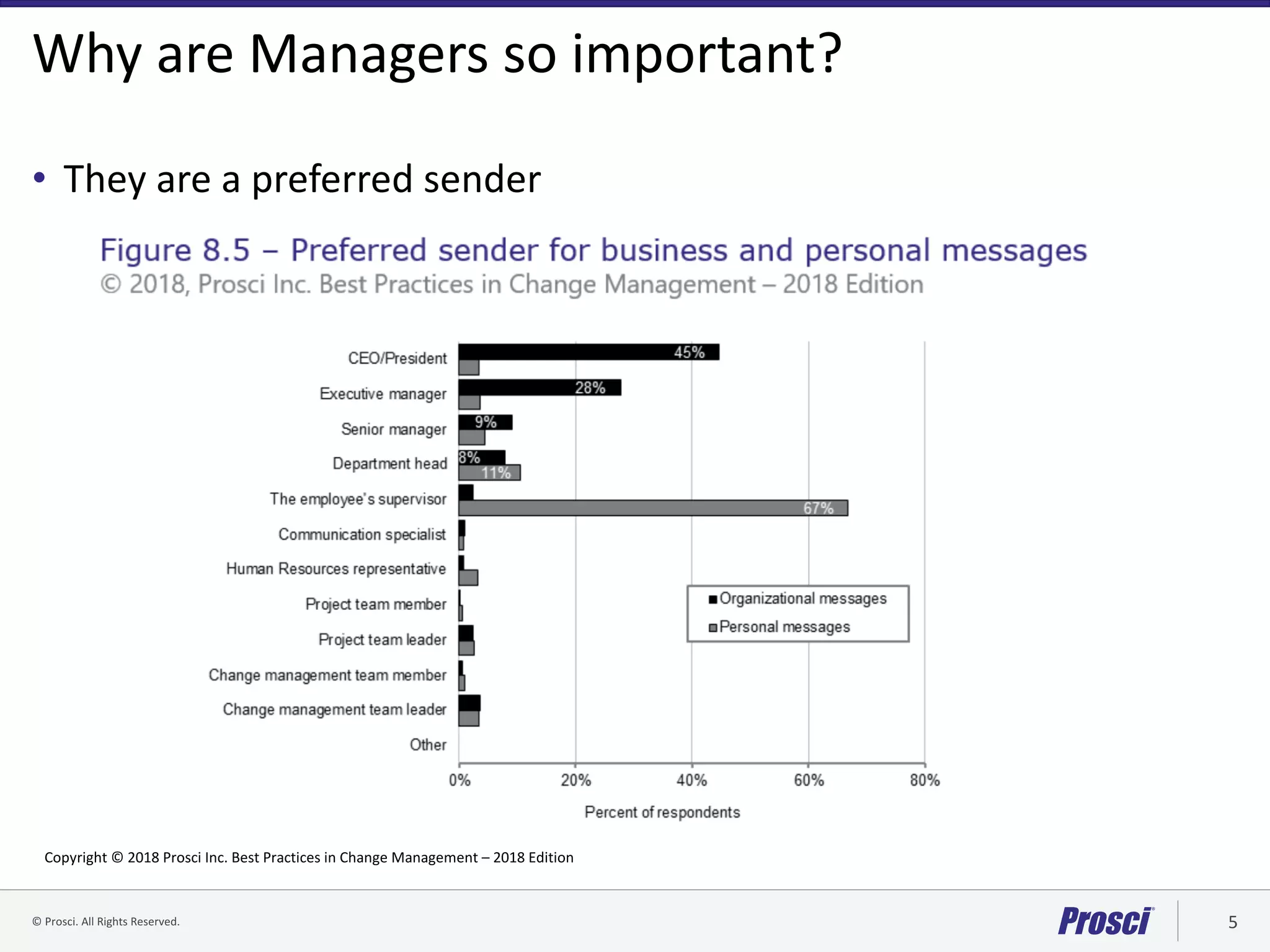
Why	are	Managers	so	important?
• They	are	a	preferred	sender
Copyright	©	2018	Prosci Inc.	Best	Practices	in	Change	Management	– 2018	Edition
©	Prosci.	All	Rights	Reserved. 6
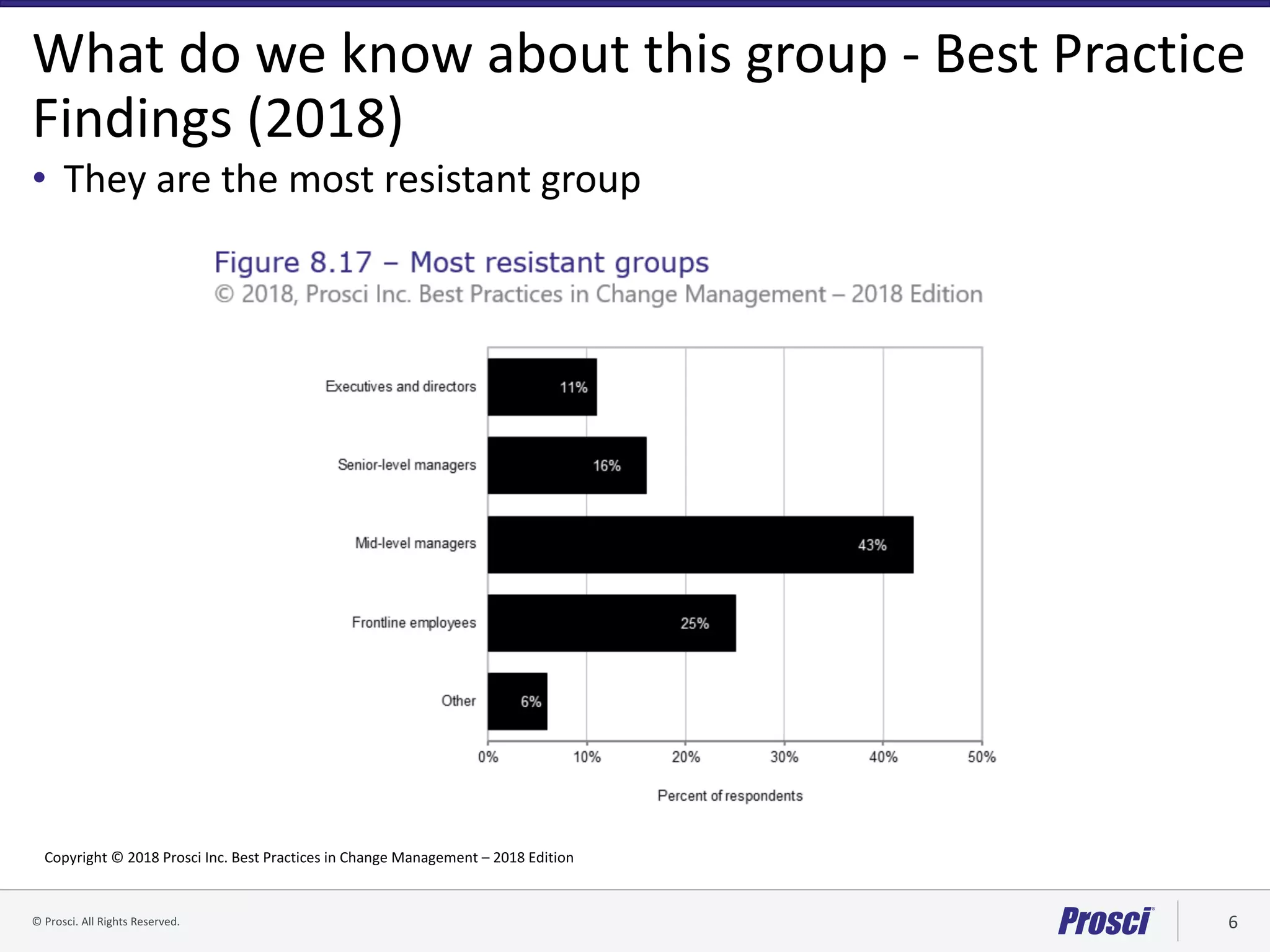
What	do	we	know	about	this	group	- Best	Practice	
Findings	(2018)
• They	are	the	most	resistant	group
Copyright	©	2018	Prosci Inc.	Best	Practices	in	Change	Management	– 2018	Edition
©	Prosci.	All	Rights	Reserved. 7
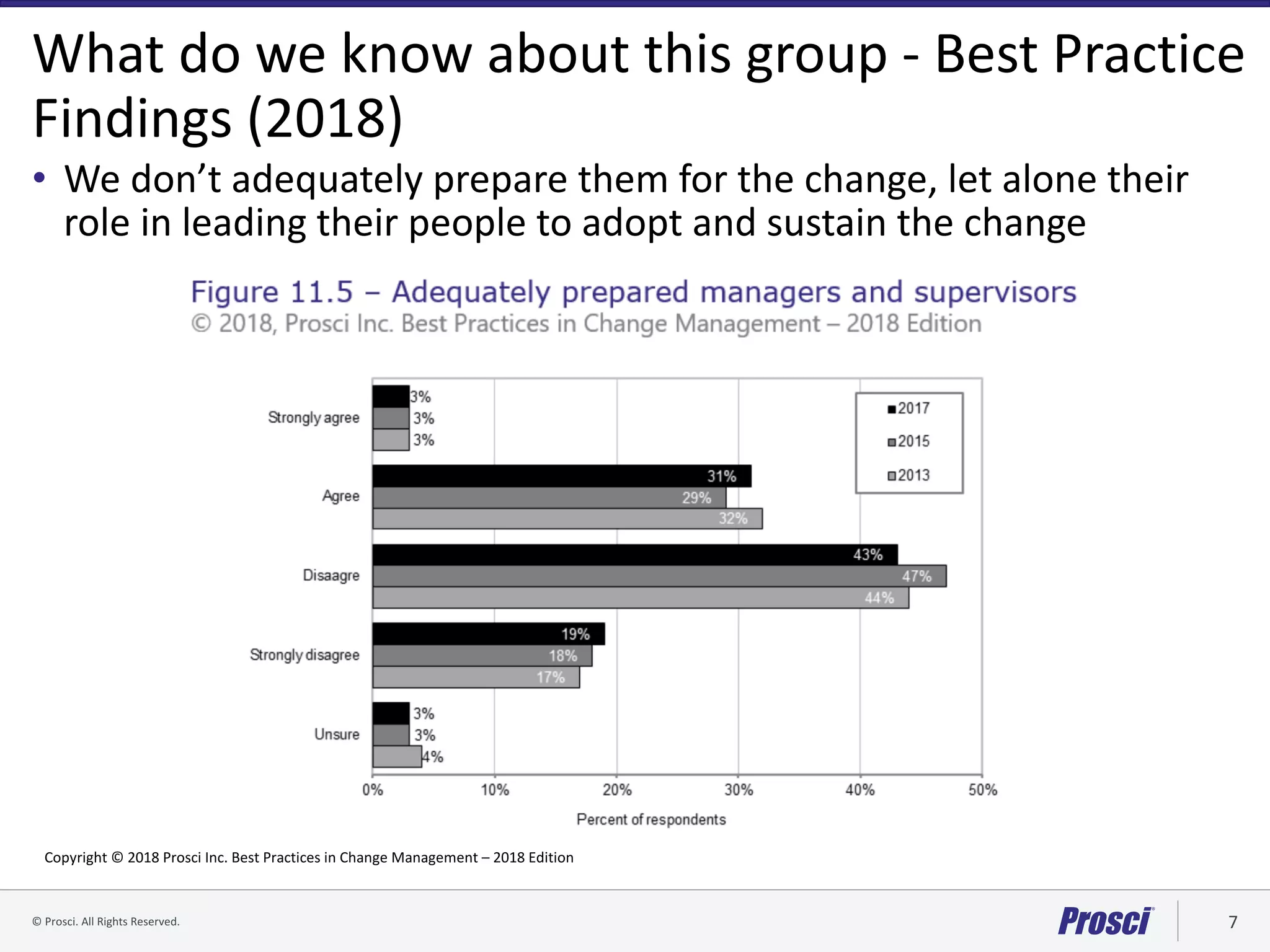
What	do	we	know	about	this	group	- Best	Practice	
Findings	(2018)
• We	don’t	adequately	prepare	them	for	the	change,	let	alone	their	
role	in	leading	their	people	to	adopt	and	sustain	the	change
Copyright	©	2018	Prosci Inc.	Best	Practices	in	Change	Management	– 2018	Edition
©	Prosci.	All	Rights	Reserved. 8
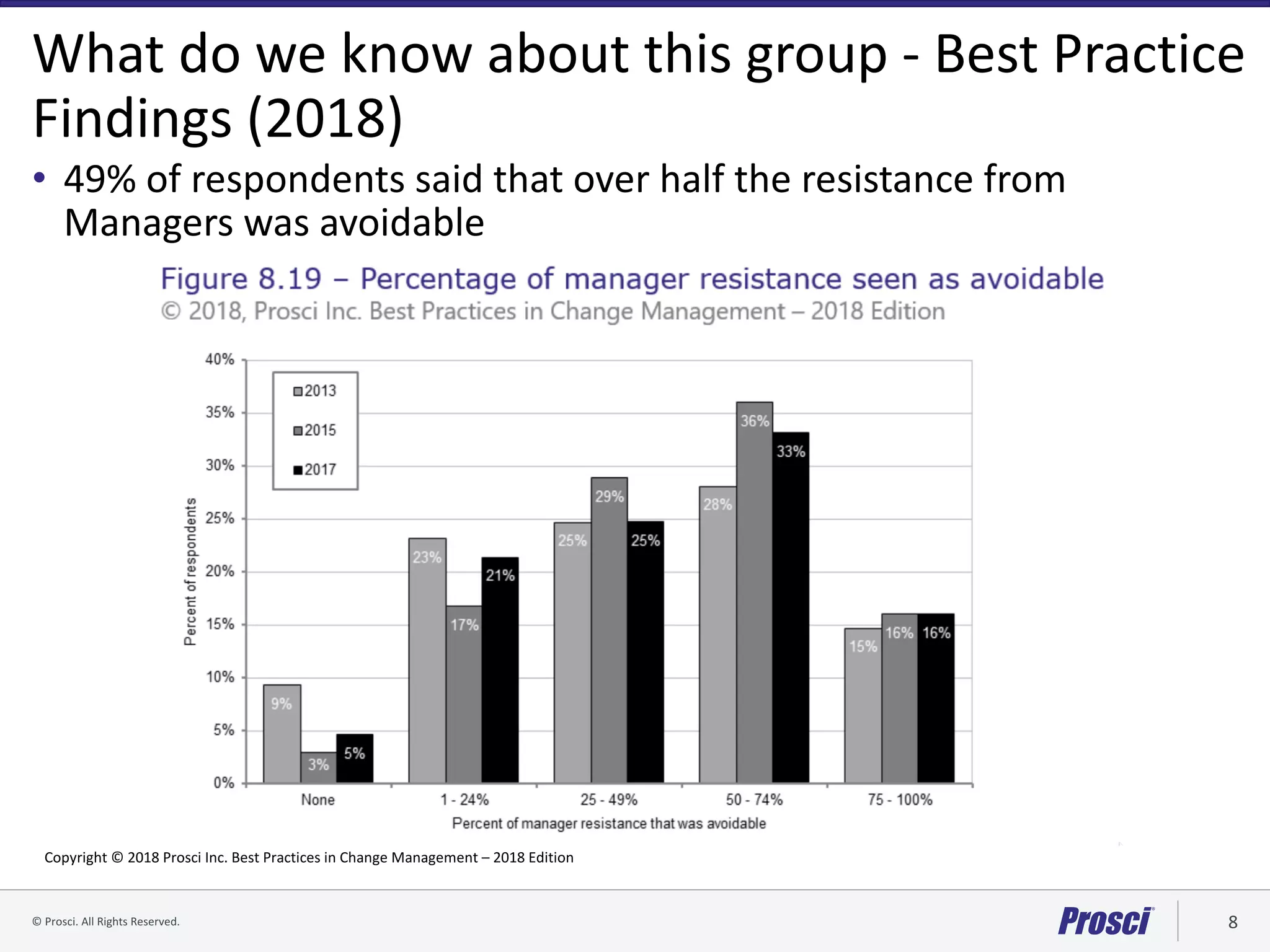
What	do	we	know	about	this	group	- Best	Practice	
Findings	(2018)
• 49%	of	respondents	said	that	over	half	the	resistance	from	
Managers	was	avoidable
Copyright	©	2018	Prosci Inc.	Best	Practices	in	Change	Management	– 2018	Edition
©	Prosci.	All	Rights	Reserved. 9
What	are	the	main	reasons	Managers	resist	
change?
• Organisational	culture
• Lack	of	awareness	and	knowledge	about	the	change
• Lack	of	buy-in
• Misalignment	of	project	goals	and	personal	incentives
• Lack	of	confidence	in	their	own	ability	to	manage	the	people	side	of	
change
©	Prosci.	All	Rights	Reserved. 10
What	is	in	it	for	the	Manager	to	engage	with	the	
change?
• Faster	adoption	by	their	team	which	means	
• Less	resistance	and	a	potentially	smoother	implementation	which	means	
less	coaching
• Building	change	muscle	– personally	and	for	their	team
• Achieve	purpose/outcomes	to	higher	degree
• Skills	that	are	transferable
• Time	back	to	spend	on	other	issues
• Increased	control	of	timelines,	training,	SMEs	and	resourcing
• Access	to	information	to	help	make	decisions	– personally	and	for	their	
team
• Channel	to	table	their	concerns,	alternative	implementation	paths,	head-
off	any	issues	
• Finally	‘get	it	done’	
• Increased	confidence
©	Prosci.	All	Rights	Reserved. 11
What	is	in	it	for	the	organisation to	engage	
Managers	early	and	well?
• Faster	adoption	by	team	which	means	less	rework
• Less	resistance	and	a	potentially	smoother	implementation	which	means	
space	for	BAU	and	other	initiatives
• Building	change	muscle	– across	a	vital	channel
• Achieve	purpose/outcomes	to	higher	degree
• Skills	‘baked	in’	to	the	organisation	and	which	increase	resilience	and	
flexibility
• Access	to	information	to	help	make	decisions	– project	teams,	Sponsors,	
vendors,	customers,	teams
• Channel	to	hear	and	understand	concerns,	alternative	implementation	
paths,	any	issues	to	make	informed	decisions	
• Finally	‘get	it	done’	
• Increased	confidence	in	the	organisation’s	ability	to	change	and	sustain	it
Top	5	Tips	for	Building	Engaged	Managers
©	Prosci.	All	Rights	Reserved. 13
Tip	1
It	is	worth	every	cent	and	every	minute	to	get	the	Managers	across	
the	change	as	an	individual,	first.	
• Start	early,	even	if	you	don’t	have	the	full	story	– they	get	that
• The	aim	is	to	include	them	and	keep	them	up	to	date	with	progress	
and	the	changes	that	will	impact	themselves,	first	so	they	can	make	
some	decisions
• Don’t	short-track	it	– it	may	take	time	to	listen	first!	
• This	is	critical	work	for	the	Primary	Sponsor	– coalition	building
• Tap	into	the	Manager’s/Managers’	drivers	– how	does	this	change	
help	or	hinder	those	drivers?
©	Prosci.	All	Rights	Reserved. 14
Tip	2
Be	clear	on	the	role	they	need	to	play	in	the	change	and	what	they	
will	have	to	help	them	do	it
• No	surprises
• Establish	clear	communication	channels	and	tools	and	use	them	
regularly	– make	it	easy
• Even	if	it	is	a	tough	change	be	crystal	clear	on	the	steps,	
conversations,	choices	and	decisions	they	need	to	make	and	what	
they	will	need	from	their	team
• Provide	a	map	of	the	tools,	supporting	documents,	resources	they	
will	have,	who	will	it	come	from,	how	can	they	access	it	(scripts,	
conversation	guides,	team	meeting	outlines,	scenarios)
• Keep	the	commitments	and	maintain	channels
• Sponsor	holds	them	accountable	and	visa	versa
©	Prosci.	All	Rights	Reserved. 15
Tip	3
This	is	Change	Gym	for	Managers	– help	build	muscle
• Provide	training	for	Managers	to	help	build	their	confidence	and	
personal		toolkit	
• Use	the	Manager	Competency	Assessment	(eToolkit)	as	part	of	
individual	development	plans
• Provide	coaching	JUST	for	them	from	a	safe	person	(external?	
Internal?	Their	own	skilled	leader?)
• Start	Coaching	Circles	– self-managed	to	share	skills	and	knowledge
• Provide	tools	and	resources	Managers	can	easily	access	and	apply
• ADKAR	is	an	excellent	and	adaptable	core	model	
• Add	it	to	KPIs,	Competency	Maps,	development	conversations,	
performance	conversations
• This	is	evidence	of	a	commitment	to	change-fitness	by	the	
organisation
©	Prosci.	All	Rights	Reserved. 16
Tip	4
Make	sure	Managers	know	what	they	can	and	can’t	offer	their	team
• They	know	their	team	and	their	potential	reactions	to	the	change
• Be	clear	on	the	boundaries	
• What	is	acceptable	and	what	is	not?	What	promises	can	they	make	
and	what	can	they	not?
• Keep	them	safe
©	Prosci.	All	Rights	Reserved. 17
Tip	5
Get	them	some	back-up!	Change	Champions	can	help
• Critically	important	that	managers	and	change	champions	have	role	clarity	
and	want	to	work	as	a	team	for	the	team!
• Three	benefits	for	Managers	working	together	with	Change	Champions
– Better	coverage	to	provide	specific	support	to	team	members	based	on	their	
needs	(am	I	more	comfortable	talking	to	my	manager	or	to	the	change	
champion	about	my	concerns?)
– A	=	support	each	other	with	different	communications	approaches	to	build	
awareness	within	the	team
– D	=	support	/	complement	each	other	to	communicate	WIIFM	messages	for	
the	team
– K	and	A	=	provide	different	approaches	to	on-the-job	support	during	the	
knowledge	and	ability	phase
– R	=	support	each	other	to	ensure	people	are	able	to	work	in	the	new	way	(but	
reward	and	recognition	is	the	role	of	the	manager)

Change Community of Practice Webinar: 'Engagement - Not just communication: Middle Management'