Cultural Mapping Bais City
Cultural Artistic Community and Private
Sector
Introduction
• Cultural mapping is not only a method for cataloguing the
cultural assets of a community it is also a tool useful for
community engagement and collaboration. For the purposes of
this chapter, cultural mapping is understood to be the process of
identifying and stating, in a written or visual inventory, all cultural
assets within a specific geographic area. This includes the
gathering of tangible and intangible assets from the community
including but not limited to cultural organizations, artists, and
stories. Cultural mapping provides an understanding of culture,
history, and a community’s unique identity that should be used at
the beginning of any community development or planning
project to create a list of potential partners, community
resources, and tools needed for successful implementation. Input
is sought from the community to guide the development of a
plan to create a map of community networks and assets.
What is Cultural Mapping?
• Cultural mapping allows individuals
to discover and identify multiple as
well as shared stories of their
community. The following are
definitions necessary for
understanding cultural mapping:
What is Cultural Mapping?
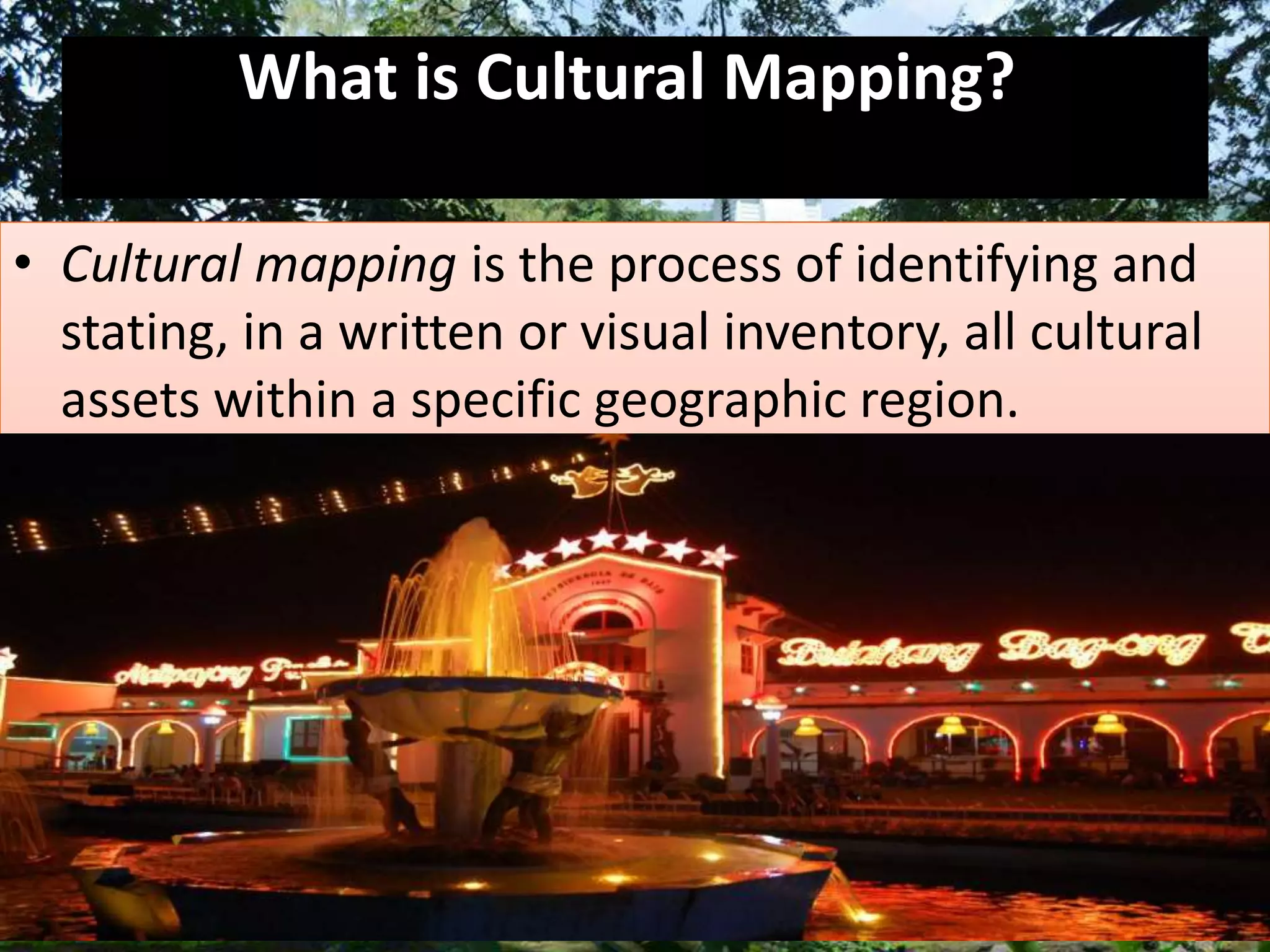
• Cultural mapping is the process of identifying and
stating, in a written or visual inventory, all cultural
assets within a specific geographic region.
Assets
• Assets are the facilities,
organizations, people, ideas,
customs, and relationships that
contribute to a way of life in a
specific place.
Culture
• Culture includes
the arts,
heritage, beliefs
and
environments
that make up our
individual
identities.
Community
• Community refer
s to a group of
people within a
specific
geographic
area, i.e. cities,
neighbourhoods,
states, or
regions.
Overview of the Cultural
Mapping Process
Step I: Planning
• Step I: Planning
• The cultural mapping process should begin with an internal capacity
and community networks assessment before opening the project to
the entire community. An internal audit is necessary to ensure that
all ideas, resources, and current partnerships are organized. This
serves as a good foundation for the community engagement work
that will follow.
•
• The establishment of goals, objectives, and parameters for
developing a cultural map is essential; however, it is critical to
include the entire community in doing so. Beginning the planning
process with a town hall meeting allows community members the
opportunity to be involved from the start. Asking for assistance in
this also enables the community to build a sense of ownership in
the project. This creates the opportunity for the cultural map to
strengthen community identity and sense of place.
Step II: Mapping Design
• Cultural maps can take multiple shapes. They can be,
for example, a written inventory, a searchable
database, a Geographic Information Systems (GIS)
map, or a hand-drawn map. The design chosen for the
cultural map not only depends upon the technology
and funding available, but also on the community
environment. Understanding how the community
would engage with the map is a necessary question to
ask during this step of the process. If the majority of
the community has a lack of online resources it would
not make sense to create a GIS map that only a few
could access. On the other hand, if a GIS map is an
important component for connecting across local and
regional barriers, it should not be neglected.
Step III: Community Support and
Insight
• This step includes ways to announce the project
to the community, getting them excited to
participate, and hosting focus groups and
meetings. Creating trust in and a sense of
transparency about the project are essential for a
fully inclusive cultural map. Encouraging
participation and support for this project can
come from announcing the cultural map as a way
to find the unique identity of the community or
to learn more about its under-recognized cultural
assets.
Step IV: Creating the Map
• Completing the cultural map takes great attention to detail
and a firm grasp of the parameters of the project. The map
design from Step II will guide the creation of the map.
Creating the actual map will involve a small group of
individuals, but must include regular check-ins with the
wider community. After asking for community support
during data collection, it is crucial to keep the community
involved throughout the implementation process. This way
both the tangible and intangible assets can be correctly
categorized and plotted. Transparency at this time also
serves to build trust between the organization leading the
mapping and the community, enhancing the likelihood of
broad support for whatever projects result from the
mapping.
Step V: Finalizing the Map
• After completing final edits based upon the community review, the
map is ready to be made public. This step should be designed to
gain enthusiastic participation by a wide range of community
members. Collaborators and, most importantly, the community as a
whole should be thanked for their help in creating the map. This
can be done as a launch party, as part of another community event,
or as a press conference. What is important is that the entire
community learns about and has access to the finished product.
During this final step the community should have the opportunity
to engage with the map and see how they helped shape it. This step
should not be the end of community engagement but should be the
door that opens up new partnerships and collaborations
throughout the community.
•
The use of cultural mapping falls into
three categories:
• Cultural Mapping to Inform Planning –
Identifying and mapping cultural assets
strengthens the base of information that can
be used to inform future planning and
decision-making in any municipality (e.g.
cultural planning and development, land use
planning, economic development and
tourism, among others).
• Cultural Mapping to
Increase Community
Awareness – Cultural
mapping helps build
consolidated databases of
assets that in turn can be
used to support marketing
and promotion of these
assets to both residents
and visitors/tourists.
• Cultural Mapping to Support Culture Sector
Development – The cultural sector in most
communities tends to be very disconnected in
the distinctions drawn between different
types of cultural activity (e.g., arts, heritage,
libraries, and cultural businesses). Building a
stronger base of information will strengthen
the networks and collaboration across a wide
range of cultural groups and activities.
Final Words
• Cultural mapping is a tool for building
community that can then be used for
advocacy and cultural planning, as well as
economic and community development. The
process of engaging citizens in the creation of
their unique cultural identity, by finding the
assets already existing in the community,
promotes community empowerment,
sustainability, diversity, and equality and
strengthens their sense of civic pride.
GAINING COMMUNITY SUPPORT FOR CULTURAL MAPPING IS TREMENDOUSLY
HELPFUL FOR COMPLETING A COMPREHENSIVE MAP. IT IS ALSO IMPORTANT TO
CONNECT WITH THE COMMUNITY TO BUILD TRUST FOR THE PEOPLE AND
ORGANIZATIONS CONDUCTING THE INTERVIEWS AND FOCUS GROUPS.
Community Support and Insight
Announcing the Project
• Letting the community know about the
project well in advance of the town hall
meetings can offer a chance to take advantage
of word of mouth advertising for it.
Excitement can grow from the opportunity to
share cultural experiences. There are a variety
of methods to get the word out:
•
Creating the Map
• This step of the cultural mapping process can be
the most creative and also the most time-
consuming. Actually building a map from the
information gathered requires sorting all of the
data into categories and double-checking with
the community to ensure that nothing was left
out. Depending on the type of map being created
it can be shared as a digital or paper product.
•
Finalizing the Map
• After completing any final edits based upon the
community review, it is time to go public with the map.
This step should be exciting and fun. Collaborators and,
most importantly, the entire community should be
thanked for their help in creating the map. This can be
done as a launch party, during a community event, or
as a press conference. What is important here is that
the whole community learns about the finished
product.
• During this event people should be informed where the
map can be found, what its use will be, how they can
continue to contribute to the map, and how much fun
it was creating it together.
Workshop Proper
Movable Heritage in Bais City
• Portrait of Baisanons . Josefa V. Perez
• Paintings Paintings
• Antique . Old Vinatage Pictures
Habal –Habal ride . Family Tree of old familiars
• Horse back riding .Pot pot
• Locomotive Bangon
• Baldwin Locomotive 1926
Heritage Baisanons
• Demetrio Larena –First Civil Governor of Negros
Oriental
• Meliton Larena- Board Member of Negros Oriental
during the American Regime
• Senator Jose M. Romero Sr.- Senator, Secretary of
Education , Ambassador to England .
• Senator Bindoy Teves Villanueva – Senator
,Secretary of Labor, Presidential Adviser for
labor relations
Heritage Baisanons
• Antonio Somoza Arnaiz –Philippine Pioneer
Pilot in Aviation History
• Dr. Vicente G. Sinco-Founder of Foundation
University ,delegate to the
Second Constitutional
Convention & UP President.
• Gov. Serafin Lajato Teves- Former Governor, past
Grand master of Masons in the
Philippines & Asia Pacific with
jurisdiction Okinawa,Guam, and
Japan
Heritage Baisanons
• Enrique Teves Villanueva- Founder of Bais Peace &
Order Council, Congressman & Governor
• Maria Somoza Arnaiz Diaz –first woman vice
governor of Negros Oriental
• Gov. Mariano Perdices –Governor & Hall of Fame
Boy Scout of the Philippines
• Genero B. Goni- The first charter city Mayor
• Eddie Sinco Romero- National Artist for Film
• Mamento Bocanegra- First Army General from Bais
Heritage Baisanons
• Manolet G. Teves-Society Historian, Civic
leader and Writer.
• Francisca Somoza Arnaiz Ponce de leon –Civic
leader & Cultural Worker
• Trinidad Teves Sagarbarria –Founder of the
Sans Rival Cake House
• Josefa Baena Teves Escano- Civic Leader ,Girls
Scout Official, Women &
Children Advocate
• Josefa Villanueva Perez - Historian and visual artist
• Juvenal Villanueva Somoza- Martyr & World War II
Hero
• Ambrosio B. Somoza –Political Hero ,Cabeza de
Barangay & Sugar Planter
• Diogenes Villanueva Baena –Historian, Politician,
Sugar Technologist
• Sergio Lopez Sinco- Revolution Hero of Bais
Heritage Baisanons
• Práxedes Daniel Teves Villanueva- Governor,
Mayor and Theatre Actor
• Alberto V. Furbeyre –Governor ,Vice Governor and
Board Member
• William Villanueva Villegas- Governor ,Vice
Governor and Hall of Fame
Boy Scout of the Philippines
• Guillermo Villanueva, Governor of Negros Oriental
BOT Vice Chair ,Silliman University
• Mellimore Saycon - former Board Member and
Broadcaster
Built Heritage
• San Nicolas de Tolentino Church
• Old Villanueva la Familia Cemetery Talungon
• UCCP Town Church
• Campana de Villanueva 1890
• Old Larena –Rubio la Familia Cemetery
Katacgahan built 1916
• Sugar Central: CENTRAL AZUCARERA DE BAIS
First Sugar Central in Asia 1918
Built Heritage
• Dulce Nombre de Maria Chapel in Talungon
• Presidencia de Bais
• Train rail system
• Steel Bridge
• Kawa
• Gabaldon Building First Educative Edifice
• Tribal Cemetery
Built Heritage
• Rizal Bronze Statue
• Veterans Marker
• Pantawan
• Mariana Mall Art deco
• La Planta Powerhouse Building
• Kiosk (1923)
• Montesol
• Alcazar Apartment
• Old Ruins of the old Hospital & Eye Peak
Built Heritage
• Old Ancestral House
Casa Rubio / Larena
Casa Lita
Casa Rotea
Casa Antonia
Gonzaga House
Judge Ybanez House
Casa Don Julian
Built Heritage
• Plantation Houses
• Manuel L. Teves Canlargo
• Serafin L. Teves Canlargo
• Villa Maria Buntod
• Nolan House
• CAB Staff House
• Julian Teves House
• Hacienda Valencia House
• URSUMCO 60th year old
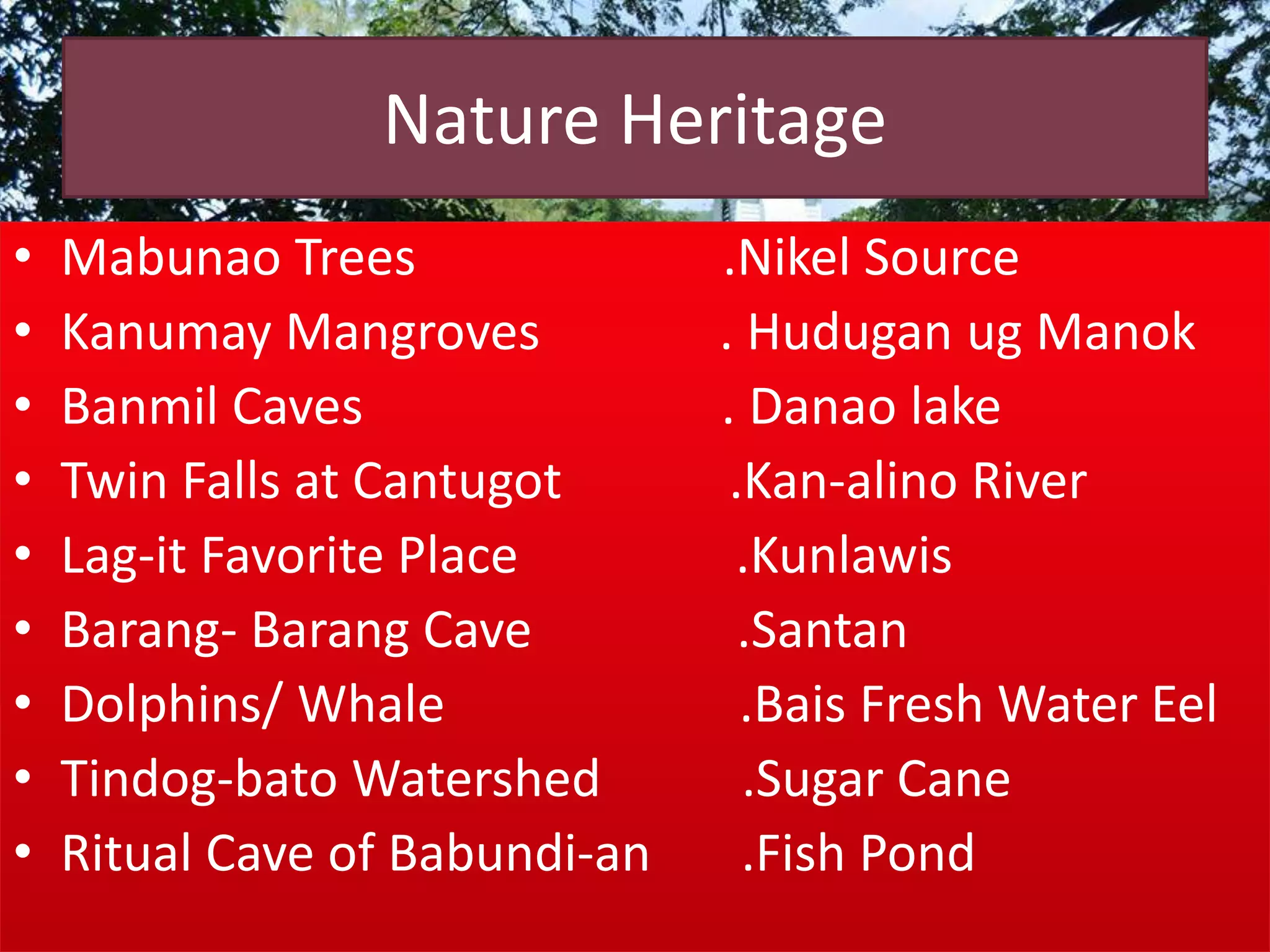
Nature Heritage
• Mabunao Trees .Nikel Source
• Kanumay Mangroves . Hudugan ug Manok
• Banmil Caves . Danao lake
• Twin Falls at Cantugot .Kan-alino River
• Lag-it Favorite Place .Kunlawis
• Barang- Barang Cave .Santan
• Dolphins/ Whale .Bais Fresh Water Eel
• Tindog-bato Watershed .Sugar Cane
• Ritual Cave of Babundi-an .Fish Pond
Intangible Heritage
• Tinalampad ( Dance of Ata) .
• Kinalasag ( Dance of Ata)
• Inagong ( Dance of Ata)
• Ginaray ( Dance of Ata)
• Inubay- ubay ( Dance of Ata)
• Sipong
• Pilising Dance
• Wake Rituals
• Tabo
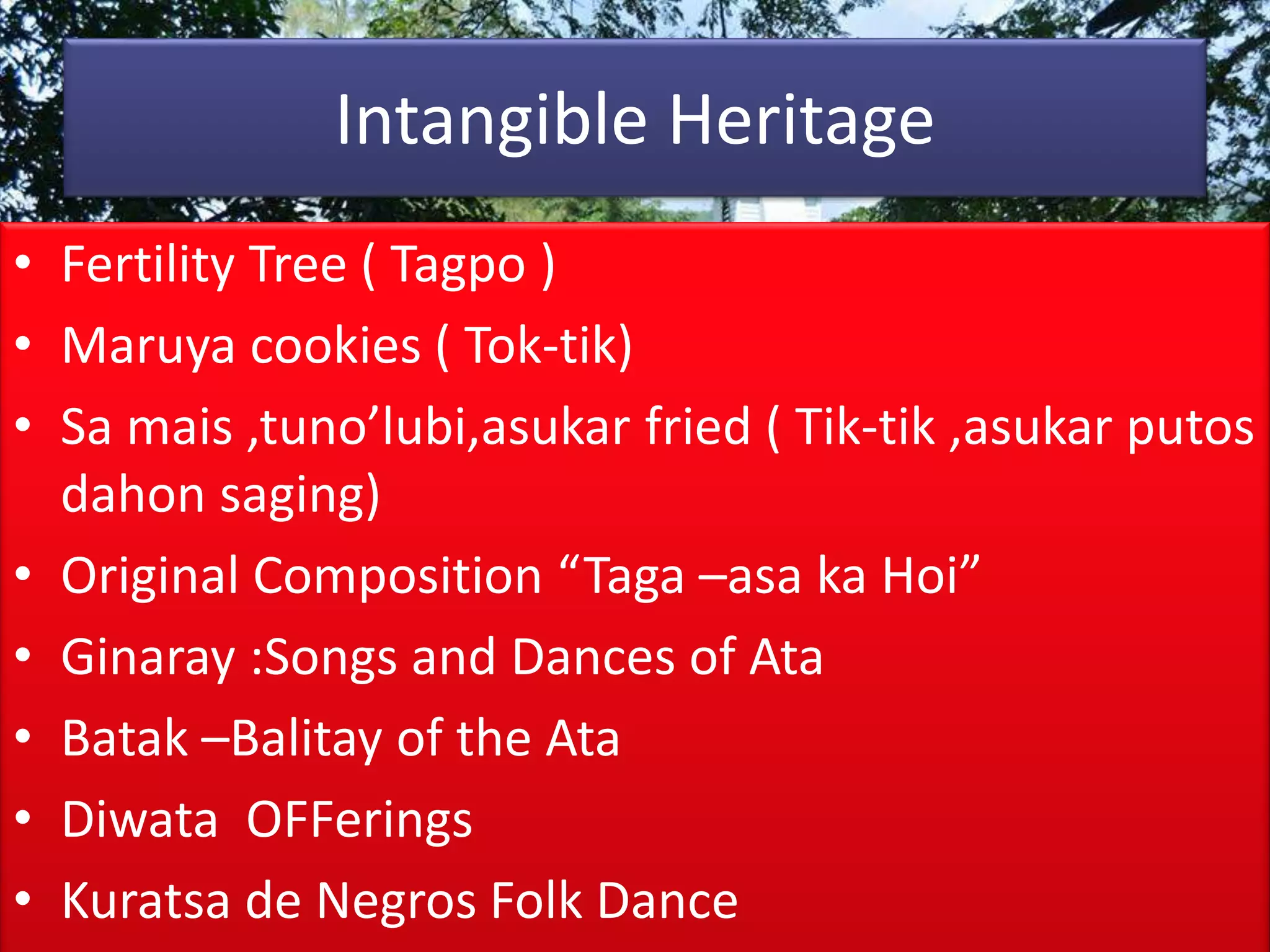
Intangible Heritage
• Fertility Tree ( Tagpo )
• Maruya cookies ( Tok-tik)
• Sa mais ,tuno’lubi,asukar fried ( Tik-tik ,asukar putos
dahon saging)
• Original Composition “Taga –asa ka Hoi”
• Ginaray :Songs and Dances of Ata
• Batak –Balitay of the Ata
• Diwata OFFerings
• Kuratsa de Negros Folk Dance
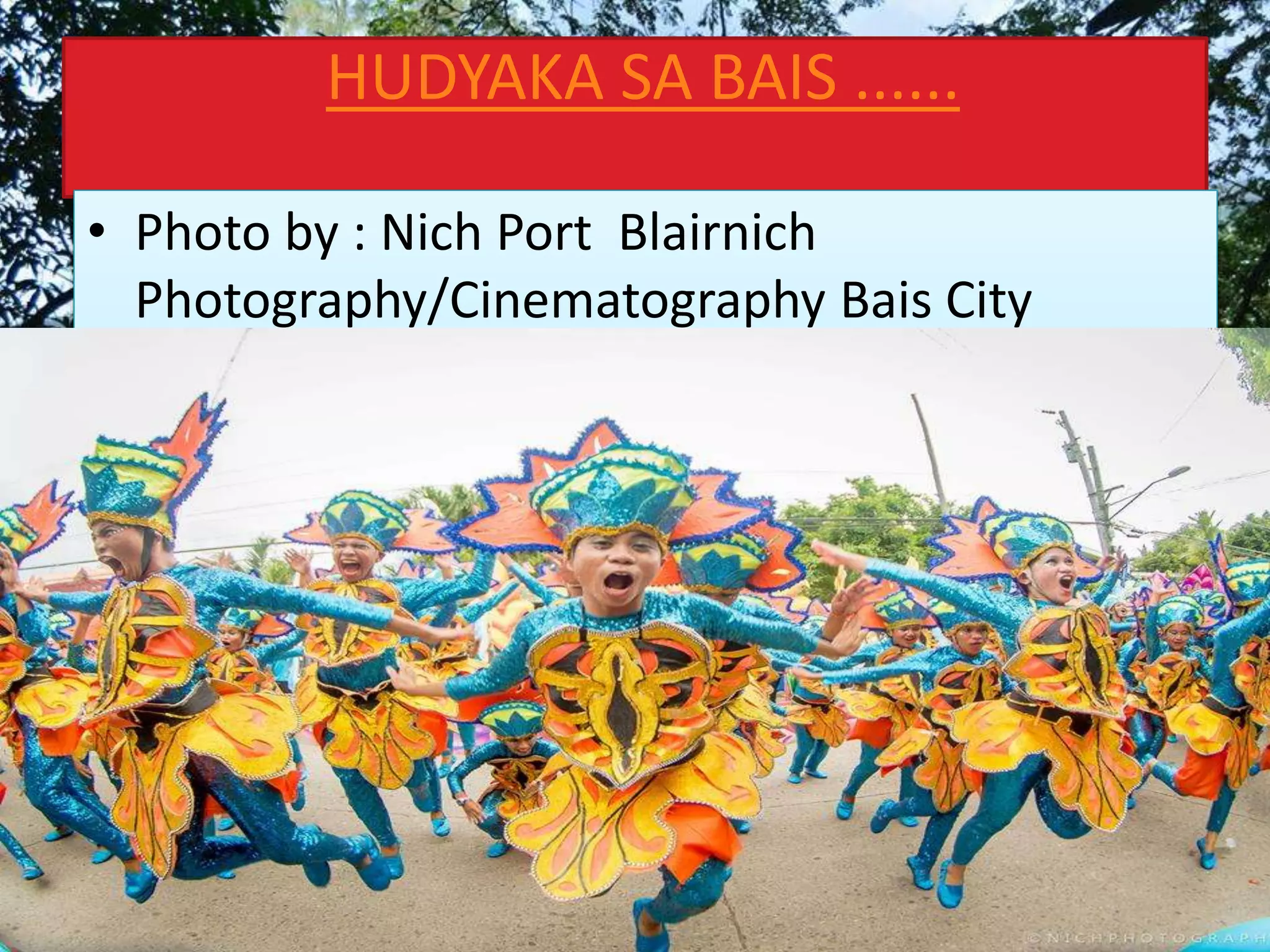
HUDYAKA SA BAIS ......
• Photo by : Nich Port Blairnich
Photography/Cinematography Bais City
Living Legacy of Baisanons
• Hector Romero Villanueva- Former Press
Secretary ,Post Master General and Writer
• Fr. Rudy Villanueva –Music Composer and
Father of Modern Cebuano Literature
• Josefino T. Larena Jr. –Family and Cultural
Historian, Civic Leader,Heritage
Advocate, Consumer Advocate
and Social Sciences Educator
• Empalz Violeta- Art Teacher, Visual Artist and
Humanities Teacher
• Francisco G. Villanueva- Sculpture
• Alex Baena- Natural History Historian and Science
Teacher
• Valene Montenegro- TV & Movie Actress
• Gretchen Nadine Teves Villanueva –Visual Artist
• Yul Gabriel Fausto Dionson - young Visual Artist
• Paula and Trina Celdran Montenegro–Visual Artists
• Jerry Miraflor-Fashion Designer
• Jeremias Navarro Perez–Music Teacher
• Jose V. Romero, Jr. Ph.D. who served as
Philippine Ambassador to
the Republic of Italy, his
mother Elisa Villanueva
Romero is from Bais.
• Frankie Ferrer -Former Original Balancing Act
• Mercedes Teves Goni- Dancer ,a former member
of the Bayanihan Folk Dance
Company
• Marissa Villanueva Yoldi – Owner Ana Maria
Bakershop
• Angela B. Vicente –Children Advocate and Theatre Arts
Old Familia
• Montenegro Clan Rubio Clan
• Teves Clan .Villacampa
Villamil .Somoza
• Villanueva Clan .Larena
* Pinili .Arnaiz
* Teves .Diaz
* Villamil .Pastrano
Bocanegra Clan Cabanang Clan
Laxina Clan de Guia Clan
Montesa Clan Pileo Clan
Old Familia
• Real Clan Baena Clan Bacang Clan
• Rotea Clan * Gomez
• Vicente Clan * Burgos
* Gomez * Gonzales
* Longa * Abilla
* Moras DiagoClan
* Ortiz Llera Clan
* Bouffard Adiong Clan
* Yoldi Ferrer Clan
Creative Industries /Occupations
• Sweet Boneless danggit
• Radio Natin
• Mazu Designs
• Jerry Miraflor Designs
• Bais Best Banana Chips
• Bais Best Okiot Spanish
Sardiness
• Marissa V.Yoldi Cakes
• Bagoong Guisado ni
Pichina Teves
• Siakoy/ butchi
• Paella ni Malca Villanueva
• Seafood & Talaba
• Bulad Danggit
• BCPS Rondalla
• Comparsa
• Lumay” Love Poison”
• Himag Oil
• Bais Visual Artists
• Halo- Halo / Peanuts
• Rhum Coke
• Callos recipe Antonia Garcia
• To preserve Heritage you need love your
hometown and embraces its culture, history
and values you learned from your ancestors
• Penn T. Larena
To God be our Glory

Cultural Mapping For Bais City

  • 1.
    Cultural Mapping BaisCity Cultural Artistic Community and Private Sector
  • 2.
    Introduction • Cultural mappingis not only a method for cataloguing the cultural assets of a community it is also a tool useful for community engagement and collaboration. For the purposes of this chapter, cultural mapping is understood to be the process of identifying and stating, in a written or visual inventory, all cultural assets within a specific geographic area. This includes the gathering of tangible and intangible assets from the community including but not limited to cultural organizations, artists, and stories. Cultural mapping provides an understanding of culture, history, and a community’s unique identity that should be used at the beginning of any community development or planning project to create a list of potential partners, community resources, and tools needed for successful implementation. Input is sought from the community to guide the development of a plan to create a map of community networks and assets.
  • 3.
    What is CulturalMapping? • Cultural mapping allows individuals to discover and identify multiple as well as shared stories of their community. The following are definitions necessary for understanding cultural mapping:
  • 4.
    What is CulturalMapping? • Cultural mapping is the process of identifying and stating, in a written or visual inventory, all cultural assets within a specific geographic region.
  • 5.
    Assets • Assets arethe facilities, organizations, people, ideas, customs, and relationships that contribute to a way of life in a specific place.
  • 6.
    Culture • Culture includes thearts, heritage, beliefs and environments that make up our individual identities.
  • 7.
    Community • Community refer sto a group of people within a specific geographic area, i.e. cities, neighbourhoods, states, or regions.
  • 8.
    Overview of theCultural Mapping Process
  • 9.
    Step I: Planning •Step I: Planning • The cultural mapping process should begin with an internal capacity and community networks assessment before opening the project to the entire community. An internal audit is necessary to ensure that all ideas, resources, and current partnerships are organized. This serves as a good foundation for the community engagement work that will follow. • • The establishment of goals, objectives, and parameters for developing a cultural map is essential; however, it is critical to include the entire community in doing so. Beginning the planning process with a town hall meeting allows community members the opportunity to be involved from the start. Asking for assistance in this also enables the community to build a sense of ownership in the project. This creates the opportunity for the cultural map to strengthen community identity and sense of place.
  • 10.
    Step II: MappingDesign • Cultural maps can take multiple shapes. They can be, for example, a written inventory, a searchable database, a Geographic Information Systems (GIS) map, or a hand-drawn map. The design chosen for the cultural map not only depends upon the technology and funding available, but also on the community environment. Understanding how the community would engage with the map is a necessary question to ask during this step of the process. If the majority of the community has a lack of online resources it would not make sense to create a GIS map that only a few could access. On the other hand, if a GIS map is an important component for connecting across local and regional barriers, it should not be neglected.
  • 11.
    Step III: CommunitySupport and Insight • This step includes ways to announce the project to the community, getting them excited to participate, and hosting focus groups and meetings. Creating trust in and a sense of transparency about the project are essential for a fully inclusive cultural map. Encouraging participation and support for this project can come from announcing the cultural map as a way to find the unique identity of the community or to learn more about its under-recognized cultural assets.
  • 12.
    Step IV: Creatingthe Map • Completing the cultural map takes great attention to detail and a firm grasp of the parameters of the project. The map design from Step II will guide the creation of the map. Creating the actual map will involve a small group of individuals, but must include regular check-ins with the wider community. After asking for community support during data collection, it is crucial to keep the community involved throughout the implementation process. This way both the tangible and intangible assets can be correctly categorized and plotted. Transparency at this time also serves to build trust between the organization leading the mapping and the community, enhancing the likelihood of broad support for whatever projects result from the mapping.
  • 13.
    Step V: Finalizingthe Map • After completing final edits based upon the community review, the map is ready to be made public. This step should be designed to gain enthusiastic participation by a wide range of community members. Collaborators and, most importantly, the community as a whole should be thanked for their help in creating the map. This can be done as a launch party, as part of another community event, or as a press conference. What is important is that the entire community learns about and has access to the finished product. During this final step the community should have the opportunity to engage with the map and see how they helped shape it. This step should not be the end of community engagement but should be the door that opens up new partnerships and collaborations throughout the community. •
  • 14.
    The use ofcultural mapping falls into three categories: • Cultural Mapping to Inform Planning – Identifying and mapping cultural assets strengthens the base of information that can be used to inform future planning and decision-making in any municipality (e.g. cultural planning and development, land use planning, economic development and tourism, among others).
  • 15.
    • Cultural Mappingto Increase Community Awareness – Cultural mapping helps build consolidated databases of assets that in turn can be used to support marketing and promotion of these assets to both residents and visitors/tourists.
  • 16.
    • Cultural Mappingto Support Culture Sector Development – The cultural sector in most communities tends to be very disconnected in the distinctions drawn between different types of cultural activity (e.g., arts, heritage, libraries, and cultural businesses). Building a stronger base of information will strengthen the networks and collaboration across a wide range of cultural groups and activities.
  • 17.
    Final Words • Culturalmapping is a tool for building community that can then be used for advocacy and cultural planning, as well as economic and community development. The process of engaging citizens in the creation of their unique cultural identity, by finding the assets already existing in the community, promotes community empowerment, sustainability, diversity, and equality and strengthens their sense of civic pride.
  • 18.
    GAINING COMMUNITY SUPPORTFOR CULTURAL MAPPING IS TREMENDOUSLY HELPFUL FOR COMPLETING A COMPREHENSIVE MAP. IT IS ALSO IMPORTANT TO CONNECT WITH THE COMMUNITY TO BUILD TRUST FOR THE PEOPLE AND ORGANIZATIONS CONDUCTING THE INTERVIEWS AND FOCUS GROUPS. Community Support and Insight
  • 19.
    Announcing the Project •Letting the community know about the project well in advance of the town hall meetings can offer a chance to take advantage of word of mouth advertising for it. Excitement can grow from the opportunity to share cultural experiences. There are a variety of methods to get the word out: •
  • 20.
    Creating the Map •This step of the cultural mapping process can be the most creative and also the most time- consuming. Actually building a map from the information gathered requires sorting all of the data into categories and double-checking with the community to ensure that nothing was left out. Depending on the type of map being created it can be shared as a digital or paper product. •
  • 21.
    Finalizing the Map •After completing any final edits based upon the community review, it is time to go public with the map. This step should be exciting and fun. Collaborators and, most importantly, the entire community should be thanked for their help in creating the map. This can be done as a launch party, during a community event, or as a press conference. What is important here is that the whole community learns about the finished product. • During this event people should be informed where the map can be found, what its use will be, how they can continue to contribute to the map, and how much fun it was creating it together.
  • 22.
  • 23.
    Movable Heritage inBais City • Portrait of Baisanons . Josefa V. Perez • Paintings Paintings • Antique . Old Vinatage Pictures Habal –Habal ride . Family Tree of old familiars • Horse back riding .Pot pot • Locomotive Bangon • Baldwin Locomotive 1926
  • 24.
    Heritage Baisanons • DemetrioLarena –First Civil Governor of Negros Oriental • Meliton Larena- Board Member of Negros Oriental during the American Regime • Senator Jose M. Romero Sr.- Senator, Secretary of Education , Ambassador to England . • Senator Bindoy Teves Villanueva – Senator ,Secretary of Labor, Presidential Adviser for labor relations
  • 25.
    Heritage Baisanons • AntonioSomoza Arnaiz –Philippine Pioneer Pilot in Aviation History • Dr. Vicente G. Sinco-Founder of Foundation University ,delegate to the Second Constitutional Convention & UP President. • Gov. Serafin Lajato Teves- Former Governor, past Grand master of Masons in the Philippines & Asia Pacific with jurisdiction Okinawa,Guam, and Japan
  • 26.
    Heritage Baisanons • EnriqueTeves Villanueva- Founder of Bais Peace & Order Council, Congressman & Governor • Maria Somoza Arnaiz Diaz –first woman vice governor of Negros Oriental • Gov. Mariano Perdices –Governor & Hall of Fame Boy Scout of the Philippines • Genero B. Goni- The first charter city Mayor • Eddie Sinco Romero- National Artist for Film • Mamento Bocanegra- First Army General from Bais
  • 27.
    Heritage Baisanons • ManoletG. Teves-Society Historian, Civic leader and Writer. • Francisca Somoza Arnaiz Ponce de leon –Civic leader & Cultural Worker • Trinidad Teves Sagarbarria –Founder of the Sans Rival Cake House • Josefa Baena Teves Escano- Civic Leader ,Girls Scout Official, Women & Children Advocate
  • 28.
    • Josefa VillanuevaPerez - Historian and visual artist • Juvenal Villanueva Somoza- Martyr & World War II Hero • Ambrosio B. Somoza –Political Hero ,Cabeza de Barangay & Sugar Planter • Diogenes Villanueva Baena –Historian, Politician, Sugar Technologist • Sergio Lopez Sinco- Revolution Hero of Bais
  • 29.
    Heritage Baisanons • PráxedesDaniel Teves Villanueva- Governor, Mayor and Theatre Actor • Alberto V. Furbeyre –Governor ,Vice Governor and Board Member • William Villanueva Villegas- Governor ,Vice Governor and Hall of Fame Boy Scout of the Philippines • Guillermo Villanueva, Governor of Negros Oriental BOT Vice Chair ,Silliman University • Mellimore Saycon - former Board Member and Broadcaster
  • 30.
    Built Heritage • SanNicolas de Tolentino Church • Old Villanueva la Familia Cemetery Talungon • UCCP Town Church • Campana de Villanueva 1890 • Old Larena –Rubio la Familia Cemetery Katacgahan built 1916 • Sugar Central: CENTRAL AZUCARERA DE BAIS First Sugar Central in Asia 1918
  • 31.
    Built Heritage • DulceNombre de Maria Chapel in Talungon • Presidencia de Bais • Train rail system • Steel Bridge • Kawa • Gabaldon Building First Educative Edifice • Tribal Cemetery
  • 32.
    Built Heritage • RizalBronze Statue • Veterans Marker • Pantawan • Mariana Mall Art deco • La Planta Powerhouse Building • Kiosk (1923) • Montesol • Alcazar Apartment • Old Ruins of the old Hospital & Eye Peak
  • 33.
    Built Heritage • OldAncestral House Casa Rubio / Larena Casa Lita Casa Rotea Casa Antonia Gonzaga House Judge Ybanez House Casa Don Julian
  • 34.
    Built Heritage • PlantationHouses • Manuel L. Teves Canlargo • Serafin L. Teves Canlargo • Villa Maria Buntod • Nolan House • CAB Staff House • Julian Teves House • Hacienda Valencia House • URSUMCO 60th year old
  • 35.
    Nature Heritage • MabunaoTrees .Nikel Source • Kanumay Mangroves . Hudugan ug Manok • Banmil Caves . Danao lake • Twin Falls at Cantugot .Kan-alino River • Lag-it Favorite Place .Kunlawis • Barang- Barang Cave .Santan • Dolphins/ Whale .Bais Fresh Water Eel • Tindog-bato Watershed .Sugar Cane • Ritual Cave of Babundi-an .Fish Pond
  • 36.
    Intangible Heritage • Tinalampad( Dance of Ata) . • Kinalasag ( Dance of Ata) • Inagong ( Dance of Ata) • Ginaray ( Dance of Ata) • Inubay- ubay ( Dance of Ata) • Sipong • Pilising Dance • Wake Rituals • Tabo
  • 37.
    Intangible Heritage • FertilityTree ( Tagpo ) • Maruya cookies ( Tok-tik) • Sa mais ,tuno’lubi,asukar fried ( Tik-tik ,asukar putos dahon saging) • Original Composition “Taga –asa ka Hoi” • Ginaray :Songs and Dances of Ata • Batak –Balitay of the Ata • Diwata OFFerings • Kuratsa de Negros Folk Dance
  • 38.
    HUDYAKA SA BAIS...... • Photo by : Nich Port Blairnich Photography/Cinematography Bais City
  • 39.
    Living Legacy ofBaisanons • Hector Romero Villanueva- Former Press Secretary ,Post Master General and Writer • Fr. Rudy Villanueva –Music Composer and Father of Modern Cebuano Literature • Josefino T. Larena Jr. –Family and Cultural Historian, Civic Leader,Heritage Advocate, Consumer Advocate and Social Sciences Educator • Empalz Violeta- Art Teacher, Visual Artist and Humanities Teacher
  • 40.
    • Francisco G.Villanueva- Sculpture • Alex Baena- Natural History Historian and Science Teacher • Valene Montenegro- TV & Movie Actress • Gretchen Nadine Teves Villanueva –Visual Artist • Yul Gabriel Fausto Dionson - young Visual Artist • Paula and Trina Celdran Montenegro–Visual Artists • Jerry Miraflor-Fashion Designer • Jeremias Navarro Perez–Music Teacher
  • 41.
    • Jose V.Romero, Jr. Ph.D. who served as Philippine Ambassador to the Republic of Italy, his mother Elisa Villanueva Romero is from Bais. • Frankie Ferrer -Former Original Balancing Act • Mercedes Teves Goni- Dancer ,a former member of the Bayanihan Folk Dance Company • Marissa Villanueva Yoldi – Owner Ana Maria Bakershop • Angela B. Vicente –Children Advocate and Theatre Arts
  • 42.
    Old Familia • MontenegroClan Rubio Clan • Teves Clan .Villacampa Villamil .Somoza • Villanueva Clan .Larena * Pinili .Arnaiz * Teves .Diaz * Villamil .Pastrano Bocanegra Clan Cabanang Clan Laxina Clan de Guia Clan Montesa Clan Pileo Clan
  • 43.
    Old Familia • RealClan Baena Clan Bacang Clan • Rotea Clan * Gomez • Vicente Clan * Burgos * Gomez * Gonzales * Longa * Abilla * Moras DiagoClan * Ortiz Llera Clan * Bouffard Adiong Clan * Yoldi Ferrer Clan
  • 44.
    Creative Industries /Occupations •Sweet Boneless danggit • Radio Natin • Mazu Designs • Jerry Miraflor Designs • Bais Best Banana Chips • Bais Best Okiot Spanish Sardiness • Marissa V.Yoldi Cakes • Bagoong Guisado ni Pichina Teves • Siakoy/ butchi • Paella ni Malca Villanueva • Seafood & Talaba • Bulad Danggit • BCPS Rondalla • Comparsa • Lumay” Love Poison” • Himag Oil • Bais Visual Artists • Halo- Halo / Peanuts • Rhum Coke • Callos recipe Antonia Garcia
  • 45.
    • To preserveHeritage you need love your hometown and embraces its culture, history and values you learned from your ancestors • Penn T. Larena
  • 46.
    To God beour Glory