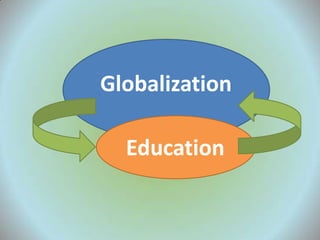
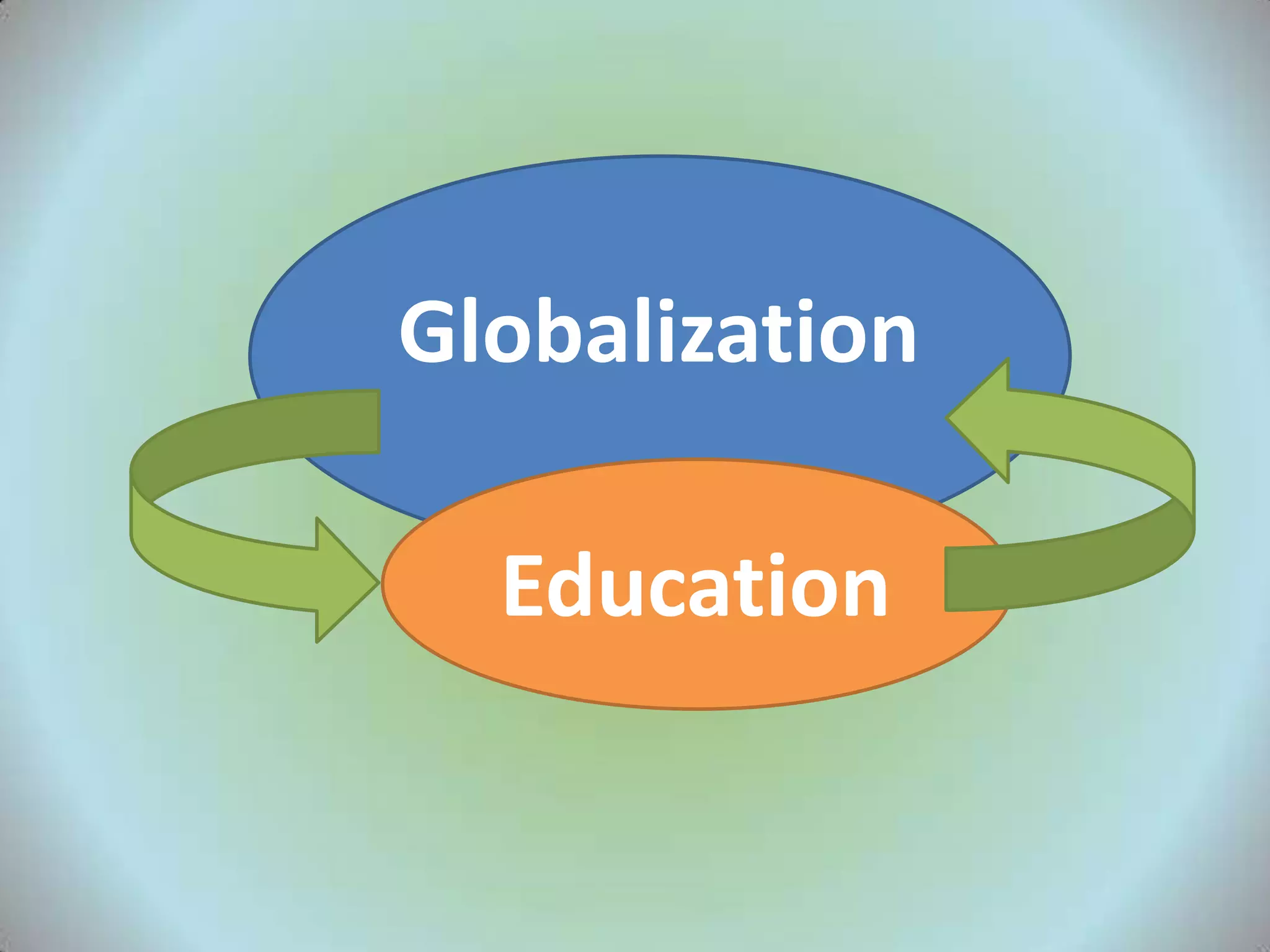
Globalization

  Education
A Challenge-Deeper Learning
• Deeper learning will prepare students to know, understand, apply material
  for critical thinking, collaboration, communication and will be self
  motivated. Deeper learning will develop competent graduates who will be
  ready for college and careers and be life long learners.
• This is ranked #1 as having the most influence on secondary students
  because PISA results measure 15 year old students knowledge and their
  ability to apply that knowledge in real-world situations.
• US trails in other developed countries in reading, math and science. In a
  global workforce, it is imperative that our students are able to compete in
  the job/labor market. (Education Digest, 2011)
• One of my previous students is now in his second year at UNB in a
  computer science program. Without the ability to think on his
  feet, collaborate, communicate and have a deep understanding of the
  subject areas taught in high school, he would not be successful in the
  course, nor at obtaining a job post graduation.
A trend-Preparing our students
   to become world citizens.
•   High schools are now multiethnic, multicultural and
    multilingual, according to an article in Educational
    Leadership (Stewart, Vivien 2007)
•   Being equipped with the knowledge of the many cultures
    will help students understand and respect their classmates
    from other cultures and in turn promote effective leaders.
•   This is ranked #2 because today’s graduates will sell and
    buy from the world, work for international companies with
    those from other cultures and countries. They will work
    collaboratively with people world wide. They ill be
    competing with people from all over the world for jobs and
    work to address global issues such as disease control and
    disaster relief.
Issue-Multliteratacy
• Multiliteracy is a broadening of the term literate. Because of technology
  the world is becoming smaller, with communication between cultures
  occurring more often and throughout various media. Students must be
  competent in using and understanding the various types of literacy as
  diverse as technology, multimedia, relationships, and culture.
• This multiliteracy is ranked 4th. The literacies needed for the 21st century
  learner will aide them in their understanding of the worlds increasing
  globalized societies. It will also aide students in effectively communicating
  and collaborating globally (Shoffner, M., DE Oliviera, L. C., & Angus, R.
  2010).
• Most secondary students in my high school classes are texting constantly.
  This texting is a form of literacy. It is not the traditional English language
  but has its own language. Students type lol, referring to “laugh out
  loud”, which, whether I like it or not, is a type of literacy. Universities and
  workforces use similar methods of communications and it is essential that
  students are able to communicate effectively in various methods.
Challenge-Multicultural Education
• Multicultural education refers to the fact that all students should
  have equal opportunity to learn, regardless of
  race, ethnicity, socioeconomics, or gender (Eunhyun, K. 2011).
• This is ranked #3 influencing secondary students because students
  need to better understand their own, as well as other cultures, to
  participate effectively within their own, others and the global
  economy. Facebooking, Twittering, texting is very important in
  education today.
• All of the students I teach are white Caucasian students. Some of
  these students are off to university in the fall, where they will sit in
  class alongside others from various ethnic
  backgrounds, race, socioeconomic status and gender. It is
  imperative that they are ready, willing and able to accept these
  students. It is through multicultural education that these areas are
  addressed.
Problem-Economy
• In order for teachers to provide rich, meaningful, lessons that
  include the multicultural, multiliterate ideas discussed
  previously, resources need to be abundant. There also needs to be
  time for teacher training. With more and more expectations on
  teaches and less and less funding educators are finding this to be a
  huge problem.
• This is ranked as #5 because I believe that if a teacher is creative
  enough, they will be able to get the lesson through. Without proper
  funding, it can occur, it is just going to much tougher, and not all
  students will have equal opportunity.
• Students in my high school are faced with this on a daily basis. We
  are a very small school and funding from our district is based on
  numbers. There are times students from the larger high school
  within the district are given more opportunities, more updated
  computers, more presenters and this is all based on funding.
References
• Eunhyun, K. (2011). Conceptions, critiques, and challenges in
  multicultural education: Informing teacher education reform in the
  U.S. KEDI Journal Of Educational Policy, 8(2), 201-218
• SHOFFNER, M., DE OLIVEIRA, L. C., & ANGUS, R. (2010).
  Multiliteracies in the secondary English classroom: Becoming
  literate in the 21st century. English Teaching: Practice &
  Critique, 9(3), 75-89
• Stewart, Vivien, (2007) Becoming Citizens of the World. Educational
  Leadership, 00131784, Apr2007, Vol. 64, Issue 7
• Education Digest (2011) A Time for Deeper Learning Preparing
  Students for a Changing World., 0013127X, Dec2011, Vol. 77, Issue
  4

Globalization and education

  • 1.
  • 2.
    A Challenge-Deeper Learning •Deeper learning will prepare students to know, understand, apply material for critical thinking, collaboration, communication and will be self motivated. Deeper learning will develop competent graduates who will be ready for college and careers and be life long learners. • This is ranked #1 as having the most influence on secondary students because PISA results measure 15 year old students knowledge and their ability to apply that knowledge in real-world situations. • US trails in other developed countries in reading, math and science. In a global workforce, it is imperative that our students are able to compete in the job/labor market. (Education Digest, 2011) • One of my previous students is now in his second year at UNB in a computer science program. Without the ability to think on his feet, collaborate, communicate and have a deep understanding of the subject areas taught in high school, he would not be successful in the course, nor at obtaining a job post graduation.
  • 3.
    A trend-Preparing ourstudents to become world citizens. • High schools are now multiethnic, multicultural and multilingual, according to an article in Educational Leadership (Stewart, Vivien 2007) • Being equipped with the knowledge of the many cultures will help students understand and respect their classmates from other cultures and in turn promote effective leaders. • This is ranked #2 because today’s graduates will sell and buy from the world, work for international companies with those from other cultures and countries. They will work collaboratively with people world wide. They ill be competing with people from all over the world for jobs and work to address global issues such as disease control and disaster relief.
  • 4.
    Issue-Multliteratacy • Multiliteracy isa broadening of the term literate. Because of technology the world is becoming smaller, with communication between cultures occurring more often and throughout various media. Students must be competent in using and understanding the various types of literacy as diverse as technology, multimedia, relationships, and culture. • This multiliteracy is ranked 4th. The literacies needed for the 21st century learner will aide them in their understanding of the worlds increasing globalized societies. It will also aide students in effectively communicating and collaborating globally (Shoffner, M., DE Oliviera, L. C., & Angus, R. 2010). • Most secondary students in my high school classes are texting constantly. This texting is a form of literacy. It is not the traditional English language but has its own language. Students type lol, referring to “laugh out loud”, which, whether I like it or not, is a type of literacy. Universities and workforces use similar methods of communications and it is essential that students are able to communicate effectively in various methods.
  • 5.
    Challenge-Multicultural Education • Multiculturaleducation refers to the fact that all students should have equal opportunity to learn, regardless of race, ethnicity, socioeconomics, or gender (Eunhyun, K. 2011). • This is ranked #3 influencing secondary students because students need to better understand their own, as well as other cultures, to participate effectively within their own, others and the global economy. Facebooking, Twittering, texting is very important in education today. • All of the students I teach are white Caucasian students. Some of these students are off to university in the fall, where they will sit in class alongside others from various ethnic backgrounds, race, socioeconomic status and gender. It is imperative that they are ready, willing and able to accept these students. It is through multicultural education that these areas are addressed.
  • 6.
    Problem-Economy • In orderfor teachers to provide rich, meaningful, lessons that include the multicultural, multiliterate ideas discussed previously, resources need to be abundant. There also needs to be time for teacher training. With more and more expectations on teaches and less and less funding educators are finding this to be a huge problem. • This is ranked as #5 because I believe that if a teacher is creative enough, they will be able to get the lesson through. Without proper funding, it can occur, it is just going to much tougher, and not all students will have equal opportunity. • Students in my high school are faced with this on a daily basis. We are a very small school and funding from our district is based on numbers. There are times students from the larger high school within the district are given more opportunities, more updated computers, more presenters and this is all based on funding.
  • 7.
    References • Eunhyun, K.(2011). Conceptions, critiques, and challenges in multicultural education: Informing teacher education reform in the U.S. KEDI Journal Of Educational Policy, 8(2), 201-218 • SHOFFNER, M., DE OLIVEIRA, L. C., & ANGUS, R. (2010). Multiliteracies in the secondary English classroom: Becoming literate in the 21st century. English Teaching: Practice & Critique, 9(3), 75-89 • Stewart, Vivien, (2007) Becoming Citizens of the World. Educational Leadership, 00131784, Apr2007, Vol. 64, Issue 7 • Education Digest (2011) A Time for Deeper Learning Preparing Students for a Changing World., 0013127X, Dec2011, Vol. 77, Issue 4

Editor's Notes

  • #3 A Time for Deeper Learning Preparing Students for a Changing World. Education Digest, 0013127X, Dec2011, Vol. 77, Issue 4
  • #4 Becoming Citizens of the World. By: Stewart, Vivien, Educational Leadership, 00131784, Apr2007, Vol. 64, Issue 7
  • #5 SHOFFNER, M., DE OLIVEIRA, L. C., & ANGUS, R. (2010). Multiliteracies in the secondary English classroom: Becoming literate in the 21st century. English Teaching: Practice & Critique, 9(3), 75-89
  • #6 Eunhyun, K. (2011). Conceptions, critiques, and challenges in multicultural education: Informing teacher education reform in the U.S. KEDI Journal Of Educational Policy, 8(2), 201-218