Word Problems on
Sets
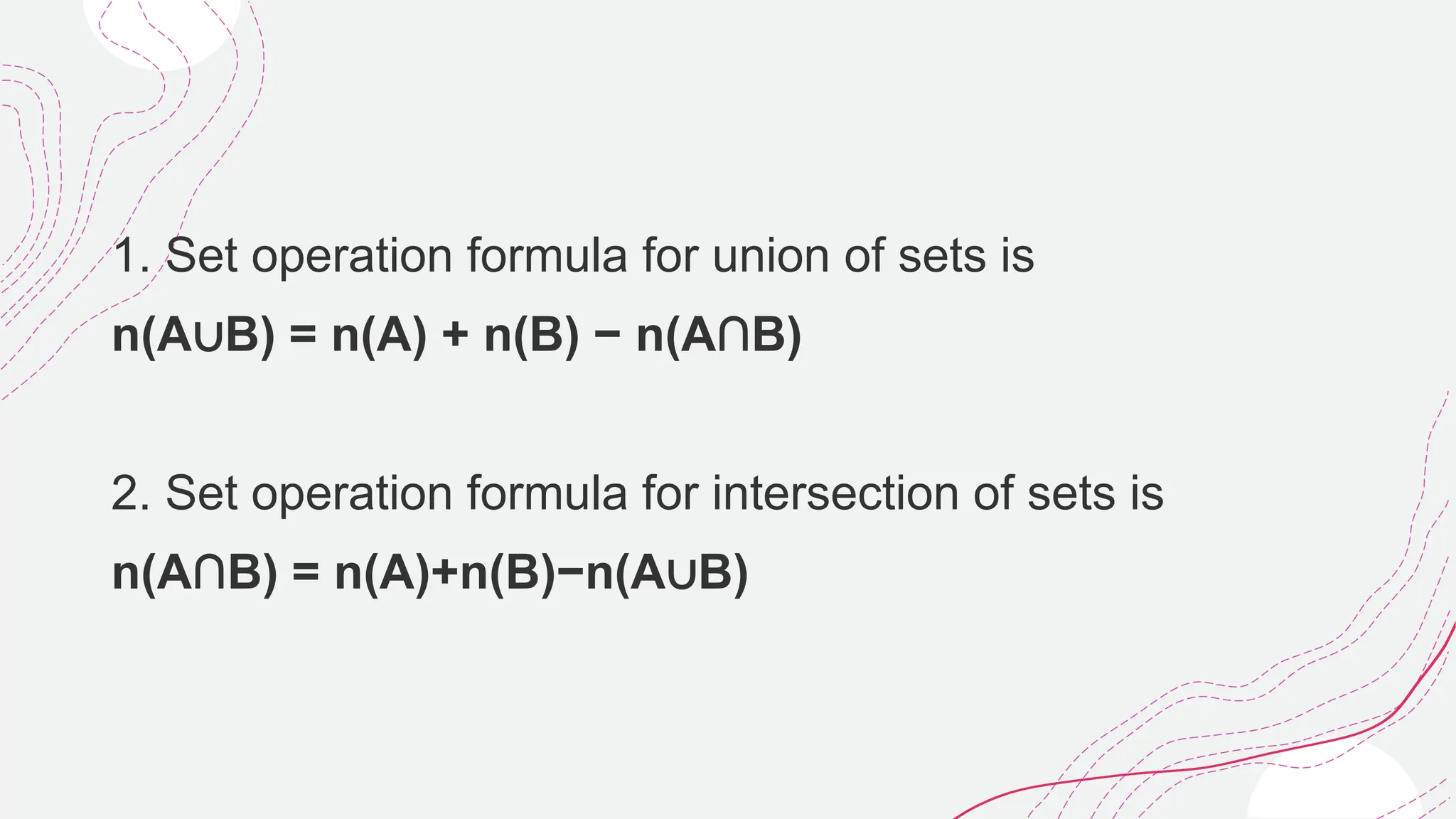
1. Set operation formula for union of sets is
n(A∪B) = n(A) + n(B) − n(A∩B)
2. Set operation formula for intersection of sets is
n(A∩B) = n(A)+n(B)−n(A∪B)
1. Let A and B be two finite sets such that n(A) =
20, n(B) = 28 and n(A ∪ B) = 36, find n(A ∩ B).
1. Let A and B be two finite sets such that n(A) =
20, n(B) = 28 and n(A ∪ B) = 36, find n(A ∩ B).
Solution:
Using the formula n(A ∪ B) = n(A) + n(B) - n(A ∩ B).
then n(A ∩ B) = n(A) + n(B) - n(A ∪ B)
= 20 + 28 - 36
= 48 - 36
= 12
2. If n(A - B) = 18, n(A ∪ B) = 70 and
n(A ∩ B) = 25, then find n(B).
2. If n(A - B) = 18, n(A ∪ B) = 70 and
n(A ∩ B) = 25, then find n(B).
Using the formula n(A∪B) = n(A - B) + n(A ∩ B) + n(B - A)
70 = 18 + 25 + n(B - A)
70 = 43 + n(B - A)
n(B - A) = 70 - 43
n(B - A) = 27
Now n(B) = n(A ∩ B) + n(B - A)
= 25 + 27
= 52
3. In a group of 60 people, 27 like cold drinks and 42
like hot drinks and each person likes at least one of the
two drinks. How many like both coffee and tea?
3. In a group of 60 people, 27 like cold drinks and 42
like hot drinks and each person likes at least one of the
two drinks. How many like both coffee and tea?
Let A = Set of people who like cold drinks.
B = Set of people who like hot drinks.
Given
(A ∪ B) = 60 n(A) = 27 n(B) = 42 then;
n(A ∩ B) = n(A) + n(B) - n(A ∪ B)
= 27 + 42 - 60
= 69 - 60 = 9
= 9
Therefore, 9 people like both tea and coffee.
4. There are 35 students in art class and 57 students in dance class. Find the
number of students who are either in art class or in dance class.
• When two classes meet at different hours and 12 students are enrolled in both
activities.
• When two classes meet at the same hour.
+ Solution:
n(A) = 35, n(B) = 57, n(A ∩ B) = 12
(Let A be the set of students in art class.
B be the set of students in dance class.)
(i) When 2 classes meet at different hours n(A ∪ B) = n(A) + n(B) - n(A ∩ B)
= 35 + 57 - 12
= 92 - 12
= 80
(ii) When two classes meet at the same hour, A∩B = ∅ n (A ∪ B) = n(A) + n(B) - n(A ∩
B)
= n(A) + n(B)
= 35 + 57
= 92
5. In a group of 100 persons, 72 people
can speak English and 43 can speak
French. How many can speak English
only? How many can speak French only
and how many can speak both English
and French?
Solution:
Let A be the set of people who speak English.
B be the set of people who speak French.
A - B be the set of people who speak English and not French.
B - A be the set of people who speak French and not English.
A ∩ B be the set of people who speak both French and English.
Given,
n(A) = 72 n(B) = 43 n(A ∪ B) = 100
Now, n(A ∩ B) = n(A) + n(B) - n(A ∪ B)
= 72 + 43 - 100
= 115 - 100
= 15
Number of people speaking French only = 28
Therefore, Number of persons who speak both French and English = 15
n(A) = n(A - B) + n(A ∩ B)
⇒ n(A - B) = n(A) - n(A ∩ B)
= 72 - 15
= 57
and n(B - A) = n(B) - n(A ∩ B)
= 43 - 15
= 28
Therefore, Number of people speaking English only = 57

Word Problems on Sets M

  • 1.
  • 2.
    1. Set operationformula for union of sets is n(A∪B) = n(A) + n(B) − n(A∩B) 2. Set operation formula for intersection of sets is n(A∩B) = n(A)+n(B)−n(A∪B)
  • 3.
    1. Let Aand B be two finite sets such that n(A) = 20, n(B) = 28 and n(A ∪ B) = 36, find n(A ∩ B).
  • 4.
    1. Let Aand B be two finite sets such that n(A) = 20, n(B) = 28 and n(A ∪ B) = 36, find n(A ∩ B). Solution: Using the formula n(A ∪ B) = n(A) + n(B) - n(A ∩ B). then n(A ∩ B) = n(A) + n(B) - n(A ∪ B) = 20 + 28 - 36 = 48 - 36 = 12
  • 5.
    2. If n(A- B) = 18, n(A ∪ B) = 70 and n(A ∩ B) = 25, then find n(B).
  • 6.
    2. If n(A- B) = 18, n(A ∪ B) = 70 and n(A ∩ B) = 25, then find n(B). Using the formula n(A∪B) = n(A - B) + n(A ∩ B) + n(B - A) 70 = 18 + 25 + n(B - A) 70 = 43 + n(B - A) n(B - A) = 70 - 43 n(B - A) = 27 Now n(B) = n(A ∩ B) + n(B - A) = 25 + 27 = 52
  • 7.
    3. In agroup of 60 people, 27 like cold drinks and 42 like hot drinks and each person likes at least one of the two drinks. How many like both coffee and tea?
  • 8.
    3. In agroup of 60 people, 27 like cold drinks and 42 like hot drinks and each person likes at least one of the two drinks. How many like both coffee and tea? Let A = Set of people who like cold drinks. B = Set of people who like hot drinks. Given (A ∪ B) = 60 n(A) = 27 n(B) = 42 then; n(A ∩ B) = n(A) + n(B) - n(A ∪ B) = 27 + 42 - 60 = 69 - 60 = 9 = 9 Therefore, 9 people like both tea and coffee.
  • 9.
    4. There are35 students in art class and 57 students in dance class. Find the number of students who are either in art class or in dance class. • When two classes meet at different hours and 12 students are enrolled in both activities. • When two classes meet at the same hour.
  • 10.
    + Solution: n(A) =35, n(B) = 57, n(A ∩ B) = 12 (Let A be the set of students in art class. B be the set of students in dance class.) (i) When 2 classes meet at different hours n(A ∪ B) = n(A) + n(B) - n(A ∩ B) = 35 + 57 - 12 = 92 - 12 = 80 (ii) When two classes meet at the same hour, A∩B = ∅ n (A ∪ B) = n(A) + n(B) - n(A ∩ B) = n(A) + n(B) = 35 + 57 = 92
  • 11.
    5. In agroup of 100 persons, 72 people can speak English and 43 can speak French. How many can speak English only? How many can speak French only and how many can speak both English and French?
  • 12.
    Solution: Let A bethe set of people who speak English. B be the set of people who speak French. A - B be the set of people who speak English and not French. B - A be the set of people who speak French and not English. A ∩ B be the set of people who speak both French and English. Given, n(A) = 72 n(B) = 43 n(A ∪ B) = 100 Now, n(A ∩ B) = n(A) + n(B) - n(A ∪ B) = 72 + 43 - 100 = 115 - 100 = 15 Number of people speaking French only = 28
  • 13.
    Therefore, Number ofpersons who speak both French and English = 15 n(A) = n(A - B) + n(A ∩ B) ⇒ n(A - B) = n(A) - n(A ∩ B) = 72 - 15 = 57 and n(B - A) = n(B) - n(A ∩ B) = 43 - 15 = 28 Therefore, Number of people speaking English only = 57