A Seminar on
Inventory Management
By
Salunkhe Nikhil Jayvant
Under the guidance of
Dr. S. G. Sudke
Inventory Management
Contents
 Introduction
 Types of inventories
 Purpose of inventories
 Importance of inventories
 Benefits of inventory Management
 Factors affecting Inventory Management
 Techniques of Inventory Control
 Conclusion
Introduction
 Inventory can be referred to as sum of the value of
 Raw materials (RM),
 Fuels and lubricants,
 Equipments & Spare parts,
 Maintenance, repair & operating supplies (MRO)
 WIP: work in progress (Semi- finished products)
 Finished goods stock (FG)
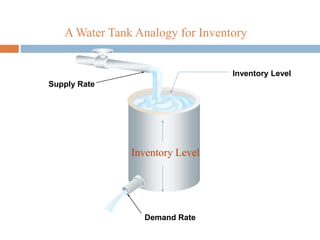
A Water Tank Analogy for Inventory
15-4
Supply Rate
Inventory Level
Demand Rate
Inventory Level
Inventory Basics
 Inventory is created when the receipt of materials, parts, or
finished goods exceeds their disbursement.
 Inventory is depleted when their disbursement exceeds their
receipt.
 An inventory manager’s job is to balance the advantages and
disadvantages of both low and high inventories.
Types of Inventory
 Raw materials Inventory- This consists of basic materials that have not
yet been committed to production in a manufacturing firm.
 Stores and Spares- Examples of stores and spares items are bolts, nuts,
clamps, screws etc.
 Work-in-Process Inventory- materials that have been committed to the
production process but have not been completed.
 Finished Goods Inventory- These are completed products awaiting sale.
Purpose of holding Inventory
 Avoid Lost of Sales
 Gain Quantity Discounts
 Improve customer service
 Transportation savings
 Unplanned shocks (labor strikes, natural disasters, etc.)
Characteristics / Importance
 Inventories serves as cushions to absorb shocks.
 Inventory for any organization is necessary evil.
 Inventories are result of many interrelated decisions and
policies of an organization.
 Inventory provides production economy.
Inventory Management
Inventory management
 Inventory management is the planning and controlling of inventories in
order to meet the competitive priorities of the organization.
 Effective inventory management is essential for realizing the full
potential of any value chain.
 Inventory management requires information about expected demands,
amounts on hand and amounts on order for every item stocked at all
locations.
 The appropriate timing and size of the reorder quantities must also be
determined.
Effective Inventory management
The goal of effective inventory management is to minimize the
total costs - direct and indirect - that are associated with
holding inventories.
Effective Inventory Management enables an
organization to meet or exceed customers'
expectations of product availability while
maximizing net profits or minimizing costs.
Benefits of Inventory Management
 Reduces inventory & purchasing cost
 Gain visibility into inventory process
 Improve customer service
 Reduce time to market
Factors affecting Inventory
The number of factors can be divided in the following categories.
 Characteristic of Manufacturing System- The nature of production
process, production planning, plant layout have an effect on inventory
policy.
 Amount of Protection against shortages- Due to fluctuation in
demand of the product
 Organizational factors- Amount of capital available for stock , Storage
and warehousing policies.
 Other factors-Strike situations,Wars, or some other natural calamities
like floods, earthquakes, etc.
Inventory Control
 Inventory control is a planned systematic method to determine
 The inventory to be indented,
 Its quantity to be indented and stocked,
 To keep the purchasing and storing costs to the minimum
possible.
OBJECTIVES OF INVENTORY CONTROL
 Maintenance of adequate inventory
 To avoid production held up/ stock out condition.
 To avoid customer dissatisfaction
 Reduce increase in cost for emergency purchase
 Avoid excessive Investment in Inventory
 To reduce carrying cost
 To avoid tying up of productive capital
 Reduce inventory decisions for management
Techniques of Inventory Control
 ABC analysis
 VED analysis
 HML analysis
 FSN analysis
ABC Analysis
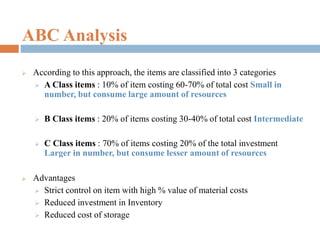
 According to this approach, the items are classified into 3 categories
 A Class items : 10% of item costing 60-70% of total cost Small in
number, but consume large amount of resources
 B Class items : 20% of items costing 30-40% of total cost Intermediate
 C Class items : 70% of items costing 20% of the total investment
Larger in number, but consume lesser amount of resources
 Advantages
 Strict control on item with high % value of material costs
 Reduced investment in Inventory
 Reduced cost of storage
VED Analysis
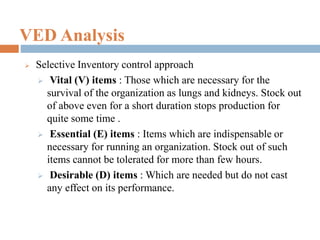
 Selective Inventory control approach
 Vital (V) items : Those which are necessary for the
survival of the organization as lungs and kidneys. Stock out
of above even for a short duration stops production for
quite some time .
 Essential (E) items : Items which are indispensable or
necessary for running an organization. Stock out of such
items cannot be tolerated for more than few hours.
 Desirable (D) items : Which are needed but do not cast
any effect on its performance.
HMLAnalysis
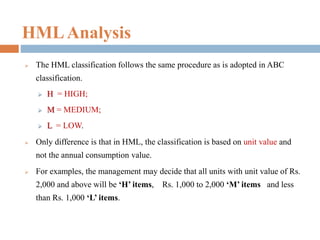
 The HML classification follows the same procedure as is adopted in ABC
classification.
 H = HIGH;
 M = MEDIUM;
 L = LOW.
 Only difference is that in HML, the classification is based on unit value and
not the annual consumption value.
 For examples, the management may decide that all units with unit value of Rs.
2,000 and above will be ‘H’ items, Rs. 1,000 to 2,000 ‘M’ items and less
than Rs. 1,000 ‘L’ items.
FSN Analysis
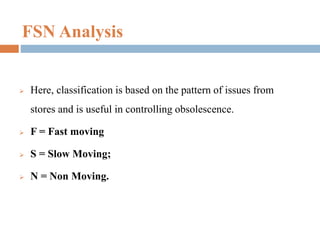
 Here, classification is based on the pattern of issues from
stores and is useful in controlling obsolescence.
 F = Fast moving
 S = Slow Moving;
 N = Non Moving.
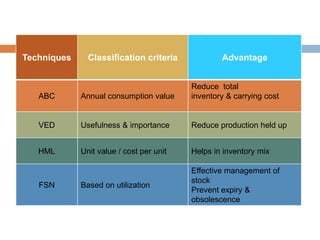
Techniques Classification criteria Advantage
ABC Annual consumption value
Reduce total
inventory & carrying cost
VED Usefulness & importance Reduce production held up
HML Unit value / cost per unit Helps in inventory mix
FSN Based on utilization
Effective management of
stock
Prevent expiry &
obsolescence
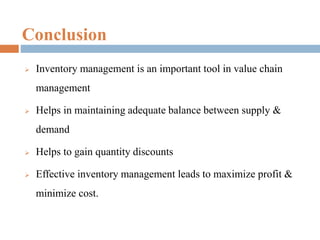
Conclusion
 Inventory management is an important tool in value chain
management
 Helps in maintaining adequate balance between supply &
demand
 Helps to gain quantity discounts
 Effective inventory management leads to maximize profit &
minimize cost.
 inventory management m pharmacy notes scop satara

inventory management m pharmacy notes scop satara

  • 1.
    A Seminar on InventoryManagement By Salunkhe Nikhil Jayvant Under the guidance of Dr. S. G. Sudke Inventory Management
  • 2.
    Contents  Introduction  Typesof inventories  Purpose of inventories  Importance of inventories  Benefits of inventory Management  Factors affecting Inventory Management  Techniques of Inventory Control  Conclusion
  • 3.
    Introduction  Inventory canbe referred to as sum of the value of  Raw materials (RM),  Fuels and lubricants,  Equipments & Spare parts,  Maintenance, repair & operating supplies (MRO)  WIP: work in progress (Semi- finished products)  Finished goods stock (FG)
  • 4.
    A Water TankAnalogy for Inventory 15-4 Supply Rate Inventory Level Demand Rate Inventory Level
  • 5.
    Inventory Basics  Inventoryis created when the receipt of materials, parts, or finished goods exceeds their disbursement.  Inventory is depleted when their disbursement exceeds their receipt.  An inventory manager’s job is to balance the advantages and disadvantages of both low and high inventories.
  • 6.
    Types of Inventory Raw materials Inventory- This consists of basic materials that have not yet been committed to production in a manufacturing firm.  Stores and Spares- Examples of stores and spares items are bolts, nuts, clamps, screws etc.  Work-in-Process Inventory- materials that have been committed to the production process but have not been completed.  Finished Goods Inventory- These are completed products awaiting sale.
  • 7.
    Purpose of holdingInventory  Avoid Lost of Sales  Gain Quantity Discounts  Improve customer service  Transportation savings  Unplanned shocks (labor strikes, natural disasters, etc.)
  • 8.
    Characteristics / Importance Inventories serves as cushions to absorb shocks.  Inventory for any organization is necessary evil.  Inventories are result of many interrelated decisions and policies of an organization.  Inventory provides production economy.
  • 9.
  • 10.
    Inventory management  Inventorymanagement is the planning and controlling of inventories in order to meet the competitive priorities of the organization.  Effective inventory management is essential for realizing the full potential of any value chain.  Inventory management requires information about expected demands, amounts on hand and amounts on order for every item stocked at all locations.  The appropriate timing and size of the reorder quantities must also be determined.
  • 11.
    Effective Inventory management Thegoal of effective inventory management is to minimize the total costs - direct and indirect - that are associated with holding inventories. Effective Inventory Management enables an organization to meet or exceed customers' expectations of product availability while maximizing net profits or minimizing costs.
  • 12.
    Benefits of InventoryManagement  Reduces inventory & purchasing cost  Gain visibility into inventory process  Improve customer service  Reduce time to market
  • 13.
    Factors affecting Inventory Thenumber of factors can be divided in the following categories.  Characteristic of Manufacturing System- The nature of production process, production planning, plant layout have an effect on inventory policy.  Amount of Protection against shortages- Due to fluctuation in demand of the product  Organizational factors- Amount of capital available for stock , Storage and warehousing policies.  Other factors-Strike situations,Wars, or some other natural calamities like floods, earthquakes, etc.
  • 14.
    Inventory Control  Inventorycontrol is a planned systematic method to determine  The inventory to be indented,  Its quantity to be indented and stocked,  To keep the purchasing and storing costs to the minimum possible.
  • 15.
    OBJECTIVES OF INVENTORYCONTROL  Maintenance of adequate inventory  To avoid production held up/ stock out condition.  To avoid customer dissatisfaction  Reduce increase in cost for emergency purchase  Avoid excessive Investment in Inventory  To reduce carrying cost  To avoid tying up of productive capital  Reduce inventory decisions for management
  • 16.
    Techniques of InventoryControl  ABC analysis  VED analysis  HML analysis  FSN analysis
  • 17.
    ABC Analysis  Accordingto this approach, the items are classified into 3 categories  A Class items : 10% of item costing 60-70% of total cost Small in number, but consume large amount of resources  B Class items : 20% of items costing 30-40% of total cost Intermediate  C Class items : 70% of items costing 20% of the total investment Larger in number, but consume lesser amount of resources  Advantages  Strict control on item with high % value of material costs  Reduced investment in Inventory  Reduced cost of storage
  • 18.
    VED Analysis  SelectiveInventory control approach  Vital (V) items : Those which are necessary for the survival of the organization as lungs and kidneys. Stock out of above even for a short duration stops production for quite some time .  Essential (E) items : Items which are indispensable or necessary for running an organization. Stock out of such items cannot be tolerated for more than few hours.  Desirable (D) items : Which are needed but do not cast any effect on its performance.
  • 19.
    HMLAnalysis  The HMLclassification follows the same procedure as is adopted in ABC classification.  H = HIGH;  M = MEDIUM;  L = LOW.  Only difference is that in HML, the classification is based on unit value and not the annual consumption value.  For examples, the management may decide that all units with unit value of Rs. 2,000 and above will be ‘H’ items, Rs. 1,000 to 2,000 ‘M’ items and less than Rs. 1,000 ‘L’ items.
  • 20.
    FSN Analysis  Here,classification is based on the pattern of issues from stores and is useful in controlling obsolescence.  F = Fast moving  S = Slow Moving;  N = Non Moving.
  • 21.
    Techniques Classification criteriaAdvantage ABC Annual consumption value Reduce total inventory & carrying cost VED Usefulness & importance Reduce production held up HML Unit value / cost per unit Helps in inventory mix FSN Based on utilization Effective management of stock Prevent expiry & obsolescence
  • 22.
    Conclusion  Inventory managementis an important tool in value chain management  Helps in maintaining adequate balance between supply & demand  Helps to gain quantity discounts  Effective inventory management leads to maximize profit & minimize cost.