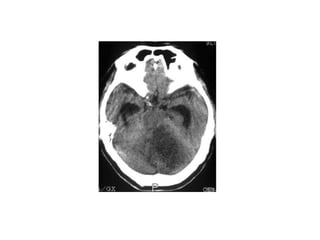
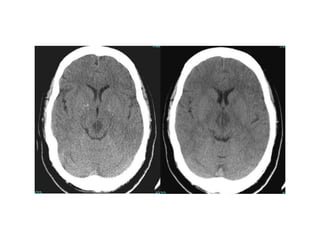
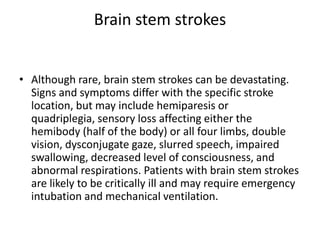
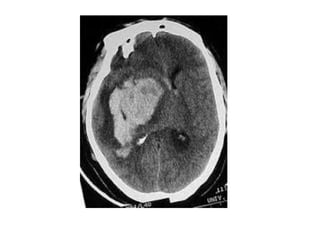
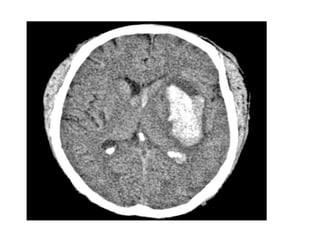
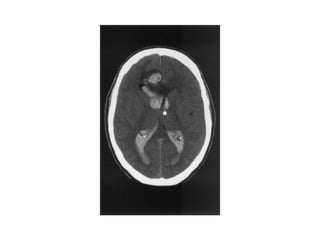
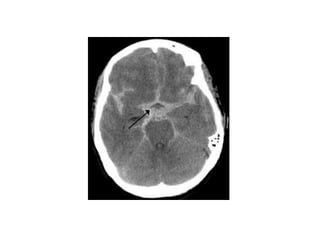
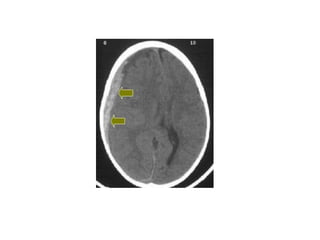
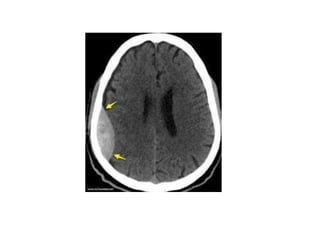
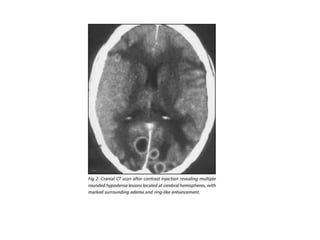
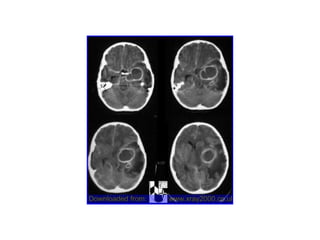
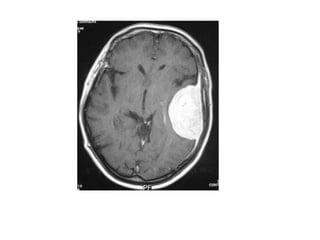
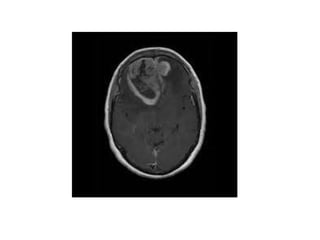
CT SCAN OF BRAIN
• Anterior cerebral artery
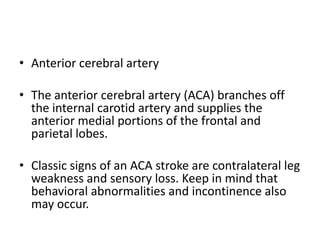
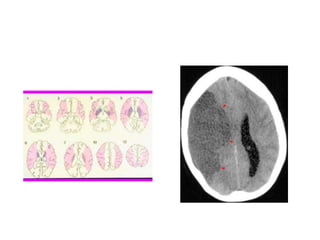
• The anterior cerebral artery (ACA) branches off
the internal carotid artery and supplies the
anterior medial portions of the frontal and
parietal lobes.
• Classic signs of an ACA stroke are contralateral leg
weakness and sensory loss. Keep in mind that
behavioral abnormalities and incontinence also
may occur.
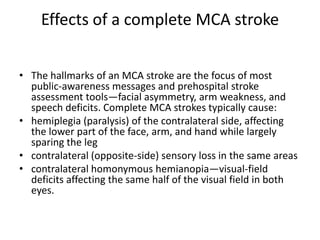
Effects of a complete MCA stroke
• The hallmarks of an MCA stroke are the focus of most
public-awareness messages and prehospital stroke
assessment tools—facial asymmetry, arm weakness, and
speech deficits. Complete MCA strokes typically cause:
• hemiplegia (paralysis) of the contralateral side, affecting
the lower part of the face, arm, and hand while largely
sparing the leg
• contralateral (opposite-side) sensory loss in the same areas
• contralateral homonymous hemianopia—visual-field
deficits affecting the same half of the visual field in both
eyes.
Posterior cerebral artery

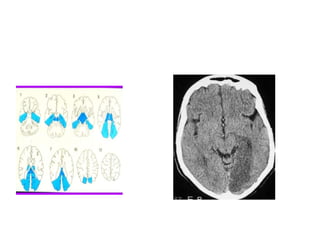
• The posterior cerebral artery (PCA) arises from
the top of the basilar artery and feeds the
medial occipital lobe and inferior and medial
temporal lobes. Vision is the primary function
of the occipital lobe, so a stroke affecting PCA
distribution commonly causes visual deficits—
specifically contralateral homonymous
hemianopia.
Cerebellar strokes

• Cerebellar strokes commonly impair balance
and coordination. Assess for ataxia
(incoordination) by having the patient extend
the index finger and then alternately touch
your finger and his or her nose. Do this on
both sides.
Brain stem strokes
• Although rare, brain stem strokes can be devastating.
Signs and symptoms differ with the specific stroke
location, but may include hemiparesis or
quadriplegia, sensory loss affecting either the
hemibody (half of the body) or all four limbs, double
vision, dysconjugate gaze, slurred speech, impaired
swallowing, decreased level of consciousness, and
abnormal respirations. Patients with brain stem strokes
are likely to be critically ill and may require emergency
intubation and mechanical ventilation.
Ct scan lecture
Ct scan lecture
Ct scan lecture
Ct scan lecture
Ct scan lecture
Ct scan lecture
Ct scan lecture
Ct scan lecture
Ct scan lecture
Ct scan lecture

Ct scan lecture

  • 1.
  • 9.
    • Anterior cerebralartery • The anterior cerebral artery (ACA) branches off the internal carotid artery and supplies the anterior medial portions of the frontal and parietal lobes. • Classic signs of an ACA stroke are contralateral leg weakness and sensory loss. Keep in mind that behavioral abnormalities and incontinence also may occur.
  • 11.
    Effects of acomplete MCA stroke • The hallmarks of an MCA stroke are the focus of most public-awareness messages and prehospital stroke assessment tools—facial asymmetry, arm weakness, and speech deficits. Complete MCA strokes typically cause: • hemiplegia (paralysis) of the contralateral side, affecting the lower part of the face, arm, and hand while largely sparing the leg • contralateral (opposite-side) sensory loss in the same areas • contralateral homonymous hemianopia—visual-field deficits affecting the same half of the visual field in both eyes.
  • 13.
    Posterior cerebral artery •The posterior cerebral artery (PCA) arises from the top of the basilar artery and feeds the medial occipital lobe and inferior and medial temporal lobes. Vision is the primary function of the occipital lobe, so a stroke affecting PCA distribution commonly causes visual deficits— specifically contralateral homonymous hemianopia.
  • 15.
    Cerebellar strokes • Cerebellarstrokes commonly impair balance and coordination. Assess for ataxia (incoordination) by having the patient extend the index finger and then alternately touch your finger and his or her nose. Do this on both sides.
  • 17.
    Brain stem strokes •Although rare, brain stem strokes can be devastating. Signs and symptoms differ with the specific stroke location, but may include hemiparesis or quadriplegia, sensory loss affecting either the hemibody (half of the body) or all four limbs, double vision, dysconjugate gaze, slurred speech, impaired swallowing, decreased level of consciousness, and abnormal respirations. Patients with brain stem strokes are likely to be critically ill and may require emergency intubation and mechanical ventilation.