


Learning Objectives
• Recognize Urgent Lesions
• Understand Acute Traumatic Lesions
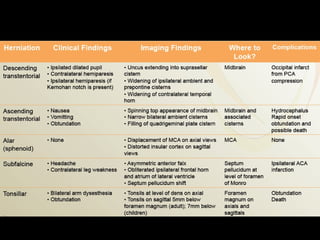
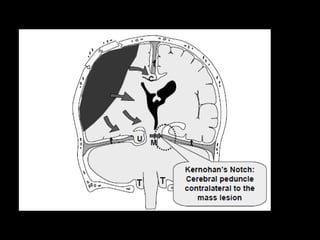
• Describe four types of herniation
• Triage Acute Vascular Lesions
• Recognize Diffuse cerebral swelling
• When to do brain imaging in trauma setting?
• What imaging is appropriate?
• Advantage and disadvantage of each
imaging modality
• Review of important cranial CT anatomy
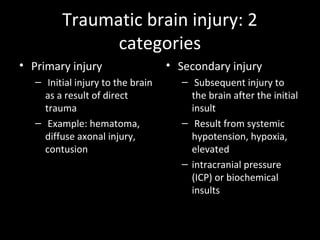
Traumatic brain injury: 2
categories
• Primary injury
– Initial injury to the brain
as a result of direct
trauma
– Example: hematoma,
diffuse axonal injury,
contusion
• Secondary injury
– Subsequent injury to
the brain after the initial
insult
– Result from systemic
hypotension, hypoxia,
elevated
– intracranial pressure
(ICP) or biochemical
insults
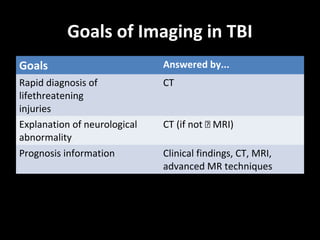
Goals of Imaging in TBI
Goals Answered by...
Rapid diagnosis of
lifethreatening
injuries
CT
Explanation of neurological
abnormality
CT (if not  MRI)
Prognosis information Clinical findings, CT, MRI,
advanced MR techniques
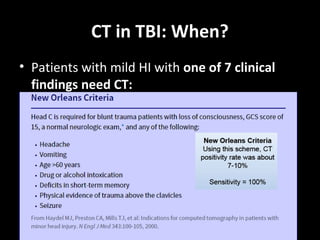
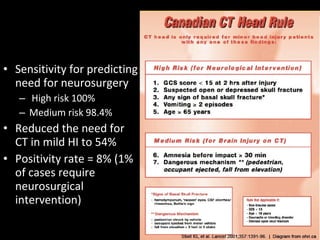
CT in TBI: When?
• Patients with mild HI with one of 7 clinical
findings need CT:
• Sensitivity for predicting
need for neurosurgery
– High risk 100%
– Medium risk 98.4%
• Reduced the need for
CT in mild HI to 54%
• Positivity rate = 8% (1%
of cases require
neurosurgical
intervention)
CT in TBI: How?
• Non-contrast, axial scan with spiral technique
• If you see maxillary hemosinus -> do facial CT
• If you see skull base fracture -> consider CTA
and skull base reformation (thin slices with
small FOV)
• If suspect C-spine fracture->  do C-spine CT
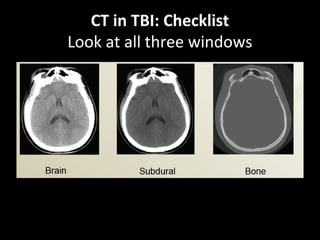
CT in TBI: Checklist
Look at all three windows
CT in TBI: Checklist
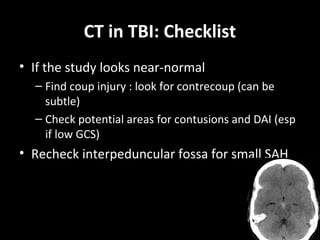
• If the study looks near-normal
– Find coup injury : look for contrecoup (can be
subtle)
– Check potential areas for contusions and DAI (esp
if low GCS)
• Recheck interpeduncular fossa for small SAH
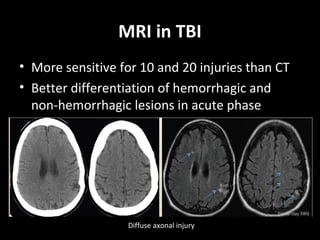
MRI in TBI
• More sensitive for 10 and 20 injuries than CT
• Better differentiation of hemorrhagic and
non-hemorrhagic lesions in acute phase
Diffuse axonal injury
Diffuse Axonal Injury
• DAI is the widespread shearing of long axons that occurs as
the result of deceleration injury. Common clinical scenarios
include high-speed motor vehicle collisions and falls from
great height.
• The CT appearance is nonspecific: normal in the hyperacute
phase, often followed by cerebral edema over hours to days.
Punctate intraparenchymal hemorrhage may occur as well.
Often, other traumatic brain injury will be evident, such as
SDH or EDH.
MRI in TBI
• Intrinsic limits:
– Absolute C/I: cardiac pacemaker, ferromagnetic
foreign bodies
– Lower sensitivity for bone fractures and
hyperacute blood
• Difficult managing trauma patients in MRI
suite: metallic life support, monitoring device,
time
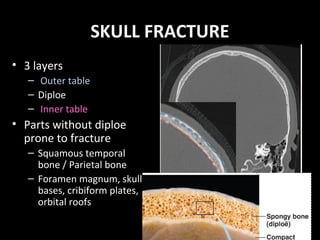
SKULL FRACTURE
• 3 layers
– Outer table
– Diploe
– Inner table
• Parts without diploe
prone to fracture
– Squamous temporal
bone / Parietal bone
– Foramen magnum, skull
bases, cribiform plates,
orbital roofs
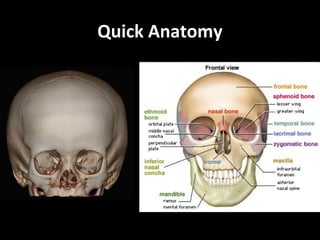
Quick Anatomy
Quick Anatomy
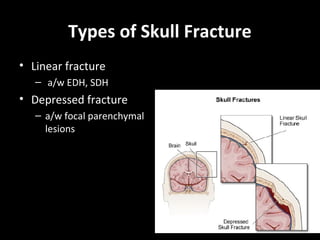
Types of Skull Fracture
• Linear fracture
– a/w EDH, SDH
• Depressed fracture
– a/w focal parenchymal
lesions
Significance of Skull Fracture
• Indicator of brain injuries?...
– Present in the majority of cases with severe HI
– Absent in 1/4 of fatal injuries at autopsy
– Absent in 1/3 of severe brain injury cases
– Injuries to underlying brain structures
• Association
– 15% concomitant C-spine injury
– 10-15% concomitant facial injury
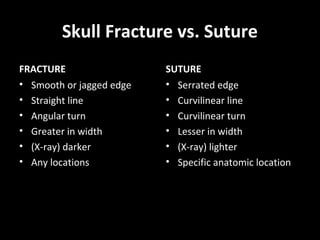
Skull Fracture vs. Suture
FRACTURE
• Smooth or jagged edge
• Straight line
• Angular turn
• Greater in width
• (X-ray) darker
• Any locations
SUTURE
• Serrated edge
• Curvilinear line
• Curvilinear turn
• Lesser in width
• (X-ray) lighter
• Specific anatomic location
Skull Fracture: CT
Skull Fracture: Skull Base
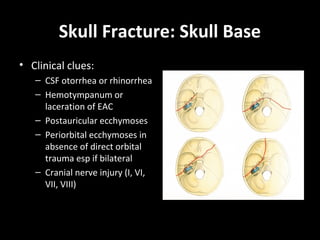
• Clinical clues:
– CSF otorrhea or rhinorrhea
– Hemotympanum or
laceration of EAC
– Postauricular ecchymoses
– Periorbital ecchymoses in
absence of direct orbital
trauma esp if bilateral
– Cranial nerve injury (I, VI,
VII, VIII)
Skull Fracture: Skull Base
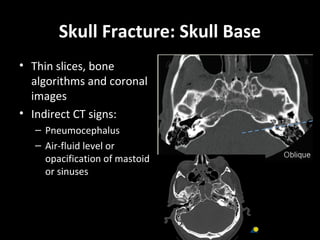
• Thin slices, bone
algorithms and coronal
images
• Indirect CT signs:
– Pneumocephalus
– Air-fluid level or
opacification of mastoid
or sinuses
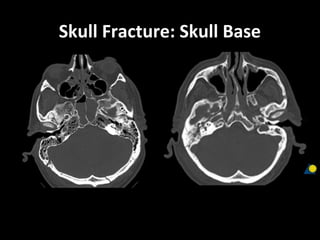
Skull Fracture: Skull Base
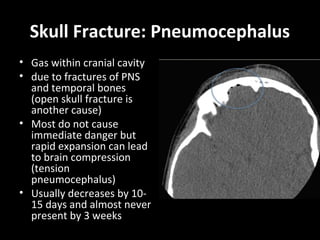
Skull Fracture: Pneumocephalus
• Gas within cranial cavity
• due to fractures of PNS
and temporal bones
(open skull fracture is
another cause)
• Most do not cause
immediate danger but
rapid expansion can lead
to brain compression
(tension
pneumocephalus)
• Usually decreases by 10-
15 days and almost never
present by 3 weeks
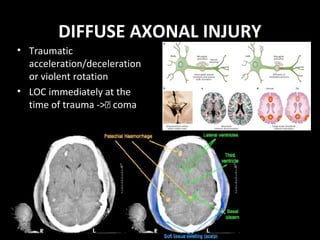
DIFFUSE AXONAL INJURY
• Traumatic
acceleration/deceleration
or violent rotation
• LOC immediately at the
time of trauma -> coma
Diffuse Axonal Injury (DAI)
• Frequent cause of
persistent vegetative
state / morbidity in
trauma patients
• Clinical symptoms
worse than CT findings
• Can be isolated with no
or little association with
SAH, SDH, fracture
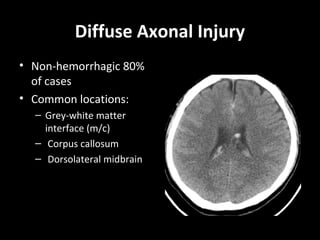
Diffuse Axonal Injury
• Non-hemorrhagic 80%
of cases
• Common locations:
– Grey-white matter
interface (m/c)
– Corpus callosum
– Dorsolateral midbrain
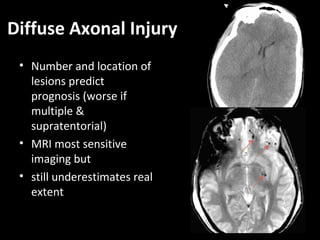
Diffuse Axonal Injury
• Number and location of
lesions predict
prognosis (worse if
multiple &
supratentorial)
• MRI most sensitive
imaging but
• still underestimates real
extent
Diffuse Axonal Injury
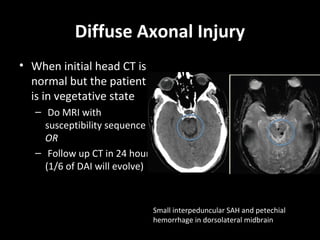
• When initial head CT is
normal but the patient
is in vegetative state
– Do MRI with
susceptibility sequence
OR
– Follow up CT in 24 hours
(1/6 of DAI will evolve)
Small interpeduncular SAH and petechial
hemorrhage in dorsolateral midbrain
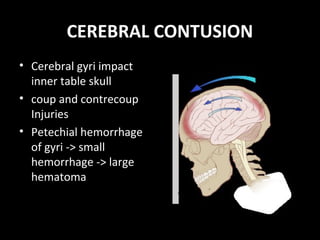
CEREBRAL CONTUSION
• Cerebral gyri impact
inner table skull
• coup and contrecoup
Injuries
• Petechial hemorrhage
of gyri -> small
hemorrhage -> large
hematoma
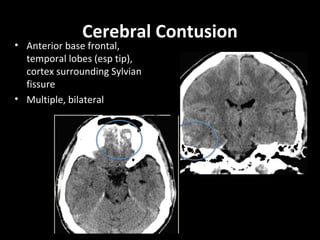
Cerebral Contusion
• Anterior base frontal,
temporal lobes (esp tip),
cortex surrounding Sylvian
fissure
• Multiple, bilateral
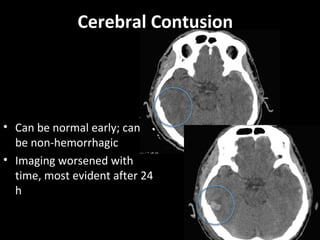
Cerebral Contusion
• Can be normal early; can
be non-hemorrhagic
• Imaging worsened with
time, most evident after 24
h
Cerebral Contusion: MRI
MRI is the study of choice in patients with
• Acute TBI when neurological findins are unexplained by CT
• Subacute or chronic phases when there are TBI-related symptoms
OTHER INTRAAXIAL LESIONS
• Traumatic intraparenchymal hematoma
• Intraventricular hemorrhage
• Traumatic lesions of deep grey structures and
brainstem
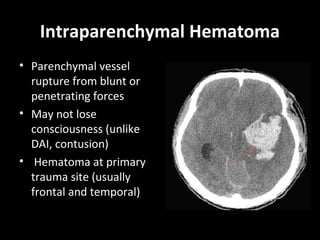
Intraparenchymal Hematoma
• Parenchymal vessel
rupture from blunt or
penetrating forces
• May not lose
consciousness (unlike
DAI, contusion)
• Hematoma at primary
trauma site (usually
frontal and temporal)
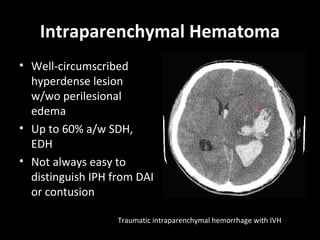
Intraparenchymal Hematoma
• Well-circumscribed
hyperdense lesion
w/wo perilesional
edema
• Up to 60% a/w SDH,
EDH
• Not always easy to
distinguish IPH from DAI
or contusion
Traumatic intraparenchymal hemorrhage with IVH
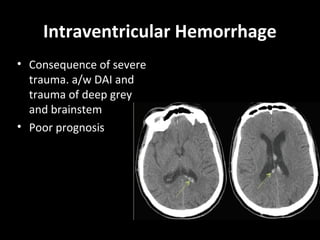
Intraventricular Hemorrhage
• Consequence of severe
trauma. a/w DAI and
trauma of deep grey
and brainstem
• Poor prognosis
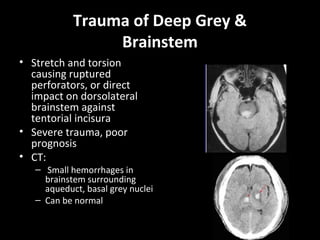
Trauma of Deep Grey &
Brainstem
• Stretch and torsion
causing ruptured
perforators, or direct
impact on dorsolateral
brainstem against
tentorial incisura
• Severe trauma, poor
prognosis
• CT:
– Small hemorrhages in
brainstem surrounding
aqueduct, basal grey nuclei
– Can be normal
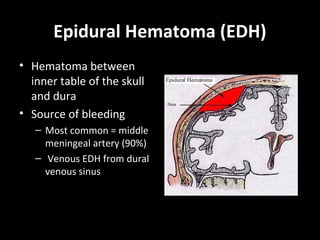
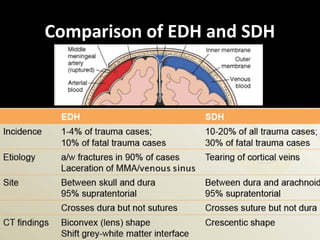
Epidural Hematoma (EDH)
• Hematoma between
inner table of the skull
and dura
• Source of bleeding
– Most common = middle
meningeal artery (90%)
– Venous EDH from dural
venous sinus
Epidural Hematoma (EDH)
• Most urgent of all cases of cranial trauma
– Requiring prompt Rx to relieve compression of
brainstem, tentorial herniation, acute
hydrocephalus
– EDH in posterior fossa very worrisome
– 1-4% of head injury cases, 10% of fatal cases
– Young men (20s – 40s). Rare in patients >60 y
– Almost always with skull fracture
– Lucid interval in 40% of cases
Epidural Hematoma (EDH)
• Delayed development in 10-25% of cases
(within 36 hrs)
• Arterial EDH: blood can flow into epidural
space only after resolution of arterial spasm
• Venous EDH bleeds slowly
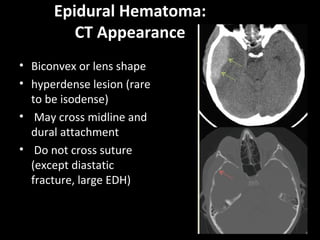
Epidural Hematoma:
CT Appearance
• Biconvex or lens shape
• hyperdense lesion (rare
to be isodense)
• May cross midline and
dural attachment
• Do not cross suture
(except diastatic
fracture, large EDH)
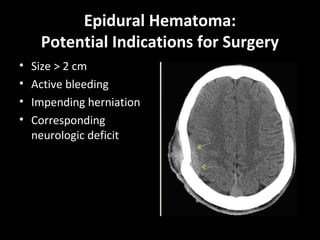
Epidural Hematoma:
Potential Indications for Surgery
• Size > 2 cm
• Active bleeding
• Impending herniation
• Corresponding
neurologic deficit
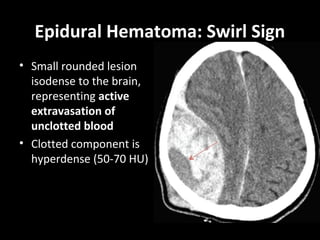
Epidural Hematoma: Swirl Sign
• Small rounded lesion
isodense to the brain,
representing active
extravasation of
unclotted blood
• Clotted component is
hyperdense (50-70 HU)
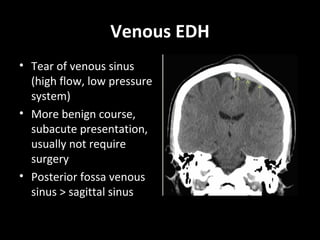
Venous EDH
• Tear of venous sinus
(high flow, low pressure
system)
• More benign course,
subacute presentation,
usually not require
surgery
• Posterior fossa venous
sinus > sagittal sinus
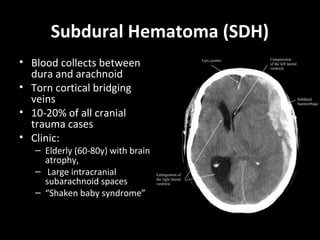
Subdural Hematoma (SDH)
• Blood collects between
dura and arachnoid
• Torn cortical bridging
veins
• 10-20% of all cranial
trauma cases
• Clinic:
– Elderly (60-80y) with brain
atrophy,
– Large intracranial
subarachnoid spaces
– “Shaken baby syndrome”
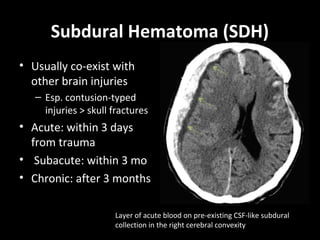
Subdural Hematoma (SDH)
• Usually co-exist with
other brain injuries
– Esp. contusion-typed
injuries > skull fractures
• Acute: within 3 days
from trauma
• Subacute: within 3 mo
• Chronic: after 3 months
Layer of acute blood on pre-existing CSF-like subdural
collection in the right cerebral convexity
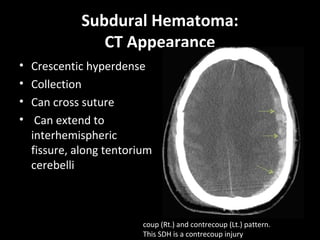
Subdural Hematoma:
CT Appearance
• Crescentic hyperdense
• Collection
• Can cross suture
• Can extend to
interhemispheric
fissure, along tentorium
cerebelli
coup (Rt.) and contrecoup (Lt.) pattern.
This SDH is a contrecoup injury
Subdural Hematoma:
Value of Coronal Reformats
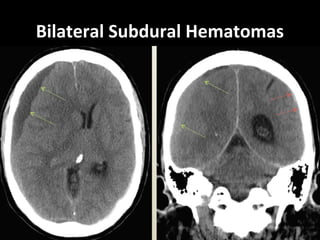
Bilateral Subdural Hematomas
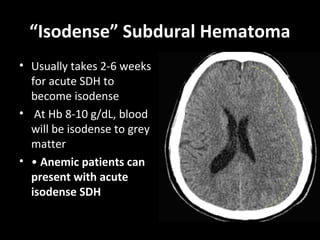
“Isodense” Subdural Hematoma
• Usually takes 2-6 weeks
for acute SDH to
become isodense
• At Hb 8-10 g/dL, blood
will be isodense to grey
matter
• • Anemic patients can
present with acute
isodense SDH
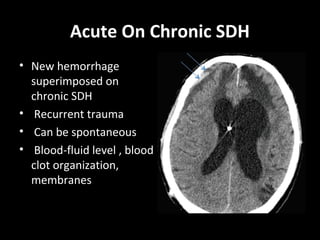
Acute On Chronic SDH
• New hemorrhage
superimposed on
chronic SDH
• Recurrent trauma
• Can be spontaneous
• Blood-fluid level , blood
clot organization,
membranes
Comparison of EDH and SDH
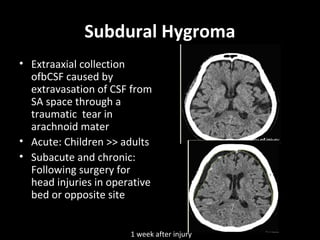
Subdural Hygroma
• Extraaxial collection
ofbCSF caused by
extravasation of CSF from
SA space through a
traumatic tear in
arachnoid mater
• Acute: Children >> adults
• Subacute and chronic:
Following surgery for
head injuries in operative
bed or opposite site
1 week after injury
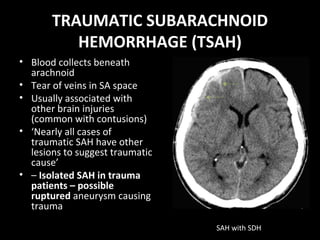
TRAUMATIC SUBARACHNOID
HEMORRHAGE (TSAH)
• Blood collects beneath
arachnoid
• Tear of veins in SA space
• Usually associated with
other brain injuries
(common with contusions)
• ‘Nearly all cases of
traumatic SAH have other
lesions to suggest traumatic
cause’
• – Isolated SAH in trauma
patients – possible
ruptured aneurysm causing
trauma
SAH with SDH
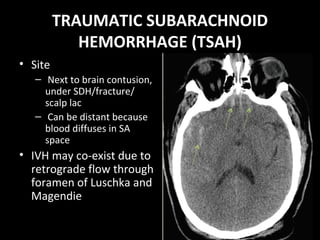
TRAUMATIC SUBARACHNOID
HEMORRHAGE (TSAH)
• Site
– Next to brain contusion,
under SDH/fracture/
scalp lac
– Can be distant because
blood diffuses in SA
space
• IVH may co-exist due to
retrograde flow through
foramen of Luschka and
Magendie
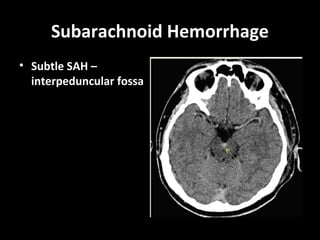
Subarachnoid Hemorrhage
• Subtle SAH –
interpeduncular fossa
TRAUMATIC VASCULAR
LESIONS
• Rare
• Can be overlooked initially
• ICA injury (dissection, aneurysm, occlusion) –
Base of skull fracture
• Traumatic carotid-cavernous fistula (TCCF)
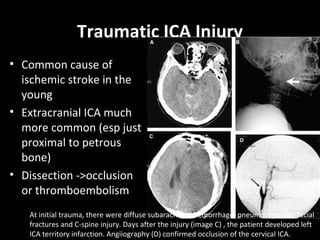
Traumatic ICA Injury
• Common cause of
ischemic stroke in the
young
• Extracranial ICA much
more common (esp just
proximal to petrous
bone)
• Dissection ->occlusion
or thromboembolism
At initial trauma, there were diffuse subarachnoid hemorrhage, pneumocephalus, facial
fractures and C-spine injury. Days after the injury (image C) , the patient developed left
ICA territory infarction. Angiiography (D) confirmed occlusion of the cervical ICA.
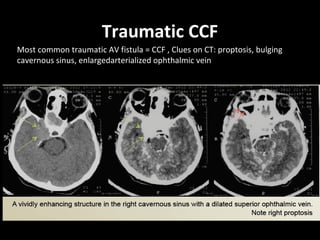
Traumatic CCF
Most common traumatic AV fistula = CCF , Clues on CT: proptosis, bulging
cavernous sinus, enlargedarterialized ophthalmic vein
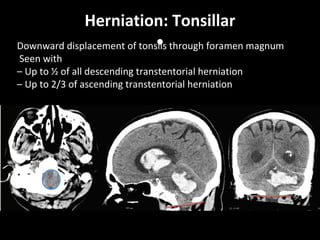
Herniation: Tonsillar
•Downward displacement of tonsils through foramen magnum
Seen with
– Up to ½ of all descending transtentorial herniation
– Up to 2/3 of ascending transtentorial herniation
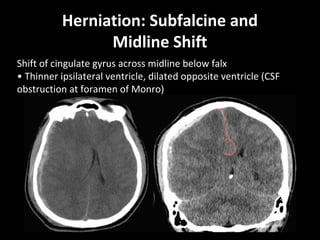
Herniation: Subfalcine and
Midline Shift
Shift of cingulate gyrus across midline below falx
• Thinner ipsilateral ventricle, dilated opposite ventricle (CSF
obstruction at foramen of Monro)
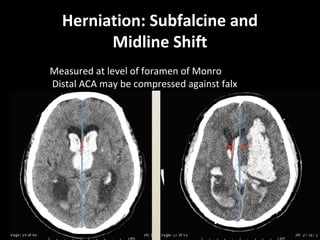
Herniation: Subfalcine and
Midline Shift
Measured at level of foramen of Monro
Distal ACA may be compressed against falx
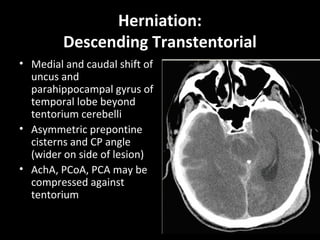
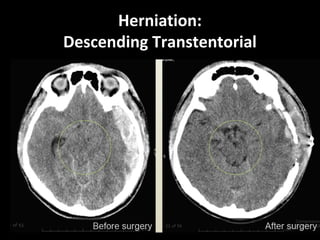
Herniation:
Descending Transtentorial
• Medial and caudal shift of
uncus and
parahippocampal gyrus of
temporal lobe beyond
tentorium cerebelli
• Asymmetric prepontine
cisterns and CP angle
(wider on side of lesion)
• AchA, PCoA, PCA may be
compressed against
tentorium
Herniation:
Descending Transtentorial
Herniation:
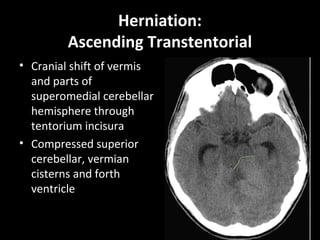
Ascending Transtentorial
• Cranial shift of vermis
and parts of
superomedial cerebellar
hemisphere through
tentorium incisura
• Compressed superior
cerebellar, vermian
cisterns and forth
ventricle
Posttraumatic Cerebral Edema
• Increased water content of brain and/or
increased intravascular blood volume
• Severe condition. Can be fatal
• Can be unilateral or bilateral
• Vasogenic and cytotoxic edema coexist
• Evolves over 24-48 hours
• Generally resolved in 2 weeks
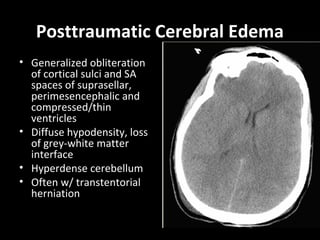
Posttraumatic Cerebral Edema
• Generalized obliteration
of cortical sulci and SA
spaces of suprasellar,
perimesencephalic and
compressed/thin
ventricles
• Diffuse hypodensity, loss
of grey-white matter
interface
• Hyperdense cerebellum
• Often w/ transtentorial
herniation
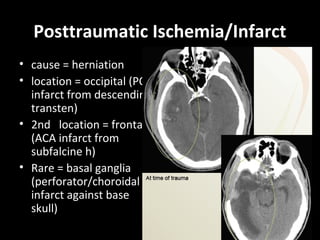
Posttraumatic Ischemia/Infarct
• cause = herniation
• location = occipital (PCA
infarct from descending
transten)
• 2nd location = frontal
(ACA infarct from
subfalcine h)
• Rare = basal ganglia
(perforator/choroidal
infarct against base
skull)
Posttraumatic
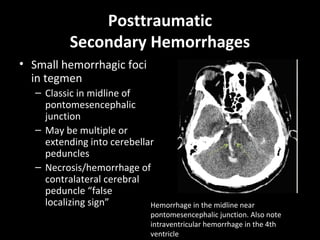
Secondary Hemorrhages
• Small hemorrhagic foci
in tegmen
– Classic in midline of
pontomesencephalic
junction
– May be multiple or
extending into cerebellar
peduncles
– Necrosis/hemorrhage of
contralateral cerebral
peduncle “false
localizing sign” Hemorrhage in the midline near
pontomesencephalic junction. Also note
intraventricular hemorrhage in the 4th
ventricle
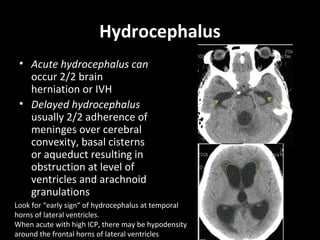
Hydrocephalus
• Acute hydrocephalus can
occur 2/2 brain
herniation or IVH
• Delayed hydrocephalus
usually 2/2 adherence of
meninges over cerebral
convexity, basal cisterns
or aqueduct resulting in
obstruction at level of
ventricles and arachnoid
granulations
Look for “early sign” of hydrocephalus at temporal
horns of lateral ventricles.
When acute with high ICP, there may be hypodensity
around the frontal horns of lateral ventricles
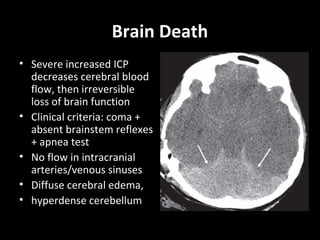
Brain Death
• Severe increased ICP
decreases cerebral blood
flow, then irreversible
loss of brain function
• Clinical criteria: coma +
absent brainstem reflexes
+ apnea test
• No flow in intracranial
arteries/venous sinuses
• Diffuse cerebral edema,
• hyperdense cerebellum
Conclusions
• CT = primary modality for head trauma,
enough for most parts
• MR to help predicting prognosis by detection
of subtle injuries i.e., contusion and DAI
• Primary vs secondary lesion. Often,
• secondary lesion more important
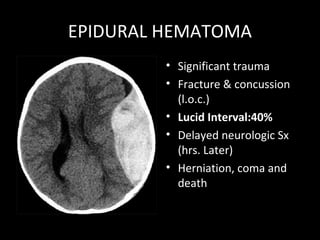
EPIDURAL HEMATOMA
• Significant trauma
• Fracture & concussion
(l.o.c.)
• Lucid Interval:40%
• Delayed neurologic Sx
(hrs. Later)
• Herniation, coma and
death
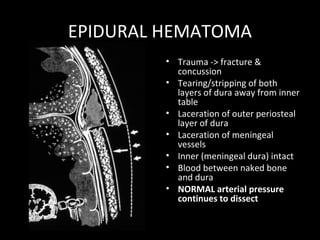
EPIDURAL HEMATOMA
• Trauma -> fracture &
concussion
• Tearing/stripping of both
layers of dura away from inner
table
• Laceration of outer periosteal
layer of dura
• Laceration of meningeal
vessels
• Inner (meningeal dura) intact
• Blood between naked bone
and dura
• NORMAL arterial pressure
continues to dissect
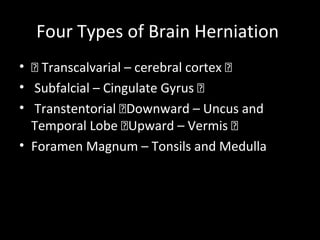
Four Types of Brain Herniation
• „ Transcalvarial – cerebral cortex „
• Subfalcial – Cingulate Gyrus „
• Transtentorial „Downward – Uncus and
Temporal Lobe „Upward – Vermis „
• Foramen Magnum – Tonsils and Medulla
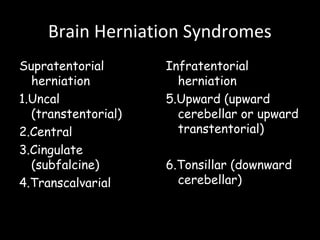
Brain Herniation Syndromes
Supratentorial
herniation
1.Uncal
(transtentorial)
2.Central
3.Cingulate
(subfalcine)
4.Transcalvarial
Infratentorial
herniation
5.Upward (upward
cerebellar or upward
transtentorial)
6.Tonsillar (downward
cerebellar)
SUBFALCINE HERNIATION
• most common
• supratentorial mass in
one hemicranium
• affected hemisphere
pushes across the midline
under the inferior "free"
margin of the falx,
extending into the
contralateral
hemicranium
Medulloblastoma
Medulloblastoma

Medulloblastoma

  • 1.
    Learning Objectives • RecognizeUrgent Lesions • Understand Acute Traumatic Lesions • Describe four types of herniation • Triage Acute Vascular Lesions • Recognize Diffuse cerebral swelling
  • 2.
    • When todo brain imaging in trauma setting? • What imaging is appropriate? • Advantage and disadvantage of each imaging modality • Review of important cranial CT anatomy
  • 3.
    Traumatic brain injury:2 categories • Primary injury – Initial injury to the brain as a result of direct trauma – Example: hematoma, diffuse axonal injury, contusion • Secondary injury – Subsequent injury to the brain after the initial insult – Result from systemic hypotension, hypoxia, elevated – intracranial pressure (ICP) or biochemical insults
  • 4.
    Goals of Imagingin TBI Goals Answered by... Rapid diagnosis of lifethreatening injuries CT Explanation of neurological abnormality CT (if not  MRI) Prognosis information Clinical findings, CT, MRI, advanced MR techniques
  • 5.
    CT in TBI:When? • Patients with mild HI with one of 7 clinical findings need CT:
  • 6.
    • Sensitivity forpredicting need for neurosurgery – High risk 100% – Medium risk 98.4% • Reduced the need for CT in mild HI to 54% • Positivity rate = 8% (1% of cases require neurosurgical intervention)
  • 7.
    CT in TBI:How? • Non-contrast, axial scan with spiral technique • If you see maxillary hemosinus -> do facial CT • If you see skull base fracture -> consider CTA and skull base reformation (thin slices with small FOV) • If suspect C-spine fracture->  do C-spine CT
  • 8.
    CT in TBI:Checklist Look at all three windows
  • 9.
    CT in TBI:Checklist • If the study looks near-normal – Find coup injury : look for contrecoup (can be subtle) – Check potential areas for contusions and DAI (esp if low GCS) • Recheck interpeduncular fossa for small SAH
  • 10.
    MRI in TBI •More sensitive for 10 and 20 injuries than CT • Better differentiation of hemorrhagic and non-hemorrhagic lesions in acute phase Diffuse axonal injury
  • 11.
    Diffuse Axonal Injury •DAI is the widespread shearing of long axons that occurs as the result of deceleration injury. Common clinical scenarios include high-speed motor vehicle collisions and falls from great height. • The CT appearance is nonspecific: normal in the hyperacute phase, often followed by cerebral edema over hours to days. Punctate intraparenchymal hemorrhage may occur as well. Often, other traumatic brain injury will be evident, such as SDH or EDH.
  • 12.
    MRI in TBI •Intrinsic limits: – Absolute C/I: cardiac pacemaker, ferromagnetic foreign bodies – Lower sensitivity for bone fractures and hyperacute blood • Difficult managing trauma patients in MRI suite: metallic life support, monitoring device, time
  • 13.
    SKULL FRACTURE • 3layers – Outer table – Diploe – Inner table • Parts without diploe prone to fracture – Squamous temporal bone / Parietal bone – Foramen magnum, skull bases, cribiform plates, orbital roofs
  • 14.
  • 15.
  • 16.
    Types of SkullFracture • Linear fracture – a/w EDH, SDH • Depressed fracture – a/w focal parenchymal lesions
  • 17.
    Significance of SkullFracture • Indicator of brain injuries?... – Present in the majority of cases with severe HI – Absent in 1/4 of fatal injuries at autopsy – Absent in 1/3 of severe brain injury cases – Injuries to underlying brain structures • Association – 15% concomitant C-spine injury – 10-15% concomitant facial injury
  • 18.
    Skull Fracture vs.Suture FRACTURE • Smooth or jagged edge • Straight line • Angular turn • Greater in width • (X-ray) darker • Any locations SUTURE • Serrated edge • Curvilinear line • Curvilinear turn • Lesser in width • (X-ray) lighter • Specific anatomic location
  • 19.
  • 20.
    Skull Fracture: SkullBase • Clinical clues: – CSF otorrhea or rhinorrhea – Hemotympanum or laceration of EAC – Postauricular ecchymoses – Periorbital ecchymoses in absence of direct orbital trauma esp if bilateral – Cranial nerve injury (I, VI, VII, VIII)
  • 21.
    Skull Fracture: SkullBase • Thin slices, bone algorithms and coronal images • Indirect CT signs: – Pneumocephalus – Air-fluid level or opacification of mastoid or sinuses
  • 22.
  • 23.
    Skull Fracture: Pneumocephalus •Gas within cranial cavity • due to fractures of PNS and temporal bones (open skull fracture is another cause) • Most do not cause immediate danger but rapid expansion can lead to brain compression (tension pneumocephalus) • Usually decreases by 10- 15 days and almost never present by 3 weeks
  • 24.
    DIFFUSE AXONAL INJURY •Traumatic acceleration/deceleration or violent rotation • LOC immediately at the time of trauma -> coma
  • 25.
    Diffuse Axonal Injury(DAI) • Frequent cause of persistent vegetative state / morbidity in trauma patients • Clinical symptoms worse than CT findings • Can be isolated with no or little association with SAH, SDH, fracture
  • 26.
    Diffuse Axonal Injury •Non-hemorrhagic 80% of cases • Common locations: – Grey-white matter interface (m/c) – Corpus callosum – Dorsolateral midbrain
  • 27.
    Diffuse Axonal Injury •Number and location of lesions predict prognosis (worse if multiple & supratentorial) • MRI most sensitive imaging but • still underestimates real extent
  • 28.
    Diffuse Axonal Injury •When initial head CT is normal but the patient is in vegetative state – Do MRI with susceptibility sequence OR – Follow up CT in 24 hours (1/6 of DAI will evolve) Small interpeduncular SAH and petechial hemorrhage in dorsolateral midbrain
  • 29.
    CEREBRAL CONTUSION • Cerebralgyri impact inner table skull • coup and contrecoup Injuries • Petechial hemorrhage of gyri -> small hemorrhage -> large hematoma
  • 30.
    Cerebral Contusion • Anteriorbase frontal, temporal lobes (esp tip), cortex surrounding Sylvian fissure • Multiple, bilateral
  • 31.
    Cerebral Contusion • Canbe normal early; can be non-hemorrhagic • Imaging worsened with time, most evident after 24 h
  • 32.
    Cerebral Contusion: MRI MRIis the study of choice in patients with • Acute TBI when neurological findins are unexplained by CT • Subacute or chronic phases when there are TBI-related symptoms
  • 33.
    OTHER INTRAAXIAL LESIONS •Traumatic intraparenchymal hematoma • Intraventricular hemorrhage • Traumatic lesions of deep grey structures and brainstem
  • 34.
    Intraparenchymal Hematoma • Parenchymalvessel rupture from blunt or penetrating forces • May not lose consciousness (unlike DAI, contusion) • Hematoma at primary trauma site (usually frontal and temporal)
  • 35.
    Intraparenchymal Hematoma • Well-circumscribed hyperdenselesion w/wo perilesional edema • Up to 60% a/w SDH, EDH • Not always easy to distinguish IPH from DAI or contusion Traumatic intraparenchymal hemorrhage with IVH
  • 36.
    Intraventricular Hemorrhage • Consequenceof severe trauma. a/w DAI and trauma of deep grey and brainstem • Poor prognosis
  • 37.
    Trauma of DeepGrey & Brainstem • Stretch and torsion causing ruptured perforators, or direct impact on dorsolateral brainstem against tentorial incisura • Severe trauma, poor prognosis • CT: – Small hemorrhages in brainstem surrounding aqueduct, basal grey nuclei – Can be normal
  • 38.
    Epidural Hematoma (EDH) •Hematoma between inner table of the skull and dura • Source of bleeding – Most common = middle meningeal artery (90%) – Venous EDH from dural venous sinus
  • 39.
    Epidural Hematoma (EDH) •Most urgent of all cases of cranial trauma – Requiring prompt Rx to relieve compression of brainstem, tentorial herniation, acute hydrocephalus – EDH in posterior fossa very worrisome – 1-4% of head injury cases, 10% of fatal cases – Young men (20s – 40s). Rare in patients >60 y – Almost always with skull fracture – Lucid interval in 40% of cases
  • 40.
    Epidural Hematoma (EDH) •Delayed development in 10-25% of cases (within 36 hrs) • Arterial EDH: blood can flow into epidural space only after resolution of arterial spasm • Venous EDH bleeds slowly
  • 41.
    Epidural Hematoma: CT Appearance •Biconvex or lens shape • hyperdense lesion (rare to be isodense) • May cross midline and dural attachment • Do not cross suture (except diastatic fracture, large EDH)
  • 42.
    Epidural Hematoma: Potential Indicationsfor Surgery • Size > 2 cm • Active bleeding • Impending herniation • Corresponding neurologic deficit
  • 43.
    Epidural Hematoma: SwirlSign • Small rounded lesion isodense to the brain, representing active extravasation of unclotted blood • Clotted component is hyperdense (50-70 HU)
  • 44.
    Venous EDH • Tearof venous sinus (high flow, low pressure system) • More benign course, subacute presentation, usually not require surgery • Posterior fossa venous sinus > sagittal sinus
  • 45.
    Subdural Hematoma (SDH) •Blood collects between dura and arachnoid • Torn cortical bridging veins • 10-20% of all cranial trauma cases • Clinic: – Elderly (60-80y) with brain atrophy, – Large intracranial subarachnoid spaces – “Shaken baby syndrome”
  • 46.
    Subdural Hematoma (SDH) •Usually co-exist with other brain injuries – Esp. contusion-typed injuries > skull fractures • Acute: within 3 days from trauma • Subacute: within 3 mo • Chronic: after 3 months Layer of acute blood on pre-existing CSF-like subdural collection in the right cerebral convexity
  • 47.
    Subdural Hematoma: CT Appearance •Crescentic hyperdense • Collection • Can cross suture • Can extend to interhemispheric fissure, along tentorium cerebelli coup (Rt.) and contrecoup (Lt.) pattern. This SDH is a contrecoup injury
  • 48.
    Subdural Hematoma: Value ofCoronal Reformats
  • 49.
  • 50.
    “Isodense” Subdural Hematoma •Usually takes 2-6 weeks for acute SDH to become isodense • At Hb 8-10 g/dL, blood will be isodense to grey matter • • Anemic patients can present with acute isodense SDH
  • 51.
    Acute On ChronicSDH • New hemorrhage superimposed on chronic SDH • Recurrent trauma • Can be spontaneous • Blood-fluid level , blood clot organization, membranes
  • 52.
  • 53.
    Subdural Hygroma • Extraaxialcollection ofbCSF caused by extravasation of CSF from SA space through a traumatic tear in arachnoid mater • Acute: Children >> adults • Subacute and chronic: Following surgery for head injuries in operative bed or opposite site 1 week after injury
  • 54.
    TRAUMATIC SUBARACHNOID HEMORRHAGE (TSAH) •Blood collects beneath arachnoid • Tear of veins in SA space • Usually associated with other brain injuries (common with contusions) • ‘Nearly all cases of traumatic SAH have other lesions to suggest traumatic cause’ • – Isolated SAH in trauma patients – possible ruptured aneurysm causing trauma SAH with SDH
  • 55.
    TRAUMATIC SUBARACHNOID HEMORRHAGE (TSAH) •Site – Next to brain contusion, under SDH/fracture/ scalp lac – Can be distant because blood diffuses in SA space • IVH may co-exist due to retrograde flow through foramen of Luschka and Magendie
  • 56.
    Subarachnoid Hemorrhage • SubtleSAH – interpeduncular fossa
  • 57.
    TRAUMATIC VASCULAR LESIONS • Rare •Can be overlooked initially • ICA injury (dissection, aneurysm, occlusion) – Base of skull fracture • Traumatic carotid-cavernous fistula (TCCF)
  • 58.
    Traumatic ICA Injury •Common cause of ischemic stroke in the young • Extracranial ICA much more common (esp just proximal to petrous bone) • Dissection ->occlusion or thromboembolism At initial trauma, there were diffuse subarachnoid hemorrhage, pneumocephalus, facial fractures and C-spine injury. Days after the injury (image C) , the patient developed left ICA territory infarction. Angiiography (D) confirmed occlusion of the cervical ICA.
  • 59.
    Traumatic CCF Most commontraumatic AV fistula = CCF , Clues on CT: proptosis, bulging cavernous sinus, enlargedarterialized ophthalmic vein
  • 61.
    Herniation: Tonsillar •Downward displacementof tonsils through foramen magnum Seen with – Up to ½ of all descending transtentorial herniation – Up to 2/3 of ascending transtentorial herniation
  • 62.
    Herniation: Subfalcine and MidlineShift Shift of cingulate gyrus across midline below falx • Thinner ipsilateral ventricle, dilated opposite ventricle (CSF obstruction at foramen of Monro)
  • 63.
    Herniation: Subfalcine and MidlineShift Measured at level of foramen of Monro Distal ACA may be compressed against falx
  • 64.
    Herniation: Descending Transtentorial • Medialand caudal shift of uncus and parahippocampal gyrus of temporal lobe beyond tentorium cerebelli • Asymmetric prepontine cisterns and CP angle (wider on side of lesion) • AchA, PCoA, PCA may be compressed against tentorium
  • 65.
  • 66.
    Herniation: Ascending Transtentorial • Cranialshift of vermis and parts of superomedial cerebellar hemisphere through tentorium incisura • Compressed superior cerebellar, vermian cisterns and forth ventricle
  • 67.
    Posttraumatic Cerebral Edema •Increased water content of brain and/or increased intravascular blood volume • Severe condition. Can be fatal • Can be unilateral or bilateral • Vasogenic and cytotoxic edema coexist • Evolves over 24-48 hours • Generally resolved in 2 weeks
  • 68.
    Posttraumatic Cerebral Edema •Generalized obliteration of cortical sulci and SA spaces of suprasellar, perimesencephalic and compressed/thin ventricles • Diffuse hypodensity, loss of grey-white matter interface • Hyperdense cerebellum • Often w/ transtentorial herniation
  • 69.
    Posttraumatic Ischemia/Infarct • cause= herniation • location = occipital (PCA infarct from descending transten) • 2nd location = frontal (ACA infarct from subfalcine h) • Rare = basal ganglia (perforator/choroidal infarct against base skull)
  • 70.
    Posttraumatic Secondary Hemorrhages • Smallhemorrhagic foci in tegmen – Classic in midline of pontomesencephalic junction – May be multiple or extending into cerebellar peduncles – Necrosis/hemorrhage of contralateral cerebral peduncle “false localizing sign” Hemorrhage in the midline near pontomesencephalic junction. Also note intraventricular hemorrhage in the 4th ventricle
  • 71.
    Hydrocephalus • Acute hydrocephaluscan occur 2/2 brain herniation or IVH • Delayed hydrocephalus usually 2/2 adherence of meninges over cerebral convexity, basal cisterns or aqueduct resulting in obstruction at level of ventricles and arachnoid granulations Look for “early sign” of hydrocephalus at temporal horns of lateral ventricles. When acute with high ICP, there may be hypodensity around the frontal horns of lateral ventricles
  • 72.
    Brain Death • Severeincreased ICP decreases cerebral blood flow, then irreversible loss of brain function • Clinical criteria: coma + absent brainstem reflexes + apnea test • No flow in intracranial arteries/venous sinuses • Diffuse cerebral edema, • hyperdense cerebellum
  • 73.
    Conclusions • CT =primary modality for head trauma, enough for most parts • MR to help predicting prognosis by detection of subtle injuries i.e., contusion and DAI • Primary vs secondary lesion. Often, • secondary lesion more important
  • 75.
    EPIDURAL HEMATOMA • Significanttrauma • Fracture & concussion (l.o.c.) • Lucid Interval:40% • Delayed neurologic Sx (hrs. Later) • Herniation, coma and death
  • 76.
    EPIDURAL HEMATOMA • Trauma-> fracture & concussion • Tearing/stripping of both layers of dura away from inner table • Laceration of outer periosteal layer of dura • Laceration of meningeal vessels • Inner (meningeal dura) intact • Blood between naked bone and dura • NORMAL arterial pressure continues to dissect
  • 77.
    Four Types ofBrain Herniation • „ Transcalvarial – cerebral cortex „ • Subfalcial – Cingulate Gyrus „ • Transtentorial „Downward – Uncus and Temporal Lobe „Upward – Vermis „ • Foramen Magnum – Tonsils and Medulla
  • 78.
  • 80.
    SUBFALCINE HERNIATION • mostcommon • supratentorial mass in one hemicranium • affected hemisphere pushes across the midline under the inferior "free" margin of the falx, extending into the contralateral hemicranium