Affordable Care Act

      March 2013
  Janlee Wong, MSW
        NASW
Learning Objectives
• Basic Health Care Policy Elements and the 
  Affordable Care Act
• Who is covered
• What is covered
• Who pays for coverage
• How to get covered
• Social worker role
• Resources
Health Care Policy
• Universal, single payer health care
• ACA provides universal coverage (except for 
  the unauthorized)
• ACA does not provide single payer
• Elements of the ACA are state electives
  – Medicaid expansion
  – Health Benefits Exchanges
Affordable Care Act (ACA)
• Healthcare Reform or Obamacare
• Signed into law March 2010, full 
  implementation 2014
                      GOALS
• Universal healthcare (excludes undocumented)
• Affordable health plans – minimum benefit
• Cost control through wellness, prevention, 
  competition
Court and State Decisions
• US Supreme Court upheld the “individual 
  mandate” of the ACA (July 2012)
• Struck down sanctions against states that fail 
  to expand Medicaid
Who Is Covered
• All are eligible (excluding the unauthorized)
• Includes those with pre‐existing conditions
• All required to have or purchase health 
  insurance or pay a fine
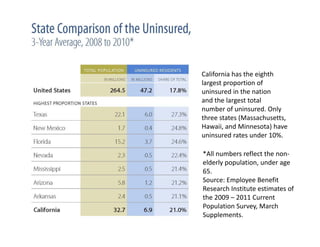
California has the eighth
largest proportion of
uninsured in the nation
and the largest total
number of uninsured. Only
three states (Massachusetts,
Hawaii, and Minnesota) have
uninsured rates under 10%.

*All numbers reflect the non‐
elderly population, under age 
65.
Source: Employee Benefit 
Research Institute estimates of 
the 2009 – 2011 Current 
Population Survey, March 
Supplements.
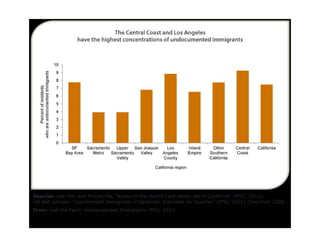
The Uninsured Unauthorized (5)
A recent report by the UC‐Berkeley Center for Labor 
Research and Education and the UCLA Center for 
Health Policy Research on California residents who 
will remain uninsured after the ACA takes effect 
found that:
• 66% of the remaining uninsured will be Latino;
• 60% of the remaining uninsured will have limited 
  English proficiency; and
• 62% of the remaining uninsured will live in 
  Southern California.
Poor Outreach
• The report also found that about 50% of those 
  still uninsured five years after the ACA takes 
  effect will qualify for coverage under the 
  Medi‐Cal expansion or for health benefit 
  exchange subsidies, but they will not be aware 
  that they qualify because of poor outreach. 
  Medi‐Cal is California's Medicaid program (5)
Clues (6)
• Uninsured about 18.5% of CA Population
• Uninsured immigrants with native born 
  children: 27.9%
• Uninsured natives with children: 12.9%
What is covered
             Essential Health Benefits
1.    Ambulatory patient services
2.    Emergency services
3.    Hospitalization
4.    Maternity and newborn care
5.    Mental health and substance use disorder services, 
      including behavioral health treatment
6.    Prescription drugs
7.    Rehabilitative and habilitative services and devices
8.    Laboratory services
9.    Preventive and wellness services and chronic disease 
      management
10.   Pediatric services, including oral and vision care
Plans
• Standardized plans ‐ Bronze, Silver, Gold, 
  Platinum (from 60‐40 to 90‐10 Premium‐
  Copay)
• No Rescissions, No Lifetime Limits & Restricted 
  Annual Limits
• Medical Loss Ratio, Consumers rebates, 80‐
  85% on healthcare and quality
• Elimination of the Medicare Part D doughnut 
  hole ($2,700 to $6,154)
Who Pays?
• Insurance model: the high cost of the sick 
  offset by low cost of the healthy
• Young adults (up to age 26) covered by 
  parents
• Emphasizes and pays for prevention
• Sets minimum benefit levels so health plans 
  compete with each other on cost and quality
• Creates a state run health benefit exchange 
  market structure for individuals and business
Reducing Healthcare Costs
       While Expanding Coverage
• Cover the healthy as well as the sick
• Wellness and prevention, early diagnosis
• Reductions in unnecessary testing and referrals
• Reductions in preventable emergency room visits 
  and hospitalizations
• Reductions in infections and adverse events in 
  hospitals
• Reductions in preventable readmissions, 
• Use of lower‐cost treatments, settings, and 
  providers
Plans are Income Tested
• Households earning less than 250 percent of the 
  federal poverty level can receive financial help if 
  they enroll in a Silver plan; the less income they 
  earn, the more financial assistance they can 
  receive. 
• For example, individuals earning between 150 to 
  250 percent of the federal poverty level can 
  expect to pay $20 to see their primary care 
  physician, while those earning 100 to 150 percent 
  would pay $4. 
How to Get Coverage
• Many employers will simply continue plans for 
  employees
• Employers with 50 or more FTE workers 
  required to provide health insurance or pay a 
  penalty
• Expands Medicaid (Medi‐Cal) up to 133% of 
  poverty ($14,404 indiv to $29, 327 family of 4)
• Health Benefits Exchange (Covered California)
• Accountable Care Organizations (ACOs)
Employers
• For employers without employee plans:
  – For businesses with 50 or fewer full time 
    employees, qualified plans available in Exchange
  – No penalties for 50 or less employers if health 
    coverage not offered
• Reactions
Employers With Over 50 FT Workers
• May have to pay a penalty if not providing 
  health insurance
• Doesn’t apply to employees working 30 hours 
  a week or less
• Reactions
Business Incentives
• Small Business Tax Credits:  2 million workers 
  get their insurance from an estimated 360,000 
  small employers 
• Early Retiree Reinsurance Program (ERRP) 
  partially reimburses employment‐based plans 
  for health benefits for early retirees and their 
  spouses, surviving spouses and dependents
• Health Care Exchanges Available to Small 
  Business
Sole Proprietors
• Health care reform ends discrimination by 
  insurance companies based on pre‐existing 
  conditions and gender. The new law also 
  eliminates lifetime caps, restricts annual caps 
  and ends the practices by which health 
  insurance companies retroactively end a 
  policy when someone becomes sick. (1)
Sole Proprietors
• Premium Subsidies and Cost Sharing 
  Credits (Starting in 2014) – Subsidies and 
  credits to lower premiums and cost‐sharing 
  requirements are available to individuals and 
  families with incomes below 400 percent of 
  the federal poverty line (below $88,000 a year 
  for a family of four) who purchase coverage in 
  the newly established exchanges. (1)
Health Benefits Exchange
          “Covered California”
• Quasi‐governmental organization, specifically 
  an "independent public entity not affiliated 
  with an agency or department.“
• Contracting with Plans: Contract with carriers 
  so as to provide health care coverage choices 
  that offer the optimal combination of choice, 
  value, quality, and service.”
Health Benefits Exchange
Essential Health Benefits: Legislation introduced 
in January 2012, would select the Kaiser small 
group HMO plan as the state’s benchmark plan 
(AB 1453/SB 951)
Exchange to offer Insurance Companies’ Bronze, 
Silver, Gold and Platinum plans
Health Benefits Exchange
Basic Health Program (BHP): Optional bridge 
program allows states to use federal funding to 
offer subsidized health insurance to adults with 
incomes between 139 and 200% of the federal 
poverty level (FPL) who would otherwise be eligible 
to purchase subsidized coverage through an 
Exchange. 
Legislation creating a BHP was initially introduced in 
2011, but in August 2012 the bill was held in
Committee, effectively tabling the legislation (SB 
703)
Health Benefits Exchange
Consumer Assistance and Outreach:  Employ Navigators to 
assist with education and enrollment activities.  CA will use 
two distinct types of Assisters registered and certified by the 
Exchange. 

Certified enrollment Assisters (Navigators) will be 
compensated by the Exchange and at a minimum will include, 
non‐profit organizations, community clinics, County Social 
Services offices employing Eligibility Workers, and labor 
unions. 

Direct Benefit Assisters, will not be paid by the Exchange and 
will include health insurance agents, hospitals, and providers. 
Health Benefits Exchange
Information Technology: Requires the creation 
of a single statewide application that will be 
available on paper and electronically for all 
systems and entities accepting and processing 
applications and eligibility. It also requires a 
simplified citizenship and identity verification at 
application and renewal and increased 
coordination with other public programs.
Accountable Care Organizations
               (ACOs)
• ACO is a network of hospitals, clinics, physician 
  practices and other providers who work together 
  to provide coordinated, integrated care for an 
  assigned population of individuals and who 
  receive financial compensation for meeting 
  specific patient outcomes.
• Goal: Reduce or control the growth of healthcare 
  costs while maintaining or improving the quality 
  of care
Accountable Care Organizations
               (ACOs)
• The core is effective primary care delivered 
  through a “medical home”
• Primary care organizations can transform
• Integrated coordinated care similar to the 
  HMO model
• Not surprising Kaiser picked as essential 
  benefit plan 
ACO Characteristics
• a strong primary care/medical home foundation
• multidisciplinary health care teams
• targeted care coordination interventions (focused 
  especially on individuals with multiple chronic 
  conditions)
• integration with behavioral health and substance 
  use treatment
• sophisticated information systems that include 
  electronic medical records 
• formal partnerships with “medical neighbors”
Role of Social Worker
• Social workers should be included in the 
  interdisciplinary care teams across a broad 
  array of health care settings
• Social workers are likely the only professionals 
  devoted to meeting the psychosocial needs of 
  patients and families
• Social workers extend the team to allow 
  members to participate at the top of their 
  licenses
Roles of Social Worker
• Clinical social workers – mental and behavioral 
  health services
• Medical social workers – care coordination 
  and case management, medically related 
  social services, patient and family education, 
  discharge planning, advance care planning, 
  community outreach and engagement
Roles of Social Worker
• Be a voice for social work in the health care 
  plan’s development of ACOs
• Advocate for comprehensive benefits 
  including psychosocial services
• Advocate for horizontal integration of health 
  and human services benefits
• Serve as a resource for identifying hard to 
  reach populations
Social Work Advocacy
NASW and California Deans and Directors got a social worker included 
on the California Workforce Investment Board, Health Workforce 
Development Council (8)
• Standardize, strengthen and expand curricula and training programs 
   to increase access and consistent competencies for Community 
   Health Workers/Promotores, Medical Assistants, Social Workers, 
   Nurses, Direct Care Workers and other workers.
• Change regulations to allow the services of Community Health 
   Workers/Promotores to be reimbursable with government and 
   private payers.
• Develop supportive payment structure and policies targeted at 
   increasing the attractiveness of primary care as a career path and 
   retention of primary care providers. 
• Ensure adequate payment for primary care and preventive services 
   with appropriate adjustments in payment incentives.
ACA Is Changing
• Check various websites for up to date changes 
  http://www.healthcare.gov/
  http://www.chcf.org/publications/2010/05/the‐
  affordable‐care‐act‐in‐california

• Continued political turmoil:
  – 27 states are expanding Medicaid, 16 are not and 8 
    are undecided (Feb 2013)
  – 17 states have set up exchanges, 27 have not
  – Some continue to seek repeal or delay
Resources
1.   http://www.cfra.org/node/2807
2.   www.socialworkers.org
3.   http://www.healthexchange.ca.gov
4.   http://www.coveredca.com/
5.   http://www.californiahealthline.org/articles/
     2012/10/24/california‐considers‐strategies‐
     for‐treating‐uninsured‐immigrants.aspx
Resources
6. http://www.cis.org/california‐education
7. http://www.ppic.org/main/publication_show
   .asp?i=818
8. http://www.cwib.ca.gov/res/docs/special_co
   mmittees/hwdc/meeting_materials/2013/H
   WDC%20Report%20‐
   %20Draft%20012113.pdf

Affordable care act ver 2