































PROMOTING
RUFFY S. NAYRE, RSW
Gmail:ruffynayre26@gmail.com
•Learn the Importance of
Personal Integrity
•Learn effective ways to
promote integrity in the
workplace
•Understanding Social Work
Profession Integrity
Objective
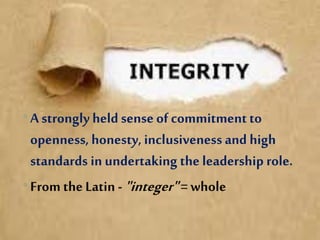
•A strongly held sense of commitmentto
openness, honesty, inclusiveness and high
standards in undertaking the leadership role.
•From theLatin -"integer"= whole
•means you stick toyour personal code
of conduct. You stick to what you
decide is right and wrong.
•When you live with integrity, you
succeed. You are open and honest.
Your life is uncomplicated and less
stressful.
•When you havegood integrity you haveno
reason to lie. You can look at yourself in
the mirror. You have nothing to hide.
According to L.Ron Hubbard….
•"What is personal integrity?
•"Personal integrity is knowing what
you know—
•"What you know is what you know—
•"And to have the courage to know
and say what you have observed.
•"And that is integrity
•"And there is no other integrity."
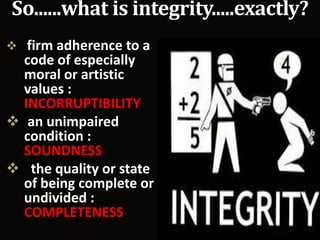
So......what is integrity.....exactly?
 firm adherence to a
code of especially
moral or artistic
values :
INCORRUPTIBILITY
 an unimpaired
condition :
SOUNDNESS
 the quality or state
of being complete or
undivided :
COMPLETENESS
10
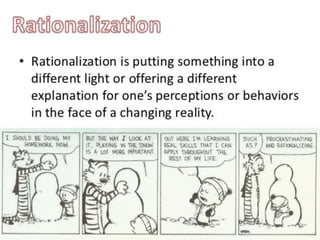
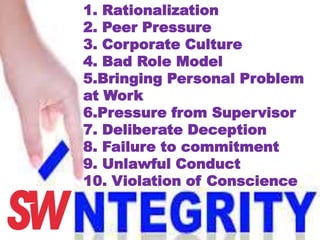
1. Rationalization
2. Peer Pressure
3. Corporate Culture
4. Bad Role Model
5.Bringing Personal Problem
at Work
6.Pressure from Supervisor
7. Deliberate Deception
8. Failure to commitment
9. Unlawful Conduct
10. Violation of Conscience
PEER PRESSURE
Bringing Personal
Problem at Work
Pressure from Supervisor
Deliberate Deception
FAILURE TO
COMMITMENT
UNLAWFUL CONDUCT
VIOLATING CONSCIENCE
1. Rationalization
2. Peer Pressure
3. Corporate Culture
4. Bad Role Model
5.Bringing Personal Problem
at Work
6.Pressure from Supervisor
7. Deliberate Deception
8. Failure to commitment
9. Unlawful Conduct
10. Violation of Conscience
PROMOTING
WORKING PLACE
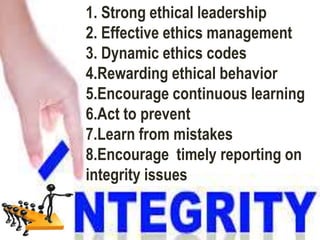
1. Strong ethical leadership
2. Effective ethics management
3. Dynamic ethics codes
4.Rewarding ethical behavior
5.Encourage continuous learning
6.Act to prevent
7.Learn from mistakes
8.Encourage timely reporting on
integrity issues
Where can Social Worker Base
its INTEGRITY?
CODEOFETHICS
•In the inherent dignity and worth of
all persons, emanating from a
Supreme Being who directs our
actions of love for one another;
•That every human being has natural
and social rights, capacities and
responsibilities to develop his full
potentials as a human being;
CODEOFETHICS
• In the human being’s capacity to change
and recognize the value of unity in
diversity, individual differences and
pluralism in society;
• In free men and women living in a free
society where poverty, in all its forms, is
neither a fate nor a punishment, but is
condition that can and must be changed;
CODEOFETHICS
• In the family as the basic unit of society
and its vital role in the growth and
development of the individual, the family
system, and community;
• That the government, the private sector
and the public have a joint responsibility
to promote social justice and to ensure
political, economic and social well-being
of all people;
CODEOFETHICS
•In the role of social workers as
agents and advocates of change
and in the promotion of
professionalism, responsibility and
accountability; and,
•That our professional practice is
deeply rooted in our cultural values,
•
To conduct myself in a manner
consistent with the philosophy,
principles, values, and beliefs of
the social work profession;
To act at all times with honesty,
openness, and transparency in
all my professional transactions;
SELF AND PROFESSION
In the human being’s capacity to
change and recognize the value of
unity in diversity, individual
differences and pluralism in society;
In free men and women living in a
free society where poverty, in all its
forms, is neither a fate nor a
punishment, but is condition that
can and must be changed;
SELF AND PROFESSION
In the family as the basic unit of society
and its vital role in the growth and
development of the individual, the
family system, and community;
That the government, the private sector
and the public have a joint
responsibility to promote social justice
and to ensure political, economic and
social well-being of all people;
SELF AND PROFESSION
In the role of social workers as
agents and advocates of change
and in the promotion of
professionalism, responsibility
and accountability; and,
That our professional practice is
deeply rooted in our cultural
values,
SELF AND PROFESSION
To uphold the basic human rights of
clients and serve them without
discrimination;
To accept primary responsibility and
accountability to clients, respecting
their right to self-determination and
observe confidentiality in all my
dealings with them;
RELATIVE TO CLIENTS
To seek out the marginalized and
ensure equal access to the resources,
services and opportunities required
to meet basic needs; and,
To expand choice and opportunity
for all persons, with special regard
for disadvantaged or oppressed
groups or persons.
RELATIVE TO CLIENTS
To acknowledge and respect
the professional expertise of
other disciplines, extending
all necessary cooperation
that will enhance effective
services;
RELATIVE TO COLLEAGUES
To bring any violation of professional
ethics and standards to the attention
of the appropriate bodies inside and
outside the profession, and ensure
that relevant clients are properly
involved; and
To advocate with legislative and
policy bodies for the welfare of all
colleagues
RELATIVE TO COLLEAGUES
Social workers must adhere to the ethical
principles on integrity on maintaining a
high code of behavior, honesty, trust
worthiness, being respectful, and having a
sense of justice and fairness. We do this
by Displaying a certain amount of sincerity
and morals when working with clients
maintaining a sense of integrity to your
profession, values, ethics, and principles
when social workers are challenged with
ethical situations.
Understanding that clients will
have different values and beliefs
that are different from our own
and as social workers we have to
be open to learning about our
clients differences and still behave
in an ethical manner with them.
keeping our word Upholding the
highest level of morality Being
honest
Your boss is asking you to include
her family member as
beneficiaries in the program,
where in fact the policy guidelines
stated that any family members of
working employees should not be
qualified as beneficiaries of the
program. What should you do?
CASE SCENARIO
Why is integrity is
important?
What are the benefits of
having integrity present in
the workplace?
Consequences of not
having workplace integrity?
Ways of promoting
workplace integrity?
Ways to promote social
worker with integrity?
Integrity means
that there is a
common ground
between our
actions and our
words.
CONCLUSION
Workplace integrity is
necessary in every
organization.
CONCLUSION
Consider strong ethical
leadership, effective ethics
management, dynamics
ethics codes and rewarding
ethical behavior as part of
effectively promoting
workplace integrity.
CONCLUSION
Social workers must adhere to the ethical
principles of integrity on maintaining a high
code of behavior, honesty, trust worthiness,
being respectful, and having a sense of
justice and fairness. Being honest and
having integrity can be a guide for
everything that one does. What to do when
no one is watching, knowing the difference
between doing the right thing and wrong
thing, and keeping your word are all
examples of integrity.
CONCLUSION
ANY
QUESTION?
LET ME PRESENT THIS:
END

Integrity in social work profession

  • 1.
    PROMOTING RUFFY S. NAYRE,RSW Gmail:ruffynayre26@gmail.com
  • 4.
    •Learn the Importanceof Personal Integrity •Learn effective ways to promote integrity in the workplace •Understanding Social Work Profession Integrity Objective
  • 5.
    •A strongly heldsense of commitmentto openness, honesty, inclusiveness and high standards in undertaking the leadership role. •From theLatin -"integer"= whole
  • 6.
    •means you sticktoyour personal code of conduct. You stick to what you decide is right and wrong.
  • 7.
    •When you livewith integrity, you succeed. You are open and honest. Your life is uncomplicated and less stressful.
  • 8.
    •When you havegoodintegrity you haveno reason to lie. You can look at yourself in the mirror. You have nothing to hide.
  • 9.
    According to L.RonHubbard…. •"What is personal integrity? •"Personal integrity is knowing what you know— •"What you know is what you know— •"And to have the courage to know and say what you have observed. •"And that is integrity •"And there is no other integrity."
  • 10.
    So......what is integrity.....exactly? firm adherence to a code of especially moral or artistic values : INCORRUPTIBILITY  an unimpaired condition : SOUNDNESS  the quality or state of being complete or undivided : COMPLETENESS
  • 12.
  • 13.
    1. Rationalization 2. PeerPressure 3. Corporate Culture 4. Bad Role Model 5.Bringing Personal Problem at Work 6.Pressure from Supervisor 7. Deliberate Deception 8. Failure to commitment 9. Unlawful Conduct 10. Violation of Conscience
  • 15.
  • 18.
  • 19.
  • 20.
  • 21.
  • 22.
  • 23.
  • 24.
    1. Rationalization 2. PeerPressure 3. Corporate Culture 4. Bad Role Model 5.Bringing Personal Problem at Work 6.Pressure from Supervisor 7. Deliberate Deception 8. Failure to commitment 9. Unlawful Conduct 10. Violation of Conscience
  • 25.
  • 26.
    1. Strong ethicalleadership 2. Effective ethics management 3. Dynamic ethics codes 4.Rewarding ethical behavior 5.Encourage continuous learning 6.Act to prevent 7.Learn from mistakes 8.Encourage timely reporting on integrity issues
  • 28.
    Where can SocialWorker Base its INTEGRITY?
  • 29.
    CODEOFETHICS •In the inherentdignity and worth of all persons, emanating from a Supreme Being who directs our actions of love for one another; •That every human being has natural and social rights, capacities and responsibilities to develop his full potentials as a human being;
  • 30.
    CODEOFETHICS • In thehuman being’s capacity to change and recognize the value of unity in diversity, individual differences and pluralism in society; • In free men and women living in a free society where poverty, in all its forms, is neither a fate nor a punishment, but is condition that can and must be changed;
  • 31.
    CODEOFETHICS • In thefamily as the basic unit of society and its vital role in the growth and development of the individual, the family system, and community; • That the government, the private sector and the public have a joint responsibility to promote social justice and to ensure political, economic and social well-being of all people;
  • 32.
    CODEOFETHICS •In the roleof social workers as agents and advocates of change and in the promotion of professionalism, responsibility and accountability; and, •That our professional practice is deeply rooted in our cultural values, •
  • 33.
    To conduct myselfin a manner consistent with the philosophy, principles, values, and beliefs of the social work profession; To act at all times with honesty, openness, and transparency in all my professional transactions; SELF AND PROFESSION
  • 34.
    In the humanbeing’s capacity to change and recognize the value of unity in diversity, individual differences and pluralism in society; In free men and women living in a free society where poverty, in all its forms, is neither a fate nor a punishment, but is condition that can and must be changed; SELF AND PROFESSION
  • 35.
    In the familyas the basic unit of society and its vital role in the growth and development of the individual, the family system, and community; That the government, the private sector and the public have a joint responsibility to promote social justice and to ensure political, economic and social well-being of all people; SELF AND PROFESSION
  • 36.
    In the roleof social workers as agents and advocates of change and in the promotion of professionalism, responsibility and accountability; and, That our professional practice is deeply rooted in our cultural values, SELF AND PROFESSION
  • 37.
    To uphold thebasic human rights of clients and serve them without discrimination; To accept primary responsibility and accountability to clients, respecting their right to self-determination and observe confidentiality in all my dealings with them; RELATIVE TO CLIENTS
  • 38.
    To seek outthe marginalized and ensure equal access to the resources, services and opportunities required to meet basic needs; and, To expand choice and opportunity for all persons, with special regard for disadvantaged or oppressed groups or persons. RELATIVE TO CLIENTS
  • 39.
    To acknowledge andrespect the professional expertise of other disciplines, extending all necessary cooperation that will enhance effective services; RELATIVE TO COLLEAGUES
  • 40.
    To bring anyviolation of professional ethics and standards to the attention of the appropriate bodies inside and outside the profession, and ensure that relevant clients are properly involved; and To advocate with legislative and policy bodies for the welfare of all colleagues RELATIVE TO COLLEAGUES
  • 41.
    Social workers mustadhere to the ethical principles on integrity on maintaining a high code of behavior, honesty, trust worthiness, being respectful, and having a sense of justice and fairness. We do this by Displaying a certain amount of sincerity and morals when working with clients maintaining a sense of integrity to your profession, values, ethics, and principles when social workers are challenged with ethical situations.
  • 42.
    Understanding that clientswill have different values and beliefs that are different from our own and as social workers we have to be open to learning about our clients differences and still behave in an ethical manner with them. keeping our word Upholding the highest level of morality Being honest
  • 43.
    Your boss isasking you to include her family member as beneficiaries in the program, where in fact the policy guidelines stated that any family members of working employees should not be qualified as beneficiaries of the program. What should you do? CASE SCENARIO
  • 44.
    Why is integrityis important? What are the benefits of having integrity present in the workplace?
  • 45.
    Consequences of not havingworkplace integrity? Ways of promoting workplace integrity? Ways to promote social worker with integrity?
  • 46.
    Integrity means that thereis a common ground between our actions and our words. CONCLUSION
  • 47.
    Workplace integrity is necessaryin every organization. CONCLUSION
  • 48.
    Consider strong ethical leadership,effective ethics management, dynamics ethics codes and rewarding ethical behavior as part of effectively promoting workplace integrity. CONCLUSION
  • 49.
    Social workers mustadhere to the ethical principles of integrity on maintaining a high code of behavior, honesty, trust worthiness, being respectful, and having a sense of justice and fairness. Being honest and having integrity can be a guide for everything that one does. What to do when no one is watching, knowing the difference between doing the right thing and wrong thing, and keeping your word are all examples of integrity. CONCLUSION
  • 50.
  • 51.
  • 53.

Editor's Notes

  • #16 Peer Presure-social pressure by members of one's peer group to take a certainaction, adopt certain values, or otherwise conform in order to be accepted. Dictionary.com
  • #17 Corporate culture refers to the beliefs and behaviors that determine how a company's employees and management interact and handle outside business transactions. Often,corporate culture is implied, not expressly defined, and develops organically over time from the cumulative traits of the people the company hires. Corporate Culture - Investopedia
  • #21 Deliberate Deception or Bluffing-for instance making false data just to make a good impression from your boss
  • #22 Failure to Commitment- Instead of attending diligently the participants don’t listened.
  • #23 Quarrelling with Your Boss
  • #24 Violating Conscience – accepting bribe.