Code of Ethics
What is Ethics?
Ethics is a set of principles and values that guide the behavior of individuals or
organisations. In social work, ethics ensure that practitioners act according to professional
standards and provide quality services to their clients.
Major types of Ethics
Universalism
Universalism in ethics is the idea that
certain ethical principles and values are
applicable to all people, regardless of
their culture or background.
• For example, according to universalist
ethics social workers should respect
human dignity and promote social
justice regardless of race, gender or
other factors.
Deontological
• Deontological ethics focus on the
morality of an action, such as whether
it is right or wrong to lie in a particular
situation.
• According to deontological ethics, a
social worker may need to decide if it
is morally acceptable for them keep
confidential information about their
client private even when required by
law disclose it.
Situational ethics
• Situational ethics is an ethical framework
that takes into account the context of a
particular situation when making
decisions.
• For Example situational ethics would
allow them to make their decision based
on all relevant factors such as potential
risks or benefits associated with each
option in order to determine what course
of action would be best suited for this
specific situation.
Consequentialist ethics
• Consequentialist ethics consider the
consequences of an action and weigh up
which outcome will have more positive
results overall
• For example, if a social worker had two
clients with conflicting needs and interests
they may need to decide which one should
take priority based on what will result in
the most beneficial outcome for both
parties involved using consequentialist
ethics.
Code of Ethics
“Codes of Ethics are documents that aim to identify the broad values,
principles and standards of ethical conduct on which a particular profession is
based” (Bowles, Collingridge, Curry & Valentine 2006, pp. 75, 76)
Purpose
 Professional standards: A code of ethics sets professional standards for social workers, establishing
the core values, principles, and ethical standards that guide their practice.
 Client protection: Social workers work with vulnerable populations, and a code of ethics helps to
protect clients from exploitation, harm, and other forms of unethical behavior.
 Accountability: A code of ethics promotes accountability among social workers, ensuring they are
responsible for their actions and held to a high standard of professional conduct.
 Professional identity: A code of ethics helps to define the professional identity of social workers,
highlighting the unique role they play in promoting social justice, human rights, and social change.
 Continuing education: A code of ethics serves as a guide for ongoing professional development,
helping social workers to stay current on ethical issues, emerging trends, and best practices in the
field.
 Promoting ethical decision-making: The code of ethics promotes ethical decision-
making in social work practice. It provides social workers with a framework for
considering ethical dilemmas and making decisions that are in the best interests of
their clients.
History of the NASW Code of Ethics
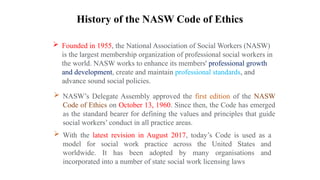
 NASW’s Delegate Assembly approved the first edition of the NASW
Code of Ethics on October 13, 1960. Since then, the Code has emerged
as the standard bearer for defining the values and principles that guide
social workers’ conduct in all practice areas.
 With the latest revision in August 2017, today’s Code is used as a
model for social work practice across the United States and
worldwide. It has been adopted by many organisations and
incorporated into a number of state social work licensing laws
 Founded in 1955, the National Association of Social Workers (NASW)
is the largest membership organization of professional social workers in
the world. NASW works to enhance its members' professional growth
and development, create and maintain professional standards, and
advance sound social policies.
The Original NASW Code of Ethics
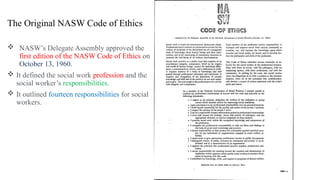
 NASW’s Delegate Assembly approved the
first edition of the NASW Code of Ethics on
October 13, 1960.
 It defined the social work profession and the
social worker’s responsibilities.
 It outlined fourteen responsibilities for social
workers.
The First Revision
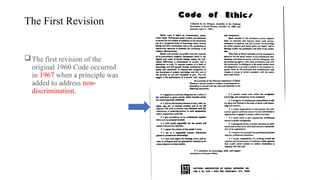
The first revision of the
original 1960 Code occurred
in 1967 when a principle was
added to address non-
discrimination.
Revision of the Code (1979)
 Represented a significant revision to include 6 sections of standards, consisting of 82
principles and a preamble.
 It set forth principles related to the social workers’ ethical responsibility to clients,
colleagues, employers and employing organisations, the social work profession and
society.
 Introduced the enforcement of ethical practices among social workers using the code
as a basis and standard for the everyday conduct of social workers.
Changes During 1990s
 In 1990, the code was modified following an inquiry by the us federal trade commission. this revision
focused on principles related to solicitation of clients, fee setting and accepting compensation for
referrals.
 In 1993, five new principles were added to the code. They included regulations related to social worker
impairment and dual relationships.
 The last major revision of the NASW code of ethics was in 1996. The need for a new code emerged because the
profession developed a more comprehensive understanding of ethical issues not addressed in the 1979 code.
Furthermore, developments in health care, litigations, and publicity in the media all forced the profession to pay
more attention to ethics.
 the 1999 revision was minor and clarified circumstances in which social workers may need to disclose
confidential information without a client’s consent.
Ethical Standards
 Ethical standards are rules that social workers must follow to ensure that they are behaving
responsibly and helping their clients in the best way possible.
 These standards cover social workers' responsibilities to their clients, colleagues, and
society.
 Some standards are rules social workers must follow, while others are ideals they should
aspire to.
 Each standard's enforceability depends on the situation, and it's up to professionals to
decide whether they have been violated.
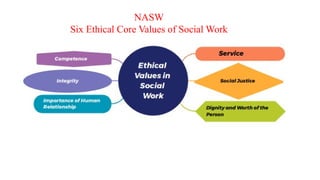
NASW
Six Ethical Core Values of Social Work
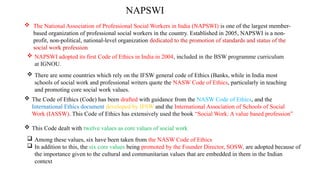
 NAPSWI adopted its first Code of Ethics in India in 2004, included in the BSW programme curriculum
at IGNOU.
 The National Association of Professional Social Workers in India (NAPSWI) is one of the largest member-
based organization of professional social workers in the country. Established in 2005, NAPSWI is a non-
profit, non-political, national-level organization dedicated to the promotion of standards and status of the
social work profession
 There are some countries which rely on the IFSW general code of Ethics (Banks, while in India most
schools of social work and professional writers quote the NASW Code of Ethics, particularly in teaching
and promoting core social work values.
 The Code of Ethics (Code) has been drafted with guidance from the NASW Code of Ethics, and the
International Ethics document developed by IFSW and the International Association of Schools of Social
Work (IASSW). This Code of Ethics has extensively used the book “Social Work: A value based profession”
 This Code dealt with twelve values as core values of social work
 Among these values, six have been taken from the NASW Code of Ethics
 In addition to this, the six core values being promoted by the Founder Director, SOSW, are adopted because of
the importance given to the cultural and communitarian values that are embedded in them in the Indian
context
NAPSWI
12 Core Values of Social work Practice in India
Service to Humanity
Self-sacrifice based on the ideal of the
brotherhood of humanity.
 Social workers must prioritise the needs
of others ahead of their interests
provide remedial, developmental,
emotional, and supportive services to
individuals, groups, families, and
communities.
Additionally, social workers must extend
every possible service to the country and
its policy makers for formulating people-
oriented welfare policies.
Social Justice
• As change agents, social workers must
challenge
injustices in the society
• Social workers must pursue for fair
distribution of
resources
• Social workers must challenge oppressive
and
unjust policies and practices by drawing the
attention of those in power
 This concept in social work
emphasizes that all individuals
have inherent worth and dignity,
regardless of their background or
circumstances.
 Social workers must treat each
client with respect, valuing their
autonomy and right to make their
own choices, without judgement or
discrimination.
Respect for Dignity and Worth of the
person
Importance of Human Relationship
 Social workers prioritize building strong,
respectful relationships with their clients,
while maintaining professional boundaries.
 They recognize the value of understanding
their clients' concerns and emotions and work
towards fostering warm and healthy
relationships.
 Social workers must not abuse their clients'
trust or use their position for personal gain.
 They must also be accountable for their
actions, recognize their mistakes and strive
towards practicing accepted social work
principles.The
 Social workers must continuously
improve their competencies to
keep up with the constantly
changing needs of their clients and
the society.
 It is important for social workers to
maintain competence in order to
provide ethical and effective
services to their clients.
Competence Integrity
 It refers to maintaining high standards of
behavior, practicing impartiality, avoiding
personal manipulation of clients, setting
limitations in personal relationships, and
being accountable for one's judgments and
actions.
 In social work, hard work is a
significant value that includes
being punctual, disciplined,
culturally sensitive, and willing to
continuously learn and modify
professional behaviour
Hard Work Teachership
Teachership is a value in social work that
promotes the idea of being a mentor, philosopher,
and guide to clients or service seekers.
 This commitment involves
refraining from unhealthy
behaviors that could affect the
values and standards of the
profession,
 Being honest with finances and
accounts.
 It also requires a dedication to
enhancing the professional status
of social work by contributing to
the theoretical base, research, and
evidence-based practices.
Loyalty to profession Cultural sensitivity
 Cultural sensitivity in social work means
respecting and valuing cultural differences
and diversity of clients.
 Social workers must have specific knowledge
of culturally minority groups and refrain from
imposing their beliefs on the clients.
 They should promote culturally competent
practice when working with different ethnic,
cultural, and religious groups.
 The value of patriotism in social
work emphasizes the importance
of being loyal and dedicated to the
growth and development of one's
country, while respecting
democratic processes and the
rights enshrined in the constitution.
 Social workers should also have
accurate knowledge about the
profile of the client's country and
culture, and should approach
individuals and communities
without discrimination.
Patriotism Responsibility and commitment
Social workers must take responsibility for their
actions and commit to upholding ethical
principles in their profession.
This includes publishing their experiences,
seeking membership in professional associations,
and being culturally aware and sensitive to their
clients.
They must also imbibe the value of patriotism
and be loyal to their country, while also
being non-discriminatory in their approach to
individuals, families, groups, and communities.

Thank You

Social Work NASW Code of Ethics & values.pptx

  • 1.
  • 2.
    What is Ethics? Ethicsis a set of principles and values that guide the behavior of individuals or organisations. In social work, ethics ensure that practitioners act according to professional standards and provide quality services to their clients.
  • 3.
    Major types ofEthics Universalism Universalism in ethics is the idea that certain ethical principles and values are applicable to all people, regardless of their culture or background. • For example, according to universalist ethics social workers should respect human dignity and promote social justice regardless of race, gender or other factors. Deontological • Deontological ethics focus on the morality of an action, such as whether it is right or wrong to lie in a particular situation. • According to deontological ethics, a social worker may need to decide if it is morally acceptable for them keep confidential information about their client private even when required by law disclose it.
  • 4.
    Situational ethics • Situationalethics is an ethical framework that takes into account the context of a particular situation when making decisions. • For Example situational ethics would allow them to make their decision based on all relevant factors such as potential risks or benefits associated with each option in order to determine what course of action would be best suited for this specific situation. Consequentialist ethics • Consequentialist ethics consider the consequences of an action and weigh up which outcome will have more positive results overall • For example, if a social worker had two clients with conflicting needs and interests they may need to decide which one should take priority based on what will result in the most beneficial outcome for both parties involved using consequentialist ethics.
  • 5.
    Code of Ethics “Codesof Ethics are documents that aim to identify the broad values, principles and standards of ethical conduct on which a particular profession is based” (Bowles, Collingridge, Curry & Valentine 2006, pp. 75, 76)
  • 6.
    Purpose  Professional standards:A code of ethics sets professional standards for social workers, establishing the core values, principles, and ethical standards that guide their practice.  Client protection: Social workers work with vulnerable populations, and a code of ethics helps to protect clients from exploitation, harm, and other forms of unethical behavior.  Accountability: A code of ethics promotes accountability among social workers, ensuring they are responsible for their actions and held to a high standard of professional conduct.  Professional identity: A code of ethics helps to define the professional identity of social workers, highlighting the unique role they play in promoting social justice, human rights, and social change.  Continuing education: A code of ethics serves as a guide for ongoing professional development, helping social workers to stay current on ethical issues, emerging trends, and best practices in the field.  Promoting ethical decision-making: The code of ethics promotes ethical decision- making in social work practice. It provides social workers with a framework for considering ethical dilemmas and making decisions that are in the best interests of their clients.
  • 7.
    History of theNASW Code of Ethics  NASW’s Delegate Assembly approved the first edition of the NASW Code of Ethics on October 13, 1960. Since then, the Code has emerged as the standard bearer for defining the values and principles that guide social workers’ conduct in all practice areas.  With the latest revision in August 2017, today’s Code is used as a model for social work practice across the United States and worldwide. It has been adopted by many organisations and incorporated into a number of state social work licensing laws  Founded in 1955, the National Association of Social Workers (NASW) is the largest membership organization of professional social workers in the world. NASW works to enhance its members' professional growth and development, create and maintain professional standards, and advance sound social policies.
  • 8.
    The Original NASWCode of Ethics  NASW’s Delegate Assembly approved the first edition of the NASW Code of Ethics on October 13, 1960.  It defined the social work profession and the social worker’s responsibilities.  It outlined fourteen responsibilities for social workers.
  • 9.
    The First Revision Thefirst revision of the original 1960 Code occurred in 1967 when a principle was added to address non- discrimination.
  • 10.
    Revision of theCode (1979)  Represented a significant revision to include 6 sections of standards, consisting of 82 principles and a preamble.  It set forth principles related to the social workers’ ethical responsibility to clients, colleagues, employers and employing organisations, the social work profession and society.  Introduced the enforcement of ethical practices among social workers using the code as a basis and standard for the everyday conduct of social workers.
  • 11.
    Changes During 1990s In 1990, the code was modified following an inquiry by the us federal trade commission. this revision focused on principles related to solicitation of clients, fee setting and accepting compensation for referrals.  In 1993, five new principles were added to the code. They included regulations related to social worker impairment and dual relationships.  The last major revision of the NASW code of ethics was in 1996. The need for a new code emerged because the profession developed a more comprehensive understanding of ethical issues not addressed in the 1979 code. Furthermore, developments in health care, litigations, and publicity in the media all forced the profession to pay more attention to ethics.  the 1999 revision was minor and clarified circumstances in which social workers may need to disclose confidential information without a client’s consent.
  • 12.
    Ethical Standards  Ethicalstandards are rules that social workers must follow to ensure that they are behaving responsibly and helping their clients in the best way possible.  These standards cover social workers' responsibilities to their clients, colleagues, and society.  Some standards are rules social workers must follow, while others are ideals they should aspire to.  Each standard's enforceability depends on the situation, and it's up to professionals to decide whether they have been violated.
  • 14.
    NASW Six Ethical CoreValues of Social Work
  • 15.
     NAPSWI adoptedits first Code of Ethics in India in 2004, included in the BSW programme curriculum at IGNOU.  The National Association of Professional Social Workers in India (NAPSWI) is one of the largest member- based organization of professional social workers in the country. Established in 2005, NAPSWI is a non- profit, non-political, national-level organization dedicated to the promotion of standards and status of the social work profession  There are some countries which rely on the IFSW general code of Ethics (Banks, while in India most schools of social work and professional writers quote the NASW Code of Ethics, particularly in teaching and promoting core social work values.  The Code of Ethics (Code) has been drafted with guidance from the NASW Code of Ethics, and the International Ethics document developed by IFSW and the International Association of Schools of Social Work (IASSW). This Code of Ethics has extensively used the book “Social Work: A value based profession”  This Code dealt with twelve values as core values of social work  Among these values, six have been taken from the NASW Code of Ethics  In addition to this, the six core values being promoted by the Founder Director, SOSW, are adopted because of the importance given to the cultural and communitarian values that are embedded in them in the Indian context NAPSWI
  • 16.
    12 Core Valuesof Social work Practice in India Service to Humanity Self-sacrifice based on the ideal of the brotherhood of humanity.  Social workers must prioritise the needs of others ahead of their interests provide remedial, developmental, emotional, and supportive services to individuals, groups, families, and communities. Additionally, social workers must extend every possible service to the country and its policy makers for formulating people- oriented welfare policies. Social Justice • As change agents, social workers must challenge injustices in the society • Social workers must pursue for fair distribution of resources • Social workers must challenge oppressive and unjust policies and practices by drawing the attention of those in power
  • 17.
     This conceptin social work emphasizes that all individuals have inherent worth and dignity, regardless of their background or circumstances.  Social workers must treat each client with respect, valuing their autonomy and right to make their own choices, without judgement or discrimination. Respect for Dignity and Worth of the person Importance of Human Relationship  Social workers prioritize building strong, respectful relationships with their clients, while maintaining professional boundaries.  They recognize the value of understanding their clients' concerns and emotions and work towards fostering warm and healthy relationships.  Social workers must not abuse their clients' trust or use their position for personal gain.  They must also be accountable for their actions, recognize their mistakes and strive towards practicing accepted social work principles.The
  • 18.
     Social workersmust continuously improve their competencies to keep up with the constantly changing needs of their clients and the society.  It is important for social workers to maintain competence in order to provide ethical and effective services to their clients. Competence Integrity  It refers to maintaining high standards of behavior, practicing impartiality, avoiding personal manipulation of clients, setting limitations in personal relationships, and being accountable for one's judgments and actions.
  • 19.
     In socialwork, hard work is a significant value that includes being punctual, disciplined, culturally sensitive, and willing to continuously learn and modify professional behaviour Hard Work Teachership Teachership is a value in social work that promotes the idea of being a mentor, philosopher, and guide to clients or service seekers.
  • 20.
     This commitmentinvolves refraining from unhealthy behaviors that could affect the values and standards of the profession,  Being honest with finances and accounts.  It also requires a dedication to enhancing the professional status of social work by contributing to the theoretical base, research, and evidence-based practices. Loyalty to profession Cultural sensitivity  Cultural sensitivity in social work means respecting and valuing cultural differences and diversity of clients.  Social workers must have specific knowledge of culturally minority groups and refrain from imposing their beliefs on the clients.  They should promote culturally competent practice when working with different ethnic, cultural, and religious groups.
  • 21.
     The valueof patriotism in social work emphasizes the importance of being loyal and dedicated to the growth and development of one's country, while respecting democratic processes and the rights enshrined in the constitution.  Social workers should also have accurate knowledge about the profile of the client's country and culture, and should approach individuals and communities without discrimination. Patriotism Responsibility and commitment Social workers must take responsibility for their actions and commit to upholding ethical principles in their profession. This includes publishing their experiences, seeking membership in professional associations, and being culturally aware and sensitive to their clients. They must also imbibe the value of patriotism and be loyal to their country, while also being non-discriminatory in their approach to individuals, families, groups, and communities.
  • 22.