
The California STEM Summit 2014
CSU’s Commitment to Preparing and Developing WorldClass STEM Teachers: A Model of Collaboration and
Excellence in Long Beach
Dr. Beverly Young, The California State University
Dr. Lisa Isbell, CSU Long Beach
Dr. Jared R. Stallones, CSU Long Beach
Dr. Laura Henriques, CSU Long Beach
Lori Grace, Long Beach Unified School District
Dr. Marquita Grenot-Scheyer, CSU Long Beach
Dr. Beverly Young
Assistant Vice Chancellor for Teacher
Education and Public School Programs
California State University
Urban Teaching Academy
STEM Professional Growth Training

California State University, Long Beach
Lisa Isbell, Ed.D.
Multiple Subject Credential Program Coordinator
UTEACH Program
(Urban Teaching Academy)

The UTEACH (Urban Teaching Academy) pathway is a unique
opportunity for students to combine pedagogy and practice in
a personalized credential program designed to fully prepare
future teachers in a hands-on supportive school
setting. Program features include the following:
•
•
•
•
•

•

UTEACH is a yearlong school/university residency program.
UTEACH teaching methods courses are held at school sites
working with children in real classroom settings.
UTEACH offers personalized attention from University faculty
and school based personnel.
UTEACH course work and student teaching are prearranged, and linked to real teaching in a real classroom.
UTEACH faculty support, instruct and advise students on
site in a school based, personalized setting.
UTEACH future teachers are taught to teach by teaching
children in a guided clinical classroom setting.
STEM Program Goal

Funded by the S.J. Bechtel Jr.
Foundation, the goal of the
Science, Technology, PreEngineering and Mathematics
professional development program
is to prepare elementary teachers
in a model, scalable, STEM-rich
clinical setting.
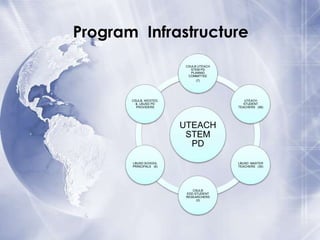
Program Infrastructure
CSULB UTEACH
STEM PD
PLANNIG
COMMITTEE
(7)

CSULB, WESTED,
& LBUSD PD
PROVIDERS

UTEACH
STUDENT
TEACHERS (58)

UTEACH
STEM
PD
LBUSD SCHOOL
PRINCIPALS (6)

LBUSD MASTER
TEACHERS (35)

CSULB
EDD STUDENT
RESEARCHERS
(3)
Program Objectives
1.

The overarching goal of this project is to change
the culture of STEM (Science, Technology, PreEngineering & Mathematics) teaching in
elementary schools from the ground up. The
program focuses on The Next Generation
Science Standards and the Common Core State
Standards for Mathematics with technology and
engineering providing context.

2.

Create a direct pipeline of highly qualified
elementary STEM instructors who will be able to
address the deep concern about not having
enough scientists, engineers, and
mathematicians to keep the United States in the
forefront of research, innovation, and
technology.

3.

Our approach is to train elementary teachers
(prospective and practicing) to teach the STEM
disciplines in an integrated, inquiry-focused way
so students understand science and
mathematics in a real-world context.
Preparing Elementary Teachers in a Model, Scalable,
STEM-Rich Clinical Setting
Over a period of two years, the program has worked
to accomplish the following:
1)

2)

3)
4)
5)

6)

intensively train and hope to inspire 150 highly
effective pre-service and in-service elementary
STEM teachers in a residency setting in four
elementary schools in LBUSD
employ a “co-teaching” model involving current
and future teachers together in teaching STEM
subjects
integrate STEM content across the teacherpreparation curriculum
provide opportunities for elementary teachers to
attend state STEM conferences
involve four CSULB doctoral students in studying,
evaluating and disseminating the model
through dissertation work
creating a handbook to serve as a resource for
establishing similar school/university STEM
education programs across California.
STEM Education PD Curriculum
This project provides professional development and
support to 30 master teachers, grades K-5, and their
60 student teachers each year. The Professional
Development was collaboratively developed and
facilitated by CSULB’s Colleges of Education and
Natural Sciences & Mathematics and the WestEd/K12 Alliance. The model integrates curriculum from The
Boston Museum of Science’s, Engineering is
Elementary program and specific topics addressed
include:

•
•
•
•
•
•
•
•

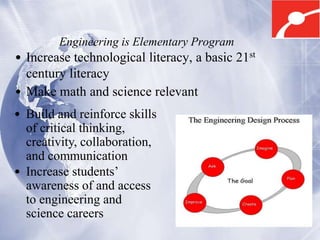
The Engineering Design Process
Common Core and Next Generation Science
Standards
Notebooking in STEM Content Areas
Nature of Science and Science Processes
Developing and Sequencing STEM Units
Inquiry-based Lesson Format for Science
Engineering-based STEM Lessons
Effective Practices for Teacher Mentoring and
Collaboration
Licensure and After-school
Programs
Over a period of two years 120 pre-service
and in-service K-5 teachers are being
provided with the opportunity to extend their
STEM education and work towards added
licensure that will allow these teachers to
expand their teaching across the K-8 grade
levels, as well as gain experience designing
STEM activities and implementing them with
K-8 students in urban, after-school settings.
Thus far about half of the first cohort of
participants have taken this opportunity. This
added credential will allow these new and
practicing teachers to expand their teaching
to the middle school level and will also
significantly strengthen their K-6 teaching of
STEM subjects.
Program Accomplishments
•

Recruit and screen master teachers and
UTEACH candidates for the program

•

Conduct Summer/Fall Institutes

•

Supply classrooms and teachers with STEM
equipment and materials

•

Conduct continuing faculty professional
development throughout the school year with 6
full days of professional development in STEM
content and pedagogy

•

Attend and present at state conferences

•

Hold Family STEM Night

•

Implement doctoral program research

•

Hold STEM Education Celebration at CSULB

•

Develop “Preparing elementary Teachers in a
STEM-Rich Clinical Setting” handbook
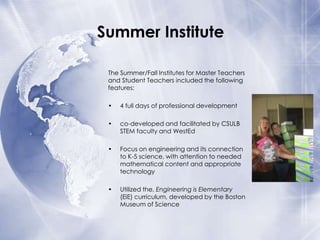
Summer Institute
The Summer/Fall Institutes for Master Teachers
and Student Teachers included the following
features:
•

4 full days of professional development

•

co-developed and facilitated by CSULB
STEM faculty and WestEd

•

Focus on engineering and its connection
to K-5 science, with attention to needed
mathematical content and appropriate
technology

•

Utilized the, Engineering is Elementary
(EiE) curriculum, developed by the Boston
Museum of Science
Institute Goals
Knowledge (Know about):
What engineering and technology are and what engineers
do
Various fields of engineering
Nearly everything in the human world has been touched by
engineering
Engineering problems have multiple solutions
How society influences and is influenced by engineering
How technology affects the world (both positively and
negatively)
Engineers are from all races, ethnicities, and genders

Skills/Experience (Be able to do):
Apply the engineering design process
Apply science and math in engineering
Employ creativity and careful thinking to solve problems
Envision one's own abilities as an engineer
Troubleshoot and learn from failure
Understand the central role of materials and their properties
in engineering solutions
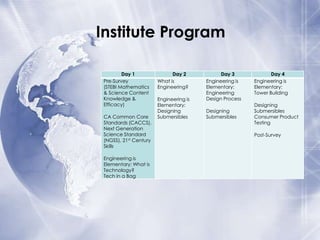
Institute Program
Day 1
Pre-Survey
(STEBI Mathematics
& Science Content
Knowledge &
Efficacy)
CA Common Core
Standards (CACCS),
Next Generation
Science Standard
(NGSS), 21st Century
Skills
Engineering is
Elementary: What is
Technology?
Tech in a Bag

Day 2
What is
Engineering?
Engineering is
Elementary:
Designing
Submersibles

Day 3
Engineering is
Elementary:
Engineering
Design Process
Designing
Submersibles

Day 4
Engineering is
Elementary:
Tower Building
Designing
Submersibles
Consumer Product
Testing

Post-Survey
Institute Strands
Content Sessions:
•Engineering is Elementary (EiE): Designing Submersibles provided
participants with a model for understanding engineering practices.
•Consumer Product Testing allowed participants to think like scientists
as they made claims about their products based on experimental
evidence.
•Nature of Science assisted participants with learning to think like
scientists.
Pedagogy Sessions:
•How People Learn (Bransford et al., 2000) provided participants with
research on how students learn. All other sessions were designed to
align with this compendium of research.
•5E Instructional Cycle (Bybee) provided participants with a common
instructional model for inquiry-based science.
•Notebooking (follow-up session) featured scientists’ notebooks and
the rationale for notebooking in science.
•Conceptual Flow (follow-up session) gave participants a planning
format for identifying the important science content to be taught at
their grade level.
Leadership Sessions:
• CA Common Core Standards, Next Generation Science Standard
(NGSS), 21st Century Skills gave participants a preview into how they
are going to integrate new standards in STEM disciplines.
• Myers-Briggs (follow-up session) helped participants with
understanding their temperament types.
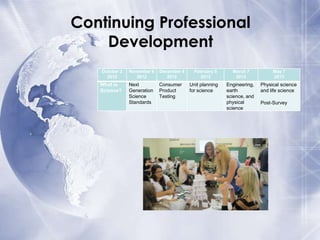
Continuing Professional
Development
October 2
2012

November 6
2012

December 4
2012

What is
Science?

Next
Generation
Science
Standards

Consumer
Product
Testing

February 5
2013

Unit planning
for science

March 7
2013

May 7
2013

Engineering,
earth
science, and
physical
science

Physical science
and life science
Post-Survey
Family Science Night
The goal of the Family Science Night program is to
provide opportunities for pre-service teachers to
develop leadership skills in planning and
implementing STEM focused curriculum, while
engaging students and their families. Program
components included:
•
•
•

Keynote speaker (female engineers)
Resource packet about science centered
venues and descriptions for family outings
2 Hands-on activities led by student teachers
selected from the following: taste buds, roller
coaster, disco raisins, mystery containers,
balloon flickers, wind powered vehicles, singing
straws, balloon magic

“Families were totally engaged and worked side by
side with their children. The families shared their
appreciation for the planning, diversity of topics and
high levels of engagement during the evening
event. They spoke highly of the UTEACH program and
how it had made a difference for their children and
their instructional program in the classroom.” Dr.
Joan Wilkes
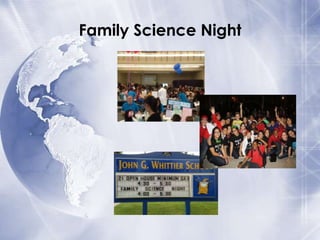
Family Science Night
Program Outcomes
A two-part survey was given to each of the Master
Teachers (MT) and Student Teachers (ST) before the
Summer Institute and again after the Institute to assess the
MT’s and ST’s learning from participating in the Institute:
Science Teaching Efficacy & Beliefs Instrument
(Enochs and Riggs, 1990), which included science
teaching and efficacy beliefs (STEB) and science
teaching outcome & expectations (STOE).
Program Outcomes
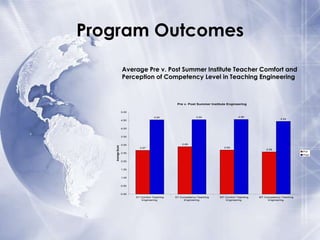
Average Pre v. Post Summer Institute Teacher Comfort and
Perception of Competency Level in Teaching Engineering

Pre v. Post Summer Institute Engineering
5.00
4.56

4.54

4.54

4.44

4.50

4.00

Average Score

3.50
2.89

3.00

2.69

2.67

2.58

2.50

2.00

1.50

1.00

0.50

0.00
ST Comfort Teaching
Engineering

ST Competency Teaching
Engineering

MT Comfort Teaching
Engineering

MT Competency Teaching
Engineering

Pre
Post
Program Outcomes
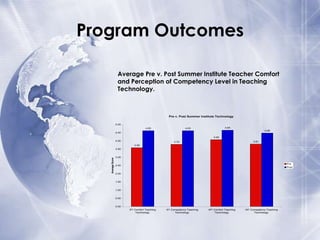
Average Pre v. Post Summer Institute Teacher Comfort
and Perception of Competency Level in Teaching
Technology.

Pre v. Post Summer Institute Technology
5.00
4.63

4.65

4.63

4.48

4.50
4.08
4.00

3.81

3.79
3.59

Average Score

3.50

3.00
Pre
Post

2.50

2.00

1.50

1.00

0.50

0.00
ST Comfort Teaching
Technology

ST Competency Teaching
Technology

MT Comfort Teaching
Technology

MT Competency Teaching
Technology
Program Outcomes
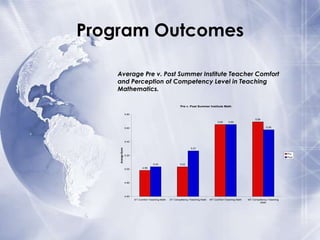
Average Pre v. Post Summer Institute Teacher Comfort
and Perception of Competency Level in Teaching
Mathematics.
Pre v. Post Summer Institute Math
5.80
5.69
5.65

5.65
5.58

5.60

Average Score

5.40
5.27
Pre
Post

5.20

5.04
5.00

5.03

4.98

4.80

4.60
ST Comfort Teaching Math

ST Competency Teaching Math

MT Comfort Teaching Math

MT Competency Teaching
Math
Dr. Jared R. Stallones
Professor of Education
University Coordinator-Single Subject
Credential Program
California State University, Long Beach
Linked Learning as a Vehicle for
STEM Teacher Preparation
Linked Learning is:
Interdisciplinary
Authentic (WBL)
Project-based

http://linkedlearning.org/
Onsite Courses
Millikan High School

GREEN Academy (Agriculture & Natural Resources)
COMPASS Academy (Arts, Media, & Entertainment)
Global Technology Academy (Engineering & Design;
Information Technology)
More Onsite Courses
Cabrillo High School

SACMAA (Arts, Media, and Entertainment)
CED (Engineering and Design)
CHOC Academy (Health Science and Medical Technology)
Still More Onsite Classes
Jordan High School
ETA and JMAC (Arts, Media, & Entertainment)
ACE Academy (Building Trades & Construction;
Engineering & Design)
AIMS (Health Science & Medical Technology)

JTECH (Transportation)
Clinical Practice
Linked Learning and Co-Teaching at:
Millikan High School
Cabrillo High School

Other Long Beach USD schools
The Future
Partnerships with:
McBride High School (Engineering & Design;
Health Science & Medical Technology)
Bellflower USD
STEM/Public Service Academy
Dr. Laura Henriques

Professor of Science Education
California State University, Long Beach
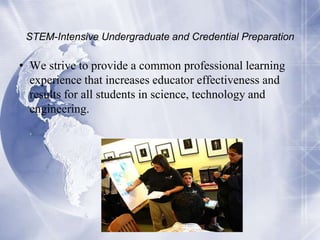
STEM-Intensive Undergraduate and Credential Preparation

• We strive to provide a common professional learning
experience that increases educator effectiveness and
results for all students in science, technology and
engineering.
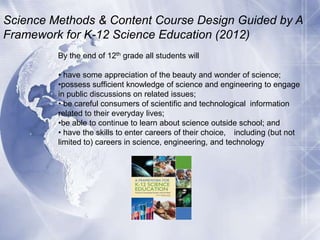
Science Methods & Content Course Design Guided by A
Framework for K-12 Science Education (2012)
By the end of 12th grade all students will
• have some appreciation of the beauty and wonder of science;
•possess sufficient knowledge of science and engineering to engage
in public discussions on related issues;
• be careful consumers of scientific and technological information
related to their everyday lives;
•be able to continue to learn about science outside school; and
• have the skills to enter careers of their choice, including (but not
limited to) careers in science, engineering, and technology
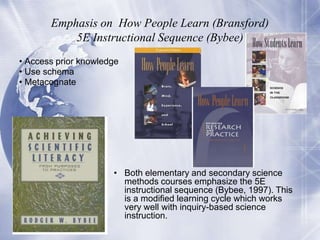
Emphasis on How People Learn (Bransford)
5E Instructional Sequence (Bybee)
• Access prior knowledge
• Use schema
• Metacognate

• Both elementary and secondary science
methods courses emphasize the 5E
instructional sequence (Bybee, 1997). This
is a modified learning cycle which works
very well with inquiry-based science
instruction.
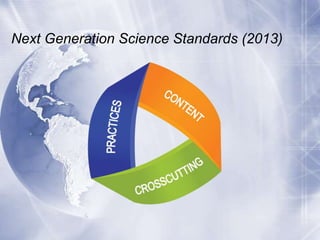
Next Generation Science Standards (2013)
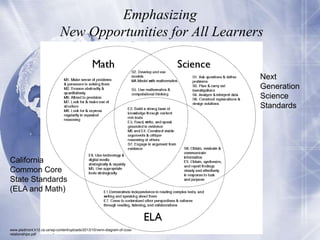
Emphasizing
New Opportunities for All Learners
Next
Generation
Science
Standards

California
Common Core
State Standards
(ELA and Math)

www.piedmont.k12.ca.us/wp-content/uploads/2013/10/venn-diagram-of-ccssrelationships.pdf
Engineering is Elementary Program

• Increase technological literacy, a basic 21st
century literacy
• Make math and science relevant
• Build and reinforce skills
of critical thinking,
creativity, collaboration,
and communication
• Increase students’
awareness of and access
to engineering and
science careers
Multiple Opportunities to Apply and Gain New
Skills and Knowledge Outside the Classroom
• Elementary science methods students
– STEM Rich Clinical Teacher Prep program
– Partnering with local elementary school for science teaching/lessonstudy model

• Secondary science candidates
– Attendance at CSTA conferences
– Teaching STEM lessons in after-school settings
– Monthly Physics Demo Days with preservice and inservice teachers

• All science teaching candidates
–
–
–
–
–

Summer science camp teaching opportunities
Summer STEM research opportunities
Future science teacher club
Multiple PD opportunities on campus
Robust listserv to share science and STEM PD opportunities
Acknowledgements
• S.D. Bechtel, Jr. Foundation
• CSU Math/Science Teacher Initiative
• CSULB ASI Instructionally Related
Activities fund
• Miller Foundation, Verizon Foundation and
individual donors (science camp support)
Long Beach Unified School District

BTSA Induction Program
Lori Grace, Program Coordinator
1399 E. 32nd Street, Signal Hill, Ca. 90755
562.997.8000 x2901
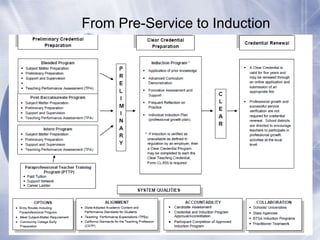
From Pre-Service to Induction
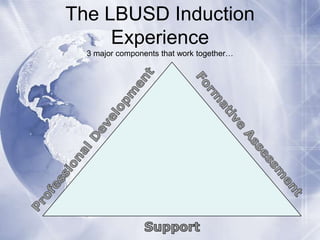
The LBUSD Induction
Experience
3 major components that work together…
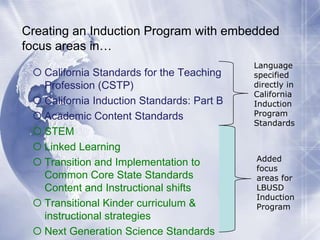
Creating an Induction Program with embedded
focus areas in…
 California Standards for the Teaching
Profession (CSTP)
 California Induction Standards: Part B
 Academic Content Standards
 STEM
 Linked Learning
 Transition and Implementation to
Common Core State Standards
Content and Instructional shifts
 Transitional Kinder curriculum &
instructional strategies
 Next Generation Science Standards

Language
specified
directly in
California
Induction
Program
Standards

Added
focus
areas for
LBUSD
Induction
Program
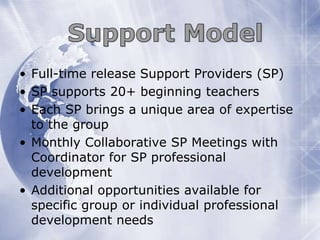
• Full-time release Support Providers (SP)
• SP supports 20+ beginning teachers
• Each SP brings a unique area of expertise
to the group
• Monthly Collaborative SP Meetings with
Coordinator for SP professional
development
• Additional opportunities available for
specific group or individual professional
development needs
•

•

PT has participates in various types of PD throughout the Induction
experience which include:
– PD trainings/seminars
– Book/article Studies
– Online discussion forums through Moodle
– Video/webinar opportunities
– Teacher observation/co-teaching/demonstration lessons
All PD is designed to meet the Induction Requirements and district focus
areas which include:
– California Standards for the Teaching Profession (CSTP)
– Induction Standards (Pedagogy, Equity, English Learners, Advanced
Learners, and students with disabilities)
– Connections to the academic content standards of the PT assignment
– District PD Focus Areas: CCSS, STEM, Linked Learning, NGSS,
Transitional Kinder
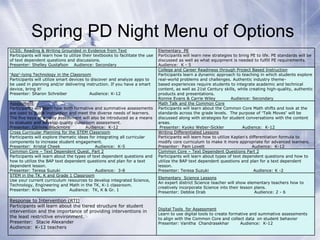
Spring PD Night Menu of Options
CCSS: Reading & Writing Grounded in Evidence from Text
Participants will learn how to utilize their textbooks to facilitate the use
of text dependent questions and discussions.
Presenter: Shelley Gustafson Audience: Secondary
“App”-lying Technology in the Classroom
Participants will utilize smart devices to discover and analyze apps to
be used in planning and/or delivering instruction. If you have a smart
device, bring it!
Presenter: Sharon Schreiber
Audience: K-12
Assessment
Participants will learn how both formative and summative assessments
are used to guide instruction and meet the diverse needs of learners.
The five keys of quality assessment will also be introduced as a means
to evaluate and develop quality classroom assessment.
Presenter: Corinne Blackmore
Audience: K-12
Cross Curricular Planning for the STEM Classroom
Participants will explore thematic ideas for integrating all curricular
components to increase student engagement.
Presenter: Kristal Cheek
Audience: K-5
Common Core – Text Dependent Quest. Part 2
Participants will learn about the types of text dependent questions and
how to utilize the BAP text dependent questions and plan for a text
dependent lesson.
Presenter: Teresa Suzuki
Audience: 3-8
STEM in the TK, K and Grade 1 Classroom
Use your current curriculum resources to develop integrated Science,
Technology, Engineering and Math in the TK, K-1 classroom.
Presenter: Kris Damon
Audience: TK, K & Gr. 1

Response to Intervention (RTI)
Participants will learn about the tiered structure for student
intervention and the importance of providing interventions in
the least restrictive environment.
Presenter: Stacie Alexander
Audience: K-12 teachers

Elementary PE
Participants will learn new strategies to bring PE to life. PE standards will be
discussed as well as what equipment is needed to fulfill PE requirements.
Audience: K - 5
College and Career Readiness through Project Based Instruction
Participants learn a dynamic approach to teaching in which students explore
real-world problems and challenges. Authentic industry themebased experiences require students to integrate academic and technical
content, as well as 21st Century skills, while creating high-quality, authentic
products and presentations.
Ronnie Evans & Carrie Wiley
Audience: Secondary
Math Talk and the Common Core
Participants will learn about the Common Core Math shifts and look at the
standards across the grade levels. The purpose of “Talk Moves” will be
discussed along with strategies for student conversations with the content
areas.
Presenter: Kyoko Weber-Sickler
Audience: K-12
Writing Differentiated Lessons
Participants will learn how to utilize Kaplan’s differentiation formula to
modify core curriculum to make it more appropriate for advanced learners.
Presenter: Pam Lovett
Audience: K-12
Common Core – Text Dependent Questions Part 2
Participants will learn about types of text dependent questions and how to
utilize the BAP text dependent questions and plan for a text dependent
lesson.
Presenter: Teresa Suzuki
Audience: K -2

Elementary Science Lessons
An expert district Science teacher will show elementary teachers how to
creatively incorporate Science into their lesson plans.
Presenter: Debbie Drab
Audience: 2 - 6

Digital Tools for Assessment
Learn to use digital tools to create formative and summative assessments
to align with the Common Core and collect data on student behavior
Presenter: Vanitha Chandrasekhar
Audience: K-12
STEM Online Discussion Forum
Sample Task
For this moodle discussion forum, there are two parts:
1. You will choose an article to read from the Education Week
"Spotline on STEM" resource (provided for you on the moodle
resource link). Once you have read the article, briefly summarize your
findings.
2. Now discuss the implications for your instructional practice:
What further questions did the article raise? How might you apply the
information in your classroom? Many of you teach one of the four
"STEM" components, such as science or math. How do you integrate
across the STEM disciplines? If you do not teach one of the 4 core
STEM disciplines, how do you incorporate STEM education into your
content area?
•

LBUSD utilizes the Formative Assessment System for California
Teachers (FACT). The FACT system includes components in:
– Context for Teaching – PT analyzes the classroom and students
by looking at information for student profiles, site and district
resources, and the community
– Initial Assessment of Teaching Practice – PT self-assesses
his/her own teaching by using the CSTP Continuum and reflecting
on professional strengths and areas of growth with their SP
– Inquiry – PT chooses areas of focus for three separate action
research projects that span the 2-year induction program. The
Inquiry topics relate to the Induction Standards and the PT
designs corresponding units of study in which to implement the
research.
– Summary of Teaching Practice – PT and SP reflect upon
instructional practices in the areas of the CSTP, Induction
Standards, and academic content standards in order to determine
next steps.
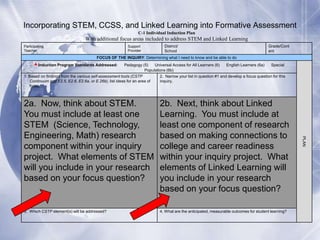
Incorporating STEM, CCSS, and Linked Learning into Formative Assessment
C-1 Individual Induction Plan

With additional focus areas included to address STEM and Linked Learning
Participating
Teacher

Support
Provider

District/
School

Grade/Cont
ent

FOCUS OF THE INQUIRY: Determining what I need to know and be able to do

Induction Program Standards Addressed:

Pedagogy (5)
Universal Access for All Learners (6)
Populations (6b)

English Learners (6a)

Special

2. Narrow your list in question #1 and develop a focus question for this
inquiry.

2a. Now, think about STEM.
You must include at least one
STEM (Science, Technology,
Engineering, Math) research
component within your inquiry
project. What elements of STEM
will you include in your research
based on your focus question?

2b. Next, think about Linked
Learning. You must include at
least one component of research
based on making connections to
college and career readiness
within your inquiry project. What
elements of Linked Learning will
you include in your research
based on your focus question?

3. Which CSTP element(s) will be addressed?

4. What are the anticipated, measurable outcomes for student learning?

PLAN

1. Based on findings from the various self-assessment tools (CSTP
Continuum and E2.5, E2.6, E2.6a, or E.26b), list ideas for an area of
focus:
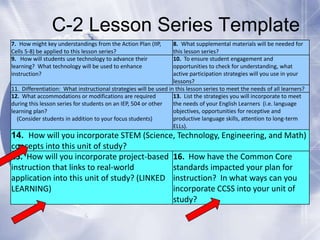
C-2 Lesson Series Template
7. How might key understandings from the Action Plan (IIP,
Cells 5-8) be applied to this lesson series?
9. How will students use technology to advance their
learning? What technology will be used to enhance
instruction?

8. What supplemental materials will be needed for
this lesson series?
10. To ensure student engagement and
opportunities to check for understanding, what
active participation strategies will you use in your
lessons?
11. Differentiation: What instructional strategies will be used in this lesson series to meet the needs of all learners?
12. What accommodations or modifications are required
13. List the strategies you will incorporate to meet
during this lesson series for students on an IEP, 504 or other
the needs of your English Learners (i.e. language
objectives, opportunities for receptive and
learning plan?
productive language skills, attention to long-term
(Consider students in addition to your focus students)
ELLs).

14. How will you incorporate STEM (Science, Technology, Engineering, and Math)
concepts into this unit of study?
15. How will you incorporate project-based 16. How have the Common Core
instruction that links to real-world
standards impacted your plan for
application into this unit of study? (LINKED instruction? In what ways can you
incorporate CCSS into your unit of
LEARNING)
study?
Dr. Marquita Grenot-Scheyer

Dean, College of Education
California State University, Long Beach
CSU's Commitment To Preparing & Developing World-Class STEM Teachers

CSU's Commitment To Preparing & Developing World-Class STEM Teachers

  • 1.
    The California STEMSummit 2014 CSU’s Commitment to Preparing and Developing WorldClass STEM Teachers: A Model of Collaboration and Excellence in Long Beach Dr. Beverly Young, The California State University Dr. Lisa Isbell, CSU Long Beach Dr. Jared R. Stallones, CSU Long Beach Dr. Laura Henriques, CSU Long Beach Lori Grace, Long Beach Unified School District Dr. Marquita Grenot-Scheyer, CSU Long Beach
  • 2.
    Dr. Beverly Young AssistantVice Chancellor for Teacher Education and Public School Programs California State University
  • 3.
    Urban Teaching Academy STEMProfessional Growth Training California State University, Long Beach Lisa Isbell, Ed.D. Multiple Subject Credential Program Coordinator
  • 4.
    UTEACH Program (Urban TeachingAcademy) The UTEACH (Urban Teaching Academy) pathway is a unique opportunity for students to combine pedagogy and practice in a personalized credential program designed to fully prepare future teachers in a hands-on supportive school setting. Program features include the following: • • • • • • UTEACH is a yearlong school/university residency program. UTEACH teaching methods courses are held at school sites working with children in real classroom settings. UTEACH offers personalized attention from University faculty and school based personnel. UTEACH course work and student teaching are prearranged, and linked to real teaching in a real classroom. UTEACH faculty support, instruct and advise students on site in a school based, personalized setting. UTEACH future teachers are taught to teach by teaching children in a guided clinical classroom setting.
  • 5.
    STEM Program Goal Fundedby the S.J. Bechtel Jr. Foundation, the goal of the Science, Technology, PreEngineering and Mathematics professional development program is to prepare elementary teachers in a model, scalable, STEM-rich clinical setting.
  • 6.
    Program Infrastructure CSULB UTEACH STEMPD PLANNIG COMMITTEE (7) CSULB, WESTED, & LBUSD PD PROVIDERS UTEACH STUDENT TEACHERS (58) UTEACH STEM PD LBUSD SCHOOL PRINCIPALS (6) LBUSD MASTER TEACHERS (35) CSULB EDD STUDENT RESEARCHERS (3)
  • 7.
    Program Objectives 1. The overarchinggoal of this project is to change the culture of STEM (Science, Technology, PreEngineering & Mathematics) teaching in elementary schools from the ground up. The program focuses on The Next Generation Science Standards and the Common Core State Standards for Mathematics with technology and engineering providing context. 2. Create a direct pipeline of highly qualified elementary STEM instructors who will be able to address the deep concern about not having enough scientists, engineers, and mathematicians to keep the United States in the forefront of research, innovation, and technology. 3. Our approach is to train elementary teachers (prospective and practicing) to teach the STEM disciplines in an integrated, inquiry-focused way so students understand science and mathematics in a real-world context.
  • 8.
    Preparing Elementary Teachersin a Model, Scalable, STEM-Rich Clinical Setting Over a period of two years, the program has worked to accomplish the following: 1) 2) 3) 4) 5) 6) intensively train and hope to inspire 150 highly effective pre-service and in-service elementary STEM teachers in a residency setting in four elementary schools in LBUSD employ a “co-teaching” model involving current and future teachers together in teaching STEM subjects integrate STEM content across the teacherpreparation curriculum provide opportunities for elementary teachers to attend state STEM conferences involve four CSULB doctoral students in studying, evaluating and disseminating the model through dissertation work creating a handbook to serve as a resource for establishing similar school/university STEM education programs across California.
  • 9.
    STEM Education PDCurriculum This project provides professional development and support to 30 master teachers, grades K-5, and their 60 student teachers each year. The Professional Development was collaboratively developed and facilitated by CSULB’s Colleges of Education and Natural Sciences & Mathematics and the WestEd/K12 Alliance. The model integrates curriculum from The Boston Museum of Science’s, Engineering is Elementary program and specific topics addressed include: • • • • • • • • The Engineering Design Process Common Core and Next Generation Science Standards Notebooking in STEM Content Areas Nature of Science and Science Processes Developing and Sequencing STEM Units Inquiry-based Lesson Format for Science Engineering-based STEM Lessons Effective Practices for Teacher Mentoring and Collaboration
  • 10.
    Licensure and After-school Programs Overa period of two years 120 pre-service and in-service K-5 teachers are being provided with the opportunity to extend their STEM education and work towards added licensure that will allow these teachers to expand their teaching across the K-8 grade levels, as well as gain experience designing STEM activities and implementing them with K-8 students in urban, after-school settings. Thus far about half of the first cohort of participants have taken this opportunity. This added credential will allow these new and practicing teachers to expand their teaching to the middle school level and will also significantly strengthen their K-6 teaching of STEM subjects.
  • 11.
    Program Accomplishments • Recruit andscreen master teachers and UTEACH candidates for the program • Conduct Summer/Fall Institutes • Supply classrooms and teachers with STEM equipment and materials • Conduct continuing faculty professional development throughout the school year with 6 full days of professional development in STEM content and pedagogy • Attend and present at state conferences • Hold Family STEM Night • Implement doctoral program research • Hold STEM Education Celebration at CSULB • Develop “Preparing elementary Teachers in a STEM-Rich Clinical Setting” handbook
  • 12.
    Summer Institute The Summer/FallInstitutes for Master Teachers and Student Teachers included the following features: • 4 full days of professional development • co-developed and facilitated by CSULB STEM faculty and WestEd • Focus on engineering and its connection to K-5 science, with attention to needed mathematical content and appropriate technology • Utilized the, Engineering is Elementary (EiE) curriculum, developed by the Boston Museum of Science
  • 13.
    Institute Goals Knowledge (Knowabout): What engineering and technology are and what engineers do Various fields of engineering Nearly everything in the human world has been touched by engineering Engineering problems have multiple solutions How society influences and is influenced by engineering How technology affects the world (both positively and negatively) Engineers are from all races, ethnicities, and genders Skills/Experience (Be able to do): Apply the engineering design process Apply science and math in engineering Employ creativity and careful thinking to solve problems Envision one's own abilities as an engineer Troubleshoot and learn from failure Understand the central role of materials and their properties in engineering solutions
  • 14.
    Institute Program Day 1 Pre-Survey (STEBIMathematics & Science Content Knowledge & Efficacy) CA Common Core Standards (CACCS), Next Generation Science Standard (NGSS), 21st Century Skills Engineering is Elementary: What is Technology? Tech in a Bag Day 2 What is Engineering? Engineering is Elementary: Designing Submersibles Day 3 Engineering is Elementary: Engineering Design Process Designing Submersibles Day 4 Engineering is Elementary: Tower Building Designing Submersibles Consumer Product Testing Post-Survey
  • 15.
    Institute Strands Content Sessions: •Engineeringis Elementary (EiE): Designing Submersibles provided participants with a model for understanding engineering practices. •Consumer Product Testing allowed participants to think like scientists as they made claims about their products based on experimental evidence. •Nature of Science assisted participants with learning to think like scientists. Pedagogy Sessions: •How People Learn (Bransford et al., 2000) provided participants with research on how students learn. All other sessions were designed to align with this compendium of research. •5E Instructional Cycle (Bybee) provided participants with a common instructional model for inquiry-based science. •Notebooking (follow-up session) featured scientists’ notebooks and the rationale for notebooking in science. •Conceptual Flow (follow-up session) gave participants a planning format for identifying the important science content to be taught at their grade level. Leadership Sessions: • CA Common Core Standards, Next Generation Science Standard (NGSS), 21st Century Skills gave participants a preview into how they are going to integrate new standards in STEM disciplines. • Myers-Briggs (follow-up session) helped participants with understanding their temperament types.
  • 16.
    Continuing Professional Development October 2 2012 November6 2012 December 4 2012 What is Science? Next Generation Science Standards Consumer Product Testing February 5 2013 Unit planning for science March 7 2013 May 7 2013 Engineering, earth science, and physical science Physical science and life science Post-Survey
  • 17.
    Family Science Night Thegoal of the Family Science Night program is to provide opportunities for pre-service teachers to develop leadership skills in planning and implementing STEM focused curriculum, while engaging students and their families. Program components included: • • • Keynote speaker (female engineers) Resource packet about science centered venues and descriptions for family outings 2 Hands-on activities led by student teachers selected from the following: taste buds, roller coaster, disco raisins, mystery containers, balloon flickers, wind powered vehicles, singing straws, balloon magic “Families were totally engaged and worked side by side with their children. The families shared their appreciation for the planning, diversity of topics and high levels of engagement during the evening event. They spoke highly of the UTEACH program and how it had made a difference for their children and their instructional program in the classroom.” Dr. Joan Wilkes
  • 18.
  • 19.
    Program Outcomes A two-partsurvey was given to each of the Master Teachers (MT) and Student Teachers (ST) before the Summer Institute and again after the Institute to assess the MT’s and ST’s learning from participating in the Institute: Science Teaching Efficacy & Beliefs Instrument (Enochs and Riggs, 1990), which included science teaching and efficacy beliefs (STEB) and science teaching outcome & expectations (STOE).
  • 20.
    Program Outcomes Average Prev. Post Summer Institute Teacher Comfort and Perception of Competency Level in Teaching Engineering Pre v. Post Summer Institute Engineering 5.00 4.56 4.54 4.54 4.44 4.50 4.00 Average Score 3.50 2.89 3.00 2.69 2.67 2.58 2.50 2.00 1.50 1.00 0.50 0.00 ST Comfort Teaching Engineering ST Competency Teaching Engineering MT Comfort Teaching Engineering MT Competency Teaching Engineering Pre Post
  • 21.
    Program Outcomes Average Prev. Post Summer Institute Teacher Comfort and Perception of Competency Level in Teaching Technology. Pre v. Post Summer Institute Technology 5.00 4.63 4.65 4.63 4.48 4.50 4.08 4.00 3.81 3.79 3.59 Average Score 3.50 3.00 Pre Post 2.50 2.00 1.50 1.00 0.50 0.00 ST Comfort Teaching Technology ST Competency Teaching Technology MT Comfort Teaching Technology MT Competency Teaching Technology
  • 22.
    Program Outcomes Average Prev. Post Summer Institute Teacher Comfort and Perception of Competency Level in Teaching Mathematics. Pre v. Post Summer Institute Math 5.80 5.69 5.65 5.65 5.58 5.60 Average Score 5.40 5.27 Pre Post 5.20 5.04 5.00 5.03 4.98 4.80 4.60 ST Comfort Teaching Math ST Competency Teaching Math MT Comfort Teaching Math MT Competency Teaching Math
  • 23.
    Dr. Jared R.Stallones Professor of Education University Coordinator-Single Subject Credential Program California State University, Long Beach
  • 24.
    Linked Learning asa Vehicle for STEM Teacher Preparation Linked Learning is: Interdisciplinary Authentic (WBL) Project-based http://linkedlearning.org/
  • 25.
    Onsite Courses Millikan HighSchool GREEN Academy (Agriculture & Natural Resources) COMPASS Academy (Arts, Media, & Entertainment) Global Technology Academy (Engineering & Design; Information Technology)
  • 26.
    More Onsite Courses CabrilloHigh School SACMAA (Arts, Media, and Entertainment) CED (Engineering and Design) CHOC Academy (Health Science and Medical Technology)
  • 27.
    Still More OnsiteClasses Jordan High School ETA and JMAC (Arts, Media, & Entertainment) ACE Academy (Building Trades & Construction; Engineering & Design) AIMS (Health Science & Medical Technology) JTECH (Transportation)
  • 28.
    Clinical Practice Linked Learningand Co-Teaching at: Millikan High School Cabrillo High School Other Long Beach USD schools
  • 29.
    The Future Partnerships with: McBrideHigh School (Engineering & Design; Health Science & Medical Technology) Bellflower USD STEM/Public Service Academy
  • 30.
    Dr. Laura Henriques Professorof Science Education California State University, Long Beach
  • 31.
    STEM-Intensive Undergraduate andCredential Preparation • We strive to provide a common professional learning experience that increases educator effectiveness and results for all students in science, technology and engineering.
  • 32.
    Science Methods &Content Course Design Guided by A Framework for K-12 Science Education (2012) By the end of 12th grade all students will • have some appreciation of the beauty and wonder of science; •possess sufficient knowledge of science and engineering to engage in public discussions on related issues; • be careful consumers of scientific and technological information related to their everyday lives; •be able to continue to learn about science outside school; and • have the skills to enter careers of their choice, including (but not limited to) careers in science, engineering, and technology
  • 33.
    Emphasis on HowPeople Learn (Bransford) 5E Instructional Sequence (Bybee) • Access prior knowledge • Use schema • Metacognate • Both elementary and secondary science methods courses emphasize the 5E instructional sequence (Bybee, 1997). This is a modified learning cycle which works very well with inquiry-based science instruction.
  • 34.
    Next Generation ScienceStandards (2013)
  • 35.
    Emphasizing New Opportunities forAll Learners Next Generation Science Standards California Common Core State Standards (ELA and Math) www.piedmont.k12.ca.us/wp-content/uploads/2013/10/venn-diagram-of-ccssrelationships.pdf
  • 36.
    Engineering is ElementaryProgram • Increase technological literacy, a basic 21st century literacy • Make math and science relevant • Build and reinforce skills of critical thinking, creativity, collaboration, and communication • Increase students’ awareness of and access to engineering and science careers
  • 37.
    Multiple Opportunities toApply and Gain New Skills and Knowledge Outside the Classroom • Elementary science methods students – STEM Rich Clinical Teacher Prep program – Partnering with local elementary school for science teaching/lessonstudy model • Secondary science candidates – Attendance at CSTA conferences – Teaching STEM lessons in after-school settings – Monthly Physics Demo Days with preservice and inservice teachers • All science teaching candidates – – – – – Summer science camp teaching opportunities Summer STEM research opportunities Future science teacher club Multiple PD opportunities on campus Robust listserv to share science and STEM PD opportunities
  • 38.
    Acknowledgements • S.D. Bechtel,Jr. Foundation • CSU Math/Science Teacher Initiative • CSULB ASI Instructionally Related Activities fund • Miller Foundation, Verizon Foundation and individual donors (science camp support)
  • 39.
    Long Beach UnifiedSchool District BTSA Induction Program Lori Grace, Program Coordinator 1399 E. 32nd Street, Signal Hill, Ca. 90755 562.997.8000 x2901
  • 40.
  • 41.
    The LBUSD Induction Experience 3major components that work together…
  • 42.
    Creating an InductionProgram with embedded focus areas in…  California Standards for the Teaching Profession (CSTP)  California Induction Standards: Part B  Academic Content Standards  STEM  Linked Learning  Transition and Implementation to Common Core State Standards Content and Instructional shifts  Transitional Kinder curriculum & instructional strategies  Next Generation Science Standards Language specified directly in California Induction Program Standards Added focus areas for LBUSD Induction Program
  • 43.
    • Full-time releaseSupport Providers (SP) • SP supports 20+ beginning teachers • Each SP brings a unique area of expertise to the group • Monthly Collaborative SP Meetings with Coordinator for SP professional development • Additional opportunities available for specific group or individual professional development needs
  • 44.
    • • PT has participatesin various types of PD throughout the Induction experience which include: – PD trainings/seminars – Book/article Studies – Online discussion forums through Moodle – Video/webinar opportunities – Teacher observation/co-teaching/demonstration lessons All PD is designed to meet the Induction Requirements and district focus areas which include: – California Standards for the Teaching Profession (CSTP) – Induction Standards (Pedagogy, Equity, English Learners, Advanced Learners, and students with disabilities) – Connections to the academic content standards of the PT assignment – District PD Focus Areas: CCSS, STEM, Linked Learning, NGSS, Transitional Kinder
  • 45.
    Spring PD NightMenu of Options CCSS: Reading & Writing Grounded in Evidence from Text Participants will learn how to utilize their textbooks to facilitate the use of text dependent questions and discussions. Presenter: Shelley Gustafson Audience: Secondary “App”-lying Technology in the Classroom Participants will utilize smart devices to discover and analyze apps to be used in planning and/or delivering instruction. If you have a smart device, bring it! Presenter: Sharon Schreiber Audience: K-12 Assessment Participants will learn how both formative and summative assessments are used to guide instruction and meet the diverse needs of learners. The five keys of quality assessment will also be introduced as a means to evaluate and develop quality classroom assessment. Presenter: Corinne Blackmore Audience: K-12 Cross Curricular Planning for the STEM Classroom Participants will explore thematic ideas for integrating all curricular components to increase student engagement. Presenter: Kristal Cheek Audience: K-5 Common Core – Text Dependent Quest. Part 2 Participants will learn about the types of text dependent questions and how to utilize the BAP text dependent questions and plan for a text dependent lesson. Presenter: Teresa Suzuki Audience: 3-8 STEM in the TK, K and Grade 1 Classroom Use your current curriculum resources to develop integrated Science, Technology, Engineering and Math in the TK, K-1 classroom. Presenter: Kris Damon Audience: TK, K & Gr. 1 Response to Intervention (RTI) Participants will learn about the tiered structure for student intervention and the importance of providing interventions in the least restrictive environment. Presenter: Stacie Alexander Audience: K-12 teachers Elementary PE Participants will learn new strategies to bring PE to life. PE standards will be discussed as well as what equipment is needed to fulfill PE requirements. Audience: K - 5 College and Career Readiness through Project Based Instruction Participants learn a dynamic approach to teaching in which students explore real-world problems and challenges. Authentic industry themebased experiences require students to integrate academic and technical content, as well as 21st Century skills, while creating high-quality, authentic products and presentations. Ronnie Evans & Carrie Wiley Audience: Secondary Math Talk and the Common Core Participants will learn about the Common Core Math shifts and look at the standards across the grade levels. The purpose of “Talk Moves” will be discussed along with strategies for student conversations with the content areas. Presenter: Kyoko Weber-Sickler Audience: K-12 Writing Differentiated Lessons Participants will learn how to utilize Kaplan’s differentiation formula to modify core curriculum to make it more appropriate for advanced learners. Presenter: Pam Lovett Audience: K-12 Common Core – Text Dependent Questions Part 2 Participants will learn about types of text dependent questions and how to utilize the BAP text dependent questions and plan for a text dependent lesson. Presenter: Teresa Suzuki Audience: K -2 Elementary Science Lessons An expert district Science teacher will show elementary teachers how to creatively incorporate Science into their lesson plans. Presenter: Debbie Drab Audience: 2 - 6 Digital Tools for Assessment Learn to use digital tools to create formative and summative assessments to align with the Common Core and collect data on student behavior Presenter: Vanitha Chandrasekhar Audience: K-12
  • 46.
    STEM Online DiscussionForum Sample Task For this moodle discussion forum, there are two parts: 1. You will choose an article to read from the Education Week "Spotline on STEM" resource (provided for you on the moodle resource link). Once you have read the article, briefly summarize your findings. 2. Now discuss the implications for your instructional practice: What further questions did the article raise? How might you apply the information in your classroom? Many of you teach one of the four "STEM" components, such as science or math. How do you integrate across the STEM disciplines? If you do not teach one of the 4 core STEM disciplines, how do you incorporate STEM education into your content area?
  • 47.
    • LBUSD utilizes theFormative Assessment System for California Teachers (FACT). The FACT system includes components in: – Context for Teaching – PT analyzes the classroom and students by looking at information for student profiles, site and district resources, and the community – Initial Assessment of Teaching Practice – PT self-assesses his/her own teaching by using the CSTP Continuum and reflecting on professional strengths and areas of growth with their SP – Inquiry – PT chooses areas of focus for three separate action research projects that span the 2-year induction program. The Inquiry topics relate to the Induction Standards and the PT designs corresponding units of study in which to implement the research. – Summary of Teaching Practice – PT and SP reflect upon instructional practices in the areas of the CSTP, Induction Standards, and academic content standards in order to determine next steps.
  • 48.
    Incorporating STEM, CCSS,and Linked Learning into Formative Assessment C-1 Individual Induction Plan With additional focus areas included to address STEM and Linked Learning Participating Teacher Support Provider District/ School Grade/Cont ent FOCUS OF THE INQUIRY: Determining what I need to know and be able to do Induction Program Standards Addressed: Pedagogy (5) Universal Access for All Learners (6) Populations (6b) English Learners (6a) Special 2. Narrow your list in question #1 and develop a focus question for this inquiry. 2a. Now, think about STEM. You must include at least one STEM (Science, Technology, Engineering, Math) research component within your inquiry project. What elements of STEM will you include in your research based on your focus question? 2b. Next, think about Linked Learning. You must include at least one component of research based on making connections to college and career readiness within your inquiry project. What elements of Linked Learning will you include in your research based on your focus question? 3. Which CSTP element(s) will be addressed? 4. What are the anticipated, measurable outcomes for student learning? PLAN 1. Based on findings from the various self-assessment tools (CSTP Continuum and E2.5, E2.6, E2.6a, or E.26b), list ideas for an area of focus:
  • 49.
    C-2 Lesson SeriesTemplate 7. How might key understandings from the Action Plan (IIP, Cells 5-8) be applied to this lesson series? 9. How will students use technology to advance their learning? What technology will be used to enhance instruction? 8. What supplemental materials will be needed for this lesson series? 10. To ensure student engagement and opportunities to check for understanding, what active participation strategies will you use in your lessons? 11. Differentiation: What instructional strategies will be used in this lesson series to meet the needs of all learners? 12. What accommodations or modifications are required 13. List the strategies you will incorporate to meet during this lesson series for students on an IEP, 504 or other the needs of your English Learners (i.e. language objectives, opportunities for receptive and learning plan? productive language skills, attention to long-term (Consider students in addition to your focus students) ELLs). 14. How will you incorporate STEM (Science, Technology, Engineering, and Math) concepts into this unit of study? 15. How will you incorporate project-based 16. How have the Common Core instruction that links to real-world standards impacted your plan for application into this unit of study? (LINKED instruction? In what ways can you incorporate CCSS into your unit of LEARNING) study?
  • 50.
    Dr. Marquita Grenot-Scheyer Dean,College of Education California State University, Long Beach

Editor's Notes

  • #25 CSULB, with assistance from the James Irvine Foundation, has developed program for teacher preparation through the “Linked Learning” lens. LL prepares students for college and career through authentic, interdisciplinary instruction centered around one or more of 15 industry themed pathways. So, teacher candidates who work in STEM-themed pathways are, by definition STEM teachers! LBUSD organizes its high schools around LL industry-themed academies, but honors a pre-existing SLC structure-some SLC encompass multiple themes.
  • #26 CSULB partners with LBUSD school sites to offer our core courses during the HS day. This allows our candidates to work directly with teachers, students, and pathway planning activities. At Millikan HS, CSULB candidates work in these academies. GREEN = Generating Respect for the Earth, the Environment, and NatureCOMPASS = Community of Musicians, Performers, Artists, and Social Scientists
  • #27 CSULB candidates participate in these academies:SACMAA = Specialized Academy for Computer Media, Arts & AnimationCED = Cabrillo Engineering and DesignCHOC = Cabrillo Health Occupations and Careers
  • #28 CSULB candidates participate in these academies:ETA = Excellence Through the ArtsJMAC = Jordan’s Media and Communication Learning CommunityACE = Architecture, Construction, and Engineering)AIMS = Aspiration in Medical ServicesJTECH = Jordan’s Technical Studies
  • #29 Following the core courses, candidates engage in clinical practice at LL sites, often the same ones at which they took core courses. At some sites, student teaching follows a co-teaching format. Once again, when candidates are placed in STEM-oriented pathways they teach their subjects through the “lens” of that pathway.
  • #30 These partnerships are so promising that we are pursuing more of them. McBride is a new HS in LBUSD designed specifically as a STEM-oriented site. We will have core courses meeting there in F14. we hope for more such partnerships as LBUSD opens several new STEM-oriented high schools in the next few years. We are also pursuing similar partnerships with Bellflower USD, and with a multi-district consortium to develop a high school that combines STEM and public service orientations.
  • #41 We have graciously heard from our collaborative partners at CSULB, so I show you this slide to illustrate the connection from CSULB to LBUSD. This is California’s Learning to Teach Cycle. Our relationship with CSULB is unique. Teachers who attend CSULB for their preliminary credential and then are hired to LBUSD and enroll in The LBUSD Induction program are provided a program that has been designed to compliment their prior experience and learning. CSULB and LBUSD work closely together to ensure that the path from preliminary credential to clear credential is a building experience. The program collaborates on a regular basis to discuss curriculum and to ensure that learning is not redundant and is a continuation of more complex ideas and experiences as teachers in their own classrooms. STEM education is a prime example. Our relationship with the personnel who organize the multiple and single subject programs plus the STEM UTEACH program and the FLGS/FLM program have allowed us to mold our program to fit the needs of the students.
  • #42 To do this…The LBUSD Induction experience is a 2-year program that include three main components to help beginning teachers along the journey of their new career. These components include support, professional development, and formative assessment. The program provides a rigorous but well-balanced experience that not only fulfills California’s Induction experience but exceeds the requirements in its unique layout and curriculum components. I will briefly explain each component and provide examples of how we weave STEM concepts throughout our Induction experience.
  • #43 The core curriculum stipulated in the standards for each approved California Induction program include the CSTP, the Induction Standards Part B, and the teachers’ academic content standards and curriculum components. What the standards do not directly call out is how an individual program will need to think about how to prepare teachers with 21st century skills and understanding/application of major state or national priorities (i.e. STEM, Linked Learning, NGSS)The LBUSD Induction experience has utilized the 3 core components (support, PD, and FA) to provide rich job-embedded experiences that engage our beginning teachers in the most current district, state, and national priorities. STEM is the focus of today’s summit so I will focus my attention on this aspect of our program but please note that LBUSD is working continuously to stay on top of all new initiatives and/or instructional strategies to keep our beginning teachers prepared for their career in teaching.
  • #44 SP are full-time Teachers on Special Assignment (TOSA) with extensive expertise in their content area and the various Induction StandardsSP are assigned to Participating Teachers (PT) in Small Learning Community cohorts. The groups work together for the entire school year. Groups are sometimes reassigned in year 2 based on PT numbers and needs.SP and PT groups meet face-to-face to collaborate monthly for support seminars SP visits PT in the classroom both formally and informally for conferencing and classroom observationsSP posts online discussions threads (aka “Moodle”) twice monthly for the group to discuss professional growth, research topics, or induction standards focus items SP is additionally available to PT as needed via face-to-face, phone, email, and “Moodle”To ensure that our Support Providers are well-versed in STEM, we have invested time in to exploring STEM concepts. We have bought various books and completed book studies within our small group. We have sent SP to attend local/state/national conferences and then report back and teach the rest of the group. We have worked with our own classroom teachers that are experts in this area to help our team become experts. We have asked these same expert classroom teachers to facilitate professional development for our teachers. And finally, we even ask our SP to practice in the classroom by providing demonstration lessons for the teachers.
  • #45 Our professional development calendar of events is intense but offers a wide range of variety in both content and medium. We do not rely solely on face-to-face PD. We include book studies, online discussion forums, focus groups, and teacher observation and feedback on a regular basis. Let me show you a couple of examples of how we balance the requirements of the California Induction Standards with our added district focus areas.
  • #46 Here is an example of one of our PD Nights. We offer 3 of these nights each year. Although the font is small (in trying to fit the whole menu on one screen), you can get an overview of the sessions offered at this particuluar PD Night. How do we choose our sessions, you ask? We use a variety of measures: (1) surveying our participants as to their interests, (2) analyzing PT inquiry topics (3) identifying timely sessions based on our Induction calendar and district calendar and (4) using anecdotal data from monthly SP classroom visits.
  • #47 Online Discussions occur at intervals of once every 2 weeks for each cohort of 20-25 teachers and is an excellent source of support and professional development for our participants. The SP chooses the topic and writes and facilitates an online discussion that is timely for his/her group. This particular discussion forum sample is for a group of single subject teachers and is focused on integrating STEM into their classroom practices.
  • #48 Formative Assessment is the third component of the BTSA Induction formula. Throughout the 2-year experience, teachers are expected to assess their own growth (with the assistance of a support provider) in a variety of prescribed modules. To ensure that these opportunities for reflection include the added focus areas, the program has added unique reflection opportunities to some of the key assignments. You will see two examples from the Inquiry Module in the following slides…
  • #49 This is an example of an Individual Induction Plan. The PT first determine what they would like to focus on in the areas of pedagogy, English Learners, advanced learners, or students with disabilities based on self-assessment. To ensure that the PT then thinks about STEM and College and Career readiness, we have added in an opportunity to research and include how they could incorporate these important practices into their research and instructional practices.
  • #50 This document is utilized for planning a unit of study. This shows page 2 of that document. You will see here that the program has added questions to help the PT to identify specific instructional strategies that will be utilized in the added focus areas. #14 asks about incorporating STEM. #15 connects Linked Learning to the unit of study. #16 asks the PT to think about how their unit connects to CCSS.