 Aim
 Introduction to problem
 Literature Review
 Brainstorming
 Fishbone Diagram
 Matrix Diagram
 Methodology
 Survey Results
 Evaluation of Survey
 Suggestions
 Village Institution
 Limitations
 Gantt Card
 References
To concrete science topics in students
mind by doing and experiencing method
and to make students more active in
learning process.
https://openclipart.org/detail/196174/question-girl
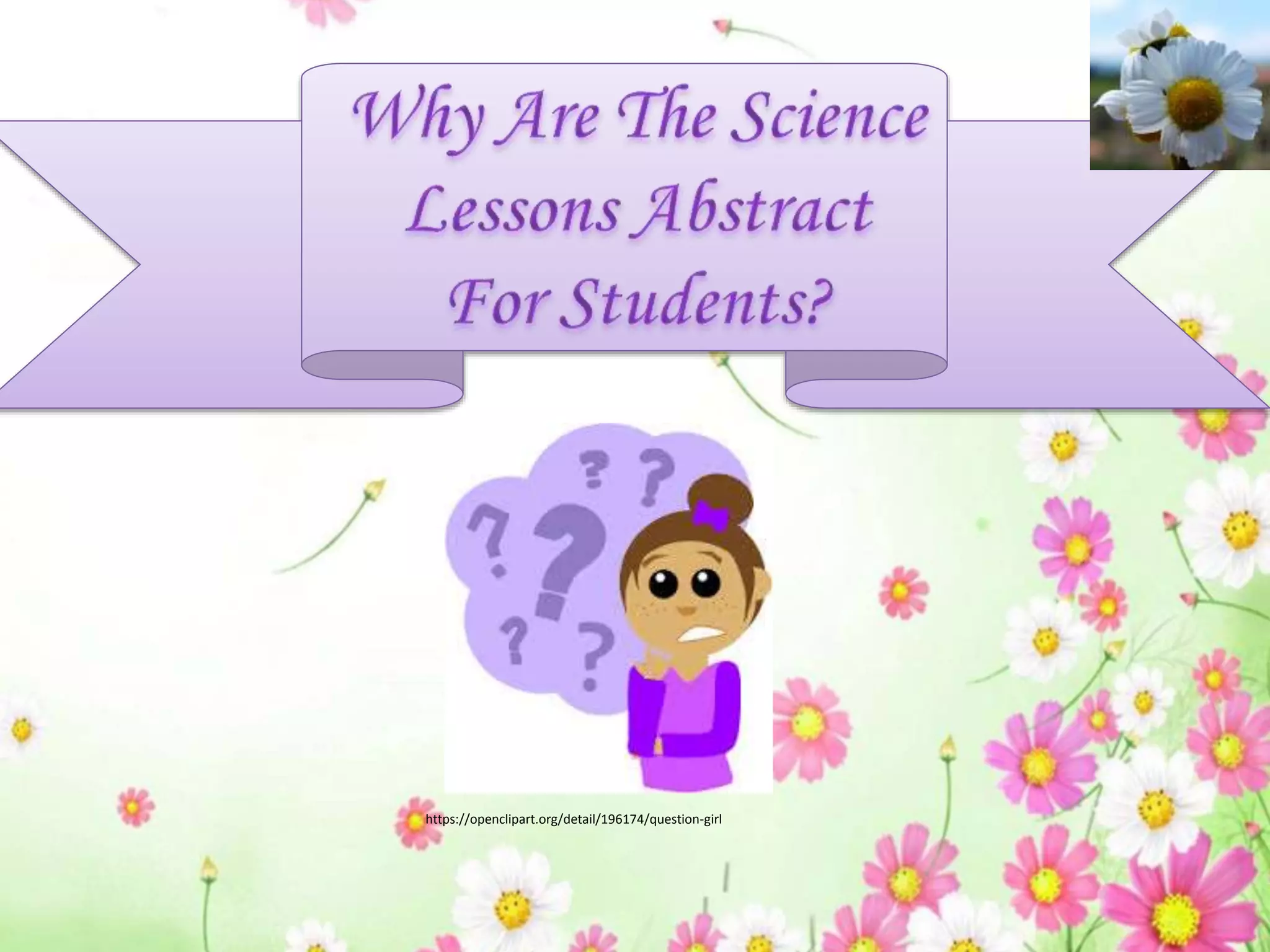
• Why is a good science education so important for every child, not
just for those who may be headed toward a scientific or technical
career?
• Because science is everywhere, and understanding how it’s a part
of our daily lives can give students a great foundation for success in
life.
• But in our country science lessons consist of formulas or multiple
choice question, so students generally cannot internalize science
lessons.
• Effective educators regularly look for ways to improve
educational programs, curriculum, and instruction to address
middle-school student needs ( National Research
Council,1996).
• Science classes incorporating inquiry- based instruction
implement a shift from teacher-directed instructional practices
to student-centered activities ( Hofstein & Lunetta,2004).
• Classroom practices like inquiry-based education create and
promote a unique social-cultural climate and social-
interactional process. (Covington, 2000)
• Today, in Turkish education system, generally, science
topic are given in a knowledge level, also learning by
practising and experiencing cannot be applied in some
schools. (Noyanalpan,1996).
• Heuristic method H.E. Armstrong said that laboratory
classes should be used in science lesson, by experiment
and observations students can learn science topic by
practising and experiencing. (Küçükahmet, 1995:149)
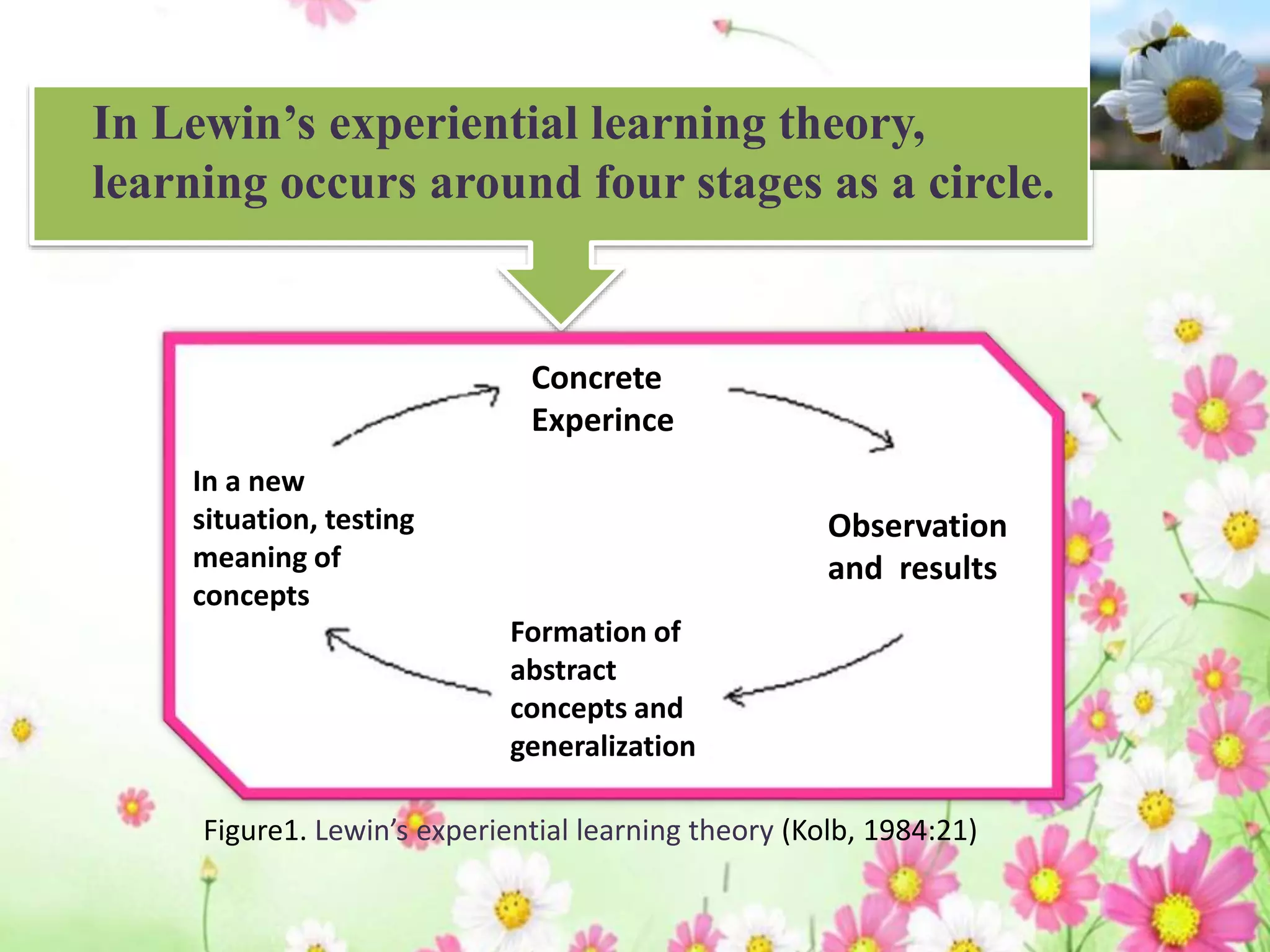
In Lewin’s experiential learning theory,
learning occurs around four stages as a circle.
Concrete
Experince
Observation
and results
Formation of
abstract
concepts and
generalization
In a new
situation, testing
meaning of
concepts
Figure1. Lewin’s experiential learning theory (Kolb, 1984:21)
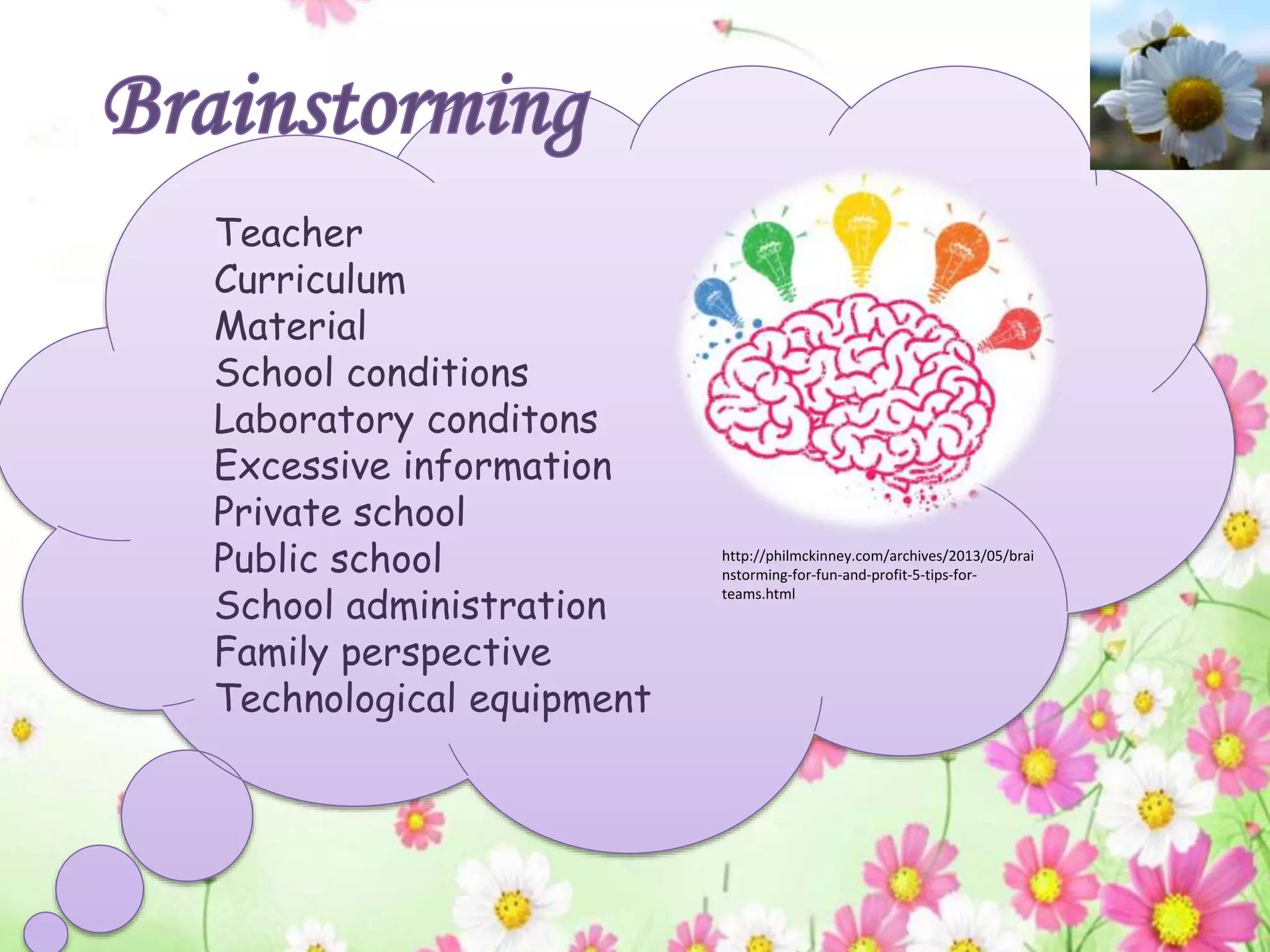
Teacher
Curriculum
Material
School conditions
Laboratory conditons
Excessive information
Private school
Public school
School administration
Family perspective
Technological equipment
http://philmckinney.com/archives/2013/05/brai
nstorming-for-fun-and-profit-5-tips-for-
teams.html
Gamze
Burcu
Sena
Total
%
Type of
schools
4
5
4
13
19.7 %
Teachers
7
7
7
21
31.8%
School
conditons
6
4
5
15
22.7%
Curriculum
5
6
6
17
25.8%
Our survey was applied on
16 students who were 8th
graders in Güneşli.
https://journalofhumannutritionanddieteticseditor.wordpress.co
m/2013/01/10/journal-of-human-nutrition-and-dietetics-what-
do-you-think/
wcselementary.wikispaces.com/WCS+Elementary+Links
a. Teacher uses only book to teach. 1 2 3 4 5
b. Teacher uses laboratory for necessary subjects. 1 2 3 4 5
c. Teacher gives an example in daily life to teach. 1 2 3 4 5
d. Teacher uses smart board. 1 2 3 4 5
e. Teacher teaches science topics with drama methods. 1 2 3 4 5
f. Teacher explains subjects shortly and then, s/he is 1 2 3 4 5
solved multiple choice problems.
g. Teacher makes it enjoyable with music. 1 2 3 4 5
h. Teacher uses visual materials (animation, video etc.). 1 2 3 4 5
i. Teacher groups all of students and then, students 1 2 3 4 5
study with group friends.
j. Teacher is passive. Students explain others and discuss 1 2 3 4 5
about subjects.
2. Which methods are effective for your science
learning? Please, write 3 methods.
1.
2.
3.
http://ancient-science-
webliography.webs.com/
0
10
20
30
40
50
60
70
80
a. Using only
book
b. Using
laboratory
c. Giving an
example in
daily life
d. Using
smart board
e. Drama
method
f. Short
explanation
and multiple
choice
questions
g. Making it
enjoyable
with music
h. Using
visual
materials
(animation,
video etc.)
i. Group
working
j. Passive
teacher
Results of first & second
questions
Survey results show that;
• Teachers use daily life examples in their science lessons.
• Teachers use visiual materials (animation, video, etc.) in
science lesson but they do not prefer to use smart board.
• Students thinks that they can understand science lesson
by solving multiple choice questions and their teacher
prefer to use this method.
-In students mind, solving multiple choice question
equals understanding science lessons.
• Since, students have not faced other techniques (drama, music,
laboratory), they did not prefer them to learn science topics.
• In our opinion, students prefer multiple choise questions to
learn science topics, because they see science topic like a key
of good high school instead of having critical science
thinking skills.
• Students think that they learn science lesson but they cannot
apply in their daily life situations.
• This result shows that, the meaning of learning science equals
solving multiple choice question rather than learning by doing
and experiencing.
• Teachers should provide students to obtain scientific
perspective to understand their environment.
• Teachers should use more learning by doing and
experiencing technique to make students more active
in the lessons.
• Teachers should take into consideration students’
learning style when applying different teaching
methods.
• Teachers should use materials that are related with
the topic such as posters, figures, documentaries,
films etc.
Village Institutions are the best solutions for education,
especially science education. Students in Village
Institutions learn new information about nature and
environment and then, they apply them. They have
nature and science, ironworking, constructiveness and
cooperation lessons. Mostly, they work soil and they
construct new buildings. They have superior knowledge
for nature. Namely, science education is related to daily
lives. (Aysal, 2005)
Limitations
• Restricted number of participants.
• Restricted number of questions.
• There is no private school students in our
survey.
• Participants selected in only one area.
MAR.
5/
APR.
1. W.
APR.
2.
WEE
K
MAR.
3.
WEE
K.
MAR.
4.
WEE
K
APR.
3.
WEE
K
APR.
4.
WEE
K
APR.
5/
MAY
1.W
MAY.
2.
WEE
K
MAY.
3.
WEEK
EXPECTED
OBSERVED
• «© İmece Halkaları ve Bilişimci Martılar Eğitimi», Hayal
Köksal, İstanbul, 2014
• Covington, M. V. (2000). Goal theory, motivation, and
school achievement: Anintegrative review. Annual Review,
51,171-200.
• Hofstein, A., & Lunetta, V. (2004). The laboratory in science
education: Foundations for the twenty-first century. Science
Education, §8(1), 28-54.
• http://www.tryscience.org/parents/wsm_1.html
• National Research Council. (1996). National Science Education
Standards. Washington,DC: National Academy Press.
• Noyanalpan, Ningur. (1996) İlköğretim Okullarında Fen Öğretimi Ve
Sorunları.Ankara: Türk Eğitim Derneği Yayınları
• Küçükahmet, Leyla. (1995) Öğretim İlke ve Yöntemleri. Ankara: Gazi
Büro Kitabevi
• Kolb, D. (1984) Experiential Learning: Experience as the Source of
Learning and Development. Englewood Cliffs, NJ: Prentice
Hall(1985) Learning Style Inventory: Self Scoring Inventory and
Interpretation Booklet. Boston:Mc Ber and Company.
• Aysal, Dr Necdet. (2005) Ankara Üniversitesi Türk İnkılâp Tarihi
Enstitüsü Atatürk Yolu Dergisi. Anadolu’da Aydınlanma Hareketinin
Doğuşu: Köy Enstitüleri.
http://dergiler.ankara.edu.tr/dergiler/45/788/10118.pdf
SPECIAL THANKS to
DR. HAYAL KÖKSAL

Group Daisy Proje

  • 2.
     Aim  Introductionto problem  Literature Review  Brainstorming  Fishbone Diagram  Matrix Diagram  Methodology  Survey Results  Evaluation of Survey  Suggestions  Village Institution  Limitations  Gantt Card  References
  • 3.
    To concrete sciencetopics in students mind by doing and experiencing method and to make students more active in learning process.
  • 4.
  • 5.
    • Why isa good science education so important for every child, not just for those who may be headed toward a scientific or technical career? • Because science is everywhere, and understanding how it’s a part of our daily lives can give students a great foundation for success in life. • But in our country science lessons consist of formulas or multiple choice question, so students generally cannot internalize science lessons.
  • 6.
    • Effective educatorsregularly look for ways to improve educational programs, curriculum, and instruction to address middle-school student needs ( National Research Council,1996). • Science classes incorporating inquiry- based instruction implement a shift from teacher-directed instructional practices to student-centered activities ( Hofstein & Lunetta,2004). • Classroom practices like inquiry-based education create and promote a unique social-cultural climate and social- interactional process. (Covington, 2000)
  • 7.
    • Today, inTurkish education system, generally, science topic are given in a knowledge level, also learning by practising and experiencing cannot be applied in some schools. (Noyanalpan,1996). • Heuristic method H.E. Armstrong said that laboratory classes should be used in science lesson, by experiment and observations students can learn science topic by practising and experiencing. (Küçükahmet, 1995:149)
  • 8.
    In Lewin’s experientiallearning theory, learning occurs around four stages as a circle. Concrete Experince Observation and results Formation of abstract concepts and generalization In a new situation, testing meaning of concepts Figure1. Lewin’s experiential learning theory (Kolb, 1984:21)
  • 9.
    Teacher Curriculum Material School conditions Laboratory conditons Excessiveinformation Private school Public school School administration Family perspective Technological equipment http://philmckinney.com/archives/2013/05/brai nstorming-for-fun-and-profit-5-tips-for- teams.html
  • 11.
  • 12.
    Our survey wasapplied on 16 students who were 8th graders in Güneşli. https://journalofhumannutritionanddieteticseditor.wordpress.co m/2013/01/10/journal-of-human-nutrition-and-dietetics-what- do-you-think/ wcselementary.wikispaces.com/WCS+Elementary+Links
  • 13.
    a. Teacher usesonly book to teach. 1 2 3 4 5 b. Teacher uses laboratory for necessary subjects. 1 2 3 4 5 c. Teacher gives an example in daily life to teach. 1 2 3 4 5 d. Teacher uses smart board. 1 2 3 4 5 e. Teacher teaches science topics with drama methods. 1 2 3 4 5 f. Teacher explains subjects shortly and then, s/he is 1 2 3 4 5 solved multiple choice problems. g. Teacher makes it enjoyable with music. 1 2 3 4 5 h. Teacher uses visual materials (animation, video etc.). 1 2 3 4 5 i. Teacher groups all of students and then, students 1 2 3 4 5 study with group friends. j. Teacher is passive. Students explain others and discuss 1 2 3 4 5 about subjects.
  • 14.
    2. Which methodsare effective for your science learning? Please, write 3 methods. 1. 2. 3. http://ancient-science- webliography.webs.com/
  • 15.
    0 10 20 30 40 50 60 70 80 a. Using only book b.Using laboratory c. Giving an example in daily life d. Using smart board e. Drama method f. Short explanation and multiple choice questions g. Making it enjoyable with music h. Using visual materials (animation, video etc.) i. Group working j. Passive teacher Results of first & second questions
  • 17.
    Survey results showthat; • Teachers use daily life examples in their science lessons. • Teachers use visiual materials (animation, video, etc.) in science lesson but they do not prefer to use smart board. • Students thinks that they can understand science lesson by solving multiple choice questions and their teacher prefer to use this method. -In students mind, solving multiple choice question equals understanding science lessons.
  • 18.
    • Since, studentshave not faced other techniques (drama, music, laboratory), they did not prefer them to learn science topics. • In our opinion, students prefer multiple choise questions to learn science topics, because they see science topic like a key of good high school instead of having critical science thinking skills. • Students think that they learn science lesson but they cannot apply in their daily life situations. • This result shows that, the meaning of learning science equals solving multiple choice question rather than learning by doing and experiencing.
  • 19.
    • Teachers shouldprovide students to obtain scientific perspective to understand their environment. • Teachers should use more learning by doing and experiencing technique to make students more active in the lessons. • Teachers should take into consideration students’ learning style when applying different teaching methods. • Teachers should use materials that are related with the topic such as posters, figures, documentaries, films etc.
  • 20.
    Village Institutions arethe best solutions for education, especially science education. Students in Village Institutions learn new information about nature and environment and then, they apply them. They have nature and science, ironworking, constructiveness and cooperation lessons. Mostly, they work soil and they construct new buildings. They have superior knowledge for nature. Namely, science education is related to daily lives. (Aysal, 2005)
  • 21.
    Limitations • Restricted numberof participants. • Restricted number of questions. • There is no private school students in our survey. • Participants selected in only one area.
  • 22.
  • 23.
    • «© İmeceHalkaları ve Bilişimci Martılar Eğitimi», Hayal Köksal, İstanbul, 2014 • Covington, M. V. (2000). Goal theory, motivation, and school achievement: Anintegrative review. Annual Review, 51,171-200. • Hofstein, A., & Lunetta, V. (2004). The laboratory in science education: Foundations for the twenty-first century. Science Education, §8(1), 28-54. • http://www.tryscience.org/parents/wsm_1.html
  • 24.
    • National ResearchCouncil. (1996). National Science Education Standards. Washington,DC: National Academy Press. • Noyanalpan, Ningur. (1996) İlköğretim Okullarında Fen Öğretimi Ve Sorunları.Ankara: Türk Eğitim Derneği Yayınları • Küçükahmet, Leyla. (1995) Öğretim İlke ve Yöntemleri. Ankara: Gazi Büro Kitabevi • Kolb, D. (1984) Experiential Learning: Experience as the Source of Learning and Development. Englewood Cliffs, NJ: Prentice Hall(1985) Learning Style Inventory: Self Scoring Inventory and Interpretation Booklet. Boston:Mc Ber and Company. • Aysal, Dr Necdet. (2005) Ankara Üniversitesi Türk İnkılâp Tarihi Enstitüsü Atatürk Yolu Dergisi. Anadolu’da Aydınlanma Hareketinin Doğuşu: Köy Enstitüleri. http://dergiler.ankara.edu.tr/dergiler/45/788/10118.pdf
  • 25.
    SPECIAL THANKS to DR.HAYAL KÖKSAL