Joey Rider-Bertrand
Curriculum & Instruction Specialist for STEM
         Lancaster-Lebanon IU 13
              November 9, 2012


                     1
2
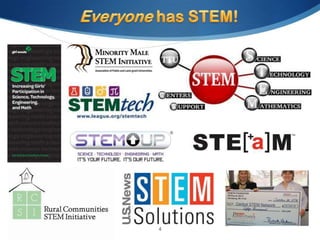
Schools around the country are
STEM-washing, using the term
STEM to gain recognition and
hope to attract funding.
                 STEM is the
                 buzzword of the
                 moment.

             3
4
Including ITEEA!
       5
How many of you have ever claimed
  one or more of the areas of STEM as
          your content area?
Examples:
 We are the “T & E” of STEM!

 I teach TECHNOLOGY, which is more than computers!

 The physics teachers can’t teach engineering. It is part of
  the CSPG for Technology Education!
                              6
•   There are a lot of other teachers claiming the “T” in
    STEM
     Instructional Technology
     Educational Technology
     Technology Classes (ie. Computers)
     Technology Integration (ie. Using computers for learning)
     Technology Coach (ie. Person identified to coach teachers
      in using instructional technology)

•   Science claims the “S” in STEM, but did you know…
     The NGSS include standards for Engineering & Technology

•   Math claims the “M”, but does not show interest in STEM

                                 7
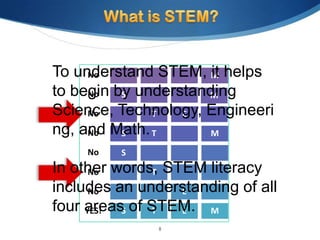
To understand STEM, M helps
     No               it
to begin by understanding
     No   S          M
Science, Technology, Engineeri
     No       T   E
ng, and Math. T
     No   S           M

     No   S
In other words, STEM literacy
      No       T
includes an understanding of all
      No          E
four areasS of STEM. M
     YES!      T  E
               8
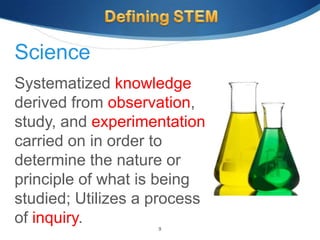
Science
Systematized knowledge
derived from observation,
study, and experimentation
carried on in order to
determine the nature or
principle of what is being
studied; Utilizes a process
of inquiry.         9
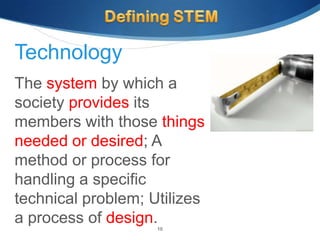
Technology
The system by which a
society provides its
members with those things
needed or desired; A
method or process for
handling a specific
technical problem; Utilizes
a process of design.10
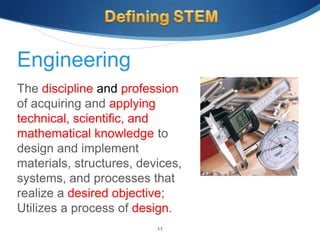
Engineering
The discipline and profession
of acquiring and applying
technical, scientific, and
mathematical knowledge to
design and implement
materials, structures, devices,
systems, and processes that
realize a desired objective;
Utilizes a process of design.
                          11
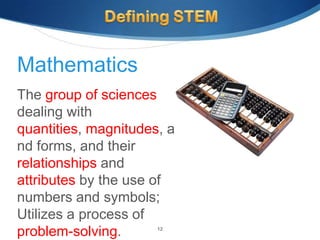
Mathematics
The group of sciences
dealing with
quantities, magnitudes, a
nd forms, and their
relationships and
attributes by the use of
numbers and symbols;
Utilizes a process of
problem-solving.      12
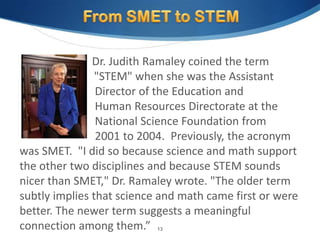
Dr. Judith Ramaley coined the term
                "STEM" when she was the Assistant
                Director of the Education and
                Human Resources Directorate at the
                National Science Foundation from
                2001 to 2004. Previously, the acronym
was SMET. "I did so because science and math support
the other two disciplines and because STEM sounds
nicer than SMET," Dr. Ramaley wrote. "The older term
subtly implies that science and math came first or were
better. The newer term suggests a meaningful
connection among them.”    13
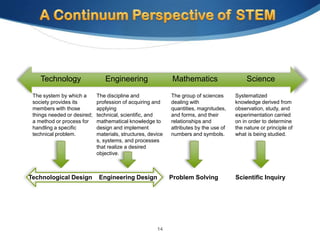
Technology                  Engineering                  Mathematics                     Science

 The system by which a       The discipline and              The group of sciences      Systematized
 society provides its        profession of acquiring and     dealing with               knowledge derived from
 members with those          applying                        quantities, magnitudes,    observation, study, and
 things needed or desired;   technical, scientific, and      and forms, and their       experimentation carried
 a method or process for     mathematical knowledge to       relationships and          on in order to determine
 handling a specific         design and implement            attributes by the use of   the nature or principle of
 technical problem.          materials, structures, device   numbers and symbols.       what is being studied.
                             s, systems, and processes
                             that realize a desired
                             objective.


Technological Design          Engineering Design             Problem Solving            Scientific Inquiry


                                                       14
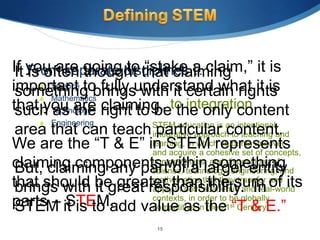
If you are going disciplines… claim,” it is
 It From separate to that claiming
    is often thought “stake a
important to fully understand what it is
       Science
 something brings with it certain rights
       Mathematics
that you are right to … to integration
 such Technology claiming. the only content
        as the          be
     Engineering    STEM education is an intentional,
 area that can teach particular content.
                     integrative approach to teaching and
We are the “T & E” in STEM represents
                     learning, in which students uncover
                     and acquire a cohesive set of concepts,
claiming components within something
                     competencies, and dispositions of
 But, claiming any part of a larger entity
                     science, technology, engineering, and
that should be greater than the sum of its
                     mathematics that they transfer and
 brings with it great responsibility. In
                     apply in both academic and real-world
parts – it is to add value as the “T & E.”
 STEM STEM.
                     contexts, in order to be globally
                     competitive in the 21st Century.

                      15
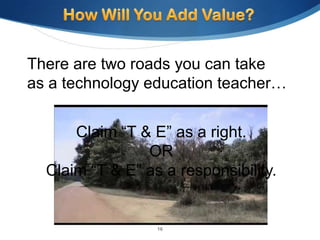
There are two roads you can take
as a technology education teacher…


      Claim “T & E” as a right.
                OR
  Claim “T & E” as a responsibility.


                  16
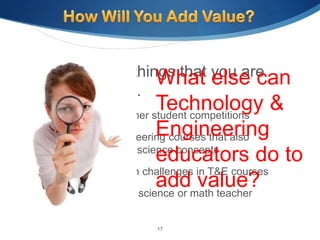
There may be things that you are
                 What else can
already doing…
                           Technology &
 TSA, FIRST, and other student competitions
                           Engineering
 Technology & Engineering courses that also
  incorporate math or science concepts
                           educators do to
 Use of STEM design challenges in T&E courses
                           addmath teacher
 Collaborating with a science or
                                  value?

                     17
STEM Professional Learning Community

•   Face-to-face at your school
•   Virtual at your school or in your district
•   Virtual extending beyond your district


     http://www.mspkmd.net/blasts/plc.php
                         18
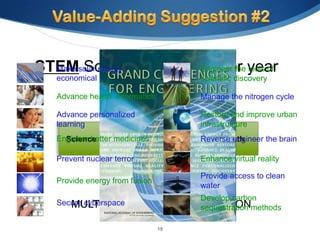
STEMsolar energy
  Make School-wide theme for year
                      Engineer the tools of
   economical                           scientific discovery

   Advance health informatics           Manage the nitrogen cycle

   Advance personalized                 Restore and improve urban
   learning                             infrastructure
   Engineer better medicines            Reverse engineer the brain

   Prevent nuclear terror               Enhance virtual reality

                                        Provide access to clean
   Provide energy from fusion
                                        water
                                         Develop carbon
   Secure cyberspace
      MULTIDISCIPLINARY              INTEGRATIONmethods
                                         sequestration

                                19
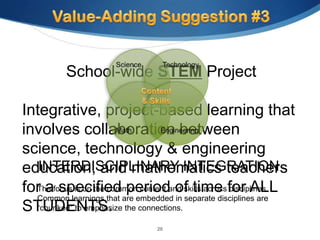
School-wide STEM Project

Integrative, project-based learning that
involves collaboration between
science, technology & engineering
   INTERDISCIPLINARY INTEGRATION
education, and mathematics teachers
for afocus is on the common content and skills acrossfor ALL
  The specified period of time disciplines.
  Common learnings that are embedded in separate disciplines are
STUDENTS. the connections.
  “chunked” to emphasize

                               20
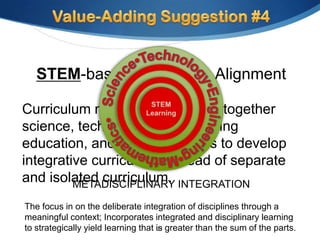
STEM-based Curriculum Alignment

Curriculum mapping that brings together
science, technology & engineering
education, and math educators to develop
integrative curriculum, instead of separate
and isolated curriculum. INTEGRATION
         METADISCIPLINARY

The focus in on the deliberate integration of disciplines through a
meaningful context; Incorporates integrated and disciplinary learning
to strategically yield learning that is greater than the sum of the parts.
                                      21
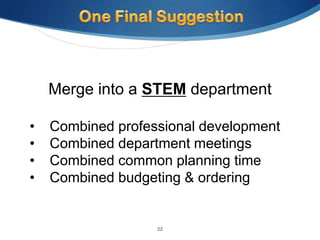
Merge into a STEM department

•   Combined professional development
•   Combined department meetings
•   Combined common planning time
•   Combined budgeting & ordering


                   22
Joey Rider-Bertrand
Curriculum & Instruction Specialist for STEM
         Lancaster-Lebanon IU 13

          joey_bertrand@iu13.org


                     23

Moving Beyond T&E of STEM

  • 1.
    Joey Rider-Bertrand Curriculum &Instruction Specialist for STEM Lancaster-Lebanon IU 13 November 9, 2012 1
  • 2.
  • 3.
    Schools around thecountry are STEM-washing, using the term STEM to gain recognition and hope to attract funding. STEM is the buzzword of the moment. 3
  • 4.
  • 5.
  • 6.
    How many ofyou have ever claimed one or more of the areas of STEM as your content area? Examples:  We are the “T & E” of STEM!  I teach TECHNOLOGY, which is more than computers!  The physics teachers can’t teach engineering. It is part of the CSPG for Technology Education! 6
  • 7.
    There are a lot of other teachers claiming the “T” in STEM  Instructional Technology  Educational Technology  Technology Classes (ie. Computers)  Technology Integration (ie. Using computers for learning)  Technology Coach (ie. Person identified to coach teachers in using instructional technology) • Science claims the “S” in STEM, but did you know…  The NGSS include standards for Engineering & Technology • Math claims the “M”, but does not show interest in STEM 7
  • 8.
    To understand STEM,M helps No it to begin by understanding No S M Science, Technology, Engineeri No T E ng, and Math. T No S M No S In other words, STEM literacy No T includes an understanding of all No E four areasS of STEM. M YES! T E 8
  • 9.
    Science Systematized knowledge derived fromobservation, study, and experimentation carried on in order to determine the nature or principle of what is being studied; Utilizes a process of inquiry. 9
  • 10.
    Technology The system bywhich a society provides its members with those things needed or desired; A method or process for handling a specific technical problem; Utilizes a process of design.10
  • 11.
    Engineering The discipline andprofession of acquiring and applying technical, scientific, and mathematical knowledge to design and implement materials, structures, devices, systems, and processes that realize a desired objective; Utilizes a process of design. 11
  • 12.
    Mathematics The group ofsciences dealing with quantities, magnitudes, a nd forms, and their relationships and attributes by the use of numbers and symbols; Utilizes a process of problem-solving. 12
  • 13.
    Dr. Judith Ramaleycoined the term "STEM" when she was the Assistant Director of the Education and Human Resources Directorate at the National Science Foundation from 2001 to 2004. Previously, the acronym was SMET. "I did so because science and math support the other two disciplines and because STEM sounds nicer than SMET," Dr. Ramaley wrote. "The older term subtly implies that science and math came first or were better. The newer term suggests a meaningful connection among them.” 13
  • 14.
    Technology Engineering Mathematics Science The system by which a The discipline and The group of sciences Systematized society provides its profession of acquiring and dealing with knowledge derived from members with those applying quantities, magnitudes, observation, study, and things needed or desired; technical, scientific, and and forms, and their experimentation carried a method or process for mathematical knowledge to relationships and on in order to determine handling a specific design and implement attributes by the use of the nature or principle of technical problem. materials, structures, device numbers and symbols. what is being studied. s, systems, and processes that realize a desired objective. Technological Design Engineering Design Problem Solving Scientific Inquiry 14
  • 15.
    If you aregoing disciplines… claim,” it is It From separate to that claiming is often thought “stake a important to fully understand what it is  Science something brings with it certain rights  Mathematics that you are right to … to integration such Technology claiming. the only content as the be  Engineering STEM education is an intentional, area that can teach particular content. integrative approach to teaching and We are the “T & E” in STEM represents learning, in which students uncover and acquire a cohesive set of concepts, claiming components within something competencies, and dispositions of But, claiming any part of a larger entity science, technology, engineering, and that should be greater than the sum of its mathematics that they transfer and brings with it great responsibility. In apply in both academic and real-world parts – it is to add value as the “T & E.” STEM STEM. contexts, in order to be globally competitive in the 21st Century. 15
  • 16.
    There are tworoads you can take as a technology education teacher… Claim “T & E” as a right. OR Claim “T & E” as a responsibility. 16
  • 17.
    There may bethings that you are What else can already doing… Technology &  TSA, FIRST, and other student competitions Engineering  Technology & Engineering courses that also incorporate math or science concepts educators do to  Use of STEM design challenges in T&E courses addmath teacher  Collaborating with a science or value? 17
  • 18.
    STEM Professional LearningCommunity • Face-to-face at your school • Virtual at your school or in your district • Virtual extending beyond your district http://www.mspkmd.net/blasts/plc.php 18
  • 19.
    STEMsolar energy Make School-wide theme for year Engineer the tools of economical scientific discovery Advance health informatics Manage the nitrogen cycle Advance personalized Restore and improve urban learning infrastructure Engineer better medicines Reverse engineer the brain Prevent nuclear terror Enhance virtual reality Provide access to clean Provide energy from fusion water Develop carbon Secure cyberspace MULTIDISCIPLINARY INTEGRATIONmethods sequestration 19
  • 20.
    School-wide STEM Project Integrative,project-based learning that involves collaboration between science, technology & engineering INTERDISCIPLINARY INTEGRATION education, and mathematics teachers for afocus is on the common content and skills acrossfor ALL The specified period of time disciplines. Common learnings that are embedded in separate disciplines are STUDENTS. the connections. “chunked” to emphasize 20
  • 21.
    STEM-based Curriculum Alignment Curriculummapping that brings together science, technology & engineering education, and math educators to develop integrative curriculum, instead of separate and isolated curriculum. INTEGRATION METADISCIPLINARY The focus in on the deliberate integration of disciplines through a meaningful context; Incorporates integrated and disciplinary learning to strategically yield learning that is greater than the sum of the parts. 21
  • 22.
    Merge into aSTEM department • Combined professional development • Combined department meetings • Combined common planning time • Combined budgeting & ordering 22
  • 23.
    Joey Rider-Bertrand Curriculum &Instruction Specialist for STEM Lancaster-Lebanon IU 13 joey_bertrand@iu13.org 23

Editor's Notes

  • #15 STEM is catchy, but doesn’t accurately capture the relationships of the four disciplines. First of all, the four disciplines should be represented as a continuum of disciplines that are all part of the same content “umbrella.”Technology and science belong on the two end of the continuum because these are the two core disciplines that share the primary relationship. Math belongs beside science because technically, all math is a group of sciences.Engineering belongs beside technology because of their similar processes, but engineering also belongs beside math because it is the application of advanced math that is partly responsible for the differences between technology and engineering.
  • #16 Science – (noun) 1. Systematized knowledge derived from observation, study, and experimentation carried on in order to determine the nature or principles of what is being studied. 2. Any specific branch of scientific knowledge, esp. one concerned with establishing and systematizing facts, principles, and methods, as by experiments and hypotheses.Mathematics – (noun) 1. The group of sciences (including arithmetic, geometry, algebra, calculus, etc.) dealing with quantities, magnitudes, and forms, and their relationships, attributes, etc., by the use of numbers and symbols 2. The act or process of using any of these sciences; computation. NOTE: Mathematics is not the language of science, it is a science!Technology – (noun) 1. The study of the practical or industrial arts, applied sciences, etc. 2. a method or a process for handling a specific technical problem 3. the system by which a society provides its members with those things needed or desired.Engineering – (noun) The discipline, art and profession of acquiring and applying technical, scientific, and mathematical knowledge to design and implement materials, structures, machines, devices, systems, and processes that safely realize a desired objective or invention.