Math/Science/Technology (MST) K-5
Teacher Preparation Program at TNCJ
Dr. Steve O
Dr. Steve O’
’Brien
Brien
Associate Professor
Associate Professor
Director, Center for Excellence in STEM Education
Dr. John Karsnitz
Dr. John Karsnitz
Professor and Chair
Professor and Chair
School of Engineering
The College of New Jersey
1
The College of New Jersey
• Primarily Undergraduate
• Schools
– Education, Engineering, Business, Nursing
– Science
– Arts & Comm., Humanities & Social Sci.
• ~6000 Undergraduates
• 95% On-Campus Freshman
• 850 Graduate Students
• 326 Faculty (12:1 Ratio)
• >50 Liberal Arts & Professional Programs
2
TCNJ School of Engineering
K-12 13-16 16-20+
Biomedical
Civil
Computer
Electrical
Mechanical
Technology/
pre-engineering
education [K-12]
MST [K-5(8)]
MAT
Active UG Research
30% graduates go
onto graduate or
prof. school
Future Prof. Dev.
Opportunities
Supports K-20+ Engineering Education Pipeline
Ctr for Excel. In STEM Ed.
3
~50
160
10
MST Education Major
1) How would you define integrated STEM education?
2) Briefly describe history, content, and impact of the MST
program, citing data whenever possible.
1) Challenges in design and implementation has the MST
program faced, and how have these challenges been addressed?
2) Few of the most important unanswered questions regarding K-
12 teacher preparation to teach integrated STEM?
Questions asked by NAE/NRC:
4
MST Education Major
1) How would you define integrated STEM education?
2) Briefly describe history, content, and impact of the MST
program, citing data whenever possible.
1) Challenges in design and implementation has the MST
program faced, and how have these challenges been addressed?
2) Few of the most important unanswered questions regarding K-
12 teacher preparation to teach integrated STEM?
Questions asked by NAE/NRC:
5
i-STEM Definition / Thoughts
 Very important to define i-STEM well
 Many studies cite lowered National performance in M & S [T&E?]
 Big impact on economic & social processes
 “STEM” has become to mean S or T or E or M
 Has lead to the acronym becoming less useful, perhaps harmful
 Government officials: “ … more support for M & S”
 Lose “interconnectedness”
 Need a better acronym: “integrated-STEM” is a good step
Why?
S M E T Separate silos with
perhaps M:S and T:E
6
i-STEM Definition / Thoughts
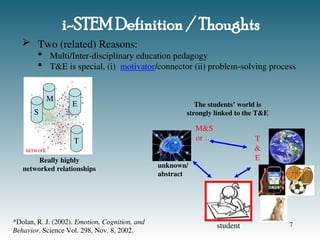
 Two (related) Reasons:
 Multi/Inter-disciplinary education pedagogy
 T&E is special, (i) motivator/connector (ii) problem-solving process
S
M
E
T
M&S
or … T
&
E
student
unknown/
abstract
*Dolan, R. J. (2002). Emotion, Cognition, and
Behavior. Science Vol. 298, Nov. 8, 2002.
network
7
Really highly
networked relationships
The students’ world is
strongly linked to the T&E
i-STEM Definition
 Possible Def’n: Integration of 2 or more of the 4 STEM
content area with each other into a teaching/learning
experience with purposeful intent of deepening learning.
 Common Ex.: M + S
 Does not include non-STEM integrations [Soc. St. + M, or … etc.]
 Does not account for context/motivation capability of the T&E
 Modified Def’n: Integration of 1 or more STEM contents into
A teaching/learning experience, with purposeful intent of
deepening learning.
 Ex.’s: M + T/E, S + M, Soc. St. + T/E, or Lang. Arts + S
 Due to context-setting and problem-solving process of T&E,
our preference is integrating T&E to other subjects. [Note: E 
M&S]
8
i-STEM & Prob. Based Learning
 PBL is not i-STEM but is often a technique used in i-STEM
activities
9
MST Education Major
1) How would you define integrated STEM education?
2) Briefly describe history, content, and impact of the MST
program, citing data whenever possible.
1) Challenges in design and implementation has the MST
program faced, and how have these challenges been addressed?
2) Few of the most important unanswered questions regarding K-
12 teacher preparation to teach integrated STEM?
Questions asked by NAE/NRC:
10
The MST K-5(8) Program
 Context / History
 Goals
 Program Description
 Impacts
11
History
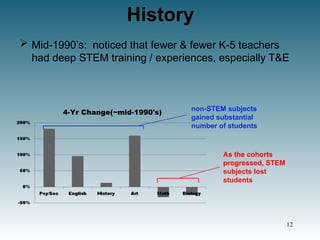
 Mid-1990’s: noticed that fewer & fewer K-5 teachers
had deep STEM training / experiences, especially T&E
As the cohorts
progressed, STEM
subjects lost
students
non-STEM subjects
gained substantial
number of students
12
History
 Technology recognized as one of 13 General Ed goals
 Society, Ethics, and Technology (1990).
 New Jersey Systemic Statewide Initiative director (STEM)
 Dr. J. Karsnitz (Chair) convenes study group (1995),
[School of Ed. and Arts & Sciences] ...
MST approved as a new major by TCNJ and NJ Higher
Education governance system (1998).
 MST approved as academic major by NJ DOE (2000).
13
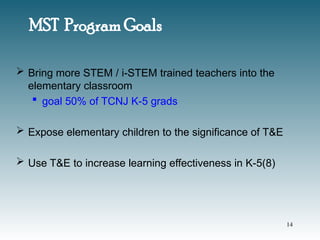
 Bring more STEM / i-STEM trained teachers into the
elementary classroom
 goal 50% of TCNJ K-5 grads
 Expose elementary children to the significance of T&E
 Use T&E to increase learning effectiveness in K-5(8)
MST Program Goals
14
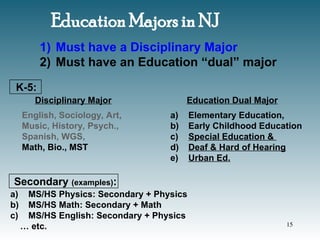
Education Majors in NJ
a) Elementary Education,
b) Early Childhood Education
c) Special Education &
d) Deaf & Hard of Hearing
e) Urban Ed.
1) Must have a Disciplinary Major
2) Must have an Education “dual” major
K-5:
English, Sociology, Art,
Music, History, Psych.,
Spanish, WGS,
Math, Bio., MST
Disciplinary Major Education Dual Major
Secondary (examples):
a) MS/HS Physics: Secondary + Physics
b) MS/HS Math: Secondary + Math
c) MS/HS English: Secondary + Physics
… etc. 15
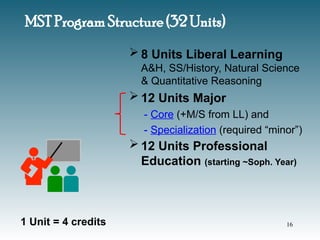
MST Program Structure (32 Units)
 8 Units Liberal Learning
A&H, SS/History, Natural Science
& Quantitative Reasoning
 12 Units Major
- Core (+M/S from LL) and
- Specialization (required “minor”)
 12 Units Professional
Education (starting ~Soph. Year)
1 Unit = 4 credits 16
MST Major Courses
CORE** – 8 units
 Mathematics – 1 units
 Technology – 2 units
 Science – 2 units
 MST Electives (M or S or T&E) – 2 units
 i-STEM [TED460] – 1 unit
SPECIALIZATION (“Minor”) – 4 units
 M, S or T (equal to a minor in discipline)
1 Unit = 4 credits
**Creative Design &
Calculus-I are contained
in Liberal Learning
17
Specializations
 ~100% of graduates satisfy requirements for Middle School
endorsements in M or S. [4 courses in M or S … etc.]
 A large majority (70-90%) satisfy requirements for Middle School
endorsements in both M or S [4 courses in both M & S … etc.]
 ~40% of graduates satisfy requirements for K-12 Technology
Education endorsement
1) Technology
2) Mathematics
3) Science (Bio, Chemistry or Physics)
For a total of 5 possible specializations
18
• Calculus-I*
• MAT105* Mathematical Structures & Algorithms for Educators-I
• MTT202* Teaching Mathematics in the Early Childhood & Elementary
Classroom {Methodology / Pedagogy}
• Engineering (applied) Math
[~85% take this and will likely become required]
• MAT106 Mathematical Structures & Algorithms for Educators-II
• Calc-II
• STA115/215
Required / Typical Math Courses
* Required 19
• MST202* Methods of Teaching Science, Health and
Technology
• SCI103 Physical, Earth, and Space Sciences
• SCI104 Genes, Cancer and the Environment
• PHY120 Introduction to Geology
• PHY161 Introduction to Astronomy
• PHY171 Introduction to Meteorology
Typical Sci. Courses
No specific Science Content courses are required
EXCEPT for Science Specialization MST [Bio., Physics, Chemistry]
* Required 20
T&E Courses
 All T&E Courses part of existing Secondary TechEd/PreEng Program
 2005: Major curriculum change
 TechEd  TechEd/Pre-Eng
 (i) More M & S and (ii) Hired Professors w/ Eng. degrees
 Unlike M & S courses, the “content” T&E courses also contain
substantial Pedagogy/methods (all students are Education)
21
• Creative Design*
• Multimedia Design (2D)*
• Structures & Mechanisms*
• Integrated-STEM for Child/Adoles. Learner* {Method. / Pedagogy}
• Engineering (applied) Math
[~85% take this and will likely become required]
• BioTech
• Facilities
• Arch. & Civil
Required / Typical T&E Courses
* Required 22
 Teaching as a Design Process*
 Young ages:
 Key for setting STEM affect / self-efficacy
 Capable age group [Age-appropriate bias]
 Girls & minorities
 Dev. a deeper understanding of i-STEM and be able to
defend it
 Research in field
 Plan and implement i-STEM lessons [Purposeful intent]
 Physical nature of learning environment
 Integrating T&E into K-5
i-STEM Course Overview
23
*Hiebert, J. et. al: Preparing teachers to learn from teaching [J. Teacher Ed. (2007)] and
Learning to learn to teach an “experimental” model for teaching and teacher preparation in
mathematics [J. of Mathematics Teacher Ed. (2003)]
• In vibrant School of Engineering
• Stay Current (pre-engineering, textbooks . . . etc.)
• STEM Center (Outreach and Research; staff of ~5)
• TSA-NJ Competition (>1600 HS and MS attendees)
• Professional Conference (21st
annual, 1-day & ~8 sessions)
• Professional Workshop Series (~6 per year)
• TECA Competitions (Annually; compete & organize …)
• FIRST Robotics:
– Hosted state competition (~700 attendees)
– Hosted Workshops (training for new – old teams)
• Active Student society (TES)
• NJTEEA; very active
Programs not “in a vacuum”
… substantial informal learning
24
Impacts of the MST Program
 Growth in K-5 STEM (i-STEM) grads
 STEM & non-STEM content knowledge
 Math Anxiety and Math teaching Self-efficacy
 Gender
 Anecdotal:
 Job Placement
 Curriculum dev. in teaching experiences
25
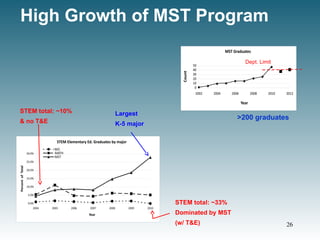
High Growth of MST Program
STEM total: ~10%
& no T&E
STEM total: ~33%
Dominated by MST
(w/ T&E)
>200 graduates
Dept. Limit
Largest
K-5 major
26
Content Knowledge- M & S
 ETS PraxisTM
test #0014
 Relative results by subscore subject
 t-test results: [95% Conf.; NMST=59, Nnon-MST=346]
• Math: p = 0.004; Science: p = 0.001
(Example: for math the MST population scored 5.5%
higher than the non-MST population.)
MST graduates relative to non-MST graduates.
Statistically significant higher
M & S performance
Statistically equivalent
performance on non-STEM
subjects !
27
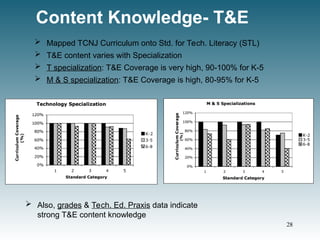
Content Knowledge- T&E
 Mapped TCNJ Curriculum onto Std. for Tech. Literacy (STL)
 T&E content varies with Specialization
 T specialization: T&E Coverage is very high, 90-100% for K-5
 M & S specialization: T&E Coverage is high, 80-95% for K-5
 Also, grades & Tech. Ed. Praxis data indicate
strong T&E content knowledge
28
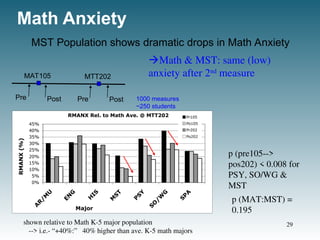
Math Anxiety
shown relative to Math K-5 major population
--> i.e.- “+40%:” 40% higher than ave. K-5 math majors
p (MAT:MST) =
0.195
p (pre105-->
pos202) < 0.008 for
PSY, SO/WG &
MST
MAT105 MTT202
Pre Post Pre
MST Population shows dramatic drops in Math Anxiety
Post
29
1000 measures
~250 students
Math & MST: same (low)
anxiety after 2nd
measure
Math Anxiety
 Non-STEM vs. STEM
 High anxiety (top quartile)
1:3
1:5
1:4
1:14
SAT (Math) Scores
TCNJ
Non-STEM [602]
MST [643]
K-5 Math [638]
- - - - - - - - - - - - -
National Ave.
Sch. of Ed. [483]
Sch. of Engin. [579]
Math [614]
30
Math Anxiety [MST Spec.’n]
RMANX: MST (Po202) RMANX: Tech. Spec.
N Ave SD N Ave SD
T&E 21 64.6 10.3 Pr105 11 76.8 15.9
Math 21 69.3 15.7 Po105 10 71 13.6
Sci 8 73.5 15.1 Pr202 18 67.2 8
Po202 21 64.6 10.3
Effects of T&E curriculum ?
Anxiety for T&E Special.z’n subpopulation drops dramatically
T&E has less M & S but more T&E courses
 Substantial context, applications (applied math)
I II
Continuing Data Collection:
Double #’s within 1 year. 31
Gender Benefits
Historically, a high level of MST graduates are male [15-20% ]
• TCNJ K-5 average is ~5%, independent of major
• National average for K-5 teachers is ~9% (2001) {1981: 18%}
 80+% MST graduates are female
 Research strongly indicates these graduates will be
effective role models for female K-5(8) students,
halting the gender “gap” in STEM
Continue?? 32
Female
Male
!!
Anecdotal Evidence
 Job Placement
 Historically, high job placement in ALL School of Ed., 90+%
 MST grads had ~100% placement ... Until economy hit NJ-
education 2010/2011
 2011 MST grads had tougher time. Placement is 70-80%
but almost ALL MST had call-backs and interviews.
 Non-STEM majors seemed to have few “bites”
 Some Districts specifically look for MST …
 i-STEM Unit/Curriculum dev.
 For both Jr. Experiences and Full-time Student Teaching,
students are developing high quality i-STEM, even in
schools where “science” is not policy.
 Same for post-grad: New elective courses offered, …
requiring 4 new Sections … etc.
33
Overall Lessons Learned
 “Teachers as Designers:” good Teach. Prep. Model
 Design Process applies to T&L environment …
ID Problem  Ideate  . . .  Assess … Loop
 Mixing Elementary with Secondary students, all in the
School of Eng., are really good
 T&E courses having Content & Pedagogy is good
 Gender benefits:
 STEM-capable female teachers [Big !]
 Perhaps attract more male K-5 teachers
 Math/Quant. literacy is a problem
 T&E content likely helping math / science anxiety.
34
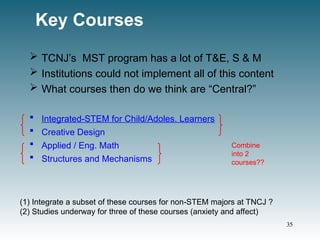
Key Courses
 TCNJ’s MST program has a lot of T&E, S & M
 Institutions could not implement all of this content
 What courses then do we think are “Central?”
 Integrated-STEM for Child/Adoles. Learners
 Creative Design
 Applied / Eng. Math
 Structures and Mechanisms
Combine
into 2
courses??
35
(1) Integrate a subset of these courses for non-STEM majors at TNCJ ?
(2) Studies underway for three of these courses (anxiety and affect)
MST Education Major
1) How would you define integrated STEM education?
2) Briefly describe history, content, and impact of the M/S/T
program, citing data whenever possible.
1) Challenges in design and implementation has the M/S/T
program faced, and how have these challenges been addressed?
2) Few of the most important unanswered questions regarding K-
12 teacher preparation to teach integrated STEM?
Questions asked by NAE/NRC:
36
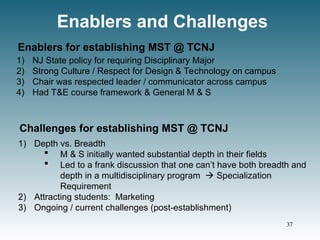
Enablers and Challenges
1) NJ State policy for requiring Disciplinary Major
2) Strong Culture / Respect for Design & Technology on campus
3) Chair was respected leader / communicator across campus
4) Had T&E course framework & General M & S
Enablers for establishing MST @ TCNJ
1) Depth vs. Breadth
 M & S initially wanted substantial depth in their fields
 Led to a frank discussion that one can’t have both breadth and
depth in a multidisciplinary program  Specialization
Requirement
2) Attracting students: Marketing
3) Ongoing / current challenges (post-establishment)
Challenges for establishing MST @ TCNJ
37
Enablers and Challenges for
other Schools
~5 Universities have inquired about our i-STEM program as part of their
effort to establish i-STEM in their K-5
Obstacles:
Entrenched & “packed” K-5 programs / Faculty Loading / Economy
No Stds/State Policies for T&E or i-STEM in K-5 (or even 6-12)
 PA: (i) K-5  K-2 & 3-8, (ii) Increase in field experience time
 MD: Counterpoint, Strong State-wide Effort in i-STEM
[Stds, Teacher Prep, Assessment … etc.]
 CN: perhaps a strong Govern.-driven effort starting … ?
Leaders / Visionaries in K-5 Faculty / Chairs
38
MST Education Major
1) How would you define integrated STEM education?
2) Briefly describe history, content, and impact of the M/S/T
program, citing data whenever possible.
1) Challenges in design and implementation has the M/S/T
program faced, and how have these challenges been addressed?
2) Few of the most important unanswered questions regarding K-
12 teacher preparation to teach integrated STEM?
Questions asked by NAE/NRC:
39
Important Questions
– Affect
– Anxiety/S. Eff.
– Content
– Problem-solving/
21st
-Cent. skills
Students
– Affect
– Anxiety/S. Eff.
– Content/Methods
– Problem-solving/
21st
-Cent. skills
Teachers
– Impact others?
[Teachers, Admin.,
Policy, State … ]
– i-STEM Curr. Dev.?
– Expanding i-STEM
activities/methods?
T&L
Environ.
Perhaps 3 categories of important research questions:
Teacher Prep
Long- and short-term Impacts, not simply Pre vs. Post
PBL is our ally and challenge here
[i-STEM approaches vs. Conventional]
40
Questions for Teacher Prep
 What aspects of i-STEM are needed / preferred in (i) K-
5(8) and (ii) Teacher Prep.?
 T&E (i-STEM content/benefits)
 PBL
 Pre- vs. in-service
 Systemic change vs. speed
 How to promote both?
 In-service data  promote systemic change
 Committee could also refer to output from ASEE’s
Workshop on Eng. Ed. in K-5 (@NCSU) [2009]
41
Foundation Funded i-STEM …
 Acquired Foundation Funding to promote i-STEM
curriculum [$100K Year-1, building over successive years]
 New NJ standards on 21st
Century skills
 New NJ policy on Prof. Learning Communities
 PD i-STEM w/ EbDTM
curriculum
o EbD is inexpensive and very flexible
o EbD onlline enables large data collection
 Key Goals:
 Successful PD for i-STEM curriculum (w/ EbD & TCNJ data
collection)
o 20 Districts in Year-1
 Pursue a few research questions (per previous slides)
 Have PD become financially self-sustaining
 Common curriculum / common dialog
42
Thank you for your time !
• Dr. Steve O’Brien
Armstrong Hall 181
(609) 771-2780
obriens@tcnj.edu
• http://www.tcnj.edu/~tstudies
Questions:
43

Obrien FINAL Chapter 5 and chapter 6.ppt

  • 1.
    Math/Science/Technology (MST) K-5 TeacherPreparation Program at TNCJ Dr. Steve O Dr. Steve O’ ’Brien Brien Associate Professor Associate Professor Director, Center for Excellence in STEM Education Director, Center for Excellence in STEM Education Dr. John Karsnitz Dr. John Karsnitz Professor and Chair Professor and Chair School of Engineering School of Engineering The College of New Jersey The College of New Jersey 1
  • 2.
    The College ofNew Jersey • Primarily Undergraduate • Schools – Education, Engineering, Business, Nursing – Science – Arts & Comm., Humanities & Social Sci. • ~6000 Undergraduates • 95% On-Campus Freshman • 850 Graduate Students • 326 Faculty (12:1 Ratio) • >50 Liberal Arts & Professional Programs 2
  • 3.
    TCNJ School ofEngineering K-12 13-16 16-20+ Biomedical Civil Computer Electrical Mechanical Technology/ pre-engineering education [K-12] MST [K-5(8)] MAT Active UG Research 30% graduates go onto graduate or prof. school Future Prof. Dev. Opportunities Supports K-20+ Engineering Education Pipeline Ctr for Excel. In STEM Ed. 3 ~50 160 10
  • 4.
    MST Education Major 1)How would you define integrated STEM education? 2) Briefly describe history, content, and impact of the MST program, citing data whenever possible. 1) Challenges in design and implementation has the MST program faced, and how have these challenges been addressed? 2) Few of the most important unanswered questions regarding K- 12 teacher preparation to teach integrated STEM? Questions asked by NAE/NRC: 4
  • 5.
    MST Education Major 1)How would you define integrated STEM education? 2) Briefly describe history, content, and impact of the MST program, citing data whenever possible. 1) Challenges in design and implementation has the MST program faced, and how have these challenges been addressed? 2) Few of the most important unanswered questions regarding K- 12 teacher preparation to teach integrated STEM? Questions asked by NAE/NRC: 5
  • 6.
    i-STEM Definition /Thoughts  Very important to define i-STEM well  Many studies cite lowered National performance in M & S [T&E?]  Big impact on economic & social processes  “STEM” has become to mean S or T or E or M  Has lead to the acronym becoming less useful, perhaps harmful  Government officials: “ … more support for M & S”  Lose “interconnectedness”  Need a better acronym: “integrated-STEM” is a good step Why? S M E T Separate silos with perhaps M:S and T:E 6
  • 7.
    i-STEM Definition /Thoughts  Two (related) Reasons:  Multi/Inter-disciplinary education pedagogy  T&E is special, (i) motivator/connector (ii) problem-solving process S M E T M&S or … T & E student unknown/ abstract *Dolan, R. J. (2002). Emotion, Cognition, and Behavior. Science Vol. 298, Nov. 8, 2002. network 7 Really highly networked relationships The students’ world is strongly linked to the T&E
  • 8.
    i-STEM Definition  PossibleDef’n: Integration of 2 or more of the 4 STEM content area with each other into a teaching/learning experience with purposeful intent of deepening learning.  Common Ex.: M + S  Does not include non-STEM integrations [Soc. St. + M, or … etc.]  Does not account for context/motivation capability of the T&E  Modified Def’n: Integration of 1 or more STEM contents into A teaching/learning experience, with purposeful intent of deepening learning.  Ex.’s: M + T/E, S + M, Soc. St. + T/E, or Lang. Arts + S  Due to context-setting and problem-solving process of T&E, our preference is integrating T&E to other subjects. [Note: E  M&S] 8
  • 9.
    i-STEM & Prob.Based Learning  PBL is not i-STEM but is often a technique used in i-STEM activities 9
  • 10.
    MST Education Major 1)How would you define integrated STEM education? 2) Briefly describe history, content, and impact of the MST program, citing data whenever possible. 1) Challenges in design and implementation has the MST program faced, and how have these challenges been addressed? 2) Few of the most important unanswered questions regarding K- 12 teacher preparation to teach integrated STEM? Questions asked by NAE/NRC: 10
  • 11.
    The MST K-5(8)Program  Context / History  Goals  Program Description  Impacts 11
  • 12.
    History  Mid-1990’s: noticedthat fewer & fewer K-5 teachers had deep STEM training / experiences, especially T&E As the cohorts progressed, STEM subjects lost students non-STEM subjects gained substantial number of students 12
  • 13.
    History  Technology recognizedas one of 13 General Ed goals  Society, Ethics, and Technology (1990).  New Jersey Systemic Statewide Initiative director (STEM)  Dr. J. Karsnitz (Chair) convenes study group (1995), [School of Ed. and Arts & Sciences] ... MST approved as a new major by TCNJ and NJ Higher Education governance system (1998).  MST approved as academic major by NJ DOE (2000). 13
  • 14.
     Bring moreSTEM / i-STEM trained teachers into the elementary classroom  goal 50% of TCNJ K-5 grads  Expose elementary children to the significance of T&E  Use T&E to increase learning effectiveness in K-5(8) MST Program Goals 14
  • 15.
    Education Majors inNJ a) Elementary Education, b) Early Childhood Education c) Special Education & d) Deaf & Hard of Hearing e) Urban Ed. 1) Must have a Disciplinary Major 2) Must have an Education “dual” major K-5: English, Sociology, Art, Music, History, Psych., Spanish, WGS, Math, Bio., MST Disciplinary Major Education Dual Major Secondary (examples): a) MS/HS Physics: Secondary + Physics b) MS/HS Math: Secondary + Math c) MS/HS English: Secondary + Physics … etc. 15
  • 16.
    MST Program Structure(32 Units)  8 Units Liberal Learning A&H, SS/History, Natural Science & Quantitative Reasoning  12 Units Major - Core (+M/S from LL) and - Specialization (required “minor”)  12 Units Professional Education (starting ~Soph. Year) 1 Unit = 4 credits 16
  • 17.
    MST Major Courses CORE**– 8 units  Mathematics – 1 units  Technology – 2 units  Science – 2 units  MST Electives (M or S or T&E) – 2 units  i-STEM [TED460] – 1 unit SPECIALIZATION (“Minor”) – 4 units  M, S or T (equal to a minor in discipline) 1 Unit = 4 credits **Creative Design & Calculus-I are contained in Liberal Learning 17
  • 18.
    Specializations  ~100% ofgraduates satisfy requirements for Middle School endorsements in M or S. [4 courses in M or S … etc.]  A large majority (70-90%) satisfy requirements for Middle School endorsements in both M or S [4 courses in both M & S … etc.]  ~40% of graduates satisfy requirements for K-12 Technology Education endorsement 1) Technology 2) Mathematics 3) Science (Bio, Chemistry or Physics) For a total of 5 possible specializations 18
  • 19.
    • Calculus-I* • MAT105*Mathematical Structures & Algorithms for Educators-I • MTT202* Teaching Mathematics in the Early Childhood & Elementary Classroom {Methodology / Pedagogy} • Engineering (applied) Math [~85% take this and will likely become required] • MAT106 Mathematical Structures & Algorithms for Educators-II • Calc-II • STA115/215 Required / Typical Math Courses * Required 19
  • 20.
    • MST202* Methodsof Teaching Science, Health and Technology • SCI103 Physical, Earth, and Space Sciences • SCI104 Genes, Cancer and the Environment • PHY120 Introduction to Geology • PHY161 Introduction to Astronomy • PHY171 Introduction to Meteorology Typical Sci. Courses No specific Science Content courses are required EXCEPT for Science Specialization MST [Bio., Physics, Chemistry] * Required 20
  • 21.
    T&E Courses  AllT&E Courses part of existing Secondary TechEd/PreEng Program  2005: Major curriculum change  TechEd  TechEd/Pre-Eng  (i) More M & S and (ii) Hired Professors w/ Eng. degrees  Unlike M & S courses, the “content” T&E courses also contain substantial Pedagogy/methods (all students are Education) 21
  • 22.
    • Creative Design* •Multimedia Design (2D)* • Structures & Mechanisms* • Integrated-STEM for Child/Adoles. Learner* {Method. / Pedagogy} • Engineering (applied) Math [~85% take this and will likely become required] • BioTech • Facilities • Arch. & Civil Required / Typical T&E Courses * Required 22
  • 23.
     Teaching asa Design Process*  Young ages:  Key for setting STEM affect / self-efficacy  Capable age group [Age-appropriate bias]  Girls & minorities  Dev. a deeper understanding of i-STEM and be able to defend it  Research in field  Plan and implement i-STEM lessons [Purposeful intent]  Physical nature of learning environment  Integrating T&E into K-5 i-STEM Course Overview 23 *Hiebert, J. et. al: Preparing teachers to learn from teaching [J. Teacher Ed. (2007)] and Learning to learn to teach an “experimental” model for teaching and teacher preparation in mathematics [J. of Mathematics Teacher Ed. (2003)]
  • 24.
    • In vibrantSchool of Engineering • Stay Current (pre-engineering, textbooks . . . etc.) • STEM Center (Outreach and Research; staff of ~5) • TSA-NJ Competition (>1600 HS and MS attendees) • Professional Conference (21st annual, 1-day & ~8 sessions) • Professional Workshop Series (~6 per year) • TECA Competitions (Annually; compete & organize …) • FIRST Robotics: – Hosted state competition (~700 attendees) – Hosted Workshops (training for new – old teams) • Active Student society (TES) • NJTEEA; very active Programs not “in a vacuum” … substantial informal learning 24
  • 25.
    Impacts of theMST Program  Growth in K-5 STEM (i-STEM) grads  STEM & non-STEM content knowledge  Math Anxiety and Math teaching Self-efficacy  Gender  Anecdotal:  Job Placement  Curriculum dev. in teaching experiences 25
  • 26.
    High Growth ofMST Program STEM total: ~10% & no T&E STEM total: ~33% Dominated by MST (w/ T&E) >200 graduates Dept. Limit Largest K-5 major 26
  • 27.
    Content Knowledge- M& S  ETS PraxisTM test #0014  Relative results by subscore subject  t-test results: [95% Conf.; NMST=59, Nnon-MST=346] • Math: p = 0.004; Science: p = 0.001 (Example: for math the MST population scored 5.5% higher than the non-MST population.) MST graduates relative to non-MST graduates. Statistically significant higher M & S performance Statistically equivalent performance on non-STEM subjects ! 27
  • 28.
    Content Knowledge- T&E Mapped TCNJ Curriculum onto Std. for Tech. Literacy (STL)  T&E content varies with Specialization  T specialization: T&E Coverage is very high, 90-100% for K-5  M & S specialization: T&E Coverage is high, 80-95% for K-5  Also, grades & Tech. Ed. Praxis data indicate strong T&E content knowledge 28
  • 29.
    Math Anxiety shown relativeto Math K-5 major population --> i.e.- “+40%:” 40% higher than ave. K-5 math majors p (MAT:MST) = 0.195 p (pre105--> pos202) < 0.008 for PSY, SO/WG & MST MAT105 MTT202 Pre Post Pre MST Population shows dramatic drops in Math Anxiety Post 29 1000 measures ~250 students Math & MST: same (low) anxiety after 2nd measure
  • 30.
    Math Anxiety  Non-STEMvs. STEM  High anxiety (top quartile) 1:3 1:5 1:4 1:14 SAT (Math) Scores TCNJ Non-STEM [602] MST [643] K-5 Math [638] - - - - - - - - - - - - - National Ave. Sch. of Ed. [483] Sch. of Engin. [579] Math [614] 30
  • 31.
    Math Anxiety [MSTSpec.’n] RMANX: MST (Po202) RMANX: Tech. Spec. N Ave SD N Ave SD T&E 21 64.6 10.3 Pr105 11 76.8 15.9 Math 21 69.3 15.7 Po105 10 71 13.6 Sci 8 73.5 15.1 Pr202 18 67.2 8 Po202 21 64.6 10.3 Effects of T&E curriculum ? Anxiety for T&E Special.z’n subpopulation drops dramatically T&E has less M & S but more T&E courses  Substantial context, applications (applied math) I II Continuing Data Collection: Double #’s within 1 year. 31
  • 32.
    Gender Benefits Historically, ahigh level of MST graduates are male [15-20% ] • TCNJ K-5 average is ~5%, independent of major • National average for K-5 teachers is ~9% (2001) {1981: 18%}  80+% MST graduates are female  Research strongly indicates these graduates will be effective role models for female K-5(8) students, halting the gender “gap” in STEM Continue?? 32 Female Male !!
  • 33.
    Anecdotal Evidence  JobPlacement  Historically, high job placement in ALL School of Ed., 90+%  MST grads had ~100% placement ... Until economy hit NJ- education 2010/2011  2011 MST grads had tougher time. Placement is 70-80% but almost ALL MST had call-backs and interviews.  Non-STEM majors seemed to have few “bites”  Some Districts specifically look for MST …  i-STEM Unit/Curriculum dev.  For both Jr. Experiences and Full-time Student Teaching, students are developing high quality i-STEM, even in schools where “science” is not policy.  Same for post-grad: New elective courses offered, … requiring 4 new Sections … etc. 33
  • 34.
    Overall Lessons Learned “Teachers as Designers:” good Teach. Prep. Model  Design Process applies to T&L environment … ID Problem  Ideate  . . .  Assess … Loop  Mixing Elementary with Secondary students, all in the School of Eng., are really good  T&E courses having Content & Pedagogy is good  Gender benefits:  STEM-capable female teachers [Big !]  Perhaps attract more male K-5 teachers  Math/Quant. literacy is a problem  T&E content likely helping math / science anxiety. 34
  • 35.
    Key Courses  TCNJ’sMST program has a lot of T&E, S & M  Institutions could not implement all of this content  What courses then do we think are “Central?”  Integrated-STEM for Child/Adoles. Learners  Creative Design  Applied / Eng. Math  Structures and Mechanisms Combine into 2 courses?? 35 (1) Integrate a subset of these courses for non-STEM majors at TNCJ ? (2) Studies underway for three of these courses (anxiety and affect)
  • 36.
    MST Education Major 1)How would you define integrated STEM education? 2) Briefly describe history, content, and impact of the M/S/T program, citing data whenever possible. 1) Challenges in design and implementation has the M/S/T program faced, and how have these challenges been addressed? 2) Few of the most important unanswered questions regarding K- 12 teacher preparation to teach integrated STEM? Questions asked by NAE/NRC: 36
  • 37.
    Enablers and Challenges 1)NJ State policy for requiring Disciplinary Major 2) Strong Culture / Respect for Design & Technology on campus 3) Chair was respected leader / communicator across campus 4) Had T&E course framework & General M & S Enablers for establishing MST @ TCNJ 1) Depth vs. Breadth  M & S initially wanted substantial depth in their fields  Led to a frank discussion that one can’t have both breadth and depth in a multidisciplinary program  Specialization Requirement 2) Attracting students: Marketing 3) Ongoing / current challenges (post-establishment) Challenges for establishing MST @ TCNJ 37
  • 38.
    Enablers and Challengesfor other Schools ~5 Universities have inquired about our i-STEM program as part of their effort to establish i-STEM in their K-5 Obstacles: Entrenched & “packed” K-5 programs / Faculty Loading / Economy No Stds/State Policies for T&E or i-STEM in K-5 (or even 6-12)  PA: (i) K-5  K-2 & 3-8, (ii) Increase in field experience time  MD: Counterpoint, Strong State-wide Effort in i-STEM [Stds, Teacher Prep, Assessment … etc.]  CN: perhaps a strong Govern.-driven effort starting … ? Leaders / Visionaries in K-5 Faculty / Chairs 38
  • 39.
    MST Education Major 1)How would you define integrated STEM education? 2) Briefly describe history, content, and impact of the M/S/T program, citing data whenever possible. 1) Challenges in design and implementation has the M/S/T program faced, and how have these challenges been addressed? 2) Few of the most important unanswered questions regarding K- 12 teacher preparation to teach integrated STEM? Questions asked by NAE/NRC: 39
  • 40.
    Important Questions – Affect –Anxiety/S. Eff. – Content – Problem-solving/ 21st -Cent. skills Students – Affect – Anxiety/S. Eff. – Content/Methods – Problem-solving/ 21st -Cent. skills Teachers – Impact others? [Teachers, Admin., Policy, State … ] – i-STEM Curr. Dev.? – Expanding i-STEM activities/methods? T&L Environ. Perhaps 3 categories of important research questions: Teacher Prep Long- and short-term Impacts, not simply Pre vs. Post PBL is our ally and challenge here [i-STEM approaches vs. Conventional] 40
  • 41.
    Questions for TeacherPrep  What aspects of i-STEM are needed / preferred in (i) K- 5(8) and (ii) Teacher Prep.?  T&E (i-STEM content/benefits)  PBL  Pre- vs. in-service  Systemic change vs. speed  How to promote both?  In-service data  promote systemic change  Committee could also refer to output from ASEE’s Workshop on Eng. Ed. in K-5 (@NCSU) [2009] 41
  • 42.
    Foundation Funded i-STEM…  Acquired Foundation Funding to promote i-STEM curriculum [$100K Year-1, building over successive years]  New NJ standards on 21st Century skills  New NJ policy on Prof. Learning Communities  PD i-STEM w/ EbDTM curriculum o EbD is inexpensive and very flexible o EbD onlline enables large data collection  Key Goals:  Successful PD for i-STEM curriculum (w/ EbD & TCNJ data collection) o 20 Districts in Year-1  Pursue a few research questions (per previous slides)  Have PD become financially self-sustaining  Common curriculum / common dialog 42
  • 43.
    Thank you foryour time ! • Dr. Steve O’Brien Armstrong Hall 181 (609) 771-2780 obriens@tcnj.edu • http://www.tcnj.edu/~tstudies Questions: 43