Dr. Julián Blanco Plataforma Solar de Almeria [email_address] CONCENTRATING SOLAR POWER AND DESALINATION Solar Desalination Webinar #2 21 October 2010
CSP+D JUSTIFICATION  DUAL POWER AND WATER SUITABLE CONFIGURATIONS CSP+D POTENTIAL BENEFITS CSP+D EFFICIENCIES ESTIMATION. MED-RO COMPARISON CSP+D ONGOING RESEARCH PRESENTATION PROGRESS
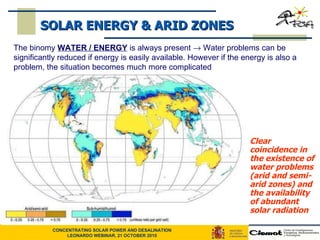
Clear coincidence in the existence of water problems (arid and semi-arid zones) and the availability of abundant solar radiation   SOLAR ENERGY & ARID ZONES The binomy  WATER / ENERGY  is always present    Water problems can be significantly reduced if energy is easily available. However if the energy is also a problem, the situation becomes much more complicated
CSP+D: ADVANTAGES & DRAWBACKS Combining CSP and Desalination facilities (CSP+D) could be a very attractive solution as:   At many location with high solar potential, projects can be more attractive to local stakeholders than just power production ones.  Technological synergies can be identified to potentially reduce the cost of combined power and water production against the independent production of the same products. Financial schemes could also benefit, as water and power cost can be better adapted to the specific local conditions of the facility.  However, the concept has also some drawbacks: CSP+D concept needs, obviously, facilities to be located near the sea, where land cost and availability could be a significant problem. DNI is normally lower at the areas close to the sea. Some / many technological aspects are not yet solved
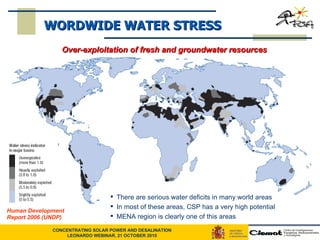
WORDWIDE WATER STRESS Over-exploitation of fresh and groundwater resources Human Development Report 2006 (UNDP) There are serious water deficits in many world areas In most of these areas, CSP has a very high potential MENA region is clearly one of this areas
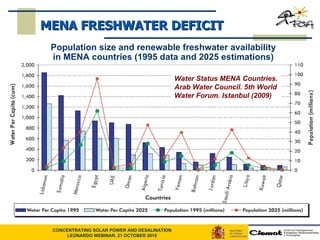
Population size and renewable freshwater availability in MENA countries (1995 data and 2025 estimations) Water Status MENA Countries. Arab Water Council. 5th World Water Forum. Istanbul (2009) MENA FRESHWATER DEFICIT
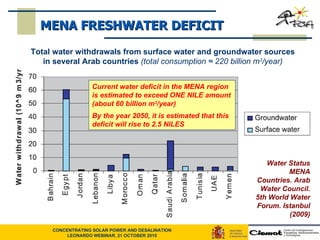
Water Status MENA Countries. Arab Water Council. 5th World Water Forum. Istanbul (2009) Total water withdrawals from surface water and groundwater sources in several Arab countries  (total consumption  ≈  220 billion m 3 /year) MENA FRESHWATER DEFICIT Current water deficit in the MENA region is estimated to exceed ONE NILE amount (about 60 billion m 3 /year) By the year 2050, it is estimated that this deficit will rise to 2.5 NILES
CSP+D JUSTIFICATION  DUAL POWER AND WATER SUITABLE CONFIGURATIONS CSP+D POTENTIAL BENEFITS CSP+D EFFICIENCIES ESTIMATION. MED-RO COMPARISON CSP+D ONGOING RESEARCH PRESENTATION PROGRESS
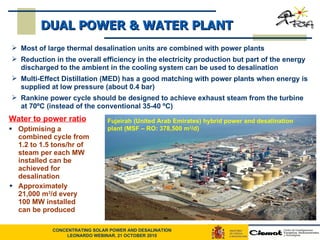
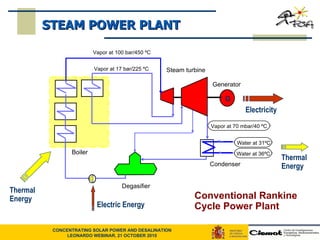
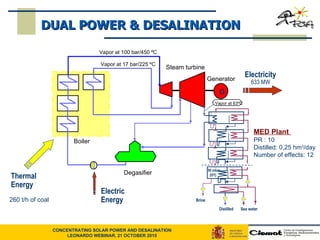
Water to power ratio Optimising a combined cycle from 1.2 to 1.5 tons/hr of steam per each MW installed can be achieved for desalination Approximately 21,000 m 3 /d every 100 MW installed can be produced DUAL POWER & WATER PLANT Most of large thermal desalination units are combined with power plants Reduction in the overall efficiency in the electricity production but part of the energy discharged to the ambient in the cooling system can be used to desalination Multi-Effect Distillation (MED) has a good matching with power plants when energy is supplied at low pressure (about 0.4 bar) Rankine power cycle should be designed to achieve exhaust steam from the turbine at 70ºC (instead of the conventional 35-40 ºC) Fujeirah (United Arab Emirates) hybrid power and desalination plant (MSF – RO: 378,500 m 3 /d)
Conventional Rankine Cycle Power Plant STEAM POWER PLANT Degasifier Condenser Water at 36ºC Water at 31ºC Thermal  Energy Generator Vapor at 70 mbar/40 ºC G Electricity Steam turbine Vapor at 100 bar/450 ºC Electric Energy Boiler Thermal  Energy Vapor at 17 bar/225 ºC
0,22 bar 62ºC MED Plant   PR : 10 Distilled: 0,25 hm 3 /day Number of effects: 12 260 t/h of coal 633 MW Boiler Generator Degasifier Steam turbine Vapor at 100 bar/450 ºC Vapor at 17 bar/225 ºC G Electricity 50 mbar 35ºC Distilled Sea water Brine Thermal  Energy Electric Energy DUAL POWER & DESALINATION Vapor at 63ºC
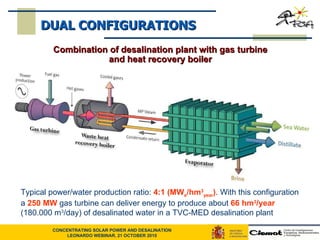
Typical power/water production ratio:  4:1 (MW e /hm 3 year ) . With this configuration a  250 MW  gas turbine can deliver energy to produce about  66 hm 3 /year  (180.000 m 3 /day) of desalinated water   in a TVC-MED desalination plant DUAL CONFIGURATIONS Combination of desalination plant with gas turbine and heat recovery boiler
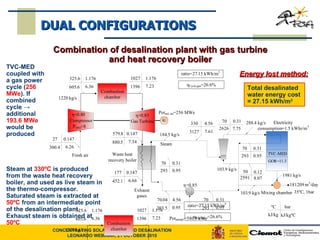
TVC-MED coupled with a gas power cycle ( 256 MWe ). If combined cycle  -> additional   193.6 MWe  would be produced Steam at  330ºC  is produced from the waste heat recovery boiler, and used as live steam in the thermo-compressor. Saturated steam is extracted at  50ºC  from an intermediate point of the desalination plant. Exhaust steam is obtained at  50ºC   Combination of desalination plant with gas turbine and heat recovery boiler Total desalinated water energy cost = 27.15 kWh/m 3 Energy lost method: DUAL CONFIGURATIONS
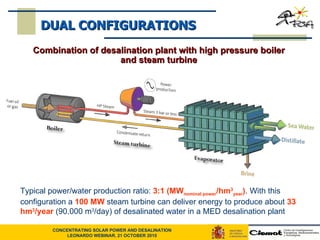
Typical power/water production ratio:  3:1 (MW nominal power /hm 3 year ) . With this configuration a  100 MW  steam turbine can deliver energy to produce about  33 hm 3 /year  (90.000 m 3 /day) of desalinated water   in a MED desalination plant Combination of desalination plant with high pressure boiler and steam turbine DUAL CONFIGURATIONS
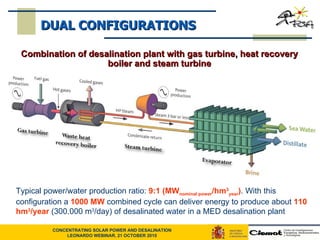
Combination of desalination plant with gas turbine, heat recovery boiler and steam turbine Typical power/water production ratio:  9:1 (MW nominal power /hm 3 year ) . With this configuration a  1000 MW  combined cycle can deliver energy to produce about  110 hm 3 /year  (300.000 m 3 /day) of desalinated water   in a MED desalination plant DUAL CONFIGURATIONS
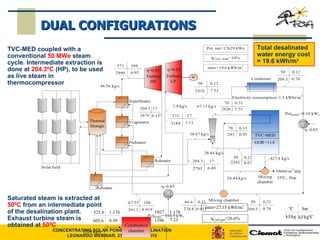
Total desalinated water energy cost = 19.6 kWh/m 3 Saturated steam is extracted at  50ºC  from an intermediate point of the desalination plant. Exhaust turbine steam is obtained at  50ºC  TVC-MED coupled with a conventional  50 MWe  steam cycle. Intermediate extraction is done at  204.3ºC  (HP), to be used as live steam in thermocompressor DUAL CONFIGURATIONS
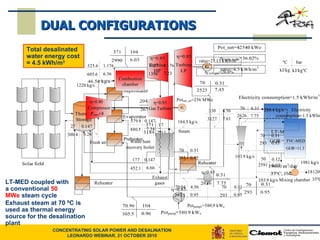
Exhaust steam at 70 ºC is used as thermal energy source for the desalination plant  Total desalinated water energy cost = 4.5 kWh/m 3 LT-MED coupled with a conventional  50 MWe  steam cycle  DUAL CONFIGURATIONS
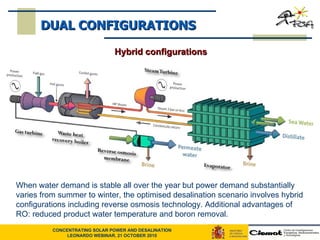
When water demand is stable all over the year but power demand substantially varies from summer to winter, the optimised desalination scenario involves hybrid configurations including reverse osmosis technology. Additional advantages of RO: reduced product water temperature and boron removal. Hybrid configurations DUAL CONFIGURATIONS
CSP+D JUSTIFICATION  DUAL POWER AND WATER SUITABLE CONFIGURATIONS CSP+D POTENTIAL BENEFITS CSP+D EFFICIENCIES ESTIMATION & MED-RO COMPARISON CSP+D ONGOING RESEARCH PRESENTATION PROGRESS
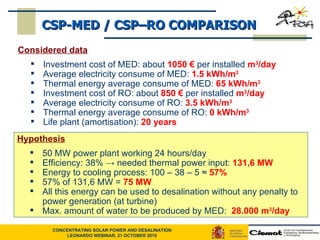
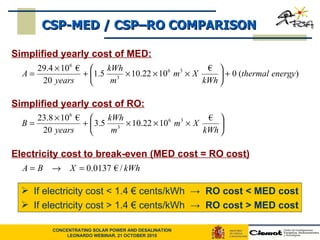
CSP-MED / CSP–RO COMPARISON Considered data Investment cost of MED: about  1050 €  per installed  m 3 /day Average electricity consume of MED:  1.5 kWh/m 3 Thermal energy average consume of MED:  65 kWh/m 3 Investment cost of RO: about  850 €  per installed  m 3 /day Average electricity consume of RO:  3.5 kWh/m 3 Thermal energy average consume of RO:  0 kWh/m 3 Life plant (amortisation):  20 years Hypothesis 50 MW power plant working 24 hours/day Efficiency: 38%  -> needed thermal power input:  131,6 MW Energy to cooling process: 100 – 38 – 5  ≈  57% 57% of 131,6 MW =  75 MW All this energy can be used to desalination without any penalty to power generation (at turbine) Max. amount of water to be produced by MED:  28.000 m 3 /day
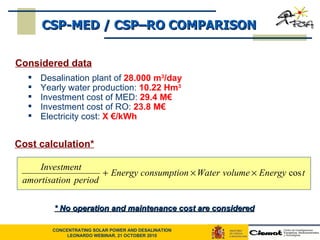
CSP-MED / CSP–RO COMPARISON Considered data Desalination plant of  28.000 m 3 /day Yearly water production:  10.22 Hm 3 Investment cost of MED:  29.4 M€  Investment cost of RO:  23.8 M€ Electricity cost:  X €/kWh * No operation and maintenance cost are considered Cost calculation*
CSP-MED / CSP–RO COMPARISON Simplified yearly cost of MED: Simplified yearly cost of RO: Electricity cost to break-even (MED cost = RO cost) If electricity cost < 1.4 € cents/kWh  ->  RO cost < MED cost If electricity cost > 1.4 € cents/kWh  ->  RO cost > MED cost
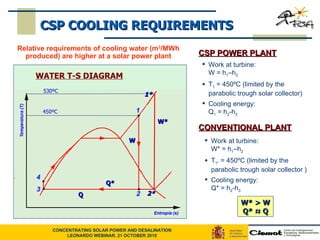
CSP COOLING REQUIREMENTS 530ºC WATER T-S DIAGRAM W Q* Q W* > W Q*  ≈  Q Relative requirements of cooling water (m 3 /MWh produced) are higher at a solar power plant 1* 2* W* 450ºC CSP POWER PLANT Work at turbine:  W = h 1 –h 2 T 1  = 450ºC (limited by the parabolic trough solar collector) Cooling energy:  Q 1  = h 2 -h 3 CONVENTIONAL PLANT Work at turbine:  W* = h 1 –h 2 T 1*  = 450ºC (limited by the parabolic trough solar collector ) Cooling energy:  Q* = h 2 -h 3
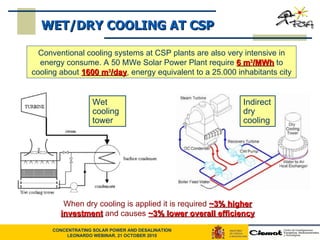
Conventional cooling systems at CSP plants are also very intensive in energy consume. A 50 MWe Solar Power Plant require  6 m 3 /MWh  to cooling about  1600 m 3 /day , energy equivalent to a 25.000 inhabitants city When dry cooling is applied it is required  ~3% higher investment  and causes  ~3% lower overall efficiency WET/DRY COOLING AT CSP Wet cooling tower Indirect dry cooling
CSP+D JUSTIFICATION  DUAL POWER AND WATER SUITABLE CONFIGURATIONS CSP+D POTENTIAL BENEFITS CSP+D EFFICIENCIES ESTIMATION & MED-RO COMPARISON CSP+D ONGOING RESEARCH PRESENTATION PROGRESS
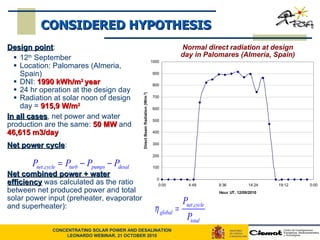
Design point : 12 th  September Location: Palomares (Almeria, Spain) DNI:  1990 kWh/m 2  year 24 hr operation at the design day Radiation at solar noon of design day =  915,9 W/m 2 In all cases , net power and water  production are the same:  50 MW  and  46,615 m3/day Net power cycle : Net combined power + water efficiency  was calculated as the ratio between net produced power and total solar power input (preheater, evaporator and superheater):  Normal direct radiation at design day in Palomares (Almería, Spain) CONSIDERED HYPOTHESIS
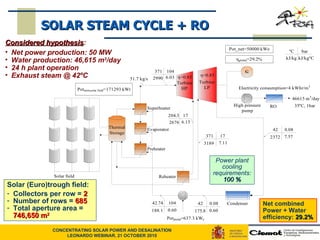
SOLAR STEAM CYCLE + RO Solar (Euro)trough field: Collectors per row =  2 Number of rows =  685 Total aperture area =  746,650 m 2   Considered hypothesis : Net power production: 50 MW Water production: 46,615 m 3 /day 24 h plant operation Exhaust steam @ 42ºC Net combined Power + Water efficiency:  29.2% Power plant cooling requirements:  100 %
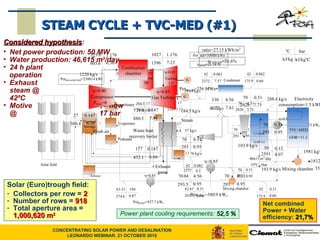
Solar (Euro)trough field: Collectors per row =  2 Number of rows =  918 Total aperture area =  1,000,620 m 2   STEAM CYCLE + TVC-MED (#1) Considered hypothesis : Net power production: 50 MW Water production: 46,615 m 3 /day 24 h plant  operation Exhaust  steam @  42ºC Motive  flow @  17 bar Net combined Power + Water efficiency:  21,7% Power plant cooling requirements:  52,5 %
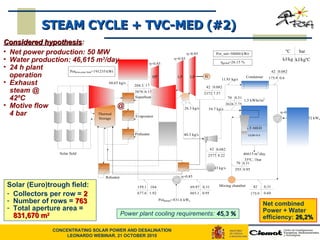
Solar (Euro)trough field: Collectors per row =  2 Number of rows =  763 Total aperture area =  831,670 m 2   Net combined Power + Water efficiency:  26,2% STEAM CYCLE + TVC-MED (#2) Considered hypothesis : Net power production: 50 MW Water production: 46,615 m 3 /day 24 h plant  operation Exhaust  steam @  42ºC Motive flow  @ 4 bar Power plant cooling requirements:  45,3 %
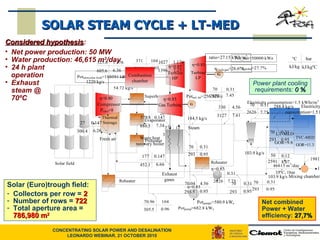
Solar (Euro)trough field: Collectors per row =  2 Number of rows =  722 Total aperture area =  786,980 m 2   SOLAR STEAM CYCLE + LT-MED Considered hypothesis : Net power production: 50 MW Water production: 46,615 m 3 /day 24 h plant  operation Exhaust  steam @  70ºC Net combined Power + Water efficiency:  27,7% Power plant cooling requirements:  0 %
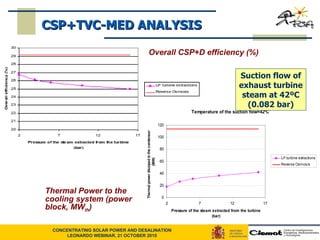
CSP+TVC-MED ANALYSIS Overall CSP+D efficiency (%) Thermal Power to the cooling system (power block, MW th ) Suction flow of exhaust turbine steam at 42ºC (0.082 bar)
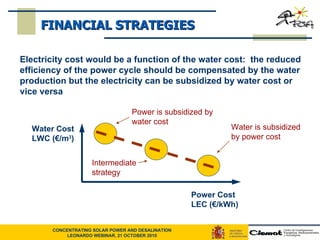
FINANCIAL STRATEGIES Electricity cost would be a function of the water cost:  the  reduced efficiency of the power cycle should be compensated by the water production but the  electricity can be subsidized by water cost or  vice versa Power Cost LEC (€/kWh) Water Cost LWC (€/m 3 ) Water is subsidized by power cost Intermediate strategy Power is subsidized by water cost
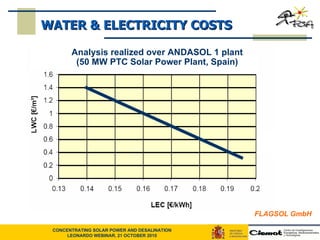
WATER & ELECTRICITY COSTS  Analysis realized over ANDASOL 1 plant (50 MW PTC Solar Power Plant, Spain) FLAGSOL GmbH
CSP+D JUSTIFICATION  DUAL POWER AND WATER SUITABLE CONFIGURATIONS CSP+D POTENTIAL BENEFITS CSP+D EFFICIENCIES ESTIMATION & MED-RO COMPARISON CSP+D ONGOING RESEARCH PRESENTATION PROGRESS
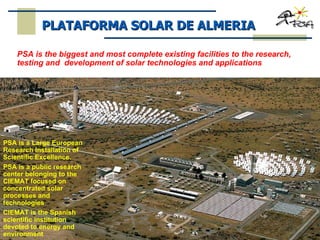
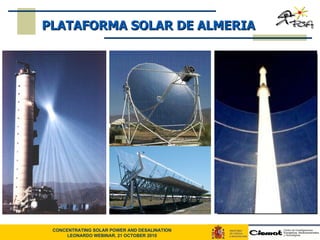
PLATAFORMA SOLAR DE ALMERIA PSA is the biggest and most complete existing facilities to the research, testing and  development of solar technologies and applications PSA is a Large European Research Installation of Scientific Excellence. PSA is a public research center belonging to the CIEMAT focused on concentrated solar processes and technologies  CIEMAT is the Spanish scientific institution devoted to energy and environment
PLATAFORMA SOLAR DE ALMERIA
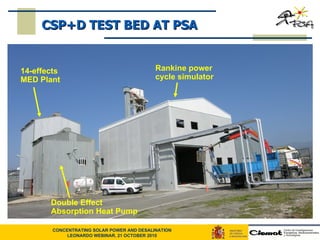
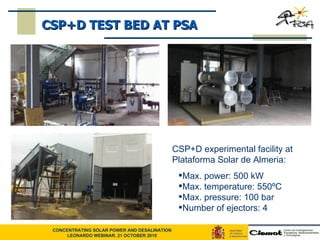
CSP+D TEST BED AT PSA 14-effects MED Plant Double Effect Absorption Heat Pump Rankine power cycle simulator
14-effects MED Plant Steam cycle simulator CSP+D TEST BED AT PSA
CSP+D experimental facility at Plataforma Solar de Almeria: Max. power: 500 kW Max. temperature: 550ºC Max. pressure: 100 bar Number of ejectors: 4 CSP+D TEST BED AT PSA
CONCLUSIONS Seawater desalination by means of solar energy is a very promising applications due to the usual coincidence, seasonal and geographical, of water availability limitations and high solar irradiation. It is essential to achieve an energy and water efficiency optimization to reduce as much as possible investment costs. Besides Reverse Osmosis is today the leading desalination technology, there is room to the use of thermal desalination technologies integrated into solar steam power cycles.  The optimization of this integration is not yet defined, as specific ideas and concepts must still be developed.  Multi-Effect Distillation is a mature & reliable technology and constitute, today, the best option to the integration of solar thermal desalination processes in dual (water & power) plants.
Thank  you very much for your attention

CSP Training series : solar desalination (2/2)

  • 1.
    Dr. Julián BlancoPlataforma Solar de Almeria [email_address] CONCENTRATING SOLAR POWER AND DESALINATION Solar Desalination Webinar #2 21 October 2010
  • 2.
    CSP+D JUSTIFICATION DUAL POWER AND WATER SUITABLE CONFIGURATIONS CSP+D POTENTIAL BENEFITS CSP+D EFFICIENCIES ESTIMATION. MED-RO COMPARISON CSP+D ONGOING RESEARCH PRESENTATION PROGRESS
  • 3.
    Clear coincidence inthe existence of water problems (arid and semi-arid zones) and the availability of abundant solar radiation SOLAR ENERGY & ARID ZONES The binomy WATER / ENERGY is always present  Water problems can be significantly reduced if energy is easily available. However if the energy is also a problem, the situation becomes much more complicated
  • 4.
    CSP+D: ADVANTAGES &DRAWBACKS Combining CSP and Desalination facilities (CSP+D) could be a very attractive solution as: At many location with high solar potential, projects can be more attractive to local stakeholders than just power production ones. Technological synergies can be identified to potentially reduce the cost of combined power and water production against the independent production of the same products. Financial schemes could also benefit, as water and power cost can be better adapted to the specific local conditions of the facility. However, the concept has also some drawbacks: CSP+D concept needs, obviously, facilities to be located near the sea, where land cost and availability could be a significant problem. DNI is normally lower at the areas close to the sea. Some / many technological aspects are not yet solved
  • 5.
    WORDWIDE WATER STRESSOver-exploitation of fresh and groundwater resources Human Development Report 2006 (UNDP) There are serious water deficits in many world areas In most of these areas, CSP has a very high potential MENA region is clearly one of this areas
  • 6.
    Population size andrenewable freshwater availability in MENA countries (1995 data and 2025 estimations) Water Status MENA Countries. Arab Water Council. 5th World Water Forum. Istanbul (2009) MENA FRESHWATER DEFICIT
  • 7.
    Water Status MENACountries. Arab Water Council. 5th World Water Forum. Istanbul (2009) Total water withdrawals from surface water and groundwater sources in several Arab countries (total consumption ≈ 220 billion m 3 /year) MENA FRESHWATER DEFICIT Current water deficit in the MENA region is estimated to exceed ONE NILE amount (about 60 billion m 3 /year) By the year 2050, it is estimated that this deficit will rise to 2.5 NILES
  • 8.
    CSP+D JUSTIFICATION DUAL POWER AND WATER SUITABLE CONFIGURATIONS CSP+D POTENTIAL BENEFITS CSP+D EFFICIENCIES ESTIMATION. MED-RO COMPARISON CSP+D ONGOING RESEARCH PRESENTATION PROGRESS
  • 9.
    Water to powerratio Optimising a combined cycle from 1.2 to 1.5 tons/hr of steam per each MW installed can be achieved for desalination Approximately 21,000 m 3 /d every 100 MW installed can be produced DUAL POWER & WATER PLANT Most of large thermal desalination units are combined with power plants Reduction in the overall efficiency in the electricity production but part of the energy discharged to the ambient in the cooling system can be used to desalination Multi-Effect Distillation (MED) has a good matching with power plants when energy is supplied at low pressure (about 0.4 bar) Rankine power cycle should be designed to achieve exhaust steam from the turbine at 70ºC (instead of the conventional 35-40 ºC) Fujeirah (United Arab Emirates) hybrid power and desalination plant (MSF – RO: 378,500 m 3 /d)
  • 10.
    Conventional Rankine CyclePower Plant STEAM POWER PLANT Degasifier Condenser Water at 36ºC Water at 31ºC Thermal Energy Generator Vapor at 70 mbar/40 ºC G Electricity Steam turbine Vapor at 100 bar/450 ºC Electric Energy Boiler Thermal Energy Vapor at 17 bar/225 ºC
  • 11.
    0,22 bar 62ºCMED Plant PR : 10 Distilled: 0,25 hm 3 /day Number of effects: 12 260 t/h of coal 633 MW Boiler Generator Degasifier Steam turbine Vapor at 100 bar/450 ºC Vapor at 17 bar/225 ºC G Electricity 50 mbar 35ºC Distilled Sea water Brine Thermal Energy Electric Energy DUAL POWER & DESALINATION Vapor at 63ºC
  • 12.
    Typical power/water productionratio: 4:1 (MW e /hm 3 year ) . With this configuration a 250 MW gas turbine can deliver energy to produce about 66 hm 3 /year (180.000 m 3 /day) of desalinated water in a TVC-MED desalination plant DUAL CONFIGURATIONS Combination of desalination plant with gas turbine and heat recovery boiler
  • 13.
    TVC-MED coupled witha gas power cycle ( 256 MWe ). If combined cycle -> additional 193.6 MWe would be produced Steam at 330ºC is produced from the waste heat recovery boiler, and used as live steam in the thermo-compressor. Saturated steam is extracted at 50ºC from an intermediate point of the desalination plant. Exhaust steam is obtained at 50ºC Combination of desalination plant with gas turbine and heat recovery boiler Total desalinated water energy cost = 27.15 kWh/m 3 Energy lost method: DUAL CONFIGURATIONS
  • 14.
    Typical power/water productionratio: 3:1 (MW nominal power /hm 3 year ) . With this configuration a 100 MW steam turbine can deliver energy to produce about 33 hm 3 /year (90.000 m 3 /day) of desalinated water in a MED desalination plant Combination of desalination plant with high pressure boiler and steam turbine DUAL CONFIGURATIONS
  • 15.
    Combination of desalinationplant with gas turbine, heat recovery boiler and steam turbine Typical power/water production ratio: 9:1 (MW nominal power /hm 3 year ) . With this configuration a 1000 MW combined cycle can deliver energy to produce about 110 hm 3 /year (300.000 m 3 /day) of desalinated water in a MED desalination plant DUAL CONFIGURATIONS
  • 16.
    Total desalinated waterenergy cost = 19.6 kWh/m 3 Saturated steam is extracted at 50ºC from an intermediate point of the desalination plant. Exhaust turbine steam is obtained at 50ºC TVC-MED coupled with a conventional 50 MWe steam cycle. Intermediate extraction is done at 204.3ºC (HP), to be used as live steam in thermocompressor DUAL CONFIGURATIONS
  • 17.
    Exhaust steam at70 ºC is used as thermal energy source for the desalination plant Total desalinated water energy cost = 4.5 kWh/m 3 LT-MED coupled with a conventional 50 MWe steam cycle DUAL CONFIGURATIONS
  • 18.
    When water demandis stable all over the year but power demand substantially varies from summer to winter, the optimised desalination scenario involves hybrid configurations including reverse osmosis technology. Additional advantages of RO: reduced product water temperature and boron removal. Hybrid configurations DUAL CONFIGURATIONS
  • 19.
    CSP+D JUSTIFICATION DUAL POWER AND WATER SUITABLE CONFIGURATIONS CSP+D POTENTIAL BENEFITS CSP+D EFFICIENCIES ESTIMATION & MED-RO COMPARISON CSP+D ONGOING RESEARCH PRESENTATION PROGRESS
  • 20.
    CSP-MED / CSP–ROCOMPARISON Considered data Investment cost of MED: about 1050 € per installed m 3 /day Average electricity consume of MED: 1.5 kWh/m 3 Thermal energy average consume of MED: 65 kWh/m 3 Investment cost of RO: about 850 € per installed m 3 /day Average electricity consume of RO: 3.5 kWh/m 3 Thermal energy average consume of RO: 0 kWh/m 3 Life plant (amortisation): 20 years Hypothesis 50 MW power plant working 24 hours/day Efficiency: 38% -> needed thermal power input: 131,6 MW Energy to cooling process: 100 – 38 – 5 ≈ 57% 57% of 131,6 MW = 75 MW All this energy can be used to desalination without any penalty to power generation (at turbine) Max. amount of water to be produced by MED: 28.000 m 3 /day
  • 21.
    CSP-MED / CSP–ROCOMPARISON Considered data Desalination plant of 28.000 m 3 /day Yearly water production: 10.22 Hm 3 Investment cost of MED: 29.4 M€ Investment cost of RO: 23.8 M€ Electricity cost: X €/kWh * No operation and maintenance cost are considered Cost calculation*
  • 22.
    CSP-MED / CSP–ROCOMPARISON Simplified yearly cost of MED: Simplified yearly cost of RO: Electricity cost to break-even (MED cost = RO cost) If electricity cost < 1.4 € cents/kWh -> RO cost < MED cost If electricity cost > 1.4 € cents/kWh -> RO cost > MED cost
  • 23.
    CSP COOLING REQUIREMENTS530ºC WATER T-S DIAGRAM W Q* Q W* > W Q* ≈ Q Relative requirements of cooling water (m 3 /MWh produced) are higher at a solar power plant 1* 2* W* 450ºC CSP POWER PLANT Work at turbine: W = h 1 –h 2 T 1 = 450ºC (limited by the parabolic trough solar collector) Cooling energy: Q 1 = h 2 -h 3 CONVENTIONAL PLANT Work at turbine: W* = h 1 –h 2 T 1* = 450ºC (limited by the parabolic trough solar collector ) Cooling energy: Q* = h 2 -h 3
  • 24.
    Conventional cooling systemsat CSP plants are also very intensive in energy consume. A 50 MWe Solar Power Plant require 6 m 3 /MWh to cooling about 1600 m 3 /day , energy equivalent to a 25.000 inhabitants city When dry cooling is applied it is required ~3% higher investment and causes ~3% lower overall efficiency WET/DRY COOLING AT CSP Wet cooling tower Indirect dry cooling
  • 25.
    CSP+D JUSTIFICATION DUAL POWER AND WATER SUITABLE CONFIGURATIONS CSP+D POTENTIAL BENEFITS CSP+D EFFICIENCIES ESTIMATION & MED-RO COMPARISON CSP+D ONGOING RESEARCH PRESENTATION PROGRESS
  • 26.
    Design point :12 th September Location: Palomares (Almeria, Spain) DNI: 1990 kWh/m 2 year 24 hr operation at the design day Radiation at solar noon of design day = 915,9 W/m 2 In all cases , net power and water production are the same: 50 MW and 46,615 m3/day Net power cycle : Net combined power + water efficiency was calculated as the ratio between net produced power and total solar power input (preheater, evaporator and superheater): Normal direct radiation at design day in Palomares (Almería, Spain) CONSIDERED HYPOTHESIS
  • 27.
    SOLAR STEAM CYCLE+ RO Solar (Euro)trough field: Collectors per row = 2 Number of rows = 685 Total aperture area = 746,650 m 2 Considered hypothesis : Net power production: 50 MW Water production: 46,615 m 3 /day 24 h plant operation Exhaust steam @ 42ºC Net combined Power + Water efficiency: 29.2% Power plant cooling requirements: 100 %
  • 28.
    Solar (Euro)trough field:Collectors per row = 2 Number of rows = 918 Total aperture area = 1,000,620 m 2 STEAM CYCLE + TVC-MED (#1) Considered hypothesis : Net power production: 50 MW Water production: 46,615 m 3 /day 24 h plant operation Exhaust steam @ 42ºC Motive flow @ 17 bar Net combined Power + Water efficiency: 21,7% Power plant cooling requirements: 52,5 %
  • 29.
    Solar (Euro)trough field:Collectors per row = 2 Number of rows = 763 Total aperture area = 831,670 m 2 Net combined Power + Water efficiency: 26,2% STEAM CYCLE + TVC-MED (#2) Considered hypothesis : Net power production: 50 MW Water production: 46,615 m 3 /day 24 h plant operation Exhaust steam @ 42ºC Motive flow @ 4 bar Power plant cooling requirements: 45,3 %
  • 30.
    Solar (Euro)trough field:Collectors per row = 2 Number of rows = 722 Total aperture area = 786,980 m 2 SOLAR STEAM CYCLE + LT-MED Considered hypothesis : Net power production: 50 MW Water production: 46,615 m 3 /day 24 h plant operation Exhaust steam @ 70ºC Net combined Power + Water efficiency: 27,7% Power plant cooling requirements: 0 %
  • 31.
    CSP+TVC-MED ANALYSIS OverallCSP+D efficiency (%) Thermal Power to the cooling system (power block, MW th ) Suction flow of exhaust turbine steam at 42ºC (0.082 bar)
  • 32.
    FINANCIAL STRATEGIES Electricitycost would be a function of the water cost: the reduced efficiency of the power cycle should be compensated by the water production but the electricity can be subsidized by water cost or vice versa Power Cost LEC (€/kWh) Water Cost LWC (€/m 3 ) Water is subsidized by power cost Intermediate strategy Power is subsidized by water cost
  • 33.
    WATER & ELECTRICITYCOSTS Analysis realized over ANDASOL 1 plant (50 MW PTC Solar Power Plant, Spain) FLAGSOL GmbH
  • 34.
    CSP+D JUSTIFICATION DUAL POWER AND WATER SUITABLE CONFIGURATIONS CSP+D POTENTIAL BENEFITS CSP+D EFFICIENCIES ESTIMATION & MED-RO COMPARISON CSP+D ONGOING RESEARCH PRESENTATION PROGRESS
  • 35.
    PLATAFORMA SOLAR DEALMERIA PSA is the biggest and most complete existing facilities to the research, testing and development of solar technologies and applications PSA is a Large European Research Installation of Scientific Excellence. PSA is a public research center belonging to the CIEMAT focused on concentrated solar processes and technologies CIEMAT is the Spanish scientific institution devoted to energy and environment
  • 36.
  • 37.
    CSP+D TEST BEDAT PSA 14-effects MED Plant Double Effect Absorption Heat Pump Rankine power cycle simulator
  • 38.
    14-effects MED PlantSteam cycle simulator CSP+D TEST BED AT PSA
  • 39.
    CSP+D experimental facilityat Plataforma Solar de Almeria: Max. power: 500 kW Max. temperature: 550ºC Max. pressure: 100 bar Number of ejectors: 4 CSP+D TEST BED AT PSA
  • 40.
    CONCLUSIONS Seawater desalinationby means of solar energy is a very promising applications due to the usual coincidence, seasonal and geographical, of water availability limitations and high solar irradiation. It is essential to achieve an energy and water efficiency optimization to reduce as much as possible investment costs. Besides Reverse Osmosis is today the leading desalination technology, there is room to the use of thermal desalination technologies integrated into solar steam power cycles. The optimization of this integration is not yet defined, as specific ideas and concepts must still be developed. Multi-Effect Distillation is a mature & reliable technology and constitute, today, the best option to the integration of solar thermal desalination processes in dual (water & power) plants.
  • 41.
    Thank youvery much for your attention