
Harlinde Peperstraete MD
Ghent University Hospital
Harlinde.peperstraete@ugent.be
Anticoagulation
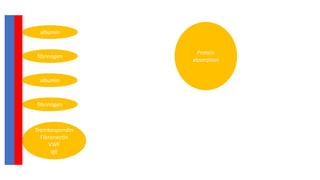
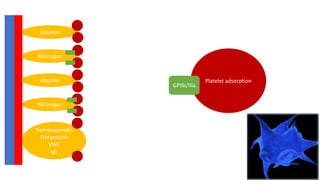
Protein
absorption
albumin
fibrinogen
albumin
fibrinogen
Trombospondin
Fibronectin
VWF
IgE
albumin
fibrinogen
albumin
fibrinogen
Trombospondin
Fibronectin
VWF
IgE
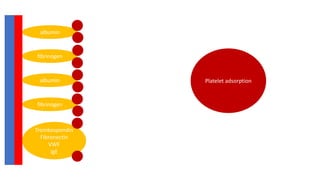
Platelet adsorption
albumin
fibrinogen
albumin
fibrinogen
Trombospondin
Fibronectin
VWF
IgE
Platelet adsorption
GPIIb/IIIa
albumin
fibrinogen
albumin
fibrinogen
Trombospondin
Fibronectin
VWF
IgE
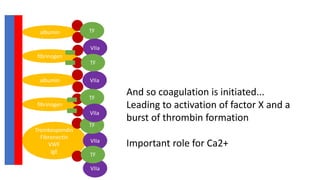
TF
VIIa
VIIa
VIIa
VIIa
TF
TF
TF
TF
VIIa
And so coagulation is initiated...
Leading to activation of factor X and a
burst of thrombin formation
Important role for Ca2+
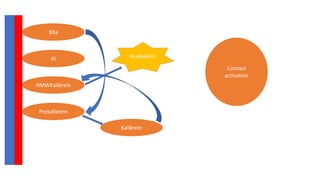
Contact
activation
Prekalikrein
HMWKalikrein
XI
XIIa
Kalikrein
Bradykinin
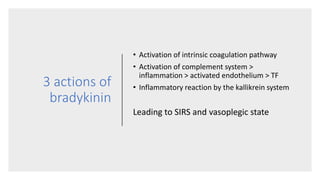
3 actions of
bradykinin
• Activation of intrinsic coagulation pathway
• Activation of complement system >
inflammation > activated endothelium > TF
• Inflammatory reaction by the kallikrein system
Leading to SIRS and vasoplegic state
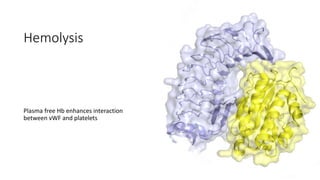
Hemolysis
Plasma free Hb enhances interaction
between vWF and platelets
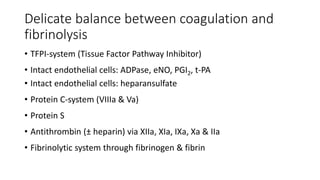
Delicate balance between coagulation and
fibrinolysis
• TFPI-system (Tissue Factor Pathway Inhibitor)
• Intact endothelial cells: ADPase, eNO, PGI2, t-PA
• Intact endothelial cells: heparansulfate
• Protein C-system (VIIIa & Va)
• Protein S
• Antithrombin (± heparin) via XIIa, XIa, IXa, Xa & IIa
• Fibrinolytic system through fibrinogen & fibrin
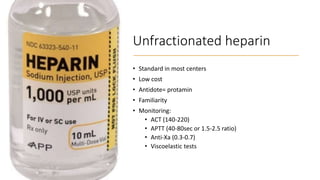
Unfractionated heparin
• Standard in most centers
• Low cost
• Antidote= protamin
• Familiarity
• Monitoring:
• ACT (140-220)
• APTT (40-80sec or 1.5-2.5 ratio)
• Anti-Xa (0.3-0.7)
• Viscoelastic tests
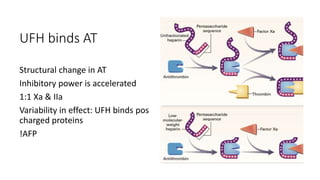
UFH binds AT
Structural change in AT
Inhibitory power is accelerated
1:1 Xa & IIa
Variability in effect: UFH binds pos
charged proteins
!AFP
Antithrombin
• Drop in levels during the first days of ECMO
therapy
• Indicated in heparin resistance
• Daily...?
• Cut off for substitution...
Low-
Molecular-
Weight
Heparin
• Anti Xa monitoring (1h before and 4h after
administering)
• Mainly renal clearance, most ECMO pts have
AKI
(parental)
Direct
Thrombin
Inhibitors
• Bivalirudin
• Agratoban
• Short half-lives (30 min and 40 min)
• No antidotes
Bivalirudin
• Direct trombin inhibitor
• HIT pts
• Best monitored with Diluted Thrombin Time
• aPTT 50-90sec (ceiling effect), ACT
• Bolus: 0.5-0.75 mg/kg
• Infusion: 1.75 mg/kg/h
• Mainly renal clearance
Argatroban
• Direct trombin inhibitor
• HIT pts
• Best monitored with Diluted Thrombin Time
• aPTT
• Can interfere with PT
• Mainly hepatic clearance
Antiplatelet
drugs
• Inhibit coagulation at the starting point
• Might reduce platelet consumption
• iNO on oxygenator
No
anticoagulation
• First 24-48h to 7days
• TBI, major bleeding, Disseminated
Intravascular Coagulation
• Waiting for resolution of shock
• Lubnow M et al. Technical complications during veno-venous
extracorporeal membrane oxygenation and their relevance predicting a
system-exchange—retrospective analysis of 265 cases. J Crit
Care 2014;29:473.e1–473.e5.
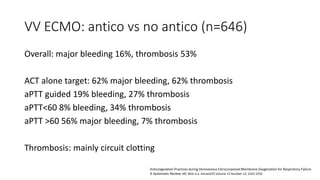
VV ECMO: antico vs no antico (n=646)
Overall: major bleeding 16%, thrombosis 53%
ACT alone target: 62% major bleeding, 62% thrombosis
aPTT guided 19% bleeding, 27% thrombosis
aPTT<60 8% bleeding, 34% thrombosis
aPTT >60 56% major bleeding, 7% thrombosis
Thrombosis: mainly circuit clotting
Anticoagulation Practices during Venovenous Extracorporeal Membrane Oxygenation for Respiratory Failure.
A Systematic Review; MC Sklar e.a. AnnalsATS Volume 13 Number 12; 2242-2250
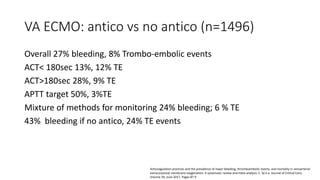
VA ECMO: antico vs no antico (n=1496)
Overall 27% bleeding, 8% Trombo-embolic events
ACT< 180sec 13%, 12% TE
ACT>180sec 28%, 9% TE
APTT target 50%, 3%TE
Mixture of methods for monitoring 24% bleeding; 6 % TE
43% bleeding if no antico, 24% TE events
Anticoagulation practices and the prevalence of major bleeding, thromboembolic events, and mortality in venoarterial
extracorporeal membrane oxygenation: A systematic review and meta-analysis. E. Sy e.a. Journal of Critical Care;
Volume 39, June 2017, Pages 87-9
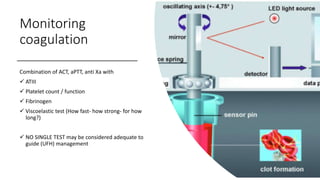
Monitoring
coagulation
Combination of ACT, aPTT, anti Xa with
 ATIII
 Platelet count / function
 Fibrinogen
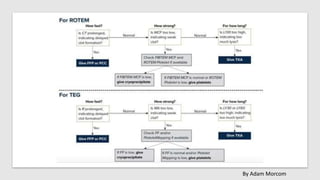
 Viscoelastic test (How fast- how strong- for how
long?)
 NO SINGLE TEST may be considered adequate to
guide (UFH) management
By Adam Morcom
4. anticoagulation during ecmo #beach2019 (peperstraete)

4. anticoagulation during ecmo #beach2019 (peperstraete)

Editor's Notes

  • #7 Activated factor XII cleaves PK to kallikrein, which in turn splits bradykinin from HMWK
  • #20 Clinical relevance of circuit clotting reported in the different papers Most included studies were descriptive and retrospective in design, thereby limiting quantitative analyses of anticoagulation modalities and strategies. The frequency and type of complications may be underreported in this review.