FE Exam Fundamentals
W. J. Wilson
Dept of Engineering & Physics
University of Central Oklahoma
1
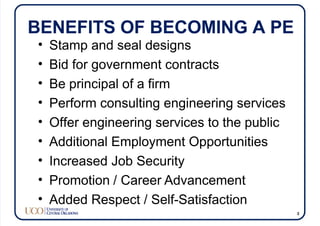
BENEFITS OF BECOMING A PE
• Stamp and seal designs
• Bid for government contracts
• Be principal of a firm
• Perform consulting engineering services
• Offer engineering services to the public
• Additional Employment Opportunities
• Increased Job Security
• Promotion / Career Advancement
• Added Respect / Self-Satisfaction
2
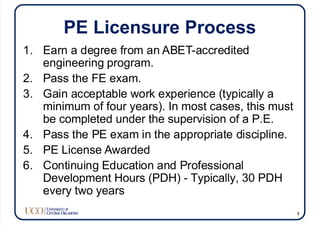
PE Licensure Process
1. Earn a degree from an ABET-accredited
engineering program.
2. Pass the FE exam.
3. Gain acceptable work experience (typically a
minimum of four years). In most cases, this must
be completed under the supervision of a P.E.
4. Pass the PE exam in the appropriate discipline.
5. PE License Awarded
6. Continuing Education and Professional
Development Hours (PDH) - Typically, 30 PDH
every two years
3
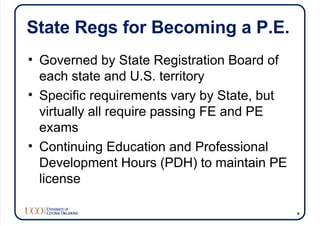
State Regs for Becoming a P.E.
• Governed by State Registration Board of
each state and U.S. territory
• Specific requirements vary by State, but
virtually all require passing FE and PE
exams
• Continuing Education and Professional
Development Hours (PDH) to maintain PE
license
4
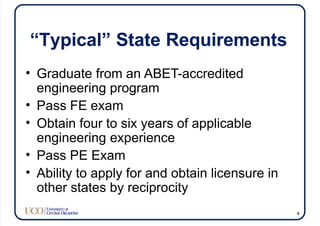
“Typical” State Requirements
• Graduate from an ABET-accredited
engineering program
• Pass FE exam
• Obtain four to six years of applicable
engineering experience
• Pass PE Exam
• Ability to apply for and obtain licensure in
other states by reciprocity
5
FE Exam Administration
The National Council of Examiners for Engineering
and Surveying (NCEES) is the exam administrator.
Volunteers from all over the U.S. help write exam
questions.
NCEES Address:
National Council of Examiners for Engineering & Surveying
280 Seneca Creek Road
Seneca, SC 29678
Tel: 800-250-3196
Web: www.ncees.org
6
Oklahoma FE Exam
Administration & Registration
Oklahoma State Board of Licensure for Professional
Engineers and Land Surveyors
Address:
Oklahoma State Board of Licensure for Professional
Engineers and Land Surveyors
Oklahoma Engineering Center, Room 120
201 NE 27th Street
Oklahoma City, OK 73105
Tel: (405) 521-2874 Web: www.pels.ok.gov
7
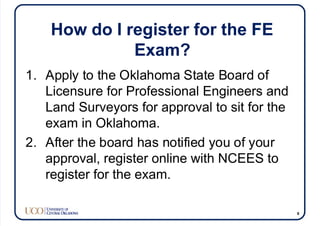
How do I register for the FE
Exam?
1. Apply to the Oklahoma State Board of
Licensure for Professional Engineers and
Land Surveyors for approval to sit for the
exam in Oklahoma.
2. After the board has notified you of your
approval, register online with NCEES to
register for the exam.
8
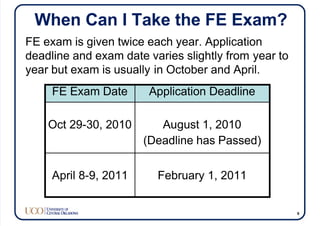
When Can I Take the FE Exam?
FE Exam Date Application Deadline
Oct 29-30, 2010 August 1, 2010
(Deadline has Passed)
April 8-9, 2011 February 1, 2011
FE exam is given twice each year. Application
deadline and exam date varies slightly from year to
year but exam is usually in October and April.
9
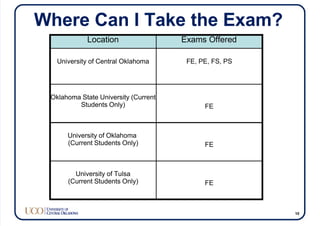
Where Can I Take the Exam?
Location Exams Offered
University of Central Oklahoma FE, PE, FS, PS
Oklahoma State University (Current
Students Only) FE
University of Oklahoma
(Current Students Only) FE
University of Tulsa
(Current Students Only) FE
10
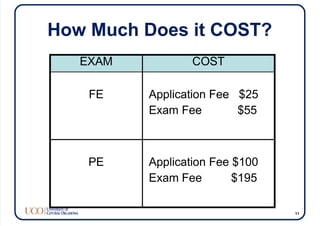
How Much Does it COST?
EXAM COST
FE Application Fee $25
Exam Fee $55
PE Application Fee $100
Exam Fee $195
11
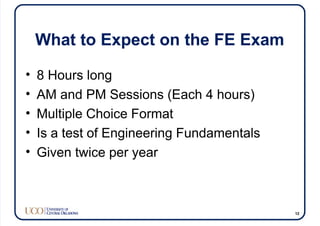
What to Expect on the FE Exam
• 8 Hours long
• AM and PM Sessions (Each 4 hours)
• Multiple Choice Format
• Is a test of Engineering Fundamentals
• Given twice per year
12
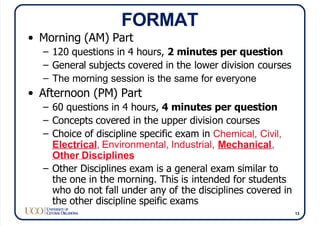
FORMAT
• Morning (AM) Part
– 120 questions in 4 hours, 2 minutes per question
– General subjects covered in the lower division courses
– The morning session is the same for everyone
• Afternoon (PM) Part
– 60 questions in 4 hours, 4 minutes per question
– Concepts covered in the upper division courses
– Choice of discipline specific exam in Chemical, Civil,
Electrical, Environmental, Industrial, Mechanical,
Other Disciplines
– Other Disciplines exam is a general exam similar to
the one in the morning. This is intended for students
who do not fall under any of the disciplines covered in
the other discipline speific exams
13
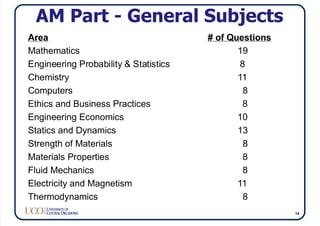
AM Part - General Subjects
Area # of Questions
Mathematics 19
Engineering Probability & Statistics 8
Chemistry 11
Computers 8
Ethics and Business Practices 8
Engineering Economics 10
Statics and Dynamics 13
Strength of Materials 8
Materials Properties 8
Fluid Mechanics 8
Electricity and Magnetism 11
Thermodynamics 8
14
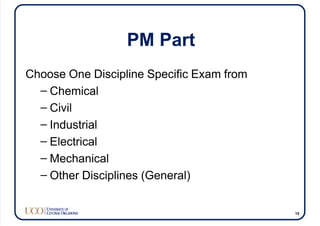
PM Part
Choose One Discipline Specific Exam from
– Chemical
– Civil
– Industrial
– Electrical
– Mechanical
– Other Disciplines (General)
15
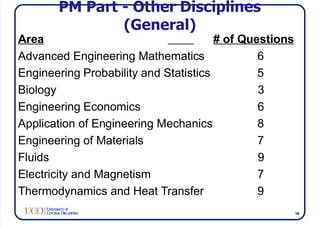
PM Part - Other Disciplines
(General)
Area # of Questions
Advanced Engineering Mathematics 6
Engineering Probability and Statistics 5
Biology 3
Engineering Economics 6
Application of Engineering Mechanics 8
Engineering of Materials 7
Fluids 9
Electricity and Magnetism 7
Thermodynamics and Heat Transfer 9
16
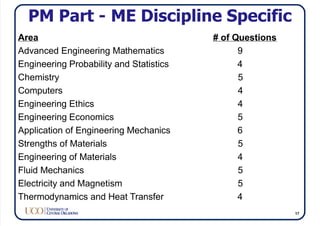
PM Part - ME Discipline Specific
Area # of Questions
Advanced Engineering Mathematics 9
Engineering Probability and Statistics 4
Chemistry 5
Computers 4
Engineering Ethics 4
Engineering Economics 5
Application of Engineering Mechanics 6
Strengths of Materials 5
Engineering of Materials 4
Fluid Mechanics 5
Electricity and Magnetism 5
Thermodynamics and Heat Transfer 4
17
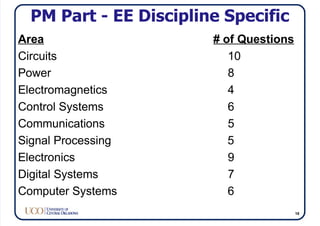
PM Part - EE Discipline Specific
Area # of Questions
Circuits 10
Power 8
Electromagnetics 4
Control Systems 6
Communications 5
Signal Processing 5
Electronics 9
Digital Systems 7
Computer Systems 6
18
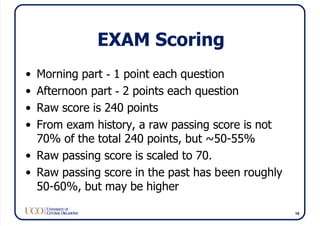
EXAM Scoring
• Morning part - 1 point each question
• Afternoon part - 2 points each question
• Raw score is 240 points
• From exam history, a raw passing score is not
70% of the total 240 points, but ~50-55%
• Raw passing score is scaled to 70.
• Raw passing score in the past has been roughly
50-60%, but may be higher
19
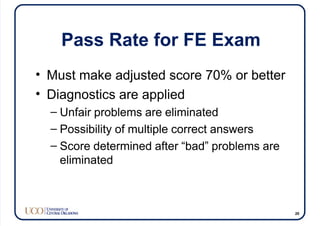
Pass Rate for FE Exam
• Must make adjusted score 70% or better
• Diagnostics are applied
– Unfair problems are eliminated
– Possibility of multiple correct answers
– Score determined after “bad” problems are
eliminated
20
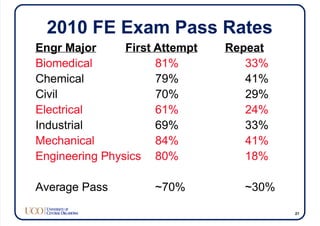
2010 FE Exam Pass Rates
Engr Major First Attempt Repeat
Biomedical 81% 33%
Chemical 79% 41%
Civil 70% 29%
Electrical 61% 24%
Industrial 69% 33%
Mechanical 84% 41%
Engineering Physics 80% 18%
Average Pass ~70% ~30%
21
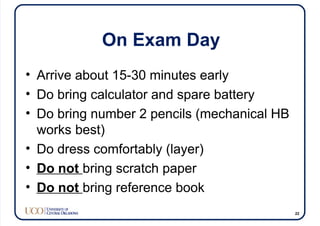
On Exam Day
• Arrive about 15-30 minutes early
• Do bring calculator and spare battery
• Do bring number 2 pencils (mechanical HB
works best)
• Do dress comfortably (layer)
• Do not bring scratch paper
• Do not bring reference book
22
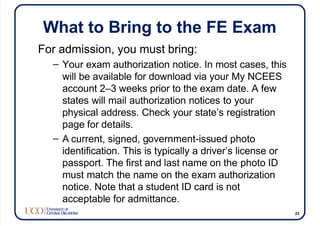
What to Bring to the FE Exam
For admission, you must bring:
– Your exam authorization notice. In most cases, this
will be available for download via your My NCEES
account 2–3 weeks prior to the exam date. A few
states will mail authorization notices to your
physical address. Check your state’s registration
page for details.
– A current, signed, government-issued photo
identification. This is typically a driver’s license or
passport. The first and last name on the photo ID
must match the name on the exam authorization
notice. Note that a student ID card is not
acceptable for admittance.
23
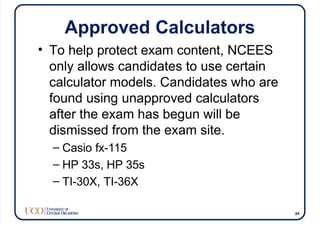
Approved Calculators
• To help protect exam content, NCEES
only allows candidates to use certain
calculator models. Candidates who are
found using unapproved calculators
after the exam has begun will be
dismissed from the exam site.
– Casio fx-115
– HP 33s, HP 35s
– TI-30X, TI-36X
24
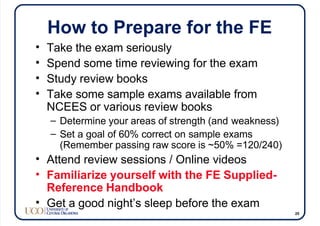
How to Prepare for the FE
• Take the exam seriously
• Spend some time reviewing for the exam
• Study review books
• Take some sample exams available from
NCEES or various review books
– Determine your areas of strength (and weakness)
– Set a goal of 60% correct on sample exams
(Remember passing raw score is ~50% =120/240)
• Attend review sessions / Online videos
• Familiarize yourself with the FE Supplied-
Reference Handbook
• Get a good night’s sleep before the exam
25
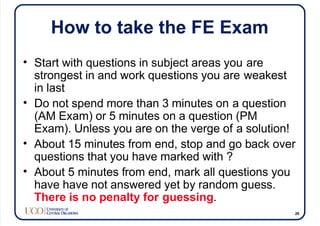
How to take the FE Exam
• Start with questions in subject areas you are
strongest in and work questions you are weakest
in last
• Do not spend more than 3 minutes on a question
(AM Exam) or 5 minutes on a question (PM
Exam). Unless you are on the verge of a solution!
• About 15 minutes from end, stop and go back over
questions that you have marked with ?
• About 5 minutes from end, mark all questions you
have have not answered yet by random guess.
There is no penalty for guessing.
26
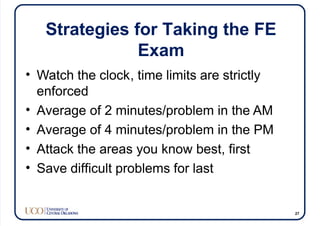
Strategies for Taking the FE
Exam
• Watch the clock, time limits are strictly
enforced
• Average of 2 minutes/problem in the AM
• Average of 4 minutes/problem in the PM
• Attack the areas you know best, first
• Save difficult problems for last
27
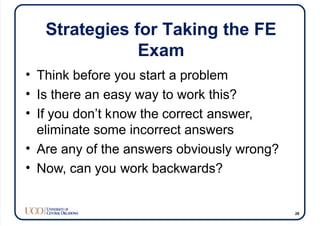
Strategies for Taking the FE
Exam
• Think before you start a problem
• Is there an easy way to work this?
• If you don’t know the correct answer,
eliminate some incorrect answers
• Are any of the answers obviously wrong?
• Now, can you work backwards?
28
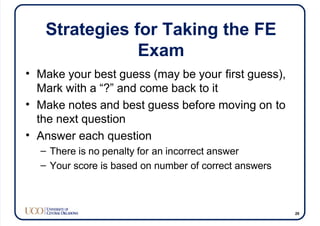
Strategies for Taking the FE
Exam
• Make your best guess (may be your first guess),
Mark with a “?” and come back to it
• Make notes and best guess before moving on to
the next question
• Answer each question
– There is no penalty for an incorrect answer
– Your score is based on number of correct answers
29
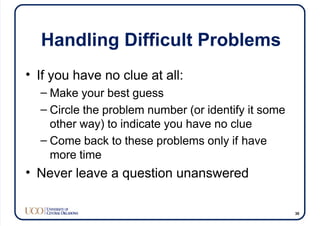
Handling Difficult Problems
• If you have no clue at all:
– Make your best guess
– Circle the problem number (or identify it some
other way) to indicate you have no clue
– Come back to these problems only if have
more time
• Never leave a question unanswered
30
Saving Time
• Write the letter of the correct answer in the
margin on the test booklet
• At the end of the page, transcribe the
answers to the answer sheet
• Do this one page at a time.
• Do not do this for the entire exam and then
attempt to transfer the answers
31
Units
• In the morning some problems are given in
both SI and US units
– Work what you are most comfortable with
• Most afternoon exams will be SI only so be
prepared
– Civil exam uses both sets of units for some
topic areas
32
Terminology
• Not everyone uses the same terminology
• Try to be familiar with other nomenclature
• Focus on the problem; do you know it by
another name?
33
Reference Manual
• Be familiar with its organization
• Where are your most frequently used
equations?
• What data will you use the most?
• Not necessarily a good idea to study by the
reference manual
34
Work Out Of Sequence
• Problems tend to be grouped in sections
• Work what you know best, first
• Save the most difficult for last
• If you don’t know it, guess
35
Write Out the Problem
• Work in the test booklet
• Solving problems in your head may not be
the fastest way
• Make sure you record your answer on the
answer sheet—graders do not look at your
test booklet
36
What If You Do Not Pass?
• Take it again
– Exam is offered twice a year
– Review and study for the next time
• No adverse information is placed on your
record
37
I’m not going to work in
Oklahoma when I graduate,
should I wait to take the
exam in another state?
38
No!
The FE is a national exam and your score
can be reported to any state in which you
wish to become registered. Not taking the
exam now will only make it more difficult for
you in the future.
39

dokumen.tips_lecture-5-fe-exam.pdf

  • 1.
    FE Exam Fundamentals W.J. Wilson Dept of Engineering & Physics University of Central Oklahoma 1
  • 2.
    BENEFITS OF BECOMINGA PE • Stamp and seal designs • Bid for government contracts • Be principal of a firm • Perform consulting engineering services • Offer engineering services to the public • Additional Employment Opportunities • Increased Job Security • Promotion / Career Advancement • Added Respect / Self-Satisfaction 2
  • 3.
    PE Licensure Process 1.Earn a degree from an ABET-accredited engineering program. 2. Pass the FE exam. 3. Gain acceptable work experience (typically a minimum of four years). In most cases, this must be completed under the supervision of a P.E. 4. Pass the PE exam in the appropriate discipline. 5. PE License Awarded 6. Continuing Education and Professional Development Hours (PDH) - Typically, 30 PDH every two years 3
  • 4.
    State Regs forBecoming a P.E. • Governed by State Registration Board of each state and U.S. territory • Specific requirements vary by State, but virtually all require passing FE and PE exams • Continuing Education and Professional Development Hours (PDH) to maintain PE license 4
  • 5.
    “Typical” State Requirements •Graduate from an ABET-accredited engineering program • Pass FE exam • Obtain four to six years of applicable engineering experience • Pass PE Exam • Ability to apply for and obtain licensure in other states by reciprocity 5
  • 6.
    FE Exam Administration TheNational Council of Examiners for Engineering and Surveying (NCEES) is the exam administrator. Volunteers from all over the U.S. help write exam questions. NCEES Address: National Council of Examiners for Engineering & Surveying 280 Seneca Creek Road Seneca, SC 29678 Tel: 800-250-3196 Web: www.ncees.org 6
  • 7.
    Oklahoma FE Exam Administration& Registration Oklahoma State Board of Licensure for Professional Engineers and Land Surveyors Address: Oklahoma State Board of Licensure for Professional Engineers and Land Surveyors Oklahoma Engineering Center, Room 120 201 NE 27th Street Oklahoma City, OK 73105 Tel: (405) 521-2874 Web: www.pels.ok.gov 7
  • 8.
    How do Iregister for the FE Exam? 1. Apply to the Oklahoma State Board of Licensure for Professional Engineers and Land Surveyors for approval to sit for the exam in Oklahoma. 2. After the board has notified you of your approval, register online with NCEES to register for the exam. 8
  • 9.
    When Can ITake the FE Exam? FE Exam Date Application Deadline Oct 29-30, 2010 August 1, 2010 (Deadline has Passed) April 8-9, 2011 February 1, 2011 FE exam is given twice each year. Application deadline and exam date varies slightly from year to year but exam is usually in October and April. 9
  • 10.
    Where Can ITake the Exam? Location Exams Offered University of Central Oklahoma FE, PE, FS, PS Oklahoma State University (Current Students Only) FE University of Oklahoma (Current Students Only) FE University of Tulsa (Current Students Only) FE 10
  • 11.
    How Much Doesit COST? EXAM COST FE Application Fee $25 Exam Fee $55 PE Application Fee $100 Exam Fee $195 11
  • 12.
    What to Expecton the FE Exam • 8 Hours long • AM and PM Sessions (Each 4 hours) • Multiple Choice Format • Is a test of Engineering Fundamentals • Given twice per year 12
  • 13.
    FORMAT • Morning (AM)Part – 120 questions in 4 hours, 2 minutes per question – General subjects covered in the lower division courses – The morning session is the same for everyone • Afternoon (PM) Part – 60 questions in 4 hours, 4 minutes per question – Concepts covered in the upper division courses – Choice of discipline specific exam in Chemical, Civil, Electrical, Environmental, Industrial, Mechanical, Other Disciplines – Other Disciplines exam is a general exam similar to the one in the morning. This is intended for students who do not fall under any of the disciplines covered in the other discipline speific exams 13
  • 14.
    AM Part -General Subjects Area # of Questions Mathematics 19 Engineering Probability & Statistics 8 Chemistry 11 Computers 8 Ethics and Business Practices 8 Engineering Economics 10 Statics and Dynamics 13 Strength of Materials 8 Materials Properties 8 Fluid Mechanics 8 Electricity and Magnetism 11 Thermodynamics 8 14
  • 15.
    PM Part Choose OneDiscipline Specific Exam from – Chemical – Civil – Industrial – Electrical – Mechanical – Other Disciplines (General) 15
  • 16.
    PM Part -Other Disciplines (General) Area # of Questions Advanced Engineering Mathematics 6 Engineering Probability and Statistics 5 Biology 3 Engineering Economics 6 Application of Engineering Mechanics 8 Engineering of Materials 7 Fluids 9 Electricity and Magnetism 7 Thermodynamics and Heat Transfer 9 16
  • 17.
    PM Part -ME Discipline Specific Area # of Questions Advanced Engineering Mathematics 9 Engineering Probability and Statistics 4 Chemistry 5 Computers 4 Engineering Ethics 4 Engineering Economics 5 Application of Engineering Mechanics 6 Strengths of Materials 5 Engineering of Materials 4 Fluid Mechanics 5 Electricity and Magnetism 5 Thermodynamics and Heat Transfer 4 17
  • 18.
    PM Part -EE Discipline Specific Area # of Questions Circuits 10 Power 8 Electromagnetics 4 Control Systems 6 Communications 5 Signal Processing 5 Electronics 9 Digital Systems 7 Computer Systems 6 18
  • 19.
    EXAM Scoring • Morningpart - 1 point each question • Afternoon part - 2 points each question • Raw score is 240 points • From exam history, a raw passing score is not 70% of the total 240 points, but ~50-55% • Raw passing score is scaled to 70. • Raw passing score in the past has been roughly 50-60%, but may be higher 19
  • 20.
    Pass Rate forFE Exam • Must make adjusted score 70% or better • Diagnostics are applied – Unfair problems are eliminated – Possibility of multiple correct answers – Score determined after “bad” problems are eliminated 20
  • 21.
    2010 FE ExamPass Rates Engr Major First Attempt Repeat Biomedical 81% 33% Chemical 79% 41% Civil 70% 29% Electrical 61% 24% Industrial 69% 33% Mechanical 84% 41% Engineering Physics 80% 18% Average Pass ~70% ~30% 21
  • 22.
    On Exam Day •Arrive about 15-30 minutes early • Do bring calculator and spare battery • Do bring number 2 pencils (mechanical HB works best) • Do dress comfortably (layer) • Do not bring scratch paper • Do not bring reference book 22
  • 23.
    What to Bringto the FE Exam For admission, you must bring: – Your exam authorization notice. In most cases, this will be available for download via your My NCEES account 2–3 weeks prior to the exam date. A few states will mail authorization notices to your physical address. Check your state’s registration page for details. – A current, signed, government-issued photo identification. This is typically a driver’s license or passport. The first and last name on the photo ID must match the name on the exam authorization notice. Note that a student ID card is not acceptable for admittance. 23
  • 24.
    Approved Calculators • Tohelp protect exam content, NCEES only allows candidates to use certain calculator models. Candidates who are found using unapproved calculators after the exam has begun will be dismissed from the exam site. – Casio fx-115 – HP 33s, HP 35s – TI-30X, TI-36X 24
  • 25.
    How to Preparefor the FE • Take the exam seriously • Spend some time reviewing for the exam • Study review books • Take some sample exams available from NCEES or various review books – Determine your areas of strength (and weakness) – Set a goal of 60% correct on sample exams (Remember passing raw score is ~50% =120/240) • Attend review sessions / Online videos • Familiarize yourself with the FE Supplied- Reference Handbook • Get a good night’s sleep before the exam 25
  • 26.
    How to takethe FE Exam • Start with questions in subject areas you are strongest in and work questions you are weakest in last • Do not spend more than 3 minutes on a question (AM Exam) or 5 minutes on a question (PM Exam). Unless you are on the verge of a solution! • About 15 minutes from end, stop and go back over questions that you have marked with ? • About 5 minutes from end, mark all questions you have have not answered yet by random guess. There is no penalty for guessing. 26
  • 27.
    Strategies for Takingthe FE Exam • Watch the clock, time limits are strictly enforced • Average of 2 minutes/problem in the AM • Average of 4 minutes/problem in the PM • Attack the areas you know best, first • Save difficult problems for last 27
  • 28.
    Strategies for Takingthe FE Exam • Think before you start a problem • Is there an easy way to work this? • If you don’t know the correct answer, eliminate some incorrect answers • Are any of the answers obviously wrong? • Now, can you work backwards? 28
  • 29.
    Strategies for Takingthe FE Exam • Make your best guess (may be your first guess), Mark with a “?” and come back to it • Make notes and best guess before moving on to the next question • Answer each question – There is no penalty for an incorrect answer – Your score is based on number of correct answers 29
  • 30.
    Handling Difficult Problems •If you have no clue at all: – Make your best guess – Circle the problem number (or identify it some other way) to indicate you have no clue – Come back to these problems only if have more time • Never leave a question unanswered 30
  • 31.
    Saving Time • Writethe letter of the correct answer in the margin on the test booklet • At the end of the page, transcribe the answers to the answer sheet • Do this one page at a time. • Do not do this for the entire exam and then attempt to transfer the answers 31
  • 32.
    Units • In themorning some problems are given in both SI and US units – Work what you are most comfortable with • Most afternoon exams will be SI only so be prepared – Civil exam uses both sets of units for some topic areas 32
  • 33.
    Terminology • Not everyoneuses the same terminology • Try to be familiar with other nomenclature • Focus on the problem; do you know it by another name? 33
  • 34.
    Reference Manual • Befamiliar with its organization • Where are your most frequently used equations? • What data will you use the most? • Not necessarily a good idea to study by the reference manual 34
  • 35.
    Work Out OfSequence • Problems tend to be grouped in sections • Work what you know best, first • Save the most difficult for last • If you don’t know it, guess 35
  • 36.
    Write Out theProblem • Work in the test booklet • Solving problems in your head may not be the fastest way • Make sure you record your answer on the answer sheet—graders do not look at your test booklet 36
  • 37.
    What If YouDo Not Pass? • Take it again – Exam is offered twice a year – Review and study for the next time • No adverse information is placed on your record 37
  • 38.
    I’m not goingto work in Oklahoma when I graduate, should I wait to take the exam in another state? 38
  • 39.
    No! The FE isa national exam and your score can be reported to any state in which you wish to become registered. Not taking the exam now will only make it more difficult for you in the future. 39