1
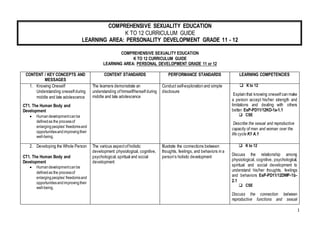
COMPREHENSIVE SEXUALITY EDUCATION
K TO 12 CURRICULUM GUIDE
LEARNING AREA: PERSONALITY DEVELOPMENT GRADE 11 - 12
COMPREHENSIVE SEXUALITY EDUCATION
K TO 12 CURRICULUM GUIDE
LEARNING AREA: PERSONAL DEVELOPMENT GRADE 11 or 12
CONTENT / KEY CONCEPTS AND
MESSAGES
CONTENT STANDARDS PERFORMANCE STANDARDS LEARNING COMPETENCIES
1. Knowing Oneself
Understanding oneselfduring
middle and late adolescence
CT1. The Human Body and
Development
 Humandevelopmentcan be
definedas the processof
enlargingpeoples’ freedomsand
opportunitiesandimprovingtheir
well-being.
The learners demonstrate an
understanding ofhimself/herselfduring
middle and late adolescence
Conduct self-exploration and simple
disclosure
 K to 12
Explain that knowing oneselfcan make
a person accept his/her strength and
limitations and dealing with others
better. EsP-PD11/12KO-1a-1.1
 CSE
Describe the sexual and reproductive
capacity of men and woman over the
life cycle K1 A.1
2. Developing the Whole Person
CT1. The Human Body and
Development
 Humandevelopmentcan be
definedas the processof
enlargingpeoples’freedomsand
opportunitiesandimprovingtheir
well-being.
The various aspectofholistic
development: physiological, cognitive,
psychological,spiritual and social
development
Illustrate the connections between
thoughts, feelings, and behaviors in a
person’s holistic development
 K to 12
Discuss the relationship among
physiological, cognitive, psychological,
spiritual and social development to
understand his/her thoughts, feelings
and behaviors EsP-PD11/12DWP-1b-
2.1
 CSE
Discuss the connection between
reproductive functions and sexual
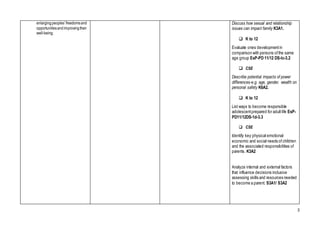
2
desires /urge that are biological; those
that are willed /desired according to
one’s rights and limitations. *K1A2.
 K to 12
Evaluate his/ her own thoughts feelings
and behaviors. EsP-PD11/12DWP-1b-
2.2
 CSE
Explain how one behaves in ways
consistentwith one’s values K2.A1
 K to 12
Show the differences between
thoughts, feelings and behaviors in
actual life situations EsP-
PD11/12DWP-1c-2.3
 CSE
Demonstrate skills to reaffirm or change
values and behaviors based on
increasing personal capacities and
experiences S2A1.
3. Developmental Stages in
Middle and Late Adolescence
CT1. The Human Body and
Development
 Humandevelopmentcan be
definedas the processof
Understands the skills and tasks
appropriate for middle and late
adolescence and preparatory to early
adulthood
Make a listof ways to become
responsible adolescents prepared for
adult life
 K to 12
Classify various developmental tasks
according to developmentstages ESP-
PD 11/12 DS-Ic-3.1
 CSE
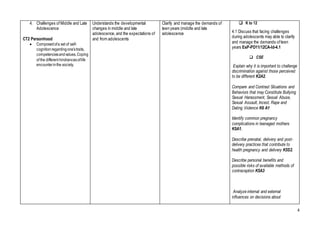
3
enlargingpeoples’freedomsand
opportunitiesandimprovingtheir
well-being.
Discuss how sexual and relationship
issues can impact family K3A1.
 K to 12
Evaluate ones developmentin
comparison with persons ofthe same
age group EsP-PD 11/12 DS-Ic-3.2
 CSE
Describe potential impacts of power
differences-e.g. age, gender, wealth on
personal safety K6A2.
 K to 12
List ways to become responsible
adolescentprepared for adultlife EsP-
PD11/12DS-1d-3.3
 CSE
Identify key physical emotional
economic and social needs ofchildren
and the associated responsibilities of
parents. K3A2
Analyze internal and external factors
that influence decisions inclusive
assessing skills and resources needed
to become a parent. S3A1/ S3A2
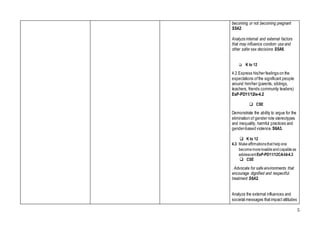
4
4. Challenges ofMiddle and Late
Adolescence
CT2 Personhood
 Composedofa set of self-
cognition regardingone’straits,
competenciesandvalues.Coping
of the different hindrancesoflife
encounterinthe society.
Understands the developmental
changes in middle and late
adolescence,and the expectations of
and from adolescents
Clarify and manage the demands of
teen years (middle and late
adolescence
 K to 12
4.1 Discuss that facing challenges
during adolescents may able to clarify
and manage the demands ofteen
years EsP-PD11/12CA-Id-4.1
 CSE
Explain why it is important to challenge
discrimination against those perceived
to be different K2A2.
Compare and Contrast Situations and
Behaviors that may Constitute Bullying
Sexual Harassment, Sexual Abuse,
Sexual Assault, Incest, Rape and
Dating Violence K6 A1
Identify common pregnancy
complications in teenaged mothers
K5A1.
Describe prenatal, delivery and post-
delivery practices that contribute to
health pregnancy and delivery K5S2.
Describe personal benefits and
possible risks of available methods of
contraception K5A3
Analyze internal and external
influences on decisions about
5
becoming or not becoming pregnant
S5A2.
Analyze internal and external factors
that may influence condom use and
other safer sex decisions S5A6.
 K to 12
4.2 Express his/her feelings on the
expectations ofthe significant people
around him/her (parents, siblings,
teachers, friends community leaders)
EsP-PD11/12Ie-4.2
 CSE
Demonstrate the ability to argue for the
elimination of gender role stereotypes
and inequality, harmful practices and
gender-based violence. S6A3.
 K to 12
4.3 Makeaffirmationsthat helpone
becomemorelovableandcapableas
adolescentEsP-PD11/12CA-Id-4.3
 CSE
. Advocate for safe environments that
encourage dignified and respectful
treatment S6A2.
Analyze the external influences and
societal messages thatimpact attitudes
6
Quarter 1
Unit 2: Aspects ofPersonal
Development
5. Coping with stress in middle
and late adolescence
CT2 Personhood
 Composedofa set of self-
cognitionregardingone’straits,
competenciesandvalues.Coping
of the different hindrancesoflife
encounterinthe society.
Stress and Its Sources: Various stress
Responses:and Coping Strategies for
Healthful Living in Middle and Late
Adolescence
Identify personal ways ofcoping for
Healthful Living
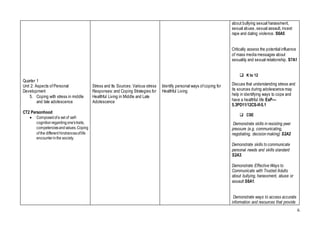
about bullying sexual harassment,
sexual abuse, sexual assault, incest
rape and dating violence. S6A5
Critically assess the potential influence
of mass media messages about
sexuality and sexual relationship. S7A1
 K to 12
Discuss that understanding stress and
its sources during adolescence may
help in identifying ways to cope and
have a healthful life EsP—
5.3PD11/12CS-If-5.1
 CSE
Demonstrate skills in resisting peer
pressure (e.g. communicating,
negotiating, decision making) S2A2
Demonstrate skills to communicate
personal needs and skills standard
S2A3.
Demonstrate Effective Ways to
Communicate with Trusted Adults
about bullying, harassment, abuse or
assault S6A1.
Demonstrate ways to access accurate
information and resources that provide
7
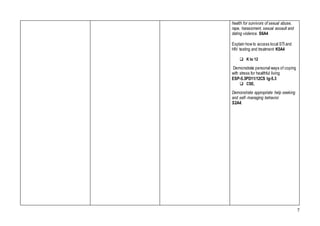
health for survivors of sexual abuse,
rape, harassment, sexual assault and
dating violence. S6A4
Explain how to access local STIand
HIV testing and treatment K5A4
 K to 12
Demonstrate personal ways of coping
with stress for healthful living
ESP-5.3PD11/12CS Ig-5.3
 CSE.
Demonstrate appropriate help seeking
and self- managing behavior
S2A4.
8
Quarter II
Unit 3- Building and Maintaining
Relationships
9. Personal Relationships
CT3. HEALTHY RELATIONSHIPS
 Thestate openness,honestand
safe communication,necessary
part of healthy living. Supportone
anotherwith mutualrespect.
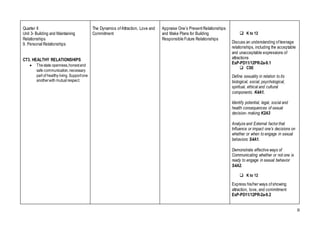
The Dynamics ofAttraction, Love and
Commitment
Appraise One’s PresentRelationships
and Make Plans for Building
Responsible Future Relationships
 K to 12
Discuss an understanding ofteenage
relationships, including the acceptable
and unacceptable expressions of
attractions
EsP-PD11/12PR-2a-9.1
 CSE
Define sexuality in relation to its
biological, social, psychological,
spiritual, ethical and cultural
components. K4A1.
Identify potential, legal, social and
health consequences of sexual
decision- making K2A3
Analyze and External factor that
Influence or impact one’s decisions on
whether or when to engage in sexual
behaviors S4A1.
Demonstrate effective ways of
Communicating whether or not one is
ready to engage in sexual behavior
S4A2.
 K to 12
Express his/her ways ofshowing
attraction, love, and commitment
EsP-PD11/12PR-2a-9.2
9
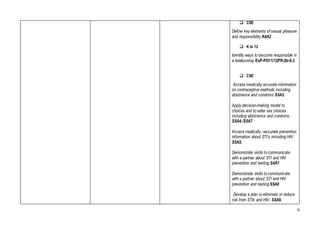
 CSE
Define key elements of sexual pleasure
and responsibility K4A2
 K to 12
Identify ways to become responsible in
a relationship EsP-PD11/12PR-2b-9.3
 CSE
Access medically accurate information
on contraceptive methods including
abstinence and condoms S5A3.
Apply decision-making model to
choices and to safer sex choices
including abstinence and condoms.
S5A4./S5A7
Access medically –accurate prevention
information about STI’s including HIV.
S5A5.
Demonstrate skills to communicate
with a partner about STI and HIV
prevention and testing.S4A1
Demonstrate skills to communicate
with a partner about STI and HIV
prevention and testing S5A8
.
Develop a plan to eliminate or reduce
risk from STIs and HIV. S5A9.
10
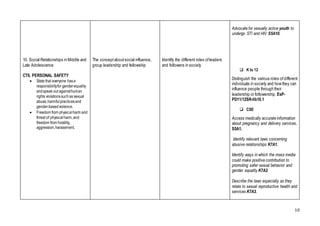
10. Social Relationships in Middle and
Late Adolescence
CT6. PERSONAL SAFETY
 State that everyone hasa
responsibilityfor genderequality
andspeak out againsthuman
rights violationssuchas sexual
abuse,harmfulpracticesand
gender-basedviolence.
 Freedom from physicalharm and
threat of physicalharm,and
freedom from hostility,
aggression,harassment.
The conceptaboutsocial influence,
group leadership and fellowship
Identify the different roles ofleaders
and followers in society
Advocate for sexually active youth to
undergo STI and HIV S5A10.
 K to 12
Distinguish the various roles ofdifferent
individuals in society and how they can
influence people through their
leadership or followership. EsP-
PD11/12SR-IIb10.1
 CSE
Access medically accurate information
about pregnancy and delivery services.
S5A1.
Identify relevant laws concerning
abusive relationships K7A1.
Identify ways in which the mass media
could make positive contribution to
promoting safer sexual behavior and
gender equality K7A2.
Describe the laws especially as they
relate to sexual reproductive health and
services K7A3.
11
Explain the concepts of human rights
related Sexual and reproductive health.
K7A4.
PREPARED BY: BELINDA M. MENDOZA ELIGIO M. JACOB NUNILON L. MORENO NOIME O. VILLEGAS
EPS, CID EPS, CLMD PRINCIPAL III HT I, R3, SDO-GAPAN CITY
SDO ROMBLON MIMAROPA REGION SDO PASAY, NCR
MIMAROPA REGION

CSE-CG-PERSONALITY-DEVELOPMENT-GRADES-11-12.docx

  • 1.
    1 COMPREHENSIVE SEXUALITY EDUCATION KTO 12 CURRICULUM GUIDE LEARNING AREA: PERSONALITY DEVELOPMENT GRADE 11 - 12 COMPREHENSIVE SEXUALITY EDUCATION K TO 12 CURRICULUM GUIDE LEARNING AREA: PERSONAL DEVELOPMENT GRADE 11 or 12 CONTENT / KEY CONCEPTS AND MESSAGES CONTENT STANDARDS PERFORMANCE STANDARDS LEARNING COMPETENCIES 1. Knowing Oneself Understanding oneselfduring middle and late adolescence CT1. The Human Body and Development  Humandevelopmentcan be definedas the processof enlargingpeoples’ freedomsand opportunitiesandimprovingtheir well-being. The learners demonstrate an understanding ofhimself/herselfduring middle and late adolescence Conduct self-exploration and simple disclosure  K to 12 Explain that knowing oneselfcan make a person accept his/her strength and limitations and dealing with others better. EsP-PD11/12KO-1a-1.1  CSE Describe the sexual and reproductive capacity of men and woman over the life cycle K1 A.1 2. Developing the Whole Person CT1. The Human Body and Development  Humandevelopmentcan be definedas the processof enlargingpeoples’freedomsand opportunitiesandimprovingtheir well-being. The various aspectofholistic development: physiological, cognitive, psychological,spiritual and social development Illustrate the connections between thoughts, feelings, and behaviors in a person’s holistic development  K to 12 Discuss the relationship among physiological, cognitive, psychological, spiritual and social development to understand his/her thoughts, feelings and behaviors EsP-PD11/12DWP-1b- 2.1  CSE Discuss the connection between reproductive functions and sexual
  • 2.
    2 desires /urge thatare biological; those that are willed /desired according to one’s rights and limitations. *K1A2.  K to 12 Evaluate his/ her own thoughts feelings and behaviors. EsP-PD11/12DWP-1b- 2.2  CSE Explain how one behaves in ways consistentwith one’s values K2.A1  K to 12 Show the differences between thoughts, feelings and behaviors in actual life situations EsP- PD11/12DWP-1c-2.3  CSE Demonstrate skills to reaffirm or change values and behaviors based on increasing personal capacities and experiences S2A1. 3. Developmental Stages in Middle and Late Adolescence CT1. The Human Body and Development  Humandevelopmentcan be definedas the processof Understands the skills and tasks appropriate for middle and late adolescence and preparatory to early adulthood Make a listof ways to become responsible adolescents prepared for adult life  K to 12 Classify various developmental tasks according to developmentstages ESP- PD 11/12 DS-Ic-3.1  CSE
  • 3.
    3 enlargingpeoples’freedomsand opportunitiesandimprovingtheir well-being. Discuss how sexualand relationship issues can impact family K3A1.  K to 12 Evaluate ones developmentin comparison with persons ofthe same age group EsP-PD 11/12 DS-Ic-3.2  CSE Describe potential impacts of power differences-e.g. age, gender, wealth on personal safety K6A2.  K to 12 List ways to become responsible adolescentprepared for adultlife EsP- PD11/12DS-1d-3.3  CSE Identify key physical emotional economic and social needs ofchildren and the associated responsibilities of parents. K3A2 Analyze internal and external factors that influence decisions inclusive assessing skills and resources needed to become a parent. S3A1/ S3A2
  • 4.
    4 4. Challenges ofMiddleand Late Adolescence CT2 Personhood  Composedofa set of self- cognition regardingone’straits, competenciesandvalues.Coping of the different hindrancesoflife encounterinthe society. Understands the developmental changes in middle and late adolescence,and the expectations of and from adolescents Clarify and manage the demands of teen years (middle and late adolescence  K to 12 4.1 Discuss that facing challenges during adolescents may able to clarify and manage the demands ofteen years EsP-PD11/12CA-Id-4.1  CSE Explain why it is important to challenge discrimination against those perceived to be different K2A2. Compare and Contrast Situations and Behaviors that may Constitute Bullying Sexual Harassment, Sexual Abuse, Sexual Assault, Incest, Rape and Dating Violence K6 A1 Identify common pregnancy complications in teenaged mothers K5A1. Describe prenatal, delivery and post- delivery practices that contribute to health pregnancy and delivery K5S2. Describe personal benefits and possible risks of available methods of contraception K5A3 Analyze internal and external influences on decisions about
  • 5.
    5 becoming or notbecoming pregnant S5A2. Analyze internal and external factors that may influence condom use and other safer sex decisions S5A6.  K to 12 4.2 Express his/her feelings on the expectations ofthe significant people around him/her (parents, siblings, teachers, friends community leaders) EsP-PD11/12Ie-4.2  CSE Demonstrate the ability to argue for the elimination of gender role stereotypes and inequality, harmful practices and gender-based violence. S6A3.  K to 12 4.3 Makeaffirmationsthat helpone becomemorelovableandcapableas adolescentEsP-PD11/12CA-Id-4.3  CSE . Advocate for safe environments that encourage dignified and respectful treatment S6A2. Analyze the external influences and societal messages thatimpact attitudes
  • 6.
    6 Quarter 1 Unit 2:Aspects ofPersonal Development 5. Coping with stress in middle and late adolescence CT2 Personhood  Composedofa set of self- cognitionregardingone’straits, competenciesandvalues.Coping of the different hindrancesoflife encounterinthe society. Stress and Its Sources: Various stress Responses:and Coping Strategies for Healthful Living in Middle and Late Adolescence Identify personal ways ofcoping for Healthful Living about bullying sexual harassment, sexual abuse, sexual assault, incest rape and dating violence. S6A5 Critically assess the potential influence of mass media messages about sexuality and sexual relationship. S7A1  K to 12 Discuss that understanding stress and its sources during adolescence may help in identifying ways to cope and have a healthful life EsP— 5.3PD11/12CS-If-5.1  CSE Demonstrate skills in resisting peer pressure (e.g. communicating, negotiating, decision making) S2A2 Demonstrate skills to communicate personal needs and skills standard S2A3. Demonstrate Effective Ways to Communicate with Trusted Adults about bullying, harassment, abuse or assault S6A1. Demonstrate ways to access accurate information and resources that provide
  • 7.
    7 health for survivorsof sexual abuse, rape, harassment, sexual assault and dating violence. S6A4 Explain how to access local STIand HIV testing and treatment K5A4  K to 12 Demonstrate personal ways of coping with stress for healthful living ESP-5.3PD11/12CS Ig-5.3  CSE. Demonstrate appropriate help seeking and self- managing behavior S2A4.
  • 8.
    8 Quarter II Unit 3-Building and Maintaining Relationships 9. Personal Relationships CT3. HEALTHY RELATIONSHIPS  Thestate openness,honestand safe communication,necessary part of healthy living. Supportone anotherwith mutualrespect. The Dynamics ofAttraction, Love and Commitment Appraise One’s PresentRelationships and Make Plans for Building Responsible Future Relationships  K to 12 Discuss an understanding ofteenage relationships, including the acceptable and unacceptable expressions of attractions EsP-PD11/12PR-2a-9.1  CSE Define sexuality in relation to its biological, social, psychological, spiritual, ethical and cultural components. K4A1. Identify potential, legal, social and health consequences of sexual decision- making K2A3 Analyze and External factor that Influence or impact one’s decisions on whether or when to engage in sexual behaviors S4A1. Demonstrate effective ways of Communicating whether or not one is ready to engage in sexual behavior S4A2.  K to 12 Express his/her ways ofshowing attraction, love, and commitment EsP-PD11/12PR-2a-9.2
  • 9.
    9  CSE Define keyelements of sexual pleasure and responsibility K4A2  K to 12 Identify ways to become responsible in a relationship EsP-PD11/12PR-2b-9.3  CSE Access medically accurate information on contraceptive methods including abstinence and condoms S5A3. Apply decision-making model to choices and to safer sex choices including abstinence and condoms. S5A4./S5A7 Access medically –accurate prevention information about STI’s including HIV. S5A5. Demonstrate skills to communicate with a partner about STI and HIV prevention and testing.S4A1 Demonstrate skills to communicate with a partner about STI and HIV prevention and testing S5A8 . Develop a plan to eliminate or reduce risk from STIs and HIV. S5A9.
  • 10.
    10 10. Social Relationshipsin Middle and Late Adolescence CT6. PERSONAL SAFETY  State that everyone hasa responsibilityfor genderequality andspeak out againsthuman rights violationssuchas sexual abuse,harmfulpracticesand gender-basedviolence.  Freedom from physicalharm and threat of physicalharm,and freedom from hostility, aggression,harassment. The conceptaboutsocial influence, group leadership and fellowship Identify the different roles ofleaders and followers in society Advocate for sexually active youth to undergo STI and HIV S5A10.  K to 12 Distinguish the various roles ofdifferent individuals in society and how they can influence people through their leadership or followership. EsP- PD11/12SR-IIb10.1  CSE Access medically accurate information about pregnancy and delivery services. S5A1. Identify relevant laws concerning abusive relationships K7A1. Identify ways in which the mass media could make positive contribution to promoting safer sexual behavior and gender equality K7A2. Describe the laws especially as they relate to sexual reproductive health and services K7A3.
  • 11.
    11 Explain the conceptsof human rights related Sexual and reproductive health. K7A4. PREPARED BY: BELINDA M. MENDOZA ELIGIO M. JACOB NUNILON L. MORENO NOIME O. VILLEGAS EPS, CID EPS, CLMD PRINCIPAL III HT I, R3, SDO-GAPAN CITY SDO ROMBLON MIMAROPA REGION SDO PASAY, NCR MIMAROPA REGION