Lesson 1
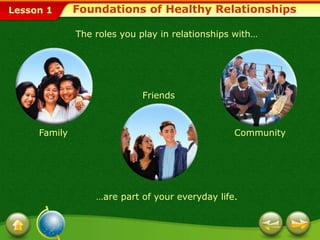
The roles you play in relationships with…
…are part of your everyday life.
Community
Friends
Family
Foundations of Healthy Relationships
Lesson 1
Evaluate the positive and negative effects of relationships with
peers, family, and friends on physical, mental/emotional, and
social health.
Demonstrate strategies for communicating needs, wants, and
emotions in healthy ways.
Identify the qualities and character traits that promote
healthy relationships with peers, family, and friends.
In this lesson, you’ll learn to:
Lesson Objectives
Lesson 1
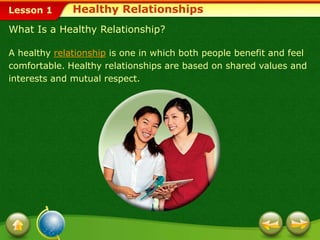
What Is a Healthy Relationship?
A healthy relationship is one in which both people benefit and feel
comfortable. Healthy relationships are based on shared values and
interests and mutual respect.
Healthy Relationships
Lesson 1
Friendships
Family
Relationships
Healthy family relationships
enhance all sides of your
health triangle.
The love, care, and
encouragement you receive
from family members also
contribute to your
mental/emotional health.
Community
Relationships
Forms of Healthy Relationships
Healthy Relationships
Lesson 1
Roles with Peers, Family, and Friends
You probably play many roles, such as daughter or son, sibling,
best friend, and employee.
The role you play in a relationship may be obvious. Example:
When you baby-sit a neighbor’s child, you are an employee.
Sometimes your roles may change gradually or even suddenly.
Example: Your relationship with a fellow choir member may
change if you begin dating.
Role changes can be confusing and can make it difficult to know
how to act.
Healthy Relationships
Lesson 1
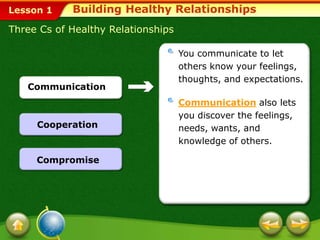
Three Cs of Healthy Relationships
You communicate to let
others know your feelings,
thoughts, and expectations.
Communication also lets
you discover the feelings,
needs, wants, and
knowledge of others.
Cooperation
Compromise
Communication
Building Healthy Relationships
Lesson 1
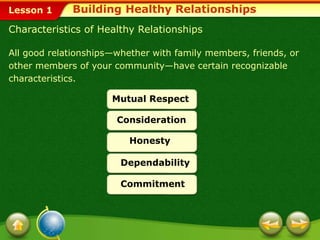
Characteristics of Healthy Relationships
All good relationships—whether with family members, friends, or
other members of your community—have certain recognizable
characteristics.
Honesty
Dependability
Commitment
Mutual Respect
Consideration
Building Healthy Relationships
Lesson 1
Traits of Good Character
You can build a foundation for healthy relationships by
demonstrating the six main traits of good character.
1. Trustworthiness
2. Fairness
3. Respect
4. Caring
5. Responsibility
6. Citizenship
Character and Healthy Relationships
Lesson 1
Trustworthiness
You show trustworthiness when you are
honest, reliable, and loyal.
Trustworthy people don’t cheat, steal, or
deceive; they have the courage to do
what’s right.
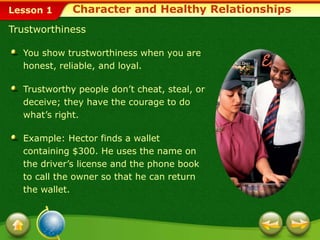
Example: Hector finds a wallet
containing $300. He uses the name on
the driver’s license and the phone book
to call the owner so that he can return
the wallet.
Character and Healthy Relationships
Lesson 1
Fairness
You show fairness when you play by
the rules, take turns, and share.
A fair person listens to others and is
open-minded.
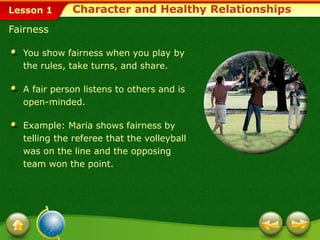
Example: Maria shows fairness by
telling the referee that the volleyball
was on the line and the opposing
team won the point.
Character and Healthy Relationships
Lesson 1
Respect
You show respect by using good
manners, being considerate of
others, and being tolerant of
differences.
Example: Sid knows that his
dad brought a lot of work home
from the office. Sid turns down
the volume of his music so he
won’t disturb his father.
Character and Healthy Relationships
Lesson 1
Caring
You show that you are caring
when you are kind and
compassionate.
Caring means putting in time
and energy to help others.
Example: Juanita is entering a
store. She holds the door open
for a man whose arms are
filled with packages.
Character and Healthy Relationships
Lesson 1
Responsibility
You show that you are responsible when
you do what is expected of you and are
accountable for your choices.
Being responsible also means that you
use self-control, think before you act,
and always try your best.
Example: Sarah’s drama rehearsal runs
late. She calls her parents to let them
know she is going to be late.
Character and Healthy Relationships
Lesson 1
Citizenship
You show good citizenship by cooperating and doing your share
to improve your school and community.
You obey laws and rules and respect authority.
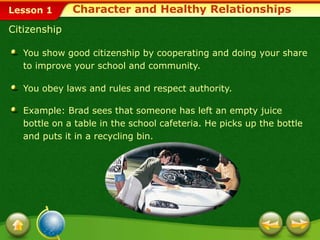
Example: Brad sees that someone has left an empty juice
bottle on a table in the school cafeteria. He picks up the bottle
and puts it in a recycling bin.
Character and Healthy Relationships
Lesson 1
Friendships
Family
Relationships
Community
Relationships
Forms of Healthy Relationships
Your friends can be of any
age, and you can choose
them for different reasons.
Good friends share similar
values.
Maintaining a good
friendship can sometimes
be hard work, but it is well
worth the effort.
Healthy Relationships
Lesson 1
Forms of Healthy Relationships
Members of a community
work together to promote
the safety and well-being
of the entire community.
You can demonstrate good
citizenship by obeying laws
and rules, by being a
friendly and helpful neighbor,
and by contributing to efforts
to improve your school and
community.
Friendships
Family
Relationships
Community
Relationships
Healthy Relationships
Lesson 1
Working together through
cooperation helps build
strong relationships.
Activities such as helping
someone to move a heavy
object are almost
impossible without
cooperation.
Cooperation
Compromise
Communication
Three Cs of Healthy Relationships
Building Healthy Relationships
Lesson 1
Cooperation
Compromise
Communication
The “give and take” of
effective compromise
strengthens relationships.
By your willingness to
give up something in
order to reach a solution,
you show the other
person that you value the
relationship.
Three Cs of Healthy Relationships
Building Healthy Relationships

PerDev Week 2 - 2nd quarter.ppt

  • 1.
    Lesson 1 The rolesyou play in relationships with… …are part of your everyday life. Community Friends Family Foundations of Healthy Relationships
  • 2.
    Lesson 1 Evaluate thepositive and negative effects of relationships with peers, family, and friends on physical, mental/emotional, and social health. Demonstrate strategies for communicating needs, wants, and emotions in healthy ways. Identify the qualities and character traits that promote healthy relationships with peers, family, and friends. In this lesson, you’ll learn to: Lesson Objectives
  • 3.
    Lesson 1 What Isa Healthy Relationship? A healthy relationship is one in which both people benefit and feel comfortable. Healthy relationships are based on shared values and interests and mutual respect. Healthy Relationships
  • 4.
    Lesson 1 Friendships Family Relationships Healthy familyrelationships enhance all sides of your health triangle. The love, care, and encouragement you receive from family members also contribute to your mental/emotional health. Community Relationships Forms of Healthy Relationships Healthy Relationships
  • 5.
    Lesson 1 Roles withPeers, Family, and Friends You probably play many roles, such as daughter or son, sibling, best friend, and employee. The role you play in a relationship may be obvious. Example: When you baby-sit a neighbor’s child, you are an employee. Sometimes your roles may change gradually or even suddenly. Example: Your relationship with a fellow choir member may change if you begin dating. Role changes can be confusing and can make it difficult to know how to act. Healthy Relationships
  • 6.
    Lesson 1 Three Csof Healthy Relationships You communicate to let others know your feelings, thoughts, and expectations. Communication also lets you discover the feelings, needs, wants, and knowledge of others. Cooperation Compromise Communication Building Healthy Relationships
  • 7.
    Lesson 1 Characteristics ofHealthy Relationships All good relationships—whether with family members, friends, or other members of your community—have certain recognizable characteristics. Honesty Dependability Commitment Mutual Respect Consideration Building Healthy Relationships
  • 8.
    Lesson 1 Traits ofGood Character You can build a foundation for healthy relationships by demonstrating the six main traits of good character. 1. Trustworthiness 2. Fairness 3. Respect 4. Caring 5. Responsibility 6. Citizenship Character and Healthy Relationships
  • 9.
    Lesson 1 Trustworthiness You showtrustworthiness when you are honest, reliable, and loyal. Trustworthy people don’t cheat, steal, or deceive; they have the courage to do what’s right. Example: Hector finds a wallet containing $300. He uses the name on the driver’s license and the phone book to call the owner so that he can return the wallet. Character and Healthy Relationships
  • 10.
    Lesson 1 Fairness You showfairness when you play by the rules, take turns, and share. A fair person listens to others and is open-minded. Example: Maria shows fairness by telling the referee that the volleyball was on the line and the opposing team won the point. Character and Healthy Relationships
  • 11.
    Lesson 1 Respect You showrespect by using good manners, being considerate of others, and being tolerant of differences. Example: Sid knows that his dad brought a lot of work home from the office. Sid turns down the volume of his music so he won’t disturb his father. Character and Healthy Relationships
  • 12.
    Lesson 1 Caring You showthat you are caring when you are kind and compassionate. Caring means putting in time and energy to help others. Example: Juanita is entering a store. She holds the door open for a man whose arms are filled with packages. Character and Healthy Relationships
  • 13.
    Lesson 1 Responsibility You showthat you are responsible when you do what is expected of you and are accountable for your choices. Being responsible also means that you use self-control, think before you act, and always try your best. Example: Sarah’s drama rehearsal runs late. She calls her parents to let them know she is going to be late. Character and Healthy Relationships
  • 14.
    Lesson 1 Citizenship You showgood citizenship by cooperating and doing your share to improve your school and community. You obey laws and rules and respect authority. Example: Brad sees that someone has left an empty juice bottle on a table in the school cafeteria. He picks up the bottle and puts it in a recycling bin. Character and Healthy Relationships
  • 15.
    Lesson 1 Friendships Family Relationships Community Relationships Forms ofHealthy Relationships Your friends can be of any age, and you can choose them for different reasons. Good friends share similar values. Maintaining a good friendship can sometimes be hard work, but it is well worth the effort. Healthy Relationships
  • 16.
    Lesson 1 Forms ofHealthy Relationships Members of a community work together to promote the safety and well-being of the entire community. You can demonstrate good citizenship by obeying laws and rules, by being a friendly and helpful neighbor, and by contributing to efforts to improve your school and community. Friendships Family Relationships Community Relationships Healthy Relationships
  • 17.
    Lesson 1 Working togetherthrough cooperation helps build strong relationships. Activities such as helping someone to move a heavy object are almost impossible without cooperation. Cooperation Compromise Communication Three Cs of Healthy Relationships Building Healthy Relationships
  • 18.
    Lesson 1 Cooperation Compromise Communication The “giveand take” of effective compromise strengthens relationships. By your willingness to give up something in order to reach a solution, you show the other person that you value the relationship. Three Cs of Healthy Relationships Building Healthy Relationships