Cooperation and collaboration to
strengthen the global research cycle

          Kay Raseroka and Lucy Browse
               lbrowse@inasp.info
                  www.inasp.info


Slide 1
The purpose of Higher Education:
       “Higher education institutions have
  responsibility for equipping individuals with
   the knowledge and skills required for key
  positions in government, business, industry
and professions. They produce new knowledge
 through research and can transfer, adapt and
    disseminate knowledge as well as being
     important institutions of civil society.”
           “Universities and development: global cooperation” Universities UK
http://www.universitiesuk.ac.uk/Publications/Documents/UniversitiesAndDevelopment201
                                        01011.pdf

  Slide 2
What about Higher Education institutions in
 developing countries?
• 1960s and 70s
   – institutions of excellence, producing leading researchers

• Years of neglect – 80s, 90s
   – pressure to expand, insufficient funding (government and
     donor)
   – quality plummeted – prospects for research severely damaged

• 2000 onward
   – Universities slowly being rebuilt
   – Donors return to HE (influential World Bank publications)

• 2010+
   – Decade of investment, initiatives, programmes
   – 3
   Slide Successes, but still a lot to be done
Where we find ourselves:
• In the context of our continent:
        Often facing social, political and economic challenges
        The impact of the global recession yet to be fully realised

•In the context of scholarly institutions:
       Historical legacy economically, structurally and
       institutionally

•For the individual scholar:
       Pulled between the research requirements and the
       teaching requirements of his/her institution
       Skills gained overseas can atrophy without CPD support
  Slide 4
Exploring the issues – “University
    Challenge”
•    Universities are complex – ‘fixing’ them isn’t easy. Financial
     constraints are significant but not the only problem…

     – Organisational constraints: structures, systems and university
       governance
     – Research management critical – funding and grant preparation
     – Good libraries – access to materials and information
     – Clear research agendas
     – Postgraduate training plans and proper research career structures
     – Incentives to do research – enabling an attractive research culture
     – Better data for planning and monitoring


       Slide 5
Some contradictions: (1)
   • Developed world universities would
        claim to be using an a-historical
   ‘universal’ model
   BUT
      Where do developing country
   universities fit into the ‘game’ of ‘research
   rankings’ ?


Slide 6
Some contradictions: (2)

   • There is no issue about the basics of
       what makes for robust research

   BUT
     The context within which that research
       content is made available is very
       different in the developing world


Slide 7
Some contradictions: (3)
      • Research communication ‘infomediaries’
      have largely achieved availability and
      quantity of content
      BUT

      • Access: i.e. usability, capability and usage
      are the continuing challenges


Slide 8
Some more contradictions: (4)
• Technical access remains a huge challenge
    despite initiatives like Bandwidth
Management and Optimisation (BMO)

BUT
• Although the Eastern / Western African sea board
      fibre optic cables are in place, landlocked
countries (at least) will still be disadvantaged
because of tax-seeking by coastal countries
and/or by their own governments: i.e. passing on
the cost levied on them to institutions
Slide 9
UbuntuNet
 Research & Education Network

• The first network of its kind in Africa
• Launched in November 2012
• The network will dramatically accelerate the
  development of the information society in Africa,
  providing advanced data communications
  infrastructure and enabling African researchers
  to collaborate more easily in advanced
  International Research projects
• Video:
   http://www.africaconnect.ue/MediaCenter/Pages/Launch-
   Event-video.aspx

 Slide 10
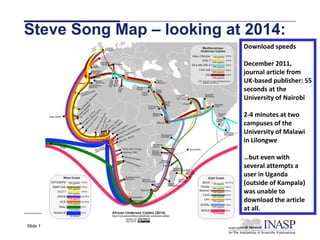
Steve Song Map – looking at 2014:
                           Download speeds

                           December 2011,
                           journal article from
                           UK-based publisher: 55
                           seconds at the
                           University of Nairobi

                           2-4 minutes at two
                           campuses of the
                           University of Malawi
                           in Lilongwe

                           …but even with
                           several attempts a
                           user in Uganda
                           (outside of Kampala)
                           was unable to
                           download the article
                           at all.

Slide 11
And what for the future?
   The partnerships, cooperation and collaboration that
have been achieved across the global south and north
are vital to strengthen research and our work.

   We must ensure that capacity, expertise and policies
are embedded at a local level. This will include:
   •More southern voices included in debates around
availability, access and use of research
   •More advocacy at Govt. level to help build and
develop the vision of the WSIS knowledge societies

  Slide 12
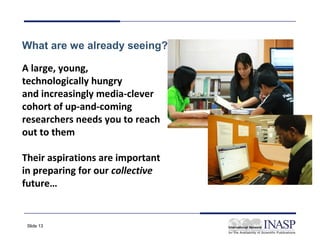
What are we already seeing?

A large, young,
technologically hungry
and increasingly media-clever
cohort of up-and-coming
researchers needs you to reach
out to them

Their aspirations are important
in preparing for our collective
future…


 Slide 13
Partnerships building bridges
• Digital Libraries
  - Green stone (digital library software)
   - International Network for the Availability of
      Scientific Publications (INASP)
       - Electronic Information for Libraries (eIFL) Project
• DL support organisations
  - Greenstone support organisation for Africa (GSOA)

• We now turn to the work of our partners - INASP

Slide 14
INASP facts and figures…
•     Established in 1992
•     19 permanent staff
•     International Board of Trustees
•     Works in Africa, Asia and Latin America
           – 22 partner countries, over 100 eligible countries


• Funded mainly by partner countries and European
  governments


Slide 15
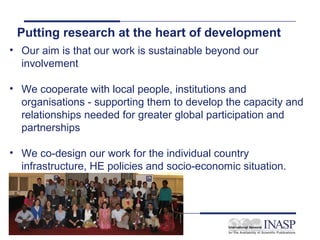
Putting research at the heart of development
• Our aim is that our work is sustainable beyond our
  involvement

• We cooperate with local people, institutions and
  organisations - supporting them to develop the capacity and
  relationships needed for greater global participation and
  partnerships

• We co-design our work for the individual country
  infrastructure, HE policies and socio-economic situation.


   Slide 16
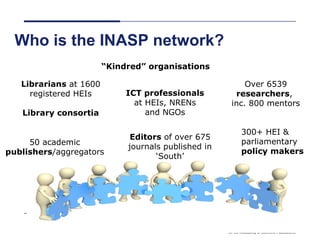
Who is the INASP network?
                        “Kindred” organisations

   Librarians at 1600                                    Over 6539
     registered HEIs         ICT professionals        researchers,
                               at HEIs, NRENs        inc. 800 mentors
   Library consortia              and NGOs

                                                       300+ HEI &
                              Editors of over 675
     50 academic                                       parliamentary
                             journals published in
publishers/aggregators                                 policy makers
                                    ‘South’


    Slide 17
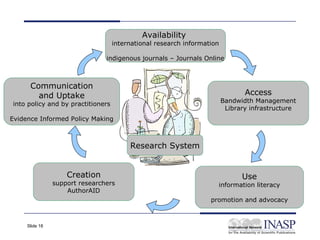
Availability
                                   international research information

                                indigenous journals – Journals Online


      Communication
        and Uptake                                                             Access
                                                                        Bandwidth Management
into policy and by practitioners
                                                                         Library infrastructure
Evidence Informed Policy Making


                                        Research System


                    Creation                                                  Use
                support researchers                                 information literacy
                    AuthorAID
                                                                  promotion and advocacy


     Slide 18
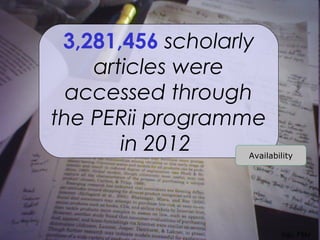
3,281,456 scholarly
               articles were
             accessed through
           the PERii programme
                  in 2012    Availability


Slide 19

                                     Inju, Flikr
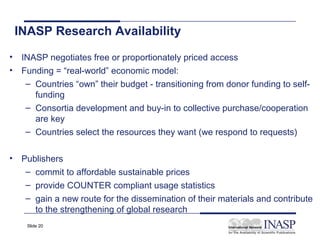
INASP Research Availability
• INASP negotiates free or proportionately priced access
• Funding = “real-world” economic model:
   – Countries “own” their budget - transitioning from donor funding to self-
     funding
   – Consortia development and buy-in to collective purchase/cooperation
     are key
   – Countries select the resources they want (we respond to requests)


• Publishers
   – commit to affordable sustainable prices
   – provide COUNTER compliant usage statistics
   – gain a new route for the dissemination of their materials and contribute
     to the strengthening of global research
    Slide 20
Interdisciplinary resources: 2012
• 50+ publishers and aggregators offering
   –    11,000 full text books
   –    31,476 full text journals
   –    23,072 abstracted journals
   –    82 databases
   –    Document delivery from 20,000 journals through
        the British Library

• List of free and Open Access resources

• Cooperation and collaboration

 Slide 21
The Importance of
     Advocacy
www.pubs-for-dev.info
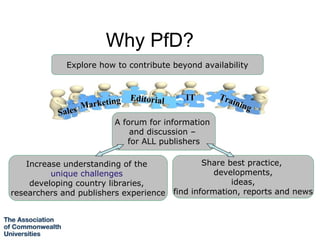
Why PfD?
             Explore how to contribute beyond availability


                             Editorial      IT      Tra
                  Mar keting                            inin
                                                             g
           Sal es
                         A forum for information
                             and discussion –
                            for ALL publishers

    Increase understanding of the                Share best practice,
          unique challenges                         developments,
     developing country libraries,                      ideas,
researchers and publishers experience    find information, reports and news
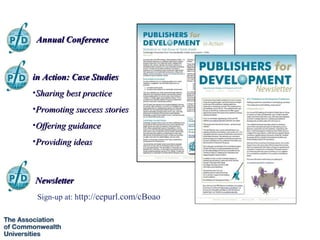
Annual Conference


in Action: Case Studies
•Sharing best practice
•Promoting success stories
•Offering guidance
•Providing ideas


Newsletter
 Sign-up at: http://eepurl.com/cBoao
Core discussions so far:
• low-bandwidth environments: supporting and
  encouraging resource interface design to increase
  access;

• supporting developing country researchers:
  encouraging greater visibility, inclusion and
  contribution;

• raising resource awareness: producing low-
  resolution promotional materials. Use networks!
Access in low-bandwidth
        environments – what can be done?

Launched in 2012:


INASP Bandwidth Management and Optimisation
• Works with institutions to reserve scarce
  bandwidth for core institutional purposes
• Encourages strengthening and formation of
  National Research and Education networks
Bandwidth matters…
As James Lush of the Biochemical Society, blogged
following a recent bandwidth session:

“Improving access makes an enormous difference to the
professional lives of individuals; how they work and think,
their research impacts and their reputation – and the
reputation of their environment.
For researchers in developing countries to succeed in
research on the global stage, the challenges are many. But
creating usable interfaces seems a simple place to start”
                                  (http://bit.ly/FPOZpL).
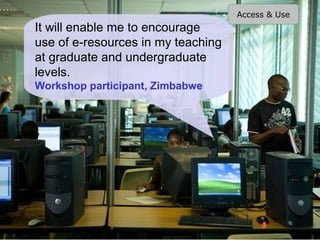
Access & Use
   It will enable me to encourage
   use of e-resources in my teaching
   at graduate and undergraduate
   levels.
   Workshop participant, Zimbabwe


Slide 28
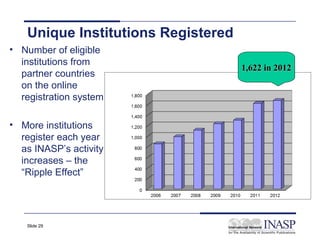
Unique Institutions Registered
• Number of eligible
  institutions from
                                    1,622 in 2012
  partner countries
  on the online
  registration system

• More institutions
  register each year
  as INASP’s activity
  increases – the
  “Ripple Effect”


   Slide 29
Developing library infrastructure
• Using OS solutions for;
           – Library automation / resource discovery tools

           – Digitisation and institutional repositories
           – e.g. KOHA, VuFind, Dspace, Drupal

      2010 Institutional repository training in Sri Lanka
         > 8 new institutional repositories
         e.g. University of Moratuwa: all 1650+ dissertations
         > federated search developed at national level


Slide 30
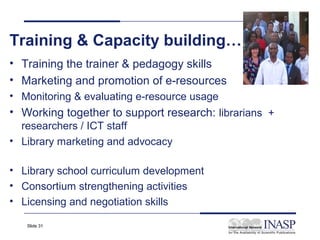
Training & Capacity building…
• Training the trainer & pedagogy skills
• Marketing and promotion of e-resources
• Monitoring & evaluating e-resource usage
• Working together to support research: librarians +
  researchers / ICT staff
• Library marketing and advocacy

• Library school curriculum development
• Consortium strengthening activities
• Licensing and negotiation skills

   Slide 31
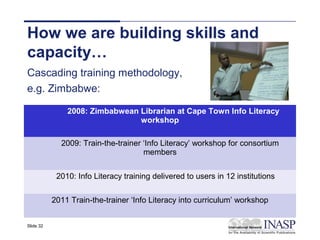
How we are building skills and
capacity…
Cascading training methodology,
e.g. Zimbabwe:

               2008: Zimbabwean Librarian at Cape Town Info Literacy
                                workshop

             2009: Train-the-trainer ‘Info Literacy’ workshop for consortium
                                     members


            2010: Info Literacy training delivered to users in 12 institutions

           2011 Train-the-trainer ‘Info Literacy into curriculum’ workshop


Slide 32
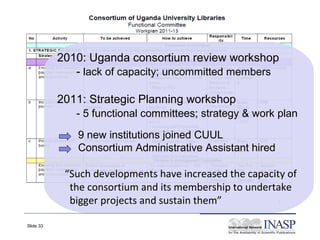
2010: Uganda consortium review workshop
              - lack of capacity; uncommitted members

           2011: Strategic Planning workshop
              - 5 functional committees; strategy & work plan

              9 new institutions joined CUUL
              Consortium Administrative Assistant hired

            “Such developments have increased the capacity of
             the consortium and its membership to undertake
             bigger projects and sustain them”

Slide 33
From            to “LfD”?
What might INASP Librarians for Development look
like?
•Community of practice in Moodle: Bringing librarians
together South and North

•Starting small – contribute ideas, designed to
increase resource awareness, promo ideas etc.

•Licensing and negotiations – offer advice and input
as INASP partners increase their expertise
Are there schemes at your Uni?

• http://www2.le.ac.uk/institution/gondar-information-hub


• http://medicine.st-andrews.ac.uk/malawi/


• For other examples see: universities UK

              Let us know what you’re doing!
Other ways for librarians to get involved in
information for development:
• Beyond Access: Libraries Powering Development –
  IFLA/EIFL/Gates looking at the role of public & community
  libraries: http://www.beyondaccess.net

• Libraries and Development: IFLA pages launched in
  February, so a growing resource (includes Building Strong
  LA programme info.): http://bit.ly/XXqUYG


Familiarise yourself with resources available to
               returning scholars!
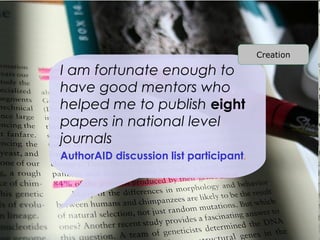
Creation

           I am fortunate enough to
           have good mentors who
           helped me to publish eight
           papers in national level
           journals
           AuthorAID discussion list participant.


Slide 37
- An Overview
• A global research community for researchers in
  developing countries with over 6,500 members
• Help for researchers in the publishing process

• Main components
   –   Mentoring by volunteers
   -   Workshops
   -   Preparing poster and oral presentations
   -   Writing grant proposals
   –   Online training delivered via moodle
   Slide 38
AuthorAID www.authoraid.info
                                   Resources Library


                           Small
                          grants


                             We would encourage you to
                             register, share information via
           Regular blog      your networks and consider
           posts
Slide 39
                             becoming a mentor!
                                     Mentoring
                                    Scheme
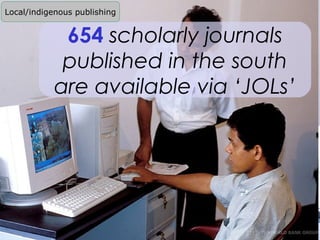
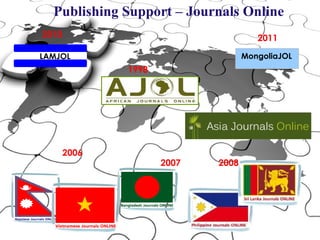
Local/indigenous publishing


                 654 scholarly journals
                 published in the south
                are available via ‘JOLs’


     Slide 40
• Websites for local journals to:
      – Increase global visibility
      – Increase editors capacity to improve journal quality
        and manage them online
      – Enable southern researchers to contribute to the
        global research community


• 1988 started with
• Now growing year on year…


Slide 41
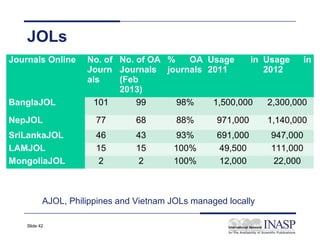
JOLs
Journals Online      No. of No. of OA %   OA Usage     in Usage    in
                     Journ Journals journals 2011         2012
                     als    (Feb
                            2013)
BanglaJOL              101      99      98%   1,500,000    2,300,000

NepJOL                 77        68       88%       971,000     1,140,000
SriLankaJOL            46        43       93%       691,000     947,000
LAMJOL                 15        15      100%        49,500     111,000
MongoliaJOL             2         2      100%        12,000      22,000


           AJOL, Philippines and Vietnam JOLs managed locally

    Slide 42
INASP &
• Make sure views from the south are represented and
  heard in OA discussions
• Signpost & provide training on OA resources
• Open access advocacy - OA champions & OA week
  competition
• AuthorAID – explore benefits of publishing OA
• Publishing Support: explore impact of OA on local
  journals (good and bad)
• Explore the APC conundrum

  Slide 43
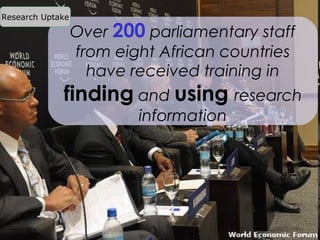
Research Uptake

                  Over 200 parliamentary staff
                  from eight African countries
                    have received training in
                finding and using research
                          information


     Slide 44
Evidence-Informed Policy Making
• EIPM (Evidence-Informed Policy Making) works
  to increase uptake of research in policy making.

• Key training topics include:
           –   Information literacy for policy makers
           –   Demystifying science
           –   Policy brief writing
           –   Summarising skills


Slide 45
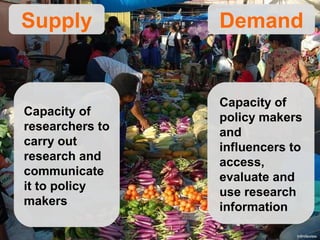
Supply           Demand


                 Capacity of
Capacity of      policy makers
researchers to   and
carry out        influencers to
research and     access,
communicate      evaluate and
it to policy     use research
makers           information

                              Infiniteview
Cooperation the bigger picture:

  “Some of the greatest challenges facing the
   world have a greater impact on developing
countries than the developed world and tackling
 them requires global effort and cooperation
by governments, international organisations
              and universities.”
              “Universities and development: global cooperation” Universities UK
http://www.universitiesuk.ac.uk/Publications/Documents/UniversitiesAndDevelopment20101011.
                                              pdf


     Slide 47
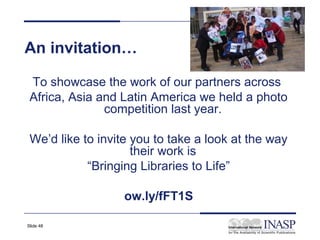
An invitation…

 To showcase the work of our partners across
 Africa, Asia and Latin America we held a photo
               competition last year.

 We’d like to invite you to take a look at the way
                     their work is
            “Bringing Libraries to Life”

                  ow.ly/fFT1S

Slide 48
Thank you for listening!

Lucy Browse          &    Kay Raseroka
lbrowse@inasp.info


@lucybrowse      @pubsfordev   @INASPinfo
@authoraid


www.inasp.info
Slide 49
2012 Statistics
• Over 80,000 visits to the website

• 6539 registrants (compared with 595 April 2009)

• Travel grants: 6 awarded to allow participants to
  present their research at international conferences
• 162 participants at workshops in Zambia, Ethiopia,
  Kenya and Sri Lanka
• 2 e-learning courses run for 75 learners

Slide 50
Registering for
• Most online AuthorAID content openly accessible

• By registering at site, also have chance to
   – Sign up for e-mail discussion list
   – Be notified when new blog posts appear
   – Seek a mentor or mentee or otherwise contact
     members of AuthorAID community

We would encourage you to register, share
 information via your networks and consider
 becoming a mentor!
Slide 51
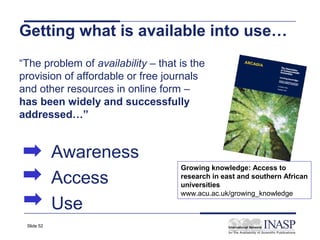
Getting what is available into use…
“The problem of availability – that is the
provision of affordable or free journals
and other resources in online form –
has been widely and successfully
addressed…”


            Awareness
                                    Growing knowledge: Access to
            Access                  research in east and southern African
                                    universities
                                    www.acu.ac.uk/growing_knowledge
            Use
 Slide 52
In practice this means
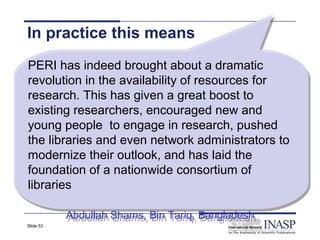
PERI has indeed brought about a dramatic
 PERI has indeed brought about a dramatic
revolution in the availability of resources for
 revolution in the availability of resources for
research. This has given a great boost to
 research. This has given a great boost to
existing researchers, encouraged new and
 existing researchers, encouraged new and
young people to engage in research, pushed
 young people to engage in research, pushed
the libraries and even network administrators to
 the libraries and even network administrators to
modernize their outlook, and has laid the
 modernize their outlook, and has laid the
foundation of a nationwide consortium of
 foundation of a nationwide consortium of
libraries
 libraries

           Abdullah Shams, Bin Tariq, Bangladesh
           Abdullah Shams, Bin Tariq, Bangladesh
Slide 53
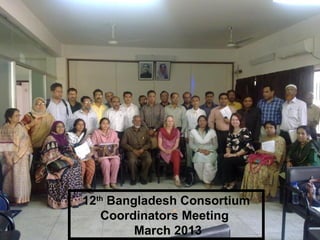
12th Bangladesh Consortium
              Coordinators Meeting
                    March 2013
Slide 54
Collaborations and partnerships
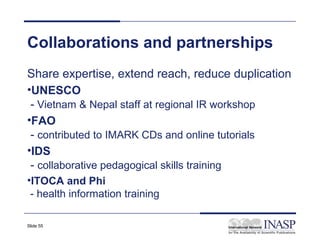
Share expertise, extend reach, reduce duplication
•UNESCO
 - Vietnam & Nepal staff at regional IR workshop
•FAO
 - contributed to IMARK CDs and online tutorials
•IDS
 - collaborative pedagogical skills training
•ITOCA and Phi
 - health information training

Slide 55
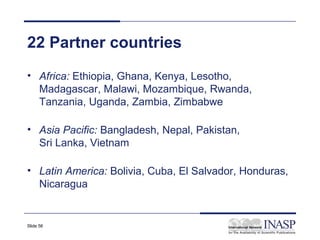
22 Partner countries
• Africa: Ethiopia, Ghana, Kenya, Lesotho,
  Madagascar, Malawi, Mozambique, Rwanda,
  Tanzania, Uganda, Zambia, Zimbabwe

• Asia Pacific: Bangladesh, Nepal, Pakistan,
  Sri Lanka, Vietnam

• Latin America: Bolivia, Cuba, El Salvador, Honduras,
  Nicaragua


Slide 56
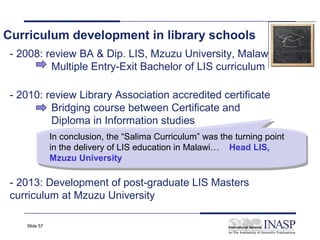
Curriculum development in library schools
 - 2008: review BA & Dip. LIS, Mzuzu University, Malawi
          Multiple Entry-Exit Bachelor of LIS curriculum

 - 2010: review Library Association accredited certificate
          Bridging course between Certificate and
          Diploma in Information studies
               In conclusion, the “Salima Curriculum” was the turning point
                In conclusion, the “Salima Curriculum” was the turning point
               in the delivery of LIS education in Malawi… Head LIS,
                in the delivery of LIS education in Malawi… Head LIS,
               Mzuzu University
                Mzuzu University

 - 2013: Development of post-graduate LIS Masters
 curriculum at Mzuzu University

    Slide 57
Publishing Support – Journals Online
       2010                                   2011

      LAMJOL                               MongoliaJOL
                      1998


              2006
                             2007   2008


Slide 58

2013 browse uksg

  • 1.
    Cooperation and collaborationto strengthen the global research cycle Kay Raseroka and Lucy Browse lbrowse@inasp.info www.inasp.info Slide 1
  • 2.
    The purpose ofHigher Education: “Higher education institutions have responsibility for equipping individuals with the knowledge and skills required for key positions in government, business, industry and professions. They produce new knowledge through research and can transfer, adapt and disseminate knowledge as well as being important institutions of civil society.” “Universities and development: global cooperation” Universities UK http://www.universitiesuk.ac.uk/Publications/Documents/UniversitiesAndDevelopment201 01011.pdf Slide 2
  • 3.
    What about HigherEducation institutions in developing countries? • 1960s and 70s – institutions of excellence, producing leading researchers • Years of neglect – 80s, 90s – pressure to expand, insufficient funding (government and donor) – quality plummeted – prospects for research severely damaged • 2000 onward – Universities slowly being rebuilt – Donors return to HE (influential World Bank publications) • 2010+ – Decade of investment, initiatives, programmes – 3 Slide Successes, but still a lot to be done
  • 4.
    Where we findourselves: • In the context of our continent: Often facing social, political and economic challenges The impact of the global recession yet to be fully realised •In the context of scholarly institutions: Historical legacy economically, structurally and institutionally •For the individual scholar: Pulled between the research requirements and the teaching requirements of his/her institution Skills gained overseas can atrophy without CPD support Slide 4
  • 5.
    Exploring the issues– “University Challenge” • Universities are complex – ‘fixing’ them isn’t easy. Financial constraints are significant but not the only problem… – Organisational constraints: structures, systems and university governance – Research management critical – funding and grant preparation – Good libraries – access to materials and information – Clear research agendas – Postgraduate training plans and proper research career structures – Incentives to do research – enabling an attractive research culture – Better data for planning and monitoring Slide 5
  • 6.
    Some contradictions: (1) • Developed world universities would claim to be using an a-historical ‘universal’ model BUT Where do developing country universities fit into the ‘game’ of ‘research rankings’ ? Slide 6
  • 7.
    Some contradictions: (2) • There is no issue about the basics of what makes for robust research BUT The context within which that research content is made available is very different in the developing world Slide 7
  • 8.
    Some contradictions: (3) • Research communication ‘infomediaries’ have largely achieved availability and quantity of content BUT • Access: i.e. usability, capability and usage are the continuing challenges Slide 8
  • 9.
    Some more contradictions:(4) • Technical access remains a huge challenge despite initiatives like Bandwidth Management and Optimisation (BMO) BUT • Although the Eastern / Western African sea board fibre optic cables are in place, landlocked countries (at least) will still be disadvantaged because of tax-seeking by coastal countries and/or by their own governments: i.e. passing on the cost levied on them to institutions Slide 9
  • 10.
    UbuntuNet Research &Education Network • The first network of its kind in Africa • Launched in November 2012 • The network will dramatically accelerate the development of the information society in Africa, providing advanced data communications infrastructure and enabling African researchers to collaborate more easily in advanced International Research projects • Video: http://www.africaconnect.ue/MediaCenter/Pages/Launch- Event-video.aspx Slide 10
  • 11.
    Steve Song Map– looking at 2014: Download speeds December 2011, journal article from UK-based publisher: 55 seconds at the University of Nairobi 2-4 minutes at two campuses of the University of Malawi in Lilongwe …but even with several attempts a user in Uganda (outside of Kampala) was unable to download the article at all. Slide 11
  • 12.
    And what forthe future? The partnerships, cooperation and collaboration that have been achieved across the global south and north are vital to strengthen research and our work. We must ensure that capacity, expertise and policies are embedded at a local level. This will include: •More southern voices included in debates around availability, access and use of research •More advocacy at Govt. level to help build and develop the vision of the WSIS knowledge societies Slide 12
  • 13.
    What are wealready seeing? A large, young, technologically hungry and increasingly media-clever cohort of up-and-coming researchers needs you to reach out to them Their aspirations are important in preparing for our collective future… Slide 13
  • 14.
    Partnerships building bridges •Digital Libraries - Green stone (digital library software) - International Network for the Availability of Scientific Publications (INASP) - Electronic Information for Libraries (eIFL) Project • DL support organisations - Greenstone support organisation for Africa (GSOA) • We now turn to the work of our partners - INASP Slide 14
  • 15.
    INASP facts andfigures… • Established in 1992 • 19 permanent staff • International Board of Trustees • Works in Africa, Asia and Latin America – 22 partner countries, over 100 eligible countries • Funded mainly by partner countries and European governments Slide 15
  • 16.
    Putting research atthe heart of development • Our aim is that our work is sustainable beyond our involvement • We cooperate with local people, institutions and organisations - supporting them to develop the capacity and relationships needed for greater global participation and partnerships • We co-design our work for the individual country infrastructure, HE policies and socio-economic situation. Slide 16
  • 17.
    Who is theINASP network? “Kindred” organisations Librarians at 1600 Over 6539 registered HEIs ICT professionals researchers, at HEIs, NRENs inc. 800 mentors Library consortia and NGOs 300+ HEI & Editors of over 675 50 academic parliamentary journals published in publishers/aggregators policy makers ‘South’ Slide 17
  • 18.
    Availability international research information indigenous journals – Journals Online Communication and Uptake Access Bandwidth Management into policy and by practitioners Library infrastructure Evidence Informed Policy Making Research System Creation Use support researchers information literacy AuthorAID promotion and advocacy Slide 18
  • 19.
    3,281,456 scholarly articles were accessed through the PERii programme in 2012 Availability Slide 19 Inju, Flikr
  • 20.
    INASP Research Availability •INASP negotiates free or proportionately priced access • Funding = “real-world” economic model: – Countries “own” their budget - transitioning from donor funding to self- funding – Consortia development and buy-in to collective purchase/cooperation are key – Countries select the resources they want (we respond to requests) • Publishers – commit to affordable sustainable prices – provide COUNTER compliant usage statistics – gain a new route for the dissemination of their materials and contribute to the strengthening of global research Slide 20
  • 21.
    Interdisciplinary resources: 2012 •50+ publishers and aggregators offering – 11,000 full text books – 31,476 full text journals – 23,072 abstracted journals – 82 databases – Document delivery from 20,000 journals through the British Library • List of free and Open Access resources • Cooperation and collaboration Slide 21
  • 22.
    The Importance of Advocacy www.pubs-for-dev.info
  • 23.
    Why PfD? Explore how to contribute beyond availability Editorial IT Tra Mar keting inin g Sal es A forum for information and discussion – for ALL publishers Increase understanding of the Share best practice, unique challenges developments, developing country libraries, ideas, researchers and publishers experience find information, reports and news
  • 24.
    Annual Conference in Action:Case Studies •Sharing best practice •Promoting success stories •Offering guidance •Providing ideas Newsletter Sign-up at: http://eepurl.com/cBoao
  • 25.
    Core discussions sofar: • low-bandwidth environments: supporting and encouraging resource interface design to increase access; • supporting developing country researchers: encouraging greater visibility, inclusion and contribution; • raising resource awareness: producing low- resolution promotional materials. Use networks!
  • 26.
    Access in low-bandwidth environments – what can be done? Launched in 2012: INASP Bandwidth Management and Optimisation • Works with institutions to reserve scarce bandwidth for core institutional purposes • Encourages strengthening and formation of National Research and Education networks
  • 27.
    Bandwidth matters… As JamesLush of the Biochemical Society, blogged following a recent bandwidth session: “Improving access makes an enormous difference to the professional lives of individuals; how they work and think, their research impacts and their reputation – and the reputation of their environment. For researchers in developing countries to succeed in research on the global stage, the challenges are many. But creating usable interfaces seems a simple place to start” (http://bit.ly/FPOZpL).
  • 28.
    Access & Use It will enable me to encourage use of e-resources in my teaching at graduate and undergraduate levels. Workshop participant, Zimbabwe Slide 28
  • 29.
    Unique Institutions Registered •Number of eligible institutions from 1,622 in 2012 partner countries on the online registration system • More institutions register each year as INASP’s activity increases – the “Ripple Effect” Slide 29
  • 30.
    Developing library infrastructure •Using OS solutions for; – Library automation / resource discovery tools – Digitisation and institutional repositories – e.g. KOHA, VuFind, Dspace, Drupal 2010 Institutional repository training in Sri Lanka > 8 new institutional repositories e.g. University of Moratuwa: all 1650+ dissertations > federated search developed at national level Slide 30
  • 31.
    Training & Capacitybuilding… • Training the trainer & pedagogy skills • Marketing and promotion of e-resources • Monitoring & evaluating e-resource usage • Working together to support research: librarians + researchers / ICT staff • Library marketing and advocacy • Library school curriculum development • Consortium strengthening activities • Licensing and negotiation skills Slide 31
  • 32.
    How we arebuilding skills and capacity… Cascading training methodology, e.g. Zimbabwe: 2008: Zimbabwean Librarian at Cape Town Info Literacy workshop 2009: Train-the-trainer ‘Info Literacy’ workshop for consortium members 2010: Info Literacy training delivered to users in 12 institutions 2011 Train-the-trainer ‘Info Literacy into curriculum’ workshop Slide 32
  • 33.
    2010: Uganda consortiumreview workshop - lack of capacity; uncommitted members 2011: Strategic Planning workshop - 5 functional committees; strategy & work plan 9 new institutions joined CUUL Consortium Administrative Assistant hired “Such developments have increased the capacity of the consortium and its membership to undertake bigger projects and sustain them” Slide 33
  • 34.
    From to “LfD”? What might INASP Librarians for Development look like? •Community of practice in Moodle: Bringing librarians together South and North •Starting small – contribute ideas, designed to increase resource awareness, promo ideas etc. •Licensing and negotiations – offer advice and input as INASP partners increase their expertise
  • 35.
    Are there schemesat your Uni? • http://www2.le.ac.uk/institution/gondar-information-hub • http://medicine.st-andrews.ac.uk/malawi/ • For other examples see: universities UK Let us know what you’re doing!
  • 36.
    Other ways forlibrarians to get involved in information for development: • Beyond Access: Libraries Powering Development – IFLA/EIFL/Gates looking at the role of public & community libraries: http://www.beyondaccess.net • Libraries and Development: IFLA pages launched in February, so a growing resource (includes Building Strong LA programme info.): http://bit.ly/XXqUYG Familiarise yourself with resources available to returning scholars!
  • 37.
    Creation I am fortunate enough to have good mentors who helped me to publish eight papers in national level journals AuthorAID discussion list participant. Slide 37
  • 38.
    - An Overview •A global research community for researchers in developing countries with over 6,500 members • Help for researchers in the publishing process • Main components – Mentoring by volunteers - Workshops - Preparing poster and oral presentations - Writing grant proposals – Online training delivered via moodle Slide 38
  • 39.
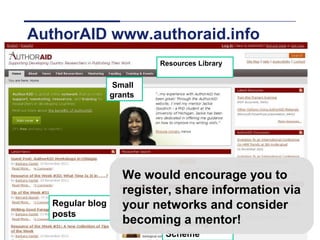
    AuthorAID www.authoraid.info Resources Library Small grants We would encourage you to register, share information via Regular blog your networks and consider posts Slide 39 becoming a mentor! Mentoring Scheme
  • 40.
    Local/indigenous publishing 654 scholarly journals published in the south are available via ‘JOLs’ Slide 40
  • 41.
    • Websites forlocal journals to: – Increase global visibility – Increase editors capacity to improve journal quality and manage them online – Enable southern researchers to contribute to the global research community • 1988 started with • Now growing year on year… Slide 41
  • 42.
    JOLs Journals Online No. of No. of OA % OA Usage in Usage in Journ Journals journals 2011 2012 als (Feb 2013) BanglaJOL 101 99 98% 1,500,000 2,300,000 NepJOL 77 68 88% 971,000 1,140,000 SriLankaJOL 46 43 93% 691,000 947,000 LAMJOL 15 15 100% 49,500 111,000 MongoliaJOL 2 2 100% 12,000 22,000 AJOL, Philippines and Vietnam JOLs managed locally Slide 42
  • 43.
    INASP & • Makesure views from the south are represented and heard in OA discussions • Signpost & provide training on OA resources • Open access advocacy - OA champions & OA week competition • AuthorAID – explore benefits of publishing OA • Publishing Support: explore impact of OA on local journals (good and bad) • Explore the APC conundrum Slide 43
  • 44.
    Research Uptake Over 200 parliamentary staff from eight African countries have received training in finding and using research information Slide 44
  • 45.
    Evidence-Informed Policy Making •EIPM (Evidence-Informed Policy Making) works to increase uptake of research in policy making. • Key training topics include: – Information literacy for policy makers – Demystifying science – Policy brief writing – Summarising skills Slide 45
  • 46.
    Supply Demand Capacity of Capacity of policy makers researchers to and carry out influencers to research and access, communicate evaluate and it to policy use research makers information Infiniteview
  • 47.
    Cooperation the biggerpicture: “Some of the greatest challenges facing the world have a greater impact on developing countries than the developed world and tackling them requires global effort and cooperation by governments, international organisations and universities.” “Universities and development: global cooperation” Universities UK http://www.universitiesuk.ac.uk/Publications/Documents/UniversitiesAndDevelopment20101011. pdf Slide 47
  • 48.
    An invitation… Toshowcase the work of our partners across Africa, Asia and Latin America we held a photo competition last year. We’d like to invite you to take a look at the way their work is “Bringing Libraries to Life” ow.ly/fFT1S Slide 48
  • 49.
    Thank you forlistening! Lucy Browse & Kay Raseroka lbrowse@inasp.info @lucybrowse @pubsfordev @INASPinfo @authoraid www.inasp.info Slide 49
  • 50.
    2012 Statistics • Over80,000 visits to the website • 6539 registrants (compared with 595 April 2009) • Travel grants: 6 awarded to allow participants to present their research at international conferences • 162 participants at workshops in Zambia, Ethiopia, Kenya and Sri Lanka • 2 e-learning courses run for 75 learners Slide 50
  • 51.
    Registering for • Mostonline AuthorAID content openly accessible • By registering at site, also have chance to – Sign up for e-mail discussion list – Be notified when new blog posts appear – Seek a mentor or mentee or otherwise contact members of AuthorAID community We would encourage you to register, share information via your networks and consider becoming a mentor! Slide 51
  • 52.
    Getting what isavailable into use… “The problem of availability – that is the provision of affordable or free journals and other resources in online form – has been widely and successfully addressed…” Awareness Growing knowledge: Access to Access research in east and southern African universities www.acu.ac.uk/growing_knowledge Use Slide 52
  • 53.
    In practice thismeans PERI has indeed brought about a dramatic PERI has indeed brought about a dramatic revolution in the availability of resources for revolution in the availability of resources for research. This has given a great boost to research. This has given a great boost to existing researchers, encouraged new and existing researchers, encouraged new and young people to engage in research, pushed young people to engage in research, pushed the libraries and even network administrators to the libraries and even network administrators to modernize their outlook, and has laid the modernize their outlook, and has laid the foundation of a nationwide consortium of foundation of a nationwide consortium of libraries libraries Abdullah Shams, Bin Tariq, Bangladesh Abdullah Shams, Bin Tariq, Bangladesh Slide 53
  • 54.
    12th Bangladesh Consortium Coordinators Meeting March 2013 Slide 54
  • 55.
    Collaborations and partnerships Shareexpertise, extend reach, reduce duplication •UNESCO - Vietnam & Nepal staff at regional IR workshop •FAO - contributed to IMARK CDs and online tutorials •IDS - collaborative pedagogical skills training •ITOCA and Phi - health information training Slide 55
  • 56.
    22 Partner countries •Africa: Ethiopia, Ghana, Kenya, Lesotho, Madagascar, Malawi, Mozambique, Rwanda, Tanzania, Uganda, Zambia, Zimbabwe • Asia Pacific: Bangladesh, Nepal, Pakistan, Sri Lanka, Vietnam • Latin America: Bolivia, Cuba, El Salvador, Honduras, Nicaragua Slide 56
  • 57.
    Curriculum development inlibrary schools - 2008: review BA & Dip. LIS, Mzuzu University, Malawi Multiple Entry-Exit Bachelor of LIS curriculum - 2010: review Library Association accredited certificate Bridging course between Certificate and Diploma in Information studies In conclusion, the “Salima Curriculum” was the turning point In conclusion, the “Salima Curriculum” was the turning point in the delivery of LIS education in Malawi… Head LIS, in the delivery of LIS education in Malawi… Head LIS, Mzuzu University Mzuzu University - 2013: Development of post-graduate LIS Masters curriculum at Mzuzu University Slide 57
  • 58.
    Publishing Support –Journals Online 2010 2011 LAMJOL MongoliaJOL 1998 2006 2007 2008 Slide 58

Editor's Notes

  • #38 Creation – research leads to more research so AuthorAID provides an online support network to assist developing world scientists to get their research written up and published . It also offers training courses in writing skills for scientists in developing world.
  • #45 Use - If research is to impact on the lives of people living in poor countries, then policy makers need to be able to access, evaluate and use research evidence in decision making. The EIPM programme works with partners to build these capacities within local policy making institutions.