Social Innovation:
the impact of Higher Education,
how can it be measured and
monitored?
Montréal 2015
Sijbolt Noorda
President Magna Charta Observatory
• The Magna Charta Observatory of Fundamental
University Values and Rights is a non-profit
organisation based on the Magna Charta
declaration of 1988, founded by the University of
Bologna and the Council of European rectors,
now associated with EUA and IAU
• from its beginnings it wished to become a
worldwide program and project
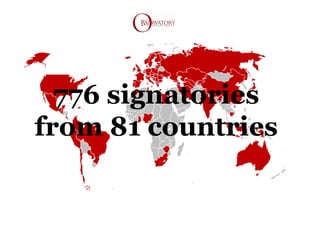
776 signatories
from 81 countries
‘ The university is an autonomous institution at the heart of
societies differently organized because
of geography and historical heritage; it produces, examines,
appraises and hands down culture by research and teaching.
To meet the needs of the world around it, its research and
teaching must be morally and intellectually independent of
all political authority and economic power.’
[from Magna Charta Universitatum]
what shall we do in this workshop?
• we’ll talk and think about the impact of HEIs on
social innovation
• and the ways in which this is being measured
and monitored
• at both ends of the line, in society as well as in
HEIs
• higher education not as end in itself, but rather as
part of a chain of experiences and developments
in society
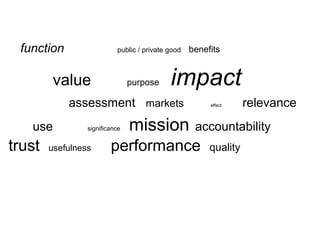
function public / private good benefits
value purpose impact
assessment markets effect relevance
use significance mission accountability
trust usefulness performance quality
what’s the concept?
• impact has become a popular concept to express the
value of higher education and research for its users.
• It is not a new concept. Although the term “impact” is a
relative newcomer to Higher Education policy speak, the
realities it refers to are perennial. Terminology may vary
(value, purpose, effect, relevance) the issue is a
constant.
• And rightly so. Universities are no l’art pour l’art
workshops and they never were meant to be. Even at
times when they served society through elites.
what’s new?
• the novelty is not in the issue but in the realities and
attitudes
• responsive universities (or rather: any HEI) must
constantly read their map and re-position themselves to
optimize their value
• yet, ‘value creation’ cannot be a one-way-street; the
product of HE is way too complicated for just a delivery
mode
• so society – businesses as well as not-for-profits,
government as well as students – should get involved
rather than just receive (in the customer mode)
current focus
• In the case of social innovation higher
education’s impact happens along a broad
variety of lines and programs
• via teaching & learning as well as
research & valorisation
• by way of attitudes & culture as well as
concrete projects & solutions
the challenge of measuring and
monitoring
• To know what we’re doing and what works
and what doesn’t we must monitor impact
and be accountable
• How to do justice to it in qualitative terms
as well as in quantitative terms?
if not quantifiable it doesn’t count
• admissions & recruitments
• ranking lists & reputation scores
• performance indicators
• bibliometrics, including impact scores
• financial figures
• awards & grants
• patents & licenses, et cetera
the qualitative value of multiple virtues
• public trust  reliable, civil, undisguised [overall
impression]
• student satisfaction  inspiring, competent, well-suited
[educational experience]
• partner confidence  sustainable, dedicated, efficient
[academic and business performance]
 impact? not uncomplicated
•  what a university must do to make a strong
impression on its users, partners, regulators
and/or funders is not a single and simple issue
• but rather a mix of accountability, market
performance and trust generation by a broad
variety of activities and qualities, involving
many actors and institutes, requiring shared
values and common attitudes & professional
achievements all over the place
what is going on in society that
(re-)defines the role of HEIs?
• growing complexities & social dynamics
• trust crisis & quest for integrity,
transparency, openness and
accountability
• grand challenges requiring new ways of
multidisciplinary thinking
• globalization, culture blending &
parochialism
• increasing competition & volatility
• et cetera
what shall we do in this workshop?
• we’ll talk and think about the impact of HEIs on
social innovation
• and the ways in which this is being measured
and monitored
• at both ends of the line, in society as well as in
HEIs
• higher education not as end in itself, but rather as
part of a chain of experiences and developments
in society

Sijbolt noorda

  • 1.
    Social Innovation: the impactof Higher Education, how can it be measured and monitored? Montréal 2015 Sijbolt Noorda President Magna Charta Observatory
  • 2.
    • The MagnaCharta Observatory of Fundamental University Values and Rights is a non-profit organisation based on the Magna Charta declaration of 1988, founded by the University of Bologna and the Council of European rectors, now associated with EUA and IAU • from its beginnings it wished to become a worldwide program and project
  • 3.
  • 4.
    ‘ The universityis an autonomous institution at the heart of societies differently organized because of geography and historical heritage; it produces, examines, appraises and hands down culture by research and teaching. To meet the needs of the world around it, its research and teaching must be morally and intellectually independent of all political authority and economic power.’ [from Magna Charta Universitatum]
  • 5.
    what shall wedo in this workshop? • we’ll talk and think about the impact of HEIs on social innovation • and the ways in which this is being measured and monitored • at both ends of the line, in society as well as in HEIs • higher education not as end in itself, but rather as part of a chain of experiences and developments in society
  • 6.
    function public /private good benefits value purpose impact assessment markets effect relevance use significance mission accountability trust usefulness performance quality
  • 11.
    what’s the concept? •impact has become a popular concept to express the value of higher education and research for its users. • It is not a new concept. Although the term “impact” is a relative newcomer to Higher Education policy speak, the realities it refers to are perennial. Terminology may vary (value, purpose, effect, relevance) the issue is a constant. • And rightly so. Universities are no l’art pour l’art workshops and they never were meant to be. Even at times when they served society through elites.
  • 12.
    what’s new? • thenovelty is not in the issue but in the realities and attitudes • responsive universities (or rather: any HEI) must constantly read their map and re-position themselves to optimize their value • yet, ‘value creation’ cannot be a one-way-street; the product of HE is way too complicated for just a delivery mode • so society – businesses as well as not-for-profits, government as well as students – should get involved rather than just receive (in the customer mode)
  • 13.
    current focus • Inthe case of social innovation higher education’s impact happens along a broad variety of lines and programs • via teaching & learning as well as research & valorisation • by way of attitudes & culture as well as concrete projects & solutions
  • 14.
    the challenge ofmeasuring and monitoring • To know what we’re doing and what works and what doesn’t we must monitor impact and be accountable • How to do justice to it in qualitative terms as well as in quantitative terms?
  • 15.
    if not quantifiableit doesn’t count • admissions & recruitments • ranking lists & reputation scores • performance indicators • bibliometrics, including impact scores • financial figures • awards & grants • patents & licenses, et cetera
  • 16.
    the qualitative valueof multiple virtues • public trust  reliable, civil, undisguised [overall impression] • student satisfaction  inspiring, competent, well-suited [educational experience] • partner confidence  sustainable, dedicated, efficient [academic and business performance]
  • 17.
     impact? notuncomplicated •  what a university must do to make a strong impression on its users, partners, regulators and/or funders is not a single and simple issue • but rather a mix of accountability, market performance and trust generation by a broad variety of activities and qualities, involving many actors and institutes, requiring shared values and common attitudes & professional achievements all over the place
  • 18.
    what is goingon in society that (re-)defines the role of HEIs? • growing complexities & social dynamics • trust crisis & quest for integrity, transparency, openness and accountability • grand challenges requiring new ways of multidisciplinary thinking • globalization, culture blending & parochialism • increasing competition & volatility • et cetera
  • 19.
    what shall wedo in this workshop? • we’ll talk and think about the impact of HEIs on social innovation • and the ways in which this is being measured and monitored • at both ends of the line, in society as well as in HEIs • higher education not as end in itself, but rather as part of a chain of experiences and developments in society

Editor's Notes

  • #4 <number>