Heila Lotz-Sisitka, Rhodes University, South Africa
IAU Conference, Iquitos, 19-21 March 2014
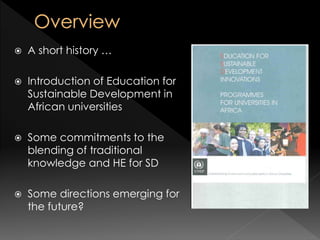
 A short history …
 Introduction of Education for
Sustainable Development in
African universities
 Some commitments to the
blending of traditional
knowledge and HE for SD
 Some directions emerging for
the future?
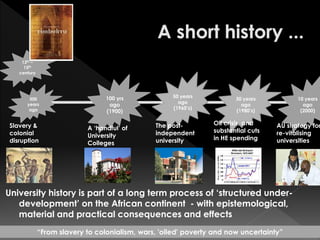
University history is part of a long term process of ‘structured under-
development’ on the African continent - with epistemological,
material and practical consequences and effects
13th –
15th
century
500
years
ago
100 yrs
ago
(1900)
50 years
ago
(1960’s)
30 years
ago
(1980’s)
10 years
ago
(2000)
“From slavery to colonialism, wars, 'oiled' poverty and now uncertainty”
Slavery &
colonial
disruption
A ‘handful’ of
University
Colleges
The post-
independent
university
AU strategy for
re-vitalising
universities
Oil crisis, and
substantial cuts
in HE spending
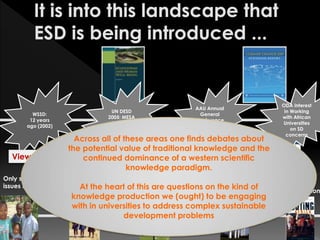
WSSD:
12 years
ago (2002)
UN DESD
2005: MESA
/ AFRITEIS
(networks)
ODA interest
in Working
with African
Universities
on SD
concerns
AAU Annual
General
Conference
on HE and
SD - 2009
Only social
issues matter
SD / ESD makes
education context
and community
relevant
SD/ESD is about
‘green economy’:
Agricultural
revolution
SD / ESD is
about a low
carbon future &
new technology
SD/ ESD is a
neo-liberal
invention /
appropriation
Views of SD emerging in African universities
Across all of these areas one finds debates about
the potential value of traditional knowledge and the
continued dominance of a western scientific
knowledge paradigm.
At the heart of this are questions on the kind of
knowledge production we (ought) to be engaging
with in universities to address complex sustainable
development problems
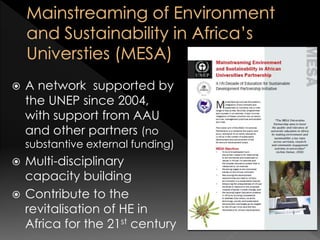
 A network supported by
the UNEP since 2004,
with support from AAU
and other partners (no
substantive external funding)
 Multi-disciplinary
capacity building
 Contribute to the
revitalisation of HE in
Africa for the 21st century
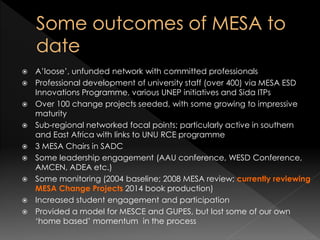
 A’loose’, unfunded network with committed professionals
 Professional development of university staff (over 400) via MESA ESD
Innovations Programme, various UNEP initiatives and Sida ITPs
 Over 100 change projects seeded, with some growing to impressive
maturity
 Sub-regional networked focal points; particularly active in southern
and East Africa with links to UNU RCE programme
 3 MESA Chairs in SADC
 Some leadership engagement (AAU conference, WESD Conference,
AMCEN, ADEA etc.)
 Some monitoring (2004 baseline; 2008 MESA review; currently reviewing
MESA Change Projects 2014 book production)
 Increased student engagement and participation
 Provided a model for MESCE and GUPES, but lost some of our own
‘home based’ momentum in the process
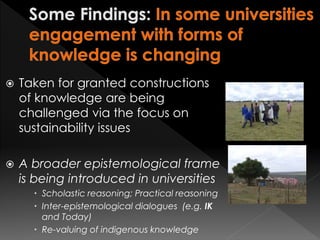
 Taken for granted constructions
of knowledge are being
challenged via the focus on
sustainability issues
 A broader epistemological frame
is being introduced in universities
 Scholastic reasoning; Practical reasoning
 Inter-epistemological dialogues (e.g. IK
and Today)
 Re-valuing of indigenous knowledge
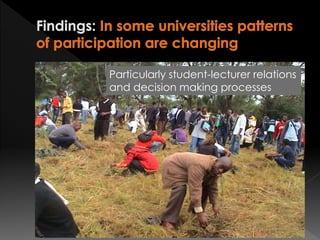
Particularly student-lecturer relations
and decision making processes
10
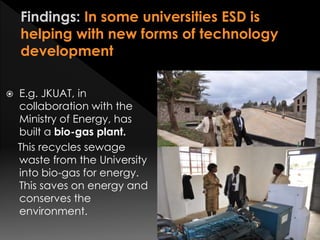
 E.g. JKUAT, in
collaboration with the
Ministry of Energy, has
built a bio-gas plant.
This recycles sewage
waste from the University
into bio-gas for energy.
This saves on energy and
conserves the
environment.
Findings: In some universities ESD is
helping with new forms of technology
development
The Kigali Institute of Science and
Technology (KIST), through its Centre for
Innovations and Technology Transfer
(CITT) has developed biogas
technology and installed large-scale
biogas plants in institutions such as
prisons and schools in Rwanda since the
year 2002 to treat sanitation waste for
generating biogas for cooking and
protect the environment.
 Through its training programme
involving over 500 people, CITT have
started the development of private
biogas companies in Rwanda
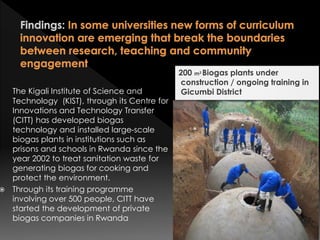
200 m3 Biogas plants under
construction / ongoing training in
Gicumbi District
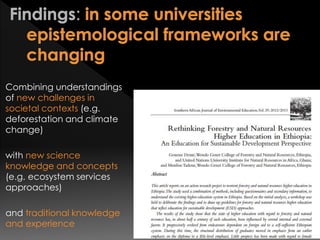
Combining understandings
of new challenges in
societal contexts (e.g.
deforestation and climate
change)
with new science
knowledge and concepts
(e.g. ecosystem services
approaches)
and traditional knowledge
and experience
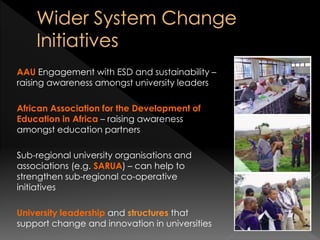
AAU Engagement with ESD and sustainability –
raising awareness amongst university leaders
African Association for the Development of
Education in Africa – raising awareness
amongst education partners
Sub-regional university organisations and
associations (e.g. SARUA) – can help to
strengthen sub-regional co-operative
initiatives
University leadership and structures that
support change and innovation in universities
“A cross-cutting knowledge and research
gap highlighted [across 12 countries]
was the lack of valuing, studying and
understanding local and indigenous
knowledge” …
“Such research must be undertaken
within a knowledge co-production
approach. This requires bringing
different contributions together in relation
to each other in the knowledge
production process.”
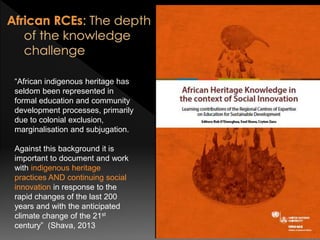
“African indigenous heritage has
seldom been represented in
formal education and community
development processes, primarily
due to colonial exclusion,
marginalisation and subjugation.
Against this background it is
important to document and work
with indigenous heritage
practices AND continuing social
innovation in response to the
rapid changes of the last 200
years and with the anticipated
climate change of the 21st
century” (Shava, 2013
The Association for the Development of Education in
Africa says:
“… a revolution in teaching and learning is
needed [for HE to address SD challenges] in the
sense that teachers need to develop their
approach to the curriculum in cooperation with,
and with the involvement of the stakeholders, in
order to provide access to the knowledge and
skills that ensure inclusion and integration into
everyday life, including as citizens and in the
workplace”. (ADEA 2012).
Is there a pattern
emerging at wider
systemic level?
 Relational – between different forms of knowledge and
between society, economy and environmental objectives
 Dialectic and change oriented – between tradition and new
forms of innovation needed for a sustainable and socially just
life
 Political and ethical – recognition and validation of what has
been marginalised, and what is in the interest of ‘the
common good’
 Inter- and transdisciplinary - the single discipline is not
adequate on its own and new methodologies of teaching
and research are needed
 Transformative – learning must linked contemporary
concerns, be transformative and contribute to social
changes
Heila Lotz Sisitka

Heila Lotz Sisitka

  • 1.
    Heila Lotz-Sisitka, RhodesUniversity, South Africa IAU Conference, Iquitos, 19-21 March 2014
  • 2.
     A shorthistory …  Introduction of Education for Sustainable Development in African universities  Some commitments to the blending of traditional knowledge and HE for SD  Some directions emerging for the future?
  • 3.
    University history ispart of a long term process of ‘structured under- development’ on the African continent - with epistemological, material and practical consequences and effects 13th – 15th century 500 years ago 100 yrs ago (1900) 50 years ago (1960’s) 30 years ago (1980’s) 10 years ago (2000) “From slavery to colonialism, wars, 'oiled' poverty and now uncertainty” Slavery & colonial disruption A ‘handful’ of University Colleges The post- independent university AU strategy for re-vitalising universities Oil crisis, and substantial cuts in HE spending
  • 4.
    WSSD: 12 years ago (2002) UNDESD 2005: MESA / AFRITEIS (networks) ODA interest in Working with African Universities on SD concerns AAU Annual General Conference on HE and SD - 2009 Only social issues matter SD / ESD makes education context and community relevant SD/ESD is about ‘green economy’: Agricultural revolution SD / ESD is about a low carbon future & new technology SD/ ESD is a neo-liberal invention / appropriation Views of SD emerging in African universities Across all of these areas one finds debates about the potential value of traditional knowledge and the continued dominance of a western scientific knowledge paradigm. At the heart of this are questions on the kind of knowledge production we (ought) to be engaging with in universities to address complex sustainable development problems
  • 5.
     A networksupported by the UNEP since 2004, with support from AAU and other partners (no substantive external funding)  Multi-disciplinary capacity building  Contribute to the revitalisation of HE in Africa for the 21st century
  • 6.
     A’loose’, unfundednetwork with committed professionals  Professional development of university staff (over 400) via MESA ESD Innovations Programme, various UNEP initiatives and Sida ITPs  Over 100 change projects seeded, with some growing to impressive maturity  Sub-regional networked focal points; particularly active in southern and East Africa with links to UNU RCE programme  3 MESA Chairs in SADC  Some leadership engagement (AAU conference, WESD Conference, AMCEN, ADEA etc.)  Some monitoring (2004 baseline; 2008 MESA review; currently reviewing MESA Change Projects 2014 book production)  Increased student engagement and participation  Provided a model for MESCE and GUPES, but lost some of our own ‘home based’ momentum in the process
  • 8.
     Taken forgranted constructions of knowledge are being challenged via the focus on sustainability issues  A broader epistemological frame is being introduced in universities  Scholastic reasoning; Practical reasoning  Inter-epistemological dialogues (e.g. IK and Today)  Re-valuing of indigenous knowledge
  • 9.
  • 10.
    10  E.g. JKUAT,in collaboration with the Ministry of Energy, has built a bio-gas plant. This recycles sewage waste from the University into bio-gas for energy. This saves on energy and conserves the environment. Findings: In some universities ESD is helping with new forms of technology development
  • 11.
    The Kigali Instituteof Science and Technology (KIST), through its Centre for Innovations and Technology Transfer (CITT) has developed biogas technology and installed large-scale biogas plants in institutions such as prisons and schools in Rwanda since the year 2002 to treat sanitation waste for generating biogas for cooking and protect the environment.  Through its training programme involving over 500 people, CITT have started the development of private biogas companies in Rwanda 200 m3 Biogas plants under construction / ongoing training in Gicumbi District
  • 12.
    Combining understandings of newchallenges in societal contexts (e.g. deforestation and climate change) with new science knowledge and concepts (e.g. ecosystem services approaches) and traditional knowledge and experience
  • 14.
    AAU Engagement withESD and sustainability – raising awareness amongst university leaders African Association for the Development of Education in Africa – raising awareness amongst education partners Sub-regional university organisations and associations (e.g. SARUA) – can help to strengthen sub-regional co-operative initiatives University leadership and structures that support change and innovation in universities
  • 15.
    “A cross-cutting knowledgeand research gap highlighted [across 12 countries] was the lack of valuing, studying and understanding local and indigenous knowledge” … “Such research must be undertaken within a knowledge co-production approach. This requires bringing different contributions together in relation to each other in the knowledge production process.”
  • 16.
    “African indigenous heritagehas seldom been represented in formal education and community development processes, primarily due to colonial exclusion, marginalisation and subjugation. Against this background it is important to document and work with indigenous heritage practices AND continuing social innovation in response to the rapid changes of the last 200 years and with the anticipated climate change of the 21st century” (Shava, 2013
  • 17.
    The Association forthe Development of Education in Africa says: “… a revolution in teaching and learning is needed [for HE to address SD challenges] in the sense that teachers need to develop their approach to the curriculum in cooperation with, and with the involvement of the stakeholders, in order to provide access to the knowledge and skills that ensure inclusion and integration into everyday life, including as citizens and in the workplace”. (ADEA 2012).
  • 18.
    Is there apattern emerging at wider systemic level?
  • 19.
     Relational –between different forms of knowledge and between society, economy and environmental objectives  Dialectic and change oriented – between tradition and new forms of innovation needed for a sustainable and socially just life  Political and ethical – recognition and validation of what has been marginalised, and what is in the interest of ‘the common good’  Inter- and transdisciplinary - the single discipline is not adequate on its own and new methodologies of teaching and research are needed  Transformative – learning must linked contemporary concerns, be transformative and contribute to social changes