Universities as engines
for the development of
their regions:

Lessons from the OECD work
IAU conference
Utrecht,17 July 2008

Jaana Puukka, OECD/IMHE
Francisco Marmolejo, CONAHEC
Contents

• OECD reviews of HE in regional development

• How to mobilise higher education for their regions:
  Good practice examples

• Barriers to Engagement

• Pointers for the future: for government, regions and
  universities
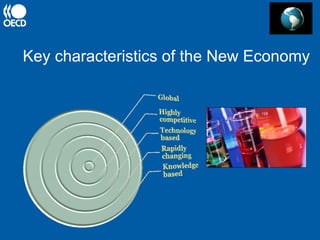
Key characteristics of the New Economy
With globalisation, the comparative
advantage of regions that can create
 the best conditions for growth and
     development is increasing.

 …High technology companies, once tied
  to their locations, can now move their
  production to anywhere in the world.

 … But to stay competitive, key parts of their
operations need to be based in knowledge and
       innovation-intensive regions …..
To Be Globally Competitive Countries
    Need to Invest in their Innovation
 Systems and human capital development

 not only at the national, but also regional
                    level


    … Universities and other higher
education institutions can play a key role
  in Regional Innovation Systems and
     Human Capital Formation…..
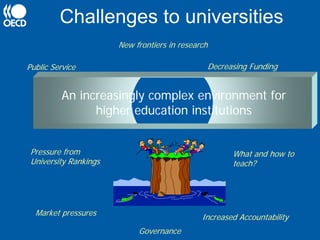
Challenges to universities
                       New frontiers in research

Public Service                                 Decreasing Funding


          An increasingly complex environment for
                higher education institutions


 Pressure from                                        What and how to
 University Rankings                                  teach?


  Market pressures
                                              Increased Accountability
                            Governance
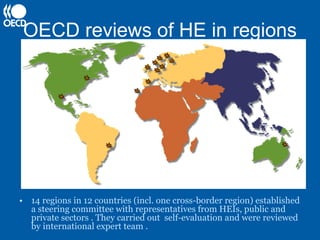
OECD reviews of HE in regions


• 14 regions in 12 countries (incl. one cross-border region) established
  a steering committee with representatives from HEIs, public and
  private sectors . They carried out self-evaluation and were reviewed
  by international expert team .
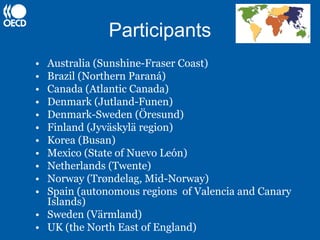
Participants
• Australia (Sunshine-Fraser Coast)
• Brazil (Northern Paraná)
• Canada (Atlantic Canada)
• Denmark (Jutland-Funen)
• Denmark-Sweden (Öresund)
• Finland (Jyväskylä region)
• Korea (Busan)
• Mexico (State of Nuevo León)
• Netherlands (Twente)
• Norway (Trøndelag, Mid-Norway)
• Spain (autonomous regions of Valencia and Canary
  Islands)
• Sweden (Värmland)
• UK (the North East of England)
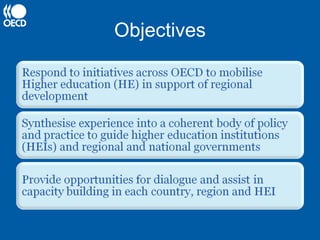
Objectives
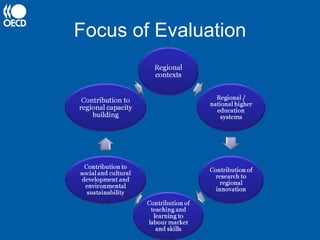
Focus of Evaluation
Diversity of Policy Environments
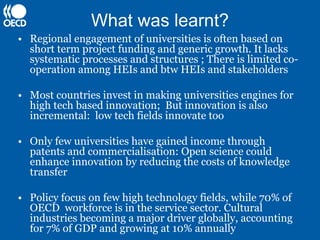
What was learnt?
• Regional engagement of universities is often based on
  short term project funding and generic growth. It lacks
  systematic processes and structures ; There is limited co-
  operation among HEIs and btw HEIs and stakeholders

• Most countries invest in making universities engines for
  high tech based innovation; But innovation is also
  incremental: low tech fields innovate too

• Only few universities have gained income through
  patents and commercialisation: Open science could
  enhance innovation by reducing the costs of knowledge
  transfer

• Policy focus on few high technology fields, while 70% of
  OECD workforce is in the service sector. Cultural
  industries becoming a major driver globally, accounting
  for 7% of GDP and growing at 10% annually
…building on existing competitive advantage can make a
                      difference…


      In Castellon, Valencia, Universidad Jaume I is
       recognised as a world leader R&D in the tile
                         industry.

         It has helped to transform the region’s
       traditional industry. The growth is built on
      technology transfer, spin-offs and upgrading
                 of existing technologies.

      – Today, Valencia is a global leader in the tiles
                  and ceramics industry.

                         Source: the Valencia Region SER
…Localising the learning process can be an effective way
 to engage students into “knowledge transfer on legs”


     In Aalborg University, Denmark, up to 50%
     of the study work consists of problem-
     oriented project work: students work in
     teams to solve problems which have been
     identified in co-operation with firms, public
     organisations and other institutions.

     At any one time there are 2000-3000
     ongoing projects that ensure the
     university’s engagement with the
     surrounding society.
                    Source: the Jutland-Funen SER
In Central Finland, Jyväskylä University of Applied
           Sciences has helped to rehabilitate 800 long term
          unemployed back to working life with a wide range of
            physical and social rehabilitation measures, partly
             delivered through the student training centre.
                      Source: The Jyväskylä region SER


    In the North East of
  England, the 5 HEIs use          In Mexico, all university
sports as a means to widen        students are obliged to do
   access to HE, to raise         480 hours community work.
aspirations and to enhance         In Monterrey University
 social cohesion within the        Social Service is geared
   excluded communities.            towards addressing the
 Source: the NE England SER        needs of the community.
                                   Source: the Nuevo Leon SER
Systematic Approach to Industry
…Creating a one-stop-shop for industry contacts


     In the North East of England, the 5 HEIs have
    set up Knowledge House to help companies access
    university skills, expertise and specialist services.
     KH offers expert solutions for developing ideas
        and solving problems through collaboration,
              consultancy, training and R&D.

    KH receives 1000 enquiries from client companies
     and delivers around 200 client contracts on an
    annual basis. Business growth is 25%. The cradle-
     to-grave service stretches from the receipt of
        enquiries to delivery and post-completion
                        evaluation.
                          Source: the NE England SER
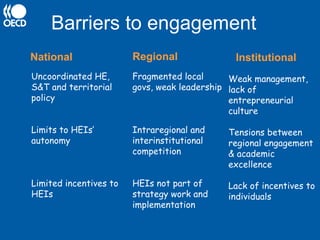
Barriers to engagement
National                Regional              Institutional
Uncoordinated HE,       Fragmented local      Weak management,
S&T and territorial     govs, weak leadership lack of
policy                                        entrepreneurial
                                              culture

Limits to HEIs’         Intraregional and    Tensions between
autonomy                interinstitutional   regional engagement
                        competition          & academic
                                             excellence

Limited incentives to   HEIs not part of     Lack of incentives to
HEIs                    strategy work and    individuals
                        implementation
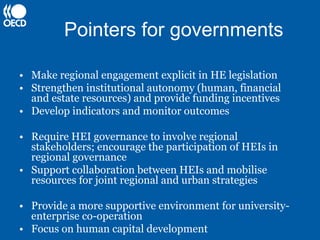
Pointers for governments

• Make regional engagement explicit in HE legislation
• Strengthen institutional autonomy (human, financial
  and estate resources) and provide funding incentives
• Develop indicators and monitor outcomes

• Require HEI governance to involve regional
  stakeholders; encourage the participation of HEIs in
  regional governance
• Support collaboration between HEIs and mobilise
  resources for joint regional and urban strategies

• Provide a more supportive environment for university-
  enterprise co-operation
• Focus on human capital development
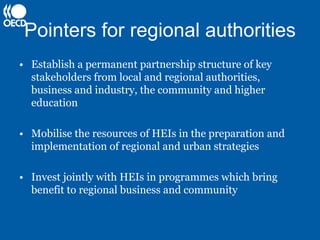
Pointers for regional authorities
• Establish a permanent partnership structure of key
  stakeholders from local and regional authorities,
  business and industry, the community and higher
  education

• Mobilise the resources of HEIs in the preparation and
  implementation of regional and urban strategies

• Invest jointly with HEIs in programmes which bring
  benefit to regional business and community
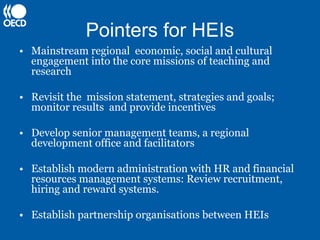
Pointers for HEIs
• Mainstream regional economic, social and cultural
  engagement into the core missions of teaching and
  research

• Revisit the mission statement, strategies and goals;
  monitor results and provide incentives

• Develop senior management teams, a regional
  development office and facilitators

• Establish modern administration with HR and financial
  resources management systems: Review recruitment,
  hiring and reward systems.

• Establish partnership organisations between HEIs
All reports published at
www.oecd.org/edu/higher/regionaldevelopment

                   Contact

          jaana.puukka@oecd.org
2nd phase of reviews will take place in
                 2008-2010

Focus on City-Regions and rapidly developing economies:


  Berlin, Barcelona, Campinas, Dublin...

              More information on
  www.oecd.org/edu/higher/regionaldevelopment
Jaana Puukka                     Francisco Marmolejo
Analyst OECD/IMHE                Executive Director
2, rue Andre Pascal              CONAHEC - University of Arizona
75775 Paris Cedex 16             220 W. Sixth Street
France                           Tucson, AZ 85721-0300 USA

Tel. +33 1 45 24 16 61           Tel. +1 (520) 621-9080
jaana.puukka@oecd.org
                                 fmarmole@email.arizona.edu
http://www.oecd.org/edu/higher
                                 http://conahec.org

Utrecht sb- francisco marmolejo

  • 1.
    Universities as engines forthe development of their regions: Lessons from the OECD work IAU conference Utrecht,17 July 2008 Jaana Puukka, OECD/IMHE Francisco Marmolejo, CONAHEC
  • 2.
    Contents • OECD reviewsof HE in regional development • How to mobilise higher education for their regions: Good practice examples • Barriers to Engagement • Pointers for the future: for government, regions and universities
  • 3.
    Key characteristics ofthe New Economy
  • 4.
    With globalisation, thecomparative advantage of regions that can create the best conditions for growth and development is increasing. …High technology companies, once tied to their locations, can now move their production to anywhere in the world. … But to stay competitive, key parts of their operations need to be based in knowledge and innovation-intensive regions …..
  • 5.
    To Be GloballyCompetitive Countries Need to Invest in their Innovation Systems and human capital development not only at the national, but also regional level … Universities and other higher education institutions can play a key role in Regional Innovation Systems and Human Capital Formation…..
  • 6.
    Challenges to universities New frontiers in research Public Service Decreasing Funding An increasingly complex environment for higher education institutions Pressure from What and how to University Rankings teach? Market pressures Increased Accountability Governance
  • 7.
    OECD reviews ofHE in regions • 14 regions in 12 countries (incl. one cross-border region) established a steering committee with representatives from HEIs, public and private sectors . They carried out self-evaluation and were reviewed by international expert team .
  • 8.
    Participants • Australia (Sunshine-FraserCoast) • Brazil (Northern Paraná) • Canada (Atlantic Canada) • Denmark (Jutland-Funen) • Denmark-Sweden (Öresund) • Finland (Jyväskylä region) • Korea (Busan) • Mexico (State of Nuevo León) • Netherlands (Twente) • Norway (Trøndelag, Mid-Norway) • Spain (autonomous regions of Valencia and Canary Islands) • Sweden (Värmland) • UK (the North East of England)
  • 9.
  • 10.
  • 11.
    Diversity of PolicyEnvironments
  • 12.
    What was learnt? •Regional engagement of universities is often based on short term project funding and generic growth. It lacks systematic processes and structures ; There is limited co- operation among HEIs and btw HEIs and stakeholders • Most countries invest in making universities engines for high tech based innovation; But innovation is also incremental: low tech fields innovate too • Only few universities have gained income through patents and commercialisation: Open science could enhance innovation by reducing the costs of knowledge transfer • Policy focus on few high technology fields, while 70% of OECD workforce is in the service sector. Cultural industries becoming a major driver globally, accounting for 7% of GDP and growing at 10% annually
  • 13.
    …building on existingcompetitive advantage can make a difference… In Castellon, Valencia, Universidad Jaume I is recognised as a world leader R&D in the tile industry. It has helped to transform the region’s traditional industry. The growth is built on technology transfer, spin-offs and upgrading of existing technologies. – Today, Valencia is a global leader in the tiles and ceramics industry. Source: the Valencia Region SER
  • 14.
    …Localising the learningprocess can be an effective way to engage students into “knowledge transfer on legs” In Aalborg University, Denmark, up to 50% of the study work consists of problem- oriented project work: students work in teams to solve problems which have been identified in co-operation with firms, public organisations and other institutions. At any one time there are 2000-3000 ongoing projects that ensure the university’s engagement with the surrounding society. Source: the Jutland-Funen SER
  • 15.
    In Central Finland,Jyväskylä University of Applied Sciences has helped to rehabilitate 800 long term unemployed back to working life with a wide range of physical and social rehabilitation measures, partly delivered through the student training centre. Source: The Jyväskylä region SER In the North East of England, the 5 HEIs use In Mexico, all university sports as a means to widen students are obliged to do access to HE, to raise 480 hours community work. aspirations and to enhance In Monterrey University social cohesion within the Social Service is geared excluded communities. towards addressing the Source: the NE England SER needs of the community. Source: the Nuevo Leon SER
  • 16.
    Systematic Approach toIndustry …Creating a one-stop-shop for industry contacts In the North East of England, the 5 HEIs have set up Knowledge House to help companies access university skills, expertise and specialist services. KH offers expert solutions for developing ideas and solving problems through collaboration, consultancy, training and R&D. KH receives 1000 enquiries from client companies and delivers around 200 client contracts on an annual basis. Business growth is 25%. The cradle- to-grave service stretches from the receipt of enquiries to delivery and post-completion evaluation. Source: the NE England SER
  • 17.
    Barriers to engagement National Regional Institutional Uncoordinated HE, Fragmented local Weak management, S&T and territorial govs, weak leadership lack of policy entrepreneurial culture Limits to HEIs’ Intraregional and Tensions between autonomy interinstitutional regional engagement competition & academic excellence Limited incentives to HEIs not part of Lack of incentives to HEIs strategy work and individuals implementation
  • 18.
    Pointers for governments •Make regional engagement explicit in HE legislation • Strengthen institutional autonomy (human, financial and estate resources) and provide funding incentives • Develop indicators and monitor outcomes • Require HEI governance to involve regional stakeholders; encourage the participation of HEIs in regional governance • Support collaboration between HEIs and mobilise resources for joint regional and urban strategies • Provide a more supportive environment for university- enterprise co-operation • Focus on human capital development
  • 19.
    Pointers for regionalauthorities • Establish a permanent partnership structure of key stakeholders from local and regional authorities, business and industry, the community and higher education • Mobilise the resources of HEIs in the preparation and implementation of regional and urban strategies • Invest jointly with HEIs in programmes which bring benefit to regional business and community
  • 20.
    Pointers for HEIs •Mainstream regional economic, social and cultural engagement into the core missions of teaching and research • Revisit the mission statement, strategies and goals; monitor results and provide incentives • Develop senior management teams, a regional development office and facilitators • Establish modern administration with HR and financial resources management systems: Review recruitment, hiring and reward systems. • Establish partnership organisations between HEIs
  • 21.
    All reports publishedat www.oecd.org/edu/higher/regionaldevelopment Contact jaana.puukka@oecd.org
  • 22.
    2nd phase ofreviews will take place in 2008-2010 Focus on City-Regions and rapidly developing economies: Berlin, Barcelona, Campinas, Dublin... More information on www.oecd.org/edu/higher/regionaldevelopment
  • 23.
    Jaana Puukka Francisco Marmolejo Analyst OECD/IMHE Executive Director 2, rue Andre Pascal CONAHEC - University of Arizona 75775 Paris Cedex 16 220 W. Sixth Street France Tucson, AZ 85721-0300 USA Tel. +33 1 45 24 16 61 Tel. +1 (520) 621-9080 jaana.puukka@oecd.org fmarmole@email.arizona.edu http://www.oecd.org/edu/higher http://conahec.org