CS 6213 – Advanced Data Structures
 A data structure is a structure to hold the data, that allows several

interesting operations to be performed on the data set.
 The data structure is designed with those specific operations in

mind.
 General problem:
 Given a data set and the operations that need to be supported, come

up with a data structure (organization) that allows those operations to
be done in an efficient manner.

ADS - Getting Started

CS6213 - Arora - L1

2
 An integral part of computer science
 You cannot have efficient solutions if you do not know data

structures

ADS - Getting Started

CS6213 - Arora - L1

3
 Example 1: Given n numbers, search for a given number x
 Example 2: Solve the Rubik’s cube
 Example 3: Implement a print driver
 Example 4: Understand Facebook dynamics for a company

 Example 5: Write a web searcher

ADS - Getting Started

CS6213 - Arora - L1

4
 A record is a built-in structure data type, that allows the packaging

of several elements (called fields)
 Every high level language allows the user to define customized

records.
 In C#/Java, this is called “class”.

 In C, this is called “struct”.

 Object Oriented Paradigm packages fields and methods as an

object (instance of a class)

ADS - Getting Started

CS6213 - Arora - L1

5
 Last In First Out (LIFO)
 Allows 3 operations:
 Push (a)
 Pop()
 Top()

ADS - Getting Started

CS6213 - Arora - L1

6
 Using an array
 Use an array S[1:N], and use a special pointer to the “top” of the

stack.
 When pushing something on the stack, increment the pointer
 When popping, decrement the pointer
 Using a linked list
 Use a special pointer to the “top” of the stack
 When pushing something on the stack, advance the “top” pointer
 When popping, move the “top” pointer back one step – this suggests

that the linked list must be a doubly linked list

ADS - Getting Started

CS6213 - Arora - L1

7
 First In First Out (FIFO)
 Allows 2 operations:
 dequeue(): Returns the first element
 enqueue(a): Adds an element a to the end of the queue

ADS - Getting Started

CS6213 - Arora - L1

8
tail  ….  head
 Using an array
 Keep “head” and “tail” indexes

 Using a linked list
 Keep “head” and “tail” pointers

 Handling operations
 When enqueuing an item, move tail one step to the left.
 When dequeuing an item, move head one step to the left

ADS - Getting Started

CS6213 - Arora - L1

9
 Singly Linked
 A singly linked list is a sequence of records, where every record has a

field that points to the next record
 A special pointer called “first” has the reference to the first record
 Doubly Linked
 A doubly linked list is a sequence of records, where every record has

a field that points to the next record, and a field that points to the
previous record
 Special pointers called “first” and “last” with references to the first and
the last records

ADS - Getting Started

CS6213 - Arora - L1

10
 A tree where every node has at most two children
 Binary Search Tree (BST): BST is a binary search tree where

every node contains a value, and for every node x, all the nodes
of the left subtree of x have values <= x, and all nodes in the right
subtree of x have values >= x.
 BST supports 3 operations: insert(x), delete(x) and search(x)
 It is more interesting (and efficient) if the BST is “height

balanced”. Red Black and AVL trees are interesting
implementations of height balanced BSTs.

ADS - Getting Started

CS6213 - Arora - L1

11
 Mother Problem – Ability to do following operations quickly:
 Search
 Insert
 Delete
 Update

 Doing a delete in Array is tricky
 Doing a search in linked list is tricky

ADS - Getting Started

CS6213 - Arora - L1

12
ADS - Getting Started

CS6213 - Arora - L1

13
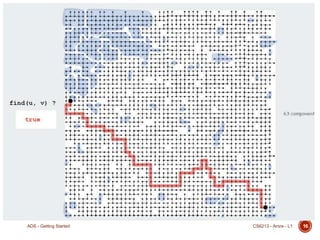
 Terrorism, insider trading, financial fraud analysis
 Are two people connected given millions of “x knows y” statements?

 Vulnerability Assessment
 Are two computers in a network connected?

 IC Design
 Are two points shot circuited on this mother board?

 Click Fraud Analysis, Page Ranking
 Are two web pages connected (indirectly)?

 Abstractions
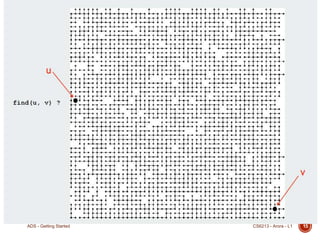
 Given a graph, is there a path connecting one node to another?
 How can we organize a given universe of objects into sets?

ADS - Getting Started

CS6213 - Arora - L1

14
ADS - Getting Started

CS6213 - Arora - L1

15
ADS - Getting Started

CS6213 - Arora - L1

16
 Binary Search Tree:

http://en.wikipedia.org/wiki/Binary_search_tree
 Red Black Trees
 AVL Trees

ADS - Getting Started

CS6213 - Arora - L1

17

Stacks, Queues, Binary Search Trees - Lecture 1 - Advanced Data Structures

  • 1.
    CS 6213 –Advanced Data Structures
  • 2.
     A datastructure is a structure to hold the data, that allows several interesting operations to be performed on the data set.  The data structure is designed with those specific operations in mind.  General problem:  Given a data set and the operations that need to be supported, come up with a data structure (organization) that allows those operations to be done in an efficient manner. ADS - Getting Started CS6213 - Arora - L1 2
  • 3.
     An integralpart of computer science  You cannot have efficient solutions if you do not know data structures ADS - Getting Started CS6213 - Arora - L1 3
  • 4.
     Example 1:Given n numbers, search for a given number x  Example 2: Solve the Rubik’s cube  Example 3: Implement a print driver  Example 4: Understand Facebook dynamics for a company  Example 5: Write a web searcher ADS - Getting Started CS6213 - Arora - L1 4
  • 5.
     A recordis a built-in structure data type, that allows the packaging of several elements (called fields)  Every high level language allows the user to define customized records.  In C#/Java, this is called “class”.  In C, this is called “struct”.  Object Oriented Paradigm packages fields and methods as an object (instance of a class) ADS - Getting Started CS6213 - Arora - L1 5
  • 6.
     Last InFirst Out (LIFO)  Allows 3 operations:  Push (a)  Pop()  Top() ADS - Getting Started CS6213 - Arora - L1 6
  • 7.
     Using anarray  Use an array S[1:N], and use a special pointer to the “top” of the stack.  When pushing something on the stack, increment the pointer  When popping, decrement the pointer  Using a linked list  Use a special pointer to the “top” of the stack  When pushing something on the stack, advance the “top” pointer  When popping, move the “top” pointer back one step – this suggests that the linked list must be a doubly linked list ADS - Getting Started CS6213 - Arora - L1 7
  • 8.
     First InFirst Out (FIFO)  Allows 2 operations:  dequeue(): Returns the first element  enqueue(a): Adds an element a to the end of the queue ADS - Getting Started CS6213 - Arora - L1 8
  • 9.
    tail  …. head  Using an array  Keep “head” and “tail” indexes  Using a linked list  Keep “head” and “tail” pointers  Handling operations  When enqueuing an item, move tail one step to the left.  When dequeuing an item, move head one step to the left ADS - Getting Started CS6213 - Arora - L1 9
  • 10.
     Singly Linked A singly linked list is a sequence of records, where every record has a field that points to the next record  A special pointer called “first” has the reference to the first record  Doubly Linked  A doubly linked list is a sequence of records, where every record has a field that points to the next record, and a field that points to the previous record  Special pointers called “first” and “last” with references to the first and the last records ADS - Getting Started CS6213 - Arora - L1 10
  • 11.
     A treewhere every node has at most two children  Binary Search Tree (BST): BST is a binary search tree where every node contains a value, and for every node x, all the nodes of the left subtree of x have values <= x, and all nodes in the right subtree of x have values >= x.  BST supports 3 operations: insert(x), delete(x) and search(x)  It is more interesting (and efficient) if the BST is “height balanced”. Red Black and AVL trees are interesting implementations of height balanced BSTs. ADS - Getting Started CS6213 - Arora - L1 11
  • 12.
     Mother Problem– Ability to do following operations quickly:  Search  Insert  Delete  Update  Doing a delete in Array is tricky  Doing a search in linked list is tricky ADS - Getting Started CS6213 - Arora - L1 12
  • 13.
    ADS - GettingStarted CS6213 - Arora - L1 13
  • 14.
     Terrorism, insidertrading, financial fraud analysis  Are two people connected given millions of “x knows y” statements?  Vulnerability Assessment  Are two computers in a network connected?  IC Design  Are two points shot circuited on this mother board?  Click Fraud Analysis, Page Ranking  Are two web pages connected (indirectly)?  Abstractions  Given a graph, is there a path connecting one node to another?  How can we organize a given universe of objects into sets? ADS - Getting Started CS6213 - Arora - L1 14
  • 15.
    ADS - GettingStarted CS6213 - Arora - L1 15
  • 16.
    ADS - GettingStarted CS6213 - Arora - L1 16
  • 17.
     Binary SearchTree: http://en.wikipedia.org/wiki/Binary_search_tree  Red Black Trees  AVL Trees ADS - Getting Started CS6213 - Arora - L1 17