BSZQRPHSBQIZ
CRYPTOGRAPHY


        Presented by Kinley
History of Cryptography
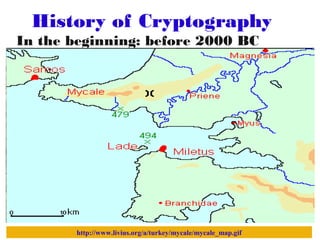
 In the beginning: before 2000 BC
Before 2,000 BC


             http://www.livius.org/a/turkey/mycale/mycale_map.gif   2
Around 1900 BC : In Egypt [Non-Standard
hieroglyphics]


     http://www.bible-history.com/maps/maps/israel_and_her_neighbors.jpg   3
487 BC: The Greek used a device called
 the Scytale


       http://flylib.com/books/2/827/1/html/2/images/1004.jpg
 Greeks and Spartans used this cipher to
  communicate during military campaigns
 Called Transposition Cipher
                                                                4
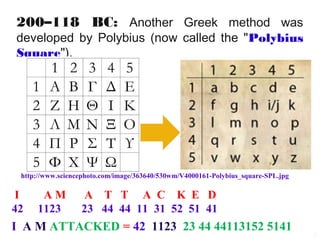
200–118 BC: Another Greek method was
developed by Polybius (now called the "Polybius
Square").


 http://www.sciencephoto.com/image/363640/530wm/V4000161-Polybius_square-SPL.jpg

 I    AM          A T T A C K E D
42   1123         23 44 44 11 31 52 51 41
I A M ATTACKED = 42 1123 23 44 44113152 5141
                                                                                   5
60-50 BC: Caesar Shift Cipher


 http://www.secretcodebreaker.com/ciphrdsk.gif

 Encrypt (“BAD”, 3) = “EDG”                       Decrypt
 (“EDG”, 3) = “BAD”
 Julius Caesar used it to communicate with his generals
  during his military campaigns.
 It is also used to secure secret communications from
  military leaders, diplomats, spies and religious groups
 Called Mono-alphabetic Substitution Ciphers
                                                            6
The Breaking Caesar Shift
     Ciphers
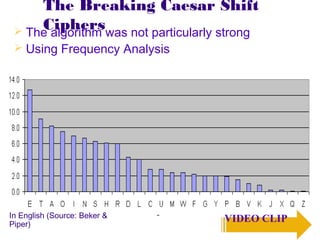
  The algorithm was not particularly strong
  Using Frequency Analysis


In English (Source: Beker &          VIDEO CLIP
Piper)
                                                  7
15th Century: Leon Battista
 Alberti
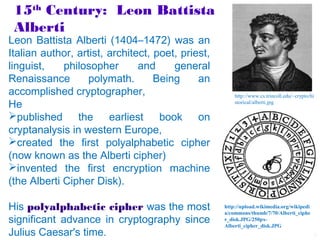
Leon Battista Alberti (1404–1472) was an
Italian author, artist, architect, poet, priest,
linguist,    philosopher       and     general
Renaissance        polymath.       Being     an
accomplished cryptographer,                            http://www.cs.trincoll.edu/~crypto/hi
He                                                     storical/alberti.jpg

published the earliest book on
cryptanalysis in western Europe,
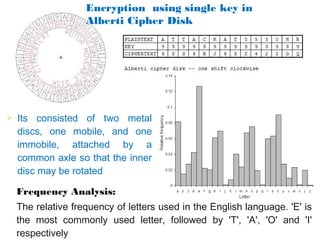
created the first polyalphabetic cipher
(now known as the Alberti cipher)
invented the first encryption machine
(the Alberti Cipher Disk).

His polyalphabetic cipher was the most             http://upload.wikimedia.org/wikipedi
                                                   a/commons/thumb/7/70/Alberti_ciphe
significant advance in cryptography since          r_disk.JPG/250px-
                                                   Alberti_cipher_disk.JPG
Julius Caesar's time.                                                                      8
Encryption using single key in
                  Alberti Cipher Disk


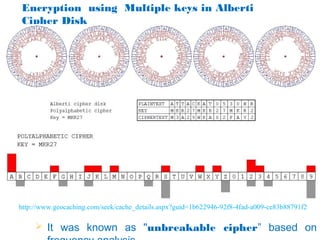
 Its  consisted of two metal
  discs, one mobile, and one
  immobile, attached by a
  common axle so that the inner
  disc may be rotated

  Frequency Analysis:
  The relative frequency of letters used in the English language. 'E' is
  the most commonly used letter, followed by 'T', 'A', 'O' and 'I'
  respectively.
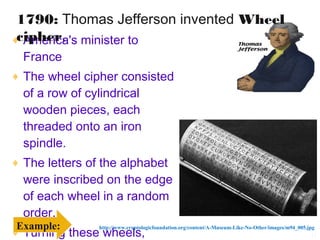
Encryption using Multiple keys in Alberti
Cipher Disk


http://www.geocaching.com/seek/cache_details.aspx?guid=1b622946-92f8-4fad-a009-ce83b88791f2

      It was known as "unbreakable cipher” based on
1790: Thomas Jefferson invented Wheel
 cipher.
♦ America's minister to
    France
♦ The wheel cipher consisted
    of a row of cylindrical
    wooden pieces, each
    threaded onto an iron
    spindle.
♦ The letters of the alphabet
    were inscribed on the edge
    of each wheel in a random
    order.
 Example:
♦ Turning these wheels,
               http://www.cryptologicfoundation.org/content/A-Museum-Like-No-Other/images/m94_005.jpg
                                                                                                    11
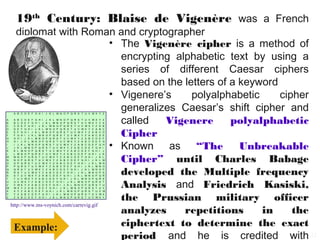
19th Century: Blaise de Vigenère was a French
       diplomat with Roman and cryptographer
                                           • The Vigenère cipher is a method of
                                             encrypting alphabetic text by using a
                                             series of different Caesar ciphers
                                             based on the letters of a keyword
                                           • Vigenere’s     polyalphabetic     cipher
    A B C D E F G H I
                                             generalizes Caesar’s shift cipher and
                                        J K L M N O P Q R S T U V W X Y Z

A
B
C
    A
    B
    C
        B
        C
        D
            C
            D
            E
                D
                E
                F
                    E
                    F
                    G
                        F
                        G
                        H
                            G
                            H
                            I
                                H
                                I
                                J
                                    I
                                    J
                                    K
                                        J
                                        K
                                        L
                                            K
                                            L
                                            M
                                             called
                                                L
                                                M
                                                N
                                                    M
                                                    N
                                                    O
                                                      Vigenere
                                                        N
                                                        O
                                                        P
                                                            O
                                                            P
                                                            Q
                                                                P
                                                                Q
                                                                R
                                                                    Q
                                                                    R
                                                                    S
                                                                     polyalphabetic
                                                                        R
                                                                        S
                                                                        T
                                                                            S
                                                                            T
                                                                            U
                                                                                T
                                                                                U
                                                                                V
                                                                                    U
                                                                                    V
                                                                                    W
                                                                                        V
                                                                                        W
                                                                                        X
                                                                                            W
                                                                                            X
                                                                                            Y
                                                                                                X
                                                                                                Y
                                                                                                Z
                                                                                                    Y
                                                                                                    Z
                                                                                                    A
                                                                                                        Z
                                                                                                        A
                                                                                                        B


                                             Cipher
D   D   E   F   G   H   I   J   K   L   M   N   O   P   Q   R   S   T   U   V   W   X   Y   Z   A   B   C
E   E   F   G   H   I   J   K   L   M   N   O   P   Q   R   S   T   U   V   W   X   Y   Z   A   B   C   D
F   F   G   H   I   J   K   L   M   N   O   P   Q   R   S   T   U   V   W   X   Y   Z   A   B   C   D   E
G   G   H   I   J   K   L   M   N   O   P   Q   R   S   T   U   V   W   X   Y   Z   A   B   C   D   E   F


                                           • Known as “The             Unbreakable
H   H   I   J   K   L   M   N   O   P   Q   R   S   T   U   V   W   X   Y   Z   A   B   C   D   E   F   G
I   I   J   K   L   M   N   O   P   Q   R   S   T   U   V   W   X   Y   Z   A   B   C   D   E   F   G   H
J   J   K   L   M   N   O   P   Q   R   S   T   U   V   W   X   Y   Z   A   B   C   D   E   F   G   H   I
K   K   L   M   N   O   P   Q   R   S   T   U   V   W   X   Y   Z   A   B   C   D   E   F   G   H   I   J


                                             Cipher” until Charles Babage
L   L   M   N   O   P   Q   R   S   T   U   V   W   X   Y   Z   A   B   C   D   E   F   G   H   I   J   K
M   M   N   O   P   Q   R   S   T   U   V   W   X   Y   Z   A   B   C   D   E   F   G   H   I   J   K   L
N   N   O   P   Q   R   S   T   U   V   W   X   Y   Z   A   B   C   D   E   F   G   H   I   J   K   L   M
O   O   P   Q   R   S   T   U   V   W   X   Y   Z   A   B   C   D   E   F   G   H   I   J   K   L   M   N
P   P   Q   R   S   T   U   V   W   X   Y   Z   A   B   C   D   E   F   G   H   I   J   K   L   M   N   O
Q
R
S
    Q
    R
    S
        R
        S
        T
            S
            T
            U
                T
                U
                V
                    U
                    V
                    W
                        V
                        W
                        X
                            W
                            X
                            Y
                                X
                                Y
                                Z
                                    Y
                                    Z
                                    A
                                        Z
                                        A
                                        B
                                            A
                                            B
                                            C
                                             developed the Multiple frequency
                                                B
                                                C
                                                D
                                                    C
                                                    D
                                                    E
                                                        D
                                                        E
                                                        F
                                                            E
                                                            F
                                                            G
                                                                F
                                                                G
                                                                H
                                                                    G
                                                                    H
                                                                    I
                                                                        H
                                                                        I
                                                                        J
                                                                            I
                                                                            J
                                                                            K
                                                                                J
                                                                                K
                                                                                L
                                                                                    K
                                                                                    L
                                                                                    M
                                                                                        L
                                                                                        M
                                                                                        N
                                                                                            M
                                                                                            N
                                                                                            O
                                                                                                N
                                                                                                O
                                                                                                P
                                                                                                    O
                                                                                                    P
                                                                                                    Q
                                                                                                        P
                                                                                                        S
                                                                                                        R


                                             Analysis and Friedrich Kasiski,
T   T   U   V   W   X   Y   Z   A   B   C   D   E   F   G   H   I   J   K   L   M   N   O   P   Q   R   S
U   U   V   W   X   Y   Z   A   B   C   D   E   F   G   H   I   J   K   L   M   N   O   P   Q   R   S   T
V   V   W   X   Y   Z   A   B   C   D   E   F   G   H   I   J   K   L   M   N   O   P   Q   R   S   T   U
W   W   X   Y   Z   A   B   C   D   E   F   G   H   I   J   K   L   M   N   O   P   Q   R   S   T   U   V
X   X   Y   Z   A   B   C   D   E   F   G   H   I   J   K   L   M   N   O   P   Q   R   S   T   U   V   W


                                             the Prussian military officer
Y   Y   Z   A   B   C   D   E   F   G   H   I   J   K   L   M   N   O   P   Q   R   S   T   U   V   W   X
Z   Z   A   B   C   D   E   F   G   H   I   J   K   L   M   N   O   P   Q   R   S   T   U   V   W   X   Y


    http://www.ms-voynich.com/carrevig.gif
                                             analyzes     repetitions      in     the
     Example:                                ciphertext to determine the exact
                                             period and he is credited with 12
1917 Century;
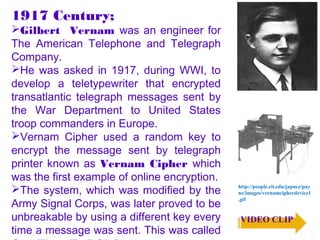
Gilbert Vernam was an engineer for
The American Telephone and Telegraph
Company.
He was asked in 1917, during WWI, to
develop a teletypewriter that encrypted
transatlantic telegraph messages sent by
the War Department to United States
troop commanders in Europe.
Vernam Cipher used a random key to
encrypt the message sent by telegraph
printer known as Vernam Cipher which
was the first example of online encryption.
The system, which was modified by the        http://people.rit.edu/japnce/pay
                                              ne/images/vernamcipherdevice1

Army Signal Corps, was later proved to be
                                              .gif


unbreakable by using a different key every    VIDEO CLIP
time a message was sent. This was called                                     13
Enigma
          Machine
 Electro-mechanical cipher machine,
  simple in design yet powerful in
  capability
 Built in Germany in 1918 at the end
  of WWI and later adapted for
 Uses rotors settings (the Germanencrypt
  commercial use, and by key) to
  each letter1926 message with a different
  military in of a
  cipher key
 Military added the plugboard to
  commercial Enigma, greatly increasing
  cryptologic strength
 Strength of Enigma design gave Germans
  complete confidence in its security, even
                                     http://math.arizona.edu/~dsl/images/enigma11.gif
1932-1944:
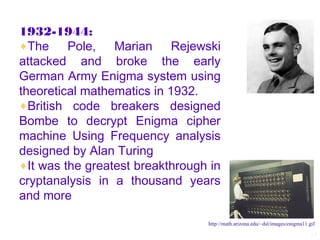
♦The     Pole, Marian Rejewski
attacked and broke the early
German Army Enigma system using
theoretical mathematics in 1932.
♦British code breakers designed
Bombe to decrypt Enigma cipher
machine Using Frequency analysis
designed by Alan Turing
♦It was the greatest breakthrough in
cryptanalysis in a thousand years
and more

                                 http://math.arizona.edu/~dsl/images/enigma11.gif

                                                                               15
Data Encryption
  Standard (DES)
♦ 1972: U.S. Government recognized
  the need to have a standardized
  cipher    for   secret    documents            http://cryptodox.com/images/thumb/d/d5/Feistel.jpg/180px-Feistel.jpg


  (encrypting classified and sensitive     Horst Feistel was a German-born
                                           cryptographer who worked on the
  information)                             design of ciphers at IBM, initiating
                                           research that would culminate in the
♦ NBS developed DES based on an            development of the Data Encryption
                                           Standard in the 1970s
  earlier IBM algorithm, Horst Feistel's
  Lucifer cipher.
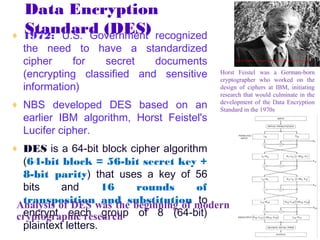
♦ DES is a 64-bit block cipher algorithm
  (64-bit block = 56-bit secret key +
  8-bit parity) that uses a key of 56
  bits     and       16   rounds      of
  transposition and substitution to
 Analysis of DES was the beginning of modern
 cryptographic research of 8 (64-bit)
  encrypt each group
  plaintext letters.
Breaking of Data Encryption
Standard (DES)
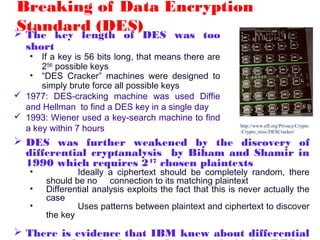
 The key length of DES was too
   short
    • If a key is 56 bits long, that means there are
      256 possible keys
   • “DES Cracker” machines were designed to
      simply brute force all possible keys
 1977: DES-cracking machine was used Diffie
  and Hellman to find a DES key in a single day
 1993: Wiener used a key-search machine to find
  a key within 7 hours                                      http://www.eff.org/Privacy/Crypto
                                                            /Crypto_misc/DESCracker/

 DES was further weakened by the discovery of
  differential cryptanalysis by Biham and Shamir in
  1990 which requires 247 chosen plaintexts
    •           Ideally a ciphertext should be completely random, there
        should be no connection to its matching plaintext
    •   Differential analysis exploits the fact that this is never actually the
        case
    •           Uses patterns between plaintext and ciphertext to discover
        the key
 There is evidence that IBM knew about differential
Advanced Encryption
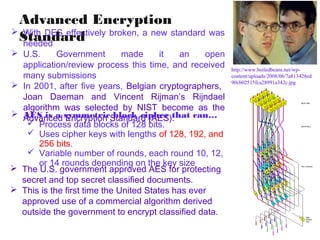
 With DES effectively broken, a new standard was
 Standard
  needed
 U.S.      Government        made      it   an    open
  application/review process this time, and received      http://www.boiledbeans.net/wp-
  many submissions                                        content/uploads/2008/06/7a813428ed
                                                          90cb02515fca28991a342c.jpg
 In 2001, after five years, Belgian cryptographers,
  Joan Daeman and Vincent Rijman’s Rijndael
  algorithm was selected by NIST become as the
 AES is a symmetricStandard (AES).
  Advanced Encryption block cipher that can…
    Process data blocks of 128 bits.
    Uses cipher keys with lengths of 128, 192, and
      256 bits.
    Variable number of rounds, each round 10, 12,
      or 14 rounds depending on the key size
 The U.S. government approved AES for protecting
  secret and top secret classified documents.
 This is the first time the United States has ever
  approved use of a commercial algorithm derived
  outside the government to encrypt classified data.
Current attacks against AES
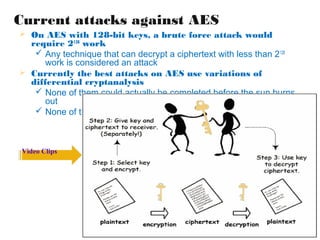
 On AES with 128-bit keys, a brute force attack would
  require 2128 work
    Any technique that can decrypt a ciphertext with less than 2 128
      work is considered an attack
 Currently the best attacks on AES use variations of
  differential cryptanalysis
    None of them could actually be completed before the sun burns
      out
    None of them work on the full number of rounds


 Video Clips
♦ 1976: Whitfield Diffie & Martin Hellman published
  New Directions in Cryptography.
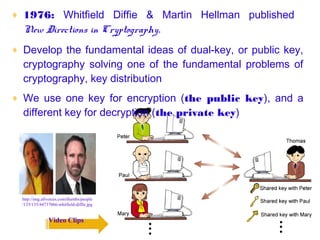
♦ Develop the fundamental ideas of dual-key, or public key,
  cryptography solving one of the fundamental problems of
  cryptography, key distribution
♦ We use one key for encryption (the public key), and a
  different key for decryption (the private key)


  http://img.allvoices.com/thumbs/people
  /135/135/44737066-whitfield-diffie.jpg


                Video Clips
 1978: Ronald L. Rivest, Adi Shamir & Leonard
  M.
  Adleman (RSA) published RSA Algorithm for
  Public Key System.
                                                    http://datanews.levif.be/ict/actualite/
 The RSA algorithm was publicly described in       apercu/2011/02/17/un-lifetime-
                                                    achievement-award-pour-les-

  1977 but was never deployed. It was not
                                                    pionniers-de-rsa/article-
                                                    1194952831693.htm

  revealed until 1998 due to its top-secret
  classification
 RSA was based on product of two large prime          Video Clip
  numbers
 Uses this product to create the public and           Video Clip
  private keys
 Sends the product and the public key one, who
  can use them to encrypt messages
 Even if some one knows the product and the
  public key, he/she can’t figure out the private
  key unless he/ she can factor the product
Cryptography in Modern
Living
♦ Secure Communications
  -Document / Data / Email
  Encryption

♦ Identification and           http://static.ddmcdn.com/gif/credit-card-3.jpg

 Authentication
 -Smart Cards

♦ Electronic Commerce and
 Payments
 –ATMs / Credit Cards
 –Net Banking / Web Shopping
References
♦   Boone, J.V. (2005). A Brief History of Cryptology. Naval Institute Press, USA
♦   Damico,Tony M. (2009), A brief history of cryptography. Retrieved June 31, 2012,
    http://www.studentpulse.com/articles/41/a-brief-history-of-cryptography
♦   Denning, Dorothy E. (1982). Cryptography and Data Security. Addison-Wesley Publishing
    Company, Inc. Canada
♦   Macgregor, Mary. The Story of Greece [on-line]. Available: http://www.heritage-
    history.com/www/heritage-books.php?
    Dir=books&author=macgregor&book=greece&story=head
♦   Mackenzie, Dana (2003). The Code War. An article was provided by the National Academy of
    Sciences. NW, Washington
♦   Pell, Oliver ().Cryptology. Retrieved July 18 2012, http://www.ridex.co.uk/cryptology
♦   Pfleeger, C.P & Pfleeger, S. L (2007). Security in Computing. Pearson education Inc. NJ,
    USA
♦   Servos, William (2006). Cryptography. Retrieved July 18 2012,
    http://www.cs.trincoll.edu/~crypto/historical/alberti.html
♦   Shannon, C. E. Communication Theory of Secrecy Systems. Retrieved 19 July 2012,
    http://netlab.cs.ucla.edu/wiki/files/shannon1949.pdf
♦   Singh, Simon (1999). The Code Book. Doubleday, USA. pp. 279-92
♦   Wardlaw, W.P. The RSA Public key cryptosystem. Mathematics department, U.S naval
    academy, Annapolis. Retrieved 19 July 2012,
    http://www.usna.edu/Users/math/wdj/papers/cryptoday/wardlaw_rsa.pdf
Paremes Laosinchai, Ph.D
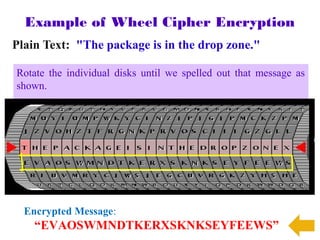
Example of Wheel Cipher Encryption
Plain Text: "The package is in the drop zone."

Rotate the individual disks until we spelled out that message as
shown.


  Encrypted Message:
    “EVAOSWMNDTKERXSKNKSEYFEEWS”
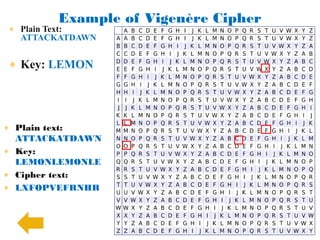
Example of Vigenère Cipher
 ♦ Plain Text:
   ATTACKATDAWN


 ♦ Key: LEMON


♦ Plain text:
  ATTACKATDAWN
♦ Key:
  LEMONLEMONLE
♦ Cipher text:
♦ LXFOPVEFRNHR
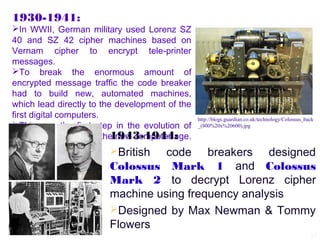
1930-1941:
In WWII, German military used Lorenz SZ
40 and SZ 42 cipher machines based on
Vernam cipher to encrypt tele-printer
messages.
To break the enormous amount of
encrypted message traffic the code breaker
had to build new, automated machines,
which lead directly to the development of the
first digital computers.                        http://blogs.guardian.co.uk/technology/Colossus_back
This was the first step in the evolution of    _(800%20x%20600).jpg

                          1943-1944:
cryptography towards the new computer age.
                        British  code breakers designed
                        Colossus Mark 1 and Colossus
                        Mark 2 to decrypt Lorenz cipher
                        machine using frequency analysis
                        Designed by Max Newman & Tommy
                        Flowers
                                                                                                  27
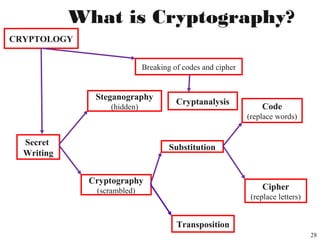
What is Cryptography?
CRYPTOLOGY


                             Breaking of codes and cipher


              Steganography
                                       Cryptanalysis
                  (hidden)                                      Code
                                                            (replace words)


  Secret
                                     Substitution
  Writing


             Cryptography
              (scrambled)                                       Cipher
                                                             (replace letters)


                                       Transposition
                                                                                 28
Cryptographic Algorithm &
Operation

Cryptography its history application and beyond

  • 1.
    BSZQRPHSBQIZ CRYPTOGRAPHY Presented by Kinley
  • 2.
    History of Cryptography In the beginning: before 2000 BC Before 2,000 BC http://www.livius.org/a/turkey/mycale/mycale_map.gif 2
  • 3.
    Around 1900 BC: In Egypt [Non-Standard hieroglyphics] http://www.bible-history.com/maps/maps/israel_and_her_neighbors.jpg 3
  • 4.
    487 BC: TheGreek used a device called the Scytale http://flylib.com/books/2/827/1/html/2/images/1004.jpg  Greeks and Spartans used this cipher to communicate during military campaigns  Called Transposition Cipher 4
  • 5.
    200–118 BC: AnotherGreek method was developed by Polybius (now called the "Polybius Square"). http://www.sciencephoto.com/image/363640/530wm/V4000161-Polybius_square-SPL.jpg I AM A T T A C K E D 42 1123 23 44 44 11 31 52 51 41 I A M ATTACKED = 42 1123 23 44 44113152 5141 5
  • 6.
    60-50 BC: CaesarShift Cipher http://www.secretcodebreaker.com/ciphrdsk.gif Encrypt (“BAD”, 3) = “EDG” Decrypt (“EDG”, 3) = “BAD”  Julius Caesar used it to communicate with his generals during his military campaigns.  It is also used to secure secret communications from military leaders, diplomats, spies and religious groups  Called Mono-alphabetic Substitution Ciphers 6
  • 7.
    The Breaking CaesarShift Ciphers  The algorithm was not particularly strong  Using Frequency Analysis In English (Source: Beker & VIDEO CLIP Piper) 7
  • 8.
    15th Century: LeonBattista Alberti Leon Battista Alberti (1404–1472) was an Italian author, artist, architect, poet, priest, linguist, philosopher and general Renaissance polymath. Being an accomplished cryptographer, http://www.cs.trincoll.edu/~crypto/hi He storical/alberti.jpg published the earliest book on cryptanalysis in western Europe, created the first polyalphabetic cipher (now known as the Alberti cipher) invented the first encryption machine (the Alberti Cipher Disk). His polyalphabetic cipher was the most http://upload.wikimedia.org/wikipedi a/commons/thumb/7/70/Alberti_ciphe significant advance in cryptography since r_disk.JPG/250px- Alberti_cipher_disk.JPG Julius Caesar's time. 8
  • 9.
    Encryption using singlekey in Alberti Cipher Disk  Its consisted of two metal discs, one mobile, and one immobile, attached by a common axle so that the inner disc may be rotated Frequency Analysis: The relative frequency of letters used in the English language. 'E' is the most commonly used letter, followed by 'T', 'A', 'O' and 'I' respectively.
  • 10.
    Encryption using Multiplekeys in Alberti Cipher Disk http://www.geocaching.com/seek/cache_details.aspx?guid=1b622946-92f8-4fad-a009-ce83b88791f2  It was known as "unbreakable cipher” based on
  • 11.
    1790: Thomas Jeffersoninvented Wheel cipher. ♦ America's minister to France ♦ The wheel cipher consisted of a row of cylindrical wooden pieces, each threaded onto an iron spindle. ♦ The letters of the alphabet were inscribed on the edge of each wheel in a random order. Example: ♦ Turning these wheels, http://www.cryptologicfoundation.org/content/A-Museum-Like-No-Other/images/m94_005.jpg 11
  • 12.
    19th Century: Blaisede Vigenère was a French diplomat with Roman and cryptographer • The Vigenère cipher is a method of encrypting alphabetic text by using a series of different Caesar ciphers based on the letters of a keyword • Vigenere’s polyalphabetic cipher A B C D E F G H I generalizes Caesar’s shift cipher and J K L M N O P Q R S T U V W X Y Z A B C A B C B C D C D E D E F E F G F G H G H I H I J I J K J K L K L M called L M N M N O Vigenere N O P O P Q P Q R Q R S polyalphabetic R S T S T U T U V U V W V W X W X Y X Y Z Y Z A Z A B Cipher D D E F G H I J K L M N O P Q R S T U V W X Y Z A B C E E F G H I J K L M N O P Q R S T U V W X Y Z A B C D F F G H I J K L M N O P Q R S T U V W X Y Z A B C D E G G H I J K L M N O P Q R S T U V W X Y Z A B C D E F • Known as “The Unbreakable H H I J K L M N O P Q R S T U V W X Y Z A B C D E F G I I J K L M N O P Q R S T U V W X Y Z A B C D E F G H J J K L M N O P Q R S T U V W X Y Z A B C D E F G H I K K L M N O P Q R S T U V W X Y Z A B C D E F G H I J Cipher” until Charles Babage L L M N O P Q R S T U V W X Y Z A B C D E F G H I J K M M N O P Q R S T U V W X Y Z A B C D E F G H I J K L N N O P Q R S T U V W X Y Z A B C D E F G H I J K L M O O P Q R S T U V W X Y Z A B C D E F G H I J K L M N P P Q R S T U V W X Y Z A B C D E F G H I J K L M N O Q R S Q R S R S T S T U T U V U V W V W X W X Y X Y Z Y Z A Z A B A B C developed the Multiple frequency B C D C D E D E F E F G F G H G H I H I J I J K J K L K L M L M N M N O N O P O P Q P S R Analysis and Friedrich Kasiski, T T U V W X Y Z A B C D E F G H I J K L M N O P Q R S U U V W X Y Z A B C D E F G H I J K L M N O P Q R S T V V W X Y Z A B C D E F G H I J K L M N O P Q R S T U W W X Y Z A B C D E F G H I J K L M N O P Q R S T U V X X Y Z A B C D E F G H I J K L M N O P Q R S T U V W the Prussian military officer Y Y Z A B C D E F G H I J K L M N O P Q R S T U V W X Z Z A B C D E F G H I J K L M N O P Q R S T U V W X Y http://www.ms-voynich.com/carrevig.gif analyzes repetitions in the Example: ciphertext to determine the exact period and he is credited with 12
  • 13.
    1917 Century; Gilbert Vernamwas an engineer for The American Telephone and Telegraph Company. He was asked in 1917, during WWI, to develop a teletypewriter that encrypted transatlantic telegraph messages sent by the War Department to United States troop commanders in Europe. Vernam Cipher used a random key to encrypt the message sent by telegraph printer known as Vernam Cipher which was the first example of online encryption. The system, which was modified by the http://people.rit.edu/japnce/pay ne/images/vernamcipherdevice1 Army Signal Corps, was later proved to be .gif unbreakable by using a different key every VIDEO CLIP time a message was sent. This was called 13
  • 14.
    Enigma Machine  Electro-mechanical cipher machine, simple in design yet powerful in capability  Built in Germany in 1918 at the end of WWI and later adapted for  Uses rotors settings (the Germanencrypt commercial use, and by key) to each letter1926 message with a different military in of a cipher key  Military added the plugboard to commercial Enigma, greatly increasing cryptologic strength  Strength of Enigma design gave Germans complete confidence in its security, even http://math.arizona.edu/~dsl/images/enigma11.gif
  • 15.
    1932-1944: ♦The Pole, Marian Rejewski attacked and broke the early German Army Enigma system using theoretical mathematics in 1932. ♦British code breakers designed Bombe to decrypt Enigma cipher machine Using Frequency analysis designed by Alan Turing ♦It was the greatest breakthrough in cryptanalysis in a thousand years and more http://math.arizona.edu/~dsl/images/enigma11.gif 15
  • 16.
    Data Encryption Standard (DES) ♦ 1972: U.S. Government recognized the need to have a standardized cipher for secret documents http://cryptodox.com/images/thumb/d/d5/Feistel.jpg/180px-Feistel.jpg (encrypting classified and sensitive Horst Feistel was a German-born cryptographer who worked on the information) design of ciphers at IBM, initiating research that would culminate in the ♦ NBS developed DES based on an development of the Data Encryption Standard in the 1970s earlier IBM algorithm, Horst Feistel's Lucifer cipher. ♦ DES is a 64-bit block cipher algorithm (64-bit block = 56-bit secret key + 8-bit parity) that uses a key of 56 bits and 16 rounds of transposition and substitution to Analysis of DES was the beginning of modern cryptographic research of 8 (64-bit) encrypt each group plaintext letters.
  • 17.
    Breaking of DataEncryption Standard (DES)  The key length of DES was too short • If a key is 56 bits long, that means there are 256 possible keys • “DES Cracker” machines were designed to simply brute force all possible keys  1977: DES-cracking machine was used Diffie and Hellman to find a DES key in a single day  1993: Wiener used a key-search machine to find a key within 7 hours http://www.eff.org/Privacy/Crypto /Crypto_misc/DESCracker/  DES was further weakened by the discovery of differential cryptanalysis by Biham and Shamir in 1990 which requires 247 chosen plaintexts • Ideally a ciphertext should be completely random, there should be no connection to its matching plaintext • Differential analysis exploits the fact that this is never actually the case • Uses patterns between plaintext and ciphertext to discover the key  There is evidence that IBM knew about differential
  • 18.
    Advanced Encryption  WithDES effectively broken, a new standard was Standard needed  U.S. Government made it an open application/review process this time, and received http://www.boiledbeans.net/wp- many submissions content/uploads/2008/06/7a813428ed 90cb02515fca28991a342c.jpg  In 2001, after five years, Belgian cryptographers, Joan Daeman and Vincent Rijman’s Rijndael algorithm was selected by NIST become as the  AES is a symmetricStandard (AES). Advanced Encryption block cipher that can…  Process data blocks of 128 bits.  Uses cipher keys with lengths of 128, 192, and 256 bits.  Variable number of rounds, each round 10, 12, or 14 rounds depending on the key size  The U.S. government approved AES for protecting secret and top secret classified documents.  This is the first time the United States has ever approved use of a commercial algorithm derived outside the government to encrypt classified data.
  • 19.
    Current attacks againstAES  On AES with 128-bit keys, a brute force attack would require 2128 work  Any technique that can decrypt a ciphertext with less than 2 128 work is considered an attack  Currently the best attacks on AES use variations of differential cryptanalysis  None of them could actually be completed before the sun burns out  None of them work on the full number of rounds Video Clips
  • 20.
    ♦ 1976: WhitfieldDiffie & Martin Hellman published New Directions in Cryptography. ♦ Develop the fundamental ideas of dual-key, or public key, cryptography solving one of the fundamental problems of cryptography, key distribution ♦ We use one key for encryption (the public key), and a different key for decryption (the private key) http://img.allvoices.com/thumbs/people /135/135/44737066-whitfield-diffie.jpg Video Clips
  • 21.
     1978: RonaldL. Rivest, Adi Shamir & Leonard M. Adleman (RSA) published RSA Algorithm for Public Key System. http://datanews.levif.be/ict/actualite/  The RSA algorithm was publicly described in apercu/2011/02/17/un-lifetime- achievement-award-pour-les- 1977 but was never deployed. It was not pionniers-de-rsa/article- 1194952831693.htm revealed until 1998 due to its top-secret classification  RSA was based on product of two large prime Video Clip numbers  Uses this product to create the public and Video Clip private keys  Sends the product and the public key one, who can use them to encrypt messages  Even if some one knows the product and the public key, he/she can’t figure out the private key unless he/ she can factor the product
  • 22.
    Cryptography in Modern Living ♦Secure Communications -Document / Data / Email Encryption ♦ Identification and http://static.ddmcdn.com/gif/credit-card-3.jpg Authentication -Smart Cards ♦ Electronic Commerce and Payments –ATMs / Credit Cards –Net Banking / Web Shopping
  • 23.
    References ♦ Boone, J.V. (2005). A Brief History of Cryptology. Naval Institute Press, USA ♦ Damico,Tony M. (2009), A brief history of cryptography. Retrieved June 31, 2012, http://www.studentpulse.com/articles/41/a-brief-history-of-cryptography ♦ Denning, Dorothy E. (1982). Cryptography and Data Security. Addison-Wesley Publishing Company, Inc. Canada ♦ Macgregor, Mary. The Story of Greece [on-line]. Available: http://www.heritage- history.com/www/heritage-books.php? Dir=books&author=macgregor&book=greece&story=head ♦ Mackenzie, Dana (2003). The Code War. An article was provided by the National Academy of Sciences. NW, Washington ♦ Pell, Oliver ().Cryptology. Retrieved July 18 2012, http://www.ridex.co.uk/cryptology ♦ Pfleeger, C.P & Pfleeger, S. L (2007). Security in Computing. Pearson education Inc. NJ, USA ♦ Servos, William (2006). Cryptography. Retrieved July 18 2012, http://www.cs.trincoll.edu/~crypto/historical/alberti.html ♦ Shannon, C. E. Communication Theory of Secrecy Systems. Retrieved 19 July 2012, http://netlab.cs.ucla.edu/wiki/files/shannon1949.pdf ♦ Singh, Simon (1999). The Code Book. Doubleday, USA. pp. 279-92 ♦ Wardlaw, W.P. The RSA Public key cryptosystem. Mathematics department, U.S naval academy, Annapolis. Retrieved 19 July 2012, http://www.usna.edu/Users/math/wdj/papers/cryptoday/wardlaw_rsa.pdf
  • 24.
  • 25.
    Example of WheelCipher Encryption Plain Text: "The package is in the drop zone." Rotate the individual disks until we spelled out that message as shown. Encrypted Message: “EVAOSWMNDTKERXSKNKSEYFEEWS”
  • 26.
    Example of VigenèreCipher ♦ Plain Text: ATTACKATDAWN ♦ Key: LEMON ♦ Plain text: ATTACKATDAWN ♦ Key: LEMONLEMONLE ♦ Cipher text: ♦ LXFOPVEFRNHR
  • 27.
    1930-1941: In WWII, Germanmilitary used Lorenz SZ 40 and SZ 42 cipher machines based on Vernam cipher to encrypt tele-printer messages. To break the enormous amount of encrypted message traffic the code breaker had to build new, automated machines, which lead directly to the development of the first digital computers. http://blogs.guardian.co.uk/technology/Colossus_back This was the first step in the evolution of _(800%20x%20600).jpg 1943-1944: cryptography towards the new computer age. British code breakers designed Colossus Mark 1 and Colossus Mark 2 to decrypt Lorenz cipher machine using frequency analysis Designed by Max Newman & Tommy Flowers 27
  • 28.
    What is Cryptography? CRYPTOLOGY Breaking of codes and cipher Steganography Cryptanalysis (hidden) Code (replace words) Secret Substitution Writing Cryptography (scrambled) Cipher (replace letters) Transposition 28
  • 29.

Editor's Notes

  • #14 The key can only be used once and must be kept entirely secret from all except the sender and receiver, creating a distribution problem. If these problems are not overcome, particularly the randomness of the key, the one-time pad is no longer unbreakable. Even if it is theoretically secure, it may be insecure in practice.
  • #17 NBS : National Bureau of Standards NIST : National Institute of Standards and Technology IBM : International Business Machines Corporation In modern cryptography, symmetric key ciphers are generally divided into stream ciphers and block ciphers. Block ciphers operate on a fixed length string of bits A parity bit is a bit that is added to ensure that the number of bits with the value one in a set of bits is even or odd. Parity bits are used as the simplest form of error detecting code
  • #21 Diffie and Martin Hellman's paper New Directions in Cryptography was published in 1976. It introduced a radically new method of distributing cryptographic keys, that went far toward solving one of the fundamental problems of cryptography, key distribution. It has become known as Diffie–Hellman key exchange The RSA algorithm was publicly described in 1977 but given the relatively expensive computers needed to implement it at the time, it was mostly considered a curiosity and, as far as is publicly known, was never deployed. His discovery, however, was not revealed until 1998 due to its top-secret classification, and Rivest, Shamir, and Adleman devised RSA independently of Cocks' work. The prime factors must be kept secret. Anyone can use the public key to encrypt a message, but with currently published methods, if the public key is large enough, only someone with knowledge of the prime factors can feasibly decode the message
  • #22 Diffie and Martin Hellman's paper New Directions in Cryptography was published in 1976. It introduced a radically new method of distributing cryptographic keys, that went far toward solving one of the fundamental problems of cryptography, key distribution. It has become known as Diffie–Hellman key exchange The RSA algorithm was publicly described in 1977 but given the relatively expensive computers needed to implement it at the time, it was mostly considered a curiosity and, as far as is publicly known, was never deployed. His discovery, however, was not revealed until 1998 due to its top-secret classification, and Rivest, Shamir, and Adleman devised RSA independently of Cocks' work. The prime factors must be kept secret. Anyone can use the public key to encrypt a message, but with currently published methods, if the public key is large enough, only someone with knowledge of the prime factors can feasibly decode the message
  • #23 Identification is the process of verifying someone's or something's identity Authentication is similar to identification, in that both allow an entity access to resources (such as an Internet account), but authentication is broader because it does not necessarily involve identifying a person or entity. Authentication merely determines whether that person or entity is authorized for whatever is in question
  • #29 Cryptology: the study of cryptanalysis and cryptography Cryptanalysis : The "breaking" of codes and ciphers Steganography is about hiding messages i.e. hides even the existence of a message In Greek: Steganos = covered and Graphein = to write Historically, secret messages were often hidden (or memorized) Today, steganography is used primarily to protect digital rights “ watermarking” copyright notices “ fingerprinting” a serial ID   Cryptography does not hide the existence of messages i.e. hiding the meaning of messages In Cryptography, the meaning of the message is hidden, not its existence In Greek:Kryptos = “hidden” and gráphō (writing) Historically, and also today, encryption involves: Substitution: replacing each character with a different character Hebrew ATBASH Kama-Sutra suggests that women learn to encrypt their love messages by substituting pre-paired letters (4 th Century AD) Cipher – replace letters Code – replace words   transposition : Moves the letter around Sparta’s scytale is first cryptographic device (5 th Century BC):Message written on a leather strip, which is then unwound to scramble the message