Laser applications inLaser applications in
periodontologyperiodontology
Laser tissue interactionLaser tissue interaction
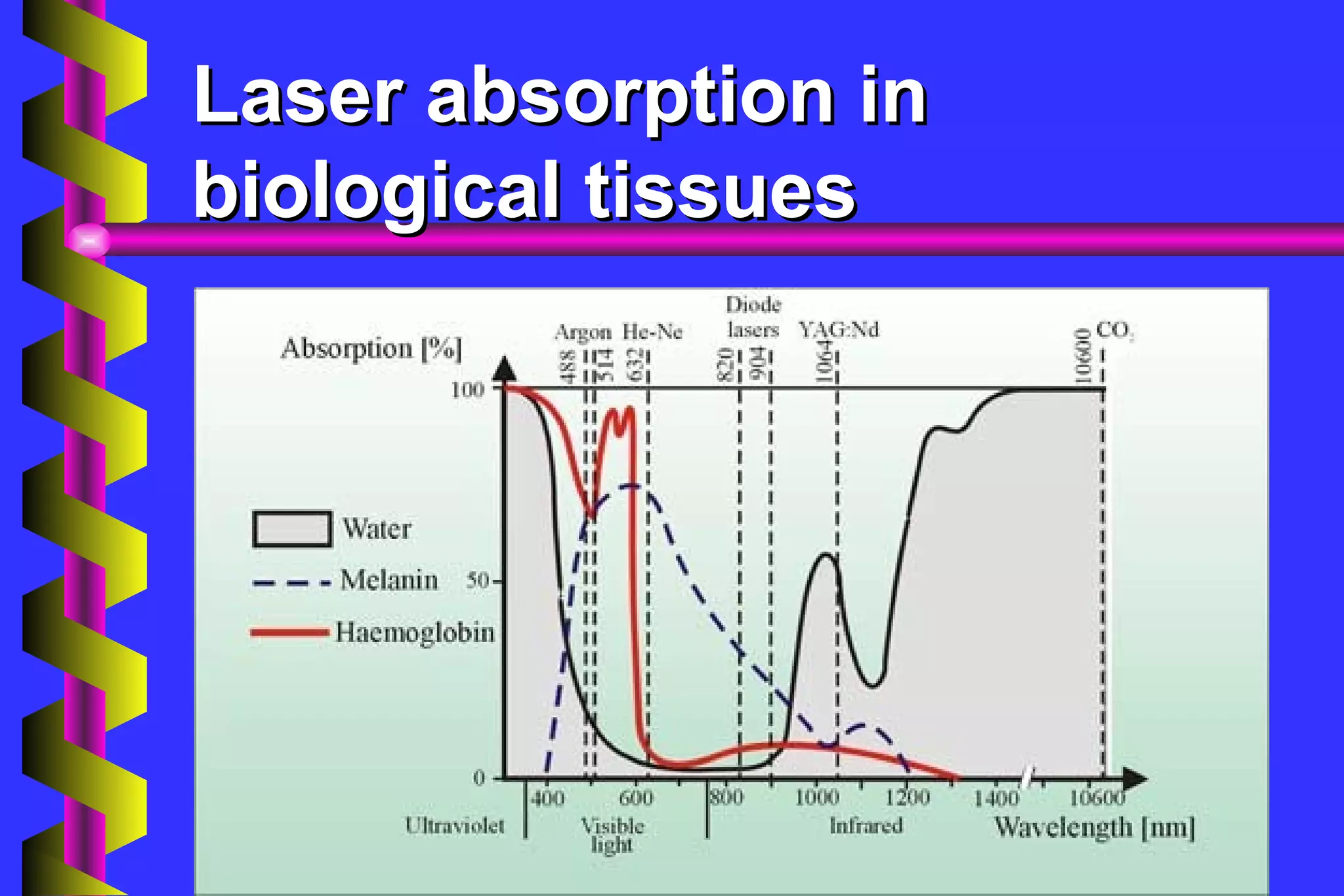
Laser absorption inLaser absorption in
biological tissuesbiological tissues
Available lasersAvailable lasers
Characteristics of laser wavelengths used in periodontology
Laser type
Common
abbreviation
Wavelength Waveform Delivery tip Reported periodontal applications
Carbon dioxide CO2 10.6 µm
Gated or
continuous
Hollow
waveguide
Soft tissue incision and ablation;
subgingival curettage
Neodymium:yttrium-
aluminum-garnet
Nd:YAG 1.064 µm Pulsed Fiber optic
Soft tissue incision and ablation;
subgingival curettage and bacterial
elimination
Holmium:yttrium-aluminum-
garnet
Ho:YAG 2.1 µm Pulsed Fiber optic
Soft tissue incision and ablation;
subgingival curettage and bacterial
elimination
Eribium:yttrium-aluminum-
garnet
Er:YAG 2.94 µm Pulsed Fiber optic
Soft tissue incision and ablation;
subgingival curettage; scaling of root
surfaces; osteoplasty and ostectomy
Erbium,chromium:yttrium-
selenium-galium-garnet
Er,Cr:YSGG 2.78 µm Pulsed Fiber optic
Soft tissue incision and ablation;
subgingival curettage; osteoplasty and
ostectomy
Neodium:yttrium-aluminum-
perovskite
Nd:YAP 1.34 nm Pulsed Fiber optic
Soft tissue incision and ablation;
subgingival curettage andbacterial
elimination
Indium-gallium-arsenide-
phosphide; gallium-aluminum-
arsenide; gallium arsenide
InGaAsP(diode)
GaAlAs(diode)
GaAs(diode)
635-950 nm
Gated or
continuous
Fiber optic
Soft tissue incision and ablation;
subgingival curettage and bacterial
elimination
Argon Ar 488, 514 nm
Gated or
continuous
Fiber optic Soft tissue incision and ablation
Available lasersAvailable lasers
Clinical applications of laser inClinical applications of laser in
periodontologyperiodontology
FrenectomyFrenectomy Whether for maxillary frenectomy orWhether for maxillary frenectomy or
lingual frenulectomy, use of the laser is superior tolingual frenulectomy, use of the laser is superior to
any other technique.any other technique.
Clinical applications of laser inClinical applications of laser in
periodontologyperiodontology
lingual frenulectomylingual frenulectomy
Clinical applications of laser inClinical applications of laser in
periodontologyperiodontology
Crown LengtheningCrown Lengthening Lasers are effective forLasers are effective for
crown lengthenings related to excessive softcrown lengthenings related to excessive soft
tissue or in areas of passive eruption.tissue or in areas of passive eruption.
Clinical applications of laser inClinical applications of laser in
periodontologyperiodontology
BiopsiesBiopsies Lasers are used effectively for bothLasers are used effectively for both
incisional and excisional biopsiesincisional and excisional biopsies
Clinical applications of laser inClinical applications of laser in
periodontologyperiodontology
Tongue LesionsTongue Lesions Lesions present on the tongueLesions present on the tongue
can be removed quite impressively using thecan be removed quite impressively using the
laser.laser.
Clinical applications of laser inClinical applications of laser in
periodontologyperiodontology
White LesionsWhite Lesions Most white lesions can be removedMost white lesions can be removed
with dental lasers once the biopsy has beenwith dental lasers once the biopsy has been
obtained or the diagnosis established.obtained or the diagnosis established.
Clinical applications of laser inClinical applications of laser in
periodontologyperiodontology
Aphthous UlcersAphthous Ulcers One of the more remarkableOne of the more remarkable
laser benefits is the ridding of the painfullaser benefits is the ridding of the painful
symptoms associated with aphthous ulcers.symptoms associated with aphthous ulcers.
Clinical applications of laser inClinical applications of laser in
periodontologyperiodontology
CoagulationCoagulation For coagulation of bleedingFor coagulation of bleeding
areas, coagulation of soft-tissue graft donorareas, coagulation of soft-tissue graft donor
sites, or other small oral bleeders, lasers aresites, or other small oral bleeders, lasers are
excellent in controlling the bleeding.excellent in controlling the bleeding.
Clinical applications of laser inClinical applications of laser in
periodontologyperiodontology
Patients with BleedingPatients with Bleeding
DisordersDisorders Lasers haveLasers have
been used quitebeen used quite
effectively to treateffectively to treat
patients who havepatients who have
various intraoralvarious intraoral
lesions compounded bylesions compounded by
hemorrhage disorders.hemorrhage disorders.
Clinical applications of laser inClinical applications of laser in
periodontologyperiodontology
Removal of Granulation Tissue All of the laser
wavelengths mentioned can be used to remove
granulation tissue from periodontal structures or
to degranulate any wound site present.
Clinical applications of laser inClinical applications of laser in
periodontologyperiodontology
Guided TissueGuided Tissue
RegenerationRegeneration
Recent research hasRecent research has
shown that lasers usedshown that lasers used
to deepithelializeto deepithelialize
surgical flaps may leadsurgical flaps may lead
to a more predictableto a more predictable
and desirable bone andand desirable bone and
soft tissue result.soft tissue result.
Clinical applications of laser inClinical applications of laser in
periodontologyperiodontology
Distal Wedge and Tuberosity Reduction
For soft-tissue distal wedge and tuberosity
reduction procedures, laser offer many
advantages.
Clinical applications of laser inClinical applications of laser in
periodontologyperiodontology
• Scaling, Root Planing, and CurettageScaling, Root Planing, and Curettage However,However,
caution should be taken by the clinician until furthercaution should be taken by the clinician until further
understanding of the proper parameters is known.understanding of the proper parameters is known.
Clinical applications of laser inClinical applications of laser in
periodontologyperiodontology
HypersensitivityHypersensitivity All dental lasers have proved toAll dental lasers have proved to
be effective in reducing or completely eliminatingbe effective in reducing or completely eliminating
temperature sensitivity.temperature sensitivity.
Clinical applications of laser inClinical applications of laser in
periodontologyperiodontology
GingivectomyGingivectomy WhenWhen
patients present withpatients present with
problems of tissueproblems of tissue
overgrowth orovergrowth or
hyperplasias fromhyperplasias from
various causes, laservarious causes, laser
are used effectively toare used effectively to
perform laserperform laser
gingivectomies.gingivectomies.
Clinical applications of laser inClinical applications of laser in
periodontologyperiodontology
GingivoplastyGingivoplasty
For small tissue aberrations,For small tissue aberrations,
pseudopockets seen afterpseudopockets seen after
periodontal surgery, orperiodontal surgery, or
small areas of reverse tissuesmall areas of reverse tissue
architecture with anarchitecture with an
otherwise healthyotherwise healthy
periodontium, all of theperiodontium, all of the
dental lasers are effective indental lasers are effective in
performing the necessaryperforming the necessary
gingivoplasty.gingivoplasty.
Clinical applications of laser inClinical applications of laser in
periodontologyperiodontology
Preprosthetic SurgeryPreprosthetic Surgery
For removal of epuli,For removal of epuli,
inflammatory papillaryinflammatory papillary
hyperplasia,hyperplasia,
vestibuloplasty, or othervestibuloplasty, or other
preprosthetic surgicalpreprosthetic surgical
needs.needs.
Clinical applications of laser inClinical applications of laser in
periodontologyperiodontology
Exposure of ImplantsExposure of Implants Lasers can be used toLasers can be used to
uncover implants, whether single or multiple, anduncover implants, whether single or multiple, and
they work exceptionally well in this case.they work exceptionally well in this case.
Clinical applications of laser inClinical applications of laser in
periodontologyperiodontology
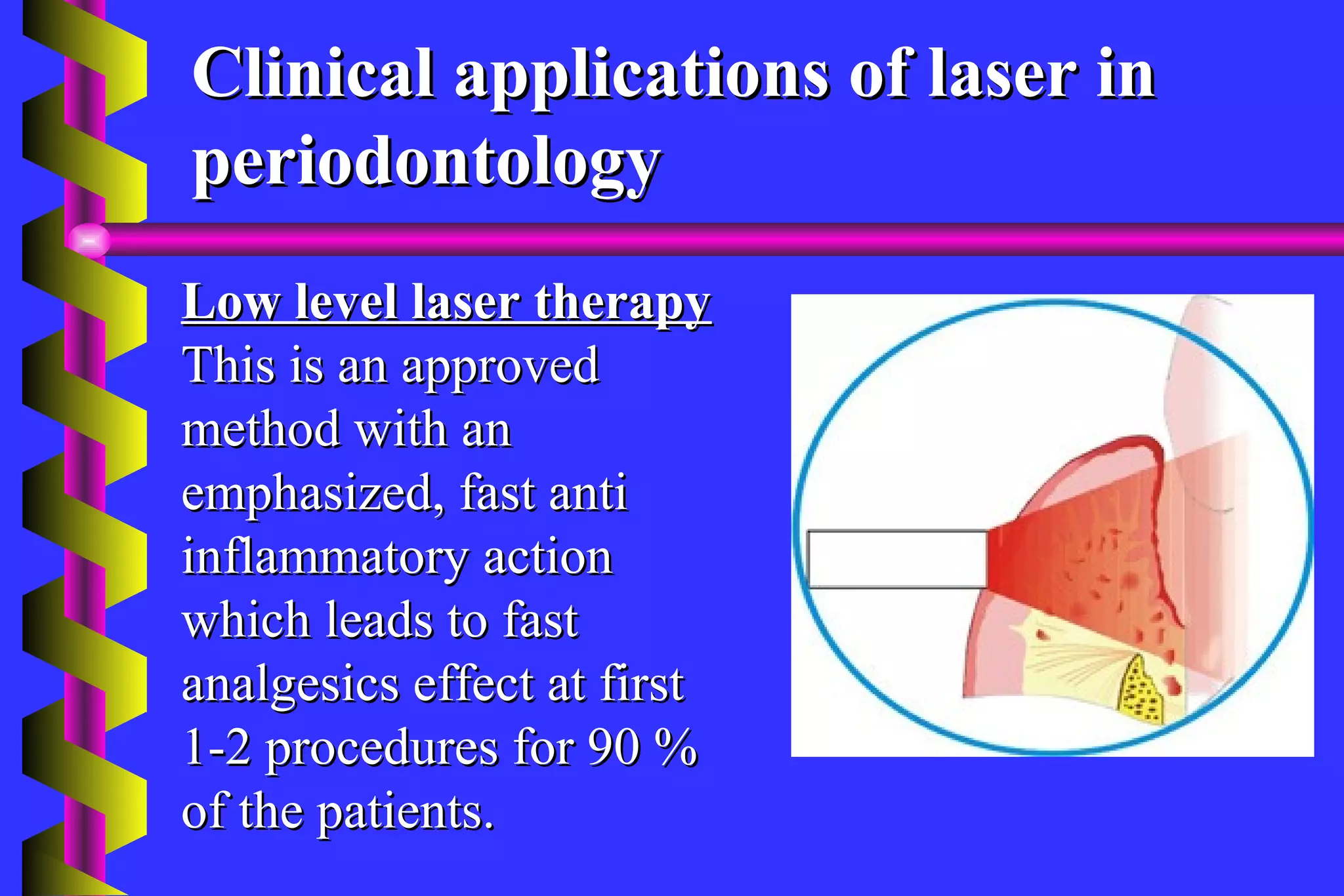
Low level laser therapyLow level laser therapy
This is an approvedThis is an approved
method with anmethod with an
emphasized, fast antiemphasized, fast anti
inflammatory actioninflammatory action
which leads to fastwhich leads to fast
analgesics effect at firstanalgesics effect at first
1-2 procedures for 90 %1-2 procedures for 90 %
of the patients.of the patients.
Laser-assisted new attachmentLaser-assisted new attachment
procedure (LANAP)procedure (LANAP)
LANAP is a step-by-step procedureLANAP is a step-by-step procedure
developed within a practice settingdeveloped within a practice setting
specifically for treating moderate tospecifically for treating moderate to
advanced periodontitis.advanced periodontitis.
Laser-assisted new attachmentLaser-assisted new attachment
procedure (LANAP)procedure (LANAP)
A. Perio probe indicates excessive pocket depthA. Perio probe indicates excessive pocket depth..
Laser-assisted new attachmentLaser-assisted new attachment
procedure (LANAP)procedure (LANAP)
B. Laser light removes bacteria and diseased tissueB. Laser light removes bacteria and diseased tissue..
Laser-assisted new attachmentLaser-assisted new attachment
procedure (LANAP)procedure (LANAP)
C. Ultrasonic scaler and special hand instrumentsC. Ultrasonic scaler and special hand instruments
are used to remove root surface calculusare used to remove root surface calculus..
Laser-assisted new attachmentLaser-assisted new attachment
procedure (LANAP)procedure (LANAP)
D. Laser finishes cleaning pocket and aids inD. Laser finishes cleaning pocket and aids in
sealing the pocketsealing the pocket..
Laser-assisted new attachmentLaser-assisted new attachment
procedure (LANAP)procedure (LANAP)
E. Healing of gums to clean root surface occursE. Healing of gums to clean root surface occurs..
Laser-assisted new attachmentLaser-assisted new attachment
procedure (LANAP)procedure (LANAP)
F. Bite trauma is adjustedF. Bite trauma is adjusted..
The advantages of laser in periodontalThe advantages of laser in periodontal
surgerysurgery
1.1. Less bleeding during the procedure.Less bleeding during the procedure.
2.2. Surgical site sterilization.Surgical site sterilization.
3.3. Less post-operative swelling and pain.Less post-operative swelling and pain.
4.4. More effective bone cleaning.More effective bone cleaning.
5.5. Faster completion of the surgical procedure.Faster completion of the surgical procedure.
6.6. No rotary tool vibrations (patient comfort).No rotary tool vibrations (patient comfort).
7.7. Working in non-contact mode enables constantWorking in non-contact mode enables constant
rinsing of the bone.rinsing of the bone.
DisadvantagesDisadvantages
1.1. Require precautions to be taken duringRequire precautions to be taken during
clinical application.clinical application.
2.2. Cost.Cost.
3.3. Size of laser device.Size of laser device.
Laser in periodontology

Laser in periodontology

  • 1.
    Laser applications inLaserapplications in periodontologyperiodontology
  • 2.
  • 3.
    Laser absorption inLaserabsorption in biological tissuesbiological tissues
  • 4.
  • 5.
    Characteristics of laserwavelengths used in periodontology Laser type Common abbreviation Wavelength Waveform Delivery tip Reported periodontal applications Carbon dioxide CO2 10.6 µm Gated or continuous Hollow waveguide Soft tissue incision and ablation; subgingival curettage Neodymium:yttrium- aluminum-garnet Nd:YAG 1.064 µm Pulsed Fiber optic Soft tissue incision and ablation; subgingival curettage and bacterial elimination Holmium:yttrium-aluminum- garnet Ho:YAG 2.1 µm Pulsed Fiber optic Soft tissue incision and ablation; subgingival curettage and bacterial elimination Eribium:yttrium-aluminum- garnet Er:YAG 2.94 µm Pulsed Fiber optic Soft tissue incision and ablation; subgingival curettage; scaling of root surfaces; osteoplasty and ostectomy Erbium,chromium:yttrium- selenium-galium-garnet Er,Cr:YSGG 2.78 µm Pulsed Fiber optic Soft tissue incision and ablation; subgingival curettage; osteoplasty and ostectomy Neodium:yttrium-aluminum- perovskite Nd:YAP 1.34 nm Pulsed Fiber optic Soft tissue incision and ablation; subgingival curettage andbacterial elimination Indium-gallium-arsenide- phosphide; gallium-aluminum- arsenide; gallium arsenide InGaAsP(diode) GaAlAs(diode) GaAs(diode) 635-950 nm Gated or continuous Fiber optic Soft tissue incision and ablation; subgingival curettage and bacterial elimination Argon Ar 488, 514 nm Gated or continuous Fiber optic Soft tissue incision and ablation Available lasersAvailable lasers
  • 6.
    Clinical applications oflaser inClinical applications of laser in periodontologyperiodontology FrenectomyFrenectomy Whether for maxillary frenectomy orWhether for maxillary frenectomy or lingual frenulectomy, use of the laser is superior tolingual frenulectomy, use of the laser is superior to any other technique.any other technique.
  • 7.
    Clinical applications oflaser inClinical applications of laser in periodontologyperiodontology lingual frenulectomylingual frenulectomy
  • 8.
    Clinical applications oflaser inClinical applications of laser in periodontologyperiodontology Crown LengtheningCrown Lengthening Lasers are effective forLasers are effective for crown lengthenings related to excessive softcrown lengthenings related to excessive soft tissue or in areas of passive eruption.tissue or in areas of passive eruption.
  • 9.
    Clinical applications oflaser inClinical applications of laser in periodontologyperiodontology BiopsiesBiopsies Lasers are used effectively for bothLasers are used effectively for both incisional and excisional biopsiesincisional and excisional biopsies
  • 10.
    Clinical applications oflaser inClinical applications of laser in periodontologyperiodontology Tongue LesionsTongue Lesions Lesions present on the tongueLesions present on the tongue can be removed quite impressively using thecan be removed quite impressively using the laser.laser.
  • 11.
    Clinical applications oflaser inClinical applications of laser in periodontologyperiodontology White LesionsWhite Lesions Most white lesions can be removedMost white lesions can be removed with dental lasers once the biopsy has beenwith dental lasers once the biopsy has been obtained or the diagnosis established.obtained or the diagnosis established.
  • 12.
    Clinical applications oflaser inClinical applications of laser in periodontologyperiodontology Aphthous UlcersAphthous Ulcers One of the more remarkableOne of the more remarkable laser benefits is the ridding of the painfullaser benefits is the ridding of the painful symptoms associated with aphthous ulcers.symptoms associated with aphthous ulcers.
  • 13.
    Clinical applications oflaser inClinical applications of laser in periodontologyperiodontology CoagulationCoagulation For coagulation of bleedingFor coagulation of bleeding areas, coagulation of soft-tissue graft donorareas, coagulation of soft-tissue graft donor sites, or other small oral bleeders, lasers aresites, or other small oral bleeders, lasers are excellent in controlling the bleeding.excellent in controlling the bleeding.
  • 14.
    Clinical applications oflaser inClinical applications of laser in periodontologyperiodontology Patients with BleedingPatients with Bleeding DisordersDisorders Lasers haveLasers have been used quitebeen used quite effectively to treateffectively to treat patients who havepatients who have various intraoralvarious intraoral lesions compounded bylesions compounded by hemorrhage disorders.hemorrhage disorders.
  • 15.
    Clinical applications oflaser inClinical applications of laser in periodontologyperiodontology Removal of Granulation Tissue All of the laser wavelengths mentioned can be used to remove granulation tissue from periodontal structures or to degranulate any wound site present.
  • 16.
    Clinical applications oflaser inClinical applications of laser in periodontologyperiodontology Guided TissueGuided Tissue RegenerationRegeneration Recent research hasRecent research has shown that lasers usedshown that lasers used to deepithelializeto deepithelialize surgical flaps may leadsurgical flaps may lead to a more predictableto a more predictable and desirable bone andand desirable bone and soft tissue result.soft tissue result.
  • 17.
    Clinical applications oflaser inClinical applications of laser in periodontologyperiodontology Distal Wedge and Tuberosity Reduction For soft-tissue distal wedge and tuberosity reduction procedures, laser offer many advantages.
  • 18.
    Clinical applications oflaser inClinical applications of laser in periodontologyperiodontology • Scaling, Root Planing, and CurettageScaling, Root Planing, and Curettage However,However, caution should be taken by the clinician until furthercaution should be taken by the clinician until further understanding of the proper parameters is known.understanding of the proper parameters is known.
  • 19.
    Clinical applications oflaser inClinical applications of laser in periodontologyperiodontology HypersensitivityHypersensitivity All dental lasers have proved toAll dental lasers have proved to be effective in reducing or completely eliminatingbe effective in reducing or completely eliminating temperature sensitivity.temperature sensitivity.
  • 20.
    Clinical applications oflaser inClinical applications of laser in periodontologyperiodontology GingivectomyGingivectomy WhenWhen patients present withpatients present with problems of tissueproblems of tissue overgrowth orovergrowth or hyperplasias fromhyperplasias from various causes, laservarious causes, laser are used effectively toare used effectively to perform laserperform laser gingivectomies.gingivectomies.
  • 21.
    Clinical applications oflaser inClinical applications of laser in periodontologyperiodontology GingivoplastyGingivoplasty For small tissue aberrations,For small tissue aberrations, pseudopockets seen afterpseudopockets seen after periodontal surgery, orperiodontal surgery, or small areas of reverse tissuesmall areas of reverse tissue architecture with anarchitecture with an otherwise healthyotherwise healthy periodontium, all of theperiodontium, all of the dental lasers are effective indental lasers are effective in performing the necessaryperforming the necessary gingivoplasty.gingivoplasty.
  • 22.
    Clinical applications oflaser inClinical applications of laser in periodontologyperiodontology Preprosthetic SurgeryPreprosthetic Surgery For removal of epuli,For removal of epuli, inflammatory papillaryinflammatory papillary hyperplasia,hyperplasia, vestibuloplasty, or othervestibuloplasty, or other preprosthetic surgicalpreprosthetic surgical needs.needs.
  • 23.
    Clinical applications oflaser inClinical applications of laser in periodontologyperiodontology Exposure of ImplantsExposure of Implants Lasers can be used toLasers can be used to uncover implants, whether single or multiple, anduncover implants, whether single or multiple, and they work exceptionally well in this case.they work exceptionally well in this case.
  • 24.
    Clinical applications oflaser inClinical applications of laser in periodontologyperiodontology Low level laser therapyLow level laser therapy This is an approvedThis is an approved method with anmethod with an emphasized, fast antiemphasized, fast anti inflammatory actioninflammatory action which leads to fastwhich leads to fast analgesics effect at firstanalgesics effect at first 1-2 procedures for 90 %1-2 procedures for 90 % of the patients.of the patients.
  • 25.
    Laser-assisted new attachmentLaser-assistednew attachment procedure (LANAP)procedure (LANAP) LANAP is a step-by-step procedureLANAP is a step-by-step procedure developed within a practice settingdeveloped within a practice setting specifically for treating moderate tospecifically for treating moderate to advanced periodontitis.advanced periodontitis.
  • 26.
    Laser-assisted new attachmentLaser-assistednew attachment procedure (LANAP)procedure (LANAP) A. Perio probe indicates excessive pocket depthA. Perio probe indicates excessive pocket depth..
  • 27.
    Laser-assisted new attachmentLaser-assistednew attachment procedure (LANAP)procedure (LANAP) B. Laser light removes bacteria and diseased tissueB. Laser light removes bacteria and diseased tissue..
  • 28.
    Laser-assisted new attachmentLaser-assistednew attachment procedure (LANAP)procedure (LANAP) C. Ultrasonic scaler and special hand instrumentsC. Ultrasonic scaler and special hand instruments are used to remove root surface calculusare used to remove root surface calculus..
  • 29.
    Laser-assisted new attachmentLaser-assistednew attachment procedure (LANAP)procedure (LANAP) D. Laser finishes cleaning pocket and aids inD. Laser finishes cleaning pocket and aids in sealing the pocketsealing the pocket..
  • 30.
    Laser-assisted new attachmentLaser-assistednew attachment procedure (LANAP)procedure (LANAP) E. Healing of gums to clean root surface occursE. Healing of gums to clean root surface occurs..
  • 31.
    Laser-assisted new attachmentLaser-assistednew attachment procedure (LANAP)procedure (LANAP) F. Bite trauma is adjustedF. Bite trauma is adjusted..
  • 32.
    The advantages oflaser in periodontalThe advantages of laser in periodontal surgerysurgery 1.1. Less bleeding during the procedure.Less bleeding during the procedure. 2.2. Surgical site sterilization.Surgical site sterilization. 3.3. Less post-operative swelling and pain.Less post-operative swelling and pain. 4.4. More effective bone cleaning.More effective bone cleaning. 5.5. Faster completion of the surgical procedure.Faster completion of the surgical procedure. 6.6. No rotary tool vibrations (patient comfort).No rotary tool vibrations (patient comfort). 7.7. Working in non-contact mode enables constantWorking in non-contact mode enables constant rinsing of the bone.rinsing of the bone.
  • 33.
    DisadvantagesDisadvantages 1.1. Require precautionsto be taken duringRequire precautions to be taken during clinical application.clinical application. 2.2. Cost.Cost. 3.3. Size of laser device.Size of laser device.